

Products
Baduanjin Wall Chart
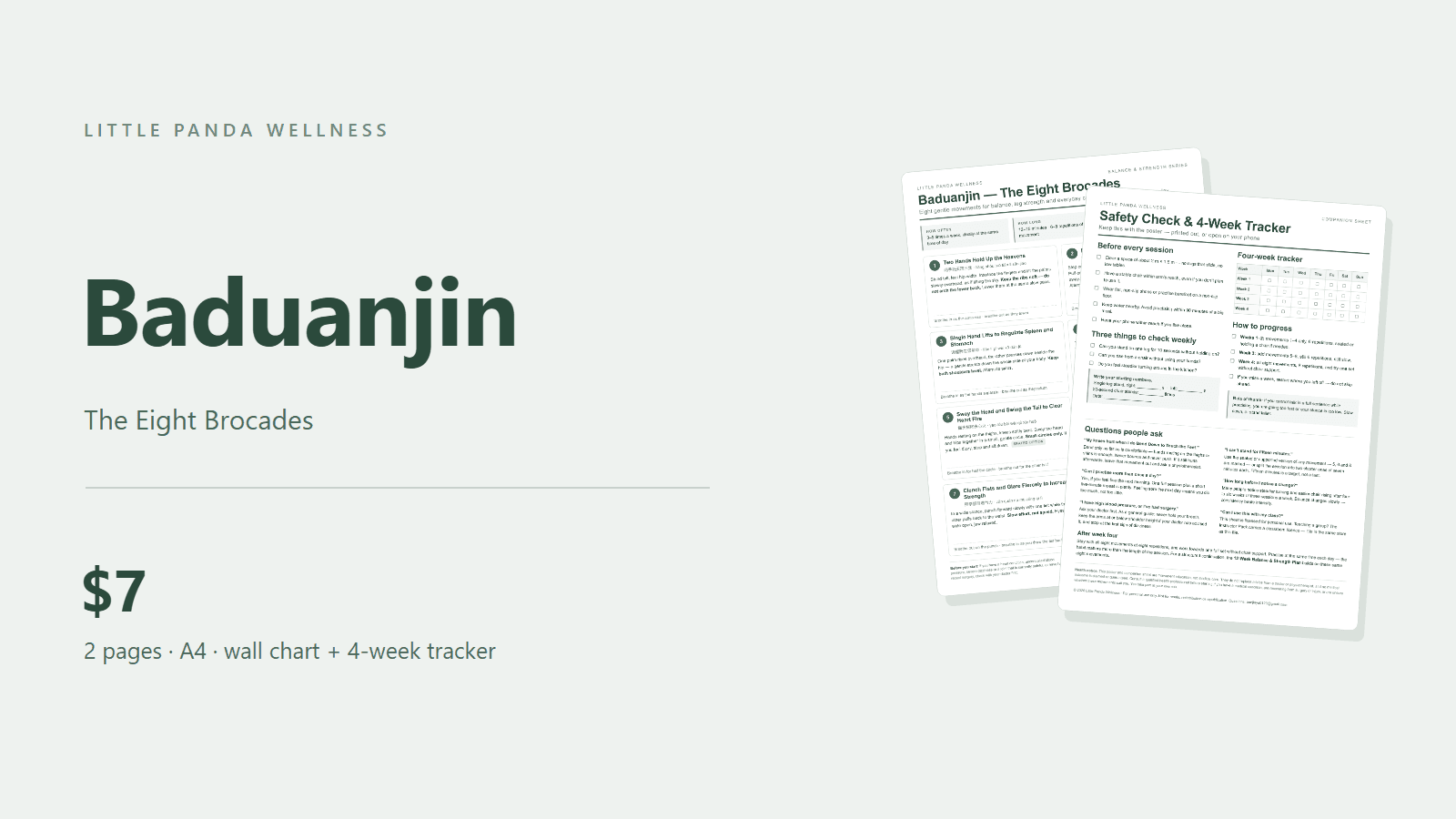
A two-page printable set for anyone who wants to start Baduanjin — the Eight Brocades — at home, and actually keep going.
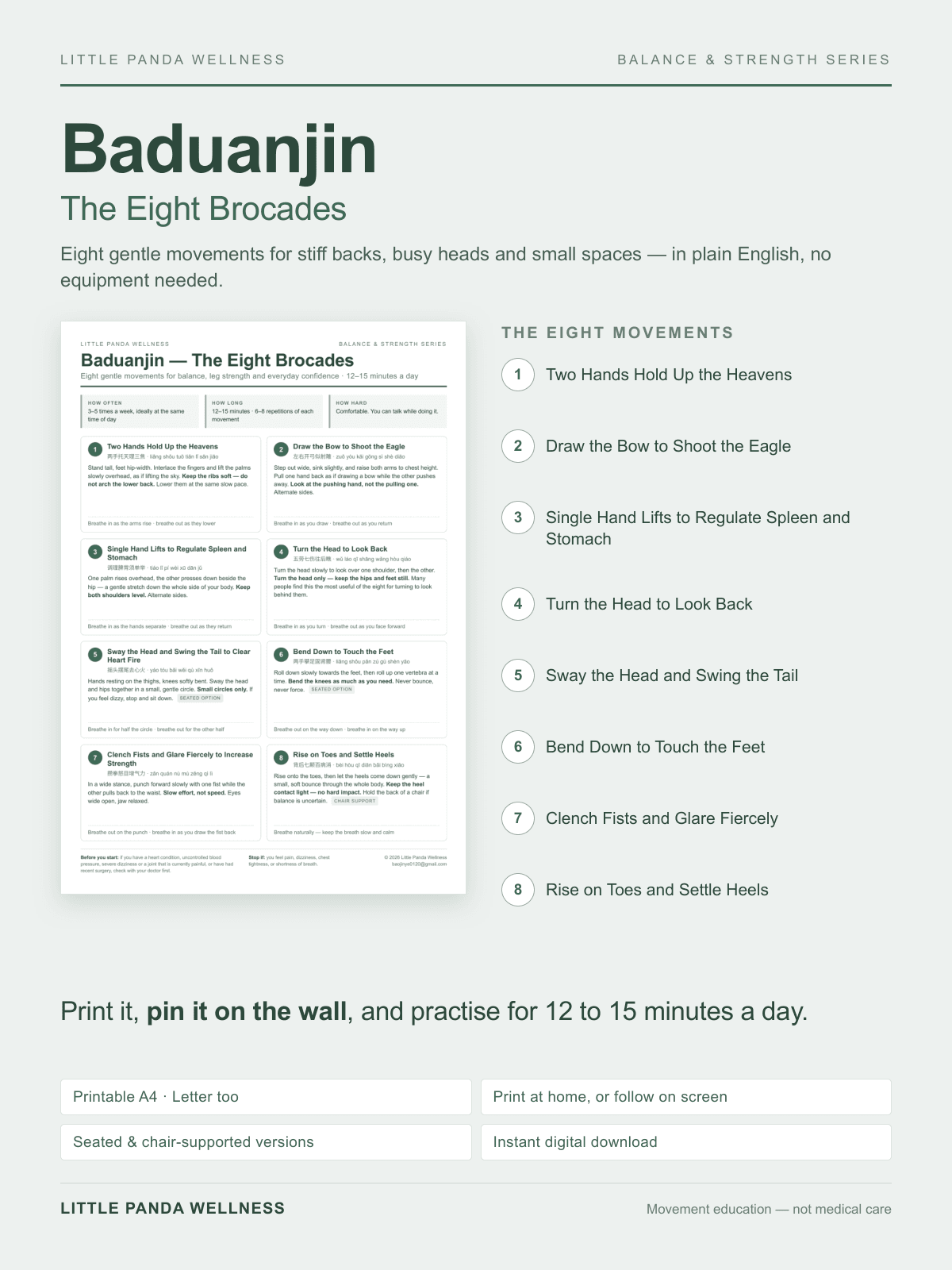
Page 1 is the wall chart: all eight movements in order, each with its key alignment cues and the traditional Chinese name alongside the English. Print it at A4 to keep beside you, or at A3 to put on the wall you walk past every day.
Page 2 is the four-week tracker — four rows of seven days, with the progression already worked out: start at six repetitions, build to eight. It also carries a short pre-session safety check, a starting-numbers test, and six questions people actually ask. A full session runs 12 to 15 minutes.
WHO IT SUITS Adults who want low-impact movement they can do standing or seated, in a small space, with no equipment. Desk workers with a stiff back by mid-afternoon and no patience for a gym. People who started a video course and stopped after a week — this is the paper version that survives. Anyone who wants a 12- to 15-minute routine they can actually keep.
WHAT YOU GET • 1 × wall chart — eight movements, alignment cues, Chinese and English names • 1 × four-week tracker — progression scheme, safety notes, starting-numbers test • Seated and chair-supported versions of the movements that need them • Both in one print-ready PDF, 2 pages, A4 210 × 297 mm — prints at A4, A3 or A2 • Instant download after checkout
WHAT IT IS NOT It is not a video course. There is no audio and no follow-along — it is paper on a wall. It is not a replacement for a physiotherapy programme or medical advice. It is not a certification. If you want to teach this to groups, the Instructor Pack with a classroom licence is available in the same store.
A NOTE ON WHAT THIS CAN AND CANNOT DO Baduanjin is a long-established set of gentle standing movements. Research on Baduanjin and similar programmes has looked at balance, leg strength and confidence in stepping. We describe the movements and how to practise them consistently. We do not claim this product treats, prevents or cures any condition, and we make no medical claim about outcomes. If you have a medical condition, are recovering from injury or surgery, or are unsure whether these movements suit you, ask your doctor or physiotherapist first.
FORMAT PDF, 2 pages, A4 (210 × 297 mm), printing in colour or greyscale. There are no photographs in the file, only text and line art, so enlarging it to A3 or A2 does not soften it.
Three sizes, all from the same file: • A4 at 100% — a reference sheet on the table beside you • A3 at 141% — a wall chart for the wall you walk past • A2 at 200% — a poster for a classroom, a hall or a shared space
Most home printers stop at A4. For A3 or A2, the simplest route is a copy shop: ask for A3 or A2 "fit to page". If you print it yourself, set the scale to 141% or 200%. On US Letter, choose "fit to page" and it prints at 94% — still legible. It also opens on a phone or tablet — pinch to zoom, since the layout is made for print.
REFUNDS Fourteen days, no questions, no form to fill in. Reply to the receipt and it is refunded. If the file is faulty or you were charged in error, email baojinye0120@gmail.com and we will help resolve the issue.
Baduanjin 12-Week Plan
You have the eight movements. What you do not have is the order.
Most people who give up on Baduanjin do not give up because the movements are hard. They stop in week two, for one of three reasons. They did all eight on the first day and their legs ached for three days. They could not tell whether they were doing it right. Or nothing seemed to change, so ten minutes stopped feeling worth it.
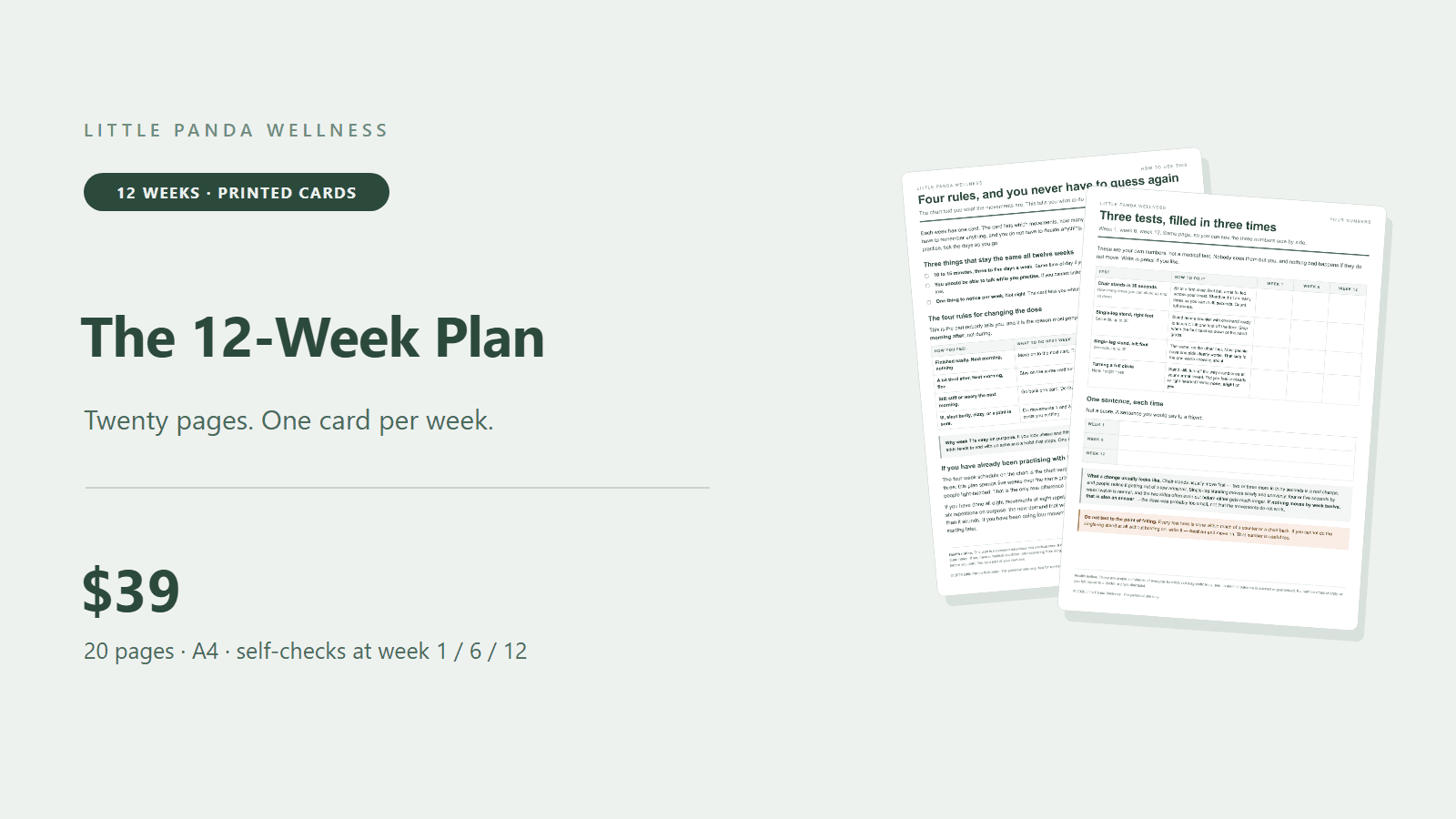
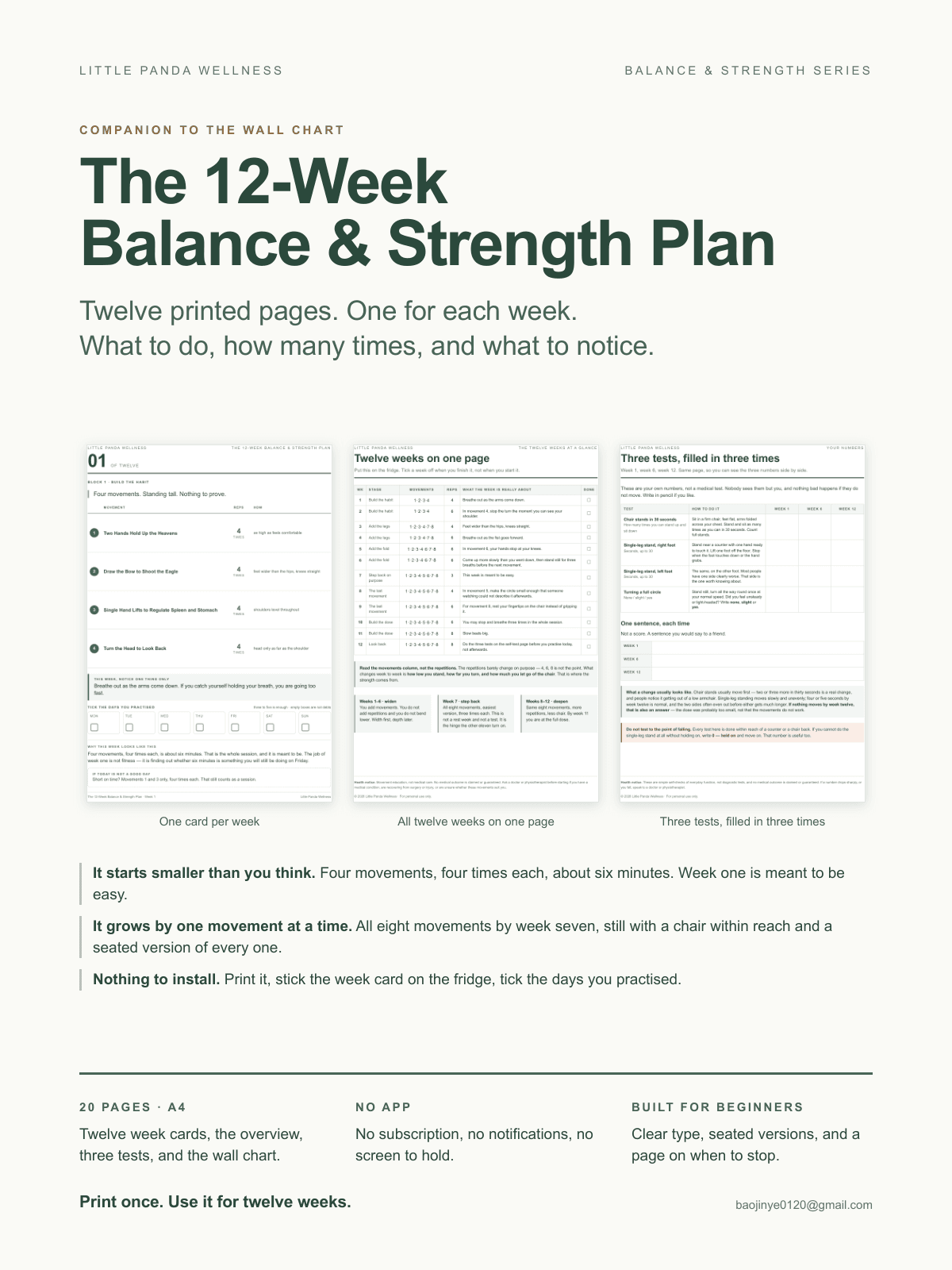
This is the part a wall chart cannot give you. Twelve printed cards, one for each week. What to do this week, how many times, and the one thing to notice. When to add. When to stop adding and go back.
WHAT YOU GET — 20 pages, A4, print at home
- 12 weekly cards, one page each, made to be pinned up or torn out
- A one-page overview of all twelve weeks, for the fridge
- Three self-tests at week 1, 6 and 12: chair stands in 30 seconds, single-leg stand, turning a full circle
- Easier and harder: one alternative each way for every movement, for stiff mornings, tight hips and low-energy days
- Two safety pages: when to stop, and six conditions worth one conversation with your doctor
- The wall chart, included, so you do not need both files
WHY PAPER
Printed pages, not an app. No subscription, no notifications, no screen to hold. Twelve weeks on paper, on the wall you already walk past. That is not nostalgia. It is the reason it gets done.
The wall chart is a bonus. What you are buying here is the order.
HOW THE TWELVE WEEKS RUN
Weeks 1 and 2: four movements, standing tall, nothing to prove. Weeks 3 and 4: add the legs, with a slow punch and a small bounce. Weeks 5 and 6: add the forward fold, hands stopping at the knees. Week 7: a light week, on purpose — all eight movements, including a first look at the last one, each at its easiest. Weeks 8 and 9: the last movement, done properly — circles small enough to be invisible. Weeks 10 and 11: the full version, building to eight repetitions by week eleven, no long pauses. Week 12: measure, and write one honest sentence.
WHAT IT IS NOT
Not a video course. No app, no login, no streaming. Not a medical treatment. No medical outcome is claimed or guaranteed. Not a class licence. This is for one household. If you teach a class, the Instructor Pack with a classroom licence is available in the same store. Not a replacement for your doctor. The safety pages tell you when to ask a question, not what the answer will be.
WHO IT IS FOR
Busy people who want a structured twelve weeks without an app, a subscription or a screen. Several movements have seated or chair-supported versions, and the plan marks which ones, so a low-energy day or a small space is a reason to adapt, not to skip.
WHAT MAKES IT DIFFERENT
Week 7 is easier than week 6, deliberately. A plan that only ever adds tends to end with an ache and a habit that stops. One light week in the middle is what keeps the other eleven going.
Every card also tells you what to do on a bad day. Not "try harder" — which movement to drop, and how to count a six-minute session as a real session.
REFUNDS
Fourteen days, no questions, no form to fill in. Reply to the receipt and it is refunded.
The file is a print-ready PDF, A4, 20 pages. Print it once and it lasts the twelve weeks. Print it again next year if you want to start over with new numbers.
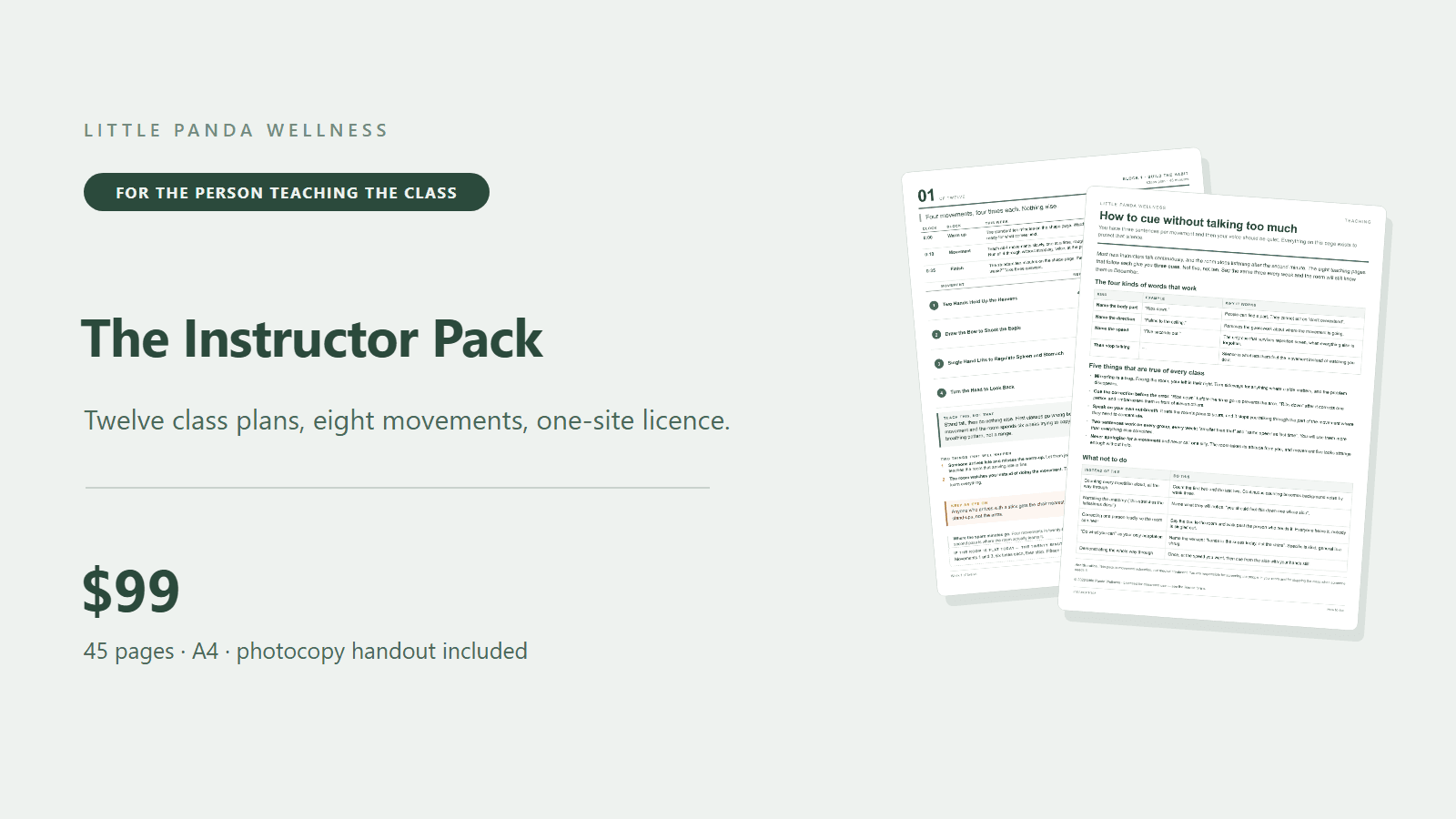
Baduanjin Instructor Pack
You have been asked to run the class. Nobody gave you a plan.
That is how most gentle movement classes start. Someone in a gym studio, a community hall or an office lunchroom says yes because they are willing, not because they were trained. The first session goes fine, because you can copy what you have seen. The third session is where it gets hard. What do I teach them next? How long do I spend on it? And what do I actually say while a room full of people are doing it?
This pack answers those three questions twelve times, and then hands you the paperwork nobody thinks about until the finance office asks for it.
WHAT YOU GET — 45 pages, A4, print at home
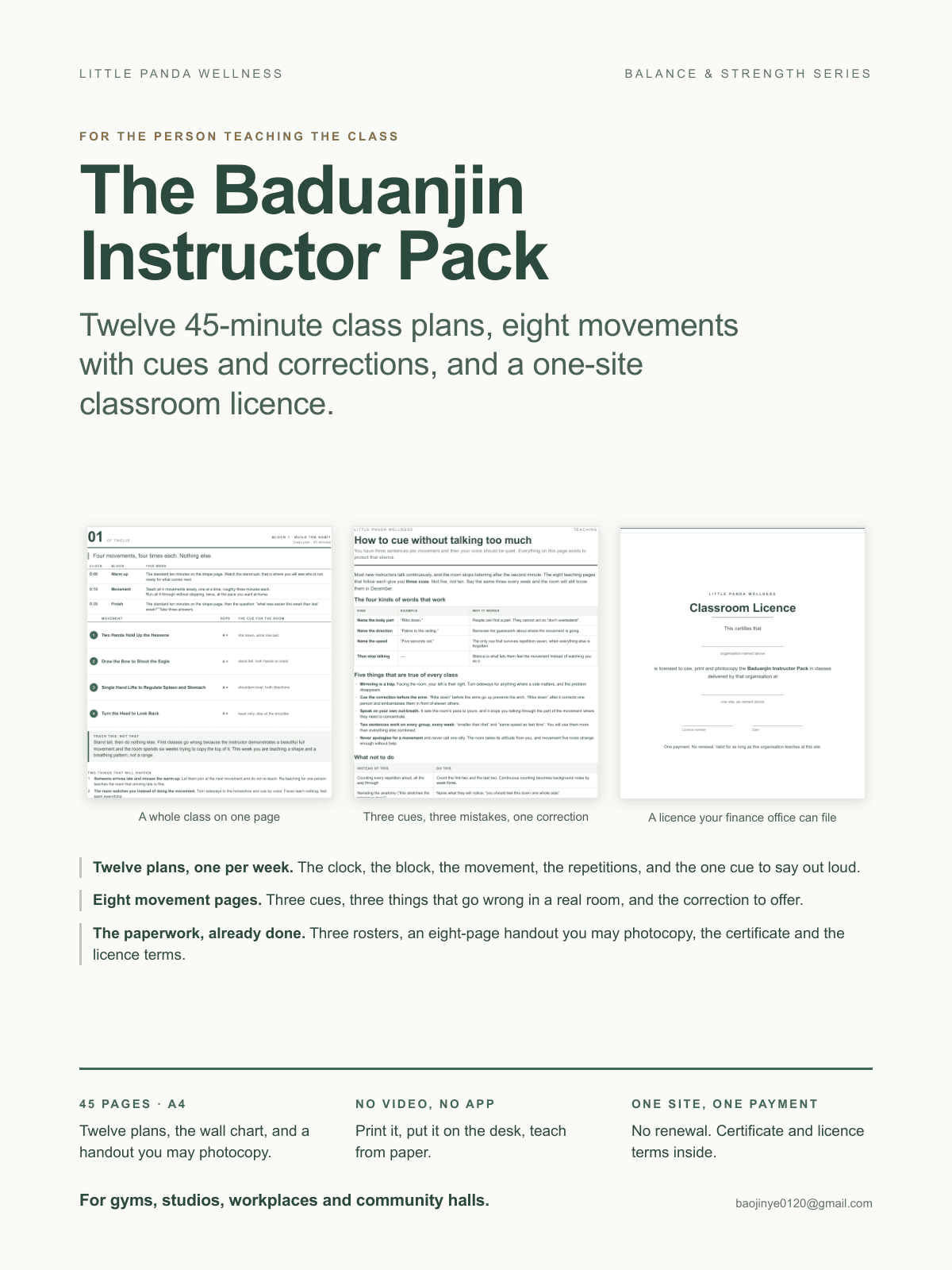
- 12 class plans, one page each, 45 minutes: the timing, the teaching block, the movements, the repetitions, and the one cue to say out loud
- 8 movement pages: three cues, three things that go wrong in a real room, the correction to offer, an easier and a harder version, and the seated version
- One page on cueing without talking too much — what to say in the first ten seconds, and what to say when somebody is struggling
- One page on teaching a mixed room: standing, chair-supported and seated, in the same hour
- A 30-minute seated class, for the weeks when the room cannot stand
- An assessment protocol and three class rosters (weeks 1, 6 and 12) — a sheet for the whole class, not a page per person
- One page on what those numbers can and cannot tell you
- An 8-page participant handout you may photocopy: large type, the eight movements on two pages, the first and last six weeks, when to stop, and a twelve-week tick log
- A classroom licence certificate to fill in and put on the wall
- The licence terms, in plain English, on one page
- A page on how this may be described in your brochure, with the words to use and the ones not to touch
- The eight-movement wall chart, included
THE LICENCE — this is what you are buying
One site. One payment. No renewal. Valid for as long as your organisation teaches at that site. It stays with the site, not with the person who bought it.
You may print these pages and photocopy the handout for the classes you teach there, as many times as you run them. You may not resell it, share the file, or use it to train or certify other instructors. If you teach at two sites, each site needs its own licence — not to be difficult, but because the price is set for one site and one group of classes.
Most PDFs sold to instructors do not say any of this. That silence is the problem: the person who buys it cannot tell whether printing a handout for every participant is allowed. Here it is written down, on its own page, with a certificate your finance office can file.
WHAT IT IS NOT
Not a teacher training or a certification. Nothing here qualifies you to certify anybody else, and it is not a substitute for a first-aid certificate or your organisation's own training. Not a medical treatment. This is movement education, not medical treatment. No medical outcome is claimed or guaranteed, and the pages say so where a participant will read it. Not a video course. Nothing to stream, no login, no subscription. It is paper on a desk. Not a script to follow blindly. The plans tell you what to teach and what to watch for; they do not know the person in front of you. Stop anyone who is unwell, in pain or dizzy, and let them sit.
WHO IT IS FOR
Fitness and yoga instructors who have been asked for something gentler. Workplace wellness leads and community centre organisers handed a movement hour. Physiotherapy assistants. Anyone who can lead a forty-five-minute session and wants the plan, the words and the paperwork in one file.
WHY THE TWELVE WEEKS ARE SHAPED THIS WAY
Week 7 is easier than week 6, deliberately. A plan that only ever adds tends to end with an ache and a class that quietly stops coming. One light week in the middle is what keeps the other eleven going — and it is also the week you will be tempted to skip, so the plan tells you not to.
Each plan also names what will happen in that particular session — who arrives late and misses the warm-up, where the spare minutes go, what to do with the question somebody walks in with. Knowing it in advance is most of the job.
REFUNDS
Fourteen days, no questions, no form to fill in. Reply to the receipt and it is refunded.
The file is a print-ready PDF, A4, 45 pages including the wall chart. Print it once, put the plans in a folder, photocopy the handout, fill in the certificate. It is built to be used by somebody standing in front of a room with no screen.