

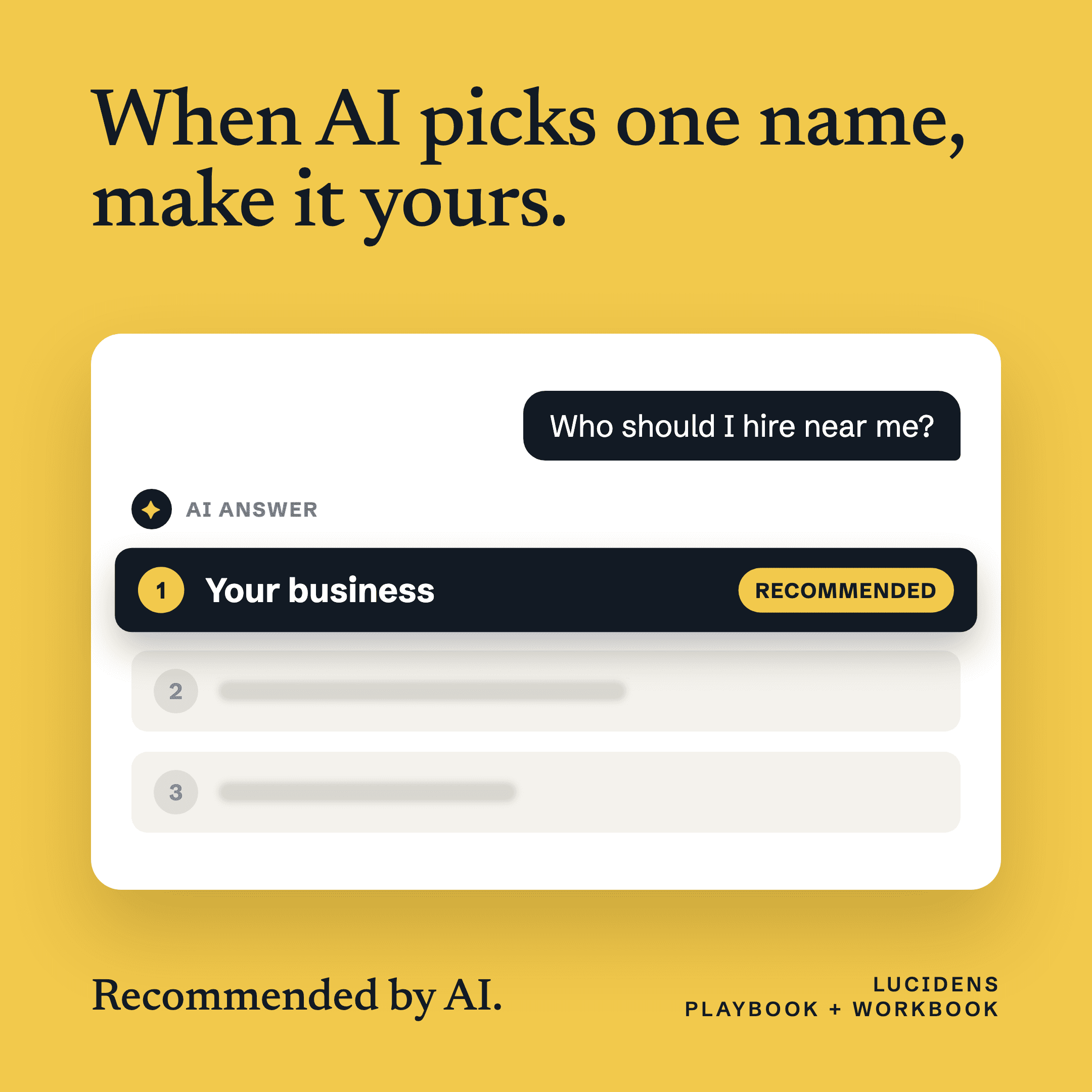
Recommended by AI: The Playbook for Getting Your Business Named in ChatGPT, Perplexity and Google AI Answers
The test-and-fix system for getting your business named, cited and described correctly in AI answers.
Your buyers are asking AI who to hire. Are you in the answer?
More and more people get their shortlist from an AI answer instead of a list of links. They ask ChatGPT, Perplexity or Google "who is the best accountant for a small online shop in Leeds?" and get three names. If yours is not one of them, or the answer describes you with an old address or a service you stopped offering, you lose that customer before you ever knew they existed.
There is no console that shows you where you stand. Advice online is generic ("add schema", "be on Reddit"), and agencies quote thousands a month to diagnose it. This playbook gives you the method to do it yourself.
Who it is for
- Owners and marketing leads at small and mid-size businesses: local services, professional firms, B2B and SaaS companies, and online shops
- Anyone who manages their own website and Google Search Console, or briefs the person who does
- No coding needed. A few fixes may need a developer for an hour.
What you will build
- A prompt panel: 20 to 40 real buyer questions, run the same way every month across five AI engines
- Four baseline numbers: presence, citation, share of voice and accuracy
- A source map of the review sites, directories and publications the engines trust for your questions
- A Readiness Score out of 100 from a 25-check audit, and the first gate that is holding you back
- A ranked fix list, a Company Facts page, and a correction log for every wrong fact AI states about you
- A 60-minute monthly routine and a one-page report you can show anyone
How it works: the Five Gates
Every AI recommendation has to pass five gates, in order.
-
Reach: can the engine fetch your pages?
-
Read: can it extract a clear answer?
-
Rely: can it verify what you say?
-
Recognise: does it know who you are?
-
Referenced: do the sources it trusts mention you?
The audit checks each gate with five tests. Each test tells you how to check it, when it passes, and what to do if it fails. You fix the earliest failing gate first, because work on later gates is wasted if an engine cannot read your site.
What is inside
- Part 1: How AI answers choose who to name, and where each engine gets its sources (checked against each provider's documentation on 30 September 2026)
- Part 2: Build and run your prompt panel, with starter question banks for local services, B2B and SaaS, ecommerce and professional firms
- Part 3: The Five Gates audit, 25 checks with pass lines and fixes
- Part 4: Five fix playbooks: the answer page, the Company Facts page, getting onto the sources that matter, correcting wrong AI answers, and local businesses
- Part 5: The 30-day sprint, the monthly routine, the one-page report, and the questions to ask before hiring a "GEO" provider
- Appendix: crawler reference with robots.txt patterns, glossary, Organization markup template, dated sources
What you get
- The playbook: 56-page PDF, bookmarked, with 9 fillable worksheets
- The Excel workbook: panel, log, source map, Readiness Score and sprint tabs. It calculates your numbers. An example copy with sample data shows how it works.
- Quick-start card: the 90-minute check and the monthly routine on two pages
What this is not
Nobody can guarantee that an AI system will name your business, and this playbook does not promise it. It will not teach tricks, fake reviews or "special AI files". It gives you a method to measure where you stand and remove the reasons you are not named, based on what the providers themselves document.
Format and requirements
PDF (US Letter, prints well on A4), Excel .xlsx (works in Excel, Google Sheets and Numbers). Version 1.0, September 2026. Licensed for use in one business.
FAQ
Is this just SEO with a new name? It is built on the same foundations, because every AI engine still relies on search indexes and web pages. What is different is how you measure (a prompt panel, not rankings), what gets weighted (verifiable facts, a consistent identity and third-party sources) and what you fix first. The playbook says plainly which parts are classic SEO and which are specific to AI answers.
Which AI tools does it cover? ChatGPT, Perplexity, Microsoft Copilot, Gemini, Claude, and Google AI Overviews and AI Mode.
I am a local business. Does it apply to me? Yes. There is a dedicated playbook for local businesses covering Google Business Profile, Bing Places, Apple Business Connect and reviews, and a local question bank.
How long does it take? The 90-minute quick check tells you if something is blocking you today. The full system is a 30-day sprint at 2 to 5 hours a week, then about an hour a month.
Do I need technical skills? No. You need access to your website, Google Search Console and your business listings. A few Gate 1 fixes (server or firewall settings) may need a developer for about an hour.
Will it go out of date? The platforms change often, so every time-sensitive fact is dated and the sources are listed so you can check the current version. The method itself (measure, audit in order, fix, repeat) does not depend on any one platform.
Can I use it for clients? The licence covers one business. Agencies should contact us about a multi-client licence.
By Lucidens. Version 1.0, September 2026. Instant download: PDF plus editable Excel files in one ZIP.
More products
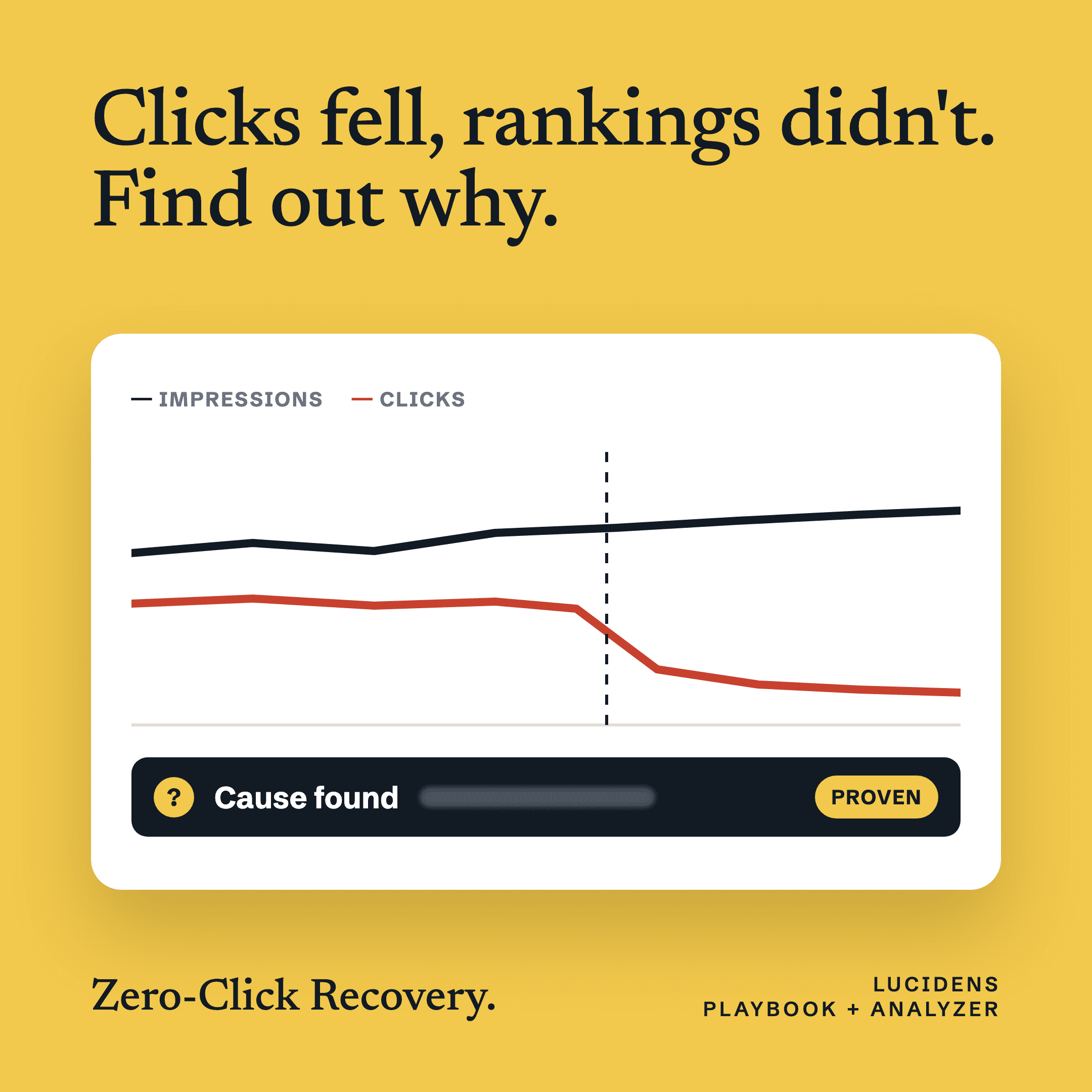
The Zero-Click Recovery System: Diagnose an Organic Traffic Drop and Recover from AI Overviews and Google Updates
Find out why your organic traffic fell, prove it with your own data, and decide page by page what to defend, rewrite or let go.
Clicks are down. Rankings look fine. Someone wants an answer by Friday.
Is it AI Overviews? The last core update? A tracking change? Seasonality? Most teams guess, fix the wrong thing, and struggle to explain the drop to the people above them. The tools show you the fall. None of them give you a method to prove the cause and decide what to do with each page.
This playbook does: a step-by-step method from first chart to recovery plan.
Who it is for
- In-house SEO and content leads, and marketing managers who own organic traffic
- Owners of content-driven sites: publishers, SaaS blogs, affiliate and ecommerce content
- Anyone with Search Console access and a chart going the wrong way
What you will do
-
Diagnose. Pull the right data, group your queries by intent, build a dated timeline against every Google update and site change, and run the Four-Line Test: impressions, position, CTR and clicks read together, per group. Each cause leaves a different fingerprint.
-
Triage. Score every affected page on AI exposure and value per visit. The Triage Matrix gives each one an action: Defend, Rewrite, Reposition, Consolidate or Let go.
-
Recover. Five playbooks: defend high-value pages and earn the AI citation, rewrite and reposition for what AI summaries cannot give, recover from core and spam updates the way Google describes, fix technical and tracking causes, and consolidate safely.
-
Report and reset. Scripts and an email template for the conversation, a one-page brief, a KPI reset that stops "sessions" from making every month look like failure, and a 90-day plan.
What is inside
- Part 1: what zero-click means and what changed in 2024 to 2026, with dated facts (Search Console's AI reporting, GA4's AI Assistant channel, every Google core and spam update since January 2025)
- Part 2: Diagnose (the Four-Line Test, worked examples, how to confirm AI Overview exposure, what to rule out first)
- Part 3: Triage (the matrix, the five actions, a priority score)
- Part 4: Recover (five playbooks, quality review worksheet, redirect map)
- Part 5: Report and reset (conversation guide, brief, KPI reset, 90-day plan)
- A full worked case, day by day
- Appendix: Search Console reference, update dates, glossary, sources
What you get
- The playbook: 49-page PDF with 8 fillable worksheets, bookmarked
- The Excel Drop Analyzer: paste two Search Console exports; it groups queries, labels each query and page with its likely cause, totals lost clicks by cause and ranks pages for triage. An example copy shows it working.
- Stakeholder brief template (Word)
- Quick-start card: the two-day diagnosis and the Four-Line Test
What this is not
No one can promise lost traffic comes back, and this playbook does not. Some clicks lost to AI answers are not returning. What you get is a way to prove what happened, put effort where it pays, and report it honestly.
Format and requirements
PDF (US Letter, prints on A4), Excel .xlsx (Excel, Google Sheets, Numbers), Word .docx. Google Search Console access. Version 1.0, September 2026. Licensed for use in one business.
FAQ
Does this only apply to AI Overviews? No. It separates six causes of a drop, including ranking loss, technical problems, tracking faults, seasonality and brand demand. AI answers are one of them.
Do I need paid tools? No. Search Console and your analytics are enough. A rank tracker helps but is optional.
How long does it take? A defensible first answer in two days; the full diagnosis and plan in two to three weeks; the recovery over 90 days.
My site is large. Will the workbook cope? It handles several thousand queries and pages per export. For very large sites, run it on your top pages or feed it from the Search Console API.
Is it technical? Moderately. You should be comfortable with Search Console and a spreadsheet. No coding needed.
Can agencies use it for clients? The licence covers one business. Contact us about an agency licence.
By Lucidens. Version 1.0, September 2026. Instant download: PDF plus editable Excel and Word files in one ZIP.
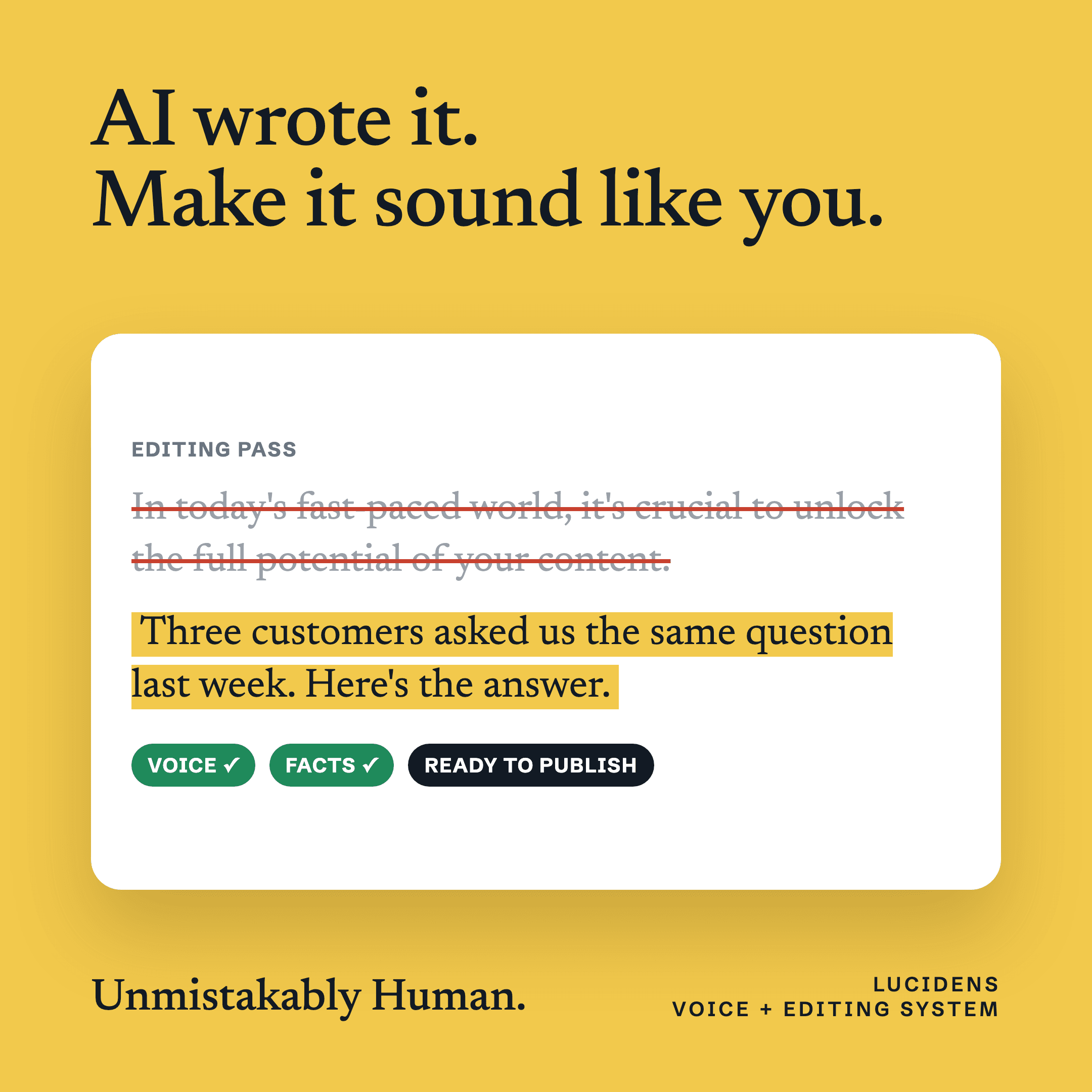
Unmistakably Human: A Brand Voice and Editing System for AI-Assisted Content
Make AI-assisted content sound like your company wrote it: a voice your tools can follow, 30 AI patterns to cut, and a rubric to score every piece.
Every AI draft sounds the same. Your readers are starting to notice.
Research now measures the house style of AI text across millions of documents, and people who use AI often turn out to be good at spotting it. When readers believe content is AI-written, several studies show trust drops. "Humanizer" tools only chase detectors. This toolkit fixes the real problem: drafts with no voice, no facts and no point of view.
The system
- Why AI drafts sound alike: what the research shows about AI vocabulary, sameness and reader trust, and why humanizers are the wrong fix.
- The voice specification: a voice audit, traits with limits, tone by channel, words and rhythm, and a one-page voice card you can paste into any AI tool.
- The pattern catalogue: thirty habits in five groups (words, structure, tone, content, formatting), each with an example and a fix.
- The example bank: how to build annotated examples per channel, plus a drafting brief that cuts invented facts and false balance.
- The editing pass and rubric: four passes in the right order (truth, substance, patterns, voice) and a six-criterion rubric with a publish rule.
- The team standard: a one-page "how we write with AI" policy, ready to adapt.
What you get
- The toolkit: 34-page fillable PDF with 6 worksheets
- Voice Kit (Word): voice card, spec, word list, pattern catalogue, drafting brief, example bank, rubric
- Team Standard (Word): "How we write with AI"
- Rubric Tracker (Excel): scores by channel and writer, publish rate and your most common patterns. Includes a filled example
Built on evidence, not vibes
Research from Science Advances, PNAS and ACL studies, plus Google's and Bing's current guidance on AI content, all cited and dated. Vendor surveys are labelled. Example sentences are illustrations written for the book, never fake clients or quotes.
FAQ
Does this help content pass AI detectors? That is not the goal. Detectors are unreliable, and readers and search engines care about value, not origin. The goal is content only your company could have written.
Which AI tools does it work with? Any. The voice card and drafting brief are plain text. The toolkit notes where Claude and ChatGPT let you save styles and instructions.
Is it for teams or solo writers? Both. Solo writers use Parts 2 to 5; teams add the standard in Part 6.
Can I edit the templates? Yes, for use in your own business or team.
By Lucidens. Version 1.0, September 2026. Instant download: PDF plus editable Excel and Word files in one ZIP.
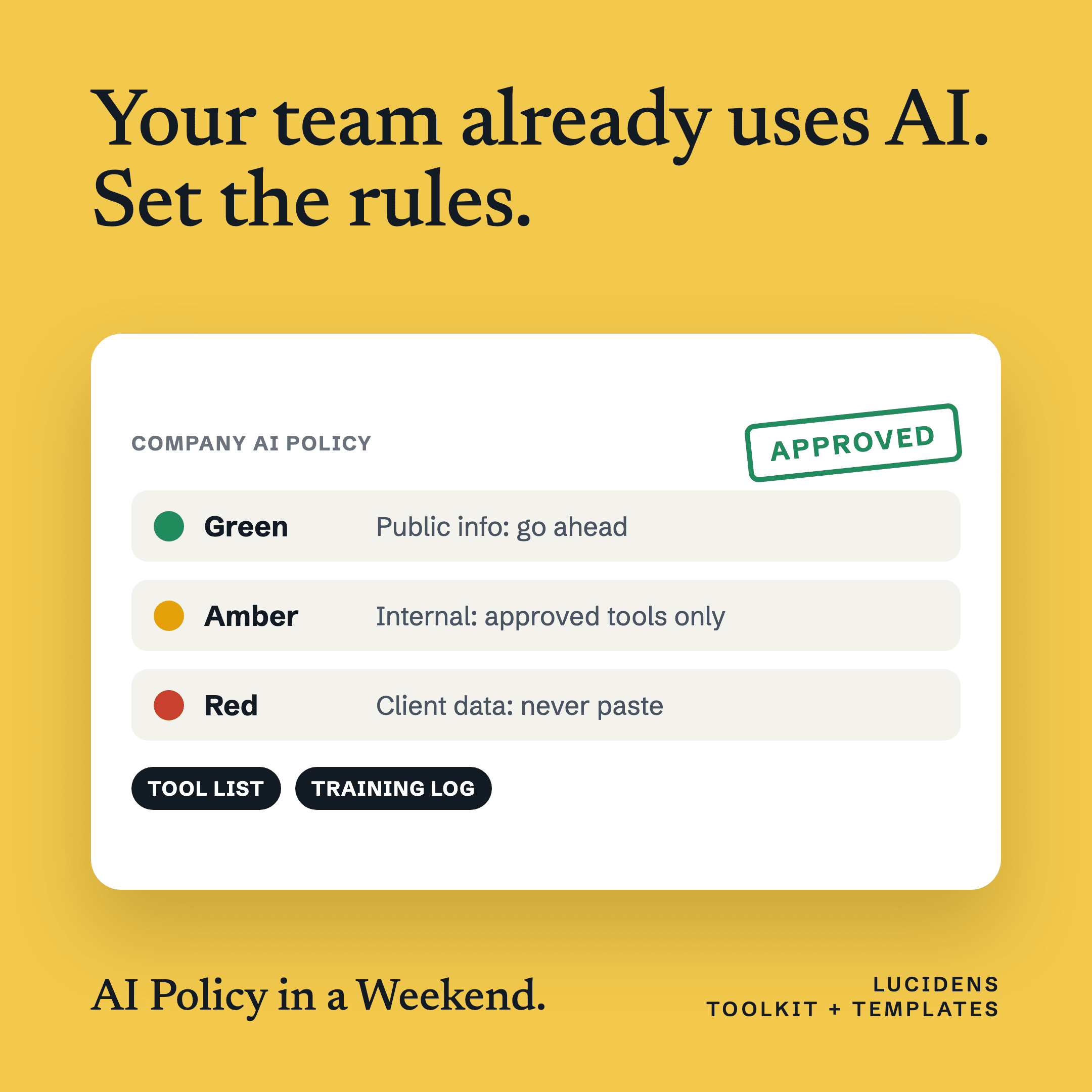
AI Policy in a Weekend: The Small Business AI Use Policy, Rollout Pack and Governance Kit
An AI use policy your team will actually follow: approved tools, simple data rules, a rollout plan and the training records to show for it.
Your staff are already using AI.
Someone drafts emails in a chatbot, someone else runs a meeting note-taker, a third pastes spreadsheets into whatever tool is open. Mostly on personal accounts, with default settings, sometimes with client data. A free template off the internet does not fix that, because nobody reads it and nothing changes. This toolkit gets you from no rules to a policy people have read, in one weekend.
The weekend
- Saturday morning: a no-blame staff survey, plus where else to look (expenses, admin panels, browser extensions). Build the tool register.
- Saturday afternoon: Green, Amber, Red data rules with examples from your own business. Check each tool people want to keep against seven questions. Approve a short list.
- Sunday morning: fill in the two-page policy template, with clause notes explaining each choice. Extra clauses for regulated and client-heavy work.
- Sunday afternoon: the announcement, a 30-minute briefing plan, a ten-question quiz, the training log and acknowledgment form.
- Then: a quick process for new tool requests, a new-starter checklist and a twice-yearly review.
What you get
- The toolkit (36-page fillable PDF) with 7 worksheets: staff survey, tool register, data matrix, vendor check, training log, incident report, review checklist.
- AI Use Policy template (Word): two pages in plain language, bracketed fields to fill.
- Rollout Pack (Word): staff survey email, announcement, briefing outline, quiz with answer key, acknowledgment form, client templates.
- AI Governance Kit (Excel): tool register, vendor checks, data matrix, training log, incident log, tool requests and review log.
Checked, dated and sourced
Rules and vendor data terms were checked against official sources on 30 September 2026, including the EU AI Act literacy duty as amended in July 2026, GDPR and UK GDPR guidance, and the business-plan data terms of the main AI assistants. Every source is listed at the back, with dates.
Who it is for
Owners and operations leads at companies of 5 to 200 people who have no compliance department and want sensible rules without banning useful tools.
Not legal advice. These are practical templates and plain-language explanations. Have your final policy reviewed by a qualified adviser, especially if you handle sensitive personal data or work in a regulated profession. Product names are trademarks of their owners and used descriptively; Lucidens is not affiliated with any vendor.
FAQ
Is this legal advice? No. It gives you templates and explains the rules in plain language. Have a qualified adviser review the final policy.
Does it cover the EU AI Act? It covers what applies to ordinary business use: the AI literacy duty (Article 4) and the transparency rules from August 2026 (Article 50), with the training log as your record. It does not cover high-risk AI systems.
We are in the US / UK. Is it still useful? Yes. The policy is jurisdiction-neutral; the toolkit summarises UK GDPR, FTC, New York City, California and Colorado points where they matter.
Will it ban ChatGPT? No. The approach is to approve a small set of tools on business accounts and set clear data rules, so people stop hiding what they use.
Can I edit the templates? Yes. The policy, rollout pack and kit are editable Word and Excel files, licensed for use in one business.
Can consultants use it with clients? Not under the standard licence. Contact us about a consultant licence.
What if the rules change? Dates are in the text. We update the toolkit when the law or vendor terms change.
By Lucidens. Version 1.0, September 2026. Instant download: PDF plus editable Excel and Word files in one ZIP.
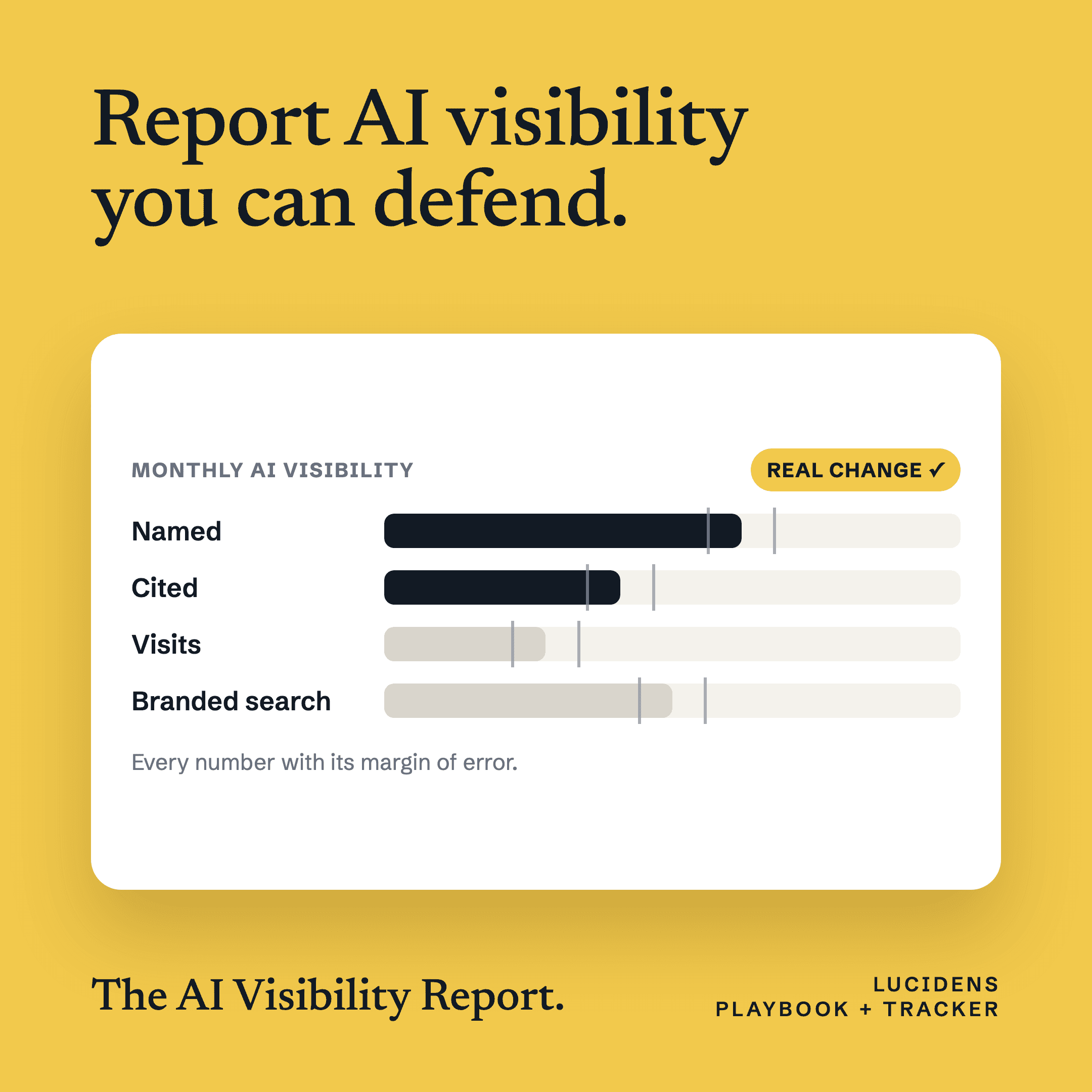
The AI Visibility Report: How to Measure and Report Brand Visibility in ChatGPT, Perplexity and Google AI Answers
Measure how often AI answers name and cite a brand, and report it every month in a way clients and executives accept.
Everyone is being asked for AI visibility numbers. Almost nobody can defend theirs.
A screenshot of one ChatGPT answer. A tool's score nobody can decompose. A client asking why it dropped this month. AI answers change from one asking to the next, so single observations are not evidence, and blended scores hide what moved.
This playbook sets up AI visibility reporting that survives scrutiny, month after month.
Who it is for
- SEO and content agencies reporting AI search to clients
- Freelance SEOs and consultants adding an AI visibility service
- In-house marketing leads reporting to a CMO or board
What you will build
- The Visibility Stack: four layers reported side by side, never blended: presence (named), citation (linked), referral (visits and conversions) and demand (branded search)
- A panel that holds up: a stratified prompt set with core and rotating prompts, and a sample size chosen for the margin of error you need
- A test for real change: a two-step check that tells a real month-over-month change from normal variation, with a worked example
- Reports people read: a monthly one-pager, a quarterly review outline, a method note, and scripts for the hard questions
- A tool-neutral approach: a scorecard to judge any AI visibility tool before you put its numbers in front of a client, plus the tool and API landscape as of September 2026
- Agency operations: onboarding checklist, effort per client, how to price the service
What you get
- The playbook: 45-page PDF with 8 fillable worksheets, bookmarked
- Excel Visibility Tracker: log answers and it calculates presence and citation rates with 95% ranges, month-over-month significance, share of voice, accuracy and source counts. Example copy included.
- Word templates: monthly report and method note, plus unbranded versions you can put your own logo on for client use
- Quick reference card (2 pages)
What makes it different
Every number carries its sample and its margin. The playbook uses the reporting surfaces that now exist (GA4's AI Assistant channel, Search Console's Generative AI report, Bing's AI Performance report) and is honest about what they miss. It flags terms-of-service issues around automated collection instead of ignoring them.
Format
PDF (US Letter, prints on A4), Excel .xlsx, Word .docx. Version 1.0, September 2026.
FAQ
Do I need a paid AI tracking tool? No. The method works with a manual panel. If you use a tool, the scorecard helps you judge it.
Is the statistics part hard? No. The workbook does the calculations; the playbook explains what to say in plain words.
Which engines does it cover? ChatGPT, Google AI Overviews and AI Mode, Perplexity, Copilot, Gemini and Claude; the method works for any engine.
How long does the monthly report take? About 4.5 to 6 hours per client per month with a manual panel, less with a tool (our estimate).
Can I use it with clients? Yes. You can use the worksheets and templates in your own client deliverables. You may not resell the playbook itself.
By Lucidens. Version 1.0, September 2026. Instant download: PDF plus editable Excel and Word files in one ZIP.
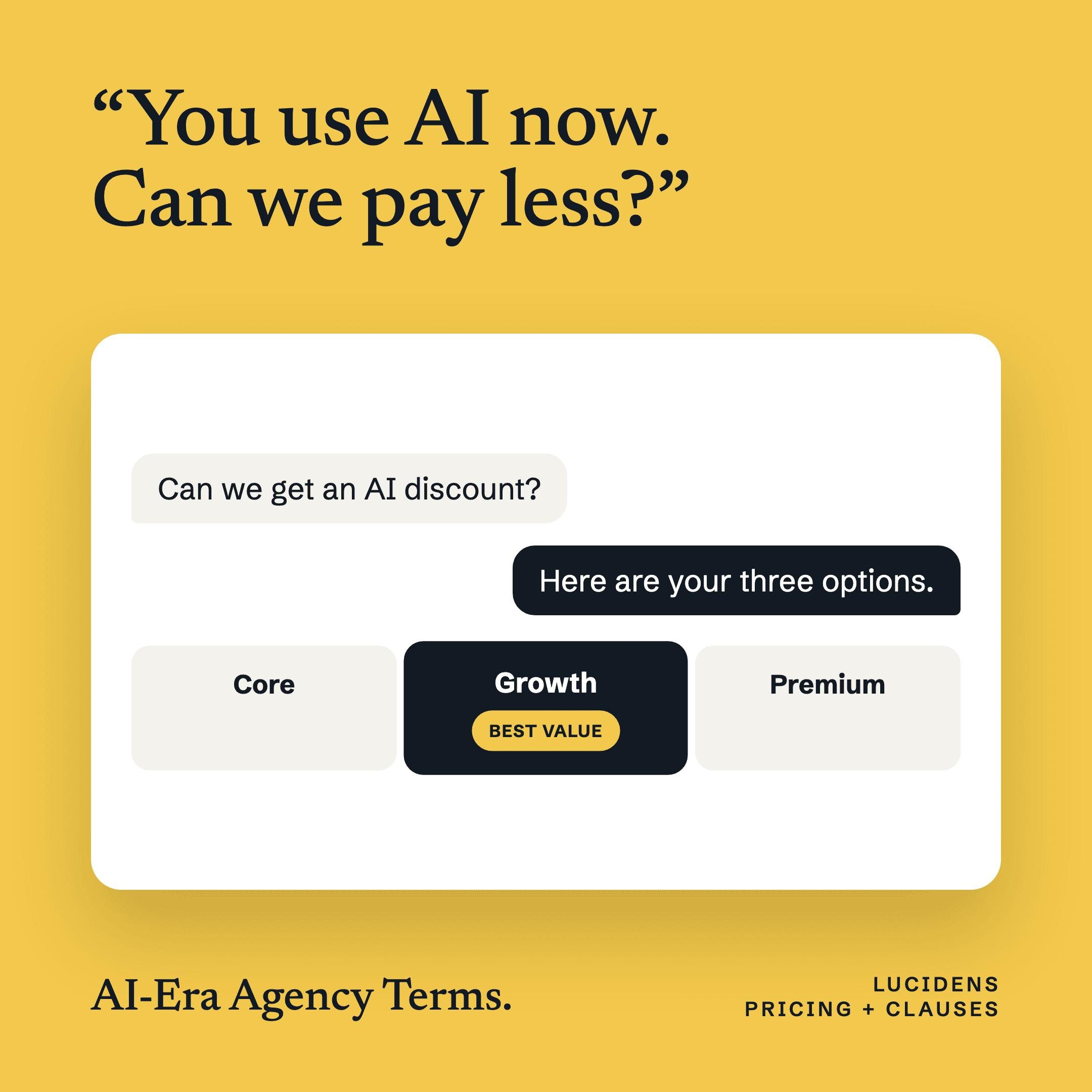
AI-Era Agency Terms: Pricing, AI Contract Clauses and Disclosure for Agencies
Price, contract and disclose AI use without giving away margin. For marketing, content, design and web agencies and senior freelancers.
"You use AI now, so it should cost less."
If you bill by the hour, every minute AI saves you is money you hand back. Meanwhile brands are writing AI into contracts: in a WFA survey published on 30 September 2026, 69% of major brands said they require agencies to disclose AI use, and 59% had added AI clauses to agency contracts. This toolkit helps you get ahead of both.
What it covers
- Reprice: find the cost floor for each service after AI, run a value conversation, and build three options priced on outcomes.
- Repackage: rebuild your service menu around what clients cannot do with a tool: strategy, judgement, review and accountability.
- The discount conversation: seven replies to the questions clients actually ask, from "can we get a discount?" to "we'll just use ChatGPT", plus a renewal plan.
- The contract: ten AI clauses covering tool use, client data, human review, disclosure, ownership, warranties, indemnities, fees, client restrictions and training. Each has a note on why it is there, plus fair counters when a client sends their own terms.
- Disclosure: four tiers for what you tell clients, and what EU, US and UK rules and the main platforms require of published work, as of September 2026.
- Proof of authorship: a light weekly routine and a handover note that record the human creative work behind each deliverable.
What you get
- The toolkit: 42-page fillable PDF with 8 worksheets
- Agency Pricing Sheet (Excel): cost floor, three options checked against floor and value, account margins, renewal prep. Includes a filled example
- AI Clause Library (Word): ten clauses with notes, ready for your lawyer to review
- Client Scripts and Templates (Word): seven replies, renewal steps, value questions, authorship note
Checked and dated
Survey figures, copyright positions, labelling rules and AI vendor terms were checked against original sources on 30 September 2026, with dates beside each point. It also flags common misreadings, such as "the EU requires all AI marketing to be labelled" (it does not), or "your AI vendor's indemnity covers your client" (it does not).
Not legal advice. The clauses are plain-English drafting starting points and the law summaries are for orientation. Have a qualified lawyer review your final wording. Names of platforms and vendors are used descriptively; Lucidens is not affiliated with any of them.
FAQ
Is this legal advice? No. Use the clauses as a starting point for your lawyer, which is usually faster and cheaper than drafting from scratch.
Does it work outside the US? Yes. The pricing and clauses are jurisdiction-neutral; the rules section covers the EU, US and UK.
Do I have to label everything made with AI? Usually not. Part 6 explains when the law or a platform does require it, and how to agree disclosure with each client.
Will this help me raise prices? It helps you stop losing margin to efficiency and gives you a clear basis for pricing. What you charge is your decision.
Can I use the clauses in my client contracts? Yes, that is what they are for, within your own business. You may not resell the library.
By Lucidens. Version 1.0, September 2026. Instant download: PDF plus editable Excel and Word files in one ZIP.
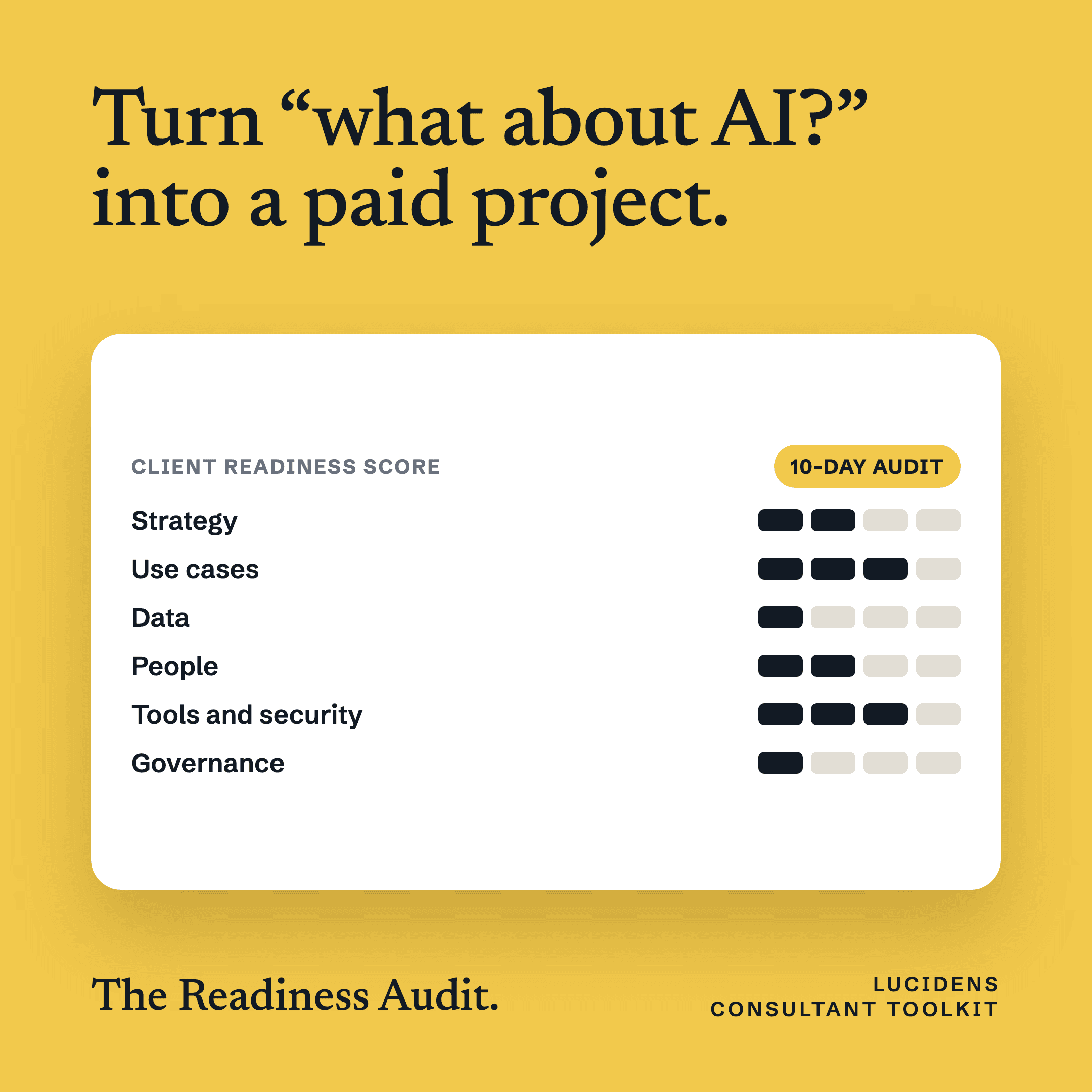
The Readiness Audit: A Consultant's Toolkit for Paid AI Readiness Assessments
Sell and deliver a paid AI readiness assessment for small and mid-size businesses, in two weeks, with evidence behind every score.
Clients keep asking you about AI. This turns those conversations into paid work.
Small business owners know they should be doing something with AI and have no idea where to start. A readiness assessment gives them a clear picture and a short plan. For you, it is a fixed-fee way into a client relationship. This toolkit gives you the whole method, so you are not inventing it on a client's time.
The ten-day delivery
- Day 1: kickoff, scope, document request, survey sent
- Days 2 to 6: six to ten interviews using four ready guides, plus an anonymous staff survey
- Day 7: score thirty criteria across six dimensions, choose use cases with the client
- Days 8 to 9: write the report from the template
- Day 10: a 60-minute readout that ends with owners and dates
What you get
- The playbook (50-page fillable PDF) with 10 worksheets: scope, document request, interview notes, survey tally, scoring sheet, use-case register, prioritisation matrix, value estimate, 90-day roadmap, pricing.
- The readiness model: six dimensions (strategy, use cases, data, people, tools and security, governance), thirty criteria, four levels, a rubric and scoring rules, including a blocker rule for tools and governance.
- Readiness Audit Workbook (Excel): survey results, scores and chart, overall stage, use-case ranking and low, likely and high value ranges. Includes a filled example with a fictional client.
- Word templates: client report, proposal with Snapshot, Standard and Deep options, and the interview and survey pack.
Honest numbers
Adoption and value statistics come from official sources (US Census Bureau, Eurostat, ONS, OECD) and clearly labelled consultancy surveys, each dated. A section on time savings sets task studies against whole-job studies, so you never over-promise. We also list the popular statistics to avoid quoting, and explain why. Published prices from eight firms selling assessments were checked on their own websites in September 2026.
Who it is for
Independent consultants, fractional operators and small consultancies who advise businesses of 10 to 250 people.
Not legal advice. The toolkit covers contract points to raise with your own lawyer, and it tells you to refer legal questions to a qualified adviser. Frameworks and studies by other organisations are cited, not copied. Product and company names are used descriptively; Lucidens is not affiliated with any firm named.
FAQ
Do I need to be an AI expert? No. You need to run good interviews and write clearly. The model and guides tell you what to look for.
Can I use it with my clients? Yes. The licence covers use in your own consulting practice, and your client reports are yours. You may not resell the toolkit itself.
What should I charge? The toolkit shows published market prices and a worksheet to set yours from your day rate. You set the price.
Is it a certification? No. It is an assessment method, not an audit against a standard.
What if the numbers change? Every figure is dated. We update the toolkit when sources change.
By Lucidens. Version 1.0, September 2026. Instant download: PDF plus editable Excel and Word files in one ZIP.
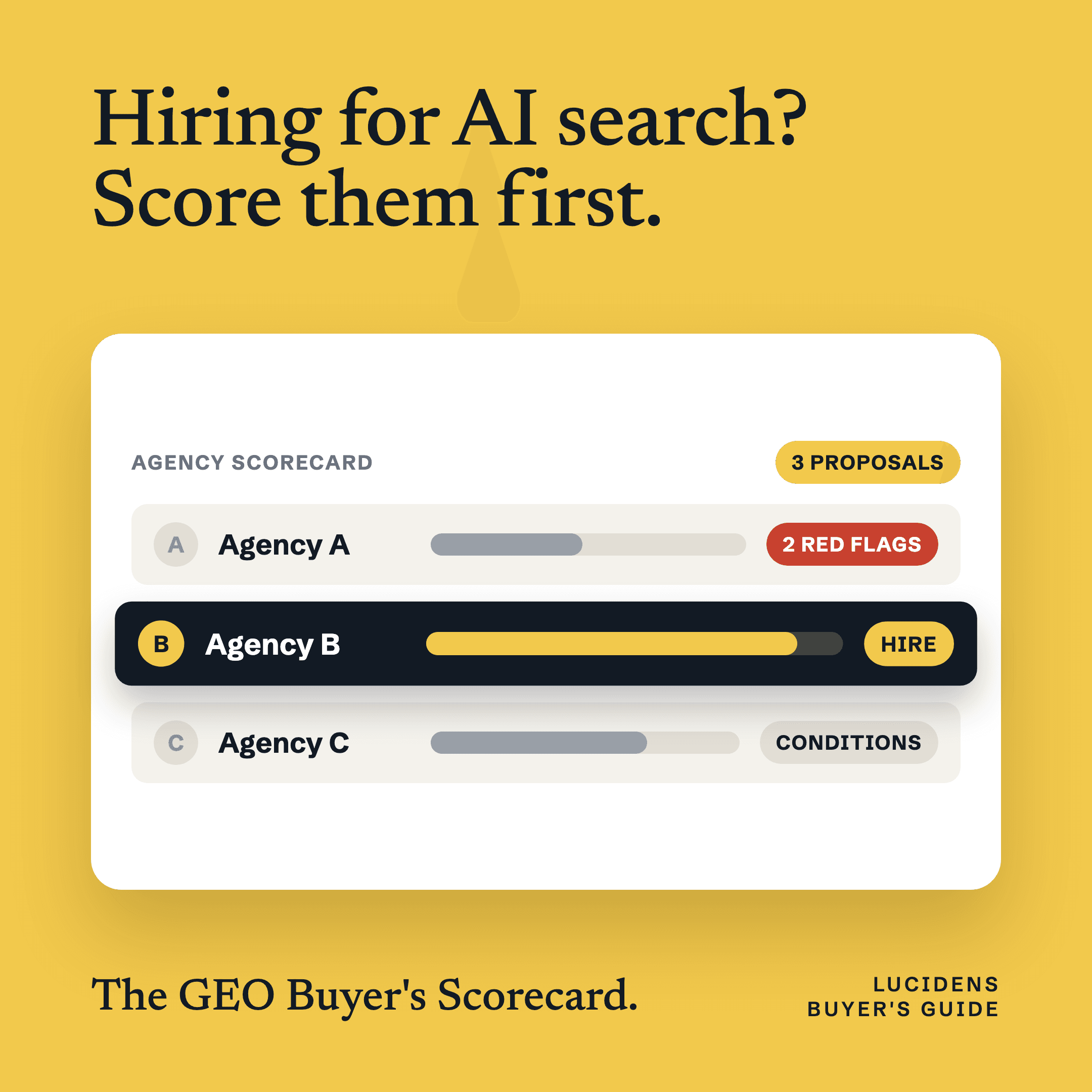
The GEO Buyer's Scorecard: How to Hire an AI Search Agency Without Paying for Hype
Hire an AI search agency on evidence, not promises. For owners, CMOs and marketing leads about to pay for "GEO", "AEO" or "AI SEO".
Same label, prices from $333 to $25,000+ a month
AI search agencies are everywhere, and the published prices for services sold under the same name differ by more than seventy times. Some proposals are solid search work. Some sell things the AI platforms themselves say you do not need. This guide gives you a neutral way to tell them apart before you sign.
What it covers
- What you are actually buying: what Google, OpenAI, Microsoft, Perplexity and Anthropic each say in their own documentation about how their AI answers pick sources, checked 3 October 2026. None of them sells a paid route into organic answers.
- Do you need an agency at all: five free checks you can run in an hour, so you have your own baseline before anyone pitches you.
- The brief: a one-page brief and a "send back" list that makes proposals comparable.
- 40 questions: on method, measurement, tactics, reporting, people and terms, with what a good answer sounds like.
- The scorecard: six weighted criteria with a written 1 to 4 rubric.
- 10 red flags: each tied to what a platform or a study actually says. Five should end the conversation.
- The contract and the first 90 days: what the agreement should say, fair asks, and a 90-day review with agreed measures.
What you get
- The guide: 37-page fillable PDF with 6 worksheets
- Agency Scorecard (Excel): weighted scores for up to four agencies, red flag count, committed cost over the term, and a 90-day review. Includes a filled example with fictional agencies
- Brief and Question Pack (Word): ready to send to every agency
- Contract Checklist (Word): for you and your lawyer
Written to be used on us too
Lucidens is an organic growth consultancy, so we sell this kind of service. Every test in this guide applies to any provider, including us. Agency prices are quoted from the agencies' own pages with the date we read them.
Not legal advice. Have a lawyer review any agreement before you sign. Platform and company names are used descriptively; Lucidens is not affiliated with any of them.
FAQ
Is GEO just SEO with a new name? Mostly, and Google says so in its own guidance. Some measurement work is genuinely new. The guide shows you which is which.
Do I need technical knowledge? No. The free checks take an hour and are explained step by step.
Can I share the questions with agencies? Yes. That is what the Word pack is for.
Will it go out of date? Every platform fact is dated. We update the guide when the sources change.
By Lucidens. Version 1.0, October 2026. Instant download: PDF plus editable Excel and Word files in one ZIP.
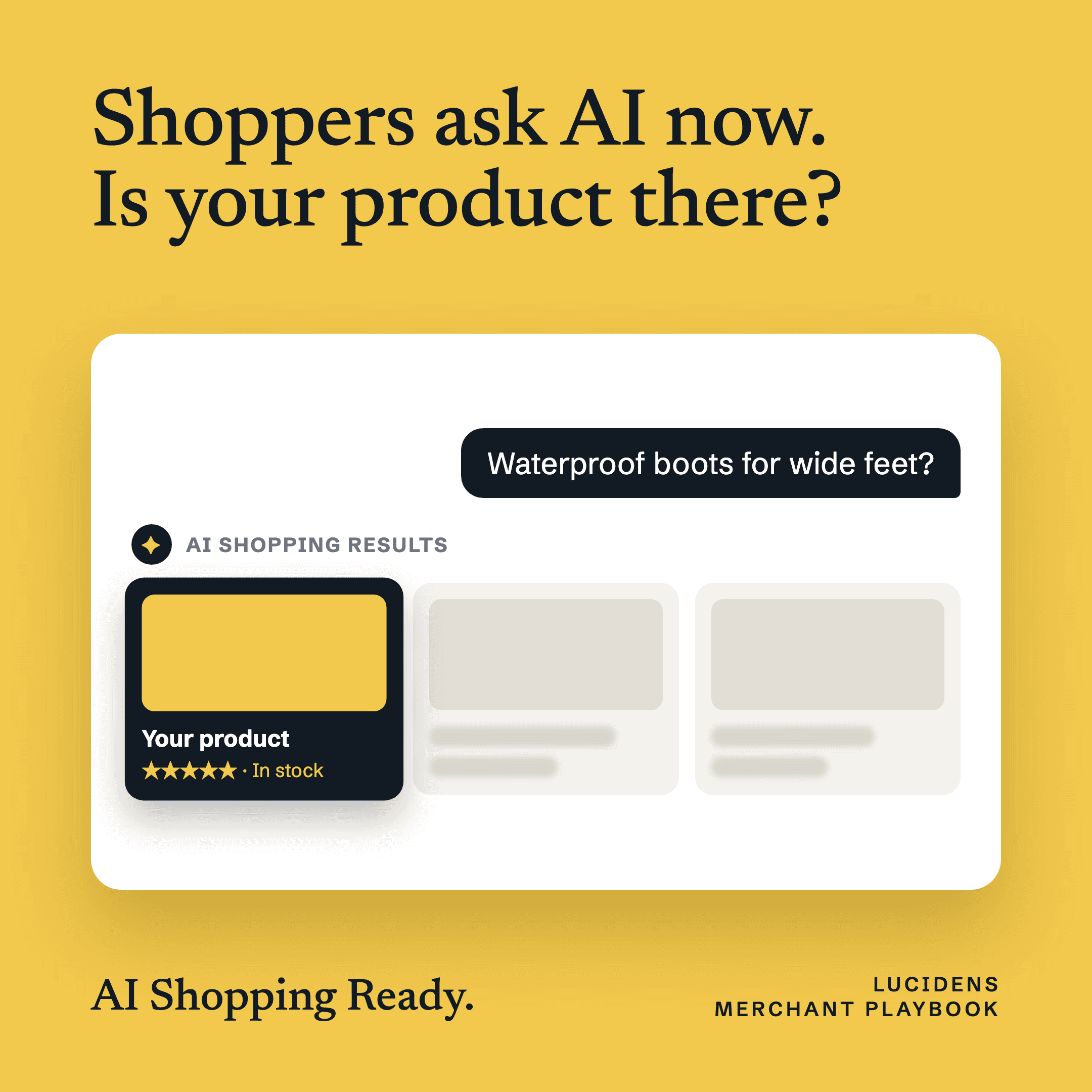
AI Shopping Ready: Get Your Products into ChatGPT, Google AI Mode, Copilot and Perplexity
Get your products shown and recommended in ChatGPT, Google AI Mode, Microsoft Copilot and Perplexity. For independent online stores on Shopify, WooCommerce and other platforms.
Most AI shopping advice is already out of date
On 24 March 2026 OpenAI moved away from Instant Checkout: ChatGPT now helps shoppers discover and compare, and purchases happen on your own site. Google, Microsoft and Perplexity run their own programmes with different rules and regions. Many free guides still tell merchants to "apply for Instant Checkout". This playbook is built on each platform's own documentation, checked 3 October 2026.
What it covers
- Status by platform: what is live, in early access or retired, and in which countries.
- How AI picks products: the inputs each platform names, including price, availability, reviews and whether you are the maker or main seller.
- Your path: a Shopify path (Agentic Storefronts, Catalog Mapping, Copilot Checkout eligibility) and a WooCommerce and other platforms path (crawl access, Merchant Centers, applications).
- Product data that wins: the feed fields OpenAI and Google ask for, titles and descriptions AI can use, and keeping price and stock true.
- Policies and trust: return, shipping and support requirements for AI checkout programmes, and reviews.
- Crawl access and markup: which crawlers to allow, product markup, and store-wide return and shipping markup.
- Measurement and a 30-day plan: where AI traffic shows up, a monthly question check, and a one-hour monthly routine.
What you get
- The playbook: 35-page fillable PDF with 6 worksheets
- AI Shopping Audit (Excel): channel status, a readiness score per product with the first fix to make, policy and technical pass rates, and a monthly AI traffic tracker. Includes a filled example store
- Setup Checklists (Word): Shopify path and WooCommerce and other platforms path
- Product Content Templates (Word): title formula, description structure, product Q&A, return and shipping policy outlines
Honest about what AI traffic is today
Adobe reports fast growth in AI-referred traffic to US retail sites and better conversion than other traffic in early 2026. It reports growth rates, not share of total traffic, and the playbook says so. Nobody can promise placement: OpenAI says its product results "are not ads".
FAQ
I am on Shopify. Do I need a paid ChatGPT feed app? No. OpenAI says Shopify catalogs are already integrated. The playbook shows what to check instead.
I sell in Europe. Is this useful? The in-chat programmes are US-focused for now, but the data, policy, crawl and markup work helps everywhere.
Do I need a developer? Not for most of it. A few markup fixes may need your theme developer for an hour.
Will it stay current? Every platform fact is dated, and we update the playbook when the rules change.
By Lucidens. Version 1.0, October 2026. Instant download: PDF plus editable Excel and Word files in one ZIP.