
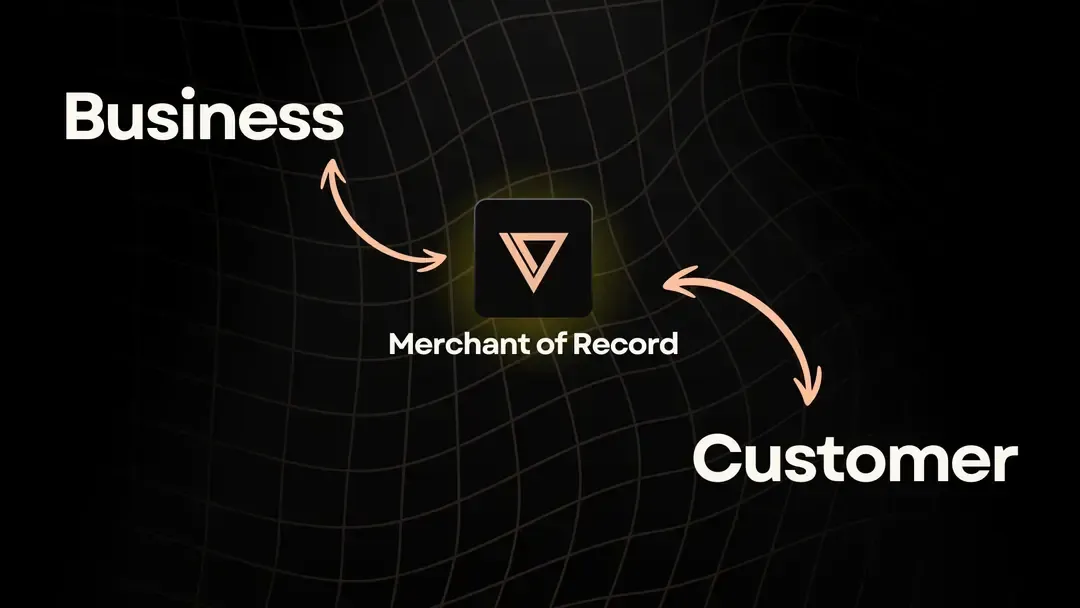
A merchant of record is the legal seller in a transaction. It is the company that takes the customer's payment and carries the duties attached to that sale, from VAT and sales tax to invoices, Payment Card Industry (PCI) compliance for card data, refunds and chargebacks.
Every sale has one. If a processor only handles the card on your checkout, without a merchant-of-record service, that company is still you.
The real decision is who holds the role. Your business can stay the merchant of record and run the tax registrations, filings and disputes itself. Or a provider can take the role and resell your product in its own name.
Even the line between processor and merchant of record can blur, because some payment processors also offer a merchant-of-record option for eligible sales.
If you run a small team selling software across borders, handing the role off usually costs less than building that operation in-house. The trade only holds when the all-in fees, payout terms and exit path also work for your business, so weigh those before you pick a provider.
What does MoR mean in business?
MoR stands for merchant of record: the company your customer legally buys from and pays. That company is responsible for the payment and owes the VAT or sales tax due on the sale.
For a software subscription sold through an MoR provider, you build and own the app. The provider sells the subscription to the buyer. Two different companies sit behind one purchase: yours makes the product, while the provider is the legal seller.
How does the merchant of record model work?
With a third-party MoR, the provider buys from your business and sells to your customer in its own name. There are two sales behind one purchase, but the buyer still sees a single charge. Visa’s rules require the seller’s own name to be the main identifier on the customer’s card statement, though other names can appear alongside it. Because the MoR is that seller, it becomes the liable party in case of any disputes or issues with the transaction.
For a software subscription, the payment moves through three stages:
- The customer pays the MoR for the subscription.
- The provider sends the buyer an invoice, collects the VAT or sales tax due, and pays it to the relevant tax authority.
- The MoR takes out tax and its fee, then pays your business what is left on its payout schedule. A cleared charge is not yet cash in your account.
If a buyer pays an illustrative $120 including $20 of VAT, that leaves $100 before the provider’s fee. The $20 goes to the tax authority, and your payout is the $100 minus that fee.
Tax can be built into your listed price or added on top at checkout. Either way, the tax portion of the charge is not your revenue.
What does a merchant of record handle, and what stays with you?
Handing the sale to an MoR does not hand over your software business. You keep ownership of the code and intellectual property, along with responsibility for making the product work.
The provider handles:
- Taking the payment, issuing the buyer’s invoice, and collecting, filing and remitting VAT, GST or sales tax on covered sales where it has tax responsibility.
- Fraud checks, refunds and fighting chargebacks, though the agreement can pass chargeback costs back to you.
- Payment Card Industry (PCI) compliance, the security rules for handling card data, on the checkout it hosts.
You still own:
- Making the product work, delivering it and fixing bugs, including granting access inside your own app.
- Describing what you sell accurately so the provider can apply the correct tax category.
- Reporting your payouts and paying your business’s corporate income tax.
- Checking whether your software can legally be sold into a given country under export-control rules.
The support boundary is practical. If a customer needs an invoice corrected, that is a billing issue for the MoR. If they paid but cannot use a feature, your team still needs to fix it.
If you embed checkout or handle a payment step in your own code, some payment-security work may remain yours, depending on the integration.
Handling a dispute and absorbing its loss are separate commitments. The agreement can require you to reimburse chargeback losses or tax corrections caused by inaccurate product information.
Merchant of record vs seller of record, processors, and tax tools
A processor takes payments without becoming the seller. Tax software can automate filings and remittance while leaving the tax obligation with your business. The test is who legally owes the tax.
Is a seller of record the same as a merchant of record?
For software sales, the terms usually name the same company, though neither label tells you who is responsible for tax, refunds or chargebacks. Some contracts separate them: seller of record identifies the legal seller, while merchant of record identifies the party responsible for payments and the card-network relationship.
Check the agreement for who carries the legal duties for invoicing, VAT, refunds and chargebacks.
Is a payment processor a merchant of record?
It depends on the product:
- Standard payment processing handles the charge while leaving you as the seller.
- A processor's tax tool helps with tax work, and adding it to checkout does not make the processor the seller.
- A processor's merchant-of-record option makes it the seller only for the sales it accepts into that option. Sales outside it leave you as the seller.
Which providers act as a merchant of record?
The role can sit with the platform or a separate service:
- Dedicated MoR platforms sell software or digital products as the legal seller on the sales they take.
- Processors with an MoR option become the seller only for eligible sales.
- Commerce platforms with a partner MoR are not the seller themselves, and the partner takes that role for eligible cross-border orders.
- Marketplace tax facilitators often handle tax on marketplace orders, which does not cover sales made directly through your own site.
Ask any provider whose name appears as seller on the invoice, and for which sales.
Benefits of using a merchant of record
An international card payment clears, but the VAT work is still waiting. For the sales an MoR provider takes on, that filing work belongs to the provider. A new customer abroad does not have to become another tax-administration project for your team.
The benefit grows with the number of markets you serve. If you had filing obligations in 10 countries, each requiring a quarterly return, that would mean 40 filings a year. If an MoR takes on all those sales and their filing obligations, those 40 returns move off your calendar.
The practical gains extend beyond filing:
- No foreign transaction-tax registrations to manage yourself or return deadlines to track for those sales.
- No customer-invoicing setup to keep current with each country’s VAT requirements.
- Less time spent tuning fraud rules or assembling chargeback evidence yourself when the provider handles that work.
For a small team, those jobs compete with shipping features, finding customers and answering product-support requests. Reducing that workload leaves more time for the work that makes the software worth buying.
What are the costs and risks of using an MoR?
You give up a fee on every sale and some control over refunds, checkout and payout timing. In return, the provider takes on the sale’s tax and dispute work.
Take your most common order size and add up every applicable charge in the provider’s pricing and agreement, including payout and currency conversion, rather than comparing headline rates alone.
The agreement also determines:
- When the money reaches you: A buyer’s payment can sit on hold or in reserve while your compute bill is due.
- Whether your account stays open: The provider decides whether your product category is accepted, and an account review can pause checkout or payouts.
- Who controls refunds and checkout: You may have to follow the provider’s refund decisions or work within its checkout customization and customer-data access rules.
- What leaving takes: If payment details and subscriptions cannot move, subscribers may need to enter a card again when you switch.
Ask the provider to answer these points in writing:
- How many days is a payment held before you can withdraw it?
- What triggers an account review, and what happens to checkout and payouts during it?
- Who can approve a refund?
- Can subscriptions, payment details and your customer list move with you if you leave?
Where Creem fits as a merchant of record
Creem becomes the legal seller of your software and digital products for 3.9% + $0.40 per successful transaction. Creem handles VAT, GST and sales tax for buyers in 190+ countries, issues customer invoices, screens for fraud and fights chargebacks. The standard plan has no monthly fee, no setup fee and no minimum sales volume.
On a $100.00 sale, the percentage fee is $3.90 and the fixed fee is $0.40, leaving $95.70 after transaction fees. Applicable tax and payout costs are separate. At its displayed sales volume, Creem's pricing calculator estimates monthly fees of $235.00 on Creem, $300.00 on Paddle, $400.00 on Lemon Squeezy and $500.00 on Gumroad, assuming a $50 average order, transactions rounded up, and international subscriptions paid with premium cards.
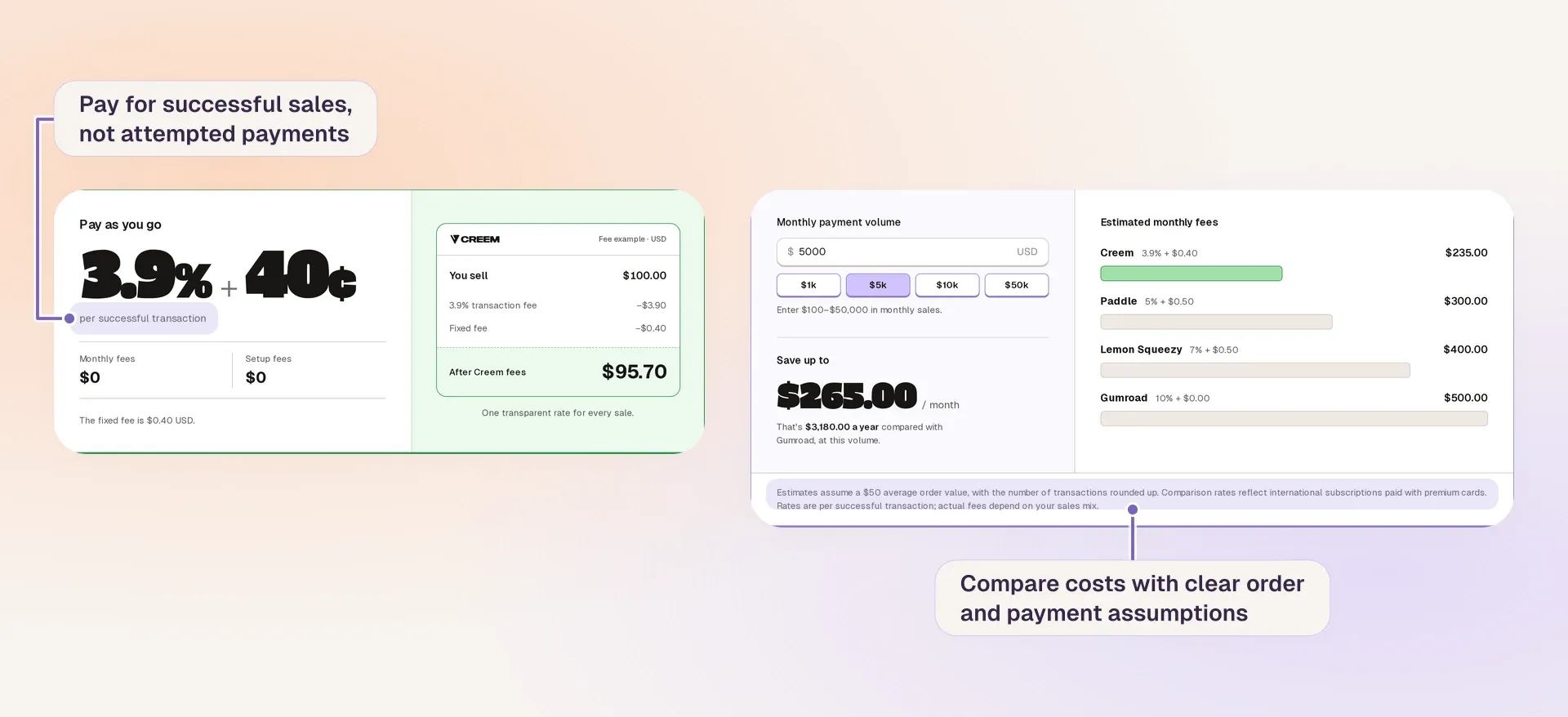
Creem pricing page: 3.9% + 40¢ per successful transaction and a calculator showing $235 in fees on $5,000 monthly volume
What sets Creem apart?
At Creem, we're not just another merchant of record service. We built billing and partner payments into the same platform, putting capabilities associated with enterprise billing stacks within reach of small teams.
That gives you several ways to match billing to your product and pay the people helping it grow:
- Subscriptions and usage billing: Run recurring plans or meter consumption instead of forcing every product into a seat-based price.
- Prepaid credit wallets: Sell credits with automatic refill, so customers can pay before consuming compute.
- Affiliates and revenue splits: Connect referral links to commissions and payments, or divide proceeds between recipients across the store or per product.
Checkout runs on your own domain, its interface appears in 42 languages, and customers get a customer portal. You can set it up from the dashboard, API, CLI or an agent, and sell as an individual or a registered company. Pricing is one clear, published rate with no monthly fee, no setup fee and no hidden fees.
Splits can replace a separate payout tool, as DaisyUI found: its profit-sharing setup needed zero extra tools.
The customer migrations were measured in minutes and hours. Uneed changed 1,500+ lines of payment code with three AI prompts and zero integration errors in minutes. DaisyUI’s manual move took a few hours, with support replies in under a day.
Do you need a merchant of record?
Hand off the role if you sell software to consumers abroad and nobody on your team can own the tax filings. Staying the seller makes more sense when you already have the necessary registrations and someone reliably filing the returns.
Where registration and filing are required, the work is concrete: getting a VAT registration, submitting a return before its deadline, and matching the sales and payouts to what was filed. On a small SaaS or AI team, that can all land on the person who should be shipping the product.
Is someone already filing VAT or sales tax returns for you?
- If yes, compare the MoR's fees with what keeping that operation running costs each year.
- If no, outsourcing covers any required filings you would otherwise need to do yourself or hire for.
List the countries you expect to sell into over the next year. Add up processing and billing fees, tax software, an accountant’s filings and your own hours for those markets, then compare that total with the MoR’s fees on the same revenue.
Ask the provider whether usage meters, prepaid credits, affiliates and revenue splits run alongside the sale, and what each adds to the rate. Any separate tools belong in that cost comparison too.
For a small SaaS or AI team selling abroad without a finance hire, handing off the role is the better choice. Before you sign, check how long payouts take and what leaving the provider would involve.
Ready to let Creem be your merchant of record?
A product can be ready in a weekend while VAT registrations, invoices and chargebacks would still take weeks to set up. For a SaaS or AI company selling subscriptions, usage or credits to buyers in many countries, that operation is the part worth handing off, and it only gets heavier as revenue grows.
Creem becomes the legal seller on every sale. The tax owed in 190+ countries, the invoice and the dispute become its job, while you keep building, shipping and supporting the product. Uneed moved its payments onto that setup in minutes.
Your product is ready, and the money side doesn't have to become another project. Creem gives your business enterprise-level financial tools and seamless global transactions, and you can start selling with no monthly fee and no setup fee. Only pay when you earn.