
Most advice on a SaaS affiliate program starts in the wrong place. It begins with commission rates and tracking tools, as if the whole decision were a setup task, when it's really a unit economics decision that can either add durable MRR or drain margin through churn, refunds, support, and payout friction.
I learned that the hard way running a partner channel through its first $100K in partner-driven MRR. The affiliates who looked great on raw clicks were often the least profitable once renewal behavior, refund rates, and support load showed up in the ledger. If you sell globally, the problem gets even messier, because payout rails, tax handling, and currency conversion can turn a simple referral program into a finance process.
Why Most SaaS Affiliate Programs Fail Before They Start
A SaaS affiliate program doesn't fail because the tracking script breaks. It usually fails because someone approved a commission structure without asking whether the acquired customers would stay long enough to make the payout rational.
That's the part most launch checklists skip. A recurring commission can look generous on paper and still be a bad deal if affiliate-sourced customers churn early, generate support tickets, or trigger refunds. The same is true if the program attracts traffic that converts, but only after discount-heavy campaigns that lower realized revenue and muddy attribution.
Start with unit economics, not enthusiasm
The first question is simple: do you have room for commissions after delivery costs, support, refunds, and partner management? Test that against collected revenue and observed retention. If the answer isn't clear, don't launch yet. The payout must be funded by durable customer value rather than by attempts to outbid other channels.
The clearest benchmark in the current market is commission structure itself. TrackRev's affiliate program benchmarks, compiled from affiliate network and partner platform data, put the median B2B SaaS affiliate commission at 20% and the B2C SaaS median at 15%.
The same page puts information products at 30% and eCommerce at 8%, so SaaS sits toward the higher-paying end of the range.
That benchmark helps, but it's not a green light by itself. The test is whether your churn-adjusted LTV still leaves enough room after commission and operating overhead. If affiliate-acquired customers behave worse than customers from organic, paid, or direct channels, the program can grow revenue while shrinking profit.
Practical rule: if you can't explain how the commission will behave after refunds and churn, you're not ready to scale the program.
Why the wrong launch feels successful
A bad program can look healthy for the first few months: partners sign up, clicks rise, and bookings appear. But if those customers churn while commissions keep accruing, the activity is masking low-intent acquisition rather than proving the channel works.
The pre-launch question isn't “Can we run an affiliate program?” It's “Will the margin still work after the full customer lifecycle costs?” If you can't support that answer with collected revenue and retention evidence, launch later, not sooner.
Choosing a Commission Model That Protects Your Margins
Commission design is where many SaaS teams accidentally choose between growth and sanity. The right model depends on customer lifetime, billing cadence, and how sensitive your product is to churn, not on what competitors are doing on their landing pages.
The current benchmark set is fairly consistent. Typical SaaS affiliate commissions in Rewardful's report commonly cluster around 20–30%. That reported range doesn't establish what you can afford; that depends on your retention, the revenue you actually collect, and what the channel costs to run.
That range is useful because it forces the conversation back to economics, not vibes.
Match the model to the product
Recurring lifetime commissions work best when retention is strong and the product is sticky. A fixed-duration recurring model can be safer when lifetime value is harder to predict, because it caps exposure while still rewarding partners for quality traffic. One-time bounties are easier to budget, but they can under-incentivize affiliates who need recurring upside to keep promoting after the first wave.
High-ACV enterprise software usually tolerates lower headline percentages because deal sizes are larger and sales assistance is common. Low-price self-serve products often need a cleaner, more disciplined payout model because margin can disappear quickly if support and billing costs stack up. Annual billing also changes the math because cash arrives upfront, while monthly billing exposes you to more retention risk over time.
Sales-assisted products need an ownership policy written before launch. Decide what happens when a referral lands on an opportunity sales already owns, or when a rep does most of the closing work.
A good way to sanity-check your rate is to cap it against the economics you already know. If the payout is large enough that a weak cohort could make the channel unprofitable, the rate is too high for an unproven program. If the payout is so small that only coupon sites and bargain hunters care, you'll recruit the wrong partners.
SaaS Commission Models Compared
| Commission Model | Typical Rate | Best For | Margin Risk |
|---|---|---|---|
| Recurring lifetime | 20% to 30% range in mature SaaS | Sticky products with strong retention | Higher if churn rises |
| Fixed-duration recurring | Usually a capped recurring window | Products with decent retention but uncertain lifetime | Moderate, because exposure ends |
| One-time bounty | Flat payout on first paid conversion | Early-stage programs or short sales cycles | Lower ongoing liability, but weaker partner motivation |
| Tiered model | Base rate with higher tiers for performance | Teams that want to reward top partners without overpaying everyone | Controlled if tiers are tied to quality |
| Performance-based model | Adjusted for retention or quality | Mature programs with enough data | Lowest if the data is reliable |
If you want a practical finance workflow for partner payouts and split logic, the revenue allocation notes in revenue splits without spreadsheets are worth a look. The point isn't the tool itself. It's that commission design and payout operations need to be modeled together, or finance ends up cleaning up after marketing.
High commission rates don't fix weak conversion quality. They just make bad traffic more expensive.
The safest approach is to start with a rate that fits the contribution you can already measure. For each affiliate cohort, over a stated observation period, take:
- Collected subscription revenue for that period
- Minus refunds issued to those customers
- Minus delivery costs such as hosting, compute, and support
- Minus partner commission, calculated on the base your terms name, like collected revenue net of refunds
- Minus platform and payout fees that apply to the channel
- Minus incremental operating costs of running the program
If you start from gross profit, delivery costs are already out, so don't subtract them twice.
Run the same terms against an earlier-churning cohort and a longer-retained one using your own figures. The gap shows how much a capped window or a smaller pilot protects you.
That result is observed contribution. Projected LTV is a forecast, so widen the rate only after the observed numbers hold.
A program that begins conservatively and learns fast is much easier to manage than one that launches aggressively and spends the next quarter clawing back margin.
Setting Up Tracking and Attribution Infrastructure
Affiliate programs fail fast when attribution is sloppy. If finance can't tie a referral to the actual subscription event, or if product can't reconcile upgrades, downgrades, and refunds, the channel becomes a manual bookkeeping exercise instead of a growth lever.
Build around the subscription record, not the click
The cleanest setup is one where the affiliate platform and billing layer speak to each other directly. That lets you calculate commissions on revenue collected, not on a booking that might fail payment, downgrade later, or get refunded. It also matters for trial-to-paid conversion, because the referral event and the revenue event are often separated by several days or weeks.
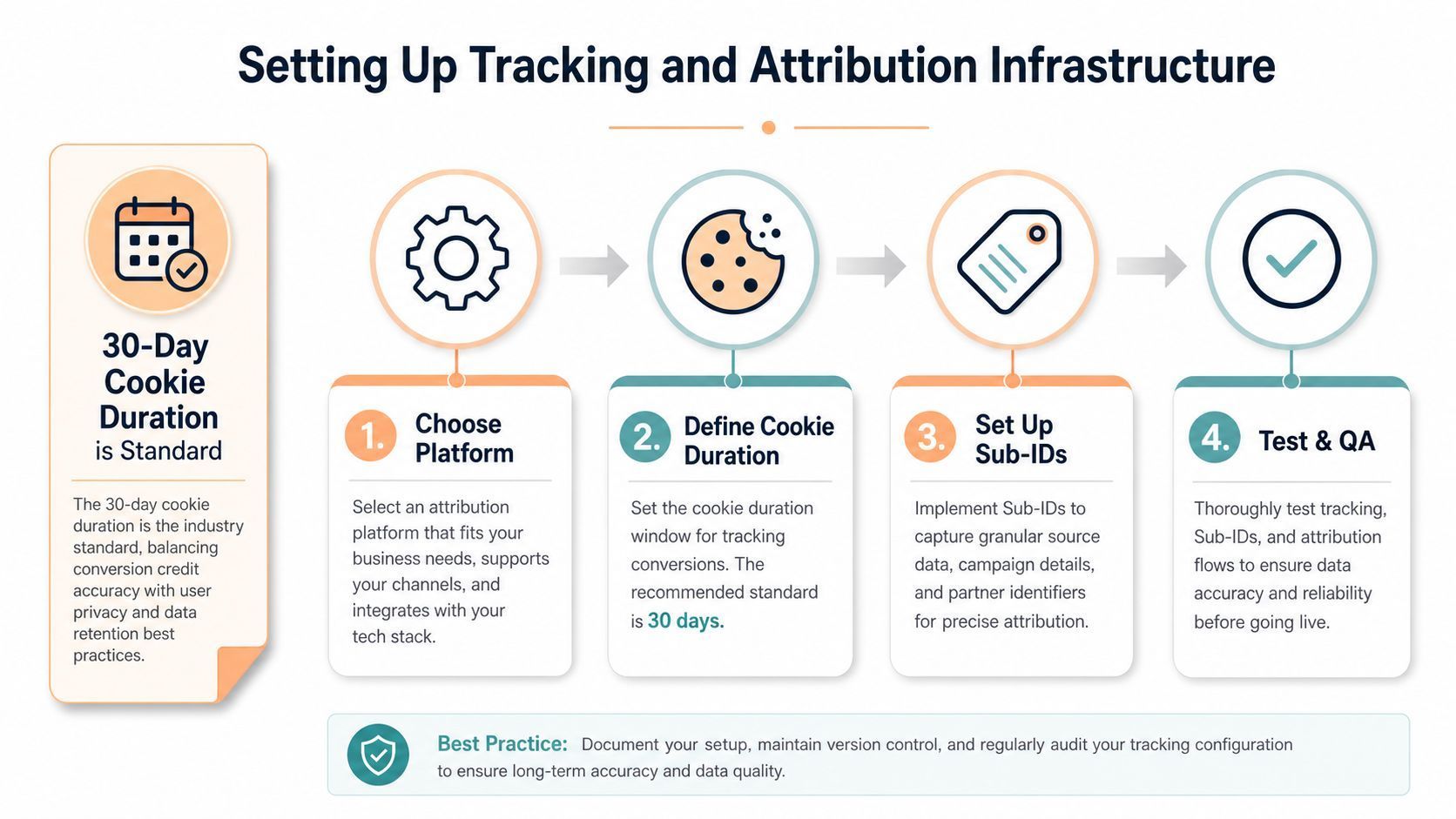
Cookie duration is usually set with a standard window in mind, but the core issue is whether the attribution window matches your customer journey. If your audience researches heavily before buying, too-short windows underpay legitimate partners. If your buyers convert quickly, an overly generous window can expose you to unnecessary disputes.
A partner can touch a sale long before it pays. A buyer might find you through a partner's tutorial, read a comparison, start a trial, then pay.
Decide what each moment earns: an introduction alone earns nothing, an attributed lead or trial gives the partner ownership, and the paid invoice earns the commission.
Then put the attribution rules in writing before the first partner joins:
- Competing referrals: which partner owns the customer when two links were clicked, and whether a later click can take over an existing trial.
- Expiry: how long a click or a trial stays attributed before the referral lapses.
- Record attachment: where the referral ID lives on the customer or subscription record, so renewals and refunds find the right partner.
Pick rules your platform can enforce. If it assigns one owner per customer, say so in the partner terms instead of promising split credit.
Operational rule: hold any commission you can't trace from click to paid invoice and current refund status out of the payout batch until it reconciles.
The workflow should also support sub-IDs or partner tags, because many affiliates run more than one promotion source. That lets you separate content, comparison pages, newsletters, and community placements instead of treating every referral as identical. Once that data is captured, you can see which traffic type creates durable customers.
Test the ugly edge cases before launch
The launch QA should include upgrades, plan changes, downgrades, failed renewals, and refunds. Those are the cases that break reporting first. If the platform can't handle clawbacks automatically, someone on finance will end up doing reconciliation by hand, which is how small programs become permanent ops projects.
A strong stack also reduces confusion around trial-to-paid conversions. If a partner sends qualified trial traffic, you want the attribution chain to survive the handoff from signup to billing to renewal. That's especially important if your product team experiments with free trials, freemium plans, or annual prepay flows.
The key distinction is simple, a standalone referral tracker can measure referrals, but integrated billing-aware infrastructure can measure business outcomes. For a SaaS affiliate program, that difference determines whether the numbers are useful enough to make decisions.
Recruiting and Activating Partners Who Actually Drive Revenue
Partner signups can make a dormant channel look alive. Watch who publishes or sends a qualified referral after the welcome email.
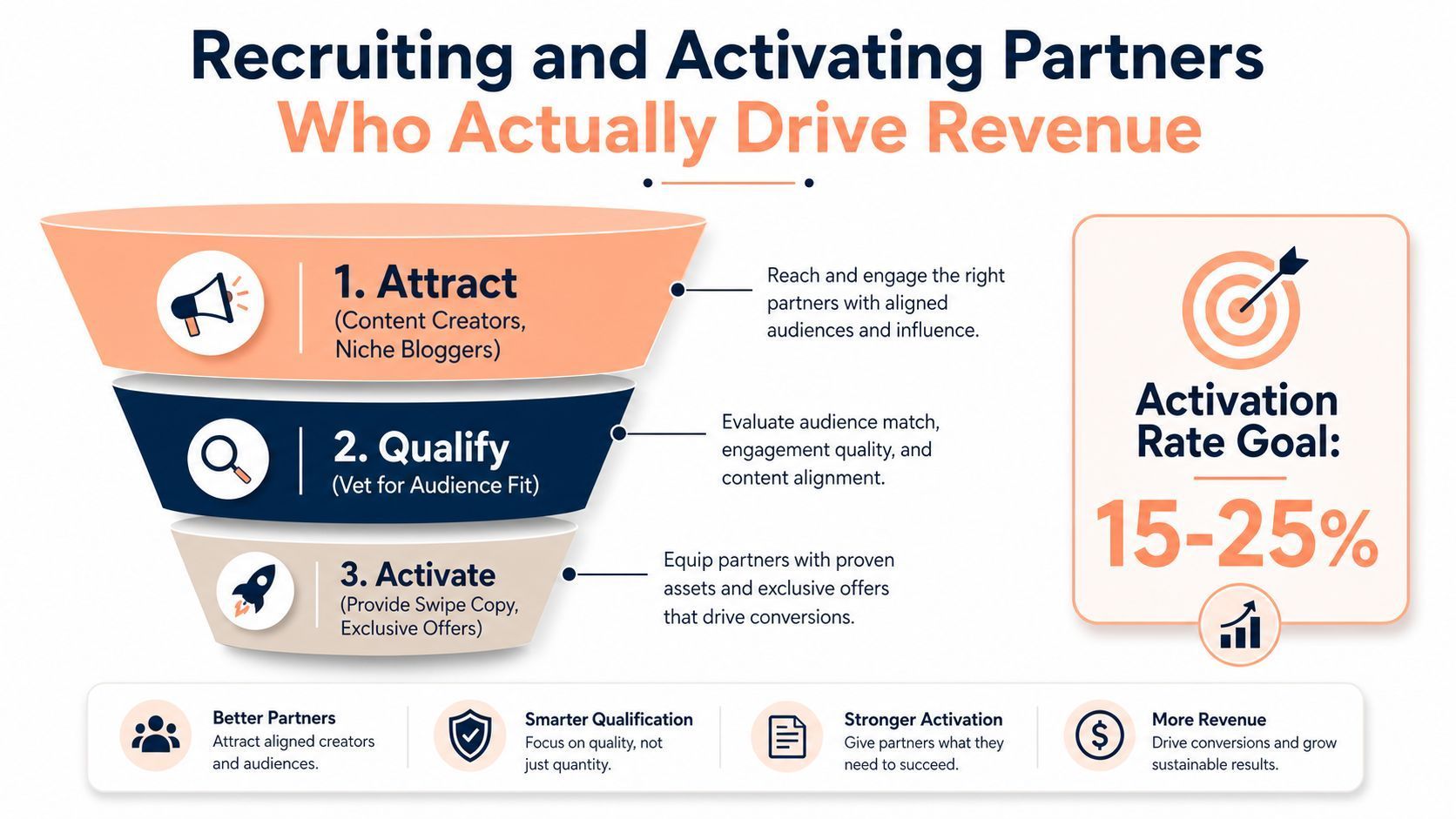
Recruitment gets attention, but activation is what determines whether the channel becomes a real acquisition system or a list of dormant accounts.
Separate partner types early
Content creators need different enablement than comparison sites. Integration partners care about product overlap and co-marketing opportunities. Community influencers often need fewer assets, but they need tighter messaging because their audience trusts them for specificity, not generic promotion.
| Partner type | Buyer question they answer | Good first action | Enablement they need |
|---|---|---|---|
| Content creators | How do I get this job done? | Tutorial showing the product in use | Product summary, demo access, screenshots |
| Comparison sites | Which tool should I pick? | Add or update a comparison entry | Accurate pricing, feature facts, fit limits |
| Integration partners | Does this work with my stack? | Integration guide or co-marketing post | Product-overlap brief, co-marketing plan |
| Community influencers | Would someone I trust use it? | Short recommendation in their community | Tight, specific messaging, few assets |
For a SaaS product, the partner program works best when each partner can explain the product to their own audience in language those buyers already recognize.
The Lovable app affiliate program example shows why offer design matters here: the product narrative and the partner's story need to match.
When they do, partners can describe the offer in terms their audience already uses instead of repeating generic promotional copy.
Focus on first action, not just signup
The first indicator of health is not total partner count. It's whether new partners take an action quickly enough to build momentum. That action could be a published review, a comparison page update, a newsletter mention, or a demo walkthrough.
A few practical behaviors help here:
- Give ready-to-use copy: Product summaries, email blurbs, and feature bullets reduce the blank-page problem.
- Ship co-marketing opportunities: Guest webinars, bundled offers, and partner spotlights give affiliates a reason to promote now instead of later.
- Review the first cohort manually: The earliest partners tell you which messages land and which ones need rewriting.
- Nurture the active minority: A small number of partners usually drives most of the channel, so you want personal contact with the ones already moving.
For that first manual review, give each new partner a short brief before they publish:
- Buyer and problem: who the piece is for and what they're trying to fix.
- Workflow to show: the one task the product handles, shown step by step.
- Fit limits: who the product doesn't suit, stated plainly.
- Product and pricing facts: current plan names and prices, checked against your pricing page.
- Referral link: the partner's own tracked link.
- Disclosure: a clear note that the partner earns a commission.
When the draft comes back, check that the facts are right and the angle fits the partner's audience. Then confirm the referral link tracks to a test signup, and the call to action suits where that buyer is.
Channel results tend to concentrate in that active minority, and it's why the first 90 days matter more than the signup count. If your early affiliates don't get activated, the program will look bigger than it is.
The strongest programs behave like editorial teams, not like passive referral directories. They help partners publish something useful, then they watch who gets traction and put more energy behind those people. Partners already weigh your offer against programs that actually pay before they publish.
Managing Global Payouts and Tax Compliance
Once the partner base crosses borders, payout logistics stop being a back-office detail. Every extra country adds friction around currency conversion, tax forms, payment rails, and support questions, and someone has to own that complexity.
If you're also deciding where to register your company, non-EU entrepreneurs can find the company-formation side of cross-border operations here. Keep that decision separate from affiliate payouts and tax reporting.
If you manage payouts manually, you get control, but you also inherit reconciliation work. Bank transfers and PayPal can work for small programs, especially when the partner list is short and domestic. The problem is that manual systems don't scale gracefully when affiliates want different currencies, different payout methods, and different schedules.
Trade-off: manual payouts are flexible, but they turn finance into a recurring operations queue.
A Merchant of Record changes that equation on the customer side of the sale. It becomes the legal seller, so it calculates, collects, files, and remits VAT, GST, and sales tax on each transaction.
Your own business-income tax stays with you, and so does any reporting or withholding that applies when you pay affiliates. Not every Merchant of Record runs affiliate payouts at all.
When one does, the records line up. For SaaS companies that sell internationally, affiliate payouts sit next to subscriptions, refunds, and revenue recognition, and those pieces need to match.
On the customer side, the EU VAT and ViDA 2026 SaaS compliance guide covers what changes for SaaS sellers. Customer sales-tax work and affiliate payouts usually land on the same finance team.
Choose the lowest-friction path that still scales
Manual payouts make sense when you're validating the program and the affiliate base is tiny. They become fragile when the program grows internationally and finance starts juggling forms, currencies, and status updates. At that point, the hidden cost isn't just time, it's the risk of mismatched records.
A platform that handles merchant-of-record flows, subscriptions, and affiliate payouts together can reduce that mismatch. Creem is one option in that category.
It is the legal seller on each sale and runs subscription billing, affiliate tooling, and payouts in one system, rather than splitting them across disconnected vendors.
That kind of consolidation matters less when you're tiny, and much more when the program starts to mature.
On the standard plan, these are the costs that touch an affiliate sale:
- Each sale: 3.9% + $0.40 per successful transaction, with tax, invoicing, compliance, and dispute handling included. A $100 sale leaves $95.70 after that transaction fee, before affiliate fees and commission, per Creem pricing.
- Affiliate platform fee: an extra 2% before the affiliate's commission, on top of what you pay the partner, per the payout docs.
- Your bank payouts: include transfer costs and FX when your bank currency differs.
- Coverage: seller onboarding and payouts cover 87 countries. Buyer payments and customer VAT, GST, and sales-tax handling cover 190+ countries, per Creem's coverage overview.
Bank payout costs apply to your own withdrawals. Your affiliate terms should name the countries, payout methods, and currencies partners can use, the details they submit, and who owns payout-related reporting.
Count the commission and every platform and payout cost in channel profitability. Keep the commission rate itself separate, so the number you quote partners stays comparable.
The best choice depends on how many markets you serve and how often you pay partners. If your affiliate channel is already global, the operational simplicity of one system usually beats the false comfort of “we'll reconcile it later.”
Optimizing Performance with the Right Metrics
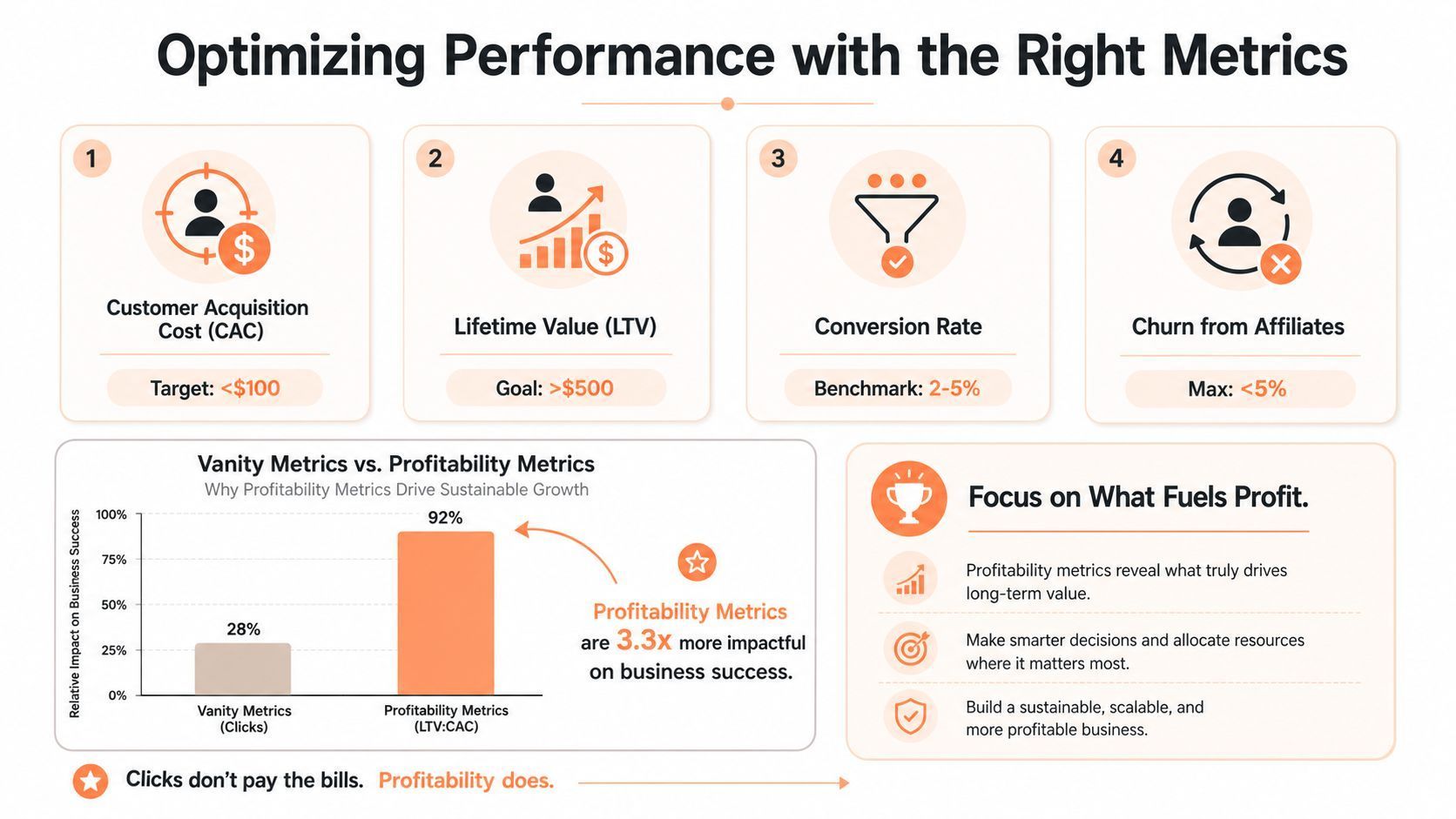
The wrong dashboard makes every affiliate program look better than it is. Clicks, signups, and raw referrals can rise while the channel underperforms on retention, so optimization has to start with metrics that show whether the customer is worth the payout.
Track the numbers that change decisions
The first metric to watch is churn-adjusted LTV, an estimate of customer value based on explicit retention assumptions. It is not revenue you've already collected. Specify whether it estimates lifetime revenue or lifetime gross profit before using it in a margin calculation, and keep observed revenue and refunds separate from that projection. Then watch commission efficiency alongside it: if estimated customer value falls while the commission burden rises, investigate before expanding the program.
You also need to monitor affiliate-attributed trial-to-paid conversion and MRR, remembering that MRR represents recurring subscription revenue, not cash collected. Those numbers help you distinguish intent from attention. Compare partners using customer cohorts of comparable age and billing cadence, and separate pending, paid, and reversed commissions when reviewing payouts. If one partner drives volume but its comparable cohort churns faster, investigate the landing page, offer, or payout terms before scaling that partner.
A useful weekly dashboard usually includes:
- Commission-to-revenue ratio: Partner commissions divided by revenue collected from the same cohort over the same period, with refunds treated the same way on both sides. Track platform fees, payout fees, and operating costs separately when calculating channel profit.
- Trial-to-paid conversion: Attributed trial starters who reach paid status within a stated window, divided by all attributed trial starters.
- Affiliate-attributed MRR: Recurring revenue on active referred subscriptions. It differs from cash collected, which moves with annual prepayments, refunds, and failed charges.
- Churn-adjusted LTV: Average monthly revenue per customer multiplied by expected customer lifetime, based on the cohort's retention. For margin decisions, use monthly gross profit instead of revenue and label the result gross-profit LTV.
- Refund and clawback volume: Refunded revenue and the commissions reversed against it, tracked for the same cohort and period. Split commission balances into pending, paid, and reversed. Are you paying for revenue that doesn't survive?
Use experiments to reward quality, not noise
Commission changes should be tied to retention behavior and conversion quality, not vanity spikes. If a partner brings in customers who renew, that partner deserves more room.
If another partner sends traffic that converts cheaply but churns quickly, cut the rate going forward or end the partnership under the notice your terms require.
Commissions already earned stay paid unless your documented refund or clawback terms reverse them.
Controlled tests work best when they're narrow. Before launch, write down the one variable you're changing, who is eligible, how long you'll watch, and the measure that decides it.
A commission change tests partner behavior, while a landing-page change tests buyer conversion. Run them as separate tests.
Then compare cohorts of similar age and billing cadence, and wait until renewals and refunds start to show. First-week signups won't settle it.
The warning sign is simple. If affiliate acquisition grows while retention weakens, the channel is becoming expensive to maintain. That's the point where founders should slow down, rework the offer, and protect the margin before the program gets bigger.
Your 90-Day SaaS Affiliate Program Launch Plan
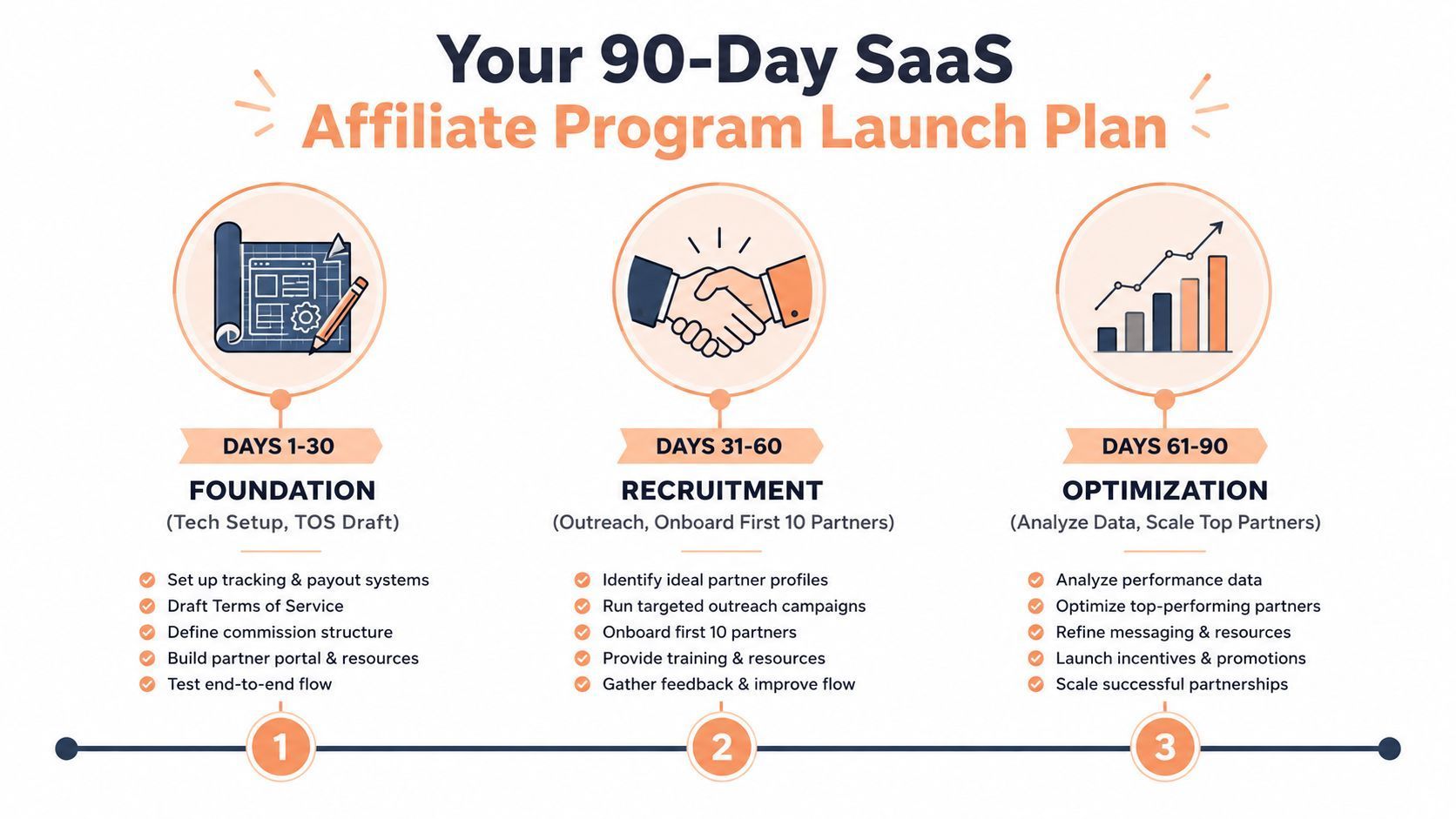
The cleanest launch plan is boring on purpose. It forces the work into three phases, and each phase has a different goal, because trying to recruit, track, pay, and optimize all at once is how programs get messy.
Days 1 to 30
Build the financial model, define the commission structure, and wire up attribution to billing. Draft the partner terms, decide how refunds and clawbacks will work, and test the edge cases before anyone joins.
You're ready for the next phase when commission and refund terms are approved and a test referral reaches a paid invoice that reconciles with its commission record. If the numbers don't survive this stage, don't recruit yet.
Days 31 to 60
Recruit the first group of partners, but keep the cohort tight enough to manage personally. Send enablement assets, co-marketing ideas, and clear next steps, then watch who publishes.
That early activity tells you far more than the sign-up count. The phase is done when pilot partners have published something you can point to and some trial or paid activity is attributed to them.
Days 61 to 90
Reconcile at least one full payout cycle, then review conversion, refunds, and monthly renewals that have occurred. Keep annual-billing cohorts under review until their first renewal.
Adjust the commission model if the data says you're overpaying for weak traffic, and double down on partners whose observed cohorts show positive contribution. Scale when the observed economics hold, and keep reviewing each cohort as it matures.
The right end state isn't just more affiliates, it's a channel you can defend on margin.
If you want the affiliate layer, billing, subscriptions, and cross-border payouts to live in one place, Creem gives software teams that stack without forcing them to stitch together separate systems.
It's a practical fit when you care about commissions, tax handling, and payout operations in the same workflow.
On Creem, each partner is paid automatically when their referral pays, so you check the first full payout cycle in days 61 to 90 instead of running it by hand. Try Creem before day 1, so the program launches on the checkout that will pay it.