

You open FastSpring's site to find out what it charges and land on a contact-sales form. FastSpring publishes no rate, so the only number in circulation is a third-party benchmark of about 5.9% + 95¢.
A benchmark is not a bill, and the quote that replaces it can carry terms the rate never shows, such as a monthly minimum or a currency-conversion fee. Sign the wrong one and a slow month still brings a fixed invoice, while every international sale costs more than the headline says.
By the end you can turn the quote into a dollar estimate at your own order size and charge count, and know which terms to pin down before you sign.
If you would rather plan from a public number, Creem publishes 3.9% + 40¢ on each successful sale, and you can try Creem without a sales call.
How FastSpring pricing works
FastSpring publishes no price list, and no standard percentage or fixed charge per transaction. Instead of a fixed monthly subscription, it sets its cut of each sale through a custom quote. That cut comes out of the customer’s payment before the rest reaches your payout.
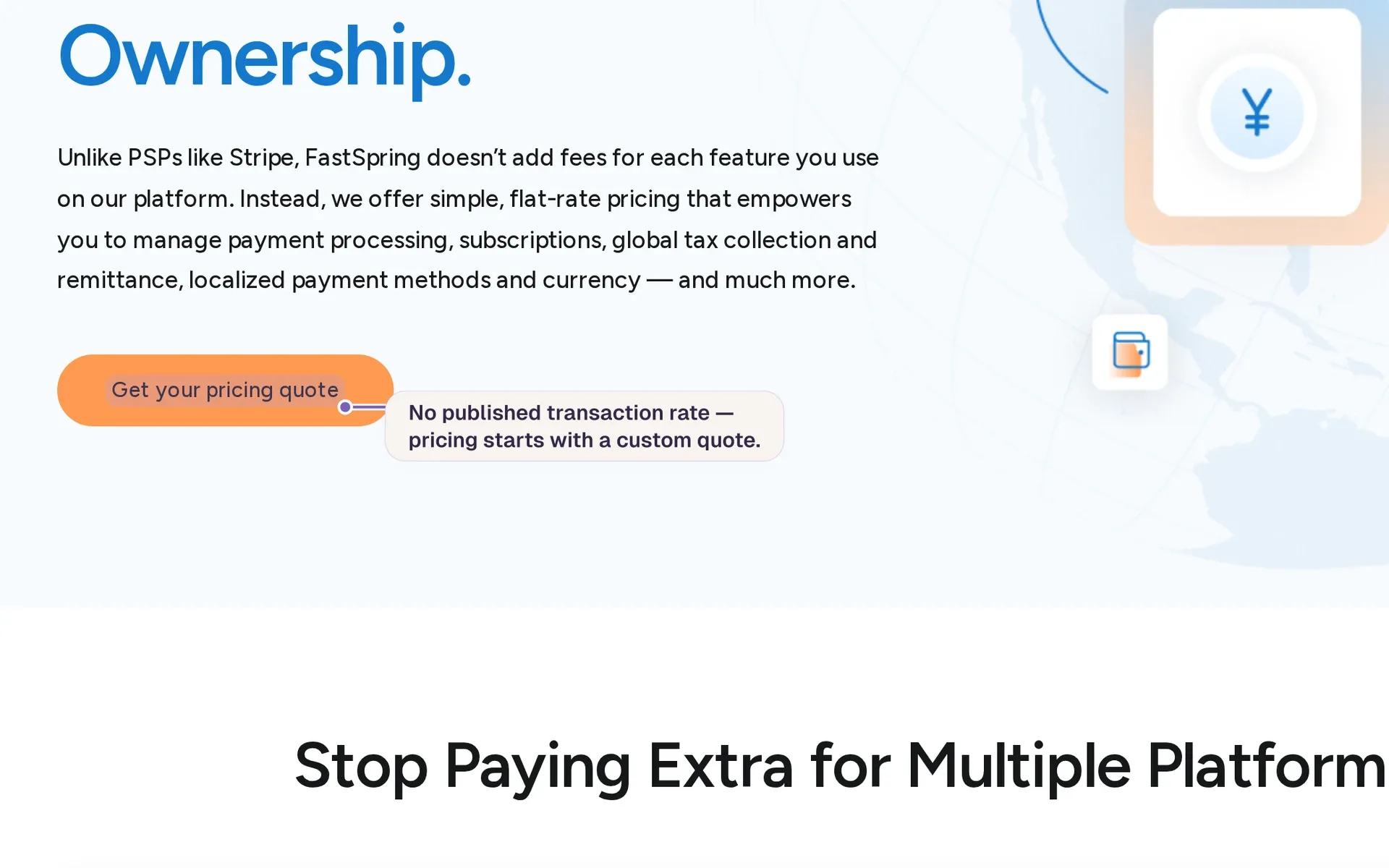
Reported standard rate (about 5.9% + 95¢)
Treat the third-party benchmark as a first-pass estimate, not FastSpring’s published price. Use it to decide whether asking for a quote is worth your time.
On an illustrative $20 sale, ($20 × 5.9%) + $0.95 gives a $2.13 fee, or about 10.7%, excluding tax and additional charges. Creem’s published 3.9% + 40¢ per successful transaction comes to $1.18 on the same sale, or 5.9%.
At that order size, FastSpring’s quote would need to bring the $2.13 fee down to $1.18 to match Creem’s published rate, close to halving it.
Run the same calculation on your average order value to decide whether the sales process is worth your time. Use the written quote to budget and sign.
Negotiated and enterprise pricing (custom quote)
FastSpring bases pricing on transaction type and business volume, and its quote form asks for monthly volume, transactions per month and your revenue split across four regions. Revenue alone does not show how many small charges you process or where your buyers are, so supply both.
ACH and wire-transfer transactions get discounted rates, but FastSpring publishes no numerical discount schedule, enterprise rate or qualifying volume threshold.
A negotiated quote is worth choosing when its total cost at your volume and order size comes in below Creem’s published rate. Include currency conversion, refund terms and any minimum in the calculation, and check for commitments you might miss in a slow month.
What the merchant of record fee covers
FastSpring's fee pays for it to be the legal seller to your buyer, not just to process the charge. That puts the applicable transaction taxes on each sale within its coverage with FastSpring rather than your business.
| Responsibility | FastSpring (merchant of record) | Your processor |
|---|---|---|
| Legal seller to the buyer | FastSpring | Your business |
| VAT, GST and sales tax compliance | FastSpring, within its coverage | Your business |
Invoicing, fraud screening and dispute handling also sit inside FastSpring's service, on top of processing the payment.
If an overseas subscription sale creates a VAT obligation within FastSpring's coverage, FastSpring collects and remits that VAT. A processor can accept the same payment, but the obligation stays with your business.
Compare the quote with processing plus VAT and sales-tax registration, filing, tax liability and the cost of a tax tool. The fee can look high next to a processor rate because it also pays for that work and responsibility.
Handling a dispute does not mean paying for it. When a buyer disputes a FastSpring payment, the disputed funds come out of your payout immediately and stay held during the investigation.
FastSpring handles the dispute, but the buyer's bank decides the outcome.
I would budget for disputes on a separate line from the per-sale fee estimate. That line covers the amount held from your payout, which you lose if the bank rules for the buyer.
Get the quote's dispute terms in writing, including which amounts and fees you remain responsible for, so "handled" does not become "covered" in your forecast.
What FastSpring costs at your order size
The fixed charge takes a bigger share of small orders. Collect the same monthly revenue through more payments and you pay it more times.
Effective rate from $10 to $1,000 orders
These estimates use the non-contractual 5.9% + 95¢ benchmark, with pre-tax product revenue as the assumed fee base and refunds and other deductions excluded. The effective rate is the fee as a share of the order.
| Order amount | Modeled fee | Effective rate |
|---|---|---|
| $10 | $1.54 | 15.4% |
| $25 | $2.43 | 9.7% |
| $50 | $3.90 | 7.8% |
| $100 | $6.85 | 6.85% |
| $500 | $30.45 | 6.1% |
| $1,000 | $59.95 | 6.0% |
Start with the row nearest your average order value. Under these assumptions, a $1,500 license costs $89.45, or about 6.0%, because larger orders spread the fixed charge over more revenue. For smaller orders, reducing that fixed charge matters more.
Same $10,000 month, different transaction counts
Excluding tax, refunds, currency conversion, disputes and other deductions, 5.9% of $10,000 is $590 however you collect it. The difference comes from the 95¢ added to each completed charge.
- 1,000 charges of $10 cost about $1,540.
- 100 charges of $100 cost about $685.
- 20 charges of $500 cost about $609.
- 10 charges of $1,000 cost about $599.50.
That puts the smallest charges roughly $940 higher, or 9.4 percentage points of revenue. Count completed charges when you estimate the bill.
I would treat annual discounts as a cash-flow and retention decision. On an illustrative $29 monthly plan, eleven fewer charges save $4.40 at Creem’s 40¢ fixed fee, or $10.45 at the FastSpring benchmark, while two months free give up $58.
Keep monthly billing when churn is unknown, buyers need to try the product, or usage changes monthly.
FastSpring pricing terms to confirm before you sign a quote
The percentage and fixed fee do not tell you the full bill. You also need the fee basis, extra charges and commitments in writing.
With an illustrative $100 monthly minimum, a month with $40 in calculated transaction fees still leaves you with a $100 bill. You owe the extra $60 because sales were slow, so below the committed volume, the transaction rate no longer tells you what you pay.
Ask for a quote with no monthly minimum or volume commitment. If either remains, treat it as a reason to walk away.
Get these terms in writing:
- Transaction rate. Record the percentage and fixed charge, including which transaction types each rate applies to.
- Fee basis. Confirm whether fees apply before or after tax. Tax-inclusive fees raise the order-size table’s effective rates, especially on high-VAT sales.
- Currency conversion. Request charges and exchange-rate markups for your settlement currency. FastSpring’s docs state a 2.5% conversion fee when your store and payout currencies differ, and an exchange-rate markup of 3.5% on major currencies and 5.5% on others for converted checkout prices.
- Refunds. Establish whether transaction fees are returned after a refund, then include any retained fees in your forecast.
- Disputes. Request the chargeback fee and ask whether it is charged even when you win the dispute.
- Payout terms. Request transfer charges, the payout schedule and minimum payout balance to model receiving costs and cash availability.
- Commitments and thresholds. Record any minimum, volume commitment, contract length and thresholds that trigger each negotiated rate.
- Billing and affiliates. Ask whether subscriptions, usage billing and affiliate tools are available and what additional charges apply.
Put those written terms into your calculation and test both your expected month and a slow one before you sign.
FastSpring vs Paddle, Creem and Stripe: fees compared
Stripe has the lowest processing fee here, but VAT and sales-tax registration and filing, plus subscription tooling, stay with your business. The other three act as the legal seller.
The table covers transaction fees only, not payouts, for 100 orders at $50 each, or $5,000 a month before tax.
| Option | Legal seller | Rate | Fees on 100 × $50 | Outside the rate |
|---|---|---|---|---|
| FastSpring | FastSpring | Custom quote, benchmark about 5.9% + 95¢ | About $390 | Fee basis, extra charges and payout terms set in the quote |
| Paddle | Paddle | 5% + 50¢ | $300.00 | Chargeback fee, SWIFT payout fee and conversion margin |
| Creem | Creem | 3.9% + 40¢ | $235.00 | Add-ons, chargeback and payout fees |
| Stripe | Your business | 2.9% + 30¢ processing | About $175 at the baseline rate, before international-card or currency-conversion surcharges | Tax compliance and subscription tools |
Stripe's figure uses only its baseline rate, so the four rows do not assume the same share of international cards.
Creem adds 2% each for affiliates and revenue splits before commission, and 5% for recovered carts, only on sales that use them. Chargebacks (25 USD/EUR each) and bank payouts (7 USD/EUR or 1%, whichever is higher, plus partner FX when your bank currency differs) are account costs.
At $50 per order, the FastSpring benchmark is $155 a month above Creem's published rate and $90 above Paddle's estimate. Your quote needs to close that gap before its other terms matter, so run your own order value and charge count through the same four rows.
Which FastSpring pricing model fits your business?
How often you charge and how much you collect determine which part of the quote to negotiate. Usage-priced products also need billing that turns measured consumption into payments.
Low-ticket monthly SaaS
On a $10 monthly renewal, 95¢ of the $1.54 modeled fee is fixed, roughly 62% of what you pay. Ask for a lower fixed fee, because it makes up most of the cost at this ticket size.
When buyers already want several items, bundling those purchases into fewer payments reduces the fixed-fee total without changing revenue.
Annual or high-ticket software
On a $1,000 order, only 95¢ of the $59.95 modeled fee is fixed. The percentage accounts for most of the cost, so that is the rate to negotiate.
An annual contract paid monthly still generates monthly charges. Calculate fees from the payment schedule and account for any annual discount separately.
Late-term annual upgrades lose proration eligibility once the last successful charge is no longer refundable, which happens after six months for credit-card charges, three months for PayPal and 60 days for UPI. Ask how those upgrades are charged before choosing annual collection.
Usage-based AI products
Collecting ten usage events in one payment instead of ten avoids nine fixed charges. At the benchmark, that saves $8.55 without changing the percentage component.
Prepaid credit packs or periodic metered invoices group consumption into fewer payments. Ask whether FastSpring supports either for your product and whether either costs extra. Calculate the fixed-fee total from the number of payments, not tokens or generations.
Prefer a published rate to a quote? Compare Creem's 3.9% + 40¢
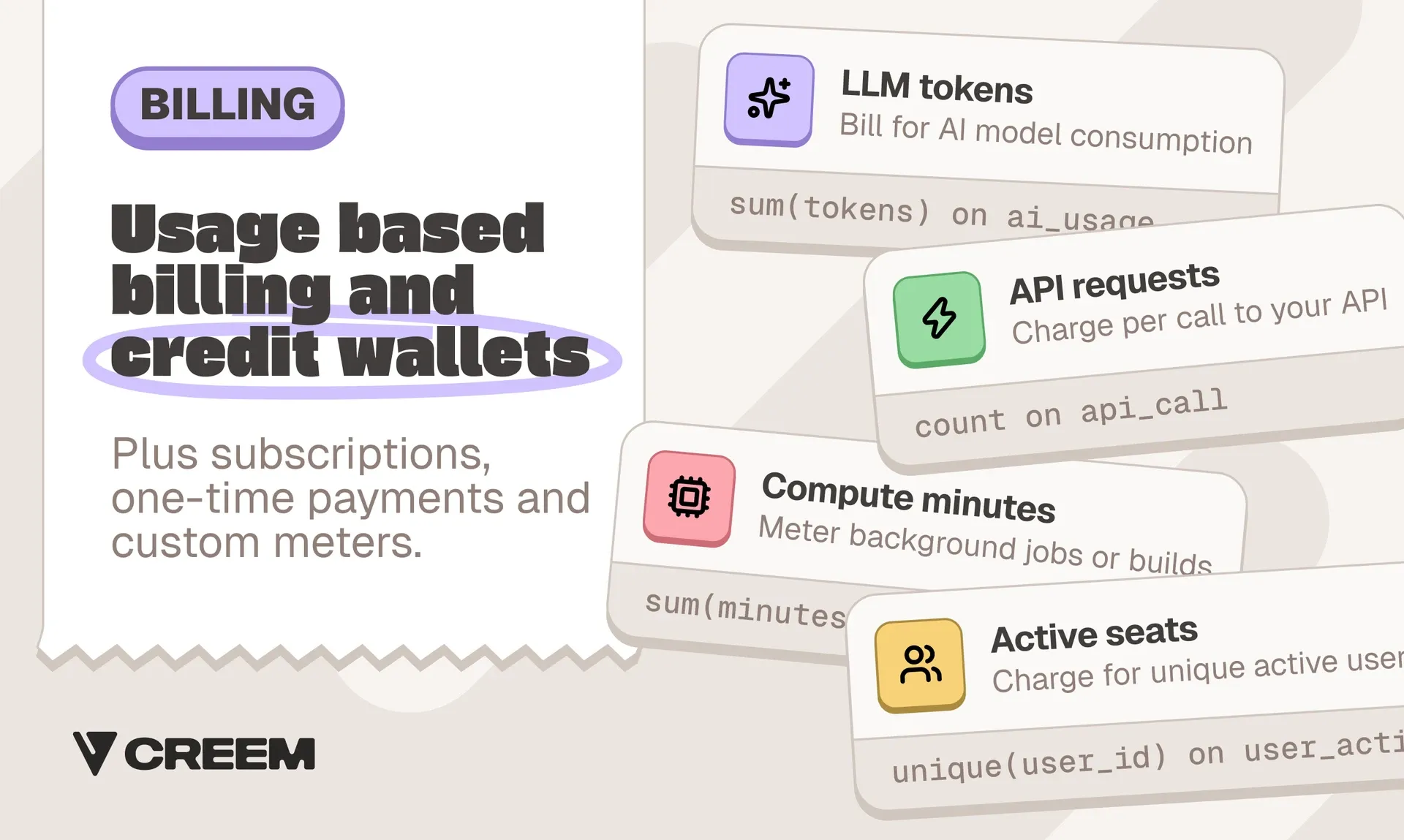
Creem suits SaaS and AI startups that want a published merchant-of-record rate and billing for subscriptions, usage or prepaid credits.
A FastSpring quote suits teams that negotiate at volume and get a written total below that rate for their order size and charge count. If you sell low-ticket renewals or charge frequently for usage, or want the number before a sales call, compare first.
If you already sell elsewhere, new buyers can use Creem checkout from day one, while existing subscribers move over at their own renewal. For DaisyUI, the manual store migration to Creem took a few hours.
Twelve months of fee savings at your current volume should exceed the cost of moving. If the savings fall short, send new sales to Creem and let existing subscriptions keep renewing where they are.
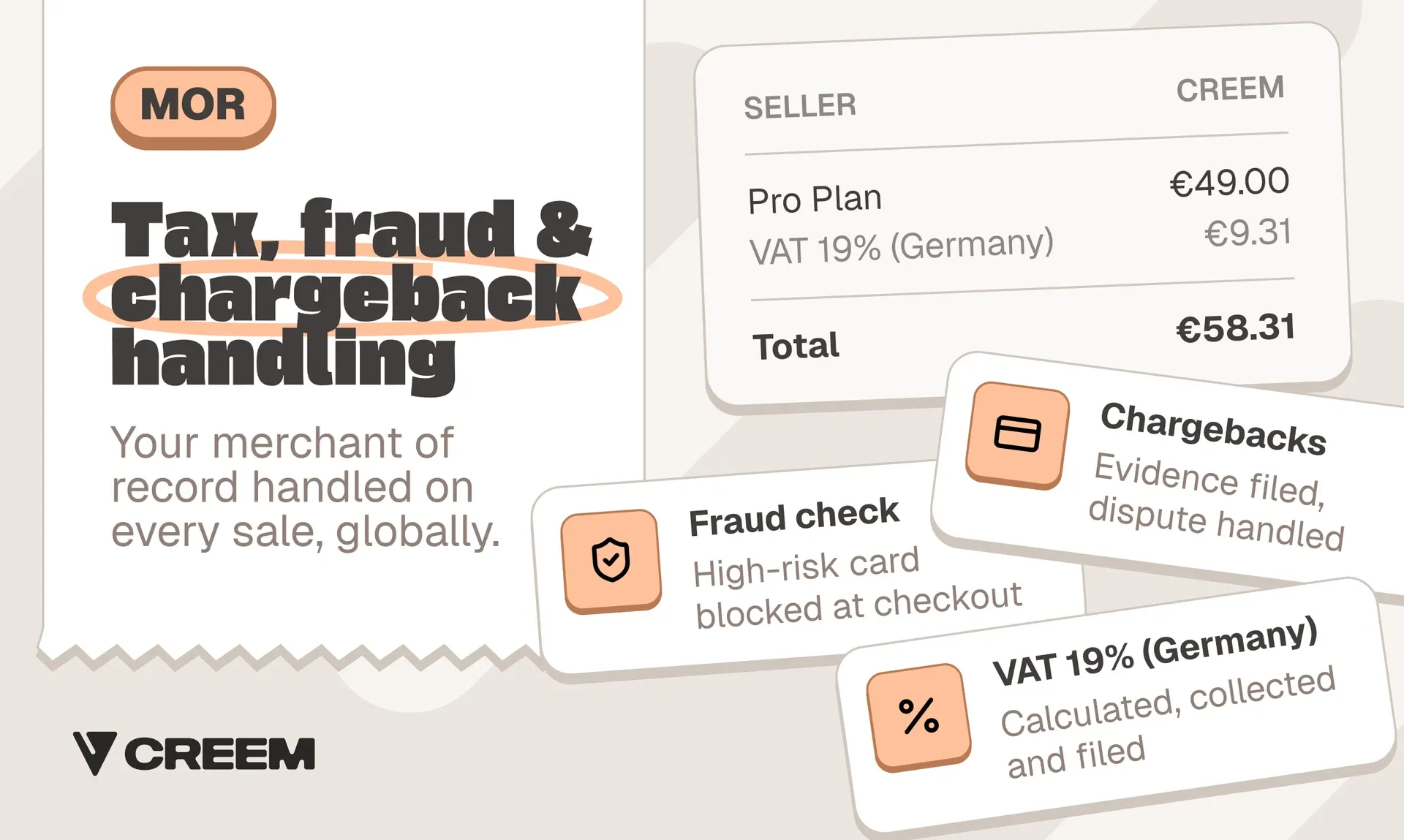
Creem is the legal seller, with a published rate of 3.9% + 40¢ per successful transaction and no monthly fee, setup fee or minimum. That rate covers tax, invoices and dispute handling, with no surcharge for international cards, subscriptions or premium cards.
Creem collects and remits VAT, GST and sales tax for buyers in 190+ countries, so registrations, returns and the liability stay with Creem. Subscriptions, usage meters and prepaid credits with auto-refill run on the same account.
With a public rate that includes tax handling, you can model your bill at your own order size before talking to anyone. Try Creem to start with published merchant-of-record pricing for your software business.