
You have a digital product to sell and need to decide whether Gumroad will still fit as it grows. A straightforward download and software with recurring access put different demands on a store.
Fees apply to each sale and renewal. You also need to know which obligations for tax, invoices and disputes the platform handles and which remain yours.
Software adds requirements a one-off download never had. Your app may need per-seat licenses or access gated by API keys and webhooks. You may charge for usage or sell credit packs, and co-founders and affiliates may expect their share of each sale paid automatically.
Compare Gumroad’s fees, tax responsibilities and software billing to decide whether it will suit your product as it grows.
If the per-sale fee is what you came to check, Creem takes 3.9% + 40¢ as the legal seller against 10% + 50¢ on a Gumroad direct sale, and you can try Creem at that rate.
What is Gumroad and how does it work?
Gumroad lets you sell digital products through hosted purchase pages. You upload your product, set a price and share the page without building a separate website.
For a downloadable UI kit, the buyer pays through Gumroad checkout and gets the download, so you do not have to build a separate checkout and delivery flow.
Can you sell physical products on Gumroad?
Qualifying accounts can sell physical goods, but a new account does not get access automatically. Automatic eligibility requires a confirmed email, an account that is at least 90 days old and not suspended, one completed payout and $1,000 in lifetime sales.
Accounts with a live physical product or prior manual approval keep access, provided the email is confirmed and the account is not suspended.
You handle shipping, with options to mark orders as shipped and add tracking information in Gumroad’s sales dashboard.
Is Gumroad legit and safe to use?
Gumroad acts as a non-exclusive reseller of eligible digital products, but that role is not an endorsement of individual products or sellers.
Its terms make no representation about interactions between users and provide the service as is, without warranty. Read those terms to decide whether the contractual protection works for your business.
Who handles tax, invoices and chargebacks?
As merchant of record, Gumroad collects and remits customer sales tax where it has an obligation to do so. If your own indirect-tax filing obligations continue, you still have returns to file.
For example, if someone buys your downloadable template in a jurisdiction where Gumroad has a tax obligation, Gumroad collects and remits the customer tax. If your filing obligation continues, Gumroad’s tax FAQ describes how to report the sale as a resale using a reseller certificate.
Tax collection is only part of the check. Before choosing a merchant of record, establish who reports the tax, whose name goes on the buyer’s invoice, and who handles a chargeback. For Gumroad, that means checking its invoice and dispute terms alongside the tax treatment.
Gumroad pricing and fees: what you actually pay
Gumroad charges 10% + $0.50 on sales through your profile or direct links, and 30% when a new customer finds your product through Discover. There is no monthly platform fee.
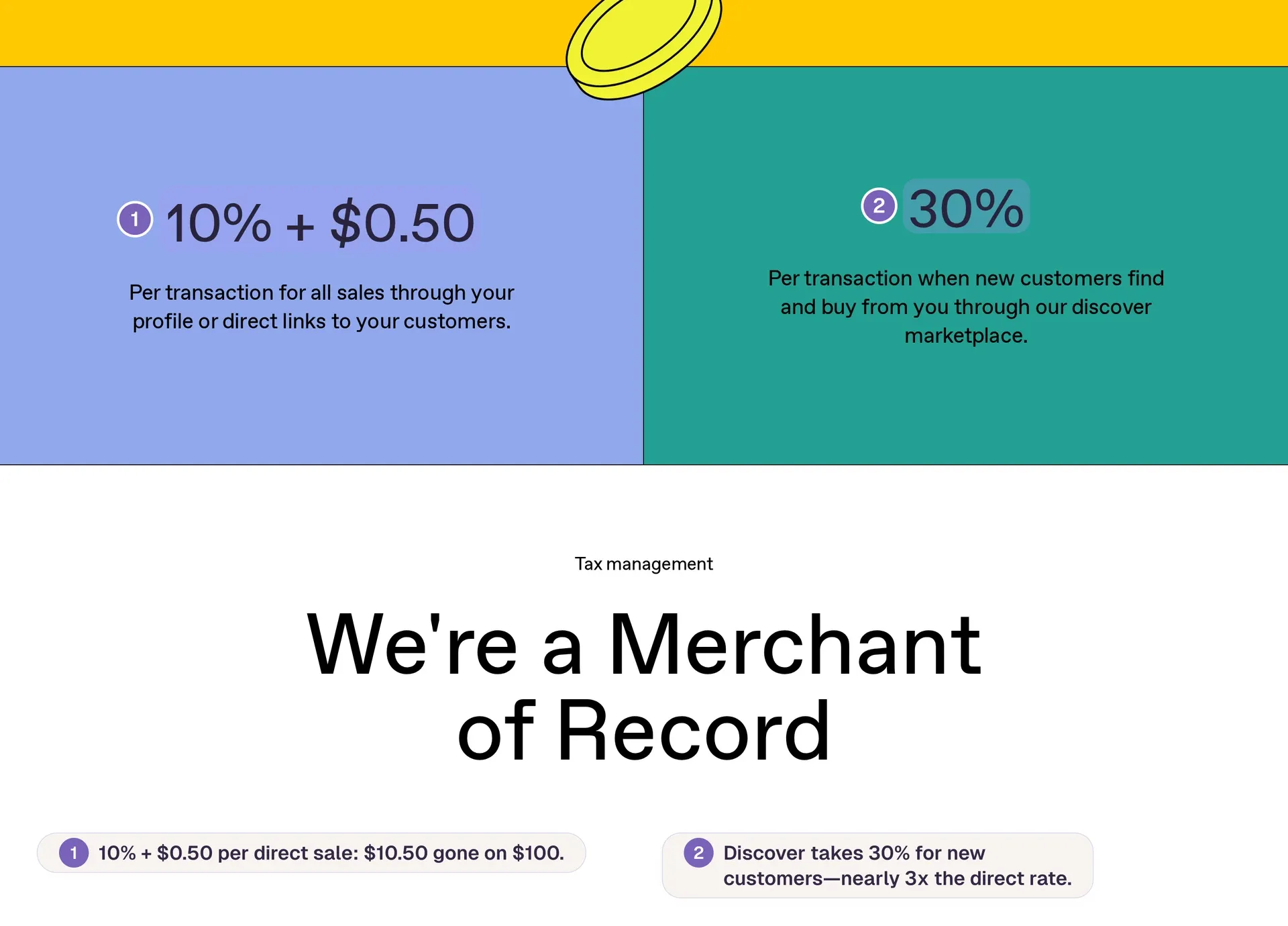
On a $100 direct sale, the transaction charge is $10.50, leaving $89.50 before customer taxes, payout costs, refunds and disputes.
On a $100 Discover sale, the 30% charge comes to $30, leaving $70 on the same basis.
That is a $19.50 difference in the transaction charge, depending on where the sale comes from. To estimate your costs, separate buyers coming through your own links from new customers finding you through Discover.
Gumroad's strengths and trade-offs in daily use
Gumroad gives you a hosted store, but limits how much you can change the look of its sales pages. You get the convenience of a ready-made page, with less freedom to present the product your way.
If your template has a distinctive visual identity, check whether the page design gives you enough control to show it before you commit.
Where Gumroad gets harder for software sellers
For software, the sale can be the start of an ongoing access and billing relationship. Before choosing on storefront appearance alone, check how licenses, usage and partner payments will work.
Storefront and checkout control
Gumroad offers a purchase overlay for your existing website, so buyers can start a purchase from your site. Checkout URL parameters can also prefill fields.
Checkout styling is one consideration, and the domain where buyers complete payment is another. Check both against the experience you want buyers to have.
Licenses, subscriptions and usage billing
Gumroad’s license-verification endpoint returns activation-use information, and its memberships support tiers and prorated upgrades.
A customer who cancels a membership and later restarts it gives you two states to handle. Gumroad’s membership-end timestamps record when the membership ends, not when cancellation was requested, and restarting can clear those fields.
Your application has to interpret those states to decide whether to grant access. It can use the membership-end timestamp to end access after cancellation, then account for cleared fields when the customer restarts.
A valid license response alone does not settle the access decision.
Per-seat licensing and API-key or webhook-driven entitlements can be reasons to reconsider Gumroad when the access logic your application needs goes beyond basic license verification.
For prepaid credits, decide what happens when a buyer uses their allowance: whether access stops, the buyer tops up or usage continues as an overage. Compare how each platform measures usage, handles top-ups and settles those charges.
Gumroad also supports collaborator revenue splits and affiliate links. If co-founders or affiliates need automatic shares, check whether those tools calculate and pay each share the way your arrangement requires.
If you still have to manage those payments separately, compare a platform that handles them in the same money path.
Gumroad alternatives worth comparing
Start with who becomes the legal seller. A merchant of record takes that role, while standard payment processing leaves it with your business.
| Platform | Transaction charge | Legal seller |
|---|---|---|
| Gumroad | 10% + $0.50 for direct and profile sales. 30% for new customers through Discover. | Gumroad, for eligible digital products |
| Paddle | 5% + 50¢ | Paddle |
| Creem | 3.9% + 40¢ per successful transaction | Creem |
| Lemon Squeezy, existing accounts only, shutting down March 31, 2027 | 5% + 50¢, plus applicable surcharges | Lemon Squeezy |
| Stripe standard processing | 2.9% + $0.30 base rate for US domestic cards | Your business |
On a $100 sale, Paddle’s standard charge comes to $5.50, and Lemon Squeezy’s base charge comes to $5.50 before applicable surcharges.
Stripe’s US domestic card base charge is $3.20 on a $100 sale, $1.10 less than Creem’s transaction charge. I would compare standard Stripe processing if you sell only in the US and already have someone handling sales tax, because your business remains responsible for tax compliance.
How to choose a Gumroad setup for your product
I would keep Gumroad on the shortlist if its billing and delivery fit how your product works and the fees make sense at your sales volume.
- A download or simple membership: If you already have an audience and need a straightforward way to sell, Gumroad is a practical option.
- Software with seats, usage or credits: Compare a software-focused merchant of record if access rules or billing require extra tools or manual updates.
- Revenue shared with partners: Compare Gumroad with a software-focused merchant of record that offers automatic revenue splits and affiliate tools.
- International software sales: Compare merchants of record on tax coverage and the billing or access your product needs. Gumroad already handles customer tax, so those other needs may be the reason to move.
Follow a customer from purchase through renewal, cancellation and any partner payment. Then compare a month of expected sales across each setup, including transaction charges, integration work and the manual updates your team still has to handle.
Sell software worldwide at 3.9% + 40¢ per sale with Creem
Gumroad can suit a straightforward download or simple membership. If your software needs renewals, usage billing or more complex access rules, compare it with a merchant of record built for software.
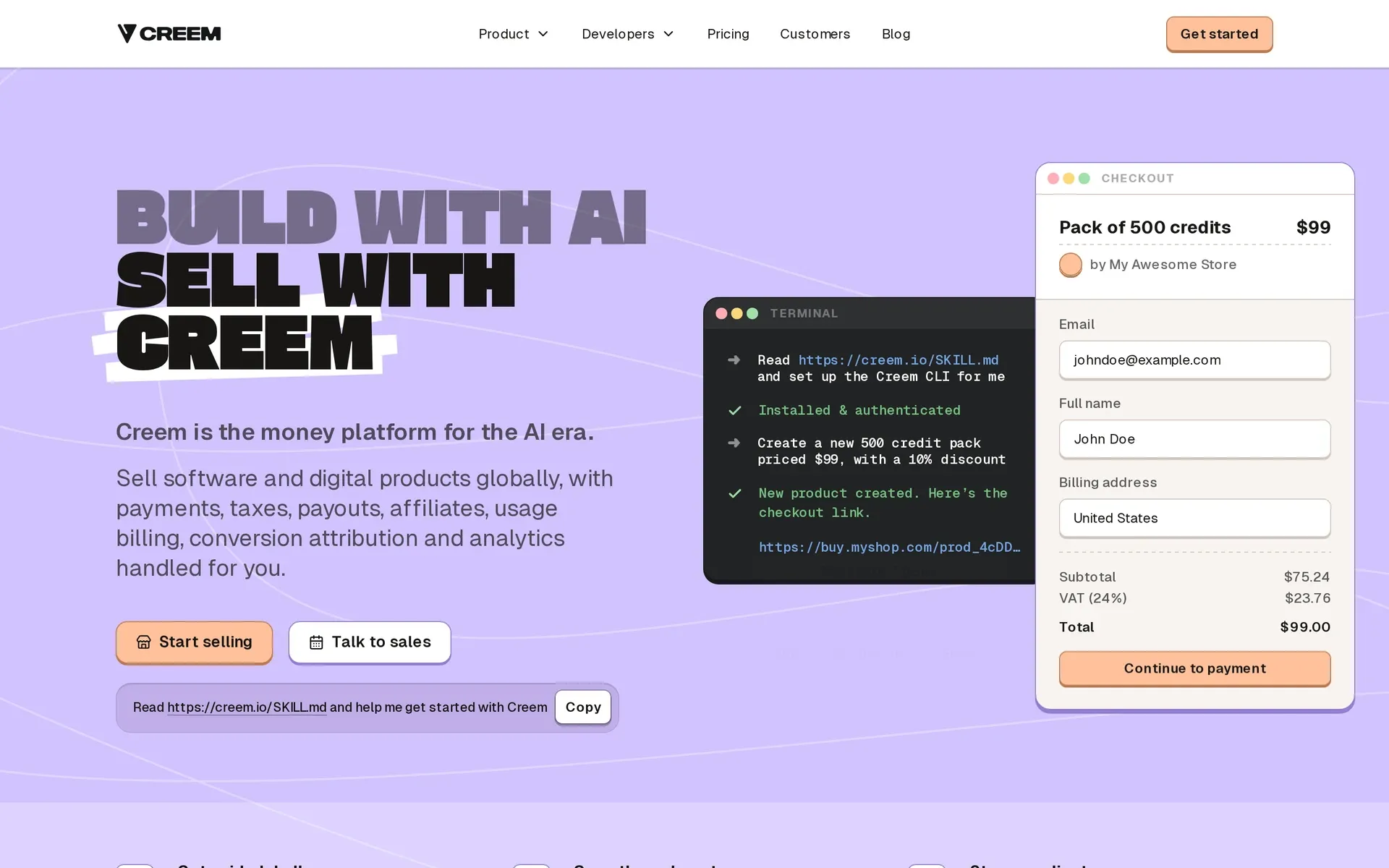
Creem is the legal seller on every sale. We calculate, collect and remit VAT, GST and sales tax, issue the invoice and handle disputes.
That work is included in the standard rate of 3.9% + 40¢ per successful transaction, with no monthly or setup fee.
Creem handles buyer payments and tax, along with seller onboarding and payouts.
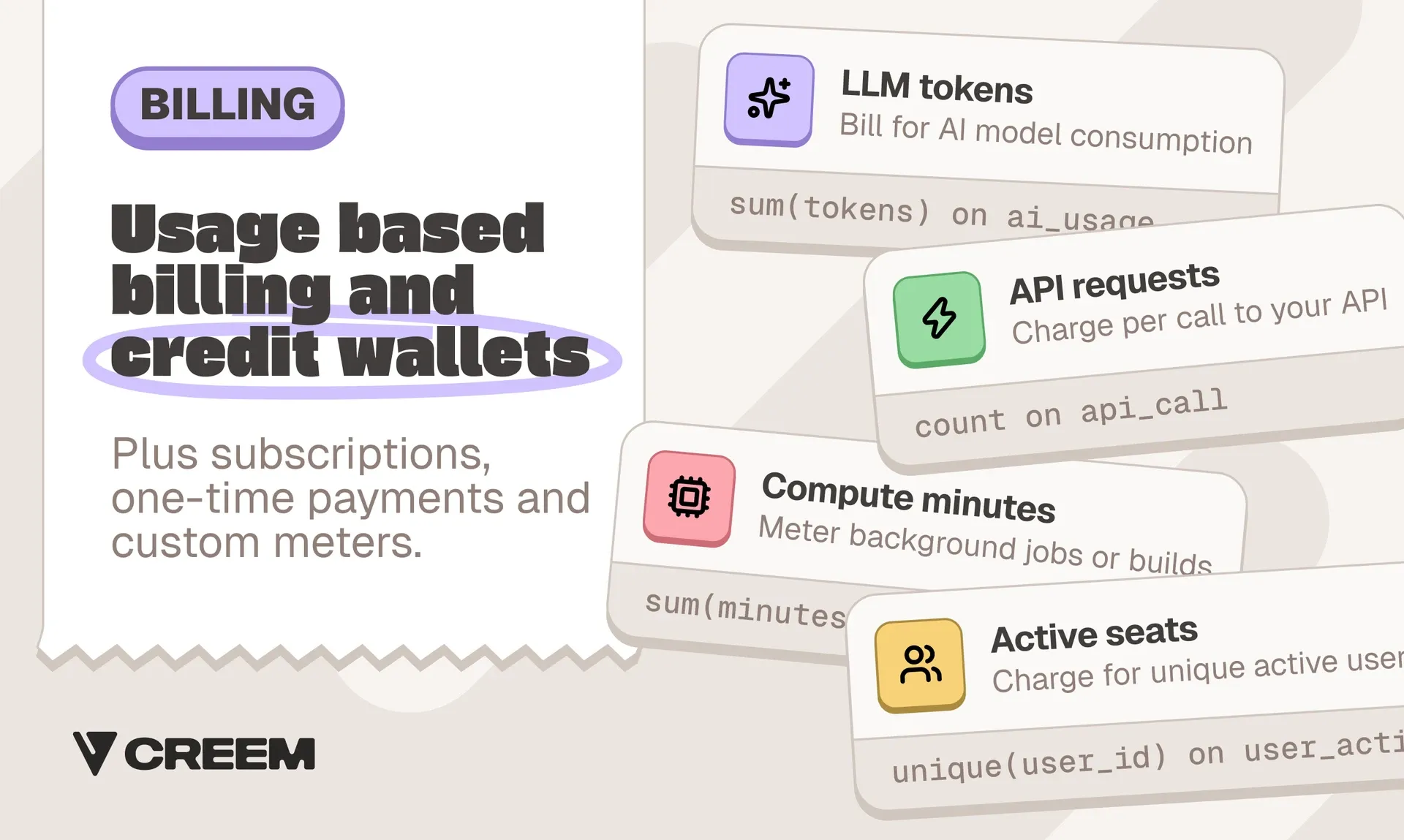
License keys, subscriptions, usage meters and prepaid credits with auto-refill run in the same account as checkout. Your app can use license keys and subscription webhooks to manage access.
To sell software worldwide while Creem handles tax and billing, try Creem.