
You can flip on global checkout in an afternoon and still wake up to a mess the next morning. The dashboard looks healthy at first, new currencies are coming in, a few international cards are clearing, then the real work shows up in the wrong places, failed renewals in one region, a tax email from a country you hadn't planned for, and a payout that arrives later than your finance model assumed.
That gap between accepting a card and keeping the revenue compliant, settled, and usable is what trips up a lot of SaaS teams. International payment processing isn't just a front-end setting, it's a chain of decisions that touches pricing, FX, tax, refunds, reconciliation, and the way your company books cash.
Table of Contents
- The Moment Going Global Stops Being a Toggle
- What International Payment Processing Actually Means
- Supported Payment Methods Around the World
- FX, Fees, and the Real Cost of Going Cross-Border
- Settlement, Currencies, and Payout Options
- Compliance, KYC, and Tax Obligations
- How Merchant-of-Record Models Change the Equation
- Best Practices for Going Global as a SaaS
The Moment Going Global Stops Being a Toggle
The cleanest way to understand global SaaS payments is to watch the first month after launch. A founder enables international checkout, then starts seeing revenue in multiple currencies, renewal failures in markets that looked promising on the spreadsheet, and a support thread about a refund that doesn't match the original charge. The dashboard says “global,” but the operational reality says something else.
That's usually when finance, product, and support stop talking about payments as a feature and start treating it like infrastructure. Payment processing, FX, compliance, and settlement are inseparable problems, because each one changes the others. If you change the payment method mix, you change authorization behavior. If you change the settlement currency, you change treasury handling. If you sell into a new country, tax and reporting start to follow.
A lot of teams miss that because the first layer feels simple. Someone enables cards in a new market, maybe adds local methods later, and assumes the hard part is done. Then a tax filing question appears, or a refund takes a different path than the original payment, and the “global expansion” project turns into a queue of small, expensive exceptions.
If you want a concrete example of how these operational layers show up outside payments, a useful parallel is the way accounting workflows have to be wired country by country. The UAE ERP accounting modules guide is a good reminder that revenue systems, finance systems, and local compliance don't stay separate for long once you start selling across borders.
Practical rule: if a new market creates a new exception for finance, support, or tax, it isn't a “checkout tweak,” it's a new operating surface.
What International Payment Processing Actually Means
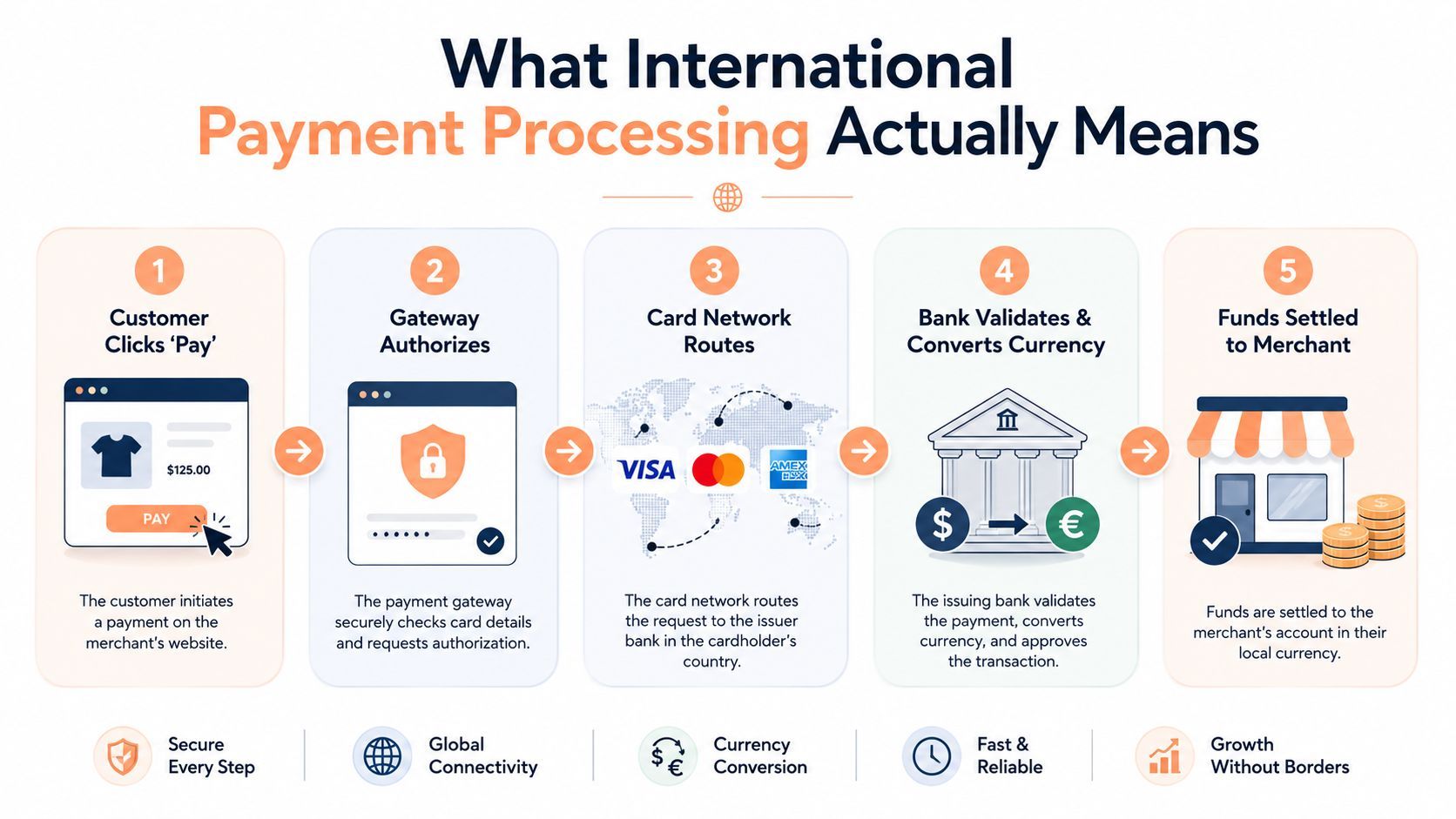
International payment processing is easier to think about as a chain of handoffs than as one transaction. A customer clicks pay, but that click has to move through a gateway, a network, an acquirer, foreign exchange, compliance checks, and finally a payout path into the merchant's account. Each step can succeed on its own while the overall experience still feels broken.
The actors in the flow
The customer is only the start. Their local payment method, whether that's a card, wallet, or domestic rail, has to be recognized by the checkout layer. Then the processor decides how to route the payment, which network or partner to use, and whether any checks need to happen before the charge is authorized.
After that comes the money-movement side. Currency conversion may happen before settlement, at settlement, or at payout, depending on the provider structure. That's where the operational difference between “accepted” and “usable” becomes obvious. A charge can be approved in seconds and still take longer to become revenue you can spend.
Why modular systems won
Modern international payment processing is increasingly built on API-first, modular architectures because cross-border systems need to integrate multiple processors, local payment methods, FX providers, KYC and AML tools, and settlement partners without rebuilding the core product. The advantage isn't just flexibility. It's also safer retries, cleaner state transitions, and fewer duplicate charges when a request gets repeated.
Think of it less like a wire transfer and more like a package going through customs. The package can be on the way, but every checkpoint still has authority to slow it down.
That's why orchestration matters. A serious global stack usually separates authorization, routing, compliance, and settlement so each layer can move at its own speed without breaking the others. That split is awkward to build, but it's what keeps checkout fast while the money layer stays correct.
Supported Payment Methods Around the World
Cards are still the baseline in a lot of SaaS flows, but they're not the baseline everywhere. That matters because international payment processing fails most often at the point where a buyer hits checkout and doesn't see the method they trust. A buyer who can't pay doesn't become a “lead,” they become lost demand.
Match the method to the market
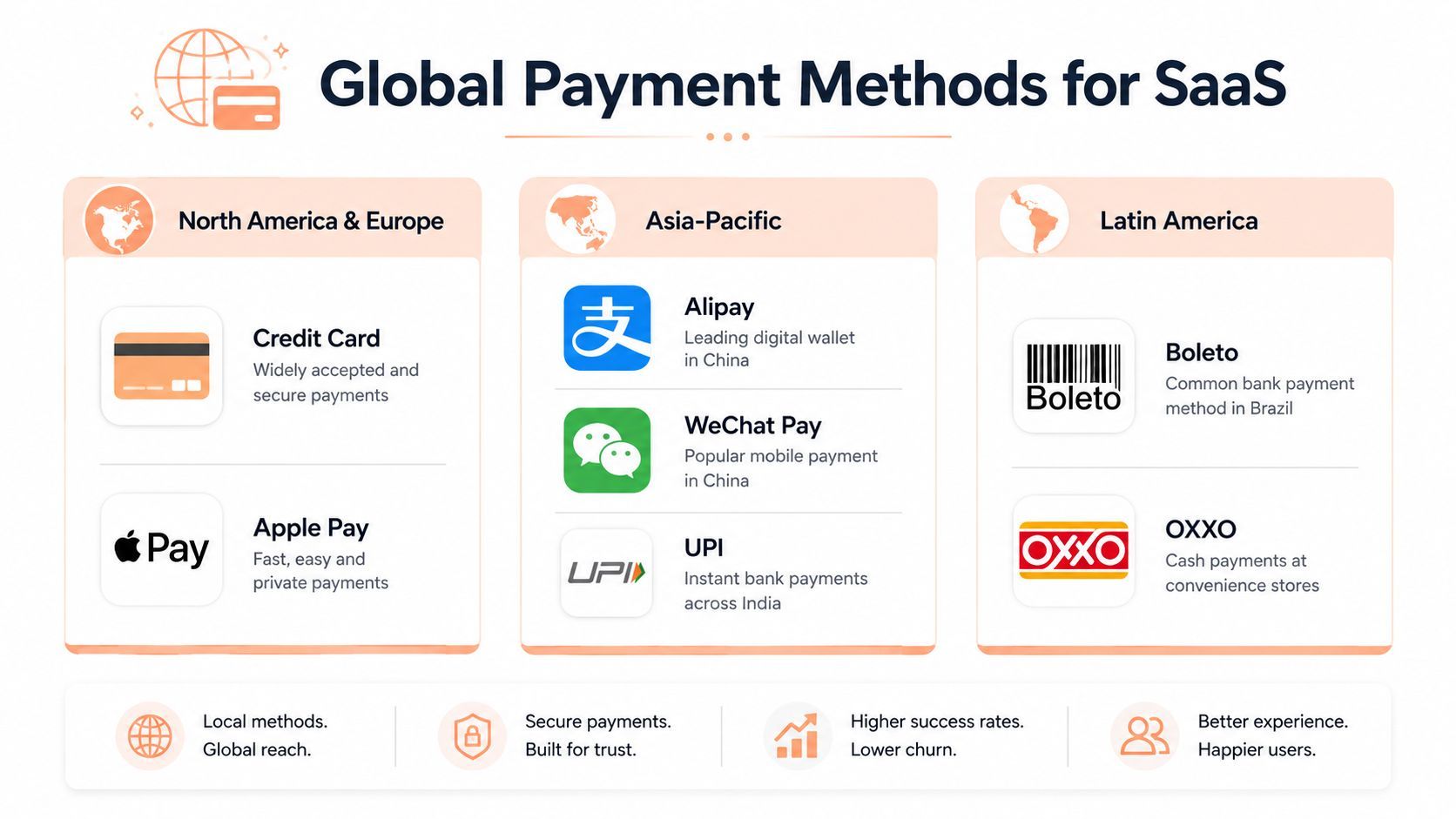
In North America and much of Europe, cards and digital wallets tend to be the first layer to support. In the eurozone, local rails like SEPA matter for some business models, while methods such as iDEAL are important in specific markets. Northern Europe often expects buy-now-pay-later options like Klarna to appear in the mix, especially when buyers are used to them elsewhere.
Brazil, India, and parts of Latin America change the picture again. PIX and UPI are not niche extras in their home markets, they're methods buyers already use. The practical implication for SaaS and digital products is simple, local preference beats generic global availability.
Prioritize based on actual buyer geography
A good rollout strategy doesn't start with a giant checklist of every payment method you've ever heard of. It starts with where revenue already comes from, where you want growth next, and which methods materially affect checkout conversion in those markets. If you only have a handful of meaningful countries, the right first move is to support the methods buyers there already trust.
That same logic applies to routing. Adding every method everywhere can create more operational noise than upside. Each new method carries testing, reconciliation, refund behavior, and support overhead. The wrong stack can look “global” while reducing your team's ability to manage it.
The cleanest mental model is this, local methods are not a nice-to-have, they're often the difference between a completed sale and an abandoned checkout. Global SaaS companies that understand this stop asking, “What methods can we offer?” and start asking, “What methods does this buyer expect?”
FX, Fees, and the Real Cost of Going Cross-Border
The sticker rate on a payment page almost never tells you what the transaction really costs. The visible fee is only one layer, and the hidden layers are usually what eat margin. On a cross-border sale, the money can leak through interchange and scheme fees, processor markup, FX spread, and downstream conversion costs that don't show up in the headline number.
Why the headline rate is misleading
A provider can advertise a simple percentage and still leave you with a worse unit economy once the currency conversion lands. If you collect in one currency and settle in another, the spread between those currencies becomes part of your cost structure. That's why two processors with similar pricing can produce very different net revenue in practice.
A better model is to track total cost of payment, not the listed rate. That means looking at the charge itself, the currency path, the payout path, and any account-level fees attached to the transfer. For SaaS, especially lower-ticket plans, those differences matter because the margin on a subscription is thinner than the margin on a one-time high-value sale.
Speed has improved, but timing still matters
Swift reported in October 2024 that 90% of all cross-border payments processed on the Swift network reach the beneficiary bank within one hour, ahead of the G20's target of 75% of cross-border payments to be completed end-to-end within an hour by 2027. That's an important milestone, because it shows speed is no longer the limiting idea it once was. The problem is now consistency at scale, not whether fast movement is possible at all. Swift's October 2024 speed report makes that shift very clear.
For a SaaS operator, the operational impact is straightforward. Faster movement supports better cash planning, reduces the lag between a sale and usable funds, and makes payouts to contractors or partners easier to schedule. It doesn't erase FX leakage, but it does reduce one of the biggest friction points in global commerce.
The unglamorous part is that finance still has to reconcile every layer. That's why transparent pricing matters more than clever packaging. If you need a point of comparison on fee structures, this honest payment fee breakdown is useful for thinking about how headline pricing differs from actual all-in cost.
Settlement, Currencies, and Payout Options
A successful charge is not the same thing as cash in the bank. Once the payment clears, the processor batches it, applies any currency conversion, and sends funds on its own schedule. That schedule might be daily, weekly, or tied to a specific calendar, and the lag between charge and payout is where treasury teams start paying attention.
The currency choice changes everything
If you settle in the customer's currency, you may get cleaner buyer messaging and fewer surprises at checkout, but your treasury team still has to decide what to do with the funds after they land. If you settle in your home currency, you simplify your books, but you also accept the provider's conversion path and timing. Either way, someone owns the FX decision.
Refunds and chargebacks are part of the same equation. If the original payment and the reversal don't follow the same path cleanly, support gets stuck explaining why a customer sees one amount and finance sees another. That's why settlement design is not just a back-office concern. It directly affects customer experience and internal workload.
Practical rule: choose one settlement currency early, then stop letting every market invent its own exception.
Payouts are part of product operations now
Payout choice matters for more than vendor payments. SaaS companies often need to pay contractors, creators, affiliates, or distribution partners in different geographies. In those cases, the options usually include bank transfers, local rails, and, for some workflows, stablecoin wallets such as USDC. The useful question is not which payout method is newest. It's which one keeps reconciliation predictable and cash usable.
If your team is already dealing with collections and receivables across regions, the mechanics can get messy quickly. A useful operational reference is receivable management for North American CFOs, because the same discipline around timing, visibility, and reconciliation applies once your revenue starts crossing borders.
The simplest takeaway is that payout speed and payout currency are strategic choices. They shape when revenue becomes spendable, how much treasury work the company absorbs, and how much manual cleanup finance inherits later.
Compliance, KYC, and Tax Obligations
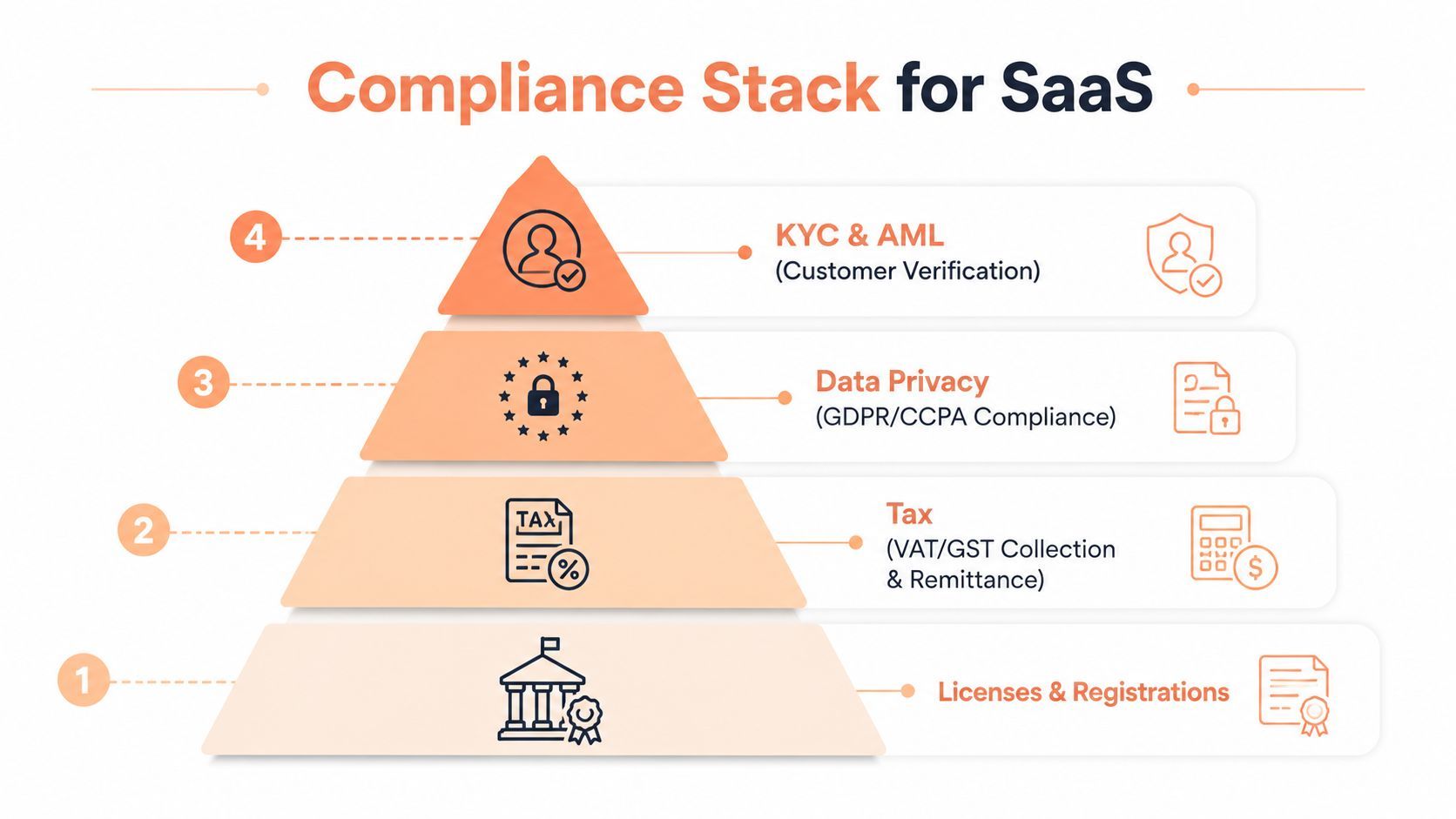
The first compliance surprise usually isn't a regulator, it's paperwork. A SaaS company selling across borders hits KYC, AML, sanctions screening, and tax collection requirements much earlier than most founders expect. If the product is digital, it can feel invisible from the customer side while creating a very visible trail for the finance team.
What the platform can handle
A payment platform can usually take on parts of verification, risk screening, and tax handling, but only within its own model. In a Merchant of Record setup, the provider may collect and remit taxes on your behalf, which removes a lot of administrative work from the seller. In a direct merchant setup, that burden stays with your company.
That distinction matters because tax isn't one rule. VAT, GST, and US sales tax all behave differently, and cross-border digital sales can trigger obligations in places where the team didn't even plan to register. Data privacy adds another layer, because payment records and customer identities have to move through systems that may have different residency expectations.
The seller still owns some work
Even when a platform helps, the seller is rarely off the hook for everything. Internal recordkeeping, pricing logic, regional reporting, and the decision about which markets to enter still sit with the business. Economic nexus thresholds and digital service taxes can also create filing obligations that don't disappear just because checkout works.
The operational pattern is familiar. You launch globally, then discover that compliance is not one task, it's a recurring calendar. The hidden cost is the team time needed to answer notices, reconcile filings, and keep product, finance, and support aligned when rules differ by market.
For teams looking at VAT specifically, this EU VAT and ViDA 2026 SaaS compliance guide is a practical reference for how indirect tax obligations can evolve for software sellers.
How Merchant-of-Record Models Change the Equation
The Merchant of Record model changes international payment processing by moving more of the compliance burden off the seller. Instead of acting as the direct merchant everywhere, the platform becomes the one that handles tax collection, filing, and remittance in supported markets. That shifts the work from your team's roadmap to the provider's operating model.
Where the trade-off shows up
The direct-merchant path usually gives you more control, but it also leaves you with more obligations. You own more of the tax process, more refund logic, more regional setup, and more reconciliation work. A Merchant of Record setup reduces that surface area, which is why a lot of small teams and digital product businesses prefer it once they start selling outside their home market.
The trade-off is cost and control. You're paying for a bundled operating layer instead of building every piece yourself. That can be a smart move when the alternative is hiring tax, legal, and finance work that doesn't move product velocity forward.
A concrete example of the model
Creem is one Merchant of Record option in this space. It centralizes global checkout, automated tax compliance, subscription billing, revenue splits, and affiliate tooling in one platform, with flat 3.9% + $0.40 per successful transaction pricing and tax handling across 100+ countries. It also supports automated payouts on the 1st and 15th, with revenue splits to bank accounts or USDC wallets. Those details matter because they move a lot of post-sale work into the payment layer itself.
For teams comparing models, the important question isn't whether MoR is “better” in the abstract. It's where you want your team's time to go. If you'd rather spend less time on filings, local payment edge cases, and payout logistics, a MoR stack can make that a deliberate choice instead of an accidental burden. For a deeper comparison, this merchant-of-record vs international payment gateways guide lays out the operational split clearly.
Best Practices for Going Global as a SaaS
Global checkout works best when the operating assumptions are explicit. The teams that do well don't treat international payment processing as a single launch event. They decide what currency they want to live in, what methods matter in each market, who owns compliance, and how much operational complexity they're willing to absorb.
Make the hard decisions before scale
- Pick one settlement currency: Don't let every market create its own finance path. One base currency makes treasury and reporting easier to maintain.
- Enable local methods by demand, not curiosity: Add the methods your buyers use, not every method available in a provider demo.
- Model net revenue, not sticker price: Compare the total cost of payment, including FX and payout effects, before you assume a method is cheap.
- Separate platform responsibility from company responsibility: Know what your provider handles and what still belongs to your finance or legal team.
- Watch region-level churn and failures: Global averages hide weak spots, so review renewals, declines, and refunds by market.
Those choices sound basic, but they save a lot of cleanup later. A checkout that accepts more currencies doesn't automatically produce better global revenue if the payout, tax, and reconciliation layers are still improvised.
Avoid the mistakes that quietly eat margin
The biggest one is treating FX like a pass-through. It isn't. The second is assuming refunds abroad behave like domestic refunds. They often don't, which means support and finance need a shared process before volume grows. The third is thinking the rollout is complete once the payment form loads in another country.
Global expansion is finished when your finance team can explain the money path without guessing.
The best SaaS operators build payments like a system, not a feature. They choose the simplest model that still gives them control over cash, compliance, and customer experience, then keep tightening the edges as volume grows.
If you're trying to sell software internationally without turning your finance team into a compliance desk, Creem gives you a Merchant of Record path with checkout, tax handling, subscriptions, and payouts in one place. It's built for teams that want to keep the operational load of global payments inside a single system instead of stitching it together market by market.