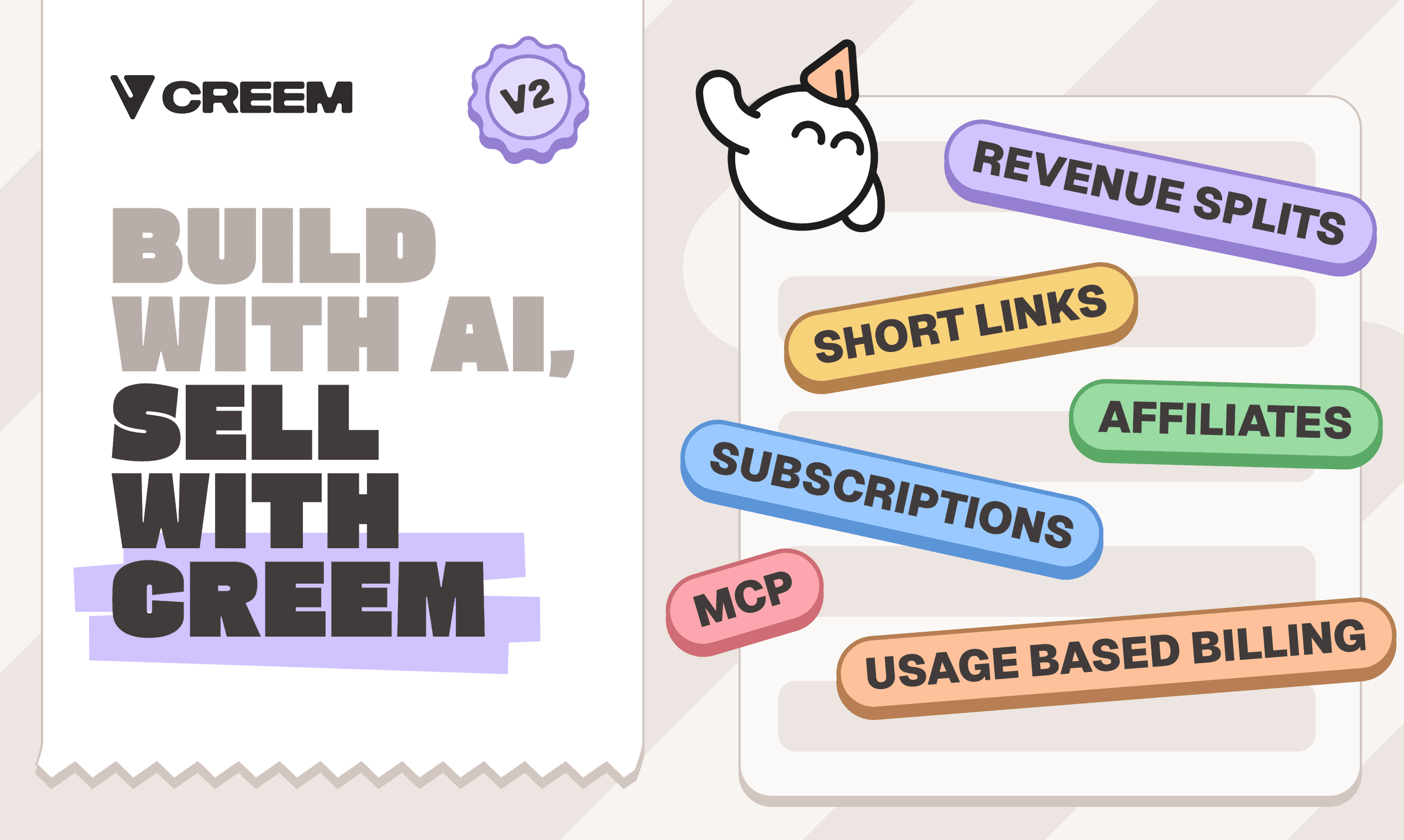
Build with AI. Sell with Creem.
We rebuilt Creem end to end. Every surface you touch has moved to Creem 2.0: a cleaner shell, a responsive collapsing sidebar with a proper mobile drawer, and one consistent visual grammar across the entire product, now in dark and light mode. Under that new surface sits the bigger story, a platform that went from a place you take payments to a place you run and grow a business.
Creem 2.0 is the money platform for the AI building era. You sell software and digital products globally while payments, taxes, payouts, affiliates and usage billing are handled for you. It is the same merchant of record you already trust, rebuilt into a full commerce surface: checkout on your own domain, billing designed for how AI products actually charge, a native distribution layer, affiliate and revenue split systems that run themselves, broader worldwide tax coverage, a native mobile app, and full API, CLI and MCP coverage so an AI agent can set up, run and monitor your store from end to end.
We are shipping it alongside a milestone we are proud of. Today we are also announcing a new seed round of 5M EUR, which brings our total funding to 7M EUR. This launch is what that money is going toward, and the Product Hunt page walks through exactly where we take it next.
This post is the deep version. If the changelog is the highlight reel, this is the director's cut: for each part of 2.0 we explain what it is, why it matters, and what you can actually do with it.
Table of Contents
What shipped in Creem 2.0, at a glance
-
Custom domain checkout. Run checkout on your own domain, fully branded, from product page to payment complete.
-
Usage based billing and credits. Metered pricing, a Meters dashboard, a public usage API, and prepaid credit wallets with auto refill.
-
Short links. Branded links, a QR studio, password protected links, and automatic click to conversion attribution, free for every merchant.
-
Run your store with AI agents. MCP, full API coverage and a CLI, so an agent can create products, wire webhooks, and run the store, not just read from it.
-
Affiliates and revenue splits v2. Per product and per affiliate commission, multi recipient and store wide splits, auto enrollment, all manageable through the API.
-
Embeddable checkout. A checkout that pops up directly inside your own website or store.
-
New payment methods. AliPay, plus native Apple Pay and Google Pay that light up automatically on your verified domain.
-
Smarter tax and VAT. Pre checkout VAT ID validation, a native tax ID flow, address first checkout, and a daily tax drift sweep across jurisdictions.
-
Storefront attribution. A real funnel on your hosted storefront: impressions, product clicks, and attributed orders.
-
Developer and API upgrades. Webhook health alerts, expanded OpenAPI, and scoped API keys that fail closed.
-
Mobile app. A native app live on the App Store and Google Play, with notifications and home screen widgets.
-
A full redesign, plus Light Mode. One consistent interface across the product, and the light theme people have asked for.
-
A Partner plan. Weekly payments concierge sessions, a CREEM Visa card to spend your balance, and several other benefits
Why Creem 2.0
For most of software history, shipping a product meant months of engineering before you could charge a single customer. AI collapsed that. A working product is now a weekend of work. Tools like Cursor, Claude Code and the current generation of agents turned building from the hard part into the fast part.
But the money side did not move at the same speed. A builder can ship a product on Saturday and still spend the next three weeks stitching together a checkout, a tax setup, a payouts flow, an affiliate tool and a billing system before the first dollar comes in. The building bottleneck moved. The money bottleneck stayed exactly where it was.
The insight we built Creem 2.0 around is simple: as AI collapses the cost of building, the winners are the ones who monetize and grow the fastest, not the ones who code the fastest. When everyone can build, distribution and monetization become the real moat.
There is a second shift underneath that one. AI products do not bill like classic SaaS. They do not charge per seat. They charge per generation, per API call, per credit, per second of video, per image. The revenue base running through Creem is already the AI maker cohort. Their pricing is consumption shaped, and setting up consumption billing has historically meant weeks buried in documentation.
So we took the most competitive merchant of record and turned it into a full commerce surface. One platform that is the legal seller of record and carries the growth, billing and collaboration tools builders actually reach for. Priced so you only pay when you earn. And modern enough that your agent does not just set it up once, it keeps running and monitoring the store afterward. If you built the product in a weekend, charging for it should feel like a weekend too.
The three headline features
Three launches sit at the center of Creem 2.0. Custom domain checkout was the single most requested feature we had, with hundreds of merchant votes behind it. Usage based billing is the one you have been asking us for since spring, and it is the feature that makes Creem fit the AI era. Short links are the distribution layer that turns getting paid into getting seen. Here is each one in full.
1. Custom domain checkout
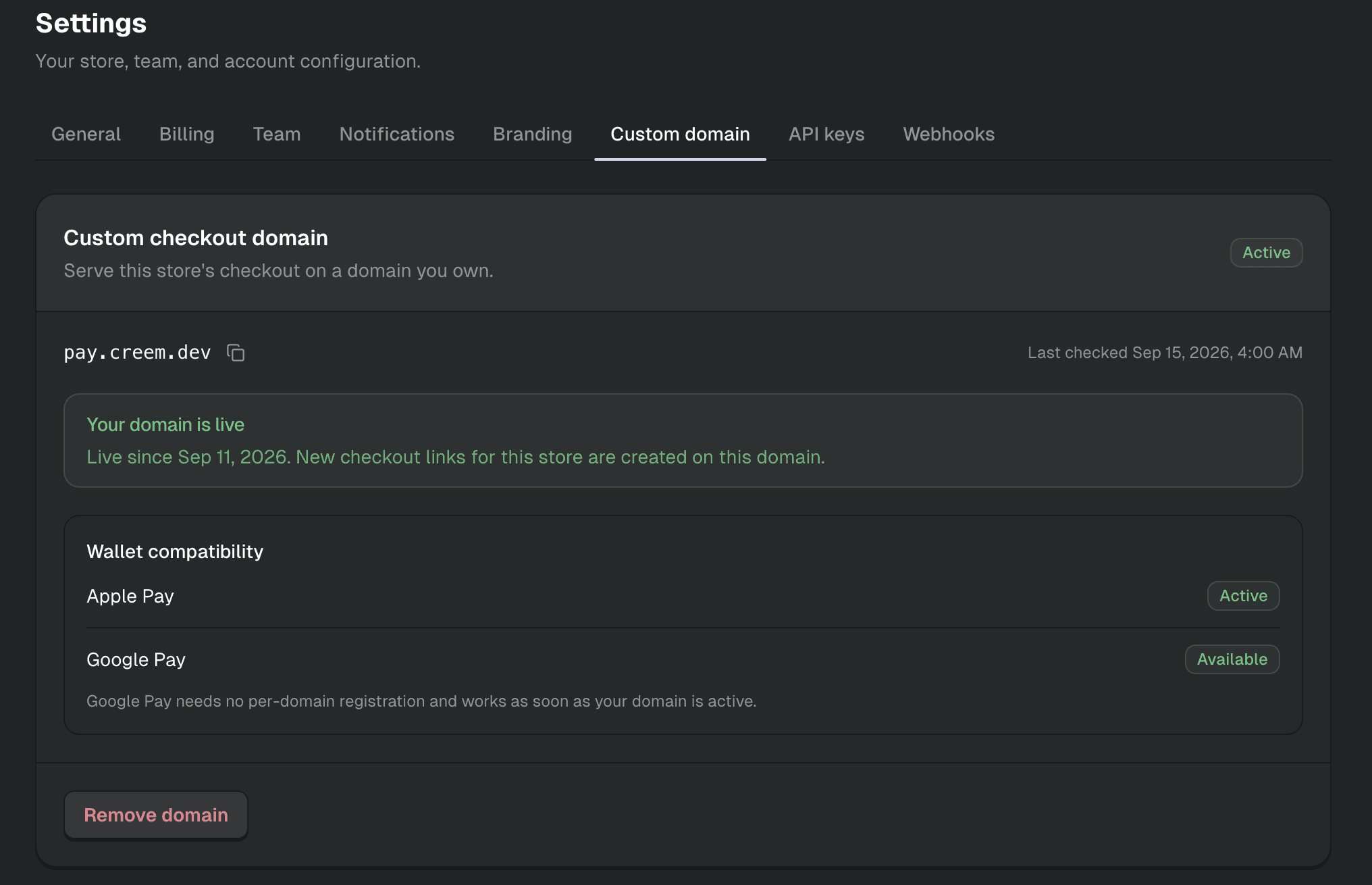
Your checkout now lives on your own domain, not ours. From the product page to the payment complete screen, buyers stay inside your brand the whole way. It is the difference between a storefront that feels borrowed and one that feels unmistakably yours.
This was the top request on our public roadmap by a wide margin, and the reason is not vanity. It is trust, and trust converts. There is a specific moment in every checkout where a buyer is bounced from your polished product page to an unfamiliar payment domain, and a small doubt creeps in: who is actually charging my card, and is this the same company I was just looking at? That flicker of hesitation costs real sales, and it costs the most on exactly the audience an indie product is trying to win, first time buyers who do not know you yet. Serving the whole flow on your own domain removes that break. The payment stops being a handoff and becomes part of the product.
How it works and what you get:
-
Mint checkout and payment link URLs directly on your store's active custom domain, so every link you share is yours.
-
Add and manage your domains from a dedicated Settings tab, with verification handled in the dashboard, no engineering ticket required.
-
Serve your public storefront at the root of your custom domain, so your product pages, checkout and storefront all live under one brand.
-
Apple Pay and Google Pay light up automatically the moment your domain is verified. Wallet payments are tied to the domain they run on, so putting checkout on your own domain is also what unlocks one tap payments, no extra configuration.
Pair it with full checkout branding, your logo, your colors, your light or dark theme, and custom fields to collect exactly the information you need, and the entire purchase reads as one continuous, professional experience. For a merchant selling to businesses or to a skeptical first time audience, this is often the single highest leverage change you can make to conversion.
2. Usage based billing and credits
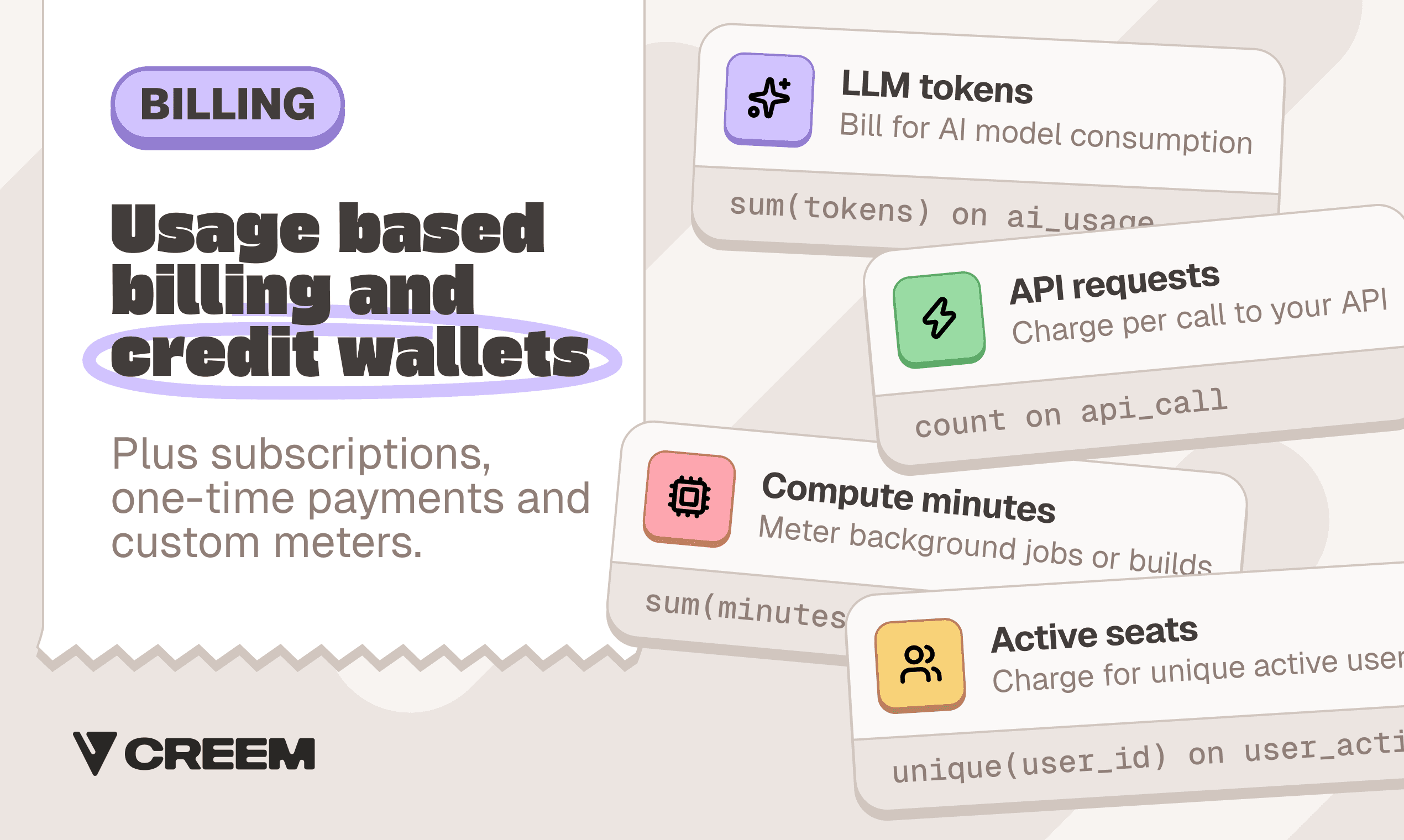
This is the one you have been asking for since spring, and it is the feature that makes Creem fit how modern AI products actually make money. Usage based billing lets you charge for what your customers actually consume: per generation, per API call, per credit, per any meter you define. No more forcing a per seat plan onto a product where one user might make ten calls one day and ten thousand the next.
Why it matters goes deeper than pricing flexibility. For an AI product, seat based pricing actively misaligns your revenue from your costs. Every generation costs you compute whether the customer is on a flat plan or not, so a heavy user on a fixed price quietly erodes your margin while a light user overpays and churns. Usage billing lines up what you charge with the value delivered and the cost incurred. Prepaid credits go one step further: the customer funds a balance up front and draws it down as they use the product, so you are paid before the compute is spent, and your cash flow stops depending on end of month invoices clearing.
Under the hood, we built this on the same audited ledger that already powers Creem's customer credits, which is why prepaid burn down is trustworthy and fully reconcilable rather than a bolt on counter. Two settlement modes ship:
-
Prepaid credits burn down. Customers fund a balance, and usage draws it down per unit. Auto refill tops the balance back up before it runs dry.
-
Postpaid metered subscription. Usage accrues across the billing period and is invoiced at period end, layered on top of your existing subscription.
The part we are proudest of is the setup. Wiring up usage billing has historically meant weeks of reading billing documentation and modeling meters by hand. In Creem 2.0 you configure it with a live preview as you go, or you let your agent stand it up in a single prompt. Here is what you can actually do:
-
Set metered pricing on any product, with a live preview of the billing math while you configure it.
-
Define and manage everything you track from a dedicated Meters dashboard, with count, sum, average, min, max and unique aggregations over your raw events.
-
Send events and read meters through a public usage API at /v1/events and /v1/meters. Ingestion is idempotent, so replays and retries never double count.
-
Set a free allowance and a usage cap per meter, so you can offer a free tier and protect customers from runaway bills in the same configuration.
-
Let customers fund prepaid credits, with per unit metering drawn down against their balance, backed by a double entry ledger you can reconcile.
-
Keep customers from running dry mid usage with auto refill and threshold top ups.
-
Recover lost usage automatically: when a balance hits zero, the customer gets an email and you get a webhook, so a dead balance becomes a recovery moment instead of silent churn.
-
React in real time to usage and credit webhooks for granted, consumed and auto recharged events, and read balances through a customer credits accounts API.
-
Keep your partners whole: revenue splits and affiliate commission now apply to auto refill orders too, so top ups pay their share automatically.
Put together, this is billing for the AI era without the thirty pages of documentation, and it is agent configurable from the first meter to the last webhook.
3. Short links
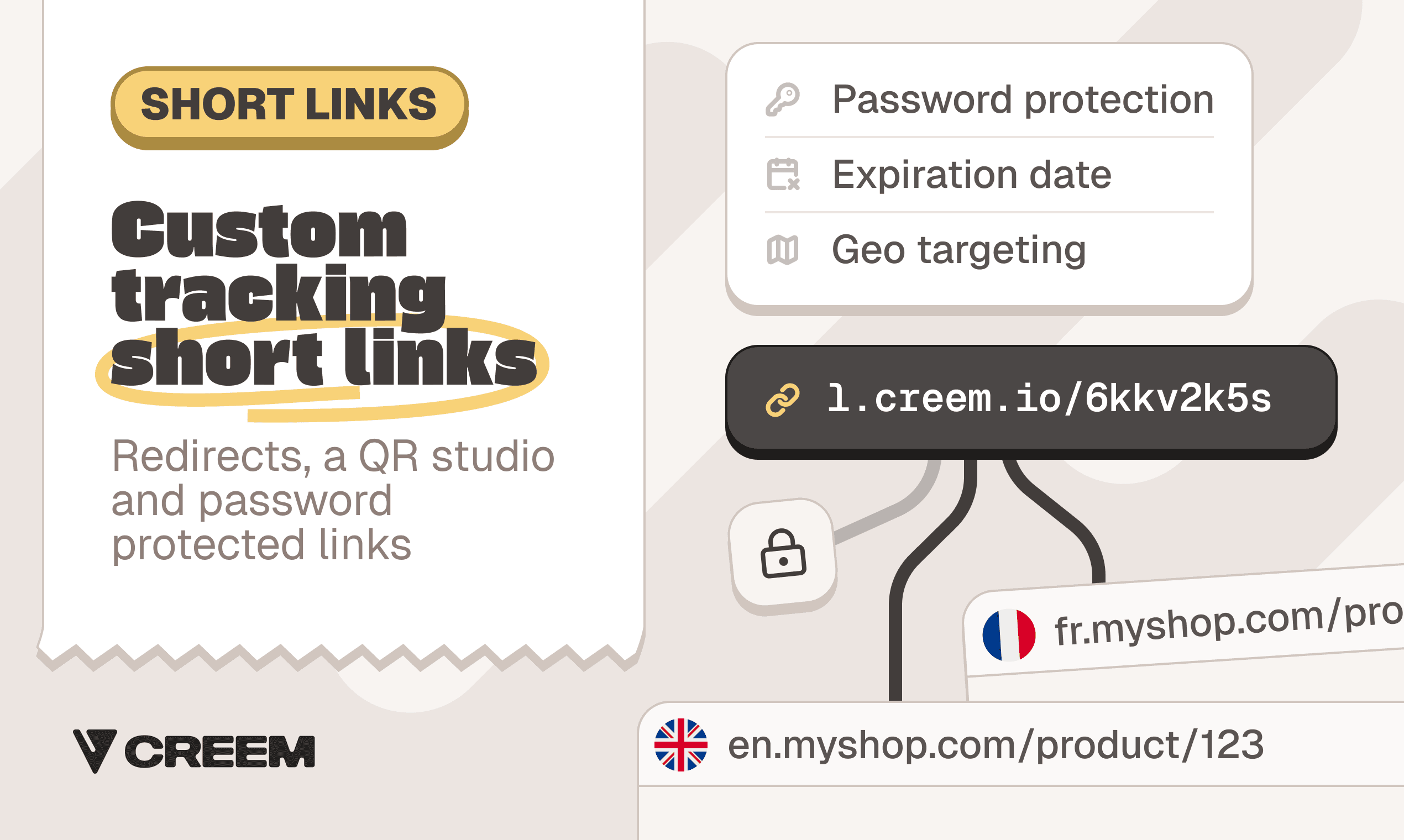
Checkout gets you paid. Short links get you seen. You can now turn any Creem product or URL into a clean, branded, shareable link in seconds, one that sends customers straight to checkout or to any custom URL, with no setup and no code.
The reason this is a headline feature and not a utility is that distribution, not checkout, is the real bottleneck for most builders once the product exists. A long, messy payment URL looks like spam, and it quietly kills clicks in exactly the places that drive discovery, a bio, a DM, a post. A short, professional link you can drop anywhere converts far better. And because Creem owns both the link and the checkout it points to, attribution just works. Distribution and revenue finally live in the same place, which means you can see which channel actually earns rather than guessing.
What a short link is, precisely: a compact, custom URL that points directly to your product, checkout, or any destination you choose. What you can do with it:
-
Create a short link for any URL or checkout in one click.
-
Customize the slug so the link matches your brand or a specific campaign.
-
Generate a QR code from any link through the built in QR studio, for physical and offline placement.
-
Password protect a link for gated drops, private offers, or early access.
-
Share one link across every channel and see how each performs.
-
Repoint a link to a new destination without ever changing the URL you already shared.
Where it earns its keep, in practice:
-
Creator in a bio. Drop one short link in your X or Instagram bio that points to your latest thing. Launch something new, repoint the link, and your bio never needs editing again.
-
Cold outreach and DMs. A short, trustworthy link converts far better than a long string of characters that trips every spam instinct a prospect has.
-
Launch campaigns. Spin up a unique link per channel, newsletter, Discord, Product Hunt, and see exactly where your sales come from, who clicked, and who converted.
-
Physical and offline. Print a short link or a QR code on packaging, a business card, or a conference booth, and send people straight to your product.
Clicks and conversions are measured automatically, with zero configuration. If someone opened your site or checkout through a short link, you will know when they convert and which link they clicked. And the best part: short links are completely free for every Creem merchant. No add on, no tier, no extra cost. It is built in and ready the moment you need it.
Everything else in 2.0
The three headliners are the story, but they are not the whole release. Creem 2.0 also rebuilt how you operate the store, who can grow it with you, how buyers pay, and how much of the world you can sell to. Here is the rest, in the depth each part deserves.
Run your entire store with AI agents
Creem used to be something you watched through the dashboard. Now you can run the whole thing programmatically. Everything the dashboard can do is exposed three ways: through full REST API coverage, through a command line tool, and through an MCP server that AI agents connect to directly.
This matters because of where software is heading. The interface is consolidating into personal AI agents that control dozens of tools on your behalf, and the products that win in that world are the ones an agent can drive without a human clicking through a UI. CLI first and API native is not a developer nicety, it is how your store gets operated when your agent is the one operating it. Creem 2.0 is built for that: an agent can create products, configure billing and meters, wire up webhooks, launch and tune an affiliate program, pull analytics, and then keep running and monitoring the store after the initial setup is done.
Concretely, this means:
-
A CLI you install in seconds that manages products, customers, subscriptions, checkouts and transactions, with an interactive mode for humans and JSON output for scripts and agents.
-
Full API coverage across the surfaces that used to be dashboard only, including usage events and meters, revenue splits, and affiliates.
-
An MCP server so an AI agent can operate Creem as a native tool, from wherever the agent already lives, your terminal, your IDE, or your chat.
-
Scriptable monitoring: an agent can watch for past due subscriptions, credit balances hitting zero, or webhook endpoints going down, and act on them without you opening a tab.
This is also the clearest proof of the direction we believe in: agents doing real business, not just writing code. Setting up and running a store end to end from a prompt is the first tangible version of that future, and it ships in 2.0.
Revenue splits and affiliates that run themselves
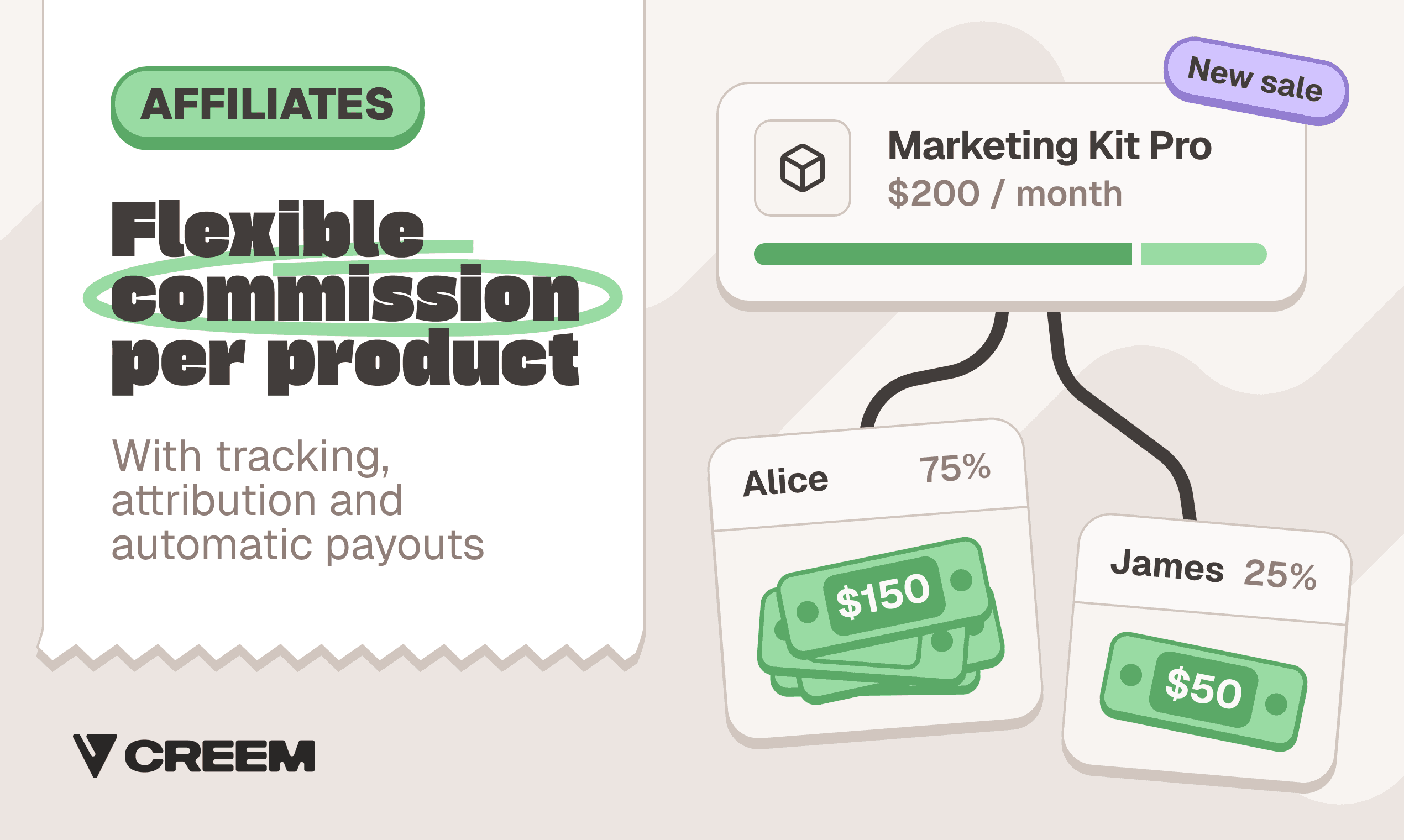
Growing through partners used to mean spreadsheets, manual math, and awkward payout logistics. Creem 2.0 turns revenue splits and affiliates into systems that operate on autopilot, configurable all the way down to the individual product and the individual partner. Both are built on the same money path, so commission is calculated and paid out through the same audited infrastructure that pays you.
Why this is strategic and not just convenient: when everyone can build, the businesses that grow are the ones that turn customers and partners into a distribution engine. Native splits and a real affiliate program are the primitives for that, and they are genuinely hard to copy. Competitors in the merchant of record space largely assume a single merchant per transaction; multi party revenue flows are a first class citizen at Creem, not a bolt on.
On revenue splits, what shipped:
-
Assign multiple recipients to a single split, not just a two way split, so co founders, contractors, investors and partners can all be paid from one sale automatically.
-
Apply a split store wide or across multiple products at once, instead of wiring it product by product.
-
Manage every split through the public API, so splits can be created and adjusted programmatically or by an agent.
-
Decide how refunds flow back with a per split refund clawback setting, so when a sale is refunded, each recipient's proportional share is handled the way you chose, and winning a disputed chargeback restores it automatically.
-
Revoke pending split invites and clean up orphaned ones, with clear invite expired messaging instead of silent dead ends.
On affiliates, what shipped:
-
Run a full application and approval workflow, with an honest pending state for applicants, so you control who joins and applicants never submit payout details before you accept them.
-
Turn buyers into partners on autopilot with automatic enrollment after purchase, your happiest customers become your distribution channel without you lifting a finger.
-
Set commission per affiliate and per product, so a specific partner can earn a specific rate on a specific product, and an override of zero cleanly excludes a product from a program.
-
Invite affiliates through the API, edit your program slug, and manage the whole program from one unified Affiliate Hub.
-
Give affiliates a clean exit with a leave program action in the affiliate portal, and a single, honest ended program state instead of contradictory statuses.
One design choice worth calling out, because it shapes how you should run a program: affiliate performance is a concentration game, not a headcount game. Across a large sample of programs, only about 15% of approved affiliates ever drive a single referral, and more than half of referred revenue comes from the top 10% of partners. Most affiliates who ever convert do so within their first week. That is why 2.0 leans on fast enrollment, quick payout enablement, and per partner commission overrides: the lever is activating and rewarding your top decile, not maximizing how many people you approve.
Embeddable checkout
Beyond running checkout on your own domain, Creem 2.0 adds an embeddable checkout that pops up directly inside your website or store. The buyer completes the entire purchase without leaving the page they were on, no redirect to a separate tab, no context switch.
The value is conversion at the moment of intent. Every redirect is a chance for a buyer to lose the thread, get distracted, or second guess. An embedded checkout keeps them in the flow they were already in, on the page that convinced them, and closes the sale right there. It is engineered to behave correctly inside a framed context too, so the embedded checkout stays inside its host instead of hijacking the parent page. For landing pages, in app upgrade prompts, and product pages, this is the difference between a buyer who completes and a buyer who wanders off.
New payment methods: AliPay and native Apple Pay
Two additions that widen who can pay you and how easily they can do it. AliPay opens the door to a large base of buyers, particularly across Asia, who simply prefer it and may not complete a card checkout at all. A native Apple Pay button, alongside Google Pay, turns checkout into a single authenticated tap on the devices most of your buyers already carry.
The mechanics matter here. Wallet payments like Apple Pay and Google Pay are tied to the domain they run on, which is why they light up automatically once your custom domain is verified, connecting this directly to the custom domain checkout above. Every tap and every field you remove at the payment step is conversion you stop leaving on the table, and for mobile buyers the gap between typing a card number and pressing a fingerprint is enormous. More accepted methods also means fewer buyers who reach checkout ready to pay and then cannot, which is the most expensive kind of lost sale.
Smarter tax and VAT at checkout
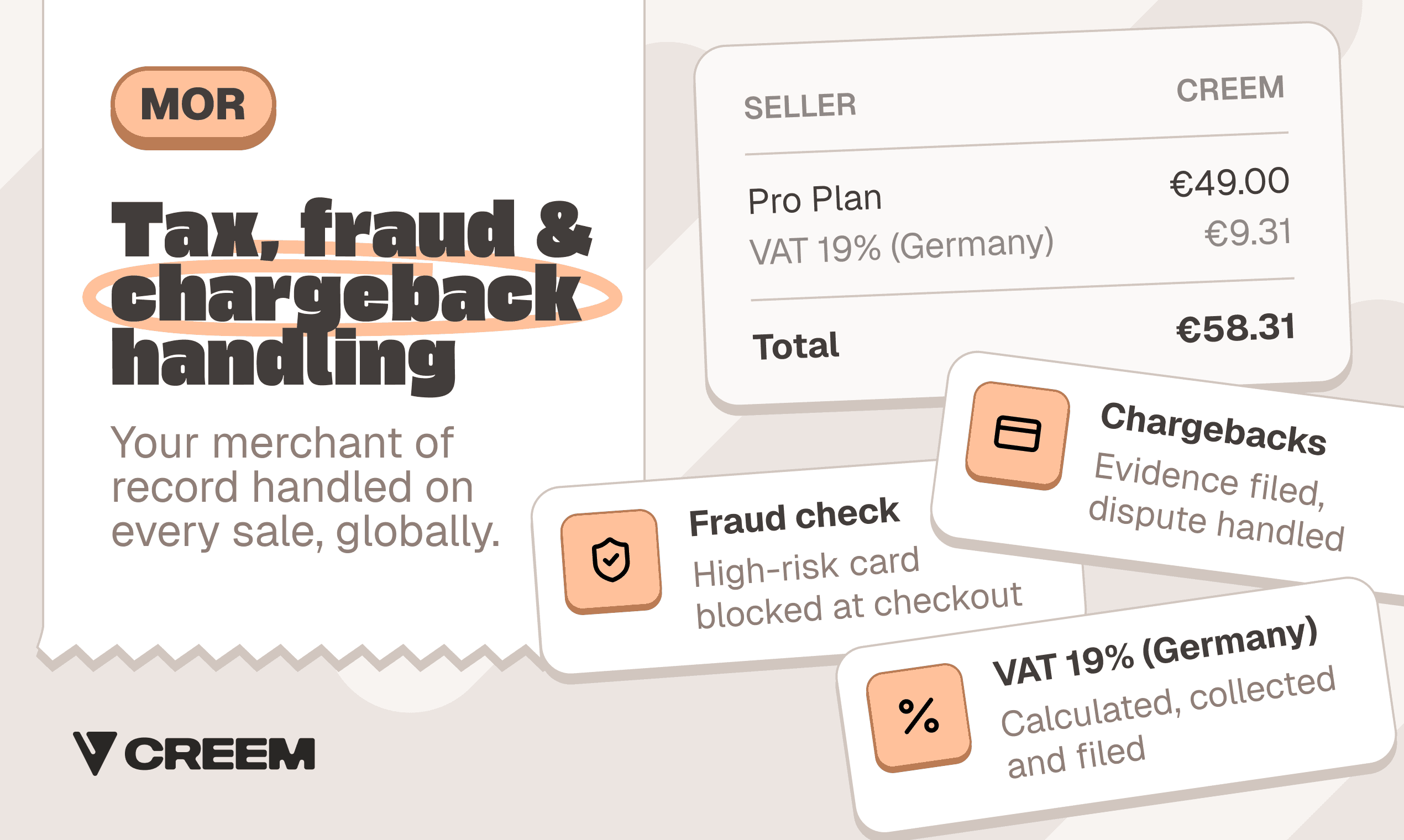
As the merchant of record, Creem is the legal seller of your products. That is the whole point of the model: taxes and compliance across 190+ countries are our problem, not yours. In 2.0 the tax engine got materially more precise, and more honest with your customers at the moment of payment.
What changed:
-
Pre checkout VAT ID validation, so business buyers enter and validate a real VAT ID before they pay, rather than after, which keeps your B2B invoices correct and reverse charges handled properly.
-
A native tax ID flow built into checkout, with the statutory rate shown clearly, so buyers see exactly what they are being charged and why.
-
Address first checkout: we hint the buyer's country up front and collect the right billing details early, which both improves the buyer experience and supplies the address the tax engine needs to compute the correct jurisdiction.
-
Per store tax provider selection, so your tax rail can be configured to fit your business.
-
A daily tax drift sweep that probes where we are actually collecting versus where we should be, and raises an alert when a jurisdiction you are registered in is not collecting correctly.
The result for you is broader, more accurate tax coverage worldwide, applied automatically, with more of your global revenue handled correctly and less risk of a nasty surprise later. The address first change is a good example of the care here: it makes checkout smoother for the buyer and, at the same time, gives the tax system the exact data it needs to get the rate right, one change serving conversion and compliance at once.
Storefronts and attribution
Storefronts is Creem's hosted, no code product catalog, a clean page that lists all your products with checkout built in, no website required. In 2.0 it gained something merchants have wanted for a long time: a real funnel, not just a final sales count.
You can now see the whole path, from someone landing on your storefront to a completed order, which means you can finally tell whether a weak storefront is a traffic problem or a conversion problem. What shipped:
-
View and product click analytics on your public storefront, so you see impressions and which products actually get clicked.
-
Storefront originated orders attributed correctly, distinguished from other checkout entry points, so you know what the storefront itself is earning.
-
Your own visits excluded from the view count, so the numbers reflect real buyers, not you refreshing the page.
-
Merchant facing storefront stats surfaced right on your Settings card, so the funnel is visible where you manage the store.
This is your first view through funnel on the hosted storefront: impressions, to product clicks, to attributed orders. Combined with short link attribution, you get a genuine picture of where sales originate and where to put your next hour of effort.
Developer and API upgrades
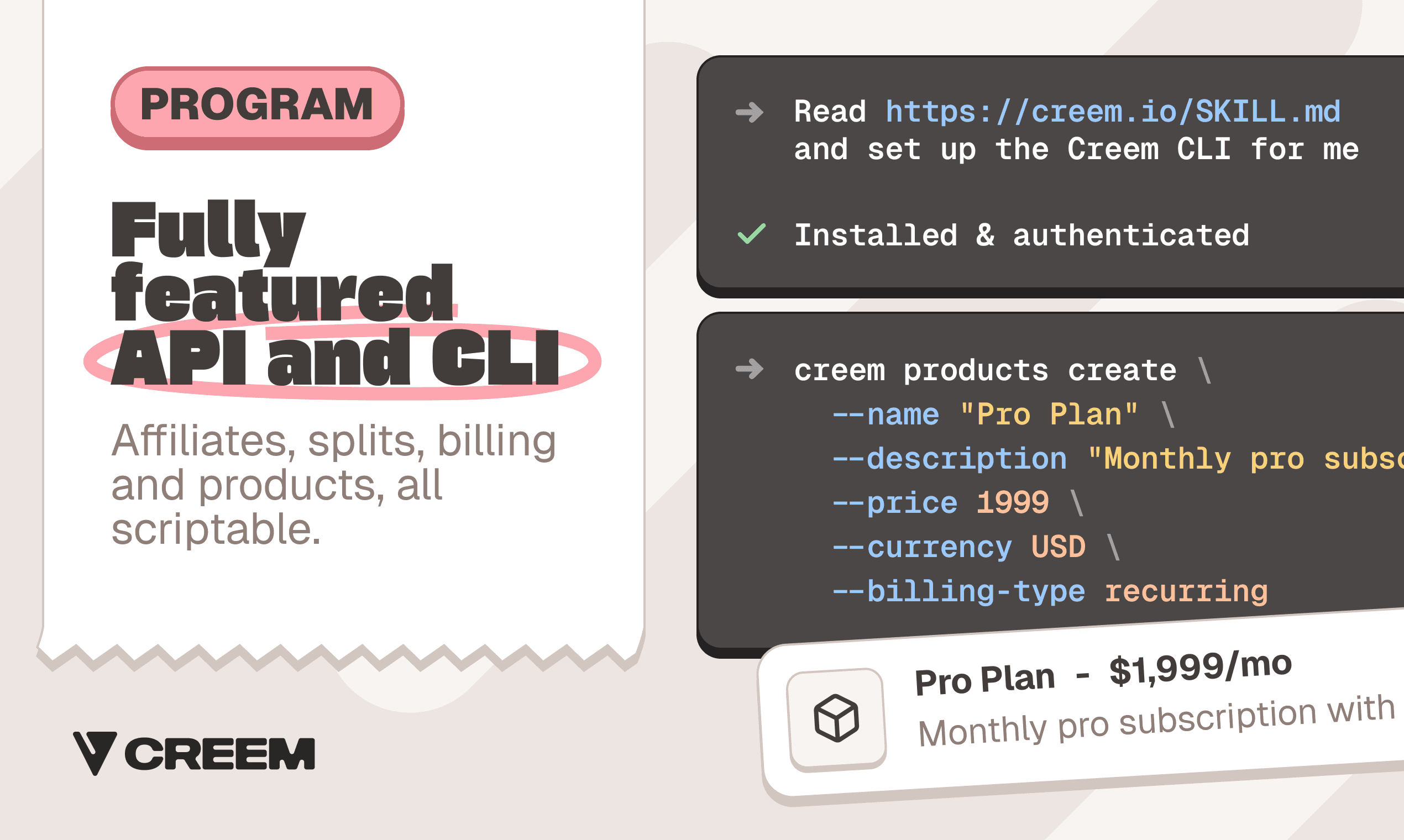
Creem 2.0 is built to be driven by code, which means the API surface itself is treated as a first class product, not an afterthought behind the dashboard.
-
Webhook endpoint health: we now tell you, and email you, when one of your webhook endpoints goes down, and let you reset it once you have fixed it. No more silently missed events you only discover when a customer complains.
-
Public usage API, affiliate API and revenue splits API, all documented in the repo, so the surfaces that used to be dashboard only are now fully scriptable.
-
An expanded OpenAPI spec covering events, meters and customer credits, so SDKs and generated clients stay in sync with what actually ships.
-
API keys that fail closed when a key has no scopes, and a scope picker that now offers splits and affiliate scopes, so least privilege is the default rather than an afterthought.
Taken together with the CLI and MCP surface above, this is what makes agent operated stores real rather than aspirational: a complete, documented, safely scoped API that an agent, or your own code, can rely on.
The mobile app
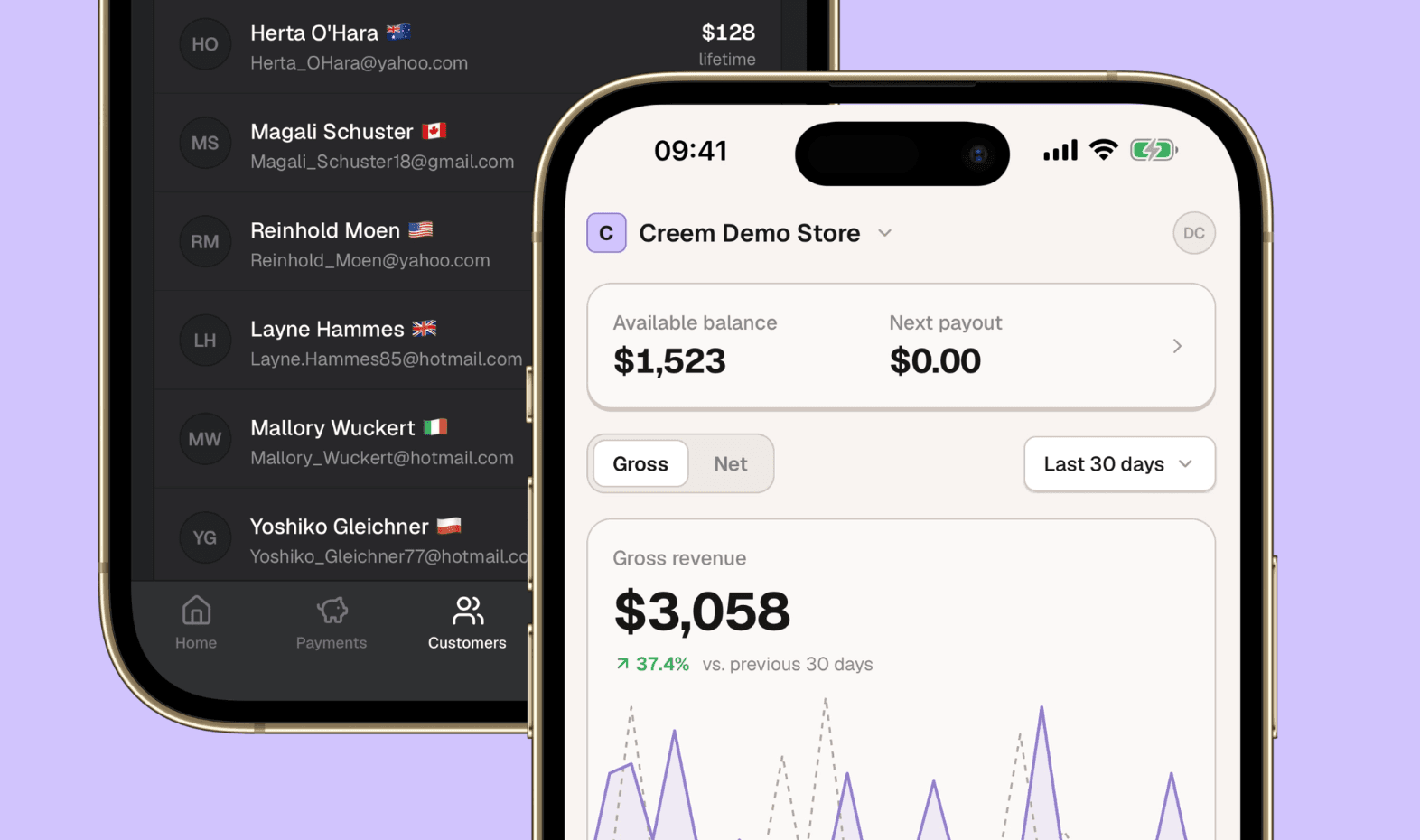
The Creem merchant app is now live on the App Store and Google Play, and it was one of the most requested things on our roadmap. It is the on the go companion to the web dashboard, rebuilt from the ground up as a native app so your store fits in your pocket.
-
Real time push notifications for sales, payouts and alerts, so you feel the business happening without opening a dashboard.
-
Home screen widgets, so your key numbers are a glance away, no app launch required.
-
A revenue ranked default store, so if you run more than one, the app opens to the one that matters most.
The app is the natural other half of the agent story: the agent runs and monitors your store programmatically, and the app is how you, the human, keep a finger on the pulse from anywhere. Your store lives in your pocket, and it stays in sync with everything else in 2.0.
A full redesign, and Light Mode

Every surface of Creem has been rebuilt for 2.0. A cleaner shell, a collapsing sidebar that behaves properly on mobile with a real drawer, and one consistent visual grammar across the entire product, from the dashboard home to splits to short links. Views that used to each have their own dialect now share the same tables, forms, and detail patterns, which makes the whole product faster to learn and faster to move through.
It is built to scale with you, from your very first sale to a large catalog, without the interface getting in the way. And yes, Light Mode is finally here for everyone who has been asking, sitting alongside the dark theme, so you can run your store in whichever one you prefer.
Introducing the Partner plan
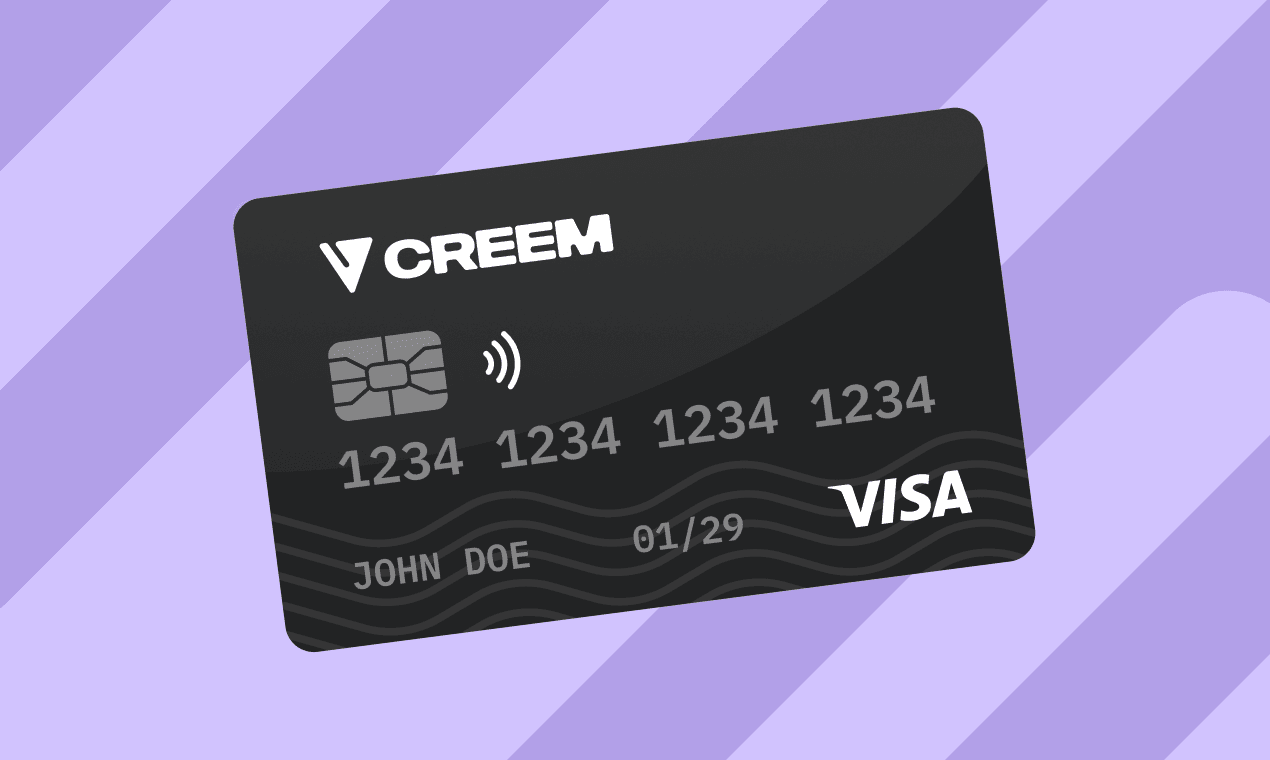
Once you scale, payments stop being a feature and start being a department. Tax and compliance, fraud investigators, analysts, acceptance rate and payment performance teams, the headcount adds up fast, and it is expensive to build in house.
The Partner plan gives you that entire team without hiring it. Creem plugs in as an extension of your own, and we scale your payments operation with you, as partners.
A team that knows your name:
-
A dedicated account manager with a direct phone number and WhatsApp, 24/7.
-
A private Slack channel straight to the Creem team.
-
Weekly payments concierge sessions: a real person goes through your payments, customers and subscriptions to find revenue you are leaving on the table and lift your operation's performance.
Money that moves your way:
-
On demand payouts, no waiting for a schedule.
-
A shorter risk hold on the payments you receive.
-
Lower fees across the board.
-
0% fees on revenue splits and affiliates.
-
A Creem Visa card shipped to you, spend your balance directly.
A seat at the table:
- Direct influence on our roadmap and product direction, the things you need get built.
If you are scaling fast and want Creem working as an extension of your team, let's talk.
Pricing stays simple
None of this changes the core promise: you only pay when you earn. The standard rate stays a flat 3.9% + 40c per successful transaction, with no monthly fees, no setup costs, and no tiered pricing that punishes low volume. As the merchant of record, that fee covers the whole service: payment processing, tax calculation, collection, filing and remittance across 190+ countries, chargeback and dispute handling, refunds, compliant invoicing, and access to every platform feature. You keep the rest.
The advantage compounds at both ends. A small merchant pays nothing in the months with no sales. A high volume merchant gets a flat, predictable rate with no surprise tiers. And on an international SaaS subscription, the most common case, that rate is meaningfully lower than the other merchant of record options, without passing surcharges for payment method or geography onto you or your customers.
Where this is going
We believe companies will start to look more like a code repository than an org chart with a payroll. Small teams of humans and AI agents, doing globally what used to take a department. Our mission is to give those teams the money platform that makes it possible, so anyone with an idea can sell and grow from day one, anywhere in the world, without building a payments, tax and compliance operation first.
Creem 2.0 is the first real proof of that. Agents doing actual business, not just writing code. A store you can stand up in a prompt, run from a terminal, monitor from your pocket, grow through partners, and bill the way modern products are actually used. The 5M EUR seed round we are announcing today, which brings our total funding to 7M EUR, is so we can take that all the way.
Thank you for building with us. This is a new chapter for Creem, and we are just getting started.
Build with AI. Sell with Creem. From first sale to global scale.