
Revenue can dip at renewal time even when nobody cancelled, because a card expired or a bank declined the charge. That loss is involuntary churn, a subscriber you lose to a failed payment when they never chose to leave.
The hard part is knowing when a failed renewal is actually a loss. A renewal marked failed in your dashboard can still be collected, and so can a customer whose card just stopped working.
Log them as gone too early and your churn number swells while you hunt for reasons people left when they never did.
Log them too late and the real losses hide, as expired cards, bank declines and bounced usage charges keep ending subscriptions while your retention work looks elsewhere.
You will be able to tell which failed renewals are already lost, which are still money you can collect, and which fix earns your time first.
TL;DR
A failed renewal counts as churn only when the subscription ends. Recovered renewals and those still awaiting retries stay out of the churn number.
For example, start with 100 subscribers and 10 failed renewals. If five recover, three remain pending and two subscriptions end, subscriber involuntary churn is 2 ÷ 100 × 100 = 2%.
Apply the fixes in this order:
- Keep payment details current before renewal and offer suitable payment methods for your buyers.
- Collect cash before compute runs with prepaid credits, or use spending caps to limit how much usage can go unpaid.
- Check the decline reason first. Retry temporary declines, and send payment-update or authentication messages when recovery needs customer action.
- Define the grace period, what access continues during it and when an unpaid subscription ends.
- Measure the revenue a recovery tool wins back beyond your platform’s own retries, minus its fees. Add one only when that leaves a positive return.
When does a failed payment become churn?
A failed payment becomes involuntary churn when the unresolved failure ends the subscription. That happens when your platform's last retry or grace period runs out, so the gap after the first failed renewal depends on your own retry rules.
While retries run, the customer is still yours and the money is still collectable. If a card declines on the renewal date and a retry collects the payment two days later, nobody churned.
Involuntary vs voluntary churn compared
Open an ended subscription and look for a cancellation action before the end date. A cancellation means the customer chose to leave. Only failed charges means billing ended it.
| Question | Voluntary churn | Involuntary churn |
|---|---|---|
| What ended it | The customer cancelled | A renewal failure nobody resolved |
| What the history shows | A cancellation record | Failed charges, then an end with no cancellation |
| What to do next | Find out why they left | Fix the payment failure |
Some customers lost to a failed card would have cancelled soon anyway, so better recovery would not have kept every one of them.
In your reporting, treat a renewal still in retry as money you can still collect. Add it to your involuntary churn rate only once the subscription has ended.
How to calculate involuntary churn
Pull two lists for the month:
- Subscriptions that ended after unresolved payment failures, dated by their end date.
- Renewals that failed during the month, each listed once regardless of retry attempts.
The churn formulas use the first list. Recovery rate uses the second, after every renewal has recovered or ended.
Subscriber and revenue formulas
Use separate rates for customers lost, recurring revenue lost and payments recovered:
- Subscriber involuntary churn rate = subscribers lost to payment failure during the period ÷ starting subscribers × 100.
- Revenue involuntary churn rate = MRR lost to payment-failure churn during the period ÷ starting MRR × 100. MRR here is recurring subscription revenue expressed monthly, so failed usage charges and credit purchases stay out.
- Payment recovery rate = failed renewals recovered ÷ failed renewals × 100.
A bounced usage charge or credit top-up is unpaid revenue. If payment failure ends the subscription, count the subscriber lost and only their recurring subscription revenue in the respective churn rates.
A worked example with 1,000 subscribers
For an illustrative month, start with 1,000 subscribers and 100 failed renewals. Use an invented split of 40 recovered, 20 pending and 40 subscriptions ended.
Subscriber involuntary churn is 40 ÷ 1,000 × 100 = 4%. If starting MRR was $50,000 and those ended subscriptions represented $3,000, revenue churn is 6%. The customers lost were on bigger plans than average.
Wait to calculate recovery. If all 20 pending renewals later recover, recovery rate is 60 ÷ 100 × 100 = 60%. Any pending subscription that ends next month counts in next month’s churn.
Creem’s automatic retries move a failed renewal to past_due, return it to active after successful collection, or cancel it if every retry fails. Check your monthly churn count against subscriptions canceled after failed retries, dated in that period. Nothing still in past_due belongs in it.
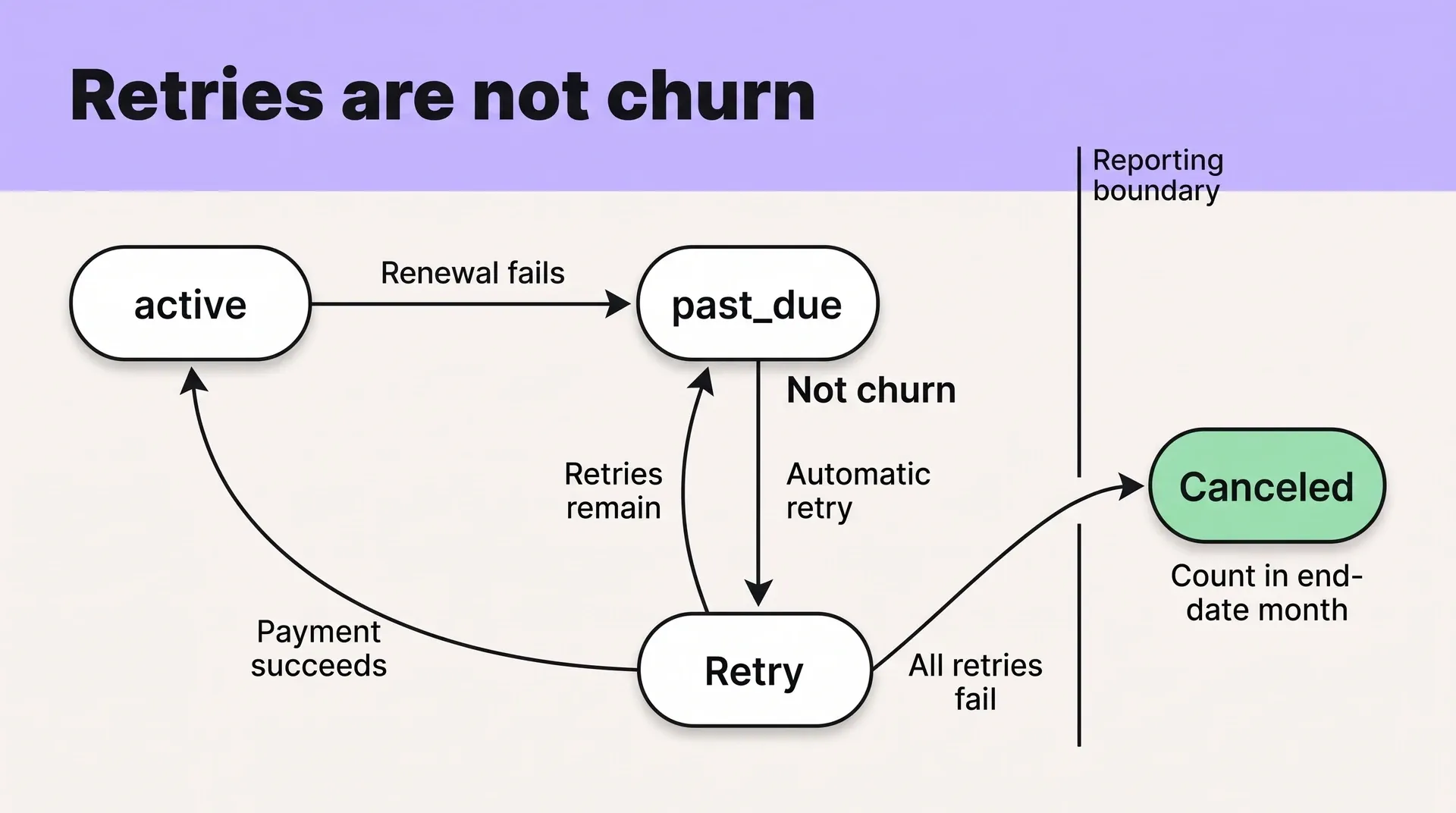
Creem retry flow returns recovered subscriptions to active; only canceled subscriptions enter the churn count
Why do recurring payments fail?
Last month's successful charge only proves the card, the funds and the bank's approval were in order that day. Any of them can change before renewal.
Expired and reissued cards
A saved card keeps its expiry date while the subscription runs, so a yearly plan can outlive its card. A bank that replaces a lost or compromised card can also break the saved details.
Retrying those details keeps failing. Send the customer a way to enter a valid card, then charge the new one.
Soft declines, hard declines and authentication
The decline reason tells you where recovery starts:
- Soft decline: a temporary rejection, such as insufficient funds or an unavailable issuer. Retry later.
- Hard decline: a closed account or a card marked lost or stolen. Ask for new payment details.
- Authentication required: the bank wants the customer to approve the charge. Send them that step.
A generic bank decline could belong to any of these. Retry it, and ask the customer to check the card if it keeps failing.
Cross-border, fraud-filter and usage-charge failures
A valid card can also fail because of where or how it is charged. An issuer may reject a charge from a seller in another country, and fraud screening can block a legitimate renewal. Ask the customer to tell their bank the charge is expected, then retry.
Usage you bill at the end of the month carries real cost. If a $300 metered charge fails and the compute behind it cost you $180, you carry that $180 until the charge lands, and you lose it outright if it never does.
List failed usage charges apart from failed renewals.
On every failed payment, read the decline reason before you pick a fix. Tag it as a card problem, a temporary decline, an approval step or a cross-border or fraud-filter block, and mark a generic decline as unclear until a retry or the customer tells you more. That tag decides your first recovery step.
How to prevent failures before renewal
Send your own reminder before a saved card expires, with a customer-specific link to Creem’s customer portal. The buyer can replace the card in one visit, giving you valid payment details before the next charge comes due.
Check two other parts of your setup:
- Account updater coverage. Check whether your billing platform refreshes saved credentials when participating issuers supply replacement details. Coverage varies by issuer and card.
- Currency and recurring payment support. Review buyer-currency options alongside Creem’s cards, Apple Pay and Google Pay. Check whether each method you show can carry the renewal.
For an AI product, prepaid credits mean the customer pays for a credit pack first and compute draws it down. That funded usage leaves no postpaid invoice to bounce afterwards, though collecting the credit-pack payment still needs to succeed.
Use Creem’s credit wallets to debit each unit before running the compute. A debit larger than the balance fails with 422 insufficient_balance, so block the operation when you get that response.
When credits run out while Creem settles a prepaid usage price, Creem refuses the settlement, fires customer_credits.exhausted and emails the customer.
An automatic refill is still a payment attempt and can fail. Creem’s auto-recharge is customer opt-in, and credits are added only after the top-up charge succeeds. Keep the same balance check whether the customer buys packs manually or enables auto-recharge.
Measure prevention with two numbers. Compare failed renewals per 100 renewals due before and after introducing reminders. Separately, track the dollar value of usage delivered but not collected each month to see whether your credit and consumption controls are limiting unpaid compute.
How to recover failed renewals
Combine automatic retries with customer follow-up and a defined access deadline. Retries give temporary failures time to clear. Messages reach customers whose card or bank needs their action.
Retries matched to the decline type
Temporary declines are worth retrying over days, since insufficient funds or an unavailable issuer can clear. Creem does this for you, moving a failed renewal to past_due and retrying automatically. Successful collection returns it to active. If every retry fails, the subscription is canceled.
To get these retries without writing retry logic of your own, try Creem for your subscription billing.
Your job is to reach customers who need to update their card or approve the charge. Another unattended attempt cannot complete those actions for them.
Dunning messages that get cards updated
Send your first email when the subscription goes past due. That payment follow-up, called dunning, should tell the customer which renewal failed, what to do and when access changes.
Compare these illustrative messages:
| Vague | Specific |
|---|---|
| “Payment failed. Please update your details.” | “Your Pro plan renewal didn’t go through. Update your card here to keep access after 30 November.” |
Make “Update your card here” the customer portal link. For an authentication failure, direct the customer to bank approval instead. Send no more reminders once the subscription is active again or canceled.
Grace periods, access and the final cutoff
Most automatic-retry recoveries on Creem came within about two days. Give retries time to work when choosing your grace period instead of cutting access at the first failure.
Continued AI usage still costs compute during that period. Preserve account access while capping or pausing costly operations, then apply your fixed access cutoff if payment remains unresolved. Suspension alone does not mean the subscription has ended.
Compare your retry-only payment recovery rate with the rate after messages and grace-period rules are running, using completed recovery windows. The gap is what your follow-up adds to payment recovery rate.
What to check in your billing setup first
Check that temporary declines trigger retries, while unusable cards and authentication requests trigger the customer action needed to resolve them.
Trace one failed renewal in your payment history as Creem moves it to past_due, then back to active or on to canceled.
Run these checks along that path:
- At
past_due, confirm your failed-payment email goes out with a working customer portal link. On Creem, that email is yours to send. - During recovery, check that the
subscription.unpaidandsubscription.expiredwebhooks keep your app's access and usage limits in line with your grace-period policy. - After a successful retry, check that full access returns and your reminder sequence stops.
- After cancellation, confirm that your app enforces the access cutoff and stops sending recovery reminders.
- For postpaid usage, test a failed charge before allowing further billable consumption. For prepaid usage, confirm an empty test wallet blocks the next call before compute runs.
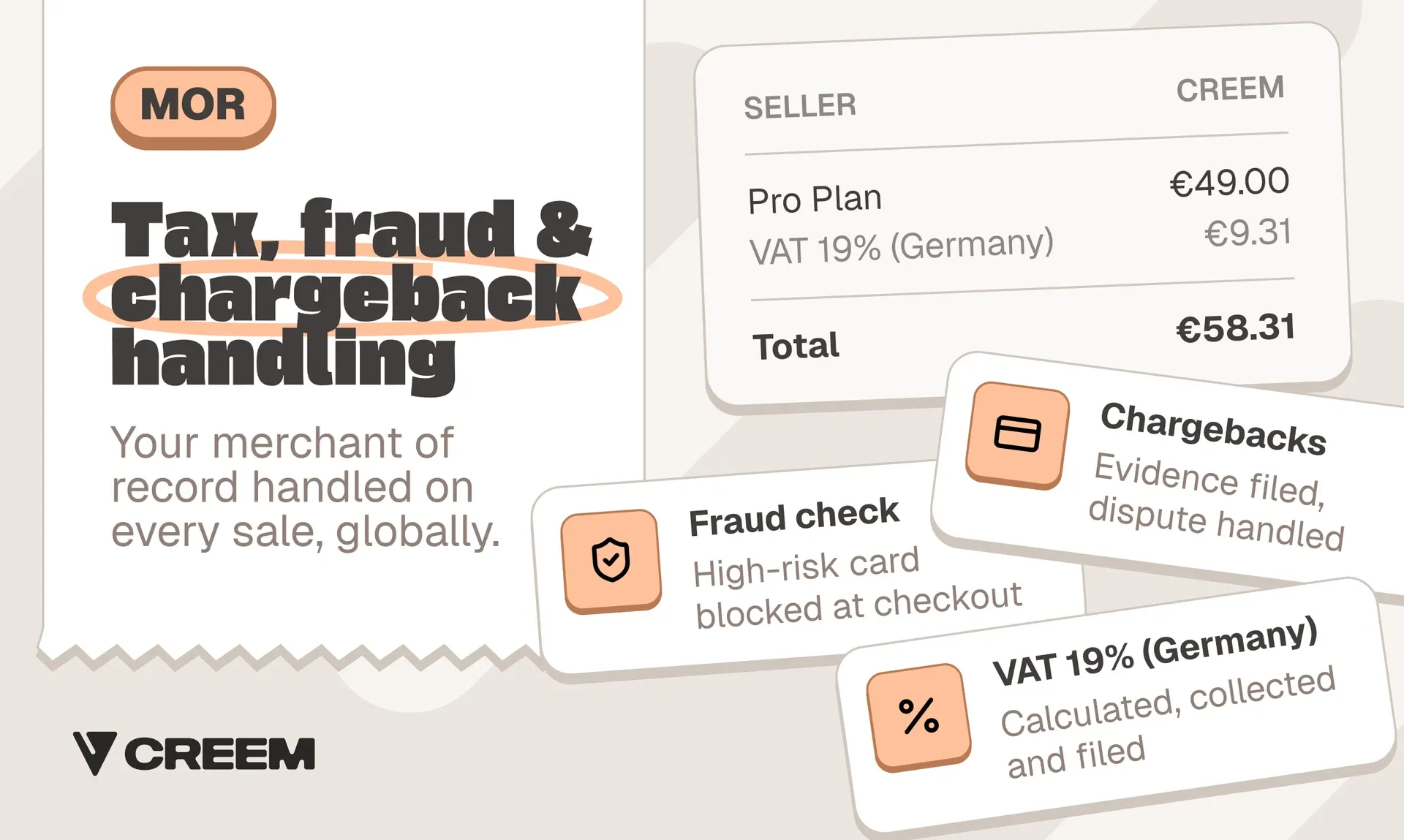
Check operational ownership separately. Creem handles fraud screening and chargeback disputes as merchant of record. Your team still needs to answer customers who contact you about a blocked payment.
Tag each gap as platform configuration, application logic or messaging, then fix it and rerun the check. Verify that each repaired path now produces the intended customer message and access change.
Do you need a separate payment recovery tool?
A dedicated recovery tool earns a look once failed renewals still go unresolved after your platform's retries and your own reminders, and you need something your billing setup cannot do.
On Creem, retries are built in, and buyers replace their card in the customer portal. When a renewal fails, the subscription moves to past_due, and that change can trigger your own reminder carrying a portal link.
Decide whether you need more than that, such as a custom retry cadence, branded multi-step email sequences or automated prompts before a card expires. A tool that ships those saves you building them.
To see what a tool adds, compare what it collects during a trial with what your platform and your own emails collected over a matching period before it. In an illustrative month of 200 failed renewals on $50 plans, that baseline recovers 120, counting your reminders as well as retries.
The trial recovers 140, so the tool added 20 renewals, or $1,000 of MRR. A $600 monthly fee leaves $400, before the hours spent wiring it into your access and email logic. Credit it with all 140 and it looks like $7,000 of recovery, when $6,000 would have arrived anyway.
A separate tool also has to stay in step with the rest of your billing. When a usage charge fails, it needs to know whether access should be limited, and the payments it recovers still have to match your invoices.
If the net number comes out small or negative, skip the fee. Watch your involuntary churn rate and recovered renewals for another quarter, then rerun the trial.
Stop chasing failed renewals by hand with Creem
Renewals that fail on expired cards and bank declines end subscriptions your customers never chose to cancel.
Creem is the merchant of record and the billing layer in one place, and it retries failed renewals for you. Between 28 July and 26 October 2026, those retries alone won back 27.7% of failed renewals across Creem stores.
Try Creem and let retries run on the platform that already bills your customers, so your own time goes to the buyers whose card or bank needs them to act.