
Paddle earned its place as a default for software sellers. It is the legal seller to your buyers, selling on your behalf and handling VAT and sales tax filing.
That service costs 5% + 50¢ per sale at the base rate, so the bill grows with every sale. If you also need meters, credit packs, affiliates or revenue splits, that often means a second vendor and a second bill.
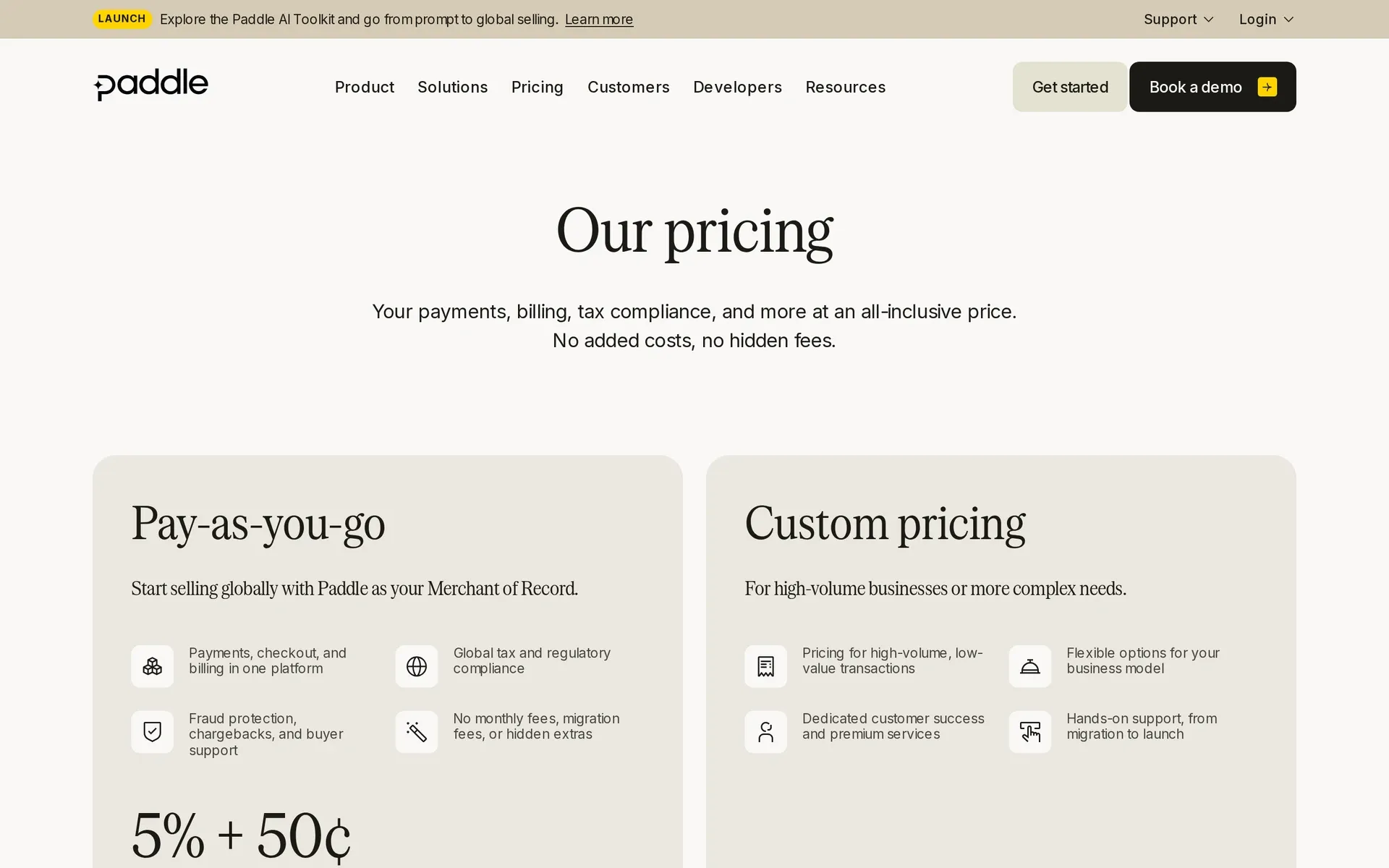
Paddle pricing page: Pay-as-you-go at 5% + 50¢ alongside custom pricing for high-volume businesses or complex needs
Here are seven Merchant of Record services that can take on that role. We start with our own, Creem, then cover FastSpring, Lemon Squeezy, Stripe Managed Payments, Chargebee Merchant of Record (where Reach is the legal seller), PayPro Global and Dodo Payments.
The headline rate is only part of the decision. Three checks help you compare them:
- The all-in fee at your volume, including surcharges.
- How much legal-seller responsibility the platform takes on, and where.
- Whether meters, credits, affiliates and splits come built in.
FastSpring and PayPro Global are established software MoRs. Stripe Managed Payments and Chargebee's option sit inside larger platforms.
Creem and Dodo Payments focus more on developers and AI products. Lemon Squeezy leans toward a simple hosted store.
1. Creem
Creem is a merchant of record like Paddle, at 3.9% + 40¢ per successful transaction against Paddle's 5% + 50¢ base rate. There is no minimum volume, and you set up and start selling yourself, without an enterprise sales process.
We are the legal seller, so we handle tax filings, customer invoices, fraud screening and chargeback disputes for you. Subscriptions, usage meters, credit wallets, affiliates and revenue splits all run on the same account. You still build, deliver and support the product.
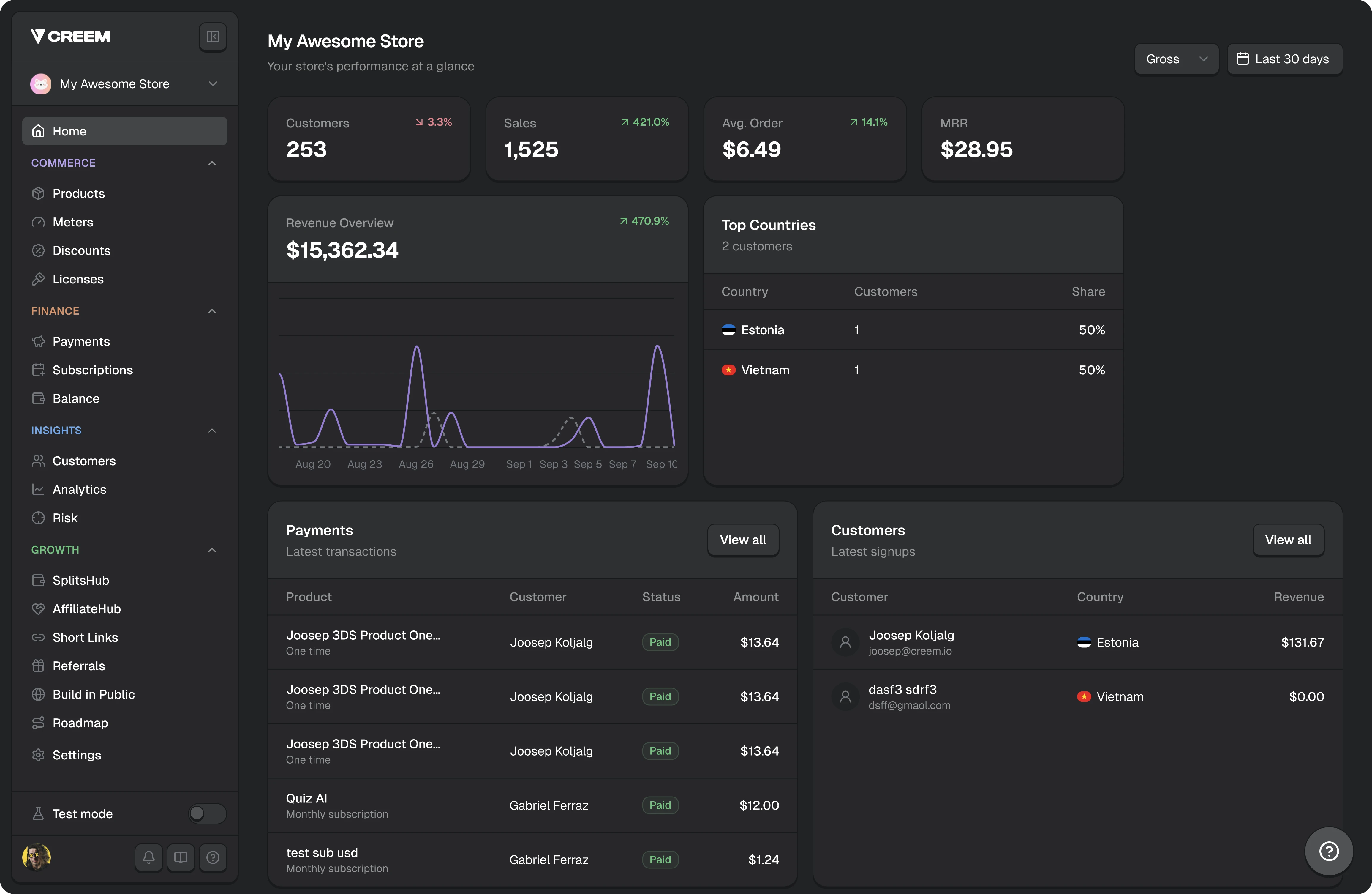
Creem dashboard with sales, revenue, top countries, payments and customers for one store
Key features
- Subscriptions: trials, seat billing, dunning and a customer portal.
- Checkout: hosted, embedded, or on your own domain, with one custom domain per store.
- Buyer payment methods: Visa, Mastercard, Amex, Discover, Apple Pay and Google Pay, with support for multi-currency payments.
- Migration help: moving active subscriptions from another provider is a custom project we run with you.
- Affiliates: referral links, partner approvals and commissions paid from the same balance as your sales.
- Revenue splits: store-wide or per-product, applied automatically to each sale.
- Usage meters: one usage price per meter, each with its own unit price, cap and settlement mode, and a set number of units each customer uses before the charge applies, billed on top of the base price.
- Credit wallets: products grant prepaid credits with auto-refill, and webhooks such as credits.consumed and customer_credits.exhausted tell your app when to act.
- License keys: automatically generated and delivered when a customer buys.
- Payment links: create a checkout link and share it without writing code.
- SDK: type-safe support for Node.js, Deno, and Bun, with full API coverage and auto-generated types.
- API, CLI and MCP: products and store settings managed from a terminal or by an agent.
Uneed moved its payment code from Polar to Creem in minutes. The migration changed 1,500+ lines with three AI prompts and zero integration errors.
DaisyUI took a different route, moving from Lemon Squeezy by hand in a few hours. It now runs revenue sharing without an extra tool, according to its case study.
Pricing
Pay as you go costs 3.9% + 40¢ per successful transaction, with no monthly fee, setup fee or minimum volume. A $100 sale leaves you $95.70 after that fee. We do not add an international card fee.
A $100 sale shows what you keep from one payment, but your monthly fee bill depends on how many sales you make and their size. For 100 sales at $50 each, all international subscriptions paid with premium cards, the pricing calculator estimates $235.00 in fees on Creem, $300.00 on Paddle and $400.00 on Lemon Squeezy.
Standard-plan add-ons cost extra:
- Revenue splits: an additional 2%, taken before commissions are calculated.
- Affiliate platform: an additional 2%, taken before affiliate commissions are calculated.
- Abandoned-cart recovery: 5% on recovered transactions, and it works only when the checkout request includes the customer's email.
- Payout transfers: 7 USD or EUR per payout, or 1% of the payout, whichever is higher.
The Partner plan has custom pricing and 0% platform fees on splits and affiliates.
Payouts run on the 1st and 15th once your balance clears 50 USD or 50 EUR, and a payment may be held 7 to 12 days for risk review before it counts toward that balance.
If the 1st or 15th falls on a weekend or holiday, the payout moves to the next business day. You can receive payouts through a bank or in USDC on the Polygon Network, with USDC payouts costing 2% of payout volume. In China, individuals can receive payouts through Alipay, while businesses can use a local bank account.
Best for
SaaS and AI products selling globally that want a merchant of record at a lower all-in rate than Paddle, with no minimum volume. It suits low-priced plans and international buyers, where fixed fees and card surcharges take the biggest share of each payment. It also fits usage or credit pricing, and sales you share with affiliates or co-founders.
Pros and cons
Pros
- 3.9% + 40¢ per successful transaction, with no monthly fee, setup fee or international card fee. A $10 sale costs 79¢ and a $100 sale costs $4.30.
- Merchant review usually takes 1 to 2 working days.
- Usage meters, credit wallets, affiliates and revenue splits run on the same account as checkout and tax, and partner payouts come from the same balance as your sales.
- License keys with activation limits and file delivery come with checkout.
- Products, store settings and webhooks can be managed through the API, CLI or MCP, including by an agent, and Test Mode lets you build before you take live payments.
Cons
- Revenue splits and the affiliate platform each add 2% on the standard plan.
- A payment may be held 7 to 12 days for risk review, and payouts run on the 1st and 15th, each costing 7 USD or EUR or 1% of the payout, whichever is higher.
- PayPal is not offered at checkout.
- AI image and video products must integrate the Creem Moderation API, deepfake tools and AI relationship companions are not accepted, and generative AI products need extra verification before approval.
Compared with Paddle
Paddle and Creem both act as the legal seller, taking tax filings, invoices and chargeback disputes off your desk. The first difference I'd look at is the rate. At 1,000 sales of $10 a month, our fee comes to $790 and Paddle's to $1,000. The second is what you get alongside checkout.
On Paddle, meters, credit packs and partner payouts often mean a second vendor. If that is a vendor you would rather drop, try Creem. We run all three in the same account that already collects your tax.
2. FastSpring
FastSpring brings B2B interactive quotes and invoicing to a software-focused Merchant of Record service. It handles payments, subscriptions, localized checkout, tax compliance and fraud for software and digital goods, so quoted deals and self-serve subscriptions can run through the same platform.
Pricing
FastSpring publishes no standard transaction rate. Your rate depends on transaction type and business volume and comes through a quote, so you cannot put a FastSpring fee next to Paddle’s until that conversation. There is no minimum transaction volume.
If your store charges in one currency and you’re paid out in another, FastSpring takes 2.5% when it converts the payout.
Live processing starts with a 45-day monitoring hold, with the first payout scheduled afterward. After the hold ends, each transaction still has a standard 14-day settlement delay. A lower transaction quote would not remove those cash-flow constraints, so budget for the gap before moving sales over.
By default, FastSpring pays out twice a month. You can request a monthly or weekly schedule instead. The minimum payout is $100 USD, with payouts available in USD, EUR, GBP, AUD, and CAD. FastSpring deducts its fees before sending the funds.
Best for
Software publishers that sell subscriptions alongside quoted B2B deals, have room to negotiate commercial terms, and can absorb the initial hold. It also fits teams with buyers who pay by ACH, SEPA Direct Debit, wire transfer or a local wallet.
Pros and cons
Pros
- B2B interactive quotes, with e-signatures and CRM integrations, run on the same platform as invoicing and self-serve subscriptions.
- Localized checkout in 23+ currencies, with cards, ACH, SEPA Direct Debit, wire transfers and wallets such as PayPal, Apple Pay and Alipay.
- Payments route across several gateways, and a payment that hits a technical failure on one gateway is retried through another.
- Tax compliance, fraud screening, chargebacks and affiliate management come in one fee, with no minimum transaction volume and volume discounts for larger sellers.
Cons
- No published transaction rate. Your rate comes through a quote based on transaction type and volume, so you cannot price a $10 or $100 sale before that conversation.
- Live processing starts with a 45-day monitoring hold, and each transaction then has a 14-day settlement delay.
- Converting a payout to another currency costs 2.5%, and the minimum payout is $100.
Compared with Paddle
Both are full Merchants of Record, so either one handles tax, fraud and chargebacks for you. I would shortlist FastSpring when B2B quoting is a real requirement, because its quotes with e-signatures sit alongside your self-serve plans.
If you’re leaving Paddle for clearer costs or faster access to revenue, FastSpring’s unpublished rate and 45-day initial hold make it a harder choice. Get the quote at your real order size before you plan the move.
3. Lemon Squeezy
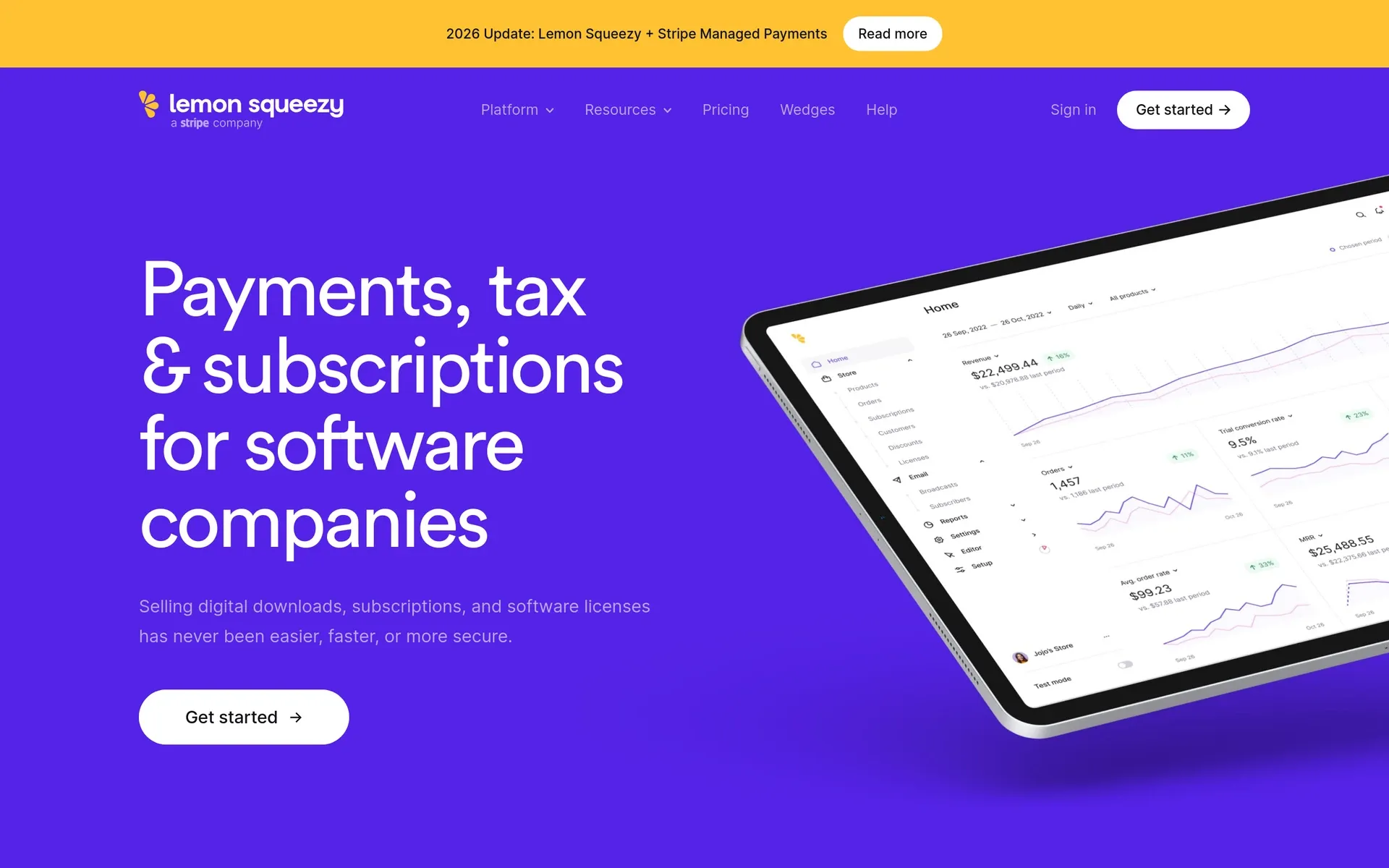
Lemon Squeezy homepage with its store dashboard: payments, tax and subscriptions for software companies
Lemon Squeezy pairs a simple hosted store with Merchant of Record coverage for approved software and digital products. It supports checkout and subscription management, but its base transaction fee is the same as Paddle’s. Stripe owns Lemon Squeezy.
Pricing
The base rate is 5% + 50¢ per transaction, with no monthly ecommerce charge. Three surcharges can stack on top:
- Subscriptions: an additional 0.5%.
- International transactions outside the US: an additional 1.5%.
- PayPal payments: an additional 1.5%.
That puts an international card subscription at 7% + 50¢ per payment, before payout costs.
On a $100 one-time US card sale, the base fee takes $5.50, leaving $94.50. As an international card subscription, the same $100 loses $7.50 and leaves $92.50. That extra $2 comes out on every renewal.
The base fee covers card processing, currency conversion and tax handling. Payout costs depend on where your account is based and how you get paid. Bank payouts through Stripe have no payout fee for US bank accounts and cost 1% per payout for bank accounts outside the US. PayPal payouts cost $0.50 per payout for US accounts. Outside the US, they cost 3%, capped at $30 per payout.
Best for
Creators and small teams selling one-off digital downloads and licenses who want a simple hosted MoR store. It fits self-serve products paid for by card, without purchase orders, net payment terms or custom contracts.
Pros and cons
Pros
- License keys, signed download links, failed-payment recovery and affiliates are included, and a license key expires with the subscription that paid for it.
- No monthly ecommerce charge, and the base fee covers card processing, currency conversion and tax handling.
- Hosted checkout, checkout links and embedded checkout, with subscription upgrades, downgrades and trials.
- Built-in email marketing at no extra cost for up to 500 subscribers.
Cons
- The base rate matches Paddle's 5% + 50¢, and surcharges take an international card subscription to 7% + 50¢. On a $10 international renewal, that is $1.20 against Paddle's $1.00.
- Percentage fees apply to the tax-inclusive price, so VAT raises the fee too.
- Payouts run twice a month, and refunds come out of the next payout. Bank payouts outside the US cost 1%, and PayPal payouts outside the US cost 3%, capped at $30.
- It does not accept services, physical goods, crypto products or resale marketplaces, and it has no native revenue splits.
Compared with Paddle
I see the appeal for a download or license business that wants a simple store. For SaaS subscriptions sold abroad, the difference is in the fees. You start at Paddle's headline rate, then add surcharges for recurring payments and foreign buyers. A $100 international renewal leaves $92.50 here and $94.50 on Paddle.
That $2 difference repeats every month. Stripe owns Lemon Squeezy, and its team has said its work now centers on Stripe Managed Payments. I'd check how payout holds and support work before moving a store with paying customers.
4. Stripe Managed Payments
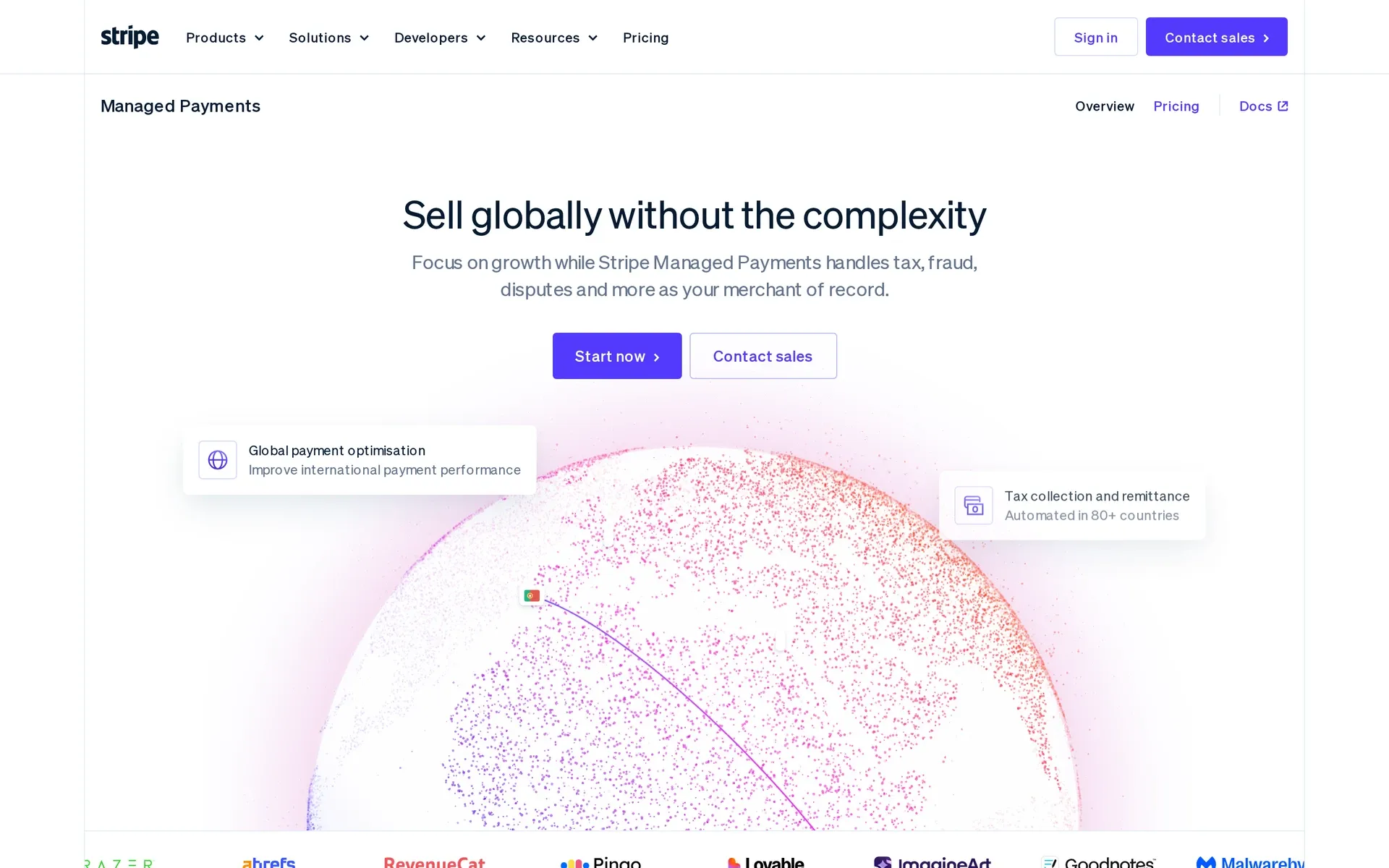
Inside direct Stripe Checkout, Managed Payments lets you activate Merchant of Record coverage transaction by transaction for eligible subscriptions and one-time sales.
Buyers see “Sold through Link” at checkout, receive transaction emails from Link and see LINK.COM* on their card statements. Custom checkout domains are unsupported, so that buyer-facing identity is part of the trade-off.
Managed Payments calculates, collects, files and remits indirect taxes in more than 80 countries. Outside those jurisdictions, tax compliance remains your responsibility.
Pricing
Managed Payments adds 3.5% per successful transaction on top of standard Stripe processing. Using US account pricing, the fees stack like this:
- Domestic cards: 2.9% + $0.30 processing plus 3.5% Managed Payments totals 6.4% + $0.30.
- Cards issued outside the US: an additional 1.5%.
- Currency conversion: an additional 1% when required.
A $100 domestic-card sale costs $6.70, leaving $93.30 before other charges. With a foreign card and currency conversion, the rate reaches 8.9% + $0.30.
For subscriptions, you also need Stripe Billing. It costs 0.7% of billing volume, on top of processing and Managed Payments fees. If you issue a refund, Stripe takes the original sales tax back out of your balance too.
Best for
Teams already running direct Stripe Checkout that want selective MoR coverage for automated digital products or cloud-hosted AI services. You can turn it on for every transaction or limit it to selected markets and products.
Pros and cons
Pros
- You turn on MoR coverage inside the Stripe Checkout you already run, so your subscriptions do not move to another company.
- It calculates, collects, files and remits indirect taxes in more than 80 countries, and handles fraud, disputes and transaction-level customer support.
- It works with Checkout and Payment Links, with usage-based billing through Stripe Billing.
- Selective coverage lets you start with Stripe as the seller and later sell as yourself, without changing providers.
Cons
- Buyers see "Sold through Link" at checkout and LINK.COM* on their statements, and custom checkout domains are unsupported.
- Embeddable web components, subscriptions created outside Checkout and Payment Links, third-party tax integrations, one-off invoices and license keys are not supported.
- Human-delivered services such as consulting and live coaching do not qualify, and payments you take for other sellers through Stripe Connect are not covered.
- Access needs an eligibility review, a low dispute rate and no prior risk issues, with your business based in Canada, the US, a supported European country, Australia, Hong Kong, Japan or Singapore.
- Stripe decides whether to accept or counter disputes, and an unanswered product question can trigger a refund without your approval after 48 hours.
Compared with Paddle
If you already use Stripe directly, I'd put Managed Payments on your shortlist. You keep your checkout and can drop the MoR layer later without moving subscriptions. The trade is cost.
With Stripe Billing's 0.7% added, a $100 domestic-card subscription costs $7.40 compared with $5.50 on Paddle. On a $10 subscription, it's $1.01 compared with $1.00. A foreign card adds another 1.5%, and currency conversion adds another 1%.
5. Chargebee Merchant of Record
Chargebee Billing's homepage.
Chargebee’s Merchant of Record option keeps subscriptions, invoicing and dunning in Chargebee while Reach becomes the legal seller for covered cross-border transactions. The integration is in private beta, so access requires approval from both companies.
On Chargebee Billing alone, you still register, file, remit and carry the tax liability. Adding Reach transfers those duties for covered sales while your subscriptions stay where they are.
Pricing
You pay Chargebee Billing about 0.65%–0.80% plus gateway fees, with the MoR fee charged separately. The integration publishes no MoR rate, so there is no public per-sale total to set against Paddle’s 5% + 50¢.
The 0.65% rate needs a committed plan, which also costs $424 a month. Pay-as-you-go is 0.80%.
If some sales would stay outside the MoR, mixing both types in one account may require Chargebee’s Enterprise multi-entity entitlement.
Before you commit, check how Chargebee's prices can change at renewal and whether you must pay a full year up front.
Best for
Subscription companies that already use Chargebee Billing and want to add a legal seller without changing their plans and invoices. It fits finance-led teams that want quotes and revenue recognition in the same system.
Pros and cons
Pros
- Subscriptions, invoicing and dunning stay in Chargebee while Reach becomes the legal seller for covered cross-border sales.
- Adding Reach moves registration, filing, remittance and tax liability off you for covered sales.
- Chargebee Billing puts subscriptions, usage metering, prepaid credits and overages on one invoice, with CPQ quotes for sales-assisted deals.
- It connects to 40+ payment gateways, including Stripe, Adyen and Braintree, and supports ASC 606 and IFRS 15 revenue recognition.
Cons
- The integration is in private beta, so access needs approval from both companies.
- There is no published MoR rate. Pay-as-you-go Billing alone takes 80¢ of a $100 sale and 8¢ of a $10 sale, before gateway fees and the MoR fee.
- The 0.65% billing rate needs a committed plan at $424 a month, and CPQ, revenue recognition and retention modules cost extra.
- Sales to Brazil, tax calculated through Avalara and unsupported currencies are not covered.
Compared with Paddle
For a small SaaS moving off Paddle, I would only consider this route if its plans and invoices already live in Chargebee. You keep the billing setup you have and add a legal seller underneath it.
Otherwise, you are joining a private beta where two companies charge separate fees and the total is not published. That leaves you without a per-sale figure to compare with Paddle's $5.50 on a $100 sale.
6. PayPro Global
PayPro Global offers assisted integration alongside its Merchant of Record service for approved SaaS and software businesses. One customer review describes getting both an account manager and a technical contact for the integration.
Pricing
Processing fees require a customized quote, with no published standard transaction rate. Withdrawal fees are separate, so the processing quote alone will not tell you what reaches your bank.
Some common payout options cost:
- North American ACH: $3 per payout.
- Wire transfer: $21 per payout.
- PayPal in the US and Canada: no payout fee.
- International PayPal: 2%, capped at $20 per payout.
Payouts run on the 15th for the previous month’s closing balance, less fees and adjustments. March’s balance is scheduled for April 15, so a sale on March 1 waits about six weeks for that payout.
The standard contract lasts one year and can be extended for another. Leaving carries no cancellation fee, but how and when your last balance is paid out follows the contract.
Best for
Established software teams that want help with integration and are comfortable with quoted pricing, monthly settlements and a one-year contract. It fits licensed software with introductory prices followed by recurring renewals.
Pros and cons
Pros
- Assisted integration. One customer review describes getting both an account manager and a technical contact.
- 70+ payment methods and 140+ currencies, with compliance coverage in over 200 countries.
- License management, introductory pricing followed by the full renewal price, and automatic retries of failed renewals.
- According to its pricing page, the quoted price includes all features, and PayPal payouts in the US and Canada carry no fee.
Cons
- No published transaction rate, and withdrawal fees come on top of the processing quote. A wire payout costs $21, and an international PayPal payout of $500 costs $10.
- Payouts run once a month, so a sale on March 1 waits about six weeks for its payout.
- The standard contract lasts one year and renews for another, and cancellation goes through your account manager.
Compared with Paddle
Integration help is the main reason I'd choose it over Paddle. The payment schedule and contract deserve just as much attention. Paddle publishes 5% + 50¢. PayPro Global gives you a rate only through a quote, so you cannot compare the cost of a $10 or $100 sale until you have that conversation.
Look at the processing quote, monthly settlement and exit terms together. A good rate only helps if the money arrives when your business needs it.
7. Dodo Payments
Dodo Payments is a Merchant of Record with checkout, recurring billing and capped ACH and SEPA direct-debit fees.
Pricing
The standard rate is 4% + $0.40 per transaction. Subscriptions add 0.5%, and cards or alternative payment methods outside the US add 1.5%. An international card subscription therefore costs 6% + $0.40.
Direct debit uses a different fee structure:
- ACH: 1.5%, capped at $15 per payment.
- SEPA: 1.5%, capped at €15 per payment.
- Both replace card pricing, with no subscription or international surcharge.
For an illustrative $2,000 US card subscription payment, the 4.5% rate plus $0.40 costs $90.40. The same payment by ACH costs $15 after the cap, a difference of $75.40.
Recovery through abandoned carts, subscription dunning or payment retries costs 5% of successfully recovered revenue. Payouts below $1,000 cost $5, while USD SWIFT payouts to non-US businesses cost $25.
PayPal and BNPL each add 3%. Usage billing adds 0.5%. There are no setup fees, monthly fees or minimum fees.
Refunds cost $1 each. Disputes cost $30 each. Customer currency conversion costs 4% on orders under $500, 3% on orders from $500 to $1,500, and 2% on orders above $1,500.
Payment collection and payout activation are separate. You can have paying customers while withdrawals remain inactive pending a monitoring review. That means subscribers you move from Paddle can be charged before you can withdraw any of that money.
Best for
Digital-product businesses whose buyers are willing to pay by ACH or SEPA, especially for larger payments where the caps matter. It also fits AI products that charge by usage or credits, including token metering, and want metering, license keys and tax handling in one MoR.
Pros and cons
Pros
- ACH and SEPA direct debit cost 1.5%, capped at $15 or €15 per payment, with no subscription or international surcharge.
- No setup, monthly or minimum fees, and a one-time US card sale of $100 costs $4.40.
- Usage and credit billing at an extra 0.5%, plus license keys, digital product delivery and a no-code storefront.
- Adaptive currency in more than 80 currencies, with the conversion fee charged to the buyer.
Cons
- An international card subscription costs 6% + $0.40, and PayPal and BNPL each add 3%.
- Payout activation needs a separate monitoring review, so you can charge customers before you can withdraw.
- Each refund costs $1 and each dispute costs $30.
- Cloud-compute credits, hosting, VPNs and AI relationship companions are not accepted, and every director and beneficial owner needs a government ID from a supported country.
Compared with Paddle
Start with how your buyers pay, not Dodo's 4% headline rate. On a $10 international card subscription, Dodo takes $1.00, the same as Paddle. On $100, it takes $6.40 compared with Paddle's $5.50. The headline rate helps on a one-time US card sale: $4.40 on $100, compared with $5.50.
Larger direct-debit payments make the strongest cost case. I'd get payout approval before moving live subscribers, because Dodo can charge them before you can withdraw.
Paddle alternatives compared: fees, MoR coverage, and billing
The headline rate is where each fee starts. Where subscription and foreign-card surcharges apply, your payment mix decides where it ends.
| Platform | Transaction pricing | Legal seller | Billing and growth |
|---|---|---|---|
| Creem | 3.9% + $0.40 per successful transaction | Creem | Subscriptions, meters, credit wallets with auto-refill, affiliates and splits |
| FastSpring | Negotiated | FastSpring | Subscriptions, B2B quotes and invoicing |
| Lemon Squeezy | 5% + $0.50, +0.5% subscriptions, +1.5% outside the US, +1.5% PayPal | Lemon Squeezy | Subscriptions and hosted store |
| Stripe Managed Payments | 3.5% plus Stripe processing, +1.5% non-US cards, +1% conversion | Link, in more than 80 countries (you keep tax elsewhere) | Subscriptions and one-time sales through Checkout |
| Chargebee Merchant of Record | Unpublished MoR rate, plus separate Billing charges | Reach for covered cross-border sales | Chargebee subscriptions, invoicing and dunning |
| PayPro Global | Customized processing quote | PayPro Global | Recurring payments and subscription notifications |
| Dodo Payments | 4% + $0.40, +0.5% subscriptions, +1.5% non-US cards/APMs. ACH/SEPA: 1.5%, capped at $15/€15, with no subscription or international surcharges | Dodo Payments | Recurring billing |
| Paddle baseline | 5% + $0.50 per Checkout transaction | Paddle | — |
Negotiated, quoted and unpublished rates still carry a fee. FastSpring, PayPro Global and Chargebee's MoR side only show their cost in a quote, so set that quote against Paddle's 5% + 50¢ before you count any savings.
Here is what those rates look like on a $50 monthly subscription priced in USD, with half the subscribers paying on non-US cards. The comparison counts listed transaction and plan fees only, before tax, payout transfer fees and currency conversion.
| Monthly fees, $50 subscription, half the subscribers on non-US cards | $5,000 a month (100 sales) | $25,000 a month (500 sales) | $100,000 a month (2,000 sales) |
|---|---|---|---|
| Paddle | $300 | $1,500 | $6,000 |
| Creem | $235 | $1,175 | $4,700 |
| Lemon Squeezy | $362.50 | $1,812.50 | $7,250 |
| Stripe Managed Payments (with Stripe Billing) | $422.50 | $2,112.50 | $8,450 |
| Dodo Payments | $302.50 | $1,512.50 | $6,050 |
These rates apply to each payment, so the gaps grow with revenue. Your plan price matters too. The fixed 50¢ and 40¢ charges take a larger share of a cheaper plan than they do of this $50 subscription. Run the same table at your own price.
Stripe Managed Payments has the highest total in this comparison because its 3.5% fee sits on top of Stripe processing and Stripe Billing's 0.7%, which subscriptions require. Lemon Squeezy, Stripe and Dodo also add a non-US card surcharge on half of these sales. FastSpring, Chargebee Merchant of Record and PayPro Global need a quote before you can compare them on the same basis.
How to choose the right Paddle alternative
A lower rate does not help if the platform cannot bill the way your product actually charges. Start with fit. Then compare costs across the platforms that make the cut.
Your own pricing page is the starting point. Sell credit packs? Look for prepaid credits that draw down as customers use them. Charge per API call? Look for usage meters. Per-seat and flat recurring plans need subscription billing.
Next, check the fit for the markets you sell in. Look at the payment methods your buyers use, checkout localization, and how much of your tax and compliance work the platform handles in those markets.
For cost, take a real month of sales and run it through each remaining platform. Use the same mix of subscriptions, international cards and currencies. Include withdrawal fees and any platform fees for running affiliates or revenue splits. Leave out the commissions and revenue shares themselves. You pay those on any platform.
Then count the days from a sale to money in your bank on each platform, including any hold at the start.
Before you move paying customers, confirm each of these works:
- Product eligibility: your category passes the platform's account review.
- Imports: you know what comes over and who runs it. On Creem, each subscriber finishes the current billing cycle where they are and renews through Creem when it ends, so nobody has to move on one cutover day.
- Renewals: moved subscribers keep renewing, with a plan for anyone who must re-enter a card.
- Cancellations: a customer who cancels keeps access until the period they paid for ends, and you've tested it.
- Product access: webhooks grant and revoke access in your app, and you've tested both.
Paddle is still the better fit if your volume qualifies you for a negotiated rate and you want a sales-led account.
Creem: a Merchant of Record for global software sales
Paddle handles the legal work of being the seller well. Creem does the same job, with tax, invoices and disputes on our side, at 3.9% + 40¢ per successful transaction and no minimum volume.
You sign up and sell yourself, and merchant review usually takes 1 to 2 working days. Moving active subscriptions is a custom project we run with you, so the switch does not fall on your team alone.
Meters, credit wallets and partner payouts run in the same account that collects your tax, so a usage or affiliate setup does not need a second vendor.
Growth tracking lives in that account too. Short links track clicks and checkouts for each link you share. You can see a launch post or partner link's traffic alongside its checkouts, and change the destination without changing the URL you already shared.
When a sale lands or a renewal fails, the mobile app shows the alert on your phone's lock screen.
If you want Paddle's tax coverage at a lower all-in rate, try Creem and run billing, partner payouts and tax from one account.