
You’ve already decided that your global SaaS needs a merchant of record. Now you’re choosing between Paddle and Dodo Payments, and a checklist of tax handling, checkout and recurring billing makes them look much alike.
Whether either can support the way your product charges still needs an answer. A lower headline rate can lose its appeal once the charges on your actual sales are counted.
Choosing wrong means rebuilding billing around live customers, with subscriber losses that can outweigh the savings. You need to know which provider can run your sales as they are, and whether switching earns back the disruption.
If you want merchant-of-record tax handling at 3.9% + 40¢ against Paddle’s published 5% + 50¢, try Creem.
The real difference between Paddle and Dodo Payments
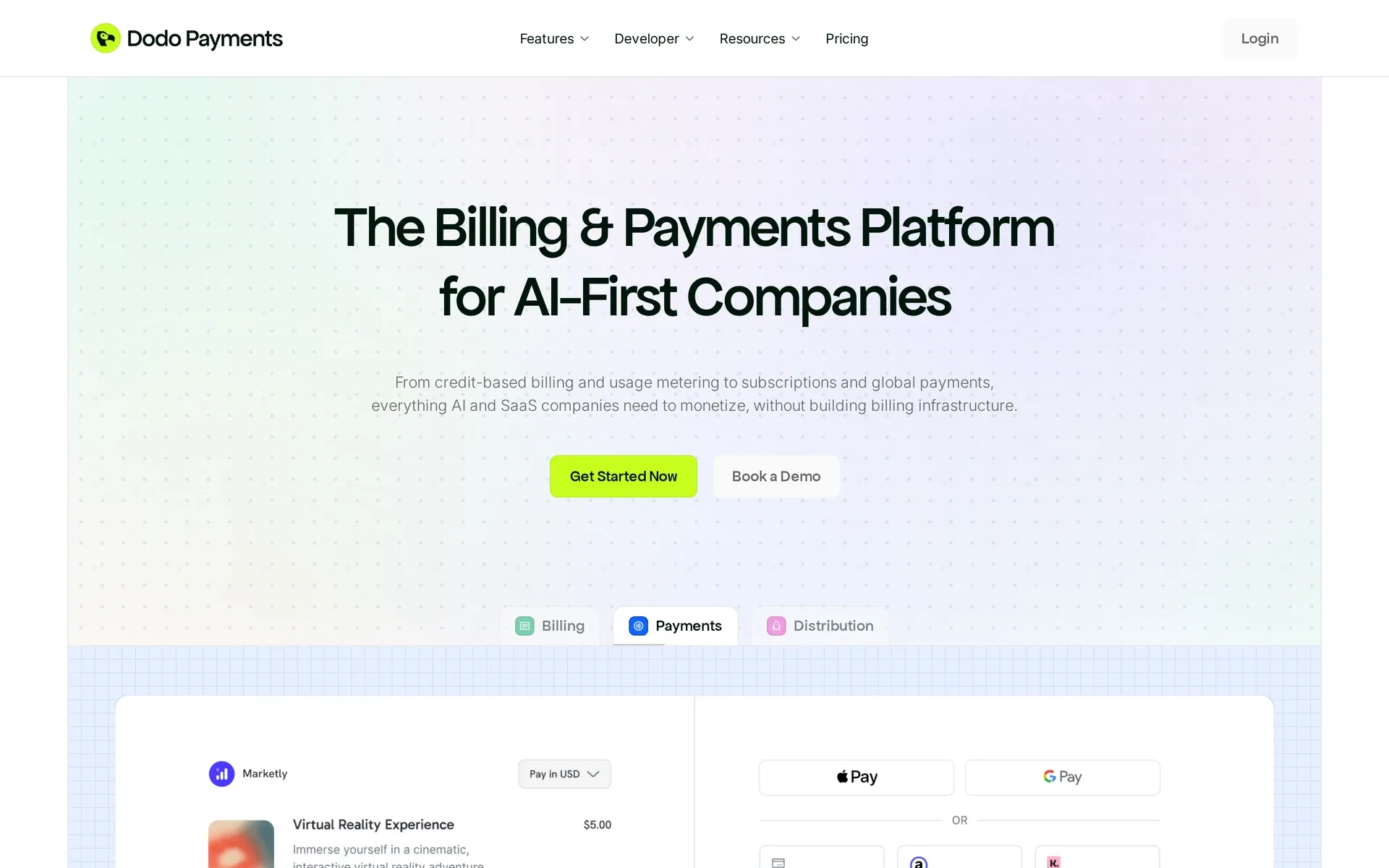
Paddle and Dodo Payments both act as merchants of record, so the useful distinction is how their billing fits your product. With either provider, the legal-seller role, payments and tax stay on their side.
For recurring SaaS plans, Paddle offers established subscription billing and a long record serving software sellers. Dodo Payments focuses on newer products, often priced by usage. Those emphases are a starting point, but the way you actually charge customers determines which provider belongs on your shortlist.
An AI product selling monthly access needs different billing from one selling prepaid credit packs, even when both sell access to the same app. Having a merchant of record handle the sale does not settle how either charging model will work.
Write down what needs to happen from the first payment through renewal or credit exhaustion, then check each platform against that flow. I would keep only providers that support your charging model in the fee comparison.
Who can sell on each platform?
Both providers sell digital products only. Each turns away physical goods and human services such as consulting or coaching, and each reviews your account before you can sell.
Check both against the same requirements:
- Seller location. Paddle accepts software businesses anywhere except a list of unsupported countries. Dodo Payments lists 177 accepted countries and territories and decides by the country that issued your ID, so a company registered in a supported country is not enough by itself.
- Business status. Both accept individuals. Paddle skips business verification for individuals and sole traders, and Dodo offers Individual and Registered Entity accounts.
- Product category. Paddle is built for software companies, including B2B SaaS, consumer software and games. Dodo accepts SaaS, AI products, digital goods, templates, plugins and apps, and puts some categories, such as AI content generation, through extra review.
Creem accepts individuals and registered businesses after verification and covers 87 countries for seller onboarding and payouts. Those seller-country rules are separate from buyer coverage.
I would rule out any provider whose rules exclude your business before comparing fees.
Pricing: what you actually pay per sale
Order value matters because a fixed fee takes a bigger share of a small payment.
How each fee is built
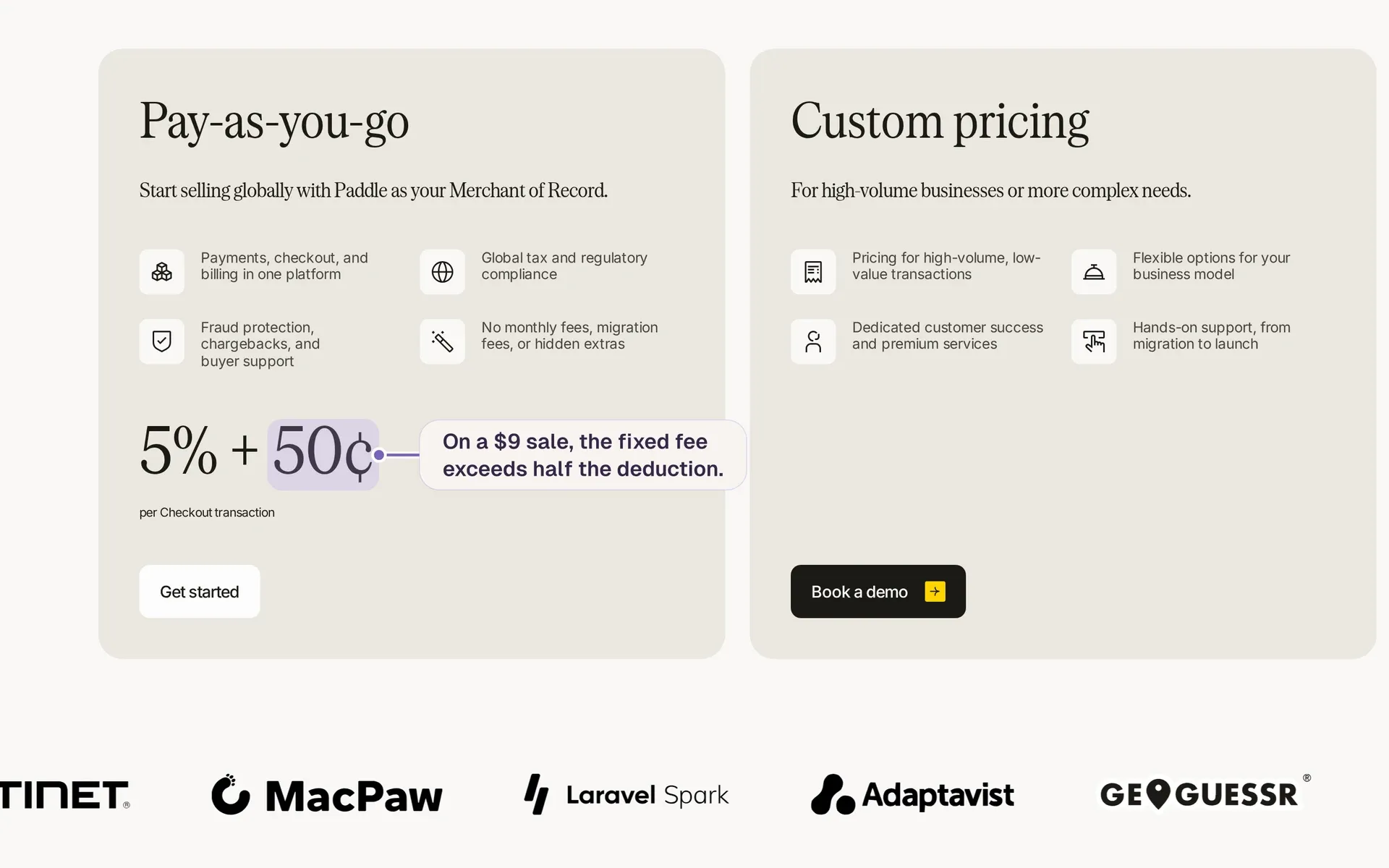
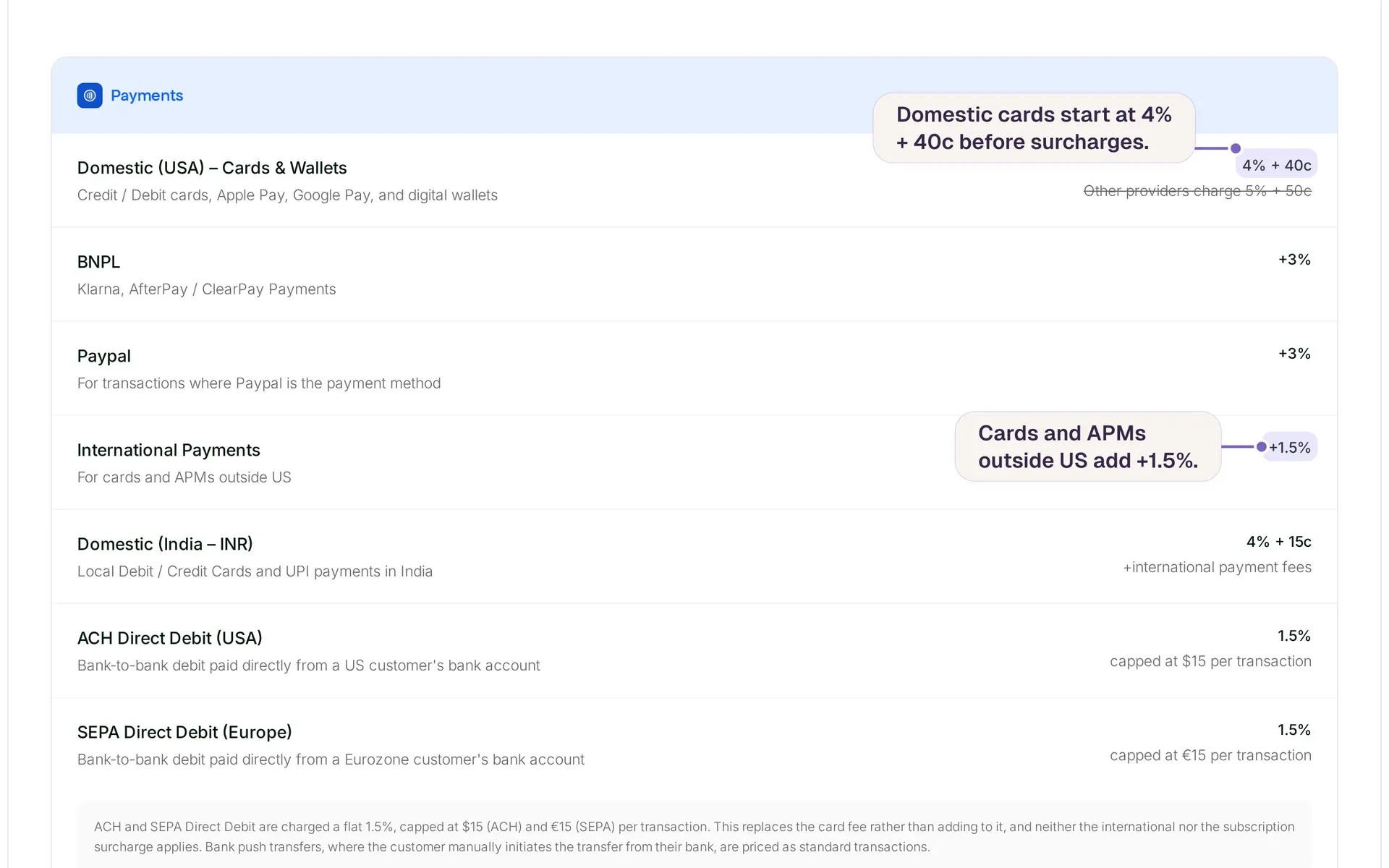
Paddle’s headline formula is sale amount × 5% + $0.50. On a $9 sale, the percentage comes to $0.45 and the fixed fee adds $0.50, making up more than half the deduction. Dodo Payments publishes 4% + 40¢ for US domestic cards and wallets, and adds 1.5% for payments from outside the US and 0.5% for subscriptions and usage billing.
Fee math on $9, $29 and $100 sales
These Paddle calculations leave out tax and additional charges. The amounts remaining are transaction proceeds, before payout costs or product expenses.
| Sale | Paddle fee | Paddle remaining | Effective rate |
|---|---|---|---|
| $9 | $0.95 | $8.05 | 10.6% |
| $29 | $1.95 | $27.05 | 6.7% |
| $100 | $5.50 | $94.50 | 5.5% |
On a $100 international subscription payment, Dodo’s 4% + 40¢ plus its 1.5% and 0.5% surcharges come to $6.40, leaving $93.60. Paddle’s headline calculation leaves $94.50, while Creem leaves $95.70 after its $4.30 base fee.
Across an illustrative 100 payments of $100 each, Paddle’s headline fees total $550 and Creem’s base fees total $430. That puts the transaction-fee difference at $120.
At $9, Creem’s 3.9% + 40¢ takes about $0.75, saving roughly 20¢ against Paddle. When the fixed fee exceeds half the total deduction, I would change the offer first if buyers accept annual billing or a higher tier.
Twelve monthly Paddle charges incur $6 in fixed fees, compared with $0.50 for one annual charge, saving $5.50.
A $90 annual offer also gives up $18 compared with twelve $9 payments, so the discount needs its own justification. If $9 monthly has to stay, compare providers at that price and count the cost of any extra features you need.
Billing models: subscriptions, seats, usage and credits
Recurring payments and consumption-based charges do different jobs. A flat subscription charges the same amount each period, while usage pricing ties the bill to what the customer consumes.
For an illustrative AI offer, a $10 monthly membership costs the buyer $10 for either 100 or 300 generations. At $0.10 per generation, those same usage levels produce bills of $10 and $30, so the second offer needs measured consumption to calculate the charge.
Test how each platform handles the charging behavior you need:
- Flat subscriptions. Can it collect the recurring price on your chosen billing cycle?
- Seats. Can the charge follow the number of paid seats?
- Metered usage. Can measured consumption determine the amount billed?
- Prepaid credits. Can customers buy a balance that decreases correctly as they consume the product?
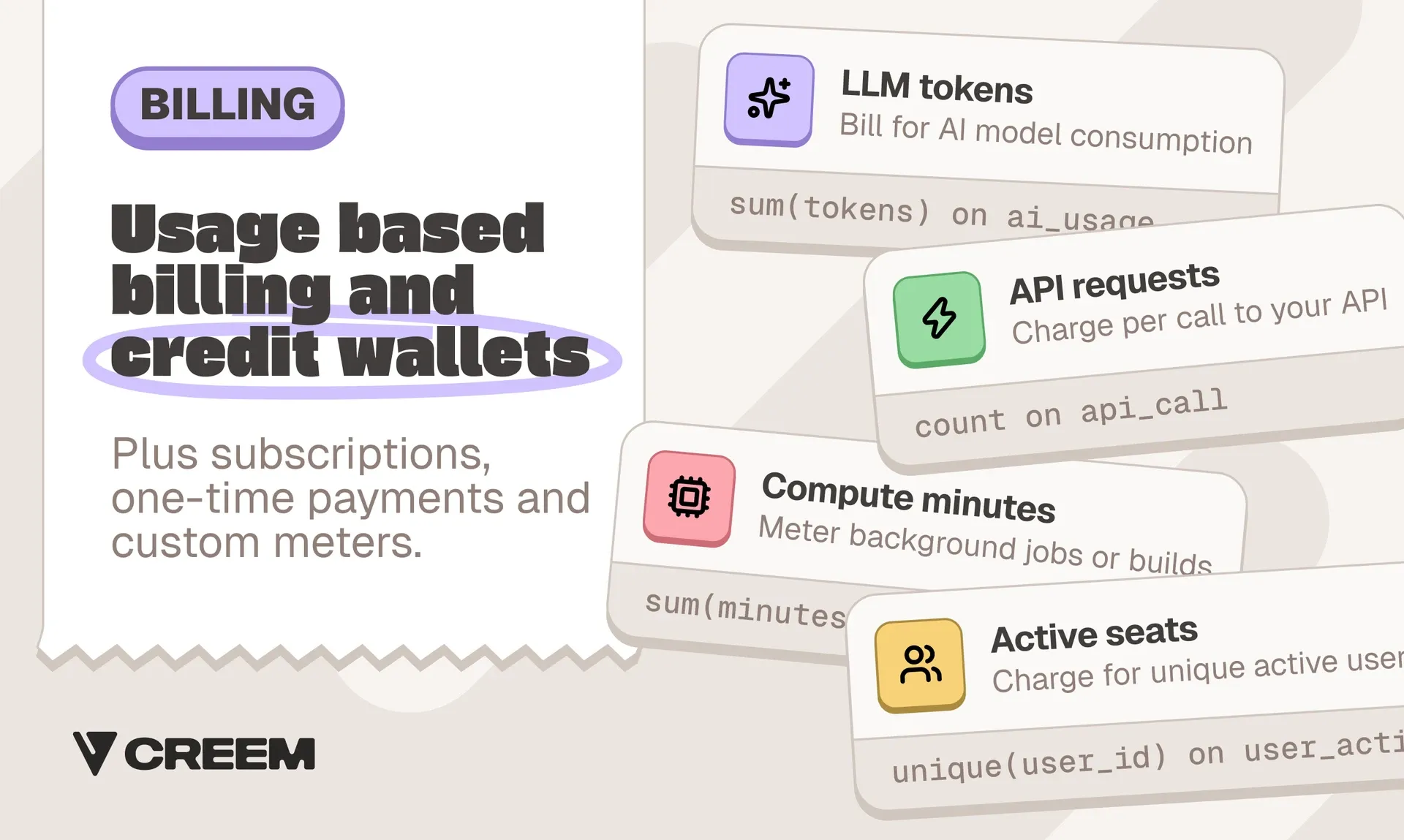
Creem supports subscriptions, seats, custom usage meters, postpaid metered invoices and prepaid credit wallets with auto-refill. To protect compute margin, test duplicate usage events, exhausted credits, failed refills and access after payment failure against your product’s rules.
Checkout and global payment methods
Your international buyers need a checkout they recognize and a payment method they can use. Checkout format tells you where they pay, while payment-method coverage tells you how they pay.
A buyer could see a price in their own currency and still reach a checkout without their preferred payment method. Keeping checkout on your site would address the handoff, not the missing method, so a currency count cannot answer either question.
Compare Paddle and Dodo Payments against the same buyer journey:
- Checkout format. Paddle offers overlay and inline checkout through Paddle.js. Dodo offers hosted, overlay and inline checkout, plus static payment links you can share without code.
- Payment methods. Paddle lists 18 methods, including cards, Apple Pay, Google Pay, PayPal, iDEAL, Pix and UPI. Dodo lists cards, Apple Pay, Google Pay, UPI, Pix, iDEAL and Klarna among its methods, and says PayPal is temporarily unavailable for new transactions.
Paddle prices in over 30 currencies and Dodo in 80+. Walk through each checkout for your buyers’ countries and check the payment options shown before committing to an integration. I would judge coverage by those markets and track checkout completion rate by country.
Tax, invoices and what stays your job
Paddle or Dodo Payments handles customer transaction taxes and buyer invoices for sales where it acts as merchant of record. Your business accounting and income taxes are still your job.
| Responsibility | Paddle | Dodo Payments |
|---|---|---|
| Customer transaction tax | Calculates, collects and remits required VAT, GST, sales tax and local equivalents on digital-product sales | Calculates, collects, files and remits transaction taxes on full-service merchant-of-record sales |
| Buyer invoices | Issues compliant buyer invoices | Issues buyer invoices as the merchant of record |
| Eligible B2B purchases | Applies reverse charge to qualifying cross-border purchases with a valid VAT ID | Validates business tax IDs and applies reverse charge to eligible purchases |
For example, an eligible business buyer may pay without VAT being collected at checkout because reverse charge applies. The buyer then accounts for VAT in its own return, so a business purchase is not automatically tax-exempt.
The buyer’s invoice records a different transaction from your payout. Paddle generates a Reverse Invoice when it pays you as the supplier, but that document is separate from the customer invoice and does not replace your local seller-documentation obligations.
You still build, supply and support the software. I would ask your accountant to review a sample buyer invoice and the supplier payout documents before you choose, so the customer sale and your business income are recorded separately.
Payouts, integration and switching costs
If sales fund compute or payroll, taking a payment is not the same as having cash you can spend. Dodo can accept live payments before payout activation, which requires approved verification forms and a completed monitoring review, so finish those checks before relying on the balance.
Dodo’s scheduled payout dates are when transfers start, so budget around when the money reaches your bank. The payout amounts it displays are reference amounts, and the final amounts depend on exchange rates at transfer.
Receiving-bank conversion and intermediary-bank charges can reduce your Dodo payout without showing up on its payout invoice.
Subscription portability also affects what it costs to leave Paddle:
- Paddle exports. Payment details transfer within two weeks after the receiving vault passes security checks. That clock starts after clearance, rather than at your request.
- Dodo imports. Saved cards can be imported, while wallet-paying customers must add a card again.
Dodo’s subscription import charges the full product price without coupons, discounts or promotions. To keep discounted or legacy prices, create products at each subscriber’s exact reduced rate.
Existing renewals can stay on Paddle while new buyers use Creem checkout from day one, so there is no single cutover day. Existing subscribers move over at their own renewal.
The one-time migration cost includes checkout and webhook engineering and reconciliation. Divide that cost by monthly fee savings at today’s volume to calculate payback in months, so an illustrative $1,200 move saving $400 monthly pays back in three months.
I would proceed around that three-month mark, but beyond a year, fees alone would not justify the move. A slower payback needs another concrete benefit, such as usage billing or built-in affiliates.
Use your negotiated Paddle rate and applicable feature charges in that calculation, including Creem’s 5% charge on recovered carts. Payback depends on the costs your sales actually incur.
Paddle vs Dodo Payments: comparison at a glance
Once your international SaaS has settled on a charging model, compare how each provider handles billing and what it deducts at the same order value.
| Decision point | Paddle | Dodo Payments | Creem |
|---|---|---|---|
| Merchant of record | Yes | Yes, on full-service MoR transactions | Yes |
| Product focus | Established software and SaaS | Newer, often usage-priced products | SaaS and AI products |
| Published transaction rate | 5% + $0.50 headline rate | US domestic 4% + 40¢, +1.5% international, +0.5% subscriptions | 3.9% + 40¢ per successful transaction |
| Amount remaining from $29 | $27.05, excluding tax and additional charges | $27.44 on a US domestic one-time sale | $27.47 after base transaction fees |
The amounts remaining are proceeds from the transaction, before payout costs.
Which one should you choose: Paddle or Dodo Payments?
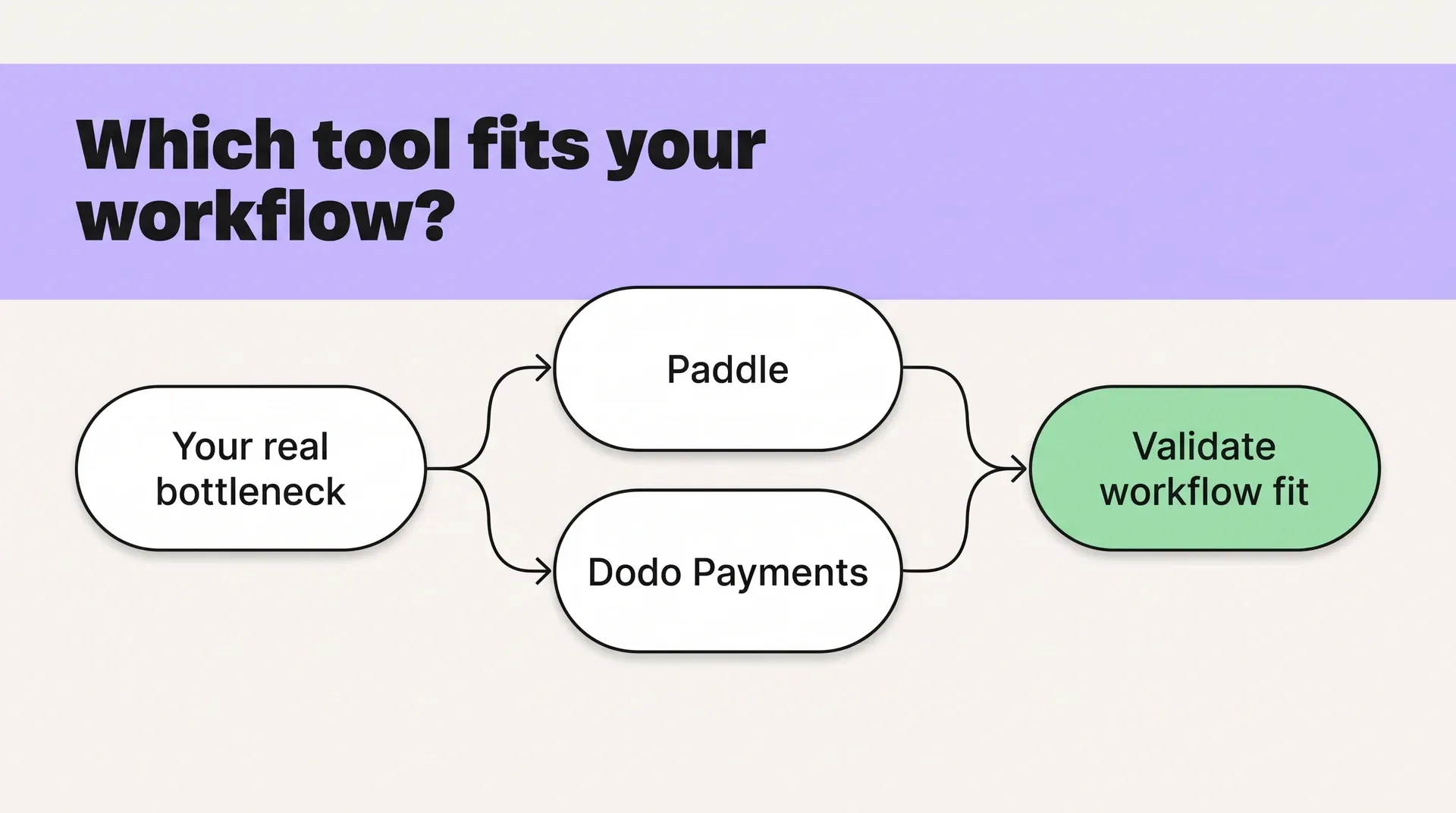
I would start with Paddle for fixed recurring plans and evaluate Dodo Payments for consumption-priced products, then use sales mix and switching costs to decide when both fit.
A global SaaS selling standard subscriptions
For a SaaS charging the same amount each month, Paddle is my starting point. Its mature subscription billing fits that job without tying the charge to consumption measurement.
Dodo belongs in the comparison if it handles the same subscription lifecycle and leaves you with more after the charges on your international sales.
An AI product billing on usage or credits
When the bill needs to track consumption, Dodo’s focus on usage-priced products makes it the more relevant starting point. A flat monthly membership needs different billing mechanics from a credit balance that generations draw down.
Prepaid credits collect payment before the corresponding compute is used. With either Paddle or Dodo, I would check that exhausted credits and failed refills enforce the product’s access rules before choosing it.
Low-ticket products where the fixed fee bites
Paddle’s $0.95 headline deduction takes 10.6% of a $9 sale. I would change the offer before switching providers if buyers accept annual billing or a higher tier, because the fixed fee makes up more than half that deduction.
If a low-ticket product has to keep its current price, I would choose between Paddle and Dodo based on the deduction at that price and the features the sale needs. Compare domestic one-time purchases separately from international renewals.
Already on Paddle and weighing a switch
On fees alone, I would stay on Paddle if your negotiated rate already matches or beats Creem at your order size, or if required add-ons wipe out the saving.
For a large subscription base, keeping existing renewals on Paddle and sending new sales to Creem keeps every renewal running as it is.
Pricing a third option? Creem at 3.9% + 40¢ with affiliates built in
Creem’s standard-plan base rate for merchant-of-record coverage is 3.9% + 40¢ per successful transaction, compared with Paddle’s published 5% + 50¢.
There is no monthly fee, setup fee or minimum volume, and you can pay affiliates and revenue partners through the same platform.
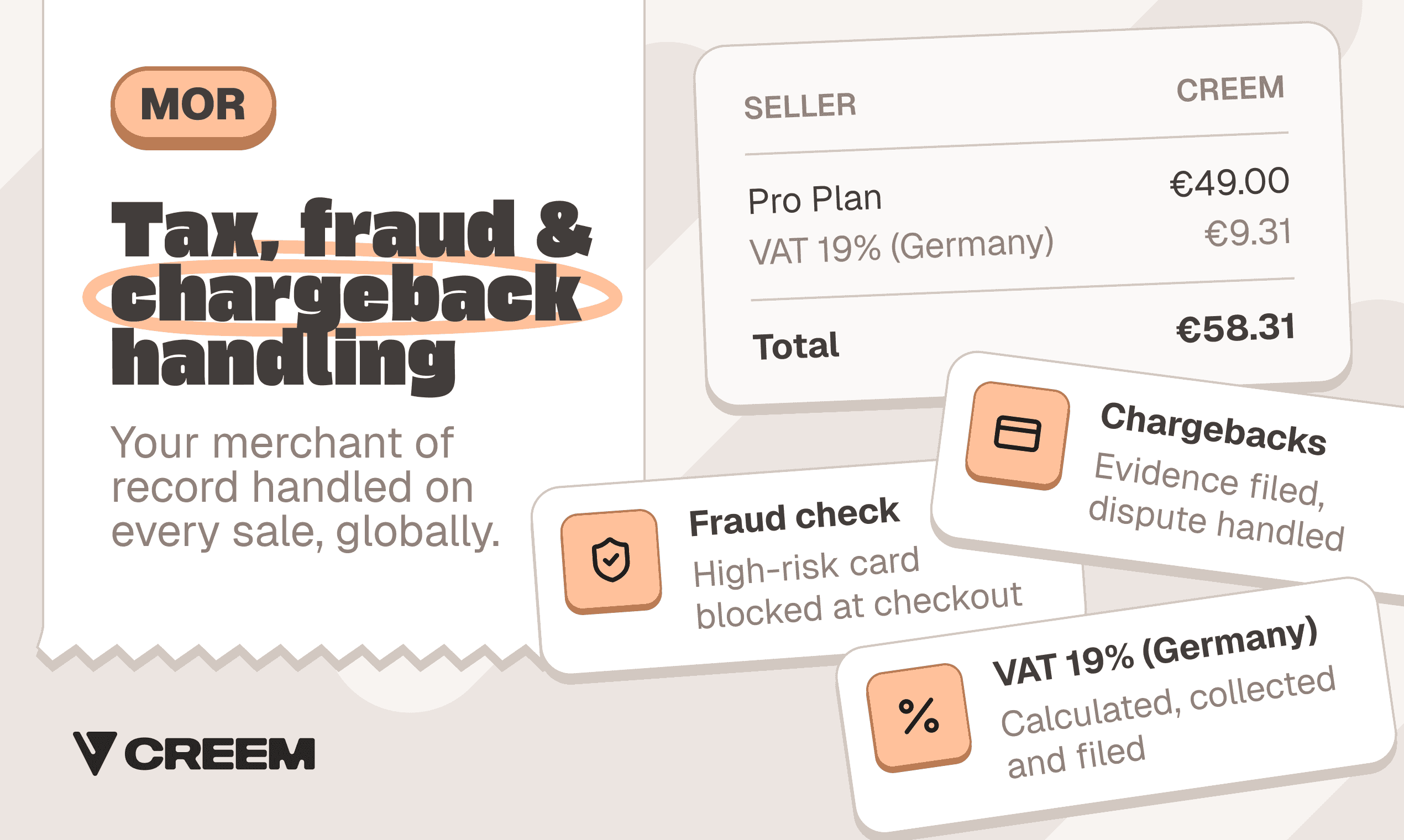
Creem becomes the legal seller, so the base transaction rate covers tax, buyer invoices, fraud screening and chargeback disputes.
Partners share referral links and get paid through Creem, which charges an additional 2% standard-plan affiliate fee before commission.
Marko Denic of Active Builders says, “When we started Active Builders, we needed two things: an easy payment processor and automatic revenue split. Creem handled both out of the box. Plus, they support affiliates natively too. Choosing them was a no-brainer!”
Standard-plan revenue splits add 2% before commissions, and global SaaS sales and affiliate payments can run from the same balance.
For tax handling and affiliate payments in the same money path, try Creem, then add your product.