
Open both pricing pages and you’ll see the same base rate: 5% + $0.50 per sale, before any surcharges. Both act as your merchant of record. Your buyer pays Paddle or Lemon Squeezy, and the platform takes responsibility for collecting and remitting VAT or sales tax on that sale.
The base fee won't decide between them. What your buyer gets after paying will. Paddle is built around subscriptions where your app decides what a customer can unlock.
Lemon Squeezy runs recurring plans too, and it also hands over a license key or file with the order. If the purchase itself is the product, you don't have to build that delivery yourself.
I'd start with Paddle if a plan unlocks features inside your software. If the sale ends with a key or a download, I'd start with Lemon Squeezy.
Stripe owns Lemon Squeezy, but ownership alone doesn't change what it can bill. For close calls, I'd look at Lemon Squeezy's surcharges on international sales and subscriptions, then at how long each platform takes to get money into your bank.
Usage billing and per-sale partner splits need a closer look. With either platform, you can still be the one maintaining the credit ledger or handling partner payouts.
Creem is a merchant of record too, at 3.9% + 40¢ per sale with no minimum volume. We built meters, credit wallets and partner splits into the same account, so you don't have to run that ledger or handle those payouts yourself. Try Creem.
Paddle vs Lemon Squeezy at a glance
Both start at the same base rate. The differences are in the surcharges and what each platform handles after the payment clears.
| Paddle | Lemon Squeezy | |
|---|---|---|
| Base fee per sale | 5% + $0.50 | 5% + $0.50 |
| Transaction surcharges | — | +1.5% for international sales, +1.5% for PayPal, +0.5% for subscriptions |
| Built for | App subscriptions where your software grants access | Recurring plans plus license keys and file downloads |
| License keys and downloads | You build fulfillment logic with Paddle Billing | License keys and downloads included |
| Owned by | — | Stripe |
I’d lean toward Paddle when a subscription determines what a customer can use inside your software. Lemon Squeezy is the more direct fit when a purchase needs a license key or digital download, though it also supports recurring plans.
The core difference: subscription billing vs packaged delivery
A renewal fails, and your app has to decide whether the customer can still use it. A buyer pays for a download, and they need the file. Both start with billing, but the work after the charge is different.
With Paddle, your app decides access based on billing status. That fits a product where payment determines what a signed-in customer can use. Lemon Squeezy can deliver a license key or download with the order, so you don’t have to build that delivery step into your checkout integration.
Uneed is an example of the first setup. Customers buy a Pro subscription ($99/year) or one-off launch services inside its platform. There’s nothing to download. daisyUI’s templates and Figma library ($19 to $69) show the other setup, where customers buy digital products to use in their own projects.
The quickest filter is what the buyer does next. If they open your app, Paddle fits because access lives there. If they receive a key or download, Lemon Squeezy fits because delivery can happen with the order. Charging monthly doesn’t settle the choice on its own.
Can your business use either platform?
A good billing fit does not guarantee account approval. Paddle and Lemon Squeezy both review your business and your product before they can sell on your behalf.
The provider’s name appears on the buyer’s invoice and card statement, and it takes responsibility for collecting and remitting the transaction tax. That responsibility is why it decides which businesses and products it will put its name on.
There’s another check for enterprise deals. If a customer’s contract requires your company to be the seller of record, a merchant of record cannot fill that role for that sale.
If the merchant of record can be the seller, the next question is how the customer pays. Paddle Billing issues invoices with payment terms, such as payment due 14 days after issue, which customers can pay by bank transfer or through Paddle Checkout. Paddle positions these invoices for bigger deals, such as enterprise plans.
Lemon Squeezy sells through its checkout, without invoices on payment terms or a purchase-order workflow. If a customer’s finance team pays by invoice, Paddle has a route for that sale and Lemon Squeezy does not.
Approval comes first, because billing or license code written for a platform that rejects you is wasted work.
Subscriptions, usage billing, and license delivery
Both platforms handle subscriptions, trials, upgrades and downgrades, and both chase failed renewals. Lemon Squeezy sends customizable failed-payment reminders with a hosted form where customers can update their card.
Paddle retries failed renewal payments, and its 5% + 50¢ also covers buyer support, fraud protection and chargebacks. If a subscriber has a question about a charge, they reach Paddle before they reach you.
Usage is where the choice gets harder.
For usage, the first choice is when to collect money. Postpaid billing charges after consumption. Prepaid credits collect money first, then usage draws down a balance. For an AI product, that determines whether you fund compute before the customer pays you.
Lemon Squeezy: charge after consumption
Lemon Squeezy bills the consumption you report after it happens. At its metered checkout, the buyer pays nothing for usage. A setup fee is the only exception, so your product serves the compute first and collects the usage payment later.
That metered workflow does not provide prepaid credits at checkout. If upfront payment is essential, you need a different credit-selling setup.
Paddle: native usage or seller-managed charges
Paddle homepage: “Sell globally. Grow without the complexity.” with demo and get-started buttons and customer logos
Paddle’s native usage billing is in early access. It covers units included in a subscription, usage events you send, and customer balances. Until you have access, plan around its seller-managed routes.
For postpaid billing, your application measures consumption and calculates the charge, which Paddle adds to a transaction. For prepaid credits, the customer buys a credit pack as a one-time product, and your app keeps the balance.
I’d decide prepaid or postpaid first. If you choose prepaid, budget the credit-ledger work before comparing billing features, because Paddle’s one-time-product route leaves it with your app, and Lemon Squeezy’s metered checkout doesn’t supply it.
Pricing: what you actually pay
A $100 international subscription leaves $94.50 after Paddle’s base fee and $92.50 on Lemon Squeezy once its two surcharges apply.
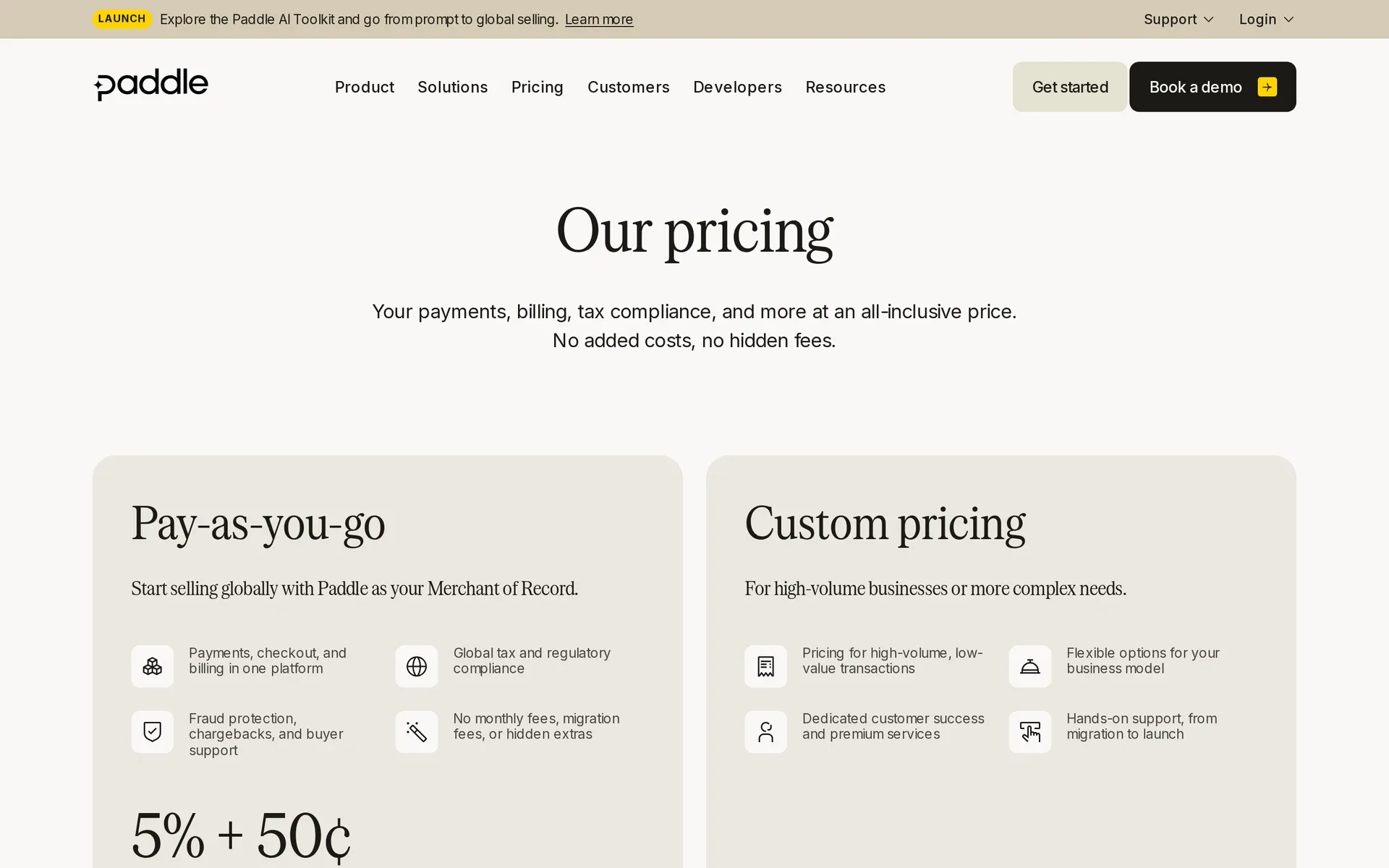
Paddle pricing page: Pay-as-you-go at 5% + 50¢ alongside custom pricing for high-volume businesses or complex needs
| $100 international subscription | Paddle | Lemon Squeezy |
|---|---|---|
| Base percentage fee | $5.00 | $5.00 |
| International surcharge | — | $1.50 |
| Subscription surcharge | — | $0.50 |
| Fixed transaction fee | $0.50 | $0.50 |
| Total listed transaction fees | $5.50 | $7.50 |
| Left after listed transaction fees, before tax, conversion and payout deductions | $94.50 | $92.50 |
If you bill 100 international subscribers $100 a month, Lemon Squeezy’s surcharges cost $200 a month. That adds up to $2,400 a year above the base fees.
I’d split your sales into four buckets to work out what Lemon Squeezy adds to its base percentage:
- One-time sales without the international surcharge: +0%.
- Subscriptions without the international surcharge: +0.5%.
- International one-time sales: +1.5%.
- International subscriptions: +2%.
Both platforms charge the $0.50 fixed fee on every transaction. With Lemon Squeezy, PayPal adds another 1.5% in every bucket.
Those are the self-serve list rates. Paddle offers custom pricing for high-volume businesses, and its pricing FAQ directs sellers with products under $10 to contact it for bespoke pricing.
The fixed fee explains why. On a $5 sale, the 50¢ alone is 10% of the price, bringing Paddle’s listed fees to 75¢, or 15%.
Paddle’s custom plans also include a dedicated customer success contact and hands-on support from migration to launch. Lemon Squeezy’s sales team offers custom packages too, with volume discounts and priority support.
If your price is under $10 or your volume is high, I’d get a quote from both before comparing the list rates above.
Payouts, refunds, and cash flow
The amount left after transaction fees still has to reach your bank. If that money funds your next compute bill, checkout revenue and available cash are different numbers.
Lemon Squeezy: allow for the wait and transfer costs
In Lemon Squeezy’s payout example, a sale on the 4th is paid out on the 28th, after a 13-day settlement hold and payout batching. Bank arrival takes another 1–5 days, putting the money in your account roughly four weeks after the charge.
If you receive a $1,000 payout to a non-US bank account, the 1% payout fee leaves $990 before currency conversion. Non-US PayPal payouts cost 3%, capped at $30, and arrive in USD, with PayPal’s conversion and withdrawal charges on top.
For US bank accounts, Lemon Squeezy adds no payout fee. US PayPal accounts pay a flat $0.50 per payout. Both bank and PayPal payouts run twice a month.
A refund comes out of your next payout, minus the platform fee Lemon Squeezy took on the sale.
Some Lemon Squeezy sellers have reported disabled payouts and unanswered support messages. I'd check how payout reviews and support work before your store depends on them.
Paddle: check refund deductions
Paddle’s refund and chargeback reports show the fees it kept, which can explain a payout below sales minus refunds.
Paddle pays monthly, with no on-demand withdrawals. The payout threshold starts at $100, and you can raise it as high as $100,000. A balance below your threshold rolls into the following month. Payouts go by bank transfer or Payoneer. Wire transfers cost 15 USD, EUR or GBP, and ACH transfers have no added fee. If currency conversion is needed, Paddle can add a margin of up to 1.5%.
Refunds on sales from earlier months can also be deducted from a later payout.
I’d allow roughly four weeks before spending Lemon Squeezy proceeds, based on its payout example. On Paddle, I’d check each payout against the refund report before counting the full amount as available cash.
Checkout, integration, and switching off Lemon Squeezy
Your new checkout can take a payment while existing customers still renew through Lemon Squeezy. If you sell only one-time products, the replacement checkout and fulfillment are the main work.
Paddle and Lemon Squeezy both offer pre-built checkout. For recurring revenue, I’d separate the migration into three jobs before setting a cutover date:
- New purchases: route buyers through the replacement checkout and deliver what they bought.
- Existing subscriptions: identify which platform charges the next renewal and how you’ll avoid double charges or missed renewals.
- Saved cards: determine whether subscribers need to enter their payment details again.
Before switching off the Lemon Squeezy integration, ask the new provider: “Can you move my active subscriptions and saved cards, or do my subscribers need to re-subscribe?”
Moving the billing records is only the visible half of the switch. Four pieces of back-office work come with it:
- Customer IDs: your app stores Lemon Squeezy customer and subscription IDs. Map each one to its new ID so access checks and webhooks keep working.
- Subscription states: active, trialing, past-due, paused and cancelled-but-paid-through subscriptions each need a matching state and renewal date on the new platform.
- Accounting: for the overlap months, two merchants of record send you payouts and reports, and refunds of older sales still come out of Lemon Squeezy payouts. With its roughly four-week payout cycle, the last Lemon Squeezy sales reach your bank about a month after the cutover.
- Support: customers will see a new name on their card statement and receipt. Prepare a short answer before the first renewal runs on the new platform.
In daisyUI’s case study, Pouya Saadeghi moved daisyUI’s products to Creem by hand in a few hours. Your subscribers need no cutover day either. Each one finishes the current billing cycle on Lemon Squeezy and renews through Creem when it ends.
Paddle vs Lemon Squeezy: which one should you choose?
Start with how your buyer gets what they paid for.
Choose Paddle if you run app subscriptions
Your customers sign in, and their subscription determines what they can use. I’d choose Paddle when your application controls access and there’s no file or license key to ship. Lemon Squeezy’s delivery tools save you little work in that setup.
Think of a B2B SaaS selling team plans. Smaller customers pay by card at checkout, while larger accounts move to annual invoices without recreating their subscriptions. Paddle quotes custom pricing once the volume is there.
The other case is a product sold mostly outside the US. On a $100 international renewal, Paddle leaves $2 more than Lemon Squeezy, and buyers can pay with local methods like iDEAL, Pix or UPI.
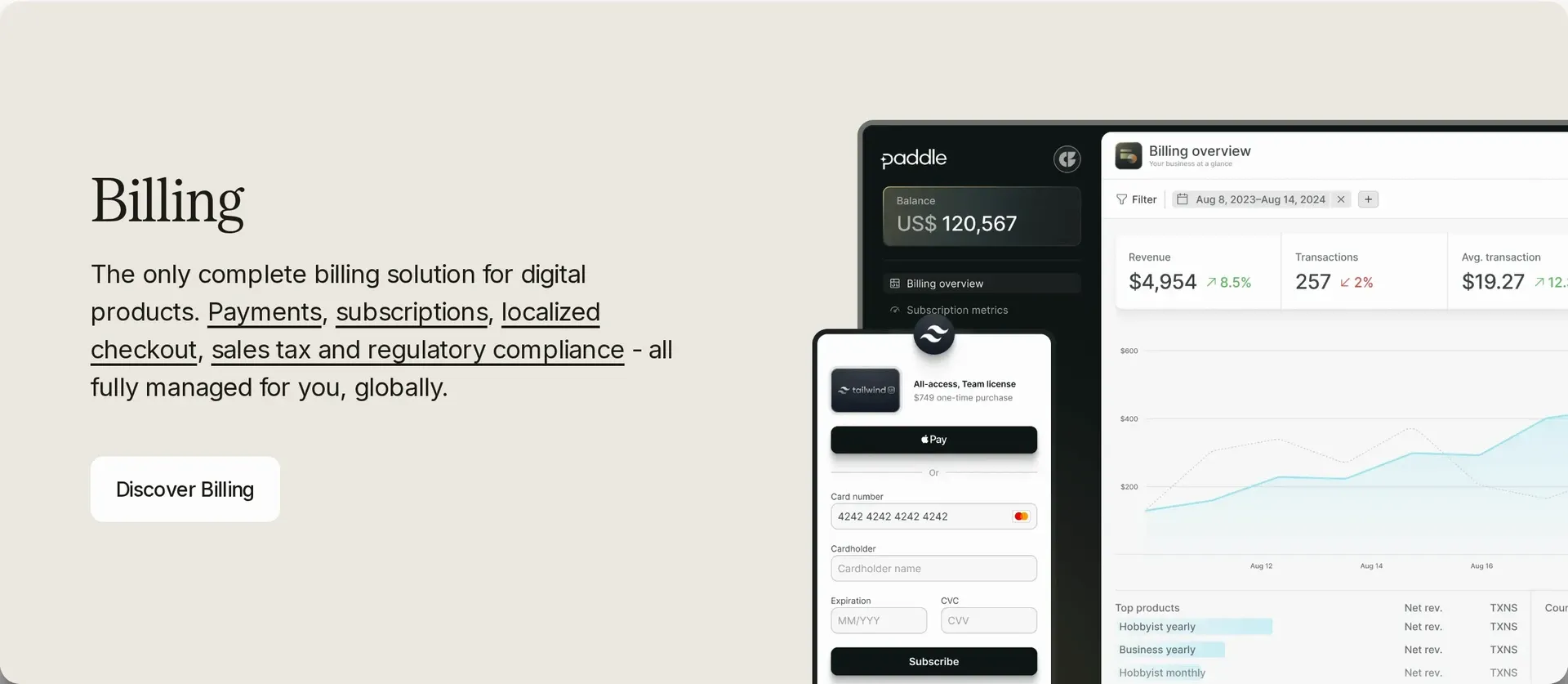
Paddle Billing dashboard and checkout preview.
If you meter usage or split sales among partners, those requirements need a separate decision before you pick either.
Choose Lemon Squeezy if you sell licenses or downloads
Lemon Squeezy homepage with its store dashboard: payments, tax and subscriptions for software companies
A purchase that ends with a key or download gives Lemon Squeezy’s built-in delivery a clear job. That’s where I’d favor it over building fulfillment around Paddle Billing.
A solo developer selling a $49 desktop app with a license key is the typical buyer. The key goes out with the order, and if you sell yearly renewals, it expires when the subscription ends. Setup is short because Lemon Squeezy’s hosted checkout, license keys and file delivery work without you having to build fulfillment code.
The limits show up when billing moves beyond a standard subscription. Usage is charged after it happens, and there are no invoices on payment terms.
Using the pricing buckets above, one-time sales skip the subscription surcharge. The fee gap is smallest for one-time sales without the international surcharge and largest for international renewals.
If you're already on Lemon Squeezy
If you're moving off Lemon Squeezy, be clear about the problem you're trying to fix. Payout problems that leave bills unpaid, support requests that go unanswered and block operations, or recurring surcharges that eat into margins are concrete reasons to make the move.
Needing to divide each sale among contributors is another trigger. Lemon Squeezy has no native way to handle that split, which is the gap daisyUI’s case study names.
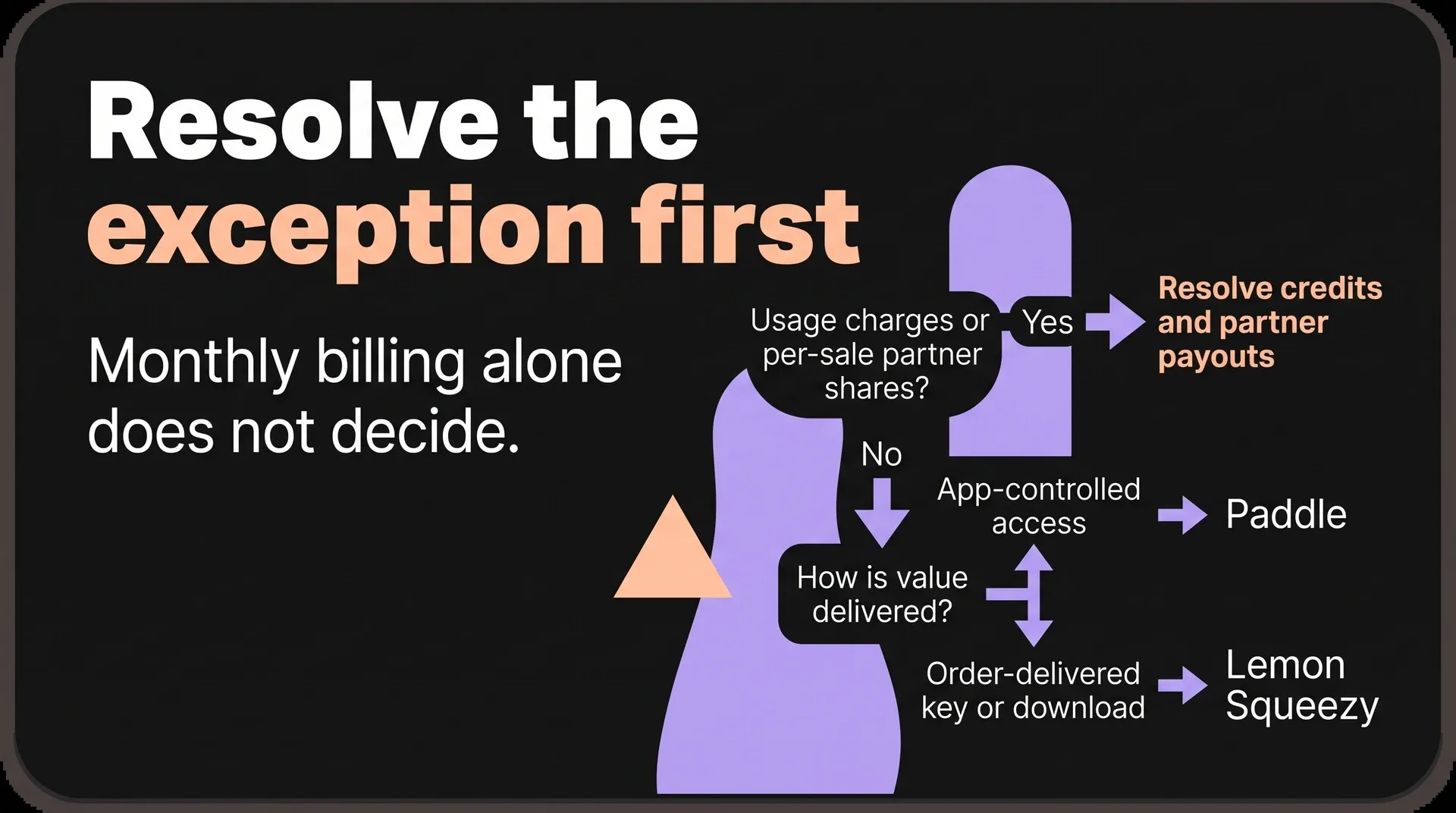
Paddle vs Lemon Squeezy decision tree prioritizing usage and partner payouts before choosing by delivery model
When neither fits how you charge
Prepaid credits are a different billing model, and neither platform fully covers it. Unless Paddle admits you to its early-access usage program, your app has to keep track of every customer’s balance. Lemon Squeezy’s metered checkout charges after the usage happens, not before.
If a co-founder or contributor gets a share of every sale, note that Lemon Squeezy does not have native revenue splits.
Usage needs meters and a credit balance
In Creem, a recurring product can have a price for each meter. Each meter can let a customer use a set number of units before the charge applies, and can cap the total. Metered charges sit on top of the base subscription.
For prepaid usage, the customer buys credits and each usage event draws down their wallet. Auto-refill tops it back up. An exhausted-credit notification tells your app when to stop serving more compute. Your application still reports usage and delivers the product.
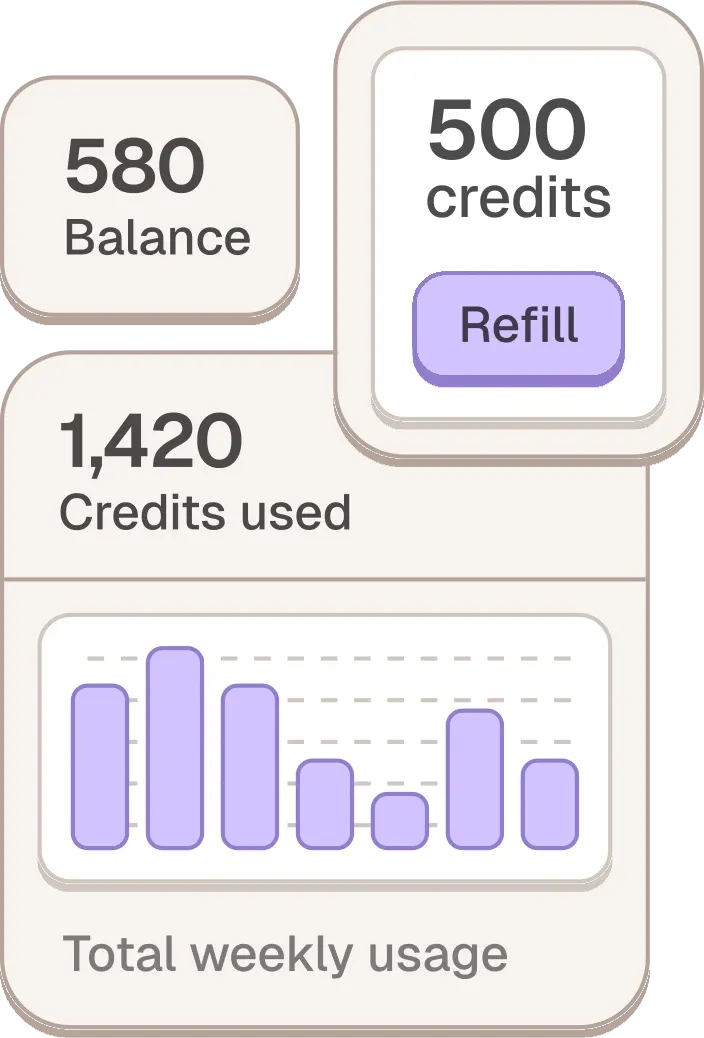
Creem credit wallet with a 580-credit balance, a 500-credit refill and weekly usage
Partners need their share of each sale
When a sale clears, Creem allocates each partner’s share from that sale and handles partner payouts.
Marko Denic of Active Builders said, “we needed two things: an easy payment processor and automatic revenue split. Creem handled both out of the box.”
For Uneed, the native affiliate program replaced a separate affiliate tool.
Those features have their own cost on the standard plan. Revenue splits add 2% of the transaction amount before commissions are distributed, and the affiliate platform adds 2% before affiliate commission.
Where Creem fits after Paddle and Lemon Squeezy
The fit comes down to what happens after payment. Paddle fits when a subscription controls what a signed-in customer can use in your app. Lemon Squeezy fits when an order delivers a license key or download, with its surcharges weighing most on international renewals.
Creem is a merchant of record too, so we are the seller on the receipt and we collect and remit the buyer's VAT or sales tax. On the same $100 international subscription, our listed fee is $4.30, which leaves $95.70 against $94.50 on Paddle and $92.50 on Lemon Squeezy. There is no monthly fee, setup fee or minimum volume.
You sign up and sell yourself, and existing subscribers move over at their own renewal. If you charge for AI usage or share each sale with partners, that sits in the same account too. We built meters, credit wallets with auto-refill and partner shares next to the tax and the invoice.
If you want the same tax coverage with more of each renewal left over, try Creem before you commit to Paddle or Lemon Squeezy.