

If you picked Polar for its developer-friendly setup, you probably assumed the hard part was settled. Polar is the merchant of record, so VAT and sales tax on your orders are handled for you.
Then the product grows. Partners start bringing in sales and their commissions need a separate tool. Or your product meters tokens and burns credits in ways Polar's billing doesn't match, and the gap ends up in your code.
Moving to fix that has its own risk. Pick a replacement on its headline rate and you can rebuild checkout and billing, only to find card surcharges, dispute fees and payout charges eating the difference. The eight merchants of record below are weighed on how much of that work they take off your hands, and what a $100 sale leaves with each.
If you're paying Polar's 5% + 50¢ Starter rate, try Creem. It's a merchant of record too, at 3.9% + 40¢ per sale.
Why look beyond Polar.sh?
Polar's headline rate is only part of the bill. Starter costs 5% + 50¢ per sale with no monthly fee, while the paid Pro, Growth and Scale plans trade a monthly fee for a lower variable rate.
The add-ons are what move the number:
- Cards issued outside the US carry an extra 1.5%, set by the card's issuing country, not your location or checkout currency.
- Each dispute costs $15, whether you win it or not.
- Payouts cost $2 per active month plus 0.25% + $0.25 each, and a cross-border payout that needs currency conversion adds 0.25% in the EU or 1% elsewhere.
On Starter, a $100 subscription paid with a UK-issued card loses $7.00 to the base rate and card surcharge, leaving $93.00 before payout charges. If most subscribers use non-US cards, that is closer to what you actually pay than the headline rate.
Affiliates are another reason to look elsewhere. Polar has no native affiliate program, so tracking partners and paying commissions happens outside Polar.
Rishi Raj Jain of LaunchFast had to maintain two separate code paths on Polar to sell through partners.
Then there is billing fit. Polar supports metered billing, but you need to test your own edge cases.
Walk credit top-ups, mid-cycle upgrades and cancellations with unbilled usage through Polar's metering to check whether the invoice matches what your product consumed.
Revenue sharing matters too. If a co-founder or contractor gets a cut of each sale, check whether each alternative pays their share from that same sale or leaves you wiring the money by hand each month.
1. Creem
Creem is the legal seller of your software. The same account runs usage meters, prepaid credit wallets, affiliates and revenue splits, with partner payouts and usage billing coming out of the same balance that pays the tax.
That legal-seller work covers tax collection and remittance for buyers in 190+ countries, invoices and chargebacks, at one rate of 3.9% + 40¢ per successful transaction.
Pricing
On a $100 sale, you pay $3.90 plus $0.40 and keep $95.70. There is no monthly fee, setup fee or minimum volume.
That rate applies to both one-time payments and subscription renewals, with no surcharge for international cards.
Tax, invoicing and dispute handling are included in that rate. On the standard plan, optional services cost extra, with 2% on affiliate sales and 2% on revenue splits before commissions, plus 5% on recovered carts.
Best for
Creem fits growing SaaS and AI startups selling subscriptions, usage or prepaid credits worldwide. It also suits teams with partners or co-founders who need to be paid from the same balance.
Pros and cons
Pros:
- Meters for LLM tokens, API requests, compute minutes and active seats, plus credit wallets with auto-refill.
- Native affiliate tracking with automatic commissions, and revenue splits paid on each sale.
- Checkout on your own domain or embedded.
Cons:
- Built for software and digital products, so physical goods need a different checkout.
- Sellers can sign up from 87 countries, a shorter list than the 190+ countries buyers pay from.
Compared with Polar.sh
Polar Pro charges $20 a month plus 3.8% + 40¢ per sale. Creem charges 3.9% + 40¢ with no monthly fee, so it costs less up to $20,000 in monthly sales. Past that line Polar Pro's base fees come in lower by a small margin: $80 on $100,000 in monthly sales, before card surcharges and add-ons.
The Creem team moves your existing Polar subscribers over for you as a custom migration, so there is no import to build and the switch starts with one message to the team.
Uneed's migration off Polar changed 1,500+ lines of payment code with 3 AI prompts and 0 integration errors. Thomas Sanlis gave "The short answer: lower fees" as his reason for the move. If you would rather pay only when you make a sale, with no monthly fee, try Creem.
2. Paddle
Paddle's public merchant-of-record homepage.
Paddle is a merchant of record, so it is the legal seller of your software and handles tax, fraud and chargebacks.
Its base pricing does not undercut Polar Starter. The difference is implementation, advisory and risk help scoped into your contract.
Pricing
Pay-as-you-go costs 5% + 50¢ per Checkout transaction, with no monthly fee or subscription-migration fee. On a $100 sale, Paddle deducts $5.00 and $0.50, leaving $94.50 before payout fees.
The published rate stays fixed unless you negotiate custom terms. That matters as your subscription business grows, because more sales alone will not move you onto a cheaper self-serve tier.
Best for
Paddle suits established subscription software teams that want implementation and risk help included in their service agreement. The published transaction rate may still be more per sale than a team watching its margins wants to pay.
Pros and cons
Pros:
- Contract-scoped implementation, advisory and risk assistance give your team defined support beyond payment processing.
- Negotiated pricing can change the cost at your volume, though no single discounted rate applies to every seller.
Cons:
- SWIFT payouts cost up to US$15, €15 or £15, and converting payouts into another currency carries a margin of up to 1.5%.
- Subscription changes are restricted while a subscription is past due or close to renewal.
- Sellers report payout timing problems and surprise refunds.
Compared with Polar.sh
Polar Starter also charges 5% + 50¢ with no monthly fee, so the base transaction cost is identical. Polar's paid plans publish lower rates, while getting a lower rate with Paddle means negotiating.
I would shortlist Paddle when its contract services cover work your team needs help with. Switching from Starter solely for a lower published transaction fee does not make sense, and payout charges still belong in the calculation.
3. Stripe Managed Payments
Stripe's Managed Payments page with its global payment illustration.
Stripe Managed Payments lets you use Stripe as the merchant of record for eligible automated digital products. Stripe files and remits tax only in supported jurisdictions.
Pricing
Stripe charges an extra 3.5% per successful sale on top of standard US card processing at 2.9% + 30¢. A $100 sale leaves:
- Domestic card: $93.30.
- Non-US card with conversion: $90.80, after another 1.5% for the card and 1% for conversion.
These figures exclude Tax, Billing and other payment-method costs.
Best for
Software sellers adding merchant-of-record coverage to selected markets.
Pros and cons
Pros:
- Enable coverage by market, product or transaction.
- Fraud prevention, dispute responses and support for individual transactions through Link are included.
Cons:
- Unsupported jurisdictions leave tax compliance with you, and invoices carry your business name and tax details.
- Subscriptions must start through Checkout or Payment Links, excluding embedded web-component payment flows.
Compared with Polar.sh
A $100 sale leaves $93.30 with Stripe on a domestic card and $90.80 on a converted non-US card, compared with $94.50 on Polar Starter.
I would shortlist Stripe for its selective coverage, not as an outright Polar replacement. The tax exceptions and subscription restrictions still leave work for teams that want to hand off global billing in full.
4. FastSpring
FastSpring's public payments, subscriptions and tax-compliance homepage.
Your B2B buyer needs a quote before they can pay. FastSpring is the legal seller of your software, with quoting tools and implementation specialists to help with the rollout.
Pricing
FastSpring negotiates transaction rates by payment type and volume. Eligible ACH and wire payments get discounted rates.
Best for
FastSpring suits established software publishers whose sales go through procurement, quotes and contracts.
Pros and cons
Pros:
- Buyers can receive formal quotes from the same platform that bills them.
- Dripify worked with FastSpring's implementation specialists on its rollout.
- HomeDesigns AI uses FastSpring for automatic billing, checkout, scheduled payments and quotes.
Cons:
- No public transaction rate means you can't calculate what a $100 sale leaves until you have a quote.
- Interactive Quotes fees are set in your order form, with a year payable upfront unless the contract says otherwise.
Compared with Polar.sh
I see FastSpring as a fit when you need B2B sales work taken off your plate. Unlike Polar, it has no published rates for a self-serve SaaS team to price the move. Shortlist it when quoting and implementation help justify reviewing negotiated terms.
5. Lemon Squeezy

Lemon Squeezy's public software payments and subscriptions hero.
Lemon Squeezy is a merchant of record with affiliates and abandoned-cart emails built in. Both add fees on top of the base checkout rate.
Pricing
The base fee is 5% + 50¢ of the order total, including tax, so a $100 order leaves $94.50 before any surcharge.
- Subscriptions add 0.5%. International payments and PayPal each add 1.5%.
- Affiliate referrals cost merchants 3% plus commission. Affiliates pay 2% on their payouts.
- Abandoned-cart email recovery adds 5% on recovered payments.
Best for
It suits digital-product sellers who use partners and email follow-ups to bring buyers back.
Pros and cons
Pros:
- Affiliates are built in, at 3% plus commission per referred sale.
- US bank payouts have no payout fee.
Cons:
- Fees use tax-inclusive order value, so the base-fee result isn't what you keep after tax remittance.
- Non-US bank payouts cost 1%.
Compared with Polar.sh
Polar Starter matches the base rate and has no subscription surcharge. I would weigh the convenience of built-in affiliates against the extra fees on renewals and referred sales, because the headline rate alone doesn't show that trade-off.
6. PayPro Global

PayPro Global's public software-sales homepage header.
PayPro Global acts as the legal seller for software and SaaS and handles tax. Ranktracker uses it for localized checkout, but pricing requires a quote.
Pricing
There is no published percentage or fixed per-sale fee, so there is no $100 comparison yet. Withdrawals carry separate charges:
- US ACH costs $3, wire $21 and Payoneer $2.
- PayPal is fee-free in the US and Canada. International PayPal costs 2%, capped at $20.
Best for
It suits established software publishers who are willing to negotiate a rate rather than pick a published one.
Pros and cons
Pros:
- Multiple scheduled withdrawal accounts and routes, with explicit charges.
- Acts as the legal seller for software and SaaS and handles tax, with localized checkout.
Cons:
- Per-sale costs require a commercial conversation.
- Payouts use the previous month's closing balance.
- Multiple accounts aren't revenue splits. Later accounts receive only what remains after earlier accounts are paid.
Compared with Polar.sh
Polar publishes its plan rates upfront. I would compare the full contract before treating PayPro Global as a way to cut costs.
Until PayPro Global quotes its per-sale fee, FX and reserve terms, there is no number to compare with a Polar bill.
7. 2Monetize by Verifone
The public 2Checkout platform homepage for Verifone's commerce services.
With 2Monetize, Verifone resells your digital goods as the legal seller. You need to describe each product accurately so Verifone can represent it correctly to buyers.
By default, the previous month's sales are paid on the 16th of the next month, or the next business day, once your balance reaches 100 USD, GBP or EUR.
Other schedules need Finance approval. A charge on the 1st can therefore take about six weeks to reach you.
Pricing
2Monetize publishes no per-sale rate, so the commercial quote sets your transaction cost. Standard pricing covers credit cards and PayPal, with no extra charge for fraud protection or recurring payments, and professional services from Verifone carry a separate fee.
Verifone sets a risk deposit for each merchant and holds it on a rolling 90-day basis. Refunds or chargebacks can push that deposit higher, leaving less money available for payout even while sales keep coming in.
Best for
Established software and digital-goods sellers that can negotiate a quoted rate and carry operating costs across a monthly settlement.
Pros and cons
Pros:
- Usage-based billing is included, giving software sellers a way to charge for consumption within the merchant-of-record package.
- Standard pricing covers credit cards and PayPal, with no extra charge for fraud protection or recurring payments.
Cons:
- No published per-sale rate means you can't model all-in transaction costs from public pricing before signing.
- Monthly settlement can leave compute bills and other operating expenses due before sales proceeds arrive.
- Each product needs a tax category, and uncategorized products default to Electronically-delivered software instead of SaaS.
Compared with Polar.sh
Polar Starter gives you a published transaction rate to budget against. 2Monetize has no public $100-sale figure to compare it with.
I would consider the move only if the quoted costs and settlement terms work together for your business. A lower transaction fee does not help much if you still need cash to cover usage already consumed.
8. Cleverbridge
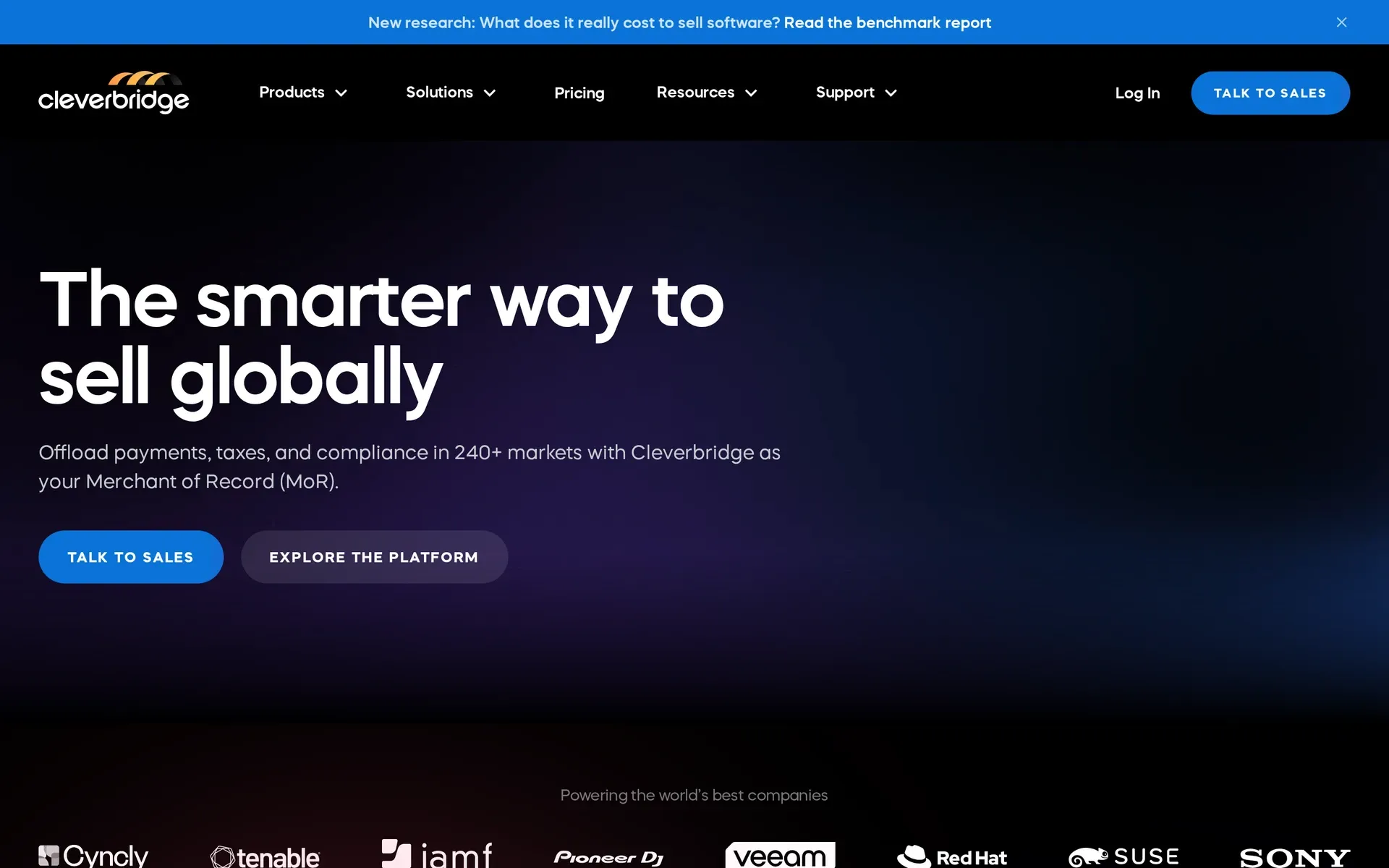
Cleverbridge's public merchant-of-record homepage.
Cleverbridge is a software merchant of record that manages fixed-term subscriptions. You negotiate the pricing rather than work from a published rate.
Pricing
Revenue share runs about 3.5% to 8% of GMV. At $1M to $10M annual GMV, initial quotes run about 5% to 8%, with negotiated rates around 4% to 6%.
Implementation is estimated at $10,000–$100,000 or more. Customer Support is optional and has its own commercial scope.
Best for
Cleverbridge suits established B2B software companies selling annual contracts, with renewal dates already on the calendar.
Pros and cons
Pros:
- For its customer Cyncly, Cleverbridge configured Mozaik's three-month paid trial to become a twelve-month contract billed monthly.
- Cyncly's migration rolled out in phases around existing contract renewals.
Cons:
- No published per-sale rate, plus a separate implementation cost.
- Your app must consume subscription notifications to keep subscription operations connected.
Compared with Polar.sh
I see the contract and migration work as useful for established publishers. For a startup comparing the cost of each sale, negotiated rates and implementation costs make the comparison with Polar's published plans less straightforward.
Polar.sh alternatives compared: fees, tax, and billing
On a $100 US-card sale, published base rates leave $93.30–$95.70 before add-ons. Stripe's foreign-card example leaves less than that. For four alternatives, you need a commercial quote before you can work out what the same sale costs.
| Platform | Base per-sale fee | Kept on a $100 sale | Billing and growth tools | Additional costs |
|---|---|---|---|---|
| Polar Starter | 5% + 50¢ | $94.50 | Metered billing, no native affiliates | +1.5% non-US cards, $15 per dispute, payout and FX fees |
| Creem | 3.9% + 40¢ | $95.70 | Meters, credit wallets, auto-refill, affiliates, splits | +2% affiliates, +2% splits, +5% recovered carts, payout transfer fees |
| Paddle | 5% + 50¢ | $94.50 | Not published | SWIFT up to $15, payout FX up to 1.5% |
| Stripe Managed Payments | 3.5% plus processing, eligible products and supported tax jurisdictions only | $93.30 US card, $90.80 non-US card with conversion | Not published | +1.5% non-US cards and +1% conversion already included in $90.80, Tax and Billing separate |
| FastSpring | Negotiated | Not published | Not published | Contract-scoped Interactive Quotes fees |
| Lemon Squeezy | 5% + 50¢ | $94.50 | Affiliates, cart recovery | +0.5% subscriptions, +1.5% international, +1.5% PayPal, +5% recovered carts, 3% affiliate referrals |
| PayPro Global | Quoted | Not published | Not published | Per withdrawal, Payoneer $2, wire $21, US ACH $3 |
| 2Monetize | Not published | Not published | Usage billing | 100 USD/GBP/EUR payout minimum, rolling 90-day risk deposit |
| Cleverbridge | Estimated 3.5%–8% of GMV, negotiated | Not published | Fixed-term contracts, renewal-aligned migration | Estimated implementation $10,000–$100,000+, Enterprise Commerce Suite $50,000–$200,000+ annually, FX 1%–2% above spot |
“Kept” is what remains after per-sale fees, but before tax remittance, other add-ons, commissions and payout fees. Lemon Squeezy calculates its fee on the tax-inclusive total.
Read the table against your own mix of US cards, non-US cards, renewals and referred sales.
Which Polar.sh alternative should you choose?
Most moves start with something you're still managing alongside Polar, like an affiliate tool, a spreadsheet for a co-founder's share, or usage code you maintain yourself. Shortlist replacements by the work they take over, then compare rates.
- When partners bring you sales, check affiliates and revenue splits separately. Lemon Squeezy has native affiliates but publishes no splits. Creem pays both from one balance, at 2% each.
- For an AI product priced on consumption, meters and prepaid credits decide whether billing work leaves your code. 2Monetize includes usage billing. Creem runs usage meters alongside auto-refilling credit wallets.
- Buyers who send purchase orders make this a procurement decision. Shortlist Paddle, FastSpring or Cleverbridge and compare their contracts.
- If every plan starts in Stripe Checkout or a Payment Link, Managed Payments keeps your Stripe integration. If a plan starts elsewhere, the integration doesn't carry over.
- Stay on Polar if its developer experience matters most and you don't need native affiliates or splits.
- If the rate is your only reason to leave, compare the "kept on a $100 sale" column at your monthly volume before you move.
Creem as Your Software Merchant of Record
If affiliate commissions need a second tool or a separate code path alongside billing, that is work your merchant of record should handle. Rishi Raj Jain of LaunchFast maintained two code paths for partner sales on Polar, and Creem's built-in affiliates replaced both.
I recommend Creem for growing SaaS and AI teams that want affiliate commissions paid inside their merchant of record. The balance that receives each sale pays the affiliate who brought it, so there is no separate payout run or month-end spreadsheet. Ordinary sales cost 3.9% + 40¢, which leaves $95.70 of a $100 sale against $94.50 on Polar Starter. Referred sales add 2% for the built-in affiliate program.
Open an account to try Creem and see how affiliate payouts would work for your own product.
FAQs
Is Polar.sh Really a Merchant of Record?
Yes. Polar acts as the merchant of record, so it is the seller on each order and collects and files the VAT and sales tax on those sales.
Polar.sh vs. Stripe: Which Is Better?
The choice comes down to who you want as the legal seller. With regular Stripe, your company stays in that role and handles VAT and sales tax registration and filing, while Polar takes it over. Stripe Managed Payments makes Stripe the seller for eligible products in supported countries.
How Much Does Polar.sh Cost?
Starter charges 5% + 50¢ with no monthly fee, Pro costs $20 monthly plus 3.8% + 40¢, Growth costs $100 monthly plus 3.6% + 35¢, and Scale costs $400 monthly plus 3.4% + 30¢ per transaction.
Cards issued outside the US add 1.5%, and each dispute costs $15 whatever the outcome.
As an illustrative $100-order example, Pro saves $1.30 per sale against Starter, so its monthly fee pays for itself at about 16 sales, roughly $1,600 in monthly sales.