
Many sellers picked Polar because the fee looked small. On Hacker News, a Lemon Squeezy seller who found its fees too high named Polar as the one to check. Since then the free tier has moved. New accounts pay 5% where it used to be 4%, and a solo founder writing on their own blog worked out that the new rate costs a quarter more.
The headline was never the full bill either. International card charges, payout transfers and any affiliate tool you connect sit outside it. Price your product on 5% alone and the difference comes out of your margin every month.
Last month's payments are enough to find your real rate on Polar. They also show whether a paid plan would earn back its monthly charge.
If you want tax and affiliate payouts on one balance, try Creem, which charges 3.9% + 40¢ per successful transaction with no monthly fee and an extra 2% for its affiliate platform.
Polar's plans and transaction fees
Polar has four public plans, Starter, Pro, Growth and Scale, and each charges separately for the monthly plan and each successful payment.
- Starter: You pay no monthly plan charge, and each successful transaction costs 5% + 50¢.
- Pro: $20 a month, and each successful transaction costs 3.8% + 40¢.
- Growth: $100 a month, at 3.6% + 35¢ per transaction.
- Scale: $400 a month, at 3.4% + 30¢ per transaction.
Starter has no plan charge even in a month with no sales, while transaction fees on every tier depend on both how much you sell and how many separate payments you collect.
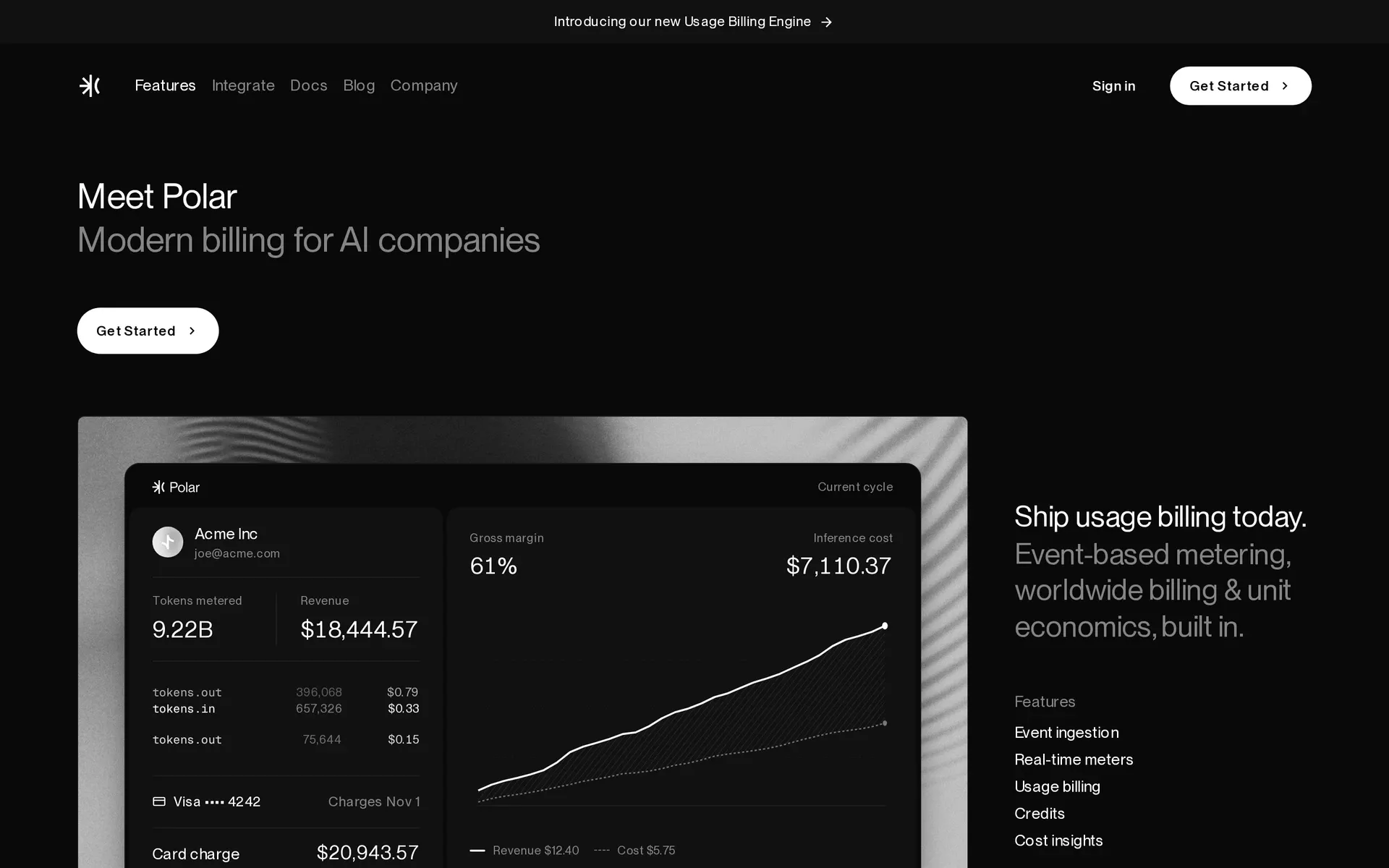
Polar homepage: “Modern billing for AI companies,” with a usage billing dashboard preview and feature list
How does the Polar bill behave?
On Starter, the 50¢ comes on top of the percentage fee for every payment, so Polar’s share is always more than 5%.
What the 50¢ fixed fee does to small payments
At Starter’s 5% + 50¢, a $10 payment costs $1.00 before international card or payout charges, taking 10% of the sale, double the 5% alone. A $29 payment costs $1.95, about 6.7%, with the fixed fee still adding roughly 1.7 points.
Low-price monthly plans and small credit top-ups feel this most because the same 50¢ takes a larger share. Divide 50¢ by your typical price and add the result to 5% to find your floor, so a $15 plan lands at about 8.3% before anything else.
International card and payout fees
Two more charges can sit outside the per-payment fee, and they come off at different stages.
An international card charge adds to the cost of accepting a buyer’s payment when their card was issued abroad, while a payout transfer charge comes off later when you move your balance to your bank.
The 5% + 50¢ formula leaves out both, so any card surcharge or payout charge that applies to your sales and withdrawals takes your actual rate above it.
What Polar costs at different sales mixes
The table uses what the buyer paid at checkout, including tax. The remaining amount is what is left after Starter's base fee, before any international card or payout charges and before the tax is paid to the authorities.
| Payment amount | Remaining after base fee | Effective transaction rate |
|---|---|---|
| $10 | $9.00 | 10% |
| $29 | $27.05 | About 6.7% |
| $100 | $94.50 | 5.5% |
| $500 | $474.50 | 5.1% |
The rate drops from 10% to 5.1% as the fixed charge becomes a smaller share of the price, so a product with lots of small payments sits near the top of the table.
On Starter, your monthly base fees are 5% of everything buyers paid at checkout that month plus 50¢ for each successful payment. The calculation works across subscriptions, credit top-ups and one-time purchases.
Pull last month's total charged and successful payment count from your billing export, then run those two numbers through the calculation. The payment count grows when the same sales volume comes from cheaper plans or smaller top-ups.
What Polar's fee covers (and what it doesn't)
The 5% + 50¢ covers the tax work. Polar is the merchant of record, so it collects VAT, GST and sales tax from buyers at checkout and remits it to the tax authorities.
That keeps tax collection and filing off your desk. A processor charges less per payment but leaves that work with you, which is why you might accept a merchant of record's higher rate.
Affiliates are outside that fee because Polar has no native affiliate program.
If partners or creators sell for you, you need a separate affiliate tool connected to Polar to track clicks, credit sales and pay commissions. That tool's charges sit on top of the 5% + 50¢ per payment.
Rishi Raj Jain, who builds LaunchFast, maintained "two separate code paths" to run distribution alongside Polar. Moving LaunchFast to Creem let him replace both with Creem's built-in affiliates.
If affiliates are part of your growth plan, budget for two Polar line items before adding international card or payout charges. One is transaction fees at your own payment sizes, and the other is what your affiliate tool charges per month or per referred sale.
When does a paid Polar plan pay for itself?
A paid tier pays for itself on base fees when the transaction-fee savings cover the extra monthly charge for a full month on that plan. Pro costs $20 a month more than Starter and saves you 1.2 percentage points plus 10¢ per payment.
The thresholds below compare base transaction fees and monthly charges for a full month on one plan, with additional fees left out.
| Upgrade | Extra monthly charge | Savings per payment | Break-even at a $40 average payment |
|---|---|---|---|
| Starter to Pro | $20 | 1.2 percentage points + 10¢ | About $1,379 |
| Pro to Growth | $80 | 0.2 percentage points + 5¢ | About $24,615 |
| Growth to Scale | $300 | 0.2 percentage points + 5¢ | About $92,308 |
At $1,379 in monthly payments averaging $40, Pro saves about $16.55 in percentage fees and $3.45 in fixed fees. Those savings add up to roughly the extra $20 monthly charge.
Below each threshold, the upgrade costs you more than it saves, and above it, you pay less in base fees.
Smaller average payments bring those thresholds down because you get the fixed-fee saving on more payments. If your average payment is closer to $10 than $40, you need less monthly volume to break even.
Early Member organizations need their own comparison because upgrading permanently gives up that pricing, and downgrading later puts you on Starter.
For standard tiers, start with last month's total charged and payment count, and compare Starter with Pro. Then work through each adjacent tier until the next upgrade's savings stop covering its extra charge, because costing less than Starter does not tell you whether Growth or Scale costs less.
Polar vs Paddle, Lemon Squeezy and Creem: fees compared
Before add-ons, a $100 sale leaves you with $94.50 at Polar Starter's 5% + 50¢ and $95.70 at Creem's 3.9% + 40¢. As merchant of record, we collect and remit the tax and issue the invoice within that rate, and we handle chargebacks.
| Platform | Base rate | Monthly fees in Creem's calculator |
|---|---|---|
| Polar | Starter: 5% + 50¢, no monthly charge | Not in the calculator |
| Paddle | 5% + 50¢ | $300.00 |
| Lemon Squeezy | 5% + 50¢ | $400.00 |
| Creem | 3.9% + 40¢, no monthly or setup fee | $235.00 |
Creem's calculator compares Creem with Paddle and Lemon Squeezy only, using a $50 average order with international subscriptions paid by premium cards.
For Polar, use the $100 comparison above. Partner and payout costs are outside the calculator, and Creem's standard plan charges for them separately:
- Affiliates: +2% before commission
- Revenue splits: +2% before commissions
- Abandoned-cart recovery: +5% of the recovered amount
- Bank payouts: 7 USD/EUR or 1%, whichever is higher, plus the banking partner's conversion charge if your bank account currency differs from your payout currency
- USDC on Polygon: 2% of payout volume
For that 2%, partners get paid automatically when they bring in a sale, through the same checkout that collects the tax, so there is no second tool or code path to price.
Who Polar's pricing suits
Where Polar works well
Starter’s effective rate gets closer to 5% on larger subscription payments and credit purchases because the fixed 50¢ takes a smaller share of each sale. The percentage charge does not change.
Starter has no monthly charge, which matters when demand is uneven and you are still deciding how much recurring overhead your product can support.
I would keep Polar on the shortlist if your buyers make larger payments and you have no affiliate program to budget for. Use your average payment size to work out the cost, including the card and payout charges that apply to your sales.
Where the fee mix works against you
Each small credit refill is another successful transaction with its own 50¢ charge. Low-priced subscriptions carry that same fixed charge at every renewal.
Collect $60 in one payment on Starter and the base fee is $3.50. Collect the same amount through six $10 payments and it costs $6.00, with the extra $2.50 coming entirely from repeated fixed charges.
If your product has frequent refills, compare larger credit packs with the purchase sizes you use now. Collecting the same revenue in fewer payments lowers the effective rate on those refills.
What to check before you commit to Polar's pricing
Last month’s actual payments give you the fairest comparison before you connect checkout. Use the same sales volume and payment sizes for every option.
- Compare each tier’s monthly, percentage and fixed fees. A paid tier lowers your bill only when its transaction savings exceed its monthly charge.
- Check whether an international-card surcharge applies and to which payments, then apply it to that share of last month’s sales.
- Check which payout charges apply, when withdrawals are available and the minimum balance required, then calculate what reaches your bank.
- Check whether the platform supports the affiliate payouts and revenue splits you need, and what you would have to connect yourself.
- Add up that month’s selling fees, divide by that month’s sales, and express the result as a percentage. That is your real rate.
Compare that all-in rate with what the headline 5% + 50¢ actually costs at your payment sizes.
Does the platform that collects your tax also pay your partners? If not, count the second tool’s fee in your real rate and its upkeep in your decision.
Need tax and affiliates handled in one place? Look at Creem
If partners already sell for you, a second affiliate tool adds its fees to every Polar payment. Before you connect checkout, compare the same month of payments with another merchant of record and include that tool’s cost.
Creem charges 3.9% + 40¢ per successful transaction with no monthly or setup fee, and as merchant of record we collect and remit tax within that rate. Affiliate commissions come from the sale’s balance, and the standard plan’s affiliate platform adds 2% before commission is calculated.
When Uneed moved its entire payment infrastructure to Creem, founder Thomas Sanlis pointed to lower fees as the short answer and called the built-in affiliate program the standout surprise.
If you already sell, our team handles a custom migration of your existing subscribers, so you have no import to build and one message to us starts the switch.
To drop the second affiliate tool and pay partners automatically when they bring a sale, try Creem.