If you are weighing Polar as your billing layer, its docs make the first step look small, with a framework adapter getting checkout running in a handful of lines. Many reviews still quote a fee that only organisations created before 27 May 2026 pay.
That checkout is the easy part. Money you can withdraw, at a cost you can predict, comes later, and a working checkout says nothing about whether Polar will let you withdraw it.
Budget on that old rate and your real fee drifts with every shift in order size, and international cards add a surcharge on top of the plan rate. If partners bring in your sales, their commissions run in a second system that has to stay in step with every refund.
By the end you can price Polar at your own monthly volume on each plan, see what has to clear between integration and a first payout, and judge which products its rules fit.
What is Polar.sh and how does it work?
Standard Stripe card processing leaves you as the seller, while Polar.sh resells your product and becomes the legal seller of every Polar Checkout sale in the territories where it operates.
That hosted merchant of record service runs on billing software with open-source code. The arrangement is non-exclusive, so you can keep your existing checkout running while you add Polar.
What Polar handles and what stays with you
Polar handles VAT, GST and sales tax on those sales, along with checkout and recurring billing. If a business in another EU country buys your annual plan and the sale qualifies for reverse charge, Polar is responsible for applying it.
Your team still builds and delivers the product, connects the integration and supports the customers using it. Corporate and income taxes on your earnings stay with you too, because Polar takes on only the taxes charged at the sale.
Does open source mean you can self-host it?
Self-hosting the code does not keep Polar as your seller. Its merchant of record role comes from its contract with each buyer, not code running on your servers, which has no seller behind it. Host it yourself and tax filings and chargebacks come back to you.
I would give the open code more weight than a fee difference when you need to audit billing for security or compliance, or plan to change or contribute to it.
It also leaves you the option to run the software yourself if Polar changes direction, provided you take on the filings or put another merchant of record in front. If your team mainly wants a fast hosted integration, the decision comes down to fees and legal-seller coverage.
Polar pricing: what you actually pay
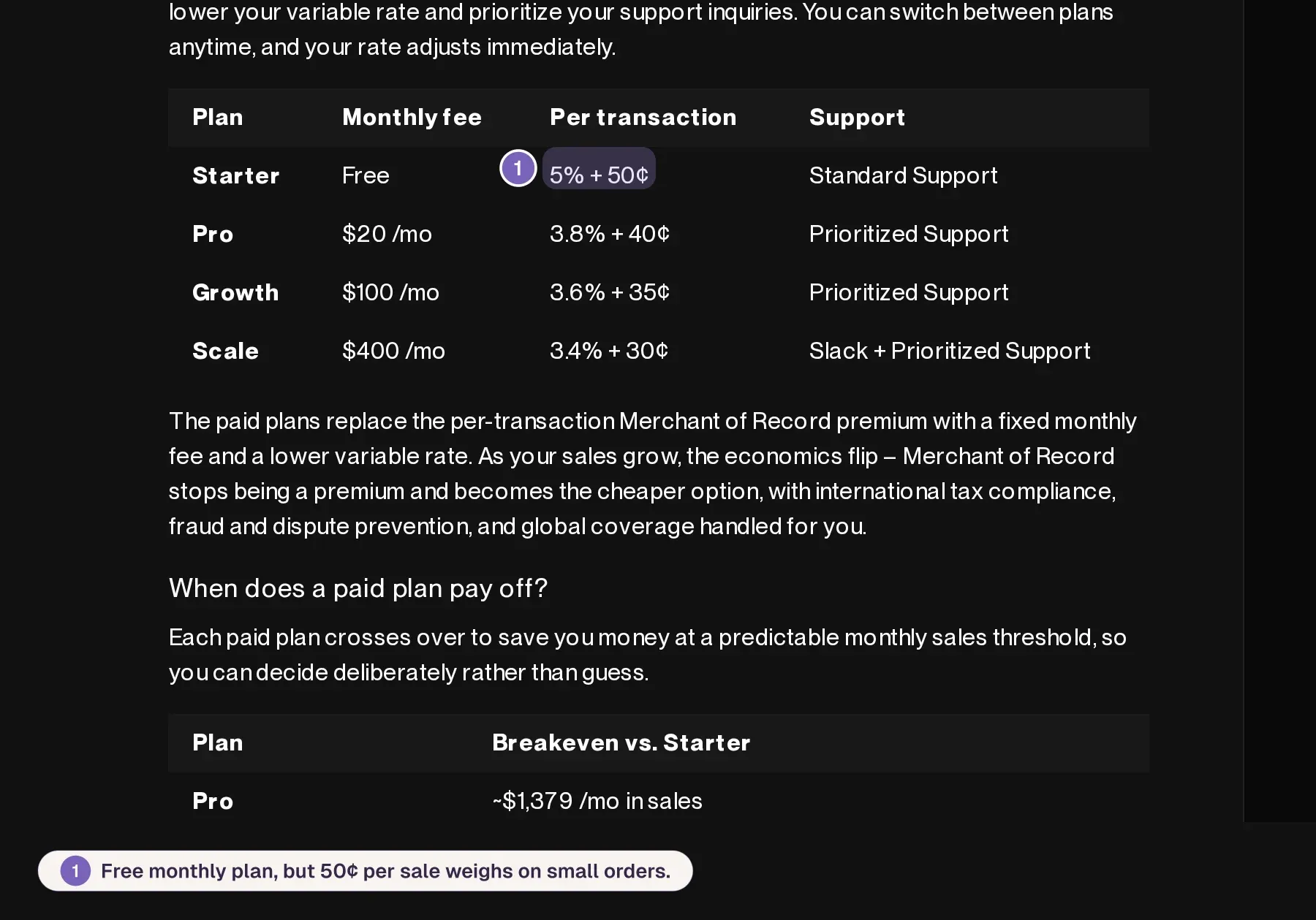
Polar Starter costs 5% + 50¢ per transaction, with no monthly fee for new accounts.
Plans and per-sale rates
| Plan | Monthly fee | Per-transaction rate |
|---|---|---|
| Starter | $0 | 5% + 50¢ |
| Pro | $20 | 3.8% + 40¢ |
| Growth | $100 | 3.6% + 35¢ |
| Scale | $400 | 3.4% + 30¢ |
Fees on top of the plan rate
- Payments with cards issued outside the US add 1.5%.
- Disputes cost $15 each.
- Payout-provider fees can apply, without Polar markup.
What $10,000 a month costs on each plan
Pro costs least once you include monthly charges, assuming US-issued cards and excluding tax, disputes and payout-provider fees.
| Plan | $20 orders (500 transactions) | $50 orders (200 transactions) | $100 orders (100 transactions) |
|---|---|---|---|
| Starter | $750 | $600 | $550 |
| Pro | $600 | $480 | $440 |
| Growth | $635 | $530 | $495 |
| Scale | $890 | $800 | $770 |
At 500 orders, Starter’s fixed fees alone total $250, and its gap above Pro is $150, compared with $110 at 100 orders. Smaller orders put more weight on fixed fees.
With $5,000 in international-card sales, add $75, taking Pro’s $480 to $555. The same surcharge applies across plans, so the cheapest plan stays the same.
At $50 an order, each paid plan becomes cheaper than the preceding tier from:
- Pro, 29 orders ($1,450).
- Growth, 534 orders ($26,700).
- Scale, 2,001 orders ($100,050), after tying Growth at 2,000.
A switch for lower fees needs twelve months’ savings at your current volume to exceed migration costs and expected subscriber losses. If savings fall short, keep existing subscriptions running and route only new sales elsewhere.
Calculate your fees as monthly charge + sales × percentage + transactions × fixed fee + international-card sales × 1.5%, using your actual transaction count.
Billing and developer tools for SaaS
Polar calculates what a customer owes and delivers what they bought, but your application still decides whether they can keep using the product.
Subscriptions, seats, usage and credits
An annual base subscription can include monthly usage invoices and monthly credit grants. Credits add units to one usage meter, not a cash balance.
Scheduled product, price and seat-count changes appear in both the merchant dashboard and the customer portal.
The gaps are in enforcement. A metered-price cap limits the bill, but consumption can continue above it. A failed separate usage invoice leaves subscription benefits active, so an active subscription does not mean usage has been paid for.
A failed renewal opens a second gap. The subscription moves to past_due, and Polar pauses usage invoicing and credit grants while usage recording continues. That usage is invoiced together once payment recovers, so the compute an AI product burns in the meantime goes unbilled only if the customer never pays.
Check unpaid usage invoices and past_due status in your own access rules so you can cap the unpaid compute you write off per customer.
I would sell prepaid credits when each unit costs money as soon as it runs, because payment is collected before compute is spent and a failed postpaid charge is a direct loss. Postpaid suits customers whose payment history you trust.
Licence keys, files and repo access
Licence keys, file downloads and GitHub repository access are granted automatically after payment. A key protects nothing until your software validates it and refuses access if the check fails.
Checkout, SDKs and webhooks
Checkout can be hosted or embedded. Framework adapters connect in as few as six lines of code, enough for a working checkout but not the access and usage logic behind it.
SDKs cover other stacks, and webhook events let your application limit consumption when a usage invoice fails.
Real-world friction: approval, payouts and control
A working Polar checkout can take payments before Polar approves your account for payouts. Until then, what you have sold and what you can withdraw are two different amounts.
Account reviews and the first payout
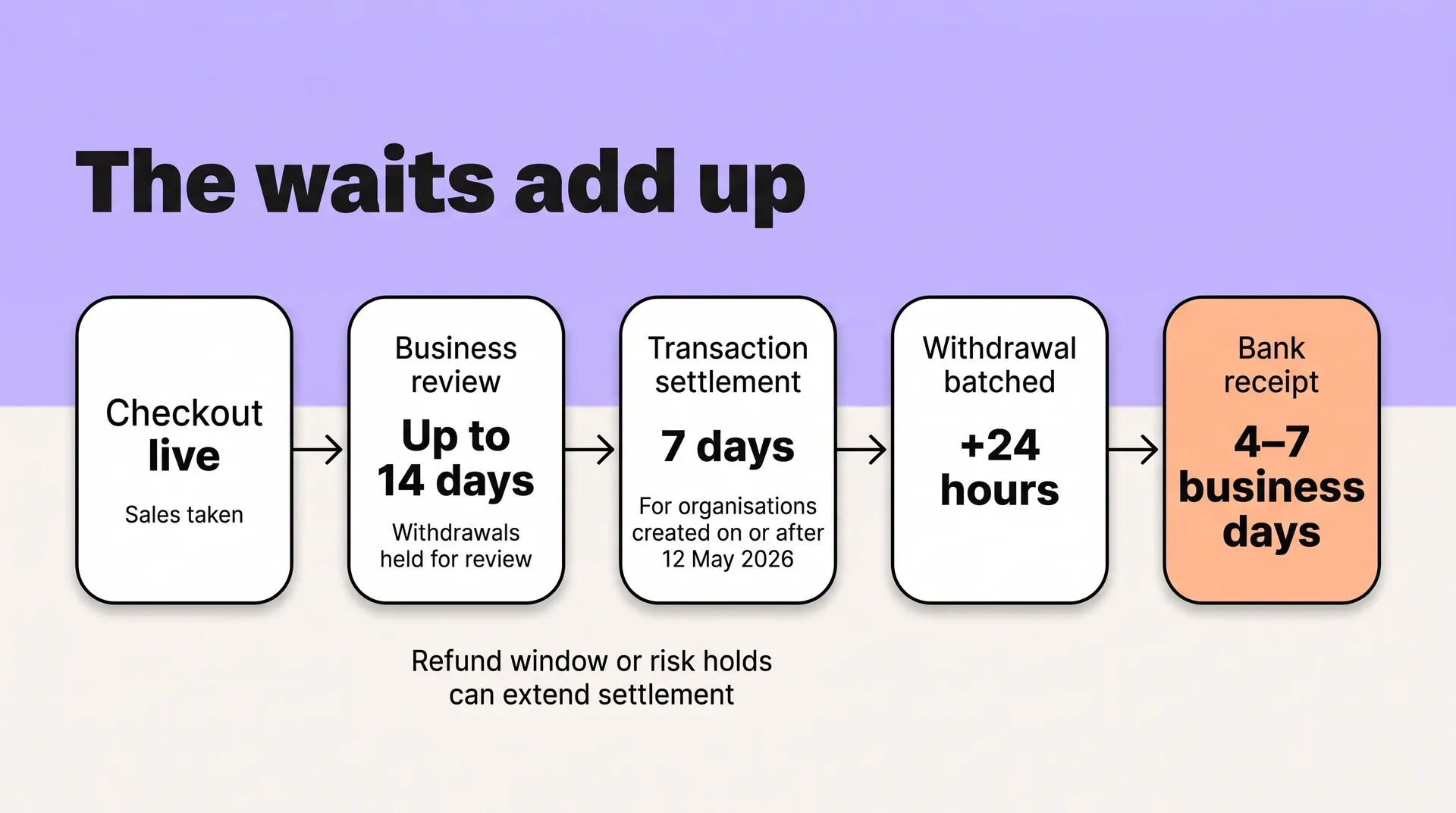
Review, settlement, payout processing and bank receipt are separate stages. Business review can take up to 14 days, while withdrawal requests remain “Held for review”.
Organisations created on or after the settlement cutoff of 12 May 2026 also have seven-day transaction settlement. You can request a payout at any time once your balance reaches the $10 minimum, but it stays held for review until the owner’s identity is verified, the payout account is set up and the review is approved.
Polar batches the withdrawal 24 hours later, with typical payout timing of 4–7 business days. I would leave held or unsettled sales out of committed spending.
Payout holds, chargebacks and refunds
Polar can extend settlement to match your refund window or hold transactions for risk or compliance. A shorter refund window shortens that extended settlement, bringing forward the day you can withdraw the money.
Within 60 days of purchase, a Polar chargeback-prevention refund can override a no-refunds policy, cancel the subscription and revoke benefits. Handle that cancellation by cutting in-app access.
A refund you issue leaves the subscription running, so cancel it too if access should end. Both checks keep access from continuing on refunded revenue.
Fixed dunning and less payment control
Renewals retry on days 2, 7, 14 and 21, unless a nonrecoverable decline stops the retries. The cadence and recovery emails are fixed, though you can reschedule renewals or manually revoke subscriptions.
Benefits revoke immediately by default when a subscription leaves active status, while a grace period gives customers time to recover without changing retries. Link the Customer Portal from past-due warnings so updating the default payment method triggers an immediate retry.
Past-due subscriptions keep cycling and return to active only after every pending order is paid. I would compare configurable recovery options if renewal recovery rate is central to the decision.
Who should choose Polar?
Polar fits developers who want tax handled and billing tools they can integrate into their product. The choice is managed billing versus control over the payout wait, fixed recovery rules and affiliate payments that need a separate tool.
Partner-led sales need a separate affiliate tool because Polar has no native affiliate program. Keep that tool if partners are onboarded, referrals reach the right accounts, commissions get paid without spreadsheet corrections and you depend on features you would lose.
Compare its subscription cost and reconciliation hours with the 2% Creem’s affiliate platform adds before commission on the standard plan. Moving makes sense if you maintain two code paths or reconcile commissions by hand every month.
That fit still depends on having enough cash to fund delivery through the payout wait.
I would keep Polar when direct sales dominate or the second system runs reliably. If every partner payout cycle needs manual fixes, compare the native option’s cost with the subscription and reconciliation work it would replace.
1. Licence and download sellers
After payment, Polar automatically issues a unique licence key and delivers files through signed personal URLs, while your application decides which product the key authorizes. Buyers can rotate an exposed key themselves, so your team has fewer “my key leaked” requests to handle.
For one-time sales, the plan crossover follows the pricing calculation above. At $50 a licence, Pro becomes cheaper than Starter from 29 orders a month. Below that, Starter has the lower base cost at 5% + 50¢ per sale, before any international-card surcharge.
The product-specific access check is the implementation detail that matters. A valid key is not necessarily valid for the product the buyer is trying to open. If you sell several licence types within one organization, a validity check alone does not distinguish them.
Your application must also check the returned benefit_id, the ID of the licence benefit the buyer purchased, against the benefit required for that product.
For a cheaper tier and a pricier tier, that check protects upgrade revenue. Without it, a buyer’s valid cheaper-tier key could unlock the pricier product.
Test a valid key from another licence type and make sure your application rejects it. That gives you a concrete acceptance test before you treat automated key issuance as a complete licensing setup.
Polar fits sellers with one product or a few tiers who will implement that product check and want purchase delivery handled automatically. If you expect the key itself to enforce which product it opens, with no application-side work, you need a different licensing setup.
2. Subscription SaaS teams
Polar takes recurring billing and transaction tax on renewals off your desk. Your application still has to match each paying customer to the right user and keep their access in step with the subscription.
As the pricing calculation shows, Pro costs least at $10,000 a month across all three order sizes. At $50 per renewal, Growth only becomes cheaper from $26,700 in monthly sales. The lower transaction rate needs enough renewals to cover the higher monthly commitment.
Timeful’s public code history shows the safeguards involved. While it ran a paid tier on Polar, its migration handling linked Polar customers to existing users to preserve subscription access.
When a renewal arrives without the app’s own user ID, it found the user through the stored Polar customer ID.
Without that fallback, a paying customer could still get locked out, creating support tickets and risking involuntary churn despite successful collection. Store the Polar customer ID against your user and test a renewal without your own user ID.
The access check depends on what you sell:
- Licence-key access follows Polar’s subscription licence benefit. The key remains valid while the subscription is active and is revoked when it ends.
- Account access requires your app to act on the subscription ending. A billing-state change alone does not remove an account’s permissions.
An ordinary subscription-order refund you issue leaves subscription benefits active. If the refund should end access, make the separate cancellation or revocation part of your workflow.
I would choose Polar when managed tax and recurring billing are the main needs, and the team can own customer mapping and account permissions. Those are concrete integration jobs you can test before launch.
A team whose retention plan depends on changing retry timing or recovery emails is a weaker fit. Its failed-renewal recovery rate depends on experiments Polar’s fixed settings do not allow, so configurable recovery should be a requirement for its next billing provider.
3. Usage-priced AI products
Polar bills usage, so each customer’s consumption determines the price. That makes it an option for AI products charging by what customers use.
Polar’s credits add units to one usage meter. When you sell each top-up as a separate purchase, every pack repeats the fixed fee.
On Starter, five illustrative $10 packs cost $5 in transaction fees, while one $50 pack costs $3, leaving $2 more from the same sales total. Price the pack around what buyers will actually buy.
Postpaid usage suits established business customers with steady consumption who have paid every invoice so far. Everyone else belongs on prepaid packs because a failed usage invoice can leave subscription benefits active while the compute stays unpaid.
Before committing, buy a pack in test mode, consume it to zero and check that usage stops. That test exposes the risk of compute delivered but never paid for and shows which controls your application still needs to own.
Polar fits trusted postpaid business accounts and prepaid packs that pass that test. Prepaying still leaves you funding the payout wait.
If that wait runs ten days, $100 of daily compute needs $1,000 of working capital, so hold that reserve before launch.
Polar.sh vs Stripe and other MoRs compared
Stripe’s lower headline rate pays for processing, while Polar and Paddle also take on the legal seller’s responsibility for transaction tax.
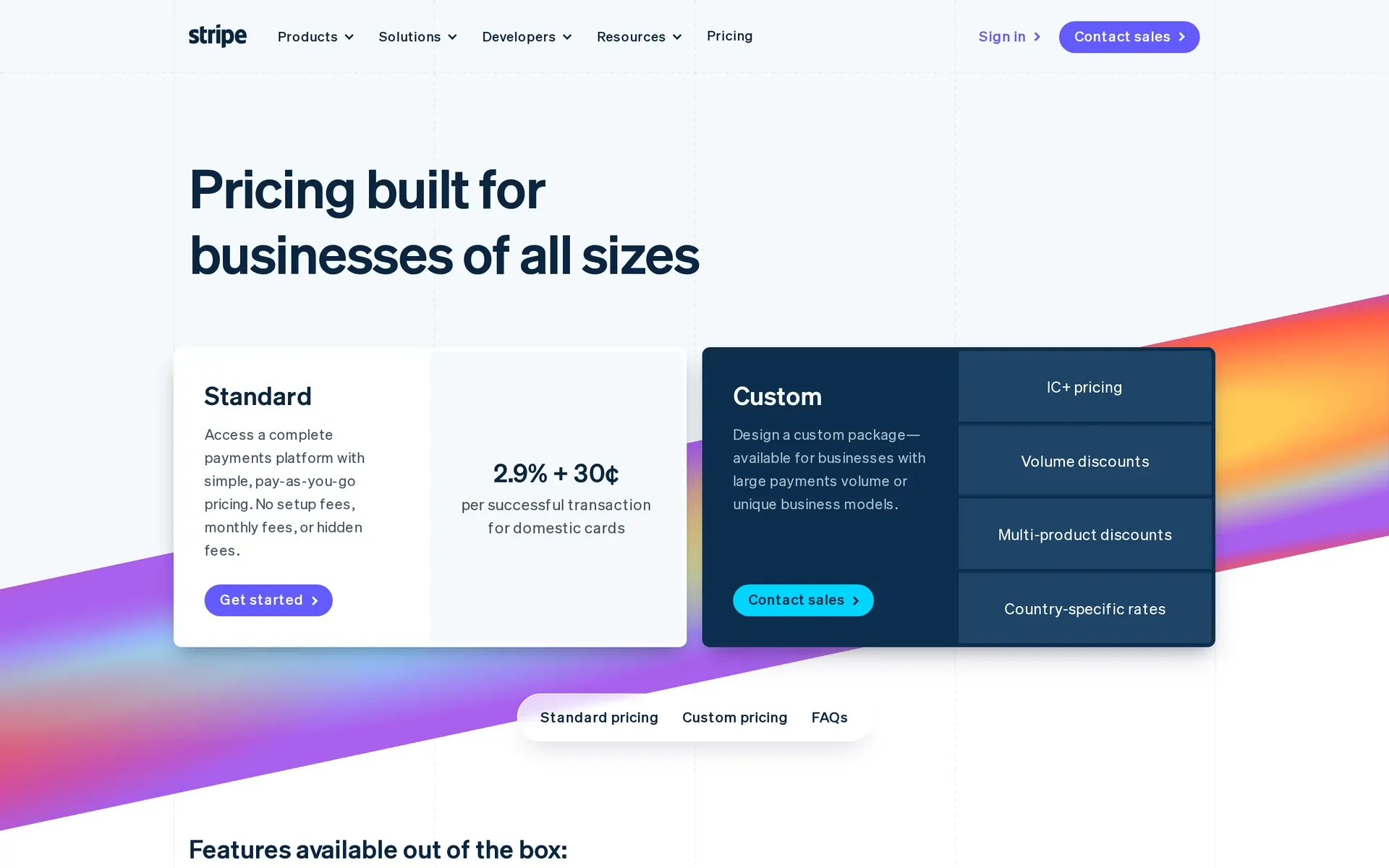
For the same $100 purchase, the published base rates work out as follows, before additional charges. Stripe’s fee covers processing alone, with billing and tax tools priced separately.
| Platform | Published rate | Fee on $100 | Who is the legal seller and handles transaction tax? |
|---|---|---|---|
| Polar Starter | 5% + 50¢ | $5.50 | Polar |
| Stripe standard processing | 2.9% + 30¢ | $3.20 | Your business |
| Paddle | 5% + 50¢ | $5.50 | Paddle |
Polar Starter and Paddle cost $2.30 more per $100 purchase than Stripe’s headline processing rate. On Stripe, you still pay for your tax setup, file where required and handle chargebacks yourself.
Add your monthly tax-tool costs to the value of the hours you spend on filings and disputes, then divide by your transaction count. At $100 per purchase, anything above $2.30 per transaction wipes out the base-fee advantage, before additional charges on either side.
The choice comes down to whether you want to keep responsibility for filings and chargebacks with your business, or pay the difference for Polar or Paddle to take responsibility for transaction tax.
Polar Starter and Paddle both charge $5.50 on $100, so billing fit, not the base price, is the deciding factor.
What Polar leaves to other tools
Customer billing runs inside Polar, but partner payments run outside it. Polar has no native affiliate management.
A separate affiliate tool puts two halves of the same sale in two systems. The affiliate tool records the referral and calculates the commission, while Polar collects the payment and processes any refund.
Refunds are where the two systems drift apart. On an illustrative $50 referred sale with a 20% commission, the partner is owed $10. If Polar refunds the buyer but the affiliate tool never hears about it, that $10 still goes out.
Twenty refunded referrals in a month mean $200 in commissions on money that went back to buyers. Every refund the affiliate tool misses adds to that cost.
Keeping them in sync is your job. Send Polar's refund and cancellation events to the affiliate tool, or hold commissions until your refund window closes.
Then check one month's commission report against Polar's refunds. Every refunded referral that still shows a commission means paying out money on revenue you no longer hold. Get commissions paid on refunded sales to zero before you trust either report.
Need affiliates and revenue splits in your MoR? Look at Creem
Polar is a sound billing layer if you sell direct, want transaction tax handled and can work within its review, payout and recovery rules. I would stay with it in that case.
For growing SaaS and AI teams, it is worth comparing options when partner payouts sit at the centre of the plan, because Polar puts affiliate commissions in a second tool and leaves your team to reconcile them.
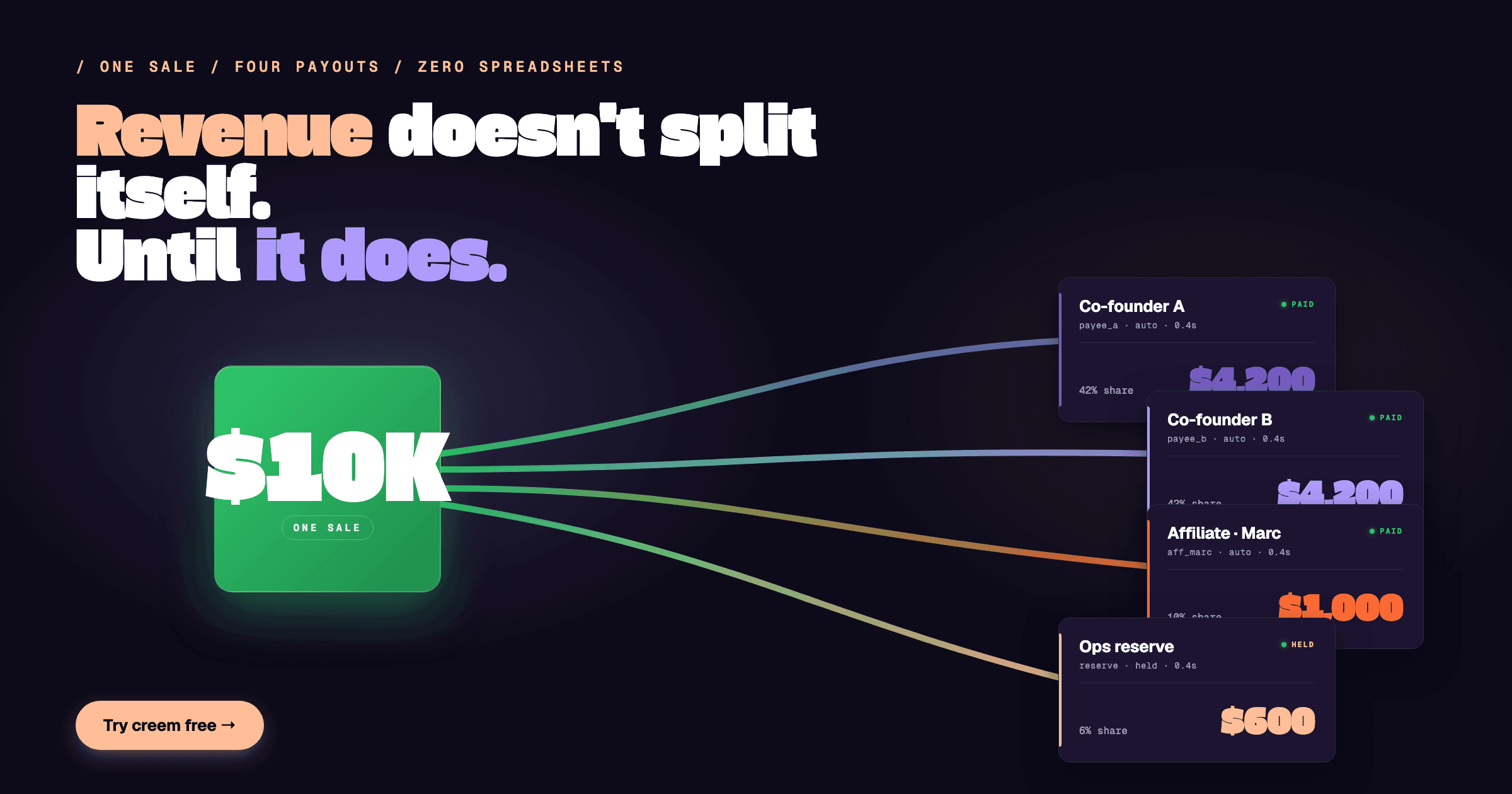
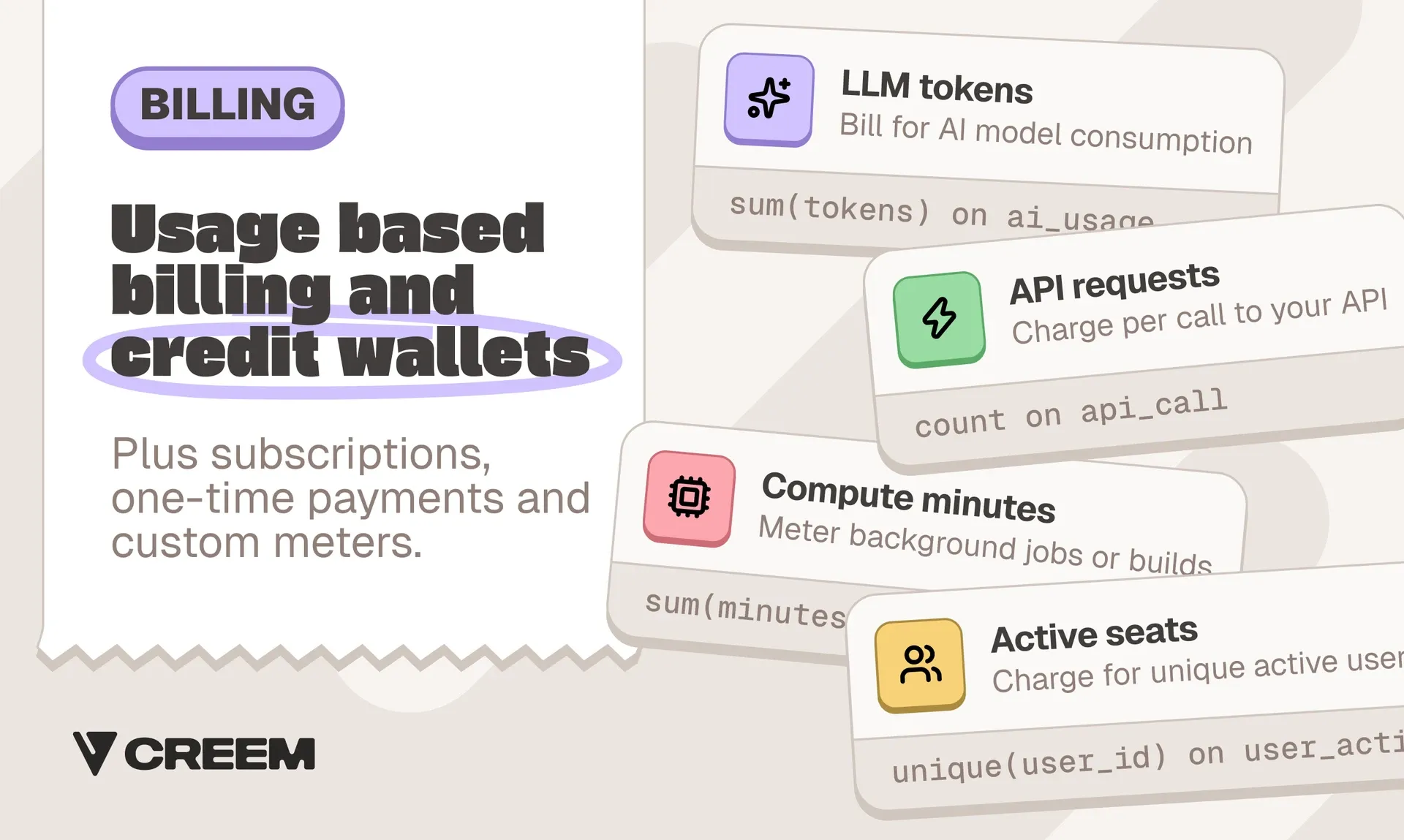
Creem is the legal seller on each sale, and affiliates and co-founders get paid from the same balance that receives the buyer's payment. Meters and prepaid credit wallets with auto-refill run on the same platform, so an AI product collects payment before spending on compute.
Creem charges 3.9% + 40¢ per successful transaction, with no monthly or setup fee. On the standard plan, the affiliate platform and revenue splits each add 2% before commission is calculated.
When DaisyUI moved to Creem, profit sharing needed 0 extra tools, according to its case study. Pouya Saadeghi, Creator of DaisyUI, said of splits, "It was like a key feature that I was looking for. Creem has this and it works really well."
If a co-founder or affiliate is owed a share of every sale, try Creem and set the split once so each sale after that pays them automatically.