
If you owe a co-founder, contractor or affiliate a cut of each sale, that deal probably lives in a spreadsheet and a few old messages. A revenue share agreement writes the cut down as a percentage of defined revenue, and on its own it transfers no ownership.
Until it is signed, every payout depends on both of you remembering the same deal the same way.
Leave that open, or pay it from a platform that splits on a different number, and the same rate pays two different amounts, so every payout reopens the argument.
You can settle each term before anyone gets paid, using the math on one $10,000 period and a term sheet you and your partner fill in together.
The short version
A percentage alone does not tell either side what to pay. Both partners need the same sales numbers, deductions and rules for when a payment is due or taken back. The argument usually reopens over what counts as revenue, while the rate itself is rarely in question.
On an illustrative $10,000 period, 20% of gross revenue pays $2,000. The same rate can pay far less after deductions, which makes the definition of revenue worth settling before you agree on the percentage.
Put these five decisions in writing:
- Revenue base: Choose gross revenue, net revenue or profit, and list every allowed deduction, including how tax, fees and refunds are treated.
- Split type: Specify fixed, performance-based, hybrid or tiered shares, with the rates and conditions both sides need to calculate them.
- Covered sales: Name qualifying products and sales, explicitly including or excluding renewals, upgrades, upsells and credit top-ups. For referrals, define how a sale gets attributed.
- Payment rules: State which month or quarter each payment covers, when the money arrives, and which report both sides use to calculate and verify it.
- Reversals and exit: Decide how paid shares are recovered after refunds or chargebacks, and whether a departing partner keeps earning on covered renewals and for how long.
Before signing, each side should take the same month's sales export and calculate the payout alone. Compare the figures. If they differ, fix the clause that caused the gap before the first payment.
How is a revenue share calculated?
Your partner’s share is the agreed percentage times whatever the agreement counts as revenue for that month or quarter.
Gross, net or profit as the base
In this illustration, one $10,000 period produces three payments at 20%. The gross-receipts base includes collected tax, even though that tax is not the seller’s revenue.
| Base | Calculation | Payment |
|---|---|---|
| Gross receipts | $10,000 × 20% | $2,000 |
| Net after $1,200 in agreed tax, fee and refund deductions | ($10,000 − $1,200) × 20% | $1,760 |
| Profit after $6,000 in agreed costs | ($8,800 − $6,000) × 20% | $560 |
Collected VAT or sales tax belongs to tax authorities. State whether gross receipts include it.
I favour net revenue with named deductions for reconciliation. For profit, define allowable costs and how shared costs are allocated.
If your payments platform splits automatically, find which amount its percentage applies to and write that same base into the clause, so automated payouts match agreed payments. On Creem, a 2% split fee is deducted from the transaction amount before any share is paid out.
Fixed, performance-based and hybrid splits
- Fixed splits keep the rate unchanged, suiting ongoing co-founder work or product licensing.
- Performance-based splits tie compensation to measurable results.
- Hybrid splits combine a base share with a result-linked bonus.
Fixed rates can cover only attributed sales. Name the qualifying referral link, code or account and how long credit lasts.
Marginal or whole-period tiers
On an illustrative $12,000 base, marginal tiers pay 10% × $10,000 plus 15% × $2,000, totaling $1,300.
Whole-period tiers triggered above $10,000 pay 15% × $12,000, totaling $1,800. That’s $500 more, because crossing the threshold reprices the whole period.
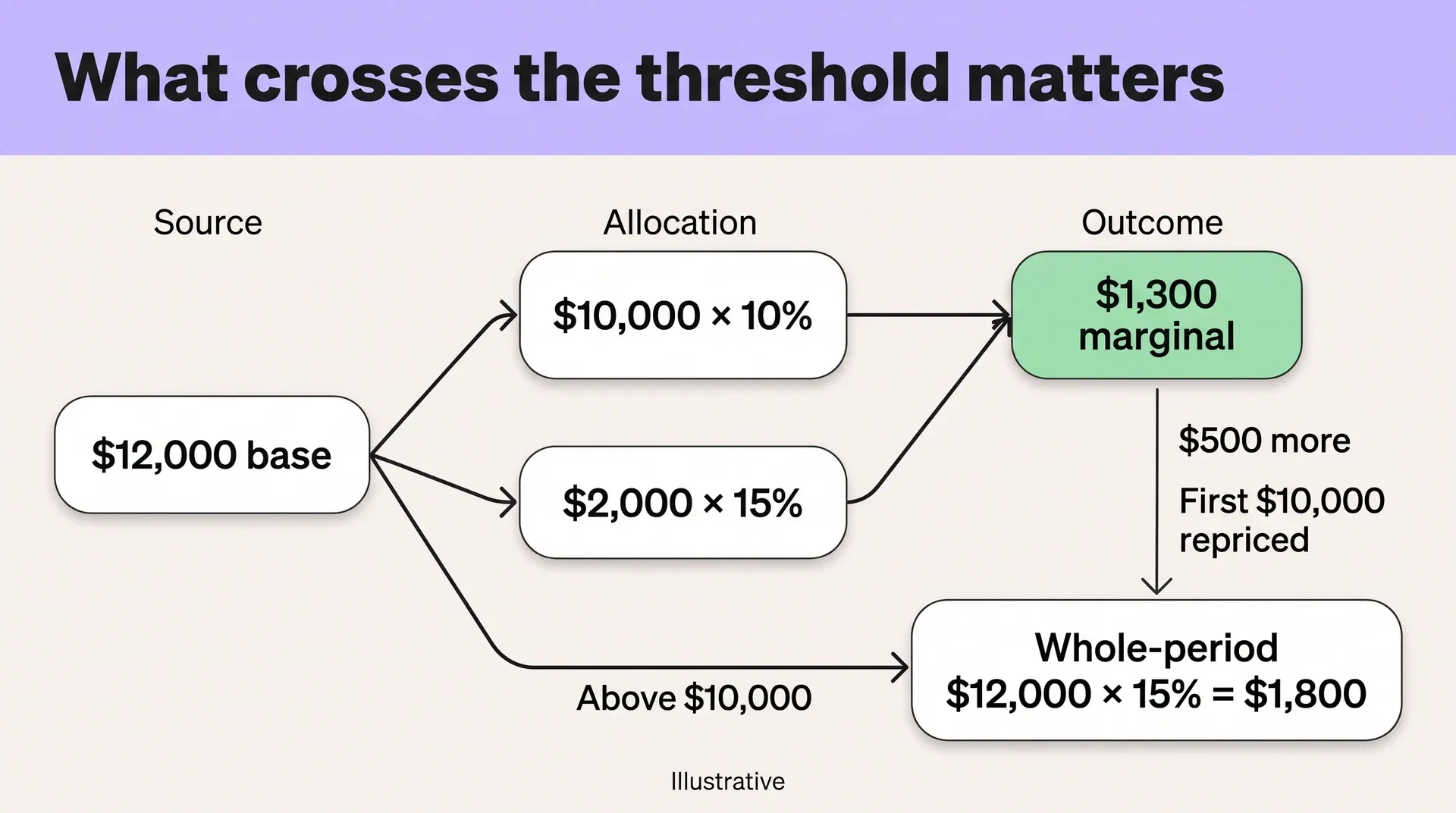
Flow comparing $1,300 marginal and $1,800 whole-period revenue shares on the same $12,000 base.
Write which method applies, where exactly $10,000 falls, and whether thresholds reset each month or accumulate.
What revenue does the agreement cover?
Renewals, upgrades and new products count toward the share only if the agreement includes them. Coverage also depends on which customers qualify and when their eligible sales begin.
For illustration, take a $10,000 period at 20%, with $2,000 coming from separately sold credit packs. Including those packs pays the partner $2,000. Excluding them leaves an $8,000 base and pays $1,600. Vague wording about “subscription revenue” leaves $400 unresolved.
Make the coverage clause specific:
- Products: List covered plans and products. Write yes or no beside renewals, upgrades, add-ons and credit top-ups.
- Customers: State whether existing customers qualify or only customers brought in by the partner.
- Time: Name the first eligible sale date and how long qualifying renewals count.
If future launches should stay outside the share, write that covered products are limited to those listed and a new product joins only through a signed written addition.
In Creem’s revenue splits, choose a per-product split for the products your coverage clause lists, or a store-wide split if every product counts.
Each payment for a covered product is split when it happens, renewals included, and a separately sold top-up stays outside a per-product split unless you add that product too.
If renewal shares end on a set date, write that date into the agreement and track it alongside the split.
Keep a product-wide split for arrangements where every buyer of that product counts. A product split pays on every buyer, so if only partner-referred customers qualify, the agreement needs an attribution rule that decides which sales are theirs.
Which terms belong in the agreement?
The percentage only pays out cleanly when the contract also says who owes the work, when the money is due and how the partner can check the figure.
Parties, duties and duration
Give each party's full legal name, address and contact details, and say whether they sign as an individual or through a company.
Then put a duty beside each name. As an illustration, one party builds and maintains the app, and the other answers buyer support within two business days.
State the start date, whether the term is fixed or runs until terminated, and whether renewal is automatic or needs a new signed agreement.
Payment timing, reporting and audit rights
The calculation period decides which sales count, and the deadline decides when the share is due.
Tie that deadline to the money. An illustrative rule reads "each month's share is paid within 10 days of the payout that contains that month's last sales," so no payment falls due before all of that month's funds arrive.
Name the transfer method, the payout currency, who pays transfer costs, and the exchange-rate source and date used to convert sales recorded in another currency. If you set a minimum, amounts below it roll into the next period and are paid once the total crosses it.
Require a statement the partner can reproduce line by line, showing gross sales, each deduction, the base, the rate and the share. Audit rights list the records open to inspection, how far back a review reaches, the notice required and when any error found gets settled.
IP, confidentiality and changing the terms
A revenue share is a right to payment. Ownership of the software or company moves only if another clause grants it, so separate what each party brings from work created together, with ownership and permitted use for each.
Confidentiality should name the protected material, such as sales statements, customer lists and pricing, plus who can see it and how long the duty lasts after the deal ends.
Record any change to the rate, base or covered products in a signed amendment with the first payment period it applies to. Without that date, a mid-month change leaves both sides arguing over which rate covers that month's sales.
What happens with refunds, chargebacks and termination?
If the agreement requires recovery on a refunded sale, the partner returns their paid share once. The agreement decides who pays chargeback fees. After termination, shares stop unless the contract preserves specified renewal rights.
If a customer gets a full refund on a $1,000 sale after your partner was paid $200 at 20%, recovering that $200 settles their share. Deducting the sale from the next period’s base and separately reclaiming $200 would recover $400.
Write that either the refunded sale reduces the next period’s base or the paid share is clawed back, never both. For a clawback, specify deduction from the next payment or direct repayment.
Chargeback wording can follow either rule:
- The partner returns their share of the reversed sale, and the seller absorbs the chargeback fee.
- The partner returns their share and bears 20% of the chargeback fee, with the seller bearing the rest.
Enable “Split refunds” in Creem’s revenue splits to recover each recipient’s share automatically, in proportion to what they received. It is on by default for new splits. If we win the chargeback dispute, recovered amounts return to recipients.
State who absorbs the 2% split fee on a refunded sale, since fees are not returned. Changes affect future sales only, so match the setting to the agreed rule before the first covered sale.
For exit, write three terms:
- Continuing renewals: Identify qualifying customers, if any, and when their renewal shares end.
- Final reconciliation: Set a deadline for paying outstanding shares and settling recorded adjustments.
- Late reversals: State how refunds and chargebacks after the final payment are recovered, with a repayment deadline.
Revenue share agreement template
Copy and complete this sheet together. Use the same names for revenue and deductions on the statement.
Revenue share term sheet

Paying party’s legal name and address: _____
Recipient’s legal name and address: _____
Each party’s duties: _____
Covered products, customers and dates: _____
Existing customers, renewals, upgrades, usage, top-ups and future products included/excluded: _____

Revenue base: gross / net / profit
Measurement rule: _____
Collected VAT/sales tax: included / excluded
Each permitted deduction and calculation rule:
  Tax: _____
  Payment fees: _____
  Refunds: _____
  Other: _____
Profit cost allocation: _____

Split: fixed / performance-based / hybrid / tiered
Rates and bonus conditions: _____
Tier thresholds: _____
Tier method: marginal / whole-period
Threshold reset: _____
Referral identifier, window and competing-referral rule: _____

Calculation period and payment deadline after cleared funds: _____
Currency, conversion rule, transfer costs and minimum carry-forward: _____
Statement delivery date: _____
Statement fields: period, covered gross revenue, each deduction separately,
defined base, rate/tier calculation, calculated share,
prior-period adjustments, amount payable.
Verification records, audit notice/window and correction deadline: _____

Refund recovery method/timing: _____
Chargeback amount/fee allocation: _____
Duration, renewal and termination rules: _____
Continuing shares and final-payment deadline: _____
Late reversal repayment rule/deadline: _____

IP ownership/use and confidentiality: _____
Amendments require written agreement signed by both parties.
Effective calculation period: _____
Governing law and dispute process: _____
Both parties’ signatures and dates: _____
Filled in with round example figures, $10,000 of covered sales minus $1,200 in deductions produces:
| Statement line | Value |
|---|---|
| Period | One calendar month |
| Covered gross revenue | $10,000 |
| Tax | −$600 |
| Payment fees | −$400 |
| Refunds | −$200 |
| Defined base | $8,800 |
| Fixed rate | 20% |
| Calculated share | $1,760 |
| Prior-period adjustments | $0 |
| Amount payable | $1,760 |
Precise choices let both partners calculate the same $1,760 from the same sales export. Have a lawyer read the filled-in sheet before either of you signs.
Revenue share agreement vs profit sharing vs equity compared
A revenue share can leave you owing your partner cash in a losing month. Profit sharing pays only when agreed costs leave profit to split. Equity creates ownership, which by itself sets no cash payment schedule.
On the same $10,000 example period at 20%, profit sharing leaves the seller $1,200 more than the net-revenue share.
If costs exceed the $8,800 net base in a bad month, the profit share drops to $0. The revenue share still owes $1,760 unless the contract makes payment depend on profit.
| Arrangement | Owed in a loss-making month? | How the partner checks it | What survives exit |
|---|---|---|---|
| Revenue share | Yes, if the defined revenue base is positive and payment does not depend on profit | Sales and named deductions | Unpaid shares, plus renewals if agreed |
| Profit sharing | No, if the covered profit base is zero or negative | Sales, expenses and allocated costs | Final profit settlement, plus continuing payments if agreed |
| Equity | No scheduled payment | Ownership and distribution or sale records | Shares, subject to vesting, transfer and repurchase terms |
Profit sharing’s lower cash obligation comes with more scrutiny. The partner needs to trust and audit every cost counted against their share. If you choose profit sharing, attach the cost list and allocation rules to the agreement.
I would use a revenue share for a contractor, licensor or affiliate paid for sales. Profit sharing suits a partner sharing the risk of costs.
Equity suits a co-founder seeking ownership and participation in a company sale. Set ownership and any voting rights separately.
Who calculates and pays the share each period?
The business collecting the sales normally works out the partner’s share and sends the money. Name that business as the paying party in the agreement.
Two contributors build some DaisyUI products and share what they earn. Before the move to Creem, they handled those splits by hand, work the DaisyUI case study describes as “spreadsheets, transfers, and trust”.
With Creem’s revenue splits, they set the split once and each transaction pays both contributors without a separate manual transfer. Decide who sets your split and name each recipient it pays.
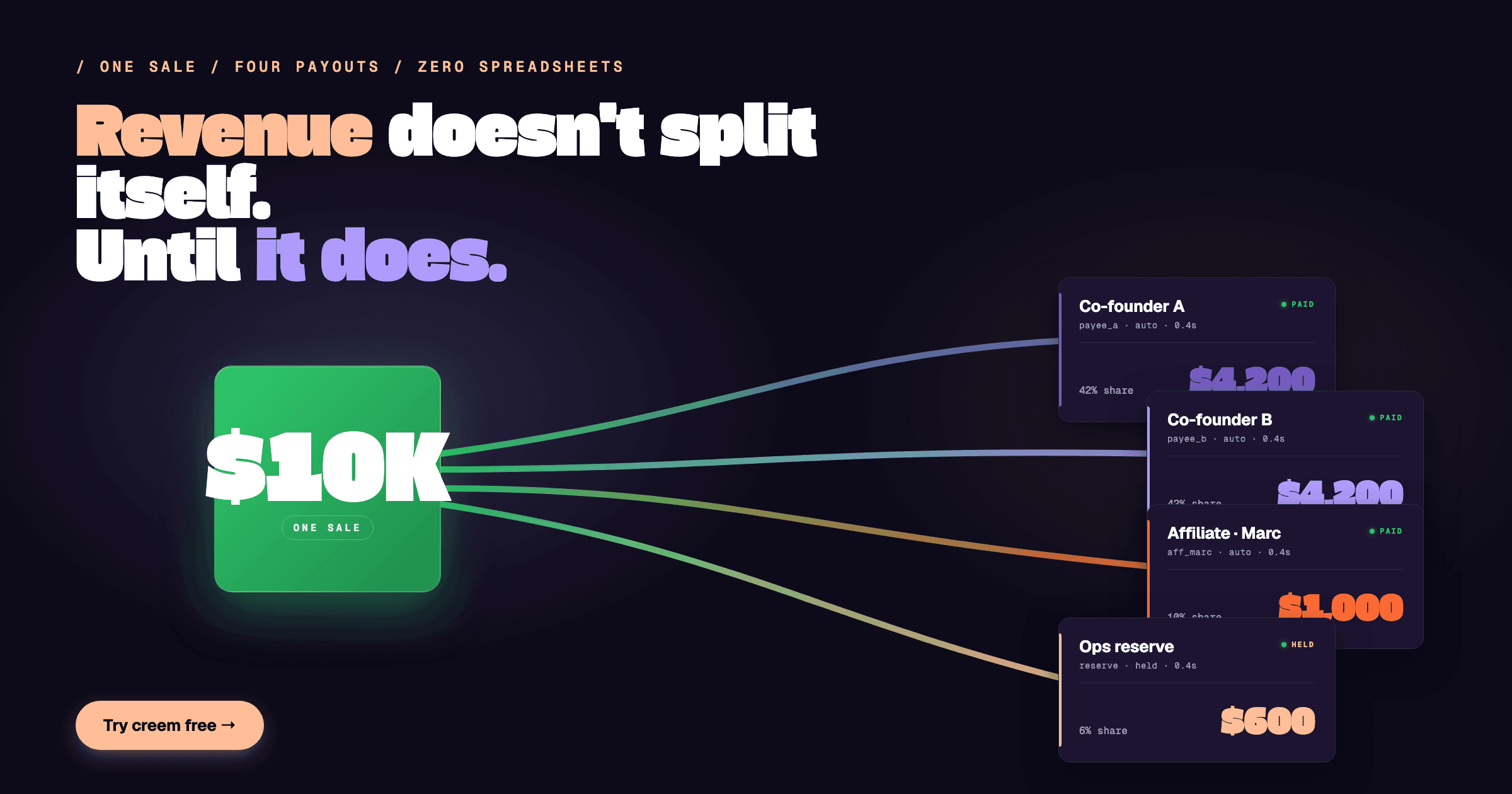
Source: Creem. Illustrative allocations of 42% to each of two co-founders, 10% to an affiliate and 6% to an operations reserve.
There are two ways to run the payments:
- Manual payments mean reconciling covered sales and agreed deductions, calculating the share, delivering a statement and transferring the money each period. A refund that lands after the partner was paid then has to be carried into the next statement or recovered separately, as the refund clause says.
- Built-in splits, where a platform supports them, remove the monthly manual transfer by allocating each sale’s proceeds to the recipients.
If you would rather not send those transfers yourself, try Creem and set up the split before the first covered sale.
Automation still needs someone responsible for exceptions. Bonuses or post-termination entitlements need separate tracking when their rules go beyond a per-sale percentage. Name who maintains the split settings and corrects mismatches, so reconciliation focuses on what the platform does not calculate.
Split the money, not the headache, with Creem
If your SaaS or AI business pays a co-founder, contractor or affiliate a fixed percentage of named products, I would take that share out of the monthly spreadsheet and run it as a per-sale split.
The work that wears founders down comes after signing, when someone has to work out every share and send every transfer. Creem's revenue splits divide each sale among the recipients you name, across the whole store or only on the products your agreement lists.
Splits add 2% before shares are paid, on top of the 3.9% + 40¢ transaction rate charged on the order total including tax.
In our case study with DaisyUI, the move took a few hours, and the split feature worked exactly as expected.
Stop working out partner shares from payouts by hand and try Creem, so every sale pays each partner the share your agreement sets.