
Your product can be ready for buyers abroad long before the money side is. A processor takes the card, then a non-business EU sale clears and the VAT registration is yours to hold.
Billing sits in one tool, tax in another and affiliates in a third. The question that sorts your options is who stays the legal seller once a sale crosses a border.
Card processors and subscription billing tools leave your business as the seller, while a merchant of record takes that role. The nine here cover all three kinds, and the first is ours, Creem.
Vendors can sit in more than one category. Stripe sells Stripe Managed Payments as its own merchant-of-record option, while its Payments, Billing and Tax stack still leaves your business as the seller.
I weigh each pick on who carries the legal seller role, whether billing covers subscriptions, seats, usage and credits, what you keep on a $100 sale and how much setup stays with your team.
How we chose these SaaS payment solutions
A cheap processor can still leave you registered for VAT and paying a second vendor for billing. If you want those registrations off your plate, I put who files the tax ahead of the headline rate.
Who stays the legal seller?
Stripe Tax calculates and collects tax, while your business remains responsible for the registrations and filings it owes. A merchant of record becomes the legal seller and takes responsibility for collecting and remitting transaction taxes.
The practical test is whether you owe registrations you do not want to manage yourself. Tax calculation alone does not solve that problem. Your own income and corporate taxes remain separate.
Does billing match what you sell?
A subscription needs renewals handled, seat pricing needs to follow changes in seat count, and usage billing needs to charge for consumption or draw down prepaid credits. Support for recurring payments alone does not cover all four.
Check what happens when customers change plans or a renewal fails.
What does the whole sale cost?
The headline rate is the starting point. The comparison needs to account for:
- Processing, billing and tax-service fees.
- International-payment surcharges.
- Affiliate or partner commissions and any platform fee on top.
- Dispute charges and payout-transfer costs.
These are categories to compare, rather than fees every provider charges.
What work stays with your team?
Checkout integration is only part of setup. Check whether buyers in your top countries see their currency and usual payment method at checkout, and whether you still need to build plan-change and failed-renewal handling.
Affiliates and revenue splits belong in that setup estimate too. A separate tool means another integration to maintain and another cost to count.
SaaS payment solutions compared: fees, tax and billing
Seven of these nine take over transaction tax as merchant of record. Stripe Billing and Chargebee leave you as the seller, which matters more than the fee difference if you want VAT registrations off your plate.
| Solution | Published fees | Who carries transaction tax? | Billing coverage |
|---|---|---|---|
| Creem | Standard base fee: 3.9% + $0.40 per successful transaction. No monthly or setup fee. Affiliates and splits each add 2% before commission. Payout transfers cost extra. | Creem calculates, collects, files and remits | Subscriptions, seats, postpaid meters, prepaid credits with auto-refill, built-in affiliates and splits |
| Stripe Billing (with Payments and Tax) | US processing: 2.9% + $0.30. Pay-as-you-go Billing: 0.7% of Billing volume, including payments outside Stripe, excluding one-off invoices. Integrated Tax Basic: +0.5% where registered. | Tax calculates and collects. You register and file. | Subscriptions, metered usage |
| Paddle Billing | Standard Checkout: 5% + $0.50. Custom pricing for products under $10. Invoicing priced separately. | Paddle collects, files and remits | Tiered subscriptions, add-ons, usage through custom invoice items |
| Chargebee | Growth Starter: $0. Gateway and Avalara costs separate. | You register and file, with separate Avalara integration | Subscription billing, revenue management |
| FastSpring | Transaction commission: not published | FastSpring calculates, collects and remits | Subscriptions, alongside existing billing logic in managed-subscription mode |
| Lemon Squeezy | 5% + $0.50. International: +1.5%. PayPal: +1.5%. Subscriptions: +0.5%. | Lemon Squeezy handles sales tax | Subscriptions, usage billing |
| PayPro Global | Core transaction rate: not published | PayPro Global collects and remits | Configurable subscription amounts and schedules |
| Polar | Starter: 5% + $0.50. Pro: $20/month + 3.8% + $0.40. Growth: $100/month + 3.6% + $0.35. Scale: $400/month + 3.4% + $0.30. Non-US cards: +1.5%. | Polar handles transaction tax | Subscriptions, event-based meters. You enforce usage limits. |
| Dodo Payments | Domestic US cards and wallets: 4% + $0.40. International: +1.5%. Subscriptions, add-ons and usage: +0.5%. | Dodo calculates, collects and remits | Subscriptions, add-ons, usage billing |
Read the tax column first, because a lower percentage can still leave you holding the registrations.
1. Creem
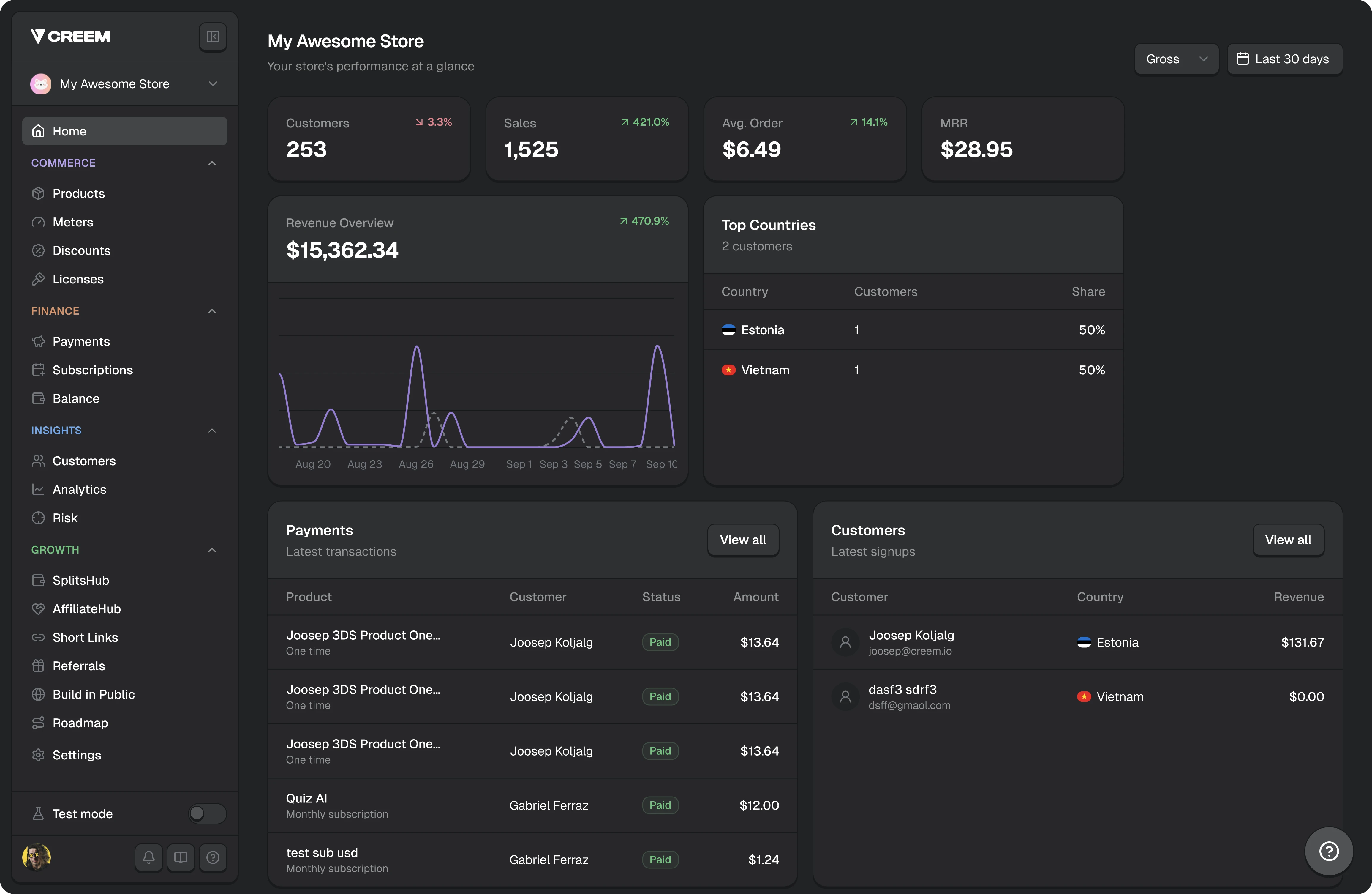
Creem dashboard with sales, revenue, top countries, payments and customers for one store
Creem is a merchant of record, so on every sale we are the legal seller. We calculate, collect, file and remit VAT, GST and sales tax, issue the buyer's invoice, and handle fraud screening, disputes and chargeback liability.
The standard rate is 3.9% + $0.40 per successful transaction. That sits below the 5% + $0.50 base rate Lemon Squeezy and Polar's Starter plan publish. The same checkout also pays affiliates and splits each sale between partners automatically.
Pricing
The standard plan charges one rate on every successful sale, with no monthly fee, setup fee or minimum volume. On a $100 sale, 3.9% is $3.90 and the fixed fee is $0.40. That leaves $95.70 after the base transaction fee, before any optional service or payout-transfer fees.
Four charges sit outside the base rate:
- Revenue splits add 2% to the transaction before commissions are calculated. That fee is not returned if the sale is refunded.
- The affiliate platform adds 2% before the affiliate's commission is calculated.
- Abandoned-cart recovery adds 5% to recovered transactions only, and works only when the buyer's email is on the checkout request.
- Payout transfers are charged separately when your balance moves to your bank account or wallet.
Best for
Growing SaaS and AI startups selling subscriptions, seats, usage or credits across many countries. It fits teams that want their legal seller to handle billing and partner payouts too.
Pros and cons
Pros:
- One rate of 3.9% + $0.40 per successful transaction includes the legal-seller role, so tax filing, invoices and chargebacks sit with us.
- No monthly fee, setup fee or minimum volume.
- Subscriptions, trials and seat billing are available on the same products.
- Postpaid meters can each carry a unit price, a cap and a set number of units before the charge applies, billed on top of the base price.
- Prepaid credit wallets refill automatically, so buyers can pay for usage up front.
- Revenue splits pay each recipient their share of a sale automatically once that recipient completes onboarding.
- Affiliate links, commissions and partner payouts run in one program.
Cons:
- Affiliate and split sales cost 2% more than the base rate, and a refunded split sale keeps that fee.
- A split recipient who has not completed onboarding does not receive their share.
- Payout transfers are charged on top of the per-sale fee.
How it compares
Stripe's processing rate is lower, but that comparison holds only if you remain the seller and handle tax registrations, filings and disputes yourself. With Creem, the 3.9% + $0.40 rate includes the legal-seller role, so we take on those obligations. If you are on Stripe today, our team helps you move over in less than a day.
On Creem, meters, credits, splits and affiliates use the same checkout and balance. Usage charges, split shares and partner commissions all come out of the same sale. Partners are paid from that balance, without a separate payout tool.
In our case study with DaisyUI, profit sharing needed zero extra tools, and Pouya moved DaisyUI's products from Lemon Squeezy by hand in a few hours.
Stores coming from Lemon Squeezy can run creem migrate lemon-squeezy in the Creem CLI to bring products over. Subscribers follow at their own renewal, finishing the current billing cycle on Lemon Squeezy and renewing through Creem when it ends. If you want your legal seller to run billing and partner payouts too, try Creem and keep every sale on one balance.
2. Stripe Billing
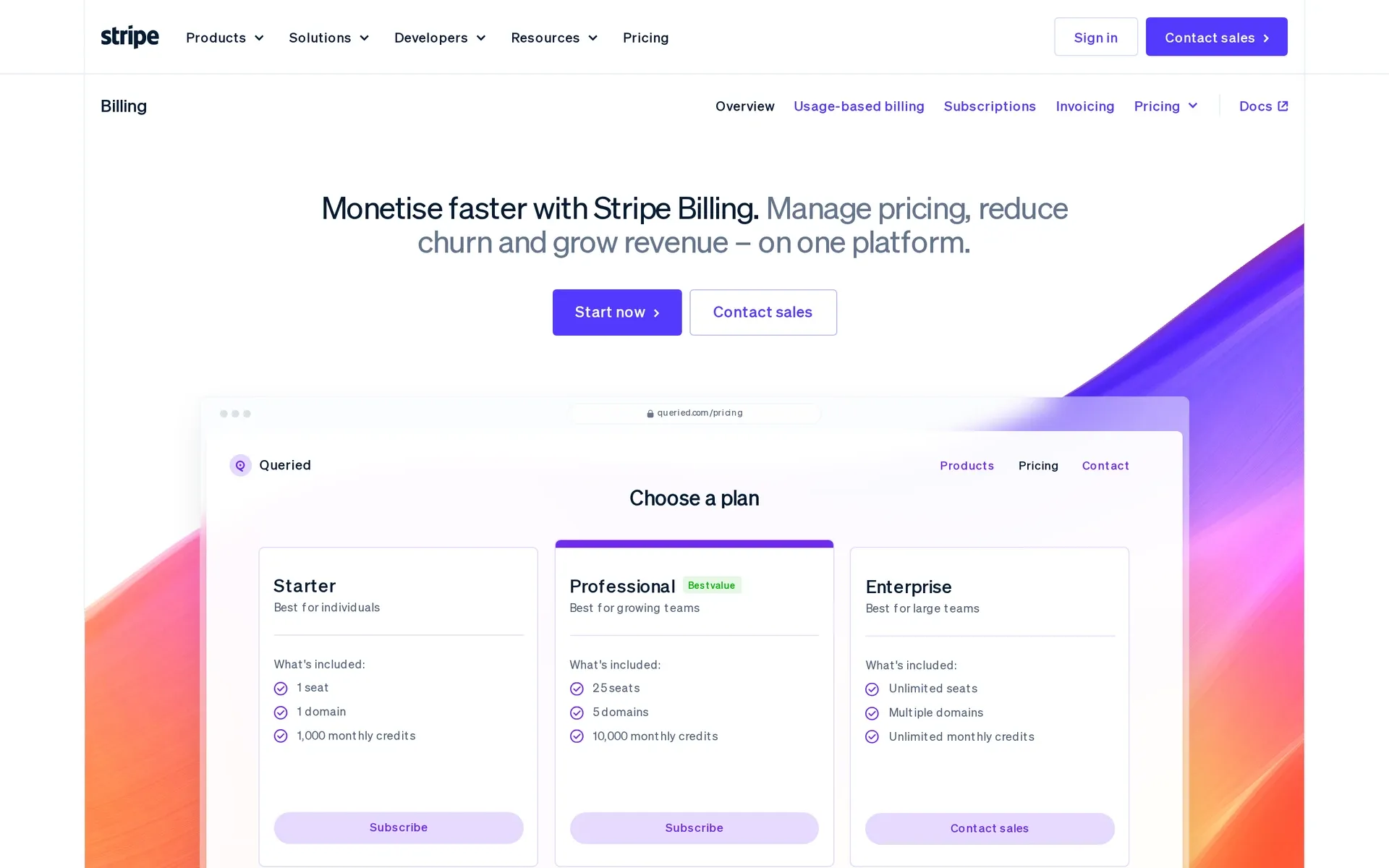
Stripe Billing runs subscriptions, Payments processes cards, and Tax calculates and collects tax. Each has its own fee. Stripe Managed Payments is a separate merchant-of-record option. This setup leaves your business as the seller.
Pricing
For a US card subscription payment, the pay-as-you-go stack charges:
- Payments: 2.9% + $0.30.
- Billing: 0.7% of Billing volume, even for payments Stripe does not process. One-off invoices are excluded.
- Integrated Tax Basic: 0.5% where you are registered to collect tax.
On a $100 payment, processing costs $3.20 and Billing adds $0.70, leaving $96.10. Tax Basic adds $0.50, leaving $95.60 after those three fees, before registration and filing costs.
For a €100 renewal from a Spanish account, with zero tax calculated, the stack costs €2.95 on a standard EEA card, €3.95 on a UK card and €4.60 on an international card, excluding currency conversion.
The Spanish/EUR Tax Complete entry plan starts at €80 a month on a one-year contract, including two registrations and four filings yearly, plus 200 transactions and 2,000 calculation calls monthly. Exceeding those allowances or registering and filing outside the US costs extra. You remain the seller.
Best for
Teams that want to build their own billing logic and already have someone who files VAT and answers disputes. A founder who wants VAT off their plate is still holding it here.
Pros and cons
Pros:
- Smart Retries, reminders, a customer portal, quotes and scheduled subscription changes are included.
- Basic usage metering includes up to 100 million events a month. Advanced usage billing through Metronome costs extra.
- Annual Billing contracts can cost less at high volume.
Cons:
- You remain the legal seller, responsible for tax registration, filing, remittance and chargeback disputes.
- Processing, Billing and Tax fees stack on each renewal where Tax applies.
- Existing subscriptions need migration before Stripe Tax collects tax automatically.
- Tax fees apply when renewal invoices are finalized, even if unpaid. Zero-tax calculations can also incur the fee.
- Tax IDs are checked for format, without verifying that the number exists or is valid.
How it compares
I rate Stripe Billing highest for configurability. On a $100 US payment the stack leaves $95.60 before registration and filing costs, less than a 3.9% + $0.40 merchant of record leaves with filing included, and the registrations and disputes stay yours.
3. Paddle Billing
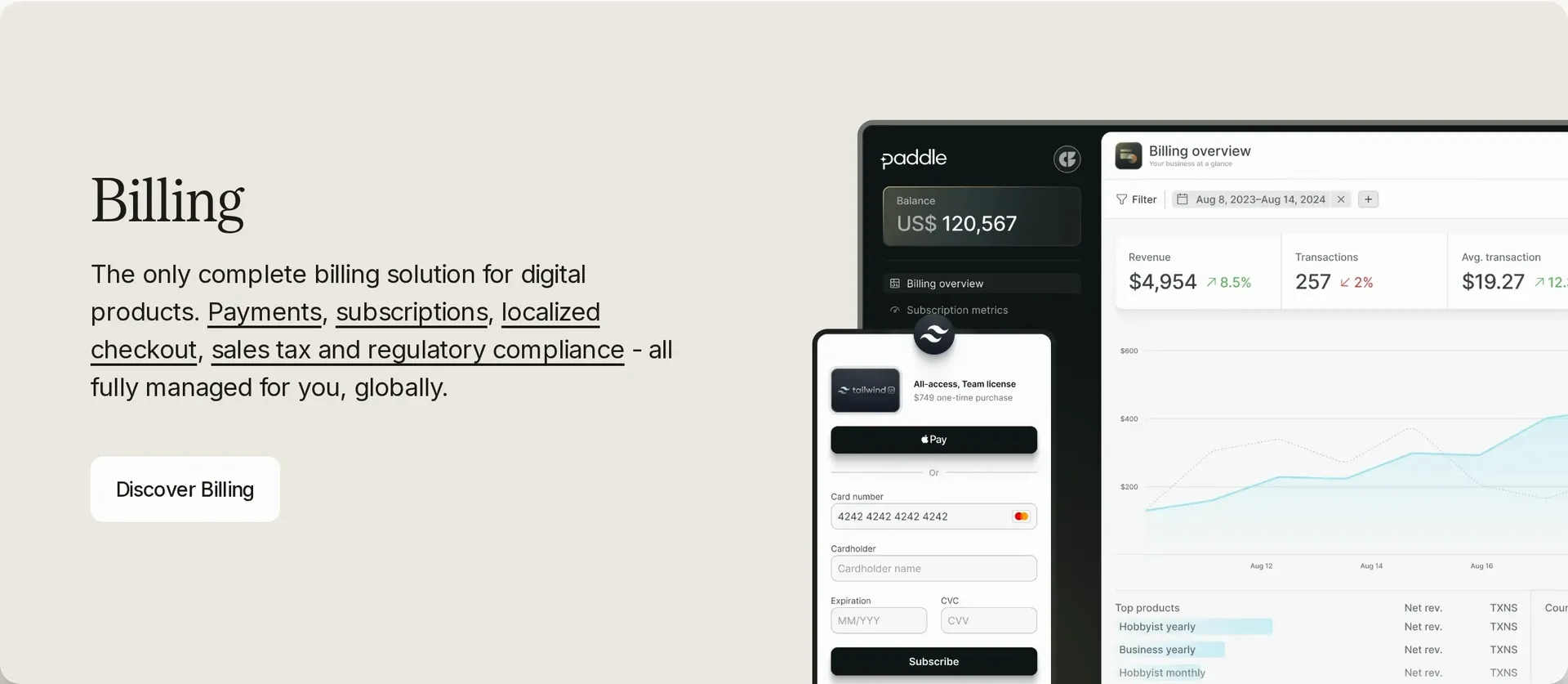
Paddle Billing is the legal seller when customers buy your software. VAT and sales-tax payments go through Paddle, which handles the returns and sends the tax owed to the authorities. That takes transaction-tax filing off your team alongside running subscription billing.
Pricing
Checkout costs 5% + 50¢ per transaction, with no monthly fee. On a $100 sale, the transaction fee is $5.50, leaving $94.50 before tax, payout costs and currency conversion.
Products priced below $10 use custom pricing. Invoicing is quoted separately, so the Checkout rate does not tell you what an invoice-led sale will cost.
Two payout charges can reduce what reaches your bank:
- SWIFT wire payouts cost $15 each.
- Payout currency conversion carries a margin of up to 1.5%.
These costs apply when earnings are transferred, separately from the fee on each sale. If your payout needs both a SWIFT wire and currency conversion, both belong in the cost comparison.
Best for
Teams selling a few paid tiers plus add-ons that want VAT filings gone and can wait for monthly payouts with a $100 minimum balance. It is a less comfortable fit if you need recent sales to fund compute or other operating costs before that payout arrives.
Pros and cons
Pros:
- Payment methods carry no surcharge on top of the Checkout transaction fee.
- Custom billing screens are supported, so the billing interface can match your application.
Cons:
- Payouts go out monthly, sent by the 15th, and require a balance of at least $100.
- Your application still needs to handle billing events so purchases and plan changes result in the right product access.
How it compares
The Stripe Payments, Billing and Tax stack keeps your business as the seller. Paddle takes that role, making the tax handoff the main structural difference.
For usage, Paddle adds charges as custom items on the next invoice. Polar feeds usage events through meters into metered prices. I see Paddle's two main trade-offs as usage billed through an invoice line next cycle and cash paid out once a month, especially when compute costs arrive sooner.
4. Chargebee
Chargebee is a billing layer that sits on top of a payment gateway and merchant account you bring yourself. It is not a merchant of record, so your business stays the legal seller.
Pricing
Chargebee Growth Starter costs $0 for the billing plan, excluding payment-gateway and tax-tool costs. Using the Avalara integration requires a separate Avalara account. CPQ, revenue recognition and receivables are separate products with their own pricing.
The Starter price alone cannot tell you what you keep from a sale. That depends on the gateway and tax services you pair with it.
Best for
B2B SaaS teams that already have a processor, CRM, accounting system and someone responsible for tax, and need subscription billing to work across them. Sales-assisted enterprise contracts with quotes and longer invoice terms are a stronger reason to consider it than simply needing an international checkout.
Pros and cons
Pros:
- Salesforce and Xero integrations connect subscription billing with sales and accounting systems.
- Separate finance products cover quotes through CPQ (configure, price, quote), when revenue is recorded rather than collected, and tracking what customers owe.
Cons:
- You need your own payment gateway and merchant account to collect payments.
- Adding Chargebee does not transfer responsibility for global transaction taxes.
- With a separate tax service, you manage three vendors, even on the $0 Starter billing plan.
How it compares
Stripe supplies all three layers in its Payments, Billing and Tax stack. Chargebee lets you choose the gateway and tax tool around its billing layer. Your business remains the seller either way.
I would consider Chargebee when the existing processor works and the harder job is getting sales, subscription billing and accounting to agree. That choice means keeping several vendor relationships, but it can fit a team whose finance systems are already in place.
5. FastSpring

FastSpring is the legal seller for software transactions. It calculates, collects and remits sales tax, VAT and GST, taking transaction-tax administration off your team alongside running subscription billing.
Pricing
Transaction commissions are quoted individually, based on transaction type and business volume. The quote form asks for transaction volume, transaction count, product type and geographic revenue split. Without that quote, you cannot calculate what you keep from a $100 sale.
Currency conversion sits outside the commission. Receiving payouts in your store currency avoids FastSpring's 2.5% conversion charge, which applies when the store and payout currencies differ. Include that charge when comparing a quote with published transaction rates if you need payouts in another currency.
Best for
Established software businesses that want to outsource transaction-tax administration through a merchant of record, alongside subscription management and B2B invoicing.
Pros and cons
Pros:
- Subscription management, fraud prevention and B2B invoicing are included in the pricing bundle.
- FastSpring handles tax audits and questions from tax authorities about the digital sales it processes.
- Its compliance team reviews potential zero-rated transactions during onboarding, rather than automatically treating every B2B buyer as tax-exempt.
Cons:
- Live payment processing starts with a 45-day monitoring hold on initial payouts.
- Transactions have a standard 14-day settlement delay, separate from the initial hold.
- There is no payment-processing-only price if you want to keep your existing billing and tax setup.
How it compares
Lemon Squeezy publishes its base transaction rate. FastSpring requires an individual commission quote before the same $100 comparison is possible, with payout conversion counted separately where it applies.
I see FastSpring as a transaction-tax outsourcing option for established software businesses.
For a small SaaS or AI startup relying on customer payments to cover near-term costs, cash flow deserves equal weight. Handing off tax still leaves you funding operations while initial revenue is unavailable. A workable commission alone does not settle that decision.
6. Lemon Squeezy
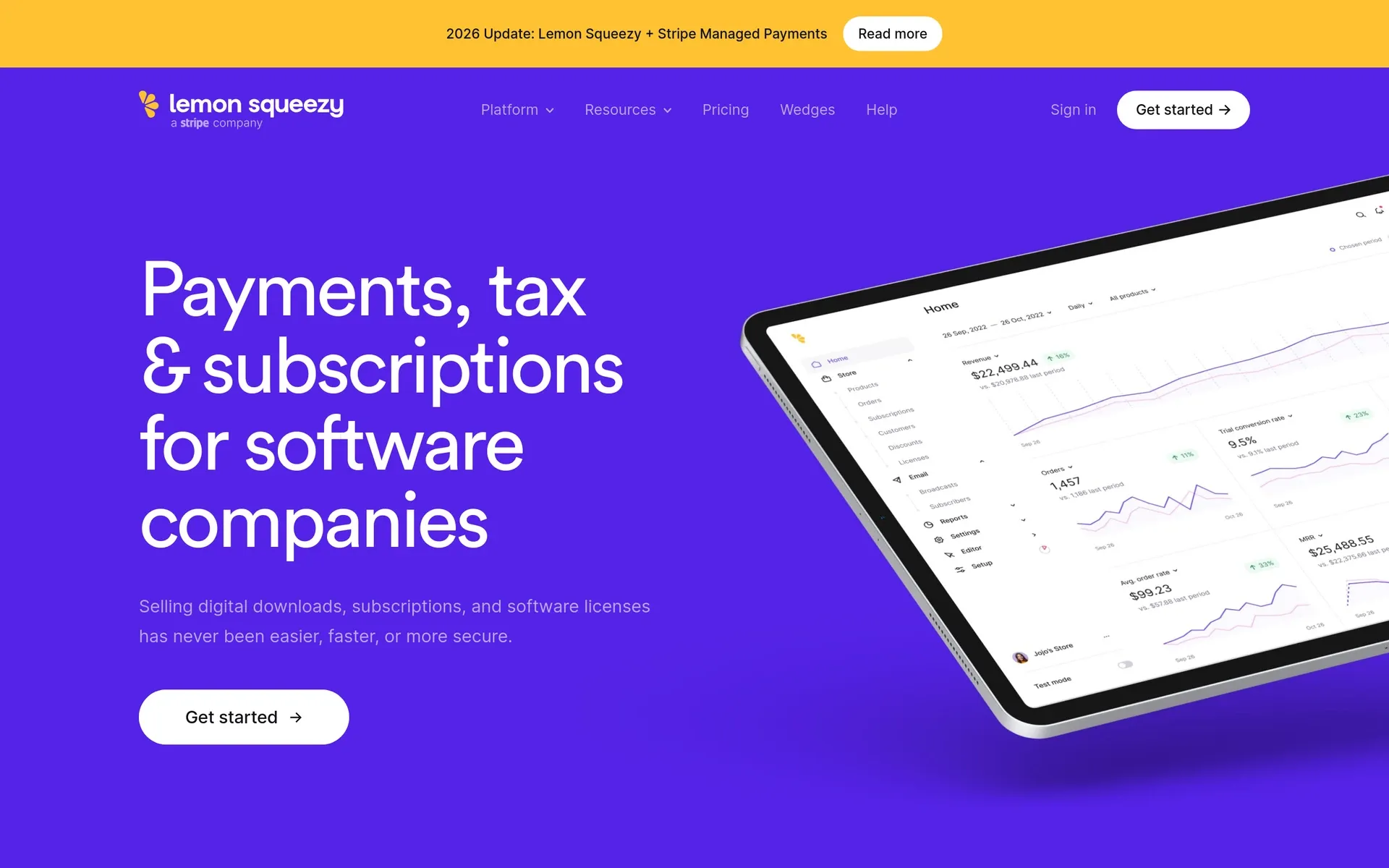
Lemon Squeezy homepage with its store dashboard: payments, tax and subscriptions for software companies
Owned by Stripe, Lemon Squeezy is a merchant of record that handles global sales tax as the legal seller. It combines checkout with software-selling tools, replacing a processor, tax service and license-key system for sellers who want those jobs together.
Pricing
The base rate is 5% + 50¢ per transaction, charged on the tax-inclusive total. Three surcharges can stack on the same payment:
- International transactions add 1.5%.
- PayPal payments add 1.5%.
- Subscription payments add 0.5%.
A $100 domestic one-time card sale costs $5.50, leaving $94.50. An international PayPal subscription reaches 8.5% + 50¢. On a $100 renewal total, that costs $9.00, leaving $91.00 before payout-transfer fees.
If you price excluding VAT, run the percentage fee on the price plus tax when comparing Lemon Squeezy with the other options. Using only your advertised product price understates the fee.
Payout-transfer costs depend on where the money goes:
- US bank payouts carry no transfer fee.
- Non-US bank payouts cost 1%.
- Non-US PayPal payouts cost 3%, capped at $30.
Best for
Indie makers and creators selling downloads, templates and software licenses who want an all-in-one merchant-of-record checkout and accept surcharge-based pricing. International SaaS subscriptions need a closer cost comparison because the added charges recur with each renewal.
Pros and cons
Pros:
- Payouts to US bank accounts carry no transfer fee.
- Usage-based billing is listed as a supported feature.
Cons:
- Affiliates add a 3% merchant referral fee and a separate 2% affiliate payout fee.
- There are no built-in revenue splits for co-founders or contractors.
- Payouts are created on the 1st and 15th, after a 13-day hold, with a $50 minimum.
- Users report disabled payouts without explanation and unanswered support requests.
How it compares
Paddle and Lemon Squeezy start at the same base rate as legal seller. Lemon Squeezy then adds the international, PayPal and subscription surcharges above, with affiliate fees separate again. The headline alone does not describe an international subscription business's cost.
For downloads and licenses, I see the appeal of having checkout and licensing together. For growing SaaS billing worldwide, I would give the actual payment mix and partner-payment needs more weight.
Without revenue splits, a co-founder's share must be paid outside the platform. Tax outsourcing does not remove that payout work.
7. PayPro Global

Assisted setup and buyer payment support are part of PayPro Global's merchant-of-record service. It helps with initial product and checkout integration, administers subscriptions, and takes over transaction-tax handling, including collecting and remitting EU VAT and Canadian GST/HST.
Pricing
The core transaction rate is quoted on request. The quote needs to include both the percentage and fixed charge before you can work out what remains from each sale.
Payout charges sit outside that rate and vary by method:
- Wire transfers cost $21 per payout.
- ACH payouts in North America cost $3 each.
- PayPal payouts carry no fee in the US and Canada.
- International PayPal payouts cost 2%, capped at $20.
On an illustrative $500 payout, a wire costs 4.2% of the balance, while ACH costs 0.6%. Before comparing quotes, pick the lowest-cost method your bank can receive.
Best for
Software vendors that are comfortable buying payment services under an annual contract. It suits a team whose buyers call about billing and that does not want to staff those calls itself.
Pros and cons
Pros:
- Buyer-facing phone support is available 24/7 in multiple languages.
- Initial and recurring subscription payments can have different amounts.
- Sellers can change prices for active subscriptions, schedule charge dates and delay the first subscription payment.
Cons:
- The standard contract lasts one year and can be extended for another year.
- Settlement is monthly for the previous month's closing balance, less payout fees and applicable adjustments.
- PayPro Global forwards refund requests to your team to try to resolve them with the buyer.
- Cancellation carries no fee, but contract terms still affect payouts after cancellation.
How it compares
Lemon Squeezy and Polar let you run the $100 comparison from published rates. With PayPro Global, that calculation waits for a quote, and accepting it means taking on the annual term above. Compare the full cost before signing, including the payout method you will use.
Cash flow needs its own check. A sale in early March is scheduled for payout on 15 April, so the payment can clear well before you have the money to cover operating costs.
I would consider PayPro Global when handing off payment administration is worth a longer commitment. A small SaaS or AI team still changing its pricing and watching cash closely has more to weigh than the quoted transaction fee.
8. Polar
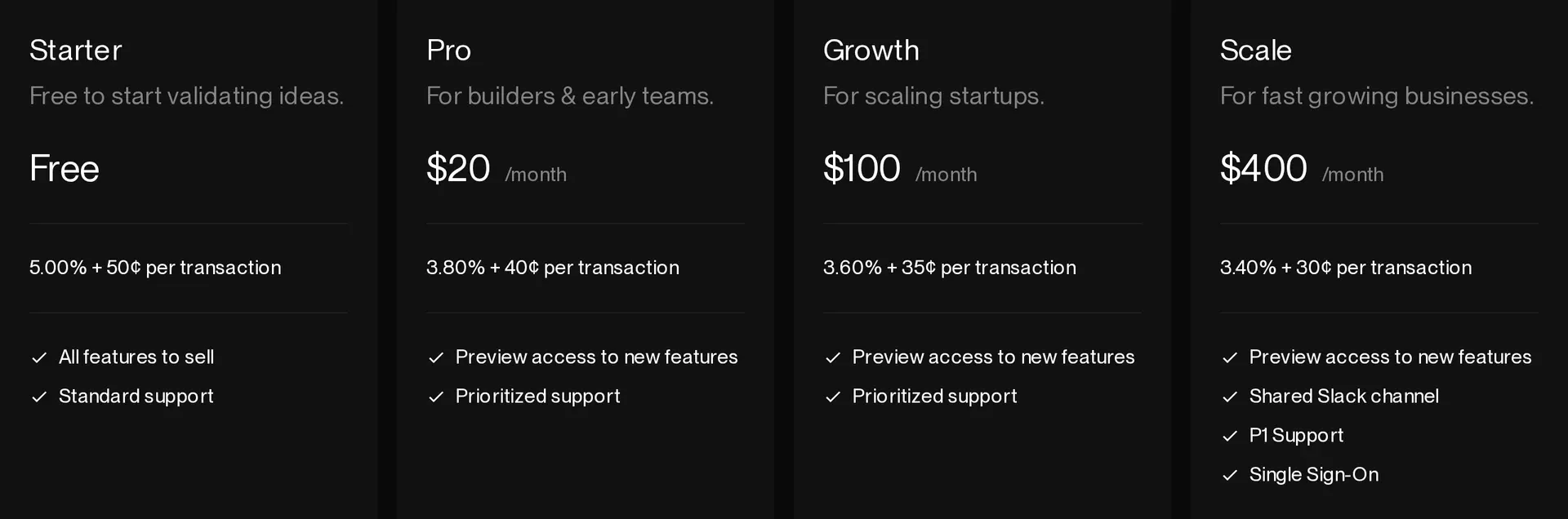
Polar pricing plans: Starter, Pro, Growth and Scale, each with its own per-transaction rate
Polar is a merchant of record built around usage billing. Your app sends usage events, Polar totals them through meters, and the resulting charges land on the customer's next invoice alongside the subscription.
Pricing
Polar trades a monthly fee for lower transaction rates:
| Plan | Monthly fee | Transaction rate |
|---|---|---|
| Starter | $0 | 5% + 50¢ |
| Pro | $20 | 3.8% + 40¢ |
| Growth | $100 | 3.6% + 35¢ |
| Scale | $400 | 3.4% + 30¢ |
On a $100 US-card sale, you keep $94.50 on Starter, $95.80 on Pro, $96.05 on Growth and $96.30 on Scale, before monthly plan and payout fees.
Scale saves $1.80 per such sale versus Starter, so roughly 223 sales monthly cover its $400 fee. Polar's published break-even figures assume a $40 average order, so your order size moves that point.
Every current plan adds 1.5% for non-US cards. Fees apply to the tax-inclusive total, so a $30 product with $7.50 VAT has a $37.50 fee base.
Other charges sit outside those rates:
- Active payouts cost $2 monthly, plus 0.25% + $0.25 per payout.
- Payout currency conversion costs 0.25% in the EU, up to 1% elsewhere.
- Disputes cost $15 each, deducted from your balance regardless of outcome.
Best for
Teams charging for tokens, storage or compute that want consumption turned into invoices and can maintain the app-side usage limits. Mostly US-card buyers make the rates easier to compare. With mostly non-US cards, include the surcharge before deciding whether a paid tier is worthwhile.
Pros and cons
Pros:
- Plan changes are self-serve, with the new transaction rate applying immediately.
- One event stream can feed several meters using count, sum, average, minimum, maximum or unique values.
- Ready-made ingestion covers OpenAI-compatible LLM usage, streaming responses, S3-compatible storage and elapsed time.
Cons:
- Your application must stop consumption when a balance or quota runs out, or decide to allow overages.
- Ingested events cannot be edited or deleted. Late events bill in the cycle received, without corrections to closed periods.
- Founders report needing a separate affiliate tool because Polar lacks a native affiliate program.
How it compares
Scale has the lowest published base per-sale MoR rate in this list. On a non-US card, its percentage becomes 4.9%, before the fixed charge.
I would compare that international rate and monthly commitment against the value of Polar's meters. For a worldwide seller, payout charges, disputes and a separate affiliate tool also belong in the budget.
9. Dodo Payments

Dodo Payments is a merchant of record for software sales that calculates, collects and remits transaction taxes. UPI checkout in India and Pix in Brazil distinguish its payment coverage, while ACH and SEPA Direct Debit offer different economics from cards.
Pricing
Domestic US cards and wallets cost 4% + $0.40 per transaction, with no fixed monthly costs. On a $100 domestic card sale, the fee is $4.40, leaving $95.60.
International cards and alternative payment methods add 1.5%, while subscriptions, add-ons and usage billing add another 0.5%. On a $100 non-US card subscription, the combined fee is 6% + $0.40. That costs $6.40, leaving $93.60.
Bank-debit pricing replaces the card fee, without international or subscription surcharges:
- ACH Direct Debit costs 1.5%, capped at $15.
- SEPA Direct Debit costs 1.5%, capped at €15.
If your buyers will pay by bank debit, offer ACH or SEPA at checkout. The separate rate replaces the higher card-subscription rate rather than adding another charge to it.
Three other charges belong in the comparison:
- PayPal and buy-now-pay-later payments add 3%.
- Successful recovery through abandoned carts, dunning or payment retries costs 5% of recovered revenue.
- Disputes cost $30 each.
Best for
SaaS teams with buyers in India or Brazil, or with renewals they can move to ACH or SEPA. For companies, eligibility depends on each director's and beneficial owner's verification-ID country as well as where the business is incorporated.
Pros and cons
Pros:
- Invoicing is included in the payment service.
- Google Pay, Amazon Pay and stablecoin payments are listed globally except India.
Cons:
- ACH processing takes up to four business days, while SEPA Direct Debit takes six. These are payment-processing times, separate from seller payouts.
- Hosted checkout cannot run inside an iframe. Redirection and Overlay Checkout are supported alternatives.
How it compares
Dodo's domestic card base rate is below Lemon Squeezy's, while its dispute charge is twice Polar's.
For Dodo, I would price the buyer mix before trusting the domestic headline. International card renewals carry the combined rate above, bank-debit renewals avoid those surcharges, and UPI or Pix lets buyers use familiar local methods at checkout. The payment method changes both acceptance and cost.
Which SaaS payment solution should you choose?
Start with who handles the tax. A merchant of record takes transaction-tax registrations and filings off your plate. A billing tool automates renewals, but VAT remains your responsibility.
From there, match your situation to a setup:
- Only US buyers and a finance person on sales tax: Stripe Billing with Stripe Tax.
- Enterprise contracts with quotes, long invoice terms and sales-assisted deals: Chargebee on top of your existing processor.
- Physical goods, or a negotiated high-volume rate with a sales-led account: Paddle, since Creem's account review excludes physical goods.
- Consumption pricing for tokens or compute: Polar if you will write the code that stops usage, or Creem for meters plus prepaid credit wallets with auto-refill.
- Tax filed, usage billed, and affiliates and partners paid on every sale from one checkout: Creem.
Before comparing costs, check that you can sign up from your country with your ID. If you are moving live subscriptions, ask whether the stored cards move too or subscribers need to re-enter them.
Find the lowest-cost option by running last month's actual sales through each setup, broken down by country, payment method and plan. Count billing fees, currency conversion, card surcharges, partner cuts and payout costs, not just the headline rate.
Sell Software Globally With Creem
I recommend Creem for a growing SaaS or AI startup that wants a merchant of record to handle transaction-tax collection and remittance. The question that decides it is who stays the seller when a card from Spain or Japan clears.
With a payment processor and a billing layer, you are still the seller, responsible for the registrations, filings and disputes that follow. A merchant of record takes on that role.
Creem becomes the legal seller of your software, so you can charge buyers worldwide without building a payments, tax or compliance operation. We calculate, collect and remit VAT, GST and sales tax for buyers in 190+ countries, at a standard base rate of 3.9% + $0.40 per successful transaction.
If you would rather not file the tax on every international sale yourself, try Creem and let us file it as the merchant of record.