

One seller on Reddit tested a small monthly Stripe subscription and got a payout under what 2.9% + 30¢ predicted, because a billing usage fee sat on top of card processing. "It's not about the 14 cents so much as having the correct information so that I can project accurate revenue," they wrote.
Tax arrives later, once sales to consumers abroad fall under a country's VAT rules and the registration and filing land on them as the seller. Stripe documents each charge, yet its pricing page never totals them for a subscription business.
Getting that sum wrong costs twice. Extra points come off every renewal, and tax work you never budgeted for arrives with its own deadlines.
By the end, you can add those layers at your own volume and know which duties stay with you as the seller.
When you would rather not be the seller at all, try Creem, which becomes the legal seller and files the VAT, GST and sales tax for you.
Key takeaways
Stripe Billing adds a software fee to payment processing, and neither fee makes Stripe the seller. At Stripe's US-account rates, a $100 domestic renewal costs $3.20 in processing at 2.9% + 30¢ and $0.70 for the 0.7% Billing fee, so $3.90 leaves before payout.
For an international card payment that also needs currency conversion, the 1.5% and 1% surcharges add $2.50, bringing the fees to $6.40 on one payment. That difference repeats on every renewal you count in the month.
Use these to add up your monthly total and check what those fees don't cover:
- Add Billing to processing. The 0.7% pay-as-you-go fee applies to billing volume, separate from the 2.9% + 30¢ card fee on each renewal.
- Count payments, not only revenue. The fixed 30¢ hits every charge, so many small renewals lose a larger share than fewer large ones.
- Tag where buyers pay from. International cards add 1.5% and currency conversion adds 1% on qualifying payments.
- Skip the Invoicing fee for subscriptions. Invoices a subscription creates carry no separate Invoicing charge. That fee applies only to one-time invoices.
- Put a cost on your first tax registration. Stripe Tax calculates the tax, but the registration, every return after it, the liability and dispute responses stay with you.
- Price a merchant of record once buyers go abroad. A real share paying from other countries or currencies, or a first VAT or sales-tax registration coming due, is the trigger.
Stripe Billing plans and fees
Billing gives you two routes, pay-as-you-go or a contract through a published annual tier or a custom quote. Invoicing has its own pricing for one-off bills.
Pay-as-you-go Billing (0.7% of billing volume)
Pay-as-you-go requires no contract. Stripe takes 0.7% of everything that runs through Billing, so the fee rises with your recurring revenue.
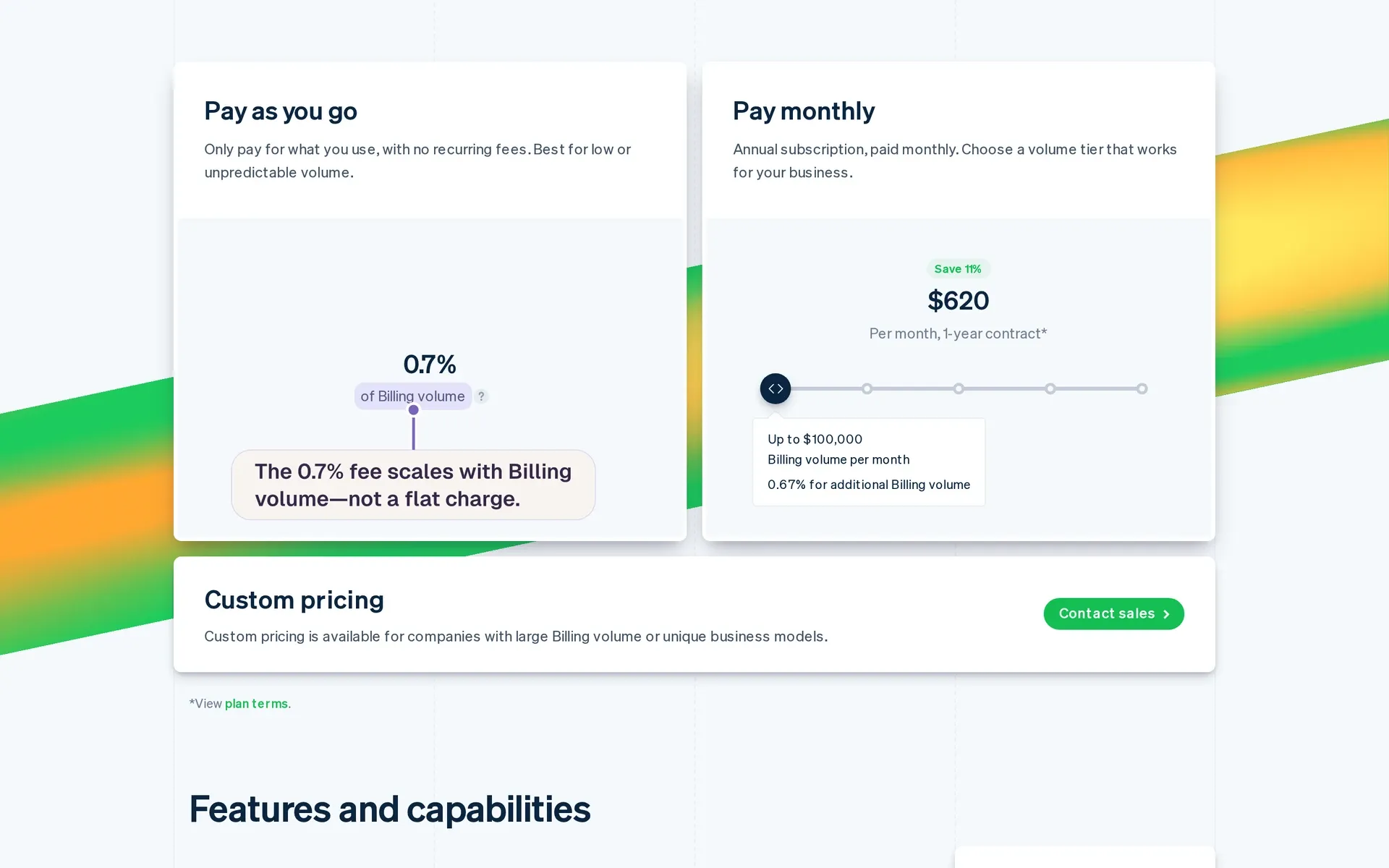
Stripe Billing pricing page: 0.7% of Billing volume pay-as-you-go, $620 monthly with a 1-year contract, and custom pricing
At $100,000 in monthly billing volume, you pay $700 a month, or $8,400 a year. To work out your own cost, multiply your monthly billing volume by 0.007. That covers Billing alone, before any card is processed.
Annual subscriptions and custom contracts
Stripe publishes volume tiers for annual Billing subscriptions. You pay monthly but commit for the full year. To check whether a tier saves you money, compare twelve months of its price with twelve months at 0.7% of your lowest expected volume.
Custom pricing is available on request when your volume is large or your pricing doesn't fit the standard plans. Stripe doesn't publish those rates, so bring your pay-as-you-go figure as the number an offer needs to beat.
Stripe Invoicing (0.4% to 0.5% per paid invoice)
Invoicing charges for the one-off bills you send, separately from the renewal invoices your subscriptions create. Starter costs 0.4% per paid invoice. Plus costs 0.5% and includes everything in Starter, plus quotes.
On a $5,000 one-time invoice, you pay $20 on Starter or $25 on Plus. Stripe's payment fees still apply to the $5,000 you collect, so processing goes on top of the invoice fee.
How do Stripe Billing subscription fees stack up?
You pay both on every renewal, with Billing and processing taken as separate deductions at Stripe's US-account rates.
What the Billing percentage is charged on
On pay-as-you-go, the 0.7% applies to billing volume, which is the amount your subscriptions bill. On a $50 renewal, that comes to 35¢.
Apply 0.7% to the $1.75 card fee instead and you get about 1¢, hiding almost the whole Billing cost. Calculate it on revenue billed, then add processing as a separate line.
Card processing on every renewal (2.9% + 30¢)
Each successful card renewal is a new transaction, so the 2.9% + 30¢ applies again every billing cycle. The percentage scales with your price, while the 30¢ stays fixed.
On a $100 plan, that fixed fee is 0.3% of the charge, while on a $10 plan it is 3%. At the same revenue, more payments mean more fixed fees, so count renewals as well as volume when you estimate the month.
Prices you set vs fees Stripe charges
Your plan price is what the buyer's card is charged. With exclusive tax, the tax is added on top of that amount.
Stripe deducts its fees from the charge before the payout lands, so you always keep less than the plan price.
On the same $50 domestic renewal, $1.75 in processing and 35¢ in Billing leave you $47.90. Those two fee layers leave every plan you sell netting less than its sticker price.
Additional fees and conditions
When a subscriber pays with a card issued abroad and the charge needs currency conversion, every renewal adds 2.5 percentage points in fees. The other costs on Stripe's list apply when something happens or you switch on a service.
If your Stripe account is outside the US or you're on a negotiated contract, your rates differ from these US standard figures.
These surcharges apply to every renewal from that card:
- International card: 1.5% on top of processing.
- Currency conversion: 1%, only when the charge needs converting. A buyer abroad paying in your currency doesn't trigger it.
These costs apply when an event happens or you choose a service:
- Dispute received: $15 per dispute, whatever happens next.
- Countering manually: another $15, returned if you win.
- Smart Disputes: 30% of the disputed amount on a win, nothing on a loss.
- Instant Payouts: 1.5% of the payout, $0.50 minimum. Standard-schedule payouts are free.
A disputed $100 renewal shows the trade-off. The $100 is at stake and the $15 received fee comes out either way, while a manual counter costs nothing more on a win and $15 more on a loss.
Smart Disputes reverses that trade-off. Stripe keeps $30 of the $100 on a win, so you recover $70, or $55 after the received fee, and a loss adds nothing.
Manual countering is cheaper on fees whenever you expect to win, but preparing the response takes your own time.
On a $10 renewal, the $15 received fee alone is more than the charge. Add at least $15 per expected dispute to your monthly total, on top of the disputed amount and whichever response costs apply.
Checkout, Payment Links, 3D Secure, Smart Retries and payment reminders come with standard pricing. The card-processing fee applies only to successful charges, so a failed retry adds no processing fee.
Adaptive Pricing shows the buyer a conversion fee from 2%. That fee goes on their total, not your bill, so leave it out of your own sum.
What Stripe Billing costs per month: worked examples
Each illustrative $20,000 month excludes tax, refunds, disputes and optional paid products, with payments presented and settled in USD. All three assume a US Stripe account on standard card pricing and pay-as-you-go Billing, charged on every successful renewal.
1. A domestic SaaS plan on cards
Start with 200 successful $100 renewals on US-issued cards, totaling $20,000 a month. For a US Stripe account on standard pricing, the fees are:
- Card processing (2.9%): $20,000 × 2.9% = $580.
- Fixed charges: 200 × 30¢ = $60.
- Stripe Billing fee (0.7%): $20,000 × 0.7% = $140.
Total fees come to $580 + $60 + $140 = $780, or 3.9%, leaving $19,220 before refunds, disputes or optional services.
This $100-renewal month has no international-card surcharge or currency conversion. I would use it as a baseline for SaaS selling mostly to US buyers on cards, but check last month’s share of renewals on US-issued cards before applying it to all your revenue.
2. The same revenue in smaller payments
Charge $20 instead of $100 and you need 1,000 successful renewals on US-issued cards to collect $20,000. For a US Stripe account on standard pricing, the fees are:
- Card processing (2.9%): $20,000 × 2.9% = $580.
- Fixed charges: 1,000 × 30¢ = $300.
- Stripe Billing fee (0.7%): $20,000 × 0.7% = $140.
Total fees come to $580 + $300 + $140 = $1,020, or 5.1%, leaving $18,980. The $100-plan month costs $780 on the same revenue, so those 800 extra payments add $240.
This case fits low-priced monthly plans and small credit top-ups. On a $20 payment, the fixed fee alone takes 1.5%, so a lower price pushes your effective rate further above the headline percentage.
To work out your own month, multiply the successful payment count by 30¢, then add the processing and Stripe Billing percentage lines.
3. The same revenue from international buyers
For a US-based seller on standard US card pricing, 200 successful $100 renewals total $20,000, and if half use cards issued outside the US, $10,000 attracts the international-card surcharge. That adds $10,000 × 1.5% = $150.
Charge those foreign buyers in USD and fees come to $780 for the all-domestic month + $150 = $930, or 4.65%, leaving $19,070.
Price in their currencies and have Stripe convert that volume to USD, and conversion adds $10,000 × 1% = $100. Total fees reach $1,030, or 5.15%, leaving $18,970.
This case fits a SaaS or AI product with a substantial share of buyers abroad. Each $1,000 that shifts to foreign cards charged in the buyer’s currency and converted to USD adds $25 in monthly fees above the domestic baseline.
Check which currencies your prices use before budgeting. For your own card-only month, with pay-as-you-go Billing volume equal to successful payment volume, use:
Fees = volume × 3.6% + successful payments × 30¢ + international-card volume × 1.5% + converted volume × 1%
The 3.6% combines processing at 2.9% and Billing at 0.7%. Add dispute fees and any Stripe add-ons you switch on separately.
Stripe Billing vs other billing setups compared
With ordinary Stripe Billing and Invoicing, you stay the legal seller and handle tax filing and disputes. A merchant of record takes on that work.
The rates below apply to US merchants on standard pricing.
| Setup | Fees charged | Legal seller | Tax filing and remittance | Disputes |
|---|---|---|---|---|
| Stripe Billing, domestic cards | 0.7% Billing + 2.9% + 30¢ per payment | Your business | Your business, even with Stripe Tax | You handle responses, $15 received fee |
| Stripe Billing, international cards with conversion | Domestic stack + 1.5% international + 1% conversion where each applies | Your business | Your business | You handle responses, $15 received fee |
| Stripe Invoicing Starter / Plus | 0.4% / 0.5% per paid one-time invoice + 2.9% + 30¢ for domestic cards | Your business | Your business | You handle responses, $15 received fee |
| Merchant of record | Provider-set per-sale rate | The provider | The provider files and remits | The provider handles disputes |
Stripe Managed Payments also makes Stripe the merchant of record, but it excludes Connect platforms, marketplaces and subscriptions created outside Checkout or Payment Links. That means an existing Billing integration may need changes before you can use it.
- Ordinary Stripe setups suit sellers whose payment mix produces lower calculated fees and who will own tax and dispute work.
- A merchant of record suits sellers who want the provider to carry those responsibilities alongside payment collection.
Which Stripe Billing setup fits your business?
Billing plans affect only the 0.7% layer, not fixed per-payment, international-card or conversion fees, so the real choice is the legal seller. Price a merchant of record when a real share of buyers pays from abroad or in other currencies, or your first VAT or sales-tax registration comes due.
If you sell mostly at home, collect small renewals and already trust your tax setup, Stripe Billing is cheaper on fees alone, so staying makes sense.
In a $20,000 month of $100 renewals with half the buyers abroad, Billing accounts for $140 of the $1,030 total. A Billing discount only touches that $140, so even cutting it to zero leaves $890 in processing, international-card and conversion charges.
Payment count works the same way. Billing the same $20,000 as 1,000 renewals of $20 costs $240 more than 200 renewals of $100, entirely because of the 30¢ fixed fee on each payment. No Billing tier changes that.
Match the fix to what drives your total:
- Many small renewals: fewer, larger charges, such as annual plans, cut the fixed per-payment fees.
- Large, steady Billing volume: an annual tier or custom quote lowers the 0.7% layer and nothing else.
- Usage or credit pricing: each top-up or metered charge is another payment, so count them the way you count renewals.
Compare provider fees alongside the work you keep as the seller, including handling failed renewals and cancellations in your app and running the tax operations that remain yours.
What stays with you as the seller on Stripe
You stay the legal seller on Stripe, so tax obligations and chargebacks remain yours, whatever you pay in fees. Stripe Tax calculates tax and helps with registration and filing, but it does not move the liability to Stripe.
That leaves duties no Stripe fee covers:
- Tax registration: each VAT or sales-tax registration your sales trigger is in your business's name.
- Returns and payments: you file every return after that registration, pay over the tax collected, and correct any late or short return.
- Chargebacks: you answer each dispute and carry its outcome, even with Stripe's dispute tools switched on.
A non-business EU sale shows where that work starts. Stripe Tax can calculate the VAT, but you still have to register, report and pay it as the seller.
The first registration is the cost to account for, because every return after it comes back on a schedule. As an illustrative figure, $300 in accountant time for each quarterly return works out to $100 a month, or half a point on $20,000 of revenue.
Add that cost to the $780 in Stripe fees on a $20,000 all-domestic month of $100 renewals and the total is $880, or 4.4%. Count last month's disputes and add their fees, then compare that total with a merchant of record.
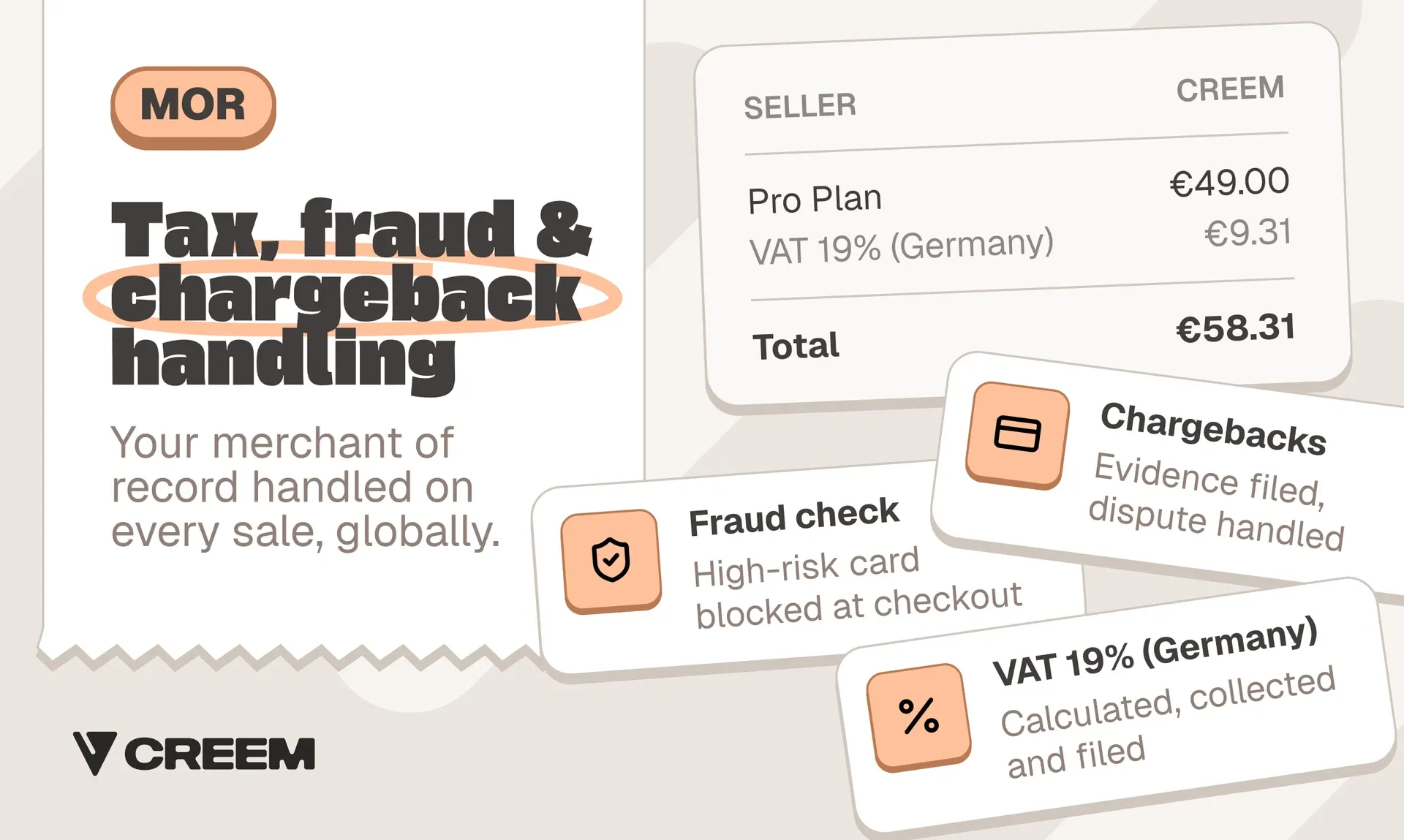
When Creem is the merchant of record for your sales, the registration, returns and tax liability on those sales move to Creem.
Compare your Stripe total with Creem's 3.9% + 40¢
The comparison is worth running once renewals from abroad account for a real share of revenue, or your first VAT or sales-tax registration is close.
For the same $20,000 month of 200 renewals at $100, Creem's 3.9% + 40¢ per successful transaction comes to $860, with no international-card surcharge. Payouts add to that. Each bank payout costs 7 USD/EUR or 1% of the amount, whichever is higher, so withdrawing the $19,140 left adds about $191 and brings Creem to about $1,051.
Stripe totals $880 for the all-domestic month with one illustrative quarterly return, so it costs less when buyers are at home. When half the buyers pay from abroad in their own currency, Stripe's $1,030 plus that return comes to $1,130, about $79 more than Creem. At 1,000 renewals of $20, Creem comes to about $1,368 with payouts, $348 above Stripe's $1,020.
Creem answers each chargeback dispute, but you still cover the disputed amount and a 25 USD or EUR fee per chargeback. The rate also covers Creem acting as the legal seller, filing and remitting VAT, GST and sales tax on those orders for buyers in 190+ countries.
If you are pricing your first registration, try Creem and let Creem register, file and remit the tax on every sale it handles instead of you. There is no monthly or setup fee, so a month without sales costs you nothing.