
A Product Hunt launch can turn a quiet SaaS business into an international tax project before the founder notices. One day, you're watching subscriptions arrive from the UK, France, Spain, and the Philippines. The next, your accountant asks where each customer lives, whether the sale is taxable, which threshold applies, and whether your checkout has been charging the right amount of VAT.
That's the trap. VAT registration isn't a milestone you hand to finance after growth happens. It's a forecast and product-design problem. Your pricing, checkout, invoices, customer records, and billing architecture all influence whether you can register and collect tax without creating a retroactive liability.
Table of Contents
- Why VAT Registration Hits Software Sellers Differently
- Thresholds That Actually Trigger VAT Registration
- How to Monitor Turnover and Trigger Registration on Time
- Documents and Information Required to Register
- DIY Registration Versus Using a Merchant of Record
- Cross-Border Nuances Most Guides Skip
- Your VAT Registration Checklist and Next Steps
Why VAT Registration Hits Software Sellers Differently
A solo developer launches a subscription tool and sees demand spike overnight. The business is established in the UK, and its taxable turnover crosses the domestic VAT threshold during a strong sales period. The founder doesn't notice immediately because the revenue is spread across monthly subscriptions, annual plans, refunds, upgrades, and customers in several countries.
That delay is expensive. The UK uses a rolling 12-month test, not a financial-year test, and the current registration threshold is £90,000 in taxable turnover. The UK government's VAT registration guidance says the business must notify HMRC within 30 days after the end of the month in which turnover crosses the threshold. The effective registration date is the first day of the second month after the breach.
Physical businesses can often start with a clearer operational map. Stock sits in a warehouse, invoices follow shipments, and the seller can identify where goods are dispatched. Software has no box crossing a border. A digital service can be purchased in one country, supplied from infrastructure in another, and supported by a company incorporated somewhere else. Customer location becomes a central tax input.
The customer changes the exposure curve
Software sellers also face several overlapping questions:
- What are you selling? A subscription, downloadable software, online access, or a mixed service can receive different treatment.
- Who is buying? A consumer and a VAT-registered business may create different invoicing and place-of-supply outcomes.
- Where is the buyer located? Customer geography can determine the tax rate, registration obligation, and evidence you need to retain.
- Are you resident or non-resident? A domestic exemption may apply to an established business while a foreign seller faces registration from its first taxable sale.
- Which sales count? Taxable, exempt, and out-of-scope revenue shouldn't be thrown into one turnover figure.
The cost of treating VAT as back-office administration isn't limited to a late form. A late decision can force changes to prices, invoices, tax-inclusive checkout displays, customer communications, accounting records, and subscription renewals. It can also leave you collecting the wrong amount from customers or absorbing VAT from your own margin.
Founder rule: Build VAT monitoring into the product and billing system before a market becomes material. Registration is the consequence of sales design, not a clerical afterthought.
Thresholds That Actually Trigger VAT Registration
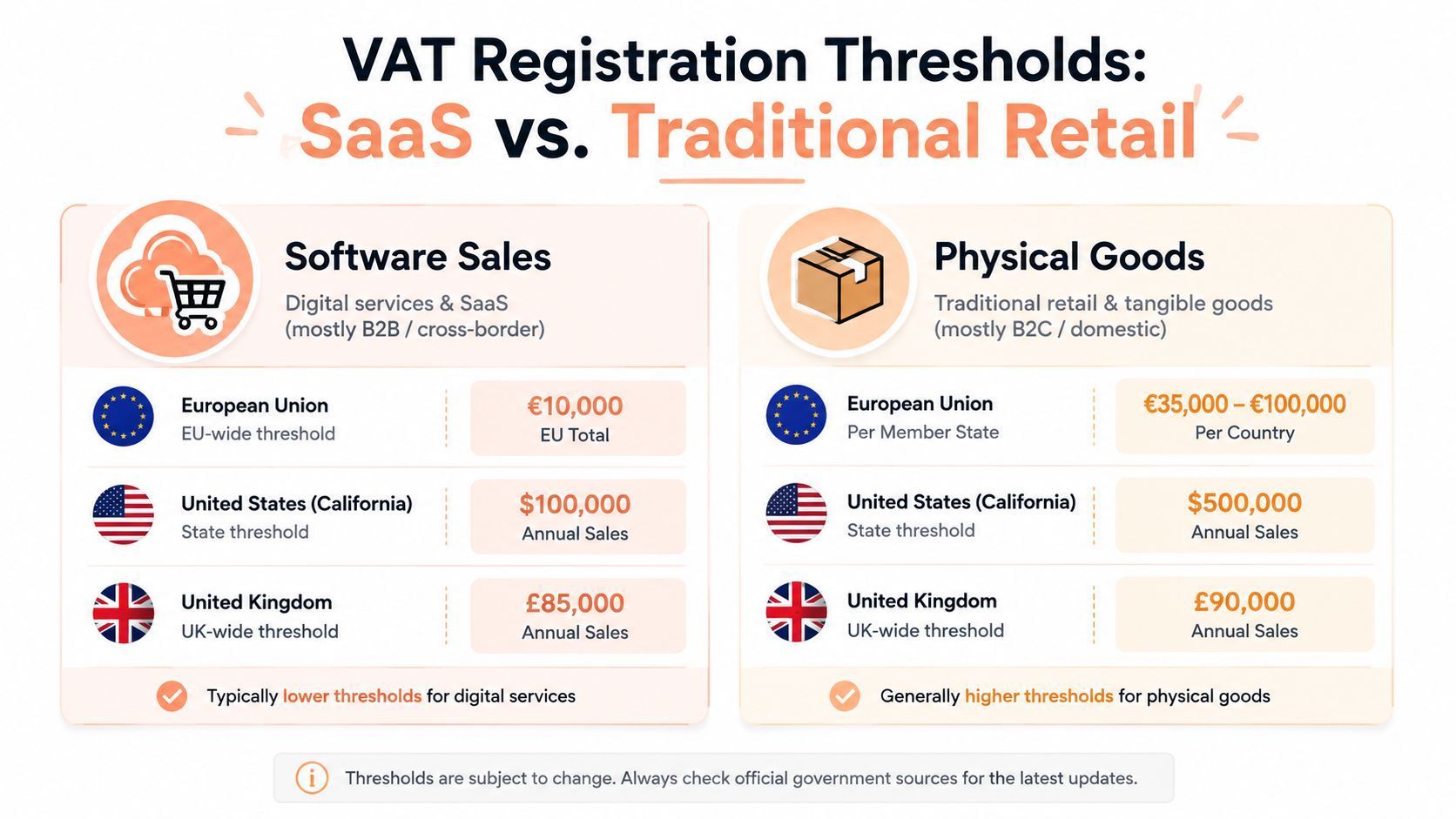
VAT thresholds vary because governments make different policy choices about small-business relief and administrative burden. The OECD reports that in 2022, ten OECD countries had relatively high general thresholds above USD 80,000 in annual turnover, including France, Ireland, Italy, Japan, Poland, Switzerland, and the United Kingdom. It also identifies six OECD countries with no general VAT exemption threshold, Chile, Colombia, Costa Rica, Mexico, Spain, and Türkiye. The same source classifies twelve OECD countries as having low thresholds below USD 40,000. These figures come from the OECD's Consumption Tax Trends 2022 report.
For a resident software company, the domestic threshold may give you room to grow before mandatory registration. The UK example is £90,000 over the last 12 months, while Switzerland has the highest absolute exemption threshold among 32 major European countries, at CHF 100,000, approximately €106,724, according to the Tax Foundation's European VAT threshold comparison.
Resident rules are only one layer
The threshold that matters to a UK-established seller may not protect a US or Asian company selling to UK customers. In Europe, foreign suppliers commonly face a nil threshold in the country of consumption, which can require registration from the first taxable sale. That distinction is why a founder who sees modest revenue in a market can still have an obligation there.
The EU also has a separate €10,000 threshold for cross-border B2C sales of goods and digital services, introduced in July 2021. It isn't a universal exemption from every VAT obligation. It belongs to the EU cross-border framework and must be assessed alongside domestic thresholds, customer status, and the seller's establishment.
A SaaS team should translate thresholds into customer economics, not just accounting totals. If the applicable limit is low or zero, a handful of customers can matter more than total global revenue. If the seller has a domestic threshold, the team still needs to identify which turnover is taxable and whether the test runs over a rolling period or a calendar year.
A useful threshold model has four fields for every market:
- Seller status, resident or non-resident.
- Customer type, B2C or B2B.
- Taxable turnover basis, including the relevant period.
- Registration consequence, exemption, immediate registration, or an available reporting scheme.
The mistake is assuming that “EU VAT” is one rule. It isn't. Thresholds range from zero in some systems to high domestic limits in others, and services can have separate treatment from goods. For software sellers, the threshold spreadsheet belongs beside the pricing and launch plan, not buried in an accountant's annual folder.
For a plain-English explanation of the UK trigger and its practical effect, review this guide to the compulsory VAT registration limit UK from Action Accountants Limited.
How to Monitor Turnover and Trigger Registration on Time
A SaaS checkout can cross a VAT threshold before finance notices. Treat registration as a forecasting and product-design problem. Your billing system must show which sales count, where they count, and when the registration clock starts.
Create a jurisdiction-level sales ledger. Each transaction should include the customer country, customer type, product category, gross amount, currency, refund status, and tax treatment. A single global revenue figure cannot support VAT decisions. Foreign exchange totals help with reporting, but local classification determines the result.
Build the monitoring workflow
1. Classify the revenue. Separate taxable turnover from exempt or non-taxable activity. Document whether each sale covers hosted access, a digital download, a licence, implementation, support, or another category. Give your tax adviser the actual checkout flow and customer journey, not a vague label such as “online software.”
2. Track each market separately. Apply the correct period to every jurisdiction. The UK test uses the last 12 months, so the monthly dashboard should recalculate the rolling total at month-end. Other systems may use a calendar year or require registration from the first taxable sale.
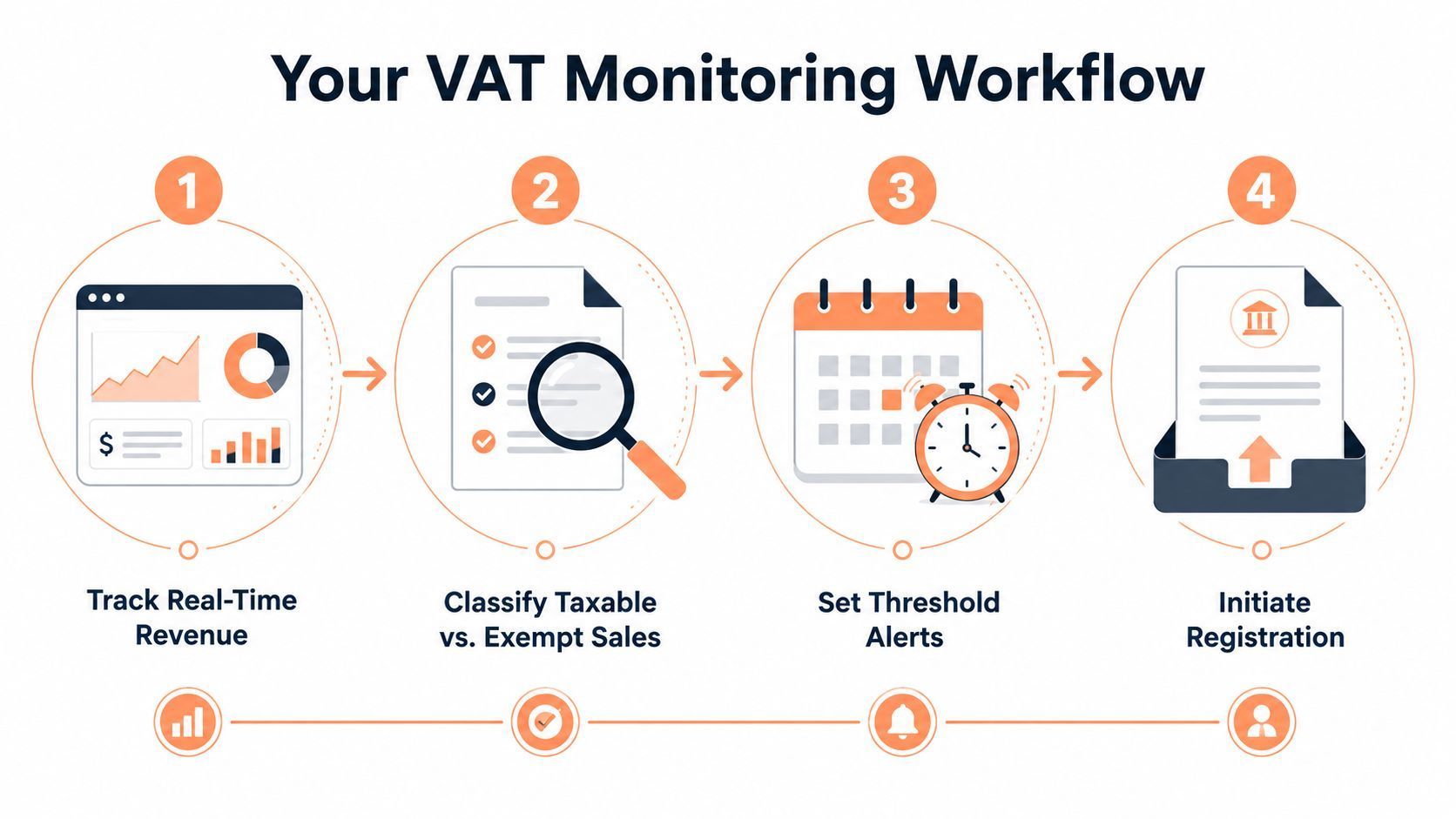
3. Set an alert before the legal line. Create an internal review point below the applicable threshold and assign the alert to a named tax owner. Set the buffer according to the jurisdiction, sales velocity, and registration process. The operating rule stays the same: forecast the breach before it happens.
4. Confirm the deadline and effective date. Under the UK process, registration is due within 30 days after the end of the month in which taxable turnover exceeds £90,000. The effective date is the first day of the second month after the breach, under GOV.UK's VAT registration rules. A mid-month breach therefore changes the date from which checkout and invoices must apply the registered treatment.
Configure the product, not just the spreadsheet
On the effective date, billing must know whether to display VAT-inclusive pricing, calculate tax from customer location, issue compliant invoices, and collect B2B evidence for reverse charge where applicable. A registration certificate arriving later does not automatically remove liability from the effective date.
Keep a decision log for each market. Record the threshold, turnover definition, registration date, tax logic, owner, and filing process. That gives the accountant an actionable record and stops engineering from changing checkout rules from memory. A Merchant of Record such as Creem can reduce the cross-border matrix to a single integration, but your team still needs accurate product and customer data.
Documents and Information Required to Register
VAT registration applications become painful when the business has no coherent description of what it sells. Tax authorities don't need your entire product roadmap or source code. They do need enough evidence to understand the legal entity, trading activity, customer base, and expected tax obligations.
Prepare an evidence pack before you submit an application. The exact requirements differ by jurisdiction, but a practical pack usually includes:
- Business identity: Legal name, incorporation details, registered address, directors or owners, and the local tax identification details already issued to the business.
- Trading evidence: Website, product pages, contracts, customer invoices, payment processor records, and a concise explanation of how customers buy the software.
- Turnover analysis: Revenue by jurisdiction, taxable versus exempt classification, customer type, and the period used for the threshold test.
- Bank information: Business bank details and evidence connecting the account to the legal entity, especially where the authority may need to process a refund.
- Product description: Explain whether you sell hosted access, subscriptions, downloads, licences, support, or bundled services.
- Customer evidence: Describe how you determine customer location and how you validate a business customer's VAT number where reverse charge may apply.
Write the product description carefully
“Software platform” is too broad. A better description states what the buyer receives, how delivery occurs, whether access renews, and whether the customer downloads anything. Explain the billing model without disclosing confidential implementation details or intellectual property.
For example, describe a subscription as recurring access to hosted functionality delivered electronically, then separate optional onboarding or consulting work if those services are billed independently. Describe a digital download as a product delivered electronically after payment. Your adviser can then assess the supplies separately instead of guessing from a marketing page.
Expect non-resident friction
Foreign applicants may encounter requirements involving a local tax representative, fiscal agent, certified translations, or a local bank account for refunds. Don't assume the registration portal will accept documents in your preferred language or that a foreign company can follow the same process as a resident business.
Give your adviser a transaction sample, not just totals. Include a B2C invoice, a B2B invoice, a refund, a subscription renewal, and a transaction from each major customer market. These examples expose checkout and invoice gaps before the tax authority does.
Keep the source records that support the application in one controlled folder. Registration is only the beginning. Filing and audit questions will depend on the same evidence, particularly customer location, taxable status, and the date your obligation began.
DIY Registration Versus Using a Merchant of Record
DIY VAT registration works when your footprint is narrow, your transaction volume is predictable, and you have internal finance capacity. It becomes a poor trade when your SaaS sells across many countries, changes pricing often, or launches new products without a tax review.
A Merchant of Record changes the operating model. Instead of your company acting as the seller responsible for the relevant collection and remittance workflow, the provider handles the checkout tax process under its own merchant model. Creem is one example of this category, offering tax collection, filing, and remittance for software and digital products across 100+ countries, as described in its publisher information.
For background on the legal and operational model, see what a Merchant of Record is.
| Dimension | DIY Registration | Merchant of Record |
|---|---|---|
| Initial setup | Register and configure each required jurisdiction | Integrate one checkout and provide product and business information |
| Tax collection | Your team maintains rates, exemptions, and customer-location logic | The provider applies checkout tax logic under its service model |
| Returns and remittance | Your team or local advisers prepare filings and payments | The provider manages filing and remittance within its coverage |
| Invoicing | You maintain jurisdiction-specific invoice requirements | The provider generates transaction receipts or invoices as supported |
| Market expansion | Each new market creates a tax review and possible registration | New markets can be added within the provider's supported framework |
| Control | Maximum control over registration, pricing, and filings | Less direct control, plus dependence on provider terms and coverage |
| Cost profile | Adviser fees, filing costs, internal time, and error exposure | Transaction fees and platform dependency |
| Best fit | Established seller with a small, stable country set | Small team testing many markets or selling internationally from launch |
The trade-off is control versus operating leverage
DIY gives you direct ownership of registrations and customer tax treatment. That can matter when a large company needs local registrations, specific refund processes, or a finance team that already owns multi-country compliance.
The downside is compounding administration. Each jurisdiction can introduce separate portals, filing calendars, invoice fields, payment instructions, and evidence requirements. You also own the consequences when a tax rule changes or a customer's status is misclassified.
A Merchant of Record usually costs more per transaction than a bare payment processor, but that comparison is incomplete. Add accountant time, filing fees, tax research, engineering maintenance, reconciliation, and the cost of correcting a late registration. For an early-stage seller, predictability can be more valuable than the lowest headline processing rate.
My recommendation is straightforward. Use DIY when you can name every market you sell into and have a capable owner for each filing. Use a Merchant of Record when your distribution is global, your team is small, and speed matters more than owning every local tax account.
Cross-Border Nuances Most Guides Skip
A software company can create a VAT obligation before revenue reaches a familiar threshold. Product type, customer geography, seller status, and local registration design can each change the result. Treat registration as a forecast and product-design decision, not a back-office task handled after launch.
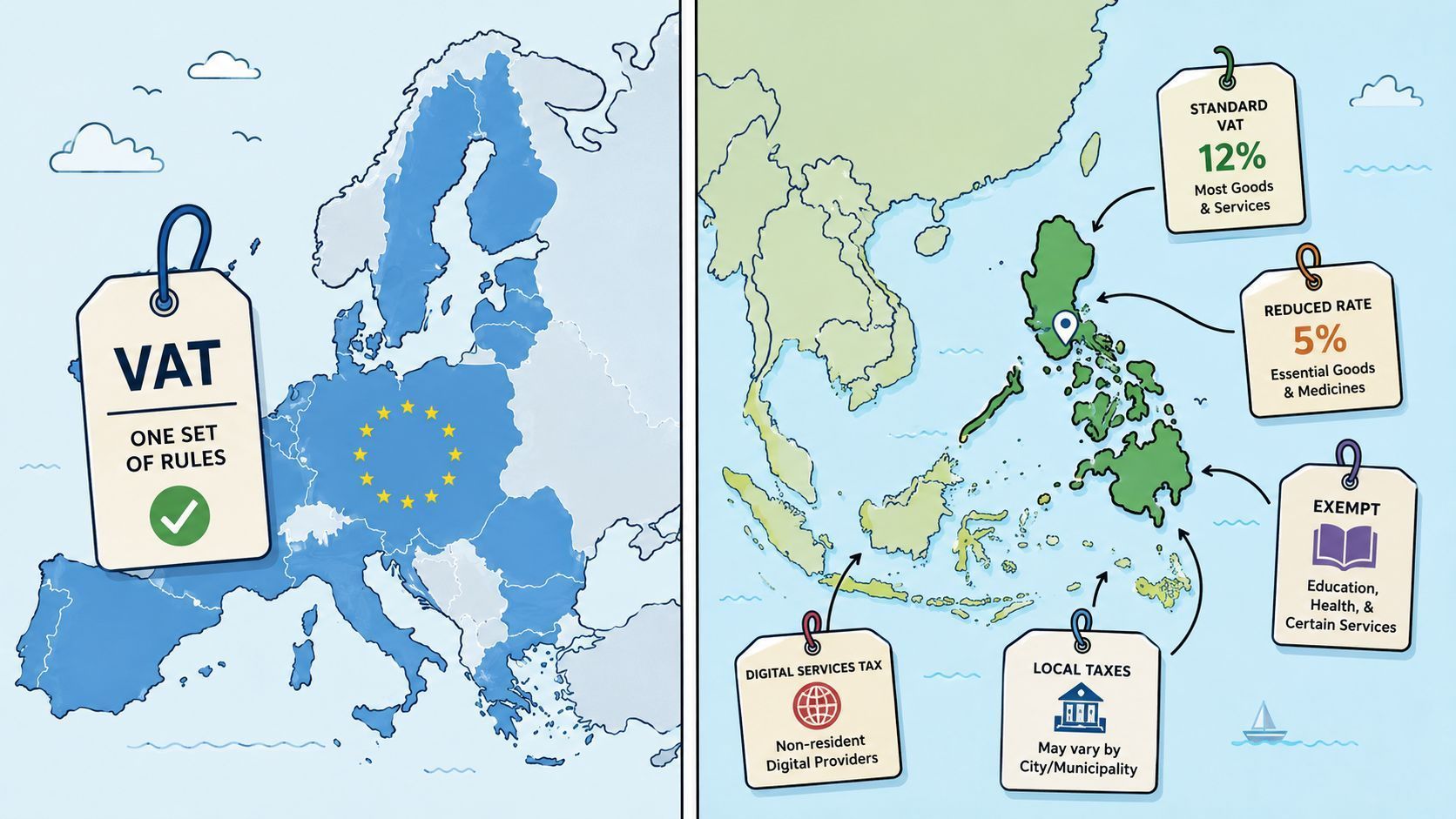
The Philippines shows why country-by-country review matters. Recent guidance from Grant Thornton Philippines states that non-resident digital service providers must register through BIR systems, including sellers serving only business customers. It also discusses a July 1, 2025 registration deadline and 12% VAT applying to digital services from June or July 2025, depending on the applicable rule version. Review the Philippines guidance on VAT for digital services before assuming B2B sales remove the registration question.
B2C and B2B require different workflows
For B2C digital sales, the customer's location commonly determines the tax treatment. Checkout must collect reliable location evidence and retain the records supporting that decision.
B2B services may qualify for reverse charge, shifting accounting responsibility to the customer when the relevant conditions apply. A company name alone is not enough. Validate business status, capture the required tax identification data, and show the correct invoice treatment.
Supply location may differ from the billing address. A customer can pay with a card issued in one country, provide a business address in another, and access the service from several places. Define which evidence controls the decision, then apply that policy consistently.
For a broader discussion of EU changes affecting SaaS compliance, read this EU VAT in the Digital Age guide. Build a market matrix with columns for B2C, B2B, customer evidence, reverse charge, registration trigger, filing route, and invoice requirements.
Product design creates tax obligations
Review tax before launching a product, not after the first sales report. Classify each offer as a subscription, download, licence, support service, or bundle. Map every customer path, including trial conversion, coupon redemption, refunds, upgrades, and reseller or affiliate arrangements.
A Merchant of Record can provide the compliance layer between your product and the customer. Confirm its country coverage, seller-of-record terms, customer tax treatment, reporting outputs, and handling of B2B VAT IDs. That model can collapse a multi-country registration matrix into one integration, but it does not remove the need to understand how your checkout and pricing flows operate.
The question is not only “Have we crossed the threshold?” Ask, “Did this product and customer journey create a registration obligation?”
Your VAT Registration Checklist and Next Steps
Make the VAT decision this week, using the facts in your own billing data. Don't wait for year-end accounts. A software company should be able to answer, for every material market, who buys, what they buy, where they are located, and which entity or platform is responsible for tax.
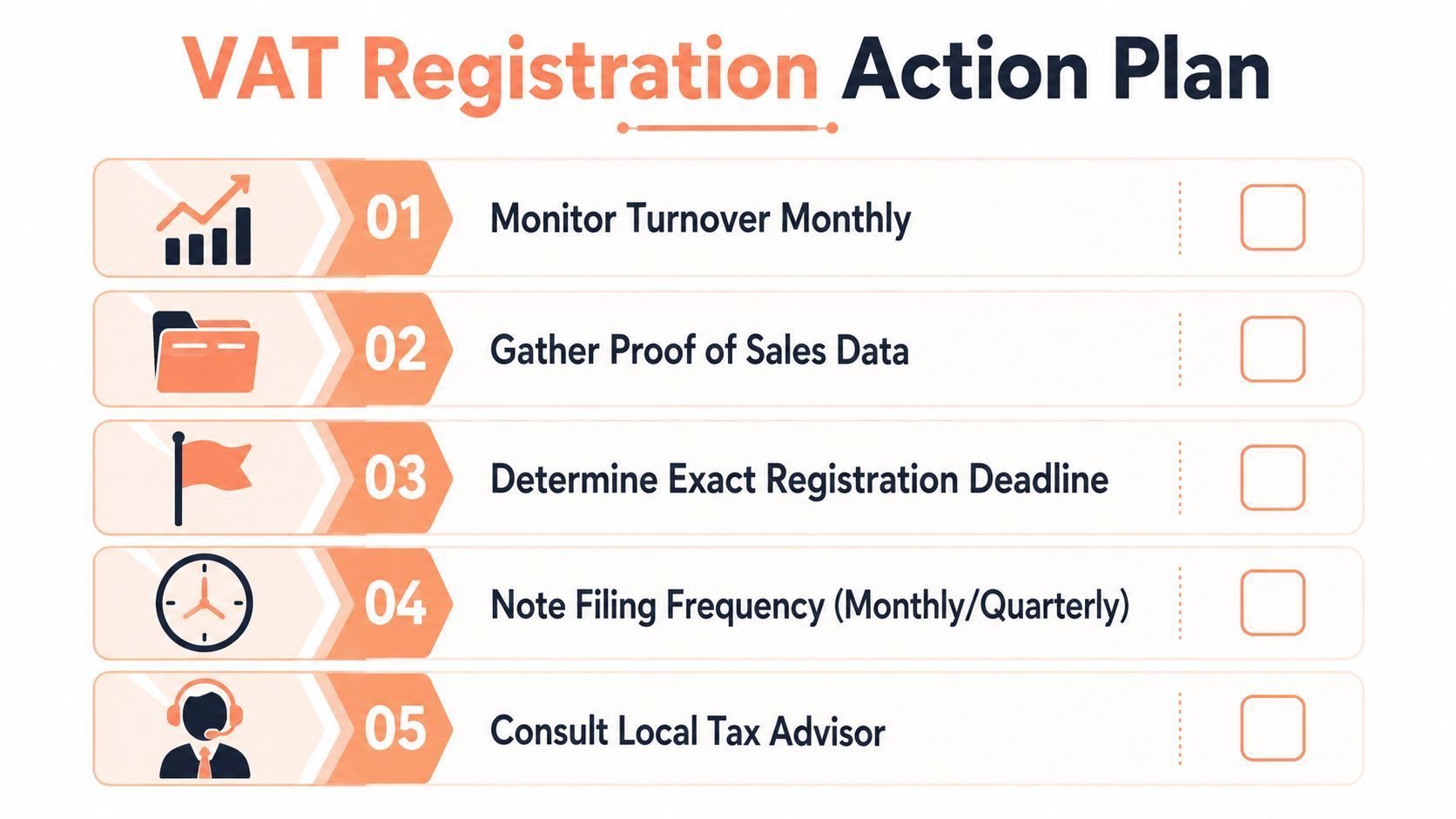
Run this checklist
- Map your products. Label every subscription, download, licence, support service, and bundle.
- Segment customers. Separate B2C from B2B and record the evidence used to establish location and business status.
- Monitor turnover monthly. Track each jurisdiction using its own threshold period and taxable-turnover definition.
- Set the registration date. Record the breach date, notification deadline, effective date, and the point at which checkout must change.
- Prepare the evidence pack. Keep incorporation records, trading proof, sample invoices, bank details, and sales analysis together.
- Choose the operating model. Compare direct registrations with a Merchant of Record using total cost, control, launch speed, and error exposure.
- Document filings. Assign an owner for returns, payments, reconciliations, customer evidence, and record retention.
Use a simple decision rule
Register directly when you have a stable market footprint, strong finance ownership, and a clear reason to control each local account. Outsource the seller-side tax workflow when you're testing many countries and the team can't reliably maintain the matrix.
Also review pricing before registration. Decide whether your displayed price is VAT-inclusive or whether tax is added at checkout, then make sure your invoice and checkout behavior match the relevant consumer rules. A tax adviser can review the setup quickly if you send a concise pack: legal entity, products, customer countries, B2B share, revenue by market, current checkout screenshots, and planned expansion markets.
VAT mistakes can become more than a filing inconvenience. Use this guide to VAT penalties for digital products as a prompt to assess late registration, inaccurate collection, missing records, and incorrect invoices before they become historical problems.
The right answer isn't always “register everywhere.” It's to forecast obligations early, design the checkout around the rules, and pick an operating model your team can execute consistently. If you're selling software internationally with a small team, evaluate whether Creem can handle VAT collection, registration, filing, and remittance through a single integration, then compare its coverage and terms against the cost of managing each jurisdiction yourself.
Creem gives software companies a Merchant of Record workflow for global checkout, VAT collection, filing, remittance, subscriptions, and invoicing without forcing the founder to build a country-by-country tax operation. Visit Creem to see whether its single integration fits your product, markets, and VAT registration plan.