
If you sell software on Whop and more of your buyers live in other countries, the 2.7% + $0.30 card rate is probably the number you remember. It says little about what a cross-border sale really costs you.
An international card, currency conversion, sales-tax collection, an affiliate referral and the payout can each add to that sale. None of those charges settles who owes the VAT. If the platform takes the payment but leaves you as the legal seller, the registration, filing and remittance your sales abroad trigger stay on your desk.
Whop still has a place in community-led selling. For software sold worldwide, any switch has to answer the tax question before the fee question, and we put that test to every platform below.
The nine alternatives below include merchant-of-record platforms and digital-product storefronts, with Dodo also offering a route through your own processor where tax remains your responsibility.
Whop competitors that can replace it for software and digital products
Start with the name on the invoice. Check who is the legal seller and who is responsible for remitting tax.
A checkout that sells monthly access may still leave you building the logic for usage charges or prepaid credits. Check that the platform bills the way your product charges, whether that means meters, credit wallets, license keys, or affiliates and splits.
Run the same international subscription renewal through an affiliate on each platform, including what it costs to pay out the proceeds.
Then compare the totals with the billing work left to your team. That gives you a shortlist based on your sales, not the lowest advertised rate.
1. Creem
Creem is a merchant of record and commerce platform for software and digital products, with subscriptions, usage meters, prepaid credit wallets, license keys, affiliates and revenue splits sharing one checkout and one balance.
We sell to your buyer on your behalf, so we handle VAT, GST, sales tax, invoices, fraud screening and chargebacks on those sales.
Creem charges 3.9% + $0.40 per successful transaction, with no monthly fee, no setup fee and no minimum volume.
Pricing
Tax and dispute handling are included in that rate. On a $100 sale, 3.9% is $3.90, and the fixed fee is $0.40.
That leaves $95.70 before paid extras and payout costs. On the standard plan, those extras are:
- Affiliate platform: an extra 2%, taken before the affiliate's commission is calculated
- Revenue splits: an extra 2%, taken before the proceeds are divided
- Abandoned-cart recovery: 5% of each recovered sale, for checkouts that carry the buyer's email
- Payouts: bank transfers carry a transfer fee, and USDC on Polygon costs 2% of payout volume
Best for
Creem fits growing SaaS and AI startups selling subscriptions, usage or credits to buyers in many countries.
Pros and cons
Pros:
- Subscriptions, seats, usage meters and prepaid credit wallets with auto-refill, so pricing can follow how an AI product consumes compute
- Hosted checkout on your own domain, or embedded on your site as a modal or inline
- License keys with activation limits, with purchased files sent by email and through the customer portal
- Affiliate tracking with automatic payouts, plus store-wide or per-product revenue splits paid from the same balance
Cons:
- Built for software and digital products, so physical goods need a different checkout.
- Sellers can sign up from 87 countries, a shorter list than the 190+ countries buyers pay from.
Compared with Whop
I'd keep Whop when its communities and marketplace are where buyers find you. I'd move to Creem for cross-border software sales that need a legal seller and billing for subscriptions, usage and credits.
One founder wrote on Reddit that they moved to Creem the day VAT became their problem.
They messaged Creem's CEO on X, and their store was live in about five minutes. They described Creem's fees as good compared with Lemon Squeezy, Paddle and Polar. Other teams report the same speed. DaisyUI moved over in a few hours, and Uneed's migration changed 1,500+ lines of payment code with 3 AI prompts and 0 integration errors.
Subscriptions, usage, prepaid credits and affiliate payouts run from the same checkout, with Creem filing the tax. If VAT has just become yours too, try Creem with your first product.
2. Paddle Billing
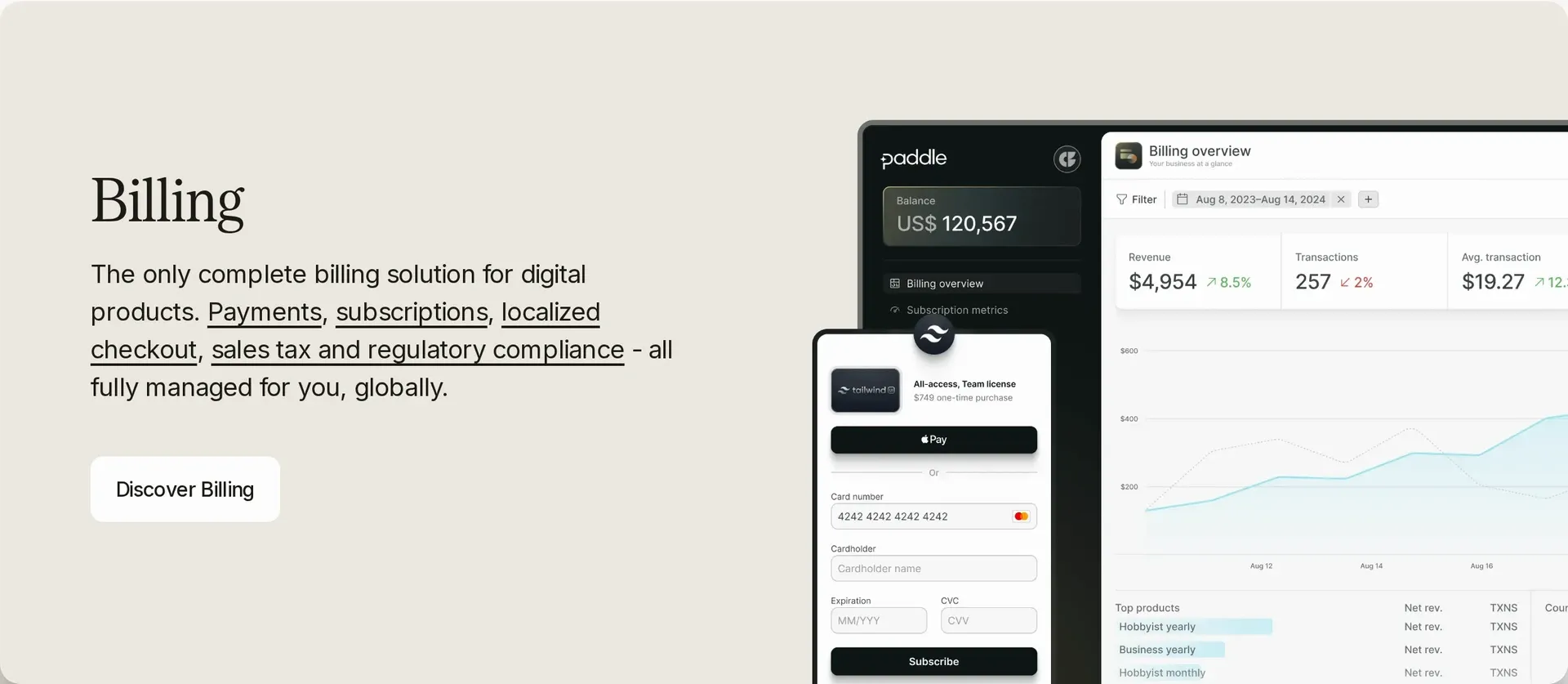
Paddle Billing puts software checkout and subscriptions under its merchant-of-record model.
For sales through its checkout, Paddle handles VAT, GST and sales-tax registration, collection, filing and remittance, taking that administration off your team.
Pricing
Standard checkout costs 5% + 50¢ per transaction, with no monthly or migration fees. On a $100 checkout, the transaction fee is $5.50, leaving $94.50 before tax and other deductions.
Negotiated pricing is available for products below $10 and high-volume, low-value transactions. Invoicing and implementation help get separate quotes.
Disputes still come out of your balance. Paddle deducts the disputed amount plus 20 USD/GBP/EUR or 40 CAD/AUD, depending on the transaction currency.
The chargeback fee stays deducted even when Paddle wins.
Best for
Paddle suits software companies that already sell on invoice and want hands-on implementation help, with both handled through negotiation.
Pros and cons
Pros:
- Recurring UPI payments let buyers in India pay for INR subscriptions.
- Pix Automático supports recurring payments in Brazil, with the buyer authorizing them at checkout.
- South Korean renewal-consent requirements are exposed to your integration, so your app can respond when consent is needed.
Cons:
- Native usage balances are in early-access beta. Outside it, you can meter usage in your application or through an external tool such as OpenMeter.
- With externally managed prepaid credit packs, you track the credit balance in your application.
- Automated dispute defense accepts no additional seller evidence and does not contest a second dispute at pre-arbitration.
Compared with Whop
The tax handoff is why I’d consider Paddle for software sales. Whop’s communities and marketplace do a different job, so replacing checkout does not replace that source of buyers.
For an AI seller, the trade-off is specific. Outside the native beta, usage tracking stays with you, and chargebacks come out of your balance even though Paddle handles the defense.
I’d choose it when the tax administration and local recurring payment methods justify that work and cost.
3. FastSpring
FastSpring is a merchant of record for software, with B2B invoicing, subscriptions and fraud prevention included. It collects and remits sales tax and VAT.
It also handles related tax audits, including the response when a tax authority audits those sales.
Pricing
FastSpring quotes a revenue-share commission rather than publishing a standard percentage or fixed per-order fee.
The quote form asks for your product type, monthly transaction count and revenue split by geography. Have those ready so the pricing reflects your sales.
There is no minimum transaction volume. Converting payouts into a currency different from your store currency adds 2.5% outside the quoted commission, so the currency you receive matters alongside the rate you negotiate.
Best for
FastSpring fits established software companies selling to businesses on negotiated quotes and wanting a merchant of record for invoicing and transaction taxes.
It is a stronger fit when the company has enough cash to cover costs while waiting for payment.
Pros and cons
Pros:
- Interactive Quotes supports B2B software deals with negotiated terms.
- Volume-negotiated rates and discounted ACH and wire-transfer fees can suit larger deals paid by bank transfer.
- Weekly, twice-monthly or monthly payout schedules let you choose a cadence for receiving funds.
Cons:
- New accounts wait 45 days before their first payout, and subsequent payouts carry a 14-day settlement delay.
- Failed bank transfers return to your balance and wait for the next scheduled payout, with no manual retry on demand.
- The default minimum payout is $100, so smaller balances roll forward to the next payout unless support lowers the threshold.
- Usage-based billing requires your application to trigger each charge, leaving the timing and charge amount with your team.
Compared with Whop
For negotiated B2B software sales, I’d value FastSpring’s quotes and tax-audit handling. Whop’s published domestic card rate gives you an immediate cost to budget, while FastSpring’s commission depends on your quote.
For an AI startup, the cash delay is the bigger concern. Compute costs start as customers use the product, but the first FastSpring payout waits 45 days.
The ongoing settlement delay also leaves time between a successful charge and cash you can use.
4. Lemon Squeezy
Lemon Squeezy, part of Stripe, is a merchant of record for digital products and software. It becomes the legal seller on those transactions, with subscriptions and license-key management alongside payments.
Pricing
The base fee is 5% + 50¢ per transaction, which leaves $94.50 from a $100 sale before supplements. Fees apply to the tax-inclusive total, so VAT collected from the buyer also increases the amount used to calculate your fee.
How the sale happens determines the additions:
- International payments add 1.5%.
- PayPal payments add 1.5%.
- Subscription payments add 0.5%.
- Affiliate-referred transactions add 3%.
- Abandoned-cart recovery adds 5% on recovered transactions.
Payout costs are separate from transaction fees. Non-US bank payouts cost 1%.
US PayPal payouts cost $0.50, while non-US PayPal payouts cost 3%, capped at $30.
Best for
Lemon Squeezy fits digital-product sellers whose downloads and license-keyed software mostly sell as one-time domestic purchases, where international and subscription supplements rarely apply.
Pros and cons
Pros:
- Sales tax and VAT are collected and remitted for transactions sold through Lemon Squeezy.
- Subscription payments let the same checkout handle recurring software sales.
- License-key management comes with the checkout, so licensed downloads need no separate key service.
Cons:
- Cross-border renewals carry multiple supplements, making the base rate an incomplete budget for global SaaS.
- Payouts have a 13-day hold, so a successful charge does not immediately become available cash.
- A $50 minimum payout means smaller balances wait until they reach the threshold.
Compared with Whop
I see Lemon Squeezy’s clearest fit in licensed downloads where handing over transaction tax matters more than Whop’s community distribution.
For an international subscription renewal, I’d budget for both the international and recurring supplements above the base fee. A PayPal renewal adds the payment-method supplement too, before the separate cost of withdrawing the proceeds.
5. Dodo Payments
Dodo Payments is a merchant of record for approved software and digital products. On that checkout, Dodo is the legal seller and files VAT and GST.
Route sales through your own processor, and tax, disputes, PCI compliance and payouts stay with you.
Dodo also supports subscriptions, add-ons, usage billing and prepaid credit balances.
Pricing
Card payments start at 4% + 40¢. A $100 transaction leaves $95.60 after that baseline fee, before surcharges and other costs.
The percentage also applies to VAT or sales tax collected, so taxed sales carry a higher fee.
The sale and payout determine the additional costs:
- International cards and alternative payment methods outside the US add 1.5%, except ACH and SEPA direct debits.
- Subscriptions add 0.5%, except those paid by ACH or SEPA direct debit.
- Recovery services cost 5% of successfully recovered revenue, with no enablement fee.
- Refunds cost $1 each.
- Payouts below $1,000 cost $5.
- USD SWIFT payouts to non-US businesses cost $25.
- Non-USD settlements incur standard FX.
Best for
Dodo fits template and plugin sellers who want VAT and sales tax filed for them.
Pros and cons
Pros:
- ACH and SEPA direct debits cost 1.5%, capped at $15 or €15 respectively, with no international or subscription surcharge.
- Buyer tax-ID validation applies reverse charge to eligible business purchases.
Cons:
- Every director and beneficial owner needs a government ID from an eligible country. A residence permit, tax residence or local bank account cannot substitute.
- Human-delivered services and pre-launch products without immediate usable value are excluded.
- Chargeback losses come from your balance, together with a $30 dispute fee.
Compared with Whop
A Whop offer built primarily around coaching or consulting falls outside Dodo’s acceptance rules. Approved software can qualify, but services whose main value is human labour cannot.
For me, capped direct debits are the strongest reason to consider Dodo, provided buyers use them. Bank push transfers use standard pricing, so that advantage does not apply to every bank payment.
6. Fungies
Fungies gives game studios a storefront and merchant-of-record checkout in one platform.
For payments processed through it, Fungies is the legal seller, with tax calculation and remittance, fraud screening and chargeback handling included in its commission.
Pricing
The standard rate is 5% + 50¢ per sale. There are no monthly, setup or per-seat fees, and higher-volume rates are negotiable.
Fungies charges no payout fee or per-dispute fee, although chargeback losses can still come out of your settlement. Foreign-exchange effects and third-party charges can also change what reaches your bank account, so the transaction commission alone does not determine your final proceeds.
Best for
Fungies fits game studios and game-software sellers taking payments through their own storefronts, particularly for Steam keys and mobile in-game assets.
Pros and cons
Pros:
- Storefronts and Steam-key uploads put the game catalogue and checkout in one platform.
- International sales, subscription renewals and payment methods add no surcharge, so a $100 sale leaves $94.50 after the 5% + 50¢ fee wherever the buyer pays from.
- No minimum payout balance keeps small balances from waiting to reach a withdrawal threshold.
- Embedded overlay checkout lets buyers pay within your site.
Cons:
- Refunds and reserve movements can reduce settlements beyond the advertised commission.
- You still deliver the game, issue the keys, ship updates and answer support requests.
- A failed-renewal retry does not suspend access on its own. You remain responsible for suspending or cancelling access.
Compared with Whop
Fungies focuses on game storefronts, Steam keys and in-game assets, while Whop centers community-led selling.
I’d shortlist it for that game-commerce fit and for having VAT and sales tax handled on those transactions.
For a SaaS team, the distinction is narrower. Subscription checkout is supported, but connecting a failed payment to continued product access still sits with you.
7. PayPro Global
PayPro Global is the legal seller on your software and SaaS sales. It collects and remits EU VAT and Canadian GST/HST, issues an invoice for every purchase that buyers can download through their accounts, and handles subscription payments with dunning and failed-payment retries.
Pricing
Your written quote sets the transaction commission and fixed per-order charge. How you receive the money determines the payout costs:
- North American ACH costs US$3 per payout.
- Wire transfers cost US$21 per payout.
- International PayPal payouts cost 2%, capped at US$20.
Best for
PayPro Global fits established software companies that want a reseller on a quoted rate and are comfortable with an annual contract.
Pros and cons
Pros:
- PayPal payouts in the US and Canada carry no fee.
- Leaving carries no cancellation fee, though cancellation terms still govern payouts of your remaining balance.
Cons:
- No standard transaction rate is published, so comparing per-sale costs requires a quote.
- The standard contract lasts one year.
- Payouts land on the 15th for the previous month. A 1 March sale enters March’s closing balance, settled on 15 April less payout fees and adjustments, about six weeks later.
- Migrated non-card subscribers receive a renewal link each billing cycle instead of an automatic charge.
- Buyers’ refund requests come back to you to resolve, with PayPro Global’s department assisting the customer.
Compared with Whop
I’d consider PayPro Global for reselling software internationally rather than selling community access through Whop. The tax handoff comes with a formal reseller agreement.
Moving card subscribers can preserve automatic renewals only if your current provider exports the payment data and cooperates with the transfer.
For a team leaving Whop, that is something to establish before treating existing renewals as transferable.
8. Gumroad
For one-off downloads, Gumroad combines a digital-product storefront with memberships and a discovery marketplace.
It is the merchant of record and collects and remits sales tax where it has that obligation, though your existing indirect-tax filing obligations can continue.
Pricing
Direct sales cost 10% + 50¢ per transaction, with no monthly platform charge. Card processing or PayPal fees come on top, with domestic US card processing costing about 2.9% + $0.30.
A $100 direct sale leaves $89.50 after the platform fee and about $86.30 after domestic US card processing, before taxes, refunds, currency conversion and payout costs.
When a new customer finds and buys through Discover, Gumroad takes 30%, including processing. A $100 Discover sale leaves $70 before those same costs.
Sales through your own links use the direct-sale fee, even when the product is also listed on Discover.
Best for
Gumroad fits creators selling one-off digital downloads who want a storefront and marketplace discovery without a monthly platform bill.
Pros and cons
Pros:
- Discover offers a way for new buyers to find your products alongside the traffic you bring yourself.
- Downloads and memberships share the same storefront, supporting one-off purchases and recurring access.
Cons:
- Card or PayPal processing comes on top of the direct-sale platform fee, so the headline rate understates your total cost.
- Discover takes 30% of the sales it brings in, leaving less per purchase than direct sales.
- Refund a $100 direct sale and you are still out the $10.50 platform fee.
- If your VAT or sales-tax filing obligations continue, report applicable Gumroad sales as resales and keep Gumroad’s reseller certificate.
Compared with Whop
Whop focuses on community access, while Gumroad centers a download and membership storefront. Both include marketplace discovery.
For a SaaS team selling to its own audience, I’d budget from what remains after card processing, not the 10% headline alone.
9. Polar

Polar combines software payments, subscriptions and usage billing under a merchant-of-record model.
It is the legal seller on covered digital sales and registers, files and pays VAT, GST and sales tax. Your own income tax stays with you.
Pricing
Paid plans trade a monthly bill for lower transaction fees:
| Plan | Monthly charge | Per transaction |
|---|---|---|
| Starter | $0 | 5% + 50¢ |
| Pro | $20 | 3.8% + 40¢ |
| Growth | $100 | 3.6% + 35¢ |
| Scale | $400 | 3.4% + 30¢ |
Starter has the same base transaction fee as Paddle. On a $100 sale, Pro leaves $95.80 before extras, a $1.30 saving against Starter.
At 16 such sales, the $20 plan costs less overall by $0.80.
Non-US cards add 1.5% across these plans, with no separate subscription surcharge. Percentage fees apply to the tax-inclusive amount, so tax collected also increases the fee.
Payouts add $2 per month when active, plus 0.25% + $0.25 per payout. Cross-border payout currency conversion costs 0.25% within the EU and up to 1% elsewhere.
Best for
Polar fits individual developers selling software without a company, in countries where it accepts individual sellers.
Pros and cons
Pros:
- Your app sends usage events, and Polar bills that usage on the subscription.
- Customers can inspect estimated metered charges in the portal before the invoice closes.
Cons:
- You cannot attach metered pricing to a one-off purchase such as a credit top-up. Metered usage has to sit inside a subscription.
- If a subscription’s billing period ends on 31 March, usage received on 1 April goes into the next period. The closed invoice stays unchanged.
- Disputes cost $15 regardless of outcome.
Compared with Whop
Whop centers community access, while Polar bills software from events your app sends. I’d shortlist Polar for an API or AI subscription whose charges follow consumption.
For me, the subscription-only restriction decides the fit. Standalone metered usage needs a different billing approach.
Whop competitors compared: fees, tax and billing
| Platform | Best for | Base transaction fee | Monthly fee | Legal seller | Billing |
|---|---|---|---|---|---|
| Whop | Creator and community access | About 2.7% + 30¢, domestic cards | $0 | - | Subscriptions |
| Creem | Growing SaaS and AI startups selling worldwide | 3.9% + 40¢ | $0 | Merchant of record | Subscriptions, seats, usage, credits |
| Paddle Billing | Software companies selling on invoice | 5% + 50¢ | $0 | Merchant of record | Subscriptions, external meters, usage beta |
| FastSpring | Established software companies on negotiated B2B quotes | Negotiated | Not published | Merchant of record | Subscriptions, seller-triggered usage |
| Lemon Squeezy | Mostly one-time domestic downloads and licensed software | 5% + 50¢, plus 1.5% international, 1.5% PayPal and 0.5% subscriptions where applicable | Not published | Merchant of record | Subscriptions |
| Dodo Payments | Template and plugin sellers | 4% + 40¢, plus 1.5% international cards/APMs outside the US and 0.5% subscriptions. ACH/SEPA direct debit costs 1.5%, capped at $15/€15, without those surcharges | Not published | Merchant of record, except own-processor routes | Subscriptions, usage, credits |
| Fungies | Game studios selling Steam keys and in-game assets | 5% + 50¢ | $0 | Merchant of record | Subscriptions |
| PayPro Global | Established software companies on an annual contract | Quoted | Not published | Merchant of record | Subscriptions, dunning |
| Gumroad | Creators selling one-off digital downloads | Direct 10% + 50¢ plus processing. Discover 30% | $0 | Merchant of record | Memberships |
| Polar | Individual developers selling without a company | 5% + 50¢ down to 3.4% + 30¢, plus 1.5% for non-US cards | $0 to $400 | Merchant of record | Subscription-only meters |
Whop has the lowest published base card rate, but nothing in its pricing settles who is the legal seller, so the VAT question stays open.
A Whop sale can also carry these extra fees, approximately:
- International cards add 1.5%.
- Currency conversion adds 1%.
- Sales-tax collection adds 2%.
- Optional billing adds 0.5%.
That 2% collects tax without establishing who files and pays it.
Each Whop withdrawal costs about $2.50 by next-day ACH, 4% + $1 by instant bank, 5% + $1 by crypto or Venmo, or $23 by wire.
An affiliate sale on Whop adds about 1.25% in fees before the partner's commission.
Which Whop competitor should you choose?
Start with tax. It decides whether switching takes work off your plate or just moves the checkout, because a lower card rate alone does not remove your VAT obligations.
For software subscriptions sold across borders, choose a platform that acts as the legal seller and remits the VAT and sales tax your buyers pay. Some local filings may still be yours to handle. Your own income tax stays with you on every option here.
Next, match the billing to how you charge for your product:
- Fixed monthly or annual plans: international cards add a surcharge on Dodo, Lemon Squeezy and Polar, renewals add one on Dodo and Lemon Squeezy, and Fungies adds neither.
- Consumption-priced AI products: Creem and Dodo sell prepaid credit balances, so the buyer pays before the compute is spent. Polar's meters bill usage inside a subscription.
- Downloads sold to your own audience: compare direct-sale costs. A marketplace cut pays for buyers the marketplace brought you, not for traffic you drive yourself.
- Affiliates or co-founders paid from each sale: Whop, Creem and Lemon Squeezy each charge their own percentage on affiliate sales before the commission.
Some sellers I would tell to stay on Whop. Creator or community access fits what buyers come there for. If most of your sales are domestic one-time card payments, staying also makes sense on fees, since Whop's rate is below Creem's 3.9% + 40¢.
Stripe fits if the low processor rate (2.9% + 30¢) matters most and you already have a tax setup you trust. Stay there if that matches your priorities, accepting that you remain the legal seller and handle the filings and chargebacks yourself.
Creem: Sell Digital Products Worldwide With a Merchant of Record
Once your software sells to buyers in other countries, the question that decides the switch is who files the VAT on each sale.
For a growing SaaS or AI startup selling software worldwide, Creem takes that question off your desk at 3.9% + $0.40 per successful transaction.
As the merchant of record on each sale, we calculate, collect and remit the VAT, GST and sales tax your buyers pay across 190+ countries. The transaction tax on those sales becomes ours to handle, and your own business taxes stay with you.
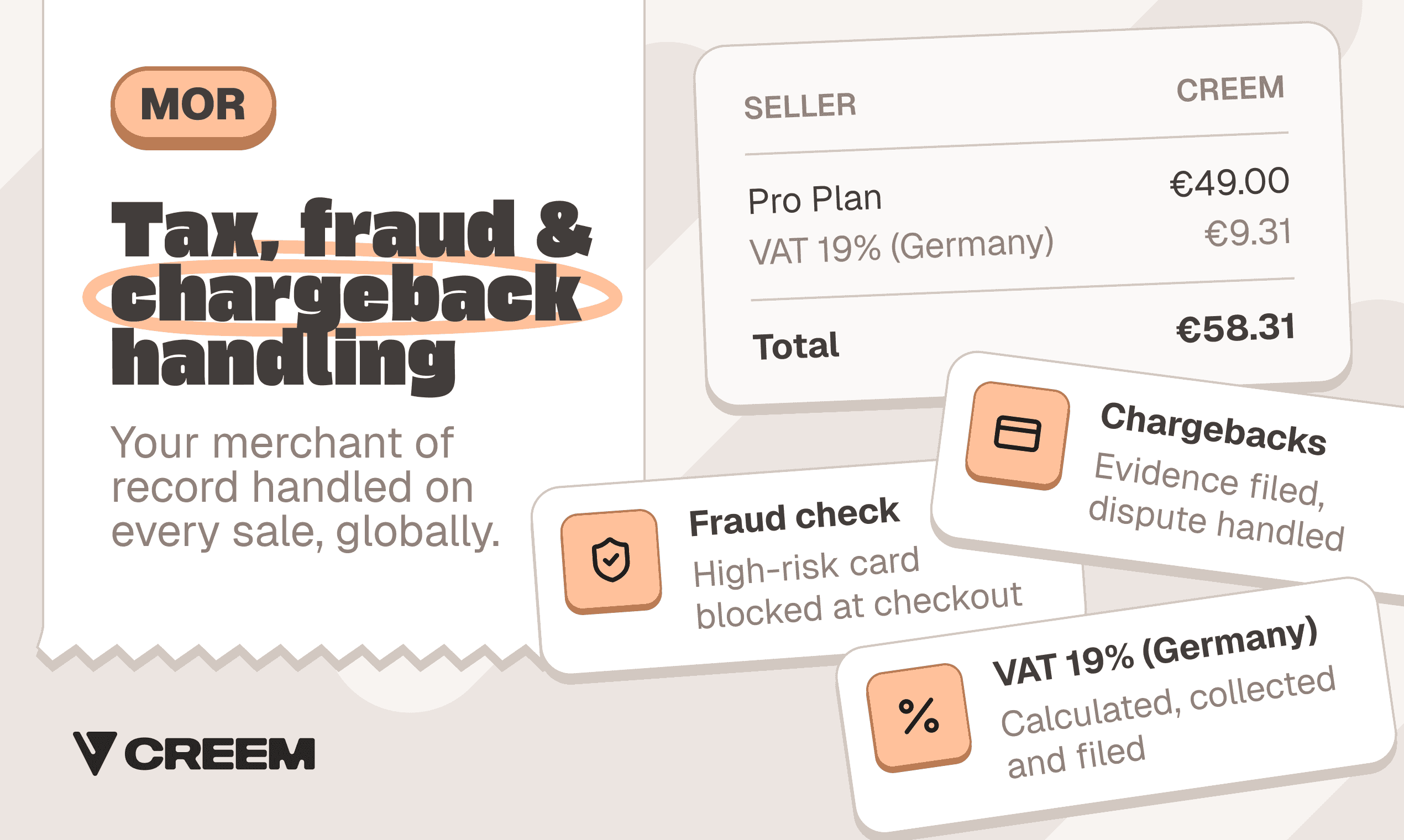
Tax and VAT calculated at checkout for buyers in different jurisdictions.
Stop working out who owes VAT on each sale. Try Creem, and the tax on every sale is ours to file.