
You're in the weekly close meeting, and the numbers on your billing dashboard don't quite match the slide your team used last month. Sales says the quarter is strong, product says usage is spiky, and finance is trying to decide which figure belongs in the board deck. That's usually where ARR calculation starts to matter, because the number has to survive questions about discounts, churn timing, upgrades, and the contracts that look recurring until you inspect them closely.
The clean answer is useful, but the useful answer is rarely clean. Annual recurring revenue gives you a standard yearly run rate for subscription revenue, while the messy reality is that contracts change mid-cycle, usage jumps, and one-time fees slip into models if nobody is careful. If you're building or defending the number, you need a way to calculate it that holds up in a spreadsheet and in front of investors. One good place to start is this practical explainer on ARR meaning, then use the math below to make the number defensible.
Table of Contents
- What ARR Means for a Subscription Business
- The Core ARR Formula and a Worked Example
- Adjusting ARR for Discounts, Churn, and Mid-Cycle Changes
- Calculating ARR for Usage-Based and Hybrid Pricing
- Monthly vs Annual Calculations and the ARR Bridge
- Reporting ARR Without Misleading the Room
- Putting It All Together This Week
What ARR Means for a Subscription Business
A founder can open two dashboards and get two different answers because one screen shows this month's recurring billings and the other shows a broader run rate that includes contracts, renewals, and change events. That confusion is exactly what Annual Recurring Revenue, or ARR, is meant to remove. In SaaS finance, ARR annualizes predictable subscription revenue, and the common shortcut is MRR × 12 ARR meaning guide from Creem.
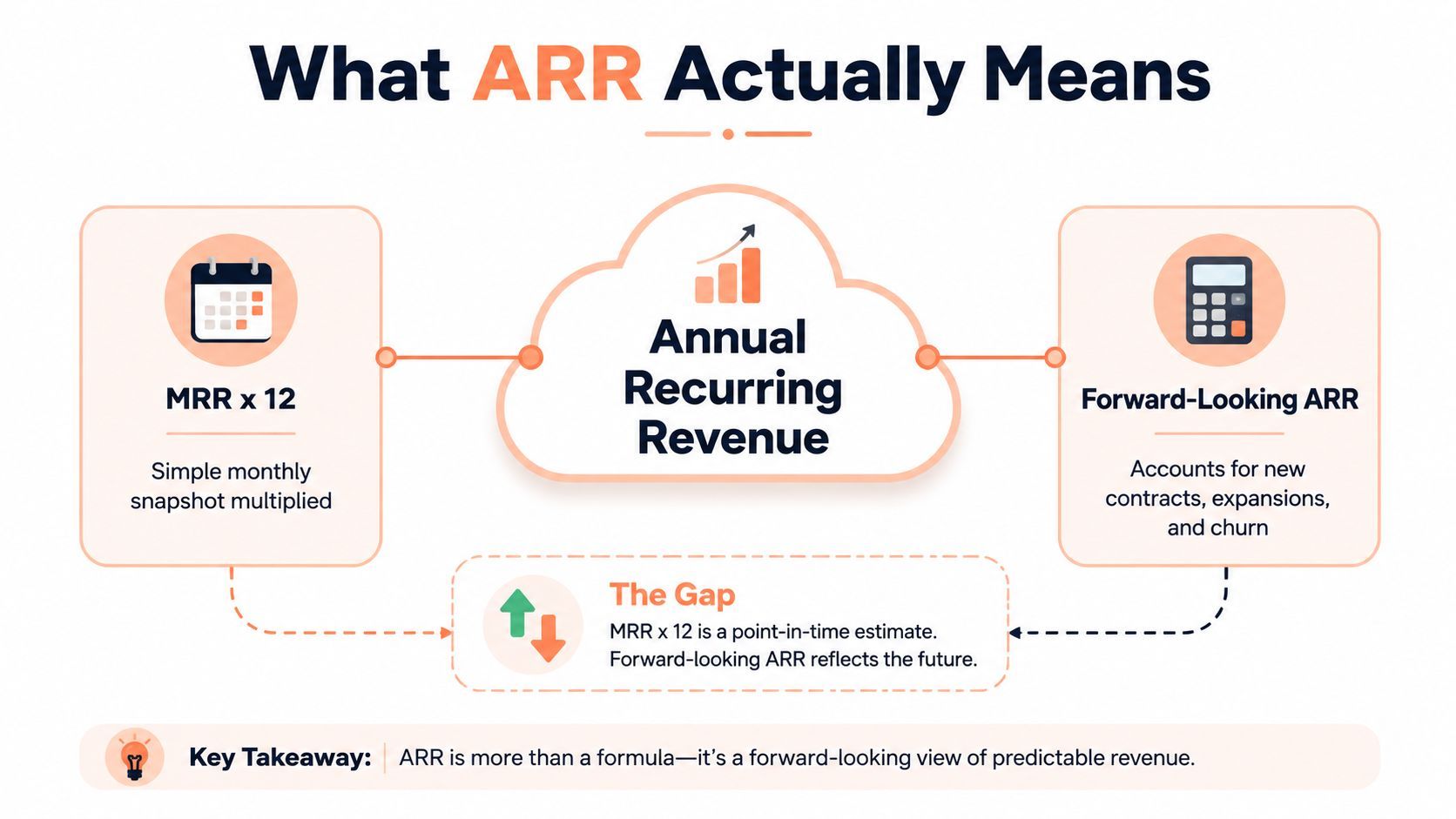
ARR is not the same thing as total revenue on the income statement. GAAP revenue follows recognition rules, while ARR is a forward-looking operating metric for recurring subscription value. That means ARR deliberately leaves out one-time fees, professional services, onboarding charges, and other non-recurring items, because those do not describe the repeatable base you can plan around.
What ARR includes and excludes
Practical rule: if the customer would have to renegotiate it or re-buy it from scratch next period, it probably doesn't belong in ARR.
A useful one-sentence definition is this. ARR is the annualized value of recurring subscription revenue you can expect if the current contract base, pricing, and usage pattern held steady. That is the mental model founders need before they start layering in changes, because the metric is supposed to show the durable run rate, not the headline cash collected this month.
The reason teams standardize on a yearly figure is simple. A monthly snapshot can move a lot from billing timing alone, but a standardized annual number is easier to compare across products, customer segments, and pricing models. It also keeps finance, sales, and the board talking about one shared number instead of three different interpretations.
For a broader primer on metric context, metrics for startup founders from Querio is a useful companion once you have the ARR baseline right.
The Core ARR Formula and a Worked Example
The simplest way to calculate ARR is still the most common starting point, ARR = MRR × 12 as shown in Creem's ARR explainer. That shortcut works when your monthly recurring revenue is clean, stable, and stripped of non-recurring items. It gets dangerous when a month includes a large one-off deal, a temporary promotion, or a customer upgrade that hasn't fully settled yet.
A more complete framework breaks ARR into components. In SaaS finance, many teams express it as new ARR + renewal ARR + expansion ARR − churned ARR − contraction ARR per the CFI reference. The point is not to make the model fancier, it's to make each movement visible so the board can see what changed.
A spreadsheet layout that holds up
Start with current monthly recurring revenue. Then separate the movements that changed that base during the month or quarter. A clean worksheet usually has one line for the opening run rate and one line for each driver.
-
Opening MRR: the recurring base at the beginning of the period.
-
New ARR: contracts that started during the period.
-
Expansion ARR: upgrades, seat adds, or higher tiers.
-
Churned ARR: customers who left.
-
Contraction ARR: downgrades or reduced usage floors.
If the opening MRR is 50,000 and nothing else changes, the ARR is MRR × 12, or ****600,000. If you add new recurring revenue and lose some to churn, you stop treating the month like a static snapshot and start treating it like a bridge from one run rate to the next. That's the difference between a number that looks right and a number a CFO can defend.
A practical way to think about this is to use the model in reverse. If you know the ending MRR and the changes that got you there, ARR is just that end-state annualized. That's why founders who keep the change log clean usually spend less time reconciling the board deck at the end of the month.
Adjusting ARR for Discounts, Churn, and Mid-Cycle Changes
A good ARR model gets complicated where real customers behave badly. Discounts make the headline contract value larger than the actual recurring amount. Mid-cycle upgrades change the run rate before the next invoice cycle. Churn can be double counted if you subtract it once in revenue reporting and again in the ARR bridge. The math is still straightforward, but the discipline has to be tight.
Discounts should be reflected at the actual transaction price, not the list price. If a customer signs a contract with a permanent discount, ARR should reflect the discounted recurring amount because that's the repeatable base. Temporary promotions are different. They belong in ARR only while the discount is active, then the run rate needs to be reset when the promotion ends.
A second example with real movement
Say a small SaaS company starts the month with three customers and $30,000 in recurring monthly revenue. One customer renews on a annual plan with a 20 percent discount, so their recurring amount is lower than the list price. Another customer upgrades mid-cycle, and a third cancels before the next billing period. The right answer is not to leave all three events inside one blended number, because that hides what happened to the base.
A clean treatment would look like this. The discounted customer contributes less recurring revenue than before, the upgrade adds only the incremental increase from the new plan, and the cancellation removes the full recurring amount tied to that account. You then recalculate the ending MRR and annualize that result.
The important habit is to net changes once, then move on. If a customer churns, don't also subtract the same account again as a downgraded plan.
That's the main reporting trap in month-to-month ARR work. A team that books churn at the account level and again at the revenue line level will understate the base. A team that only records gross additions and forgets contraction will overstate it. The cleanest convention is to log every change once, at the moment the contract economics change, and keep the bridge consistent each month.
For teams that need a deeper operating lens on lost revenue and retention patterns, churn analysis from Creem is a natural next read if you're reconciling a messy customer book.
Calculating ARR for Usage-Based and Hybrid Pricing
Usage-based pricing is where lazy ARR calculation usually breaks. If you multiply last month's usage by 12, you can overstate the business the moment consumption spikes for a short-lived reason. The safer method is to annualize GAAP-recognized usage revenue from the most recent quarter by multiplying by 4, and only use the monthly view or trailing twelve months as a cross-check when billing is stable as recommended by Ordway.
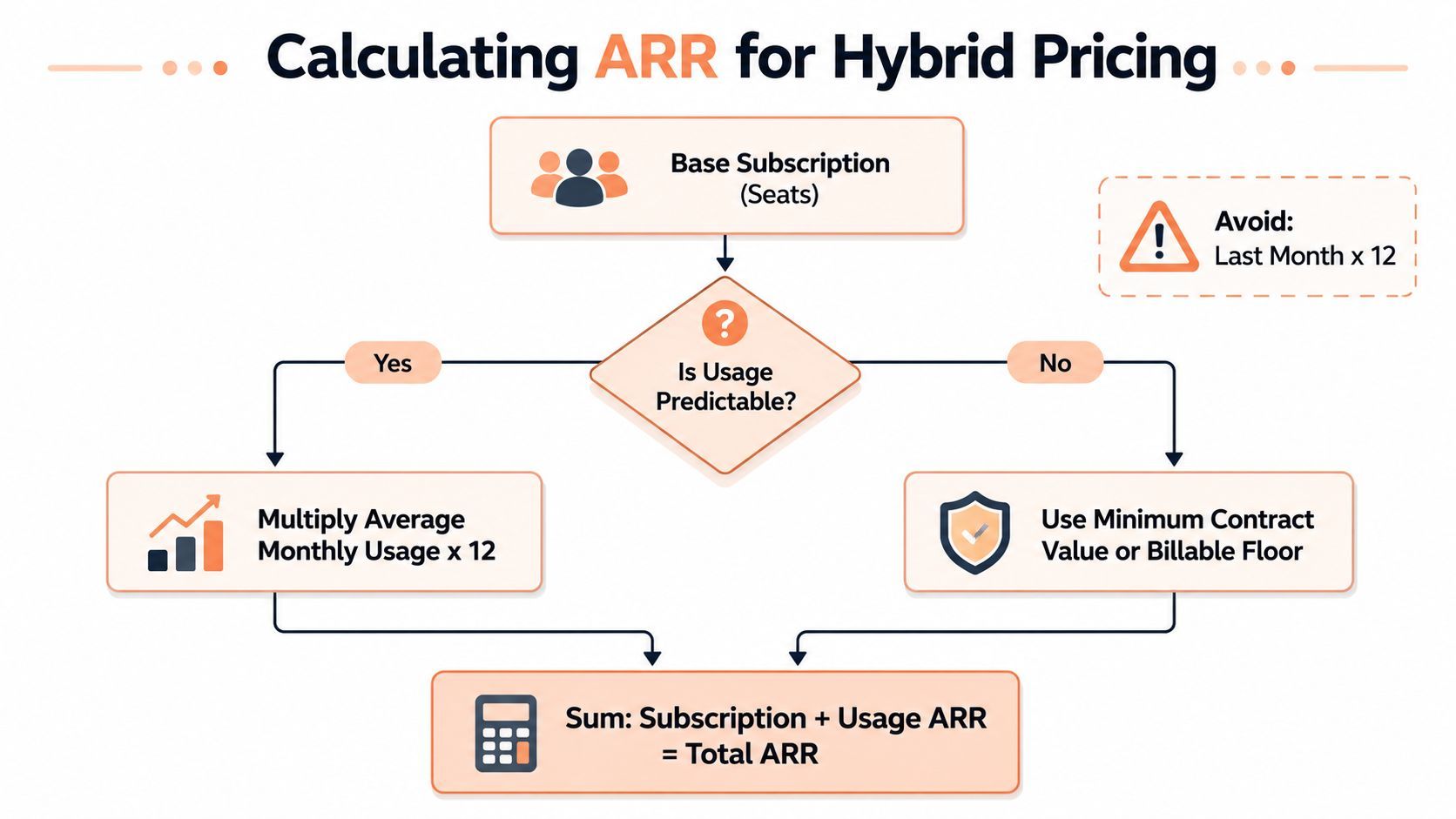
The reason is simple. ARR is supposed to represent repeatable run-rate revenue, not a lucky month of heavier consumption. If a customer ran a one-time overage spike or paid onboarding fees, those amounts should stay out of ARR because they don't recur in a dependable way. The board should see the recurring floor, not a peak that won't repeat.
What belongs in the recurring base
Hybrid pricing usually has two parts, a seat-based subscription and a variable usage layer. The subscription piece is easy. The usage piece needs judgment, because some consumption is predictable enough to annualize and some isn't. If the usage pattern is stable, finance teams can treat it as part of the recurring base. If it swings because of implementation, seasonality, or a one-off customer event, it belongs in a separate line.
A simple operating rule helps keep this clean:
-
Include predictable minimums: committed floors, base platform fees, or stable usage bands.
-
Annualize from the quarter: use the most recent quarter's GAAP-recognized usage revenue, then multiply by 4.
-
Exclude the spike: do not turn one unusual month into a year-long story.
-
Keep onboarding separate: setup fees and similar charges should stay outside ARR.
For hybrid businesses, Creem's usage-based billing guide is useful when you need to keep the billing model and the finance model aligned. The board slide should show the recurring base clearly, and the working model can carry the extra detail underneath.
Monthly vs Annual Calculations and the ARR Bridge
Finance teams usually compute ARR every month even when customer contracts are annual, because the business changes monthly. Waiting until year-end hides churn timing, delays expansion visibility, and makes forecasting harder than it needs to be. Monthly ARR also gives you a clean bridge from one period to the next, which is easier for non-finance leaders to read than a block of raw invoices.
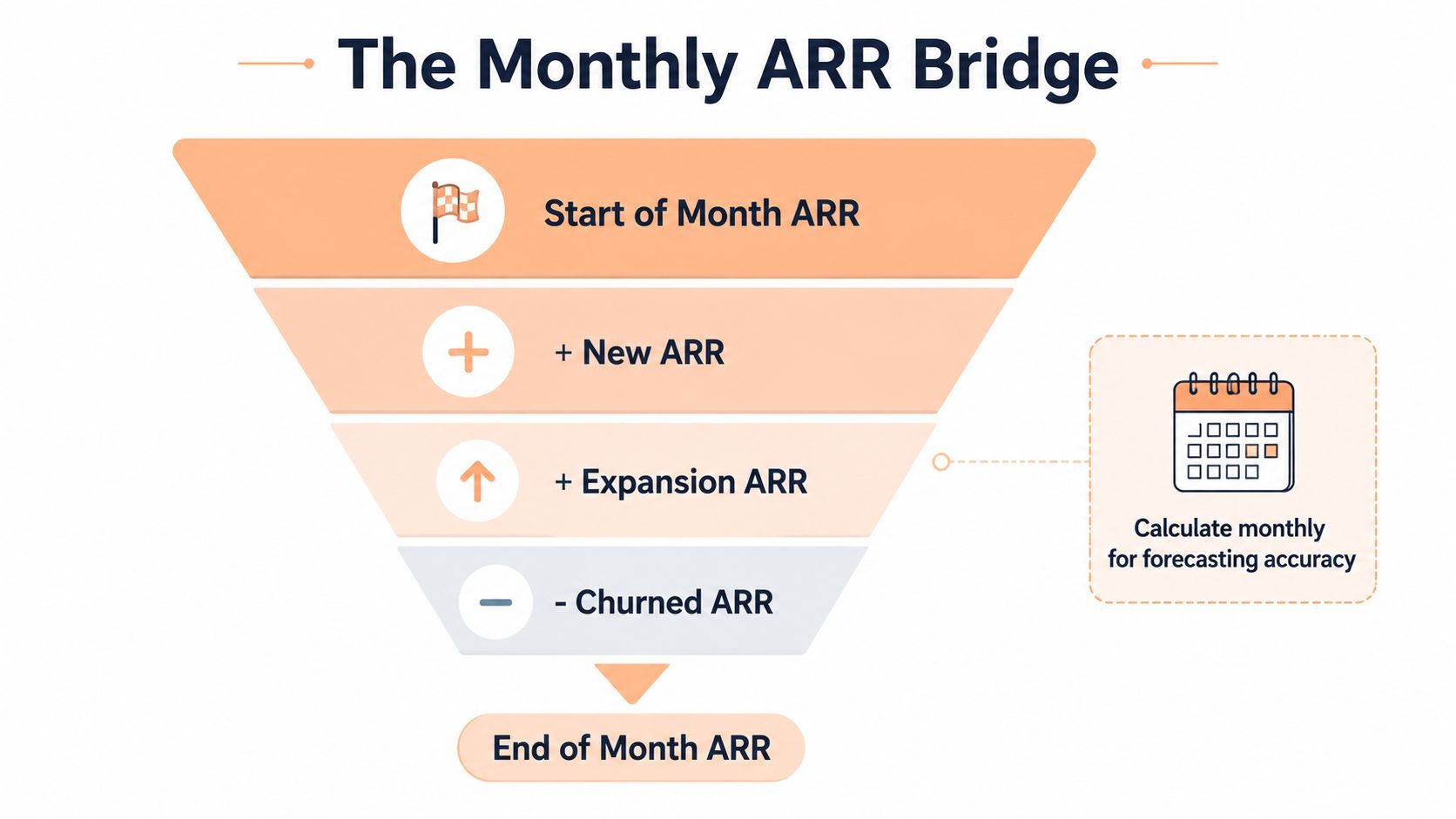
An ARR bridge starts with opening ARR, then adds new logo ARR, expansion ARR, and subtracts churn and contraction. That format tells the story of the month in one view. If the bridge is built properly, the ending ARR should match the forward-looking run rate after all changes are applied.
Reading a bridge without overcomplicating it
Suppose you start the month at $600,000 ARR. You add new ARR from a few signed deals, you gain some expansion from existing customers, and you lose some revenue to churn. The bridge should show each movement separately, not as one blended change. That way, sales can see whether growth came from new logos or existing accounts, and finance can spot whether churn is dragging the base.
A board member doesn't need a full contract dump. They need to know whether the business is growing because the top of the funnel is healthy, or because current customers are expanding fast enough to offset losses. The bridge answers that in one glance.
Build the bridge monthly, not quarterly. Waiting too long turns the story into a postmortem instead of a forecast tool.
A clean dashboard can do this without new software. The data already exists in the CRM, billing platform, and spreadsheet model. The work is making sure each movement lands in the right bucket and that the month-end rollforward matches the story your team tells out loud.
Reporting ARR Without Misleading the Room
Board conversations get messy when the ARR number is technically right but operationally confusing. The safest approach is to lead with one definition and footnote the exceptions. If your ARR is recognized from subscriptions only, say that clearly. If backlog, deferred revenue, or committed but not yet live contracts exist elsewhere in the model, keep them separate so nobody mistakes them for run rate.
The biggest reporting mistake is mixing billed ARR with recognized ARR. Billings tell you what was invoiced, while recognized revenue tells you what was earned under accounting rules. ARR is neither of those things. It is a forward-looking subscription run rate, so if you blur the lines, the room will spend the meeting untangling definitions instead of discussing the business.
Checks before an external update
-
Confirm the definition: use the same ARR treatment every month.
-
Separate backlog: don't fold unstarted contracts into run rate.
-
Net out churn once: avoid counting the same loss in two places.
-
Footnote discounts: show where permanent or temporary discounts change the base.
-
Call out one-time fees: keep services, onboarding, and setup outside the figure.
If you want to automate the recurring model instead of maintaining it by hand, formula automation with GPT for Work can help teams speed up spreadsheet workflows. That still doesn't replace discipline, though. Automation only works when the source fields are clean and the finance team agrees on the rules.
The best board-ready ARR number is boring in the right way. It reconciles, it rolls forward cleanly, and it doesn't surprise anyone in diligence. If that's not true, the number may still be useful internally, but it isn't ready for the outside room.
Putting It All Together This Week
Monday morning is the right time to run the ARR check, because the month has enough data to matter and not enough time has passed for errors to hide. Pull the latest dashboard, compare opening ARR to ending ARR, and make sure every new deal, upgrade, downgrade, and cancellation landed in one bucket only. Then verify whether the model treated discounts, churn timing, and usage spikes the same way it did last month.
The three decisions that matter most are simple. First, pick one ARR definition and keep it consistent. Second, separate backlog and one-time revenue from run rate. Third, review the ARR bridge before forecast updates, because the bridge usually reveals the problem before the final number does.
If you're using a spreadsheet-heavy process today, the fastest win is to clean the source fields before you add more formulas. If your revenue stack already includes subscription billing, proration, plan changes, and automated receipts, the reporting job gets easier because the recurring base is captured closer to the transaction. For teams that want a system built around that flow, Creem centralizes checkout, subscriptions, tax handling, and revenue tooling so ARR can be tracked from the same place the contract lives.
If you need a cleaner way to manage subscription revenue, billing changes, and the data that feeds ARR, Creem gives software teams one place to run checkout, subscriptions, and revenue workflows. It's built for founders who want the recurring number to reconcile without manual cleanup, so your next board review starts with a figure you can defend.