
You're usually not debugging usage based billing when the first invoice goes out. You're untangling a mess you built three layers earlier, a meter fired, the rating math drifted, and now finance is staring at a number that doesn't match what the customer saw in the product. That's why metered billing fails so often, not because teams can't count events, but because they shipped a system that customers can't read, support can't explain, and finance can't trust.
The hard part is that usage based billing sits at the intersection of product engineering, revenue operations, and customer trust. The commercial model is straightforward, customers pay for measurable consumption such as API calls, transactions, data volume, compute hours, or feature access, and the bill moves with usage. The operational reality is less friendly. You need metering, rating, and automated invoicing working together, plus the revenue recognition and customer-facing usage visibility that enterprise vendors now treat as part of the baseline stack Salesforce usage-based billing overview.
A healthy implementation behaves like a four-stage pipeline, meter usage, apply pricing logic, generate invoices, and recognize revenue. The breakdown usually starts before the invoice ever leaves the system, because the value metric was vague, the event stream was messy, or the customer never understood how the charge would be calculated. That's why the best teams treat usage based billing less like a pricing toggle and more like a trust system with accounting attached.
Table of Contents
- Why Usage Based Billing Trips Up Teams That Ship It
- Choosing the Right Pricing Model for Your Product
- Picking a Value Metric Your Customers Will Defend
- How the Rating Engine Turns Events Into a Number
- Should You Build the Billing Engine or Buy It
- Invoicing, Tax, and the Parts That Decide Whether Customers Stay
- Forecasting and Recognizing Revenue That Moves With Usage
- Designing Thresholds, Alerts, and Caps That Prevent Bill Shock
- A Pre-Launch Checklist and a Realistic Rollout Timeline
Why Usage Based Billing Trips Up Teams That Ship It
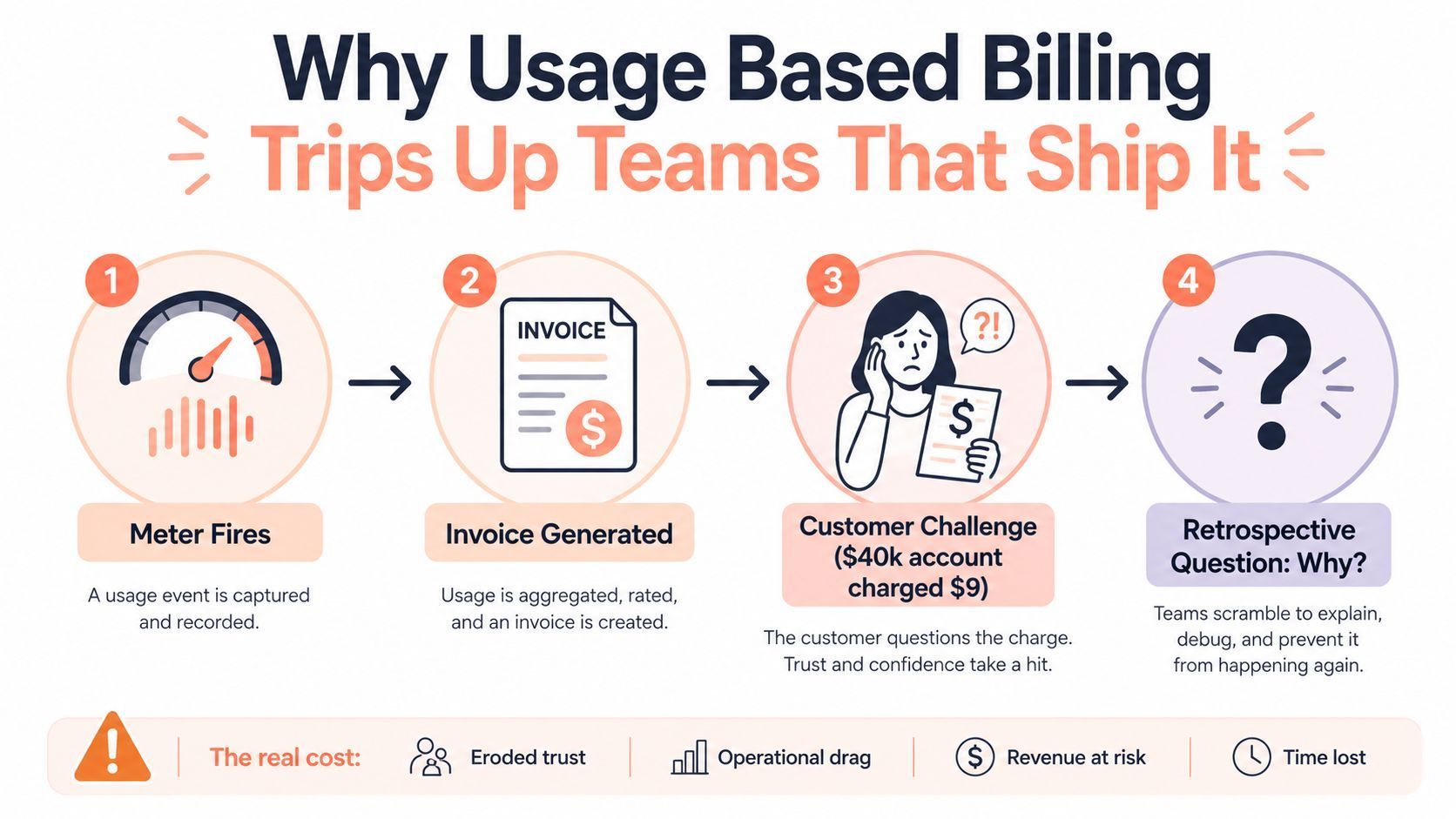
Launch week usually starts with confidence and ends in a support thread. The meter is firing, the invoice is out, and finance is asking why a large account got charged a tiny amount, or why a small account got hit with a charge nobody can explain. I have watched that same pattern break trust at two SaaS companies, even when the underlying product was solid. The failure is not just technical. Three groups are judging the same number from different angles, and the bill has to make sense to all of them.
The implementation details get lost
Usage based billing gets described as pay-as-you-go or metered billing, but that shorthand hides the underlying work. The system has to capture events cleanly, turn them into a price customers recognize, and show the result in a way finance can defend. Salesforce's overview of usage-based billing points to the same operational stack, and the issue is never just the metering layer. The harder part is the glue between product events, billing rules, invoice presentation, and the systems that need the same numbers later.
That glue is where implementations slip. The value metric is often hard to explain, the invoice line items are hard to read, or the customer sees a usage number that does not match what your team sees in the admin console. Once that happens, a billing dispute stops being a billing issue and turns into a debate about whether the product is fair.
Practical rule: if the customer cannot explain the bill back to you in one sentence, the billing model is not ready yet.
The other thing teams underestimate is visibility. Customers do not just want a total at the end of the month. They want to see how usage is trending, where the threshold sits, and what happens if they cross it. That is why a usage-based SaaS product needs billing that is legible before it needs billing that is clever. People will tolerate complexity if they can trace it. They will not tolerate surprise.
Usage based billing also asks finance, support, and product to share responsibility for the same numbers. A recurring payment setup can hide that tension for a while, because the invoice stays predictable. Usage based billing does the opposite. It makes every mismatch visible, which is useful when the model is right and painful when the meter, the thresholds, or the invoice design are off.
The market has also raised the bar. Operators now expect itemized invoices, usage trends, burndown, and clear expansion or contraction signals. Teams that treat billing as a back-office afterthought usually find out too late that the customer experience is the system of record.
Choosing the Right Pricing Model for Your Product
The shape of the pricing model matters before the first event is metered. A product with spiky consumption and obvious unit economics usually wants a different structure than a bundled SaaS app that only needs overage protection. If you pick the wrong model, the invoice may still be mathematically correct, but it'll feel wrong to the customer, and that feeling is where disputes start.
For teams comparing options, a practical guide to usage-based SaaS packaging can help frame the trade-offs between pure usage and hybrid structures, especially when the product has both recurring and variable costs usage-based SaaS.
Match the model to the usage curve
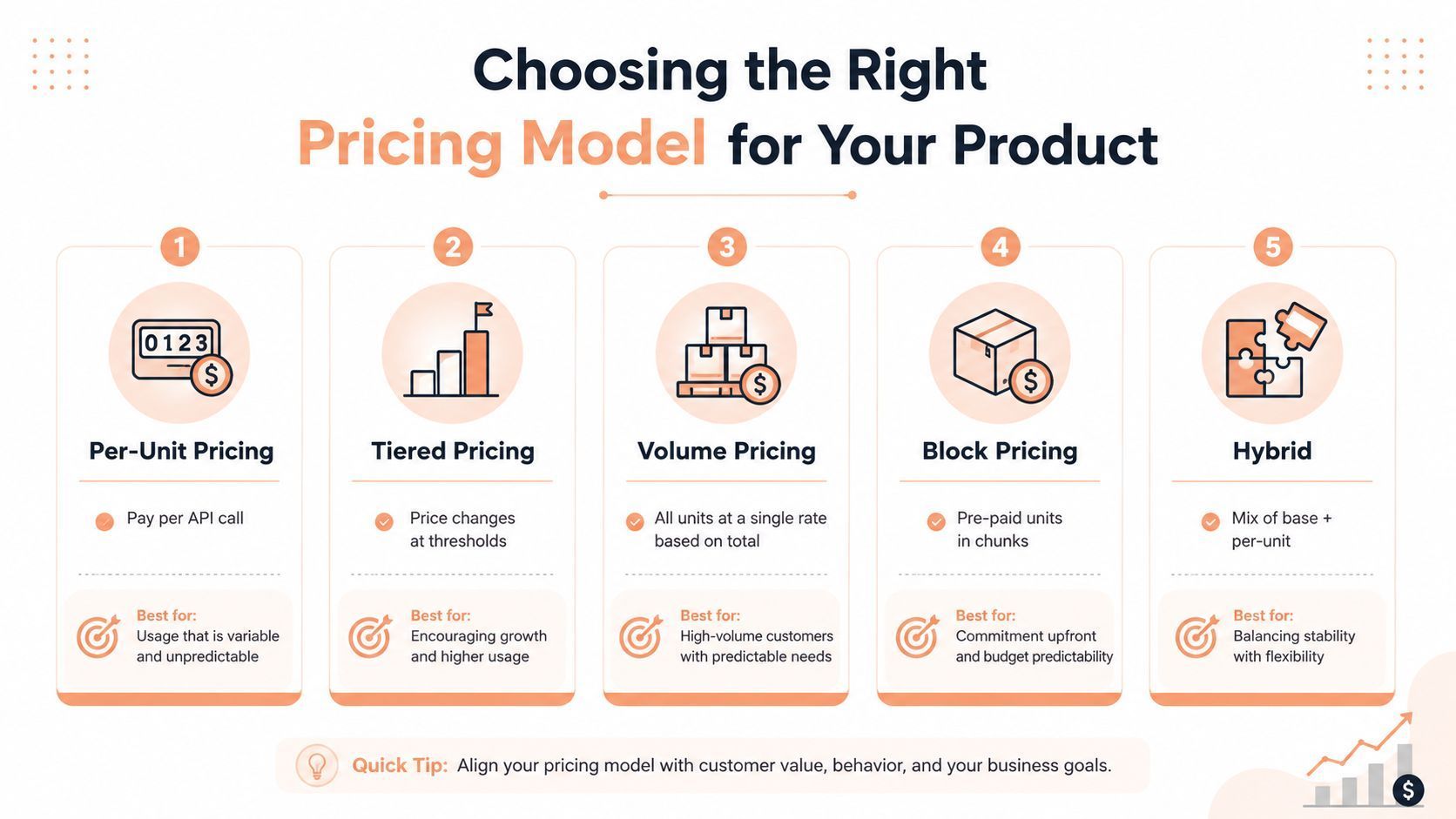
- Per-unit pricing: Good when the customer naturally understands each billable action. An API product that charges per request fits this shape because the unit is obvious and the bill scales linearly with demand.
- Tiered pricing: Works when the rate changes at thresholds. It suits products where bigger customers should get a different effective rate without rewriting the whole contract.
- Volume pricing: Makes sense when total usage should determine one blended rate for all units. It's easier to defend when a customer wants one clear price break tied to overall scale.
- Block pricing: Fits prepaid chunks of usage. It gives customers a defined spend envelope and works well when they want to buy access in chunks rather than watch every unit accrue live.
- Hybrid pricing: Combines a base amount with usage overages. This is the model most likely to survive a CFO review because it protects predictable revenue while leaving room for growth.
An API that bills per request is the cleanest mental model. A token-based AI product can also work on per-unit logic, but only if the customer can track the burn rate without guessing. A data warehouse charging for scanned data leans toward volume or tiered pricing because the customer already thinks in aggregate workload, not isolated clicks. A SaaS bundle with a committed minimum plus overage is usually hybrid, because it gives finance a floor and still aligns with expansion. And flat rate still wins when consumption is steady and the buyer mostly wants a predictable price. If every month looks the same, metering adds work without adding clarity.
When you charge is a separate choice from how you price. With postpaid billing the customer consumes first and you collect later, which is a real exposure for AI and API products, because every call has already cost you compute by the time the charge runs. If that charge fails, you hold the cost. Prepaid credits flip the order. The customer funds a balance, usage draws it down, and unpaid consumption has far less room to pile up. That only holds if customers can see their balance, know how refills work, and know before they buy what happens when credits run out or a refill fails.
The simplest rule is this, choose the model that mirrors how the customer thinks about value. If the bill feels like a metered utility, per-unit or volume pricing usually reads clearly. If the customer wants predictability first and elasticity second, hybrid is often the safer negotiation shape.
A platform like Creem's recurring payment flow can handle subscription logic, but the billing shape still needs to match product behavior or customers will see the model as arbitrary. That's the mistake that creates friction before you've even argued about price.
For usage pricing, Creem adds meters for units like tokens, calls, or compute, prepaid credit wallets with auto-refill, and postpaid metered invoices. Your app still sends accurate usage events and decides what happens when a balance hits zero. Auto-refill tops up a wallet, but the refill charge can still be declined, so your policy has to cover that case.
Takeaway: don't ask which model is most advanced. Ask which one makes the least explanation debt.
Picking a Value Metric Your Customers Will Defend
The most expensive mistake in usage based billing is choosing the wrong value metric. It's the unit you charge against, and if that unit doesn't match what the customer believes they bought, every invoice feels like a trap. Good metrics make people nod. Bad metrics make people call support before they even open the bill.
Use the smile or wince test
A metric passes the smile or wince test if the customer would instinctively say, “That makes sense,” when they see it on the invoice. That happens when they understand the unit, can check the count, and can tie it to what they received. API calls usually pass that test for API-first products because the charge maps directly to consumption. Compute hours can work for infrastructure tools, and transactions can work for payment-adjacent services. The moment the metric becomes a proxy for value instead of value itself, customers start wince-reading the bill for hidden behavior.
The risk is highest when the meter counts something tangential. If the customer bought workflow automation but gets billed on an internal activity that only loosely tracks success, the bill is technically accurate and commercially annoying. They can't see that count in their own tools, so they can't verify it. That gap is where disputes start, because people don't argue about arithmetic when they can argue about fairness. A proxy can still work, but only when the customer can see it and it moves with the outcome they care about.
Your cost driver and the customer's sense of value are sometimes different units. Charge on the one the customer can read, then check that it tracks your cost closely enough to protect margin.
Build metering where the event is born
Metering has to start inside the product, not in a spreadsheet later. The cleanest pattern is a small pipeline, an event emitter in the app, an ingestion queue, a dedupe store, and a raw event warehouse that keeps the downstream rating engine honest. Events should be idempotent and timestamped, because duplicate or out-of-order events are how teams end up reconciling revenue instead of shipping product.
Here's a practical checklist for what each billable event should carry before it reaches rating:
- Customer or account ID: who gets billed for the usage.
- Unique event ID: the dedupe key, which must stay the same on every retry.
- Event timestamp: when the usage happened, which can differ from when the event arrived.
- Metric name: which meter the event counts toward.
- Quantity: how much was used in this event.
- Unit: what the quantity measures, such as calls, tokens, or gigabytes.
The step that checks these fields is called usage mediation. It validates each event and normalizes it into billable usage before any pricing rule touches it.
Events that fail validation or can't be tied to a customer go to a visible rejection or quarantine queue. Billing them silently, or dropping them, is how invoices drift.
Keep the raw event as close to the source as possible, then let billing systems consume a clean stream instead of guessing at intent.
Batch flushing helps when traffic spikes, and replay-safe event IDs matter when the pipeline retries. Every event also carries two times, when the usage happened and when the event arrived. Bill on the first and use the second to spot late events. A sensible default is a 24-hour aggregation window, because it gives operations room to absorb late events without making the bill feel stale.
The window alone doesn't settle late arrivals, so set a grace period and a cutoff after each billing period closes. Until the cutoff, label dashboard totals as provisional. After it, the totals are final, the invoice is built from them, and anything later goes through a documented adjustment such as a credit or a line on the next invoice. The point isn't to maximize immediacy at all costs. It's to make the usage number stable enough that support can defend it and engineering can replay it if something goes wrong.
How the Rating Engine Turns Events Into a Number
The rating engine is the part of the stack that decides whether customers trust your bill or start disputing it. It takes raw events and turns them into a charge, so aggregation windows, rounding rules, free-tier credits, tier crossings, committed-use discounts, and proration all land here. If this layer is sloppy, every invoice line becomes a negotiation, and support ends up explaining math that should have been obvious in the first place.
Usage reaches the invoice through four billing stages, followed by a separate handoff to finance:
| Stage | What happens | What it hands off |
|---|---|---|
| Ingest | Raw events accepted and deduplicated | Clean event log |
| Aggregate | Events grouped by customer, metric, period | Usage totals per billing period |
| Rate | Active pricing rule applied to totals | Versioned rated charges |
| Assemble | Charges plus approved credits, discounts, adjustments | Invoice lines ready to issue |
| Recognize | Finance applies its revenue policy | Recognition entries owned by finance |
Work the math before you write the code
Say you charge $0.001 per API call, give the customer a 100,000-call free tier, and then drop the rate to $0.0008 after the next 50,000 calls. This period the customer sends 175,000 calls. The first 100,000 calls produce no charge because they're covered by the included usage. Every call after that starts moving the billed amount, and the subtotal depends on where the usage lands relative to the tiers.
| Usage Tier | Calls in Tier | Rate per Call | Tier Subtotal |
|---|---|---|---|
| Free tier | 100,000 | $0.000 | $0.000 |
| First paid tier | 50,000 | $0.001 | $50.000 |
| Additional tier | 25,000 | $0.0008 | $20.000 |
That table is still simple, but now the numbers can be checked by hand. Add $0, $50, and $20, and 175,000 calls produce a $70 usage subtotal before credits and tax. This is graduated pricing, so the $0.0008 rate applies only to the 25,000 calls in the additional tier. Under volume pricing, crossing the threshold would reprice every paid call at the new rate, and the same usage would produce a different bill. Either way, the engine should show exactly how many calls were priced at each rate, and the bill should line up with the raw usage record.
In a real system, the logic gets more complicated as soon as you add plan changes mid-cycle, credits, or a discount for committed usage. Prices that differ by model, region, or contract belong in effective-dated rules that name what they price and the dates they apply. For a mid-cycle plan change, rate each slice of usage under the rule that was active when it happened, and keep the prorated fixed fee on its own line so it never changes how usage was rated. The point is not to make the example clever. It is to make the math reproducible outside the billing engine.
Make the billing trail auditable
If a customer asks why they got a specific number six months later, the answer needs to come from system records, not tribal memory. That means the charge should be traceable back to the original event, the applied rate, and the version of the pricing rule that was active when the usage was rated. Sync with CRM, ERP, and the general ledger matters for the same reason, and it works when each record has one owner and one direction:
- Commercial terms flow into billing. The CRM or contract system owns approved prices and plan changes, and billing reads them.
- Rated charges flow out to invoicing and accounting. Billing owns the versioned charge, and the ERP or general ledger posts what it receives.
- Payment and adjustment statuses flow back. Paid, failed, refunded, and credited states return through defined interfaces such as webhooks or an API.
Every charge, invoice, and payment carries a stable record ID, so a retried message gets matched and skipped instead of posted twice. Once an invoice is final, leave it alone. A wrong charge gets a credit note or a documented adjustment that points to the original, and the audit log keeps both. A billing stack that cannot explain itself will eventually lose a dispute even when it is right.
The integration layer deserves the same care as the pricing logic. A payment management setup can handle recurring money movement, but the rating engine still has to produce a clean charge record first, one traceable, versioned record per invoice line, because collecting a payment doesn't show which usage was priced or which rule set the amount. That's why I've had better luck treating billing math like a product artifact, not a finance script Creem payment management system.
Should You Build the Billing Engine or Buy It?
Building in-house means your team owns every stage from ingestion to the finance handoff, and keeps owning it long after launch. Answer these before you commit:
- Ingestion and deduplication. Who fixes it when a client retries and the same event arrives twice?
- Aggregation and rating. Who updates pricing rules and keeps old versions, so past invoices still reproduce?
- Invoice assembly. Who applies credits and adjustments, and who handles corrections to final invoices?
- Finance handoff. Who keeps the ledger feed working when the accounting system changes?
- Pricing-change lead time. How long does a new tier or metric take to ship?
- New models without re-architecture. Can you move from per-call pricing to prepaid credits without rebuilding the pipeline?
- Throughput and visibility. Does the system keep up at peak event volume and show customers usage in near real time?
- Complex rules. Can it handle contract rates, minimums, and effective dates without hand-edited exceptions?
If a pricing change takes weeks, find out why before you add the next model. That delay usually points at the stage your team can least afford to maintain. You can also split the job, keeping metering in-house and handing tax, invoicing, and payment recovery to a merchant of record. Creem, for example, takes usage through its API into meters and credit wallets and stays the legal seller on each sale.
Invoicing, Tax, and the Parts That Decide Whether Customers Stay
Invoices are where customers stop evaluating your pricing strategy in theory and start judging it in practice. A clean invoice does more than ask for payment. It proves that the model is legible, that the meter wasn't hiding anything, and that the customer can reconcile the number against the contract without opening a ticket.
The invoice should read like a receipt, not a riddle
The most useful invoice line items separate the metric, the volume, and the rate. That makes it obvious what was consumed and how the number was derived, which is exactly what customers need when usage is variable. A commitment burndown view helps too, because it shows how much credit or commitment remains instead of forcing the buyer to reverse-engineer the balance.
That legibility matters because billing disputes are often trust disputes in disguise. If the customer sees a charge they can't decode, they start questioning the product, not just the invoice.
The invoice header names the customer account and the exact billing period. List included usage and each paid tier separately, with quantity, rate, and amount on each line.
Below the subtotal come any approved credits, then transaction tax, then the final amount due, each on its own line so the usage subtotal stays visible. The usage view in the product must use the same period and the same unit as these lines. If the dashboard counts calls by calendar week and the invoice bills by month, nothing reconciles. Before launch, also check that each customer is invoiced in their configured currency and that checkout offers the payment methods buyers in that market expect.
Tax and recovery should be invisible when they're working
Global SaaS gets messy fast if you try to bolt tax handling onto the billing layer after launch. A merchant-of-record model removes most of that burden by calculating, collecting, and remitting VAT, GST, and sales tax in 190+ countries on the seller's behalf, which is exactly the kind of operational glue teams underestimate before they ship. Creem also positions automatic invoicing and receipts as part of the transaction flow, so the customer gets a matched record without extra manual handling Creem invoice automation.
Smart dunning matters just as much. Failed payments create churn that never had to happen, so the recovery flow should retry at the right moments and stop nagging customers who are paying on time. The best systems use recovery logic that's tuned for failed payments, not a one-size-fits-all reminder blast.
A recovery flow that works runs in this order:
- Record the failure reason the processor returns, such as insufficient funds or an expired card.
- Treat payment notifications as repeatable and unordered. Check the invoice's current status by its ID before retrying or contacting the customer, so a late failure event can't reopen a paid invoice.
- Retry only failures that can succeed on a retry. An expired or blocked card needs the customer, so ask instead of retrying.
- Request updated payment details with a direct link to change the payment method.
- Stop retries and reminders the moment a payment succeeds.
- If recovery fails, apply the grace period and service policy you disclosed in your terms.
Good invoicing doesn't feel impressive when it works. Nobody opens a ticket about the bill, and finance closes the month without a spreadsheet of corrections.
If the invoice is clear, the tax story is clean, and failed cards are handled without drama, customers stop associating billing with surprise. Before you call invoicing done, check that line items match the usage record, that each sale carries the right transaction tax, and that retries stop the moment a payment succeeds. Handing the legal-seller role to a merchant of record for SaaS teams is how foreign VAT stops landing on your books.
Forecasting and Recognizing Revenue That Moves With Usage
Usage revenue moves with customer behavior. It is usually billed after consumption, so a month's number is only known when the period closes, and seasonality makes it harder still. A launch or a busy season lifts a customer's bill, and a quiet month drops it. Forecast from trailing usage with a low, expected, and high scenario, because a trailing average only tells you what already happened.
Two mechanisms change the picture, and they do different jobs:
- A committed minimum sets a contractual revenue floor. The customer owes it whether or not usage reaches it.
- Prepaid credits bring cash in before usage happens. How that cash becomes revenue is a finance decision.
Keep dated usage and invoice records for every period, since finance needs them to apply its recognition policy and to explain a number later. The same trends tell you where to talk to customers. A pilot whose usage climbs month over month is an expansion conversation, and falling usage before renewal is worth an early call.
Designing Thresholds, Alerts, and Caps That Prevent Bill Shock
Real-time visibility sounds useful until you realize it can also become a stress machine. A dashboard that shows consumption but doesn't let anyone act on it just turns uncertainty into a live feed. The key control lever is governance, because customers want to know what's happening, when it becomes risky, and what they can do before the bill closes.
Alerts need to change behavior, not just report activity
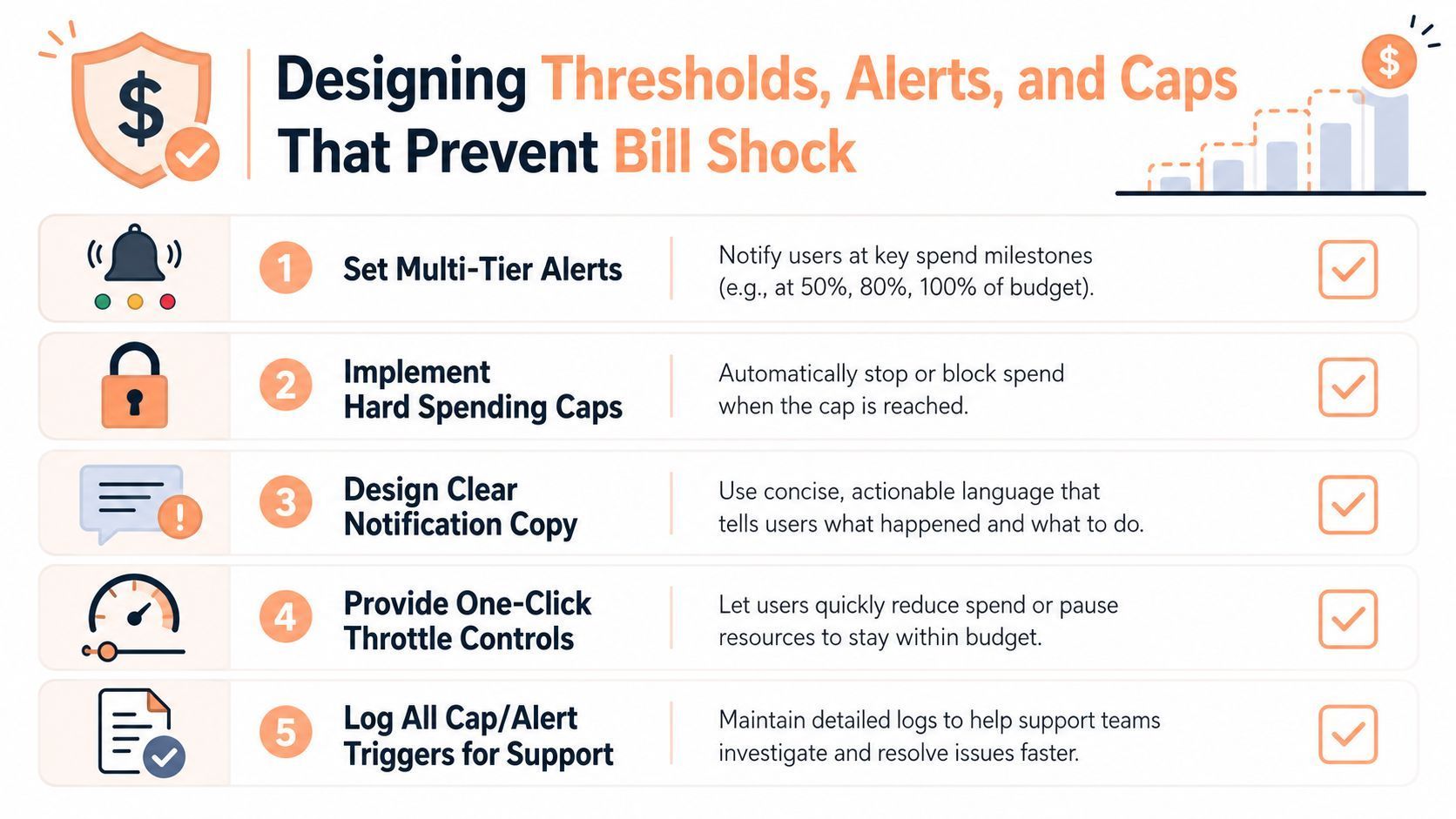
Billing guides often stop at “show usage in real time,” but that doesn't prevent surprise charges by itself. The useful layer is threshold design, with warning levels before the bill gets too far from expectation, projected invoice emails before cycle close, and hard caps that stop runaway usage when the buyer needs protection.
Set unit alerts against a customer's usage allowance and money alerts against their budget, with rated spend reflecting the pricing tiers. A practical policy is to trigger alerts at 50%, 80%, and 100% of that allowance or budget, then add a projected invoice notice seven days before cycle close. You can also alert when daily usage exceeds 1.5x the trailing 7-day average. That's not magic, it's just early enough to catch weird behavior before support hears about it from an angry customer.
Make the message plain and the controls obvious
- Set multi-tier alerts: Tell customers when they're approaching the point where the bill changes meaningfully.
- Implement hard spending caps: Let the buyer choose protection over flexibility when the account can't tolerate drift. A real cap checks or reserves spend before accepting billable work, so concurrent requests can't exhaust the same remaining budget, and at the limit it rejects new requests with a clear reason. Usage that arrives hours later can drive a warning, not a hard cap.
- Use clear notification copy: Say what changed, what it means, and what happens next.
- Provide one-click throttle controls: Give the operator a way to slow consumption without filing a ticket.
- Log every trigger: Support needs a record of what fired, when it fired, and what the user saw.
The notification itself should sound like a useful operator warning, not a marketing email. For an account with an enforced cap, something like this works:
You've reached 80% of your configured budget for {billing_period}: {current_spend} of {budget}. Projected invoice: {projected_amount}. Review usage or lower your cap in the portal. Without a change, billable work continues until the cap, then new requests are blocked. Raise the cap to authorize more spend.
That is blunt enough to help and calm enough not to panic the buyer. It respects the fact that variable billing is only acceptable when the customer still feels in control.
A Pre-Launch Checklist and a Realistic Rollout Timeline
Usage based billing turns into a trust problem fast. Customers do not complain about the metering engine first, they complain when the invoice is hard to read, the threshold logic feels arbitrary, or the support team cannot explain a charge without digging through three systems. The teams that ship it cleanly treat launch as a billing and operations release, not just a pricing change.
Run the launch audit before any customer sees a live invoice
- Verify metering logic: Confirm the billable event is idempotent, timestamped, and replay-safe.
- Test invoice generation: Reconcile sample charges from raw usage all the way to the final invoice line.
- Review customer-facing dashboards: Make sure the customer sees the same unit and the same usage number that finance sees.
- Stress-test API latency: Billing logic should not become a product slowdown.
- Finalize legal and terms language: The contract has to match the billing behavior or the invoice becomes a dispute trigger.
- Check revenue recognition handoff: The charge record needs to flow cleanly into the finance system before launch.
If any of those fail, the rollout is too early. A meter that looks fine in a sandbox can still create support noise, late-night finance cleanup, and lost confidence once real invoices go out. The pre-launch audit is where you catch those breaks before a customer has to.
Use a 30, 60, 90 day rollout instead of a big-bang launch
By Day 30, the new plan should be running in sandbox and internal testing with measured parity against manual calculations. The target is not just “it runs.” Every deterministic test should match the hand-calculated usage and invoice lines exactly, and the team should be able to explain and resolve every mismatch it finds before moving on. Cover the edge cases that break invoice line mapping:
- Duplicate events are counted once.
- Tier boundaries produce the expected rate and charge.
- Credits reduce the correct invoice lines.
- Late arrivals land in the intended billing period.
- Plan changes use the correct effective dates and rates.
Set the allowed event-count and monetary differences for production reconciliation before testing starts, along with the comparison window and late-arrival cutoff, so each tolerance is measurable.
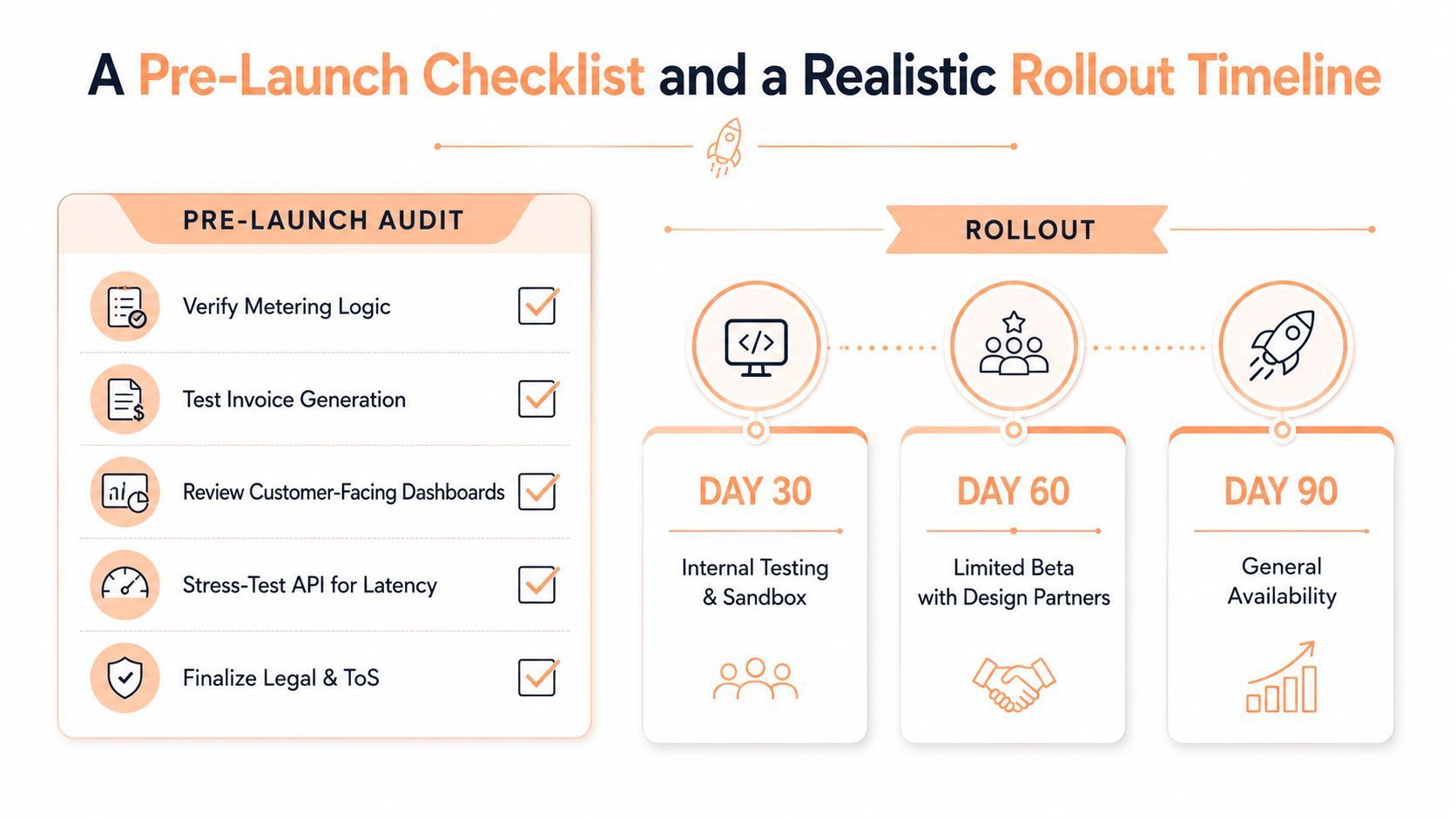
By Day 60, run shadow billing on design partners' real traffic without charging them, and start a limited paid beta only once those results reconcile and the partners have agreed to the metric, rates, and thresholds. The operational loop has to work first. That means finance can close the beta invoices without manual correction on most accounts, support can answer the common billing questions from the playbook instead of escalating them, and the team can track customer-reported discrepancies against the raw event stream. If the beta exposes repeated disputes over the same metric or threshold, the plan is not ready for wider release.
By Day 90, general availability only makes sense after shadow billing has matched real traffic closely enough that the remaining deltas are explainable and small. The rollout should have clear go or no-go criteria, not a vague sense that things “look good.” Name one launch owner to make that call, and give them a tested way to pause invoice issuance or roll back the billing release if unexplained discrepancies appear. That is the point where you prove the bill is legible, the invoice matches the promise, and the integration glue between product, finance, and support will hold once real customers start checking every line.
That cadence gives you room to fix the ugly parts before a customer's finance team sees them. It also forces the team to treat usage based billing as a living system, not a launch-day announcement. The companies that get this right do not just meter usage, they build a billing experience people can understand, trust, and renew.