
Most advice about SaaS pricing models starts with a lazy instruction: pick one model and commit to it. That advice belongs to a simpler software market. Today, the model you choose determines how customers expand, how finance forecasts revenue, how tax is handled, and whether an unexpected invoice damages the renewal.
The shift is already visible. In a January 2025 benchmark of 100 SaaS companies, 85% had adopted usage-based pricing, while companies combining subscription and usage models recorded a 21% median growth rate, the highest among the models measured. The same benchmark found that SaaS list prices rose 11.4%, compared with 2.7% average G7 inflation, and that data-led pricing companies were nearly 10 times more likely to exceed growth targets. Orb's SaaS pricing statistics benchmark makes the point clearly: pricing is an operating lever, not decorative copy on a landing page.
The practical conclusion is simple. Use a hybrid model by default, then add guardrails that protect customer trust. Keep a predictable base, connect expansion to a value metric, and make the bill understandable before the customer receives it.
Table of Contents
- Why SaaS Pricing Models Matter More Than Ever
- The Six Core SaaS Pricing Models Explained
- Pros and Cons Across Revenue, Trust, and Complexity
- Real Pricing Structures From Companies You Know
- Billing, Tax, and Revenue Operations by Model
- How to Choose the Right Model for Your Product
- Experiments and Metrics That Improve Pricing
- A Decision Checklist and Where Pricing Goes Next
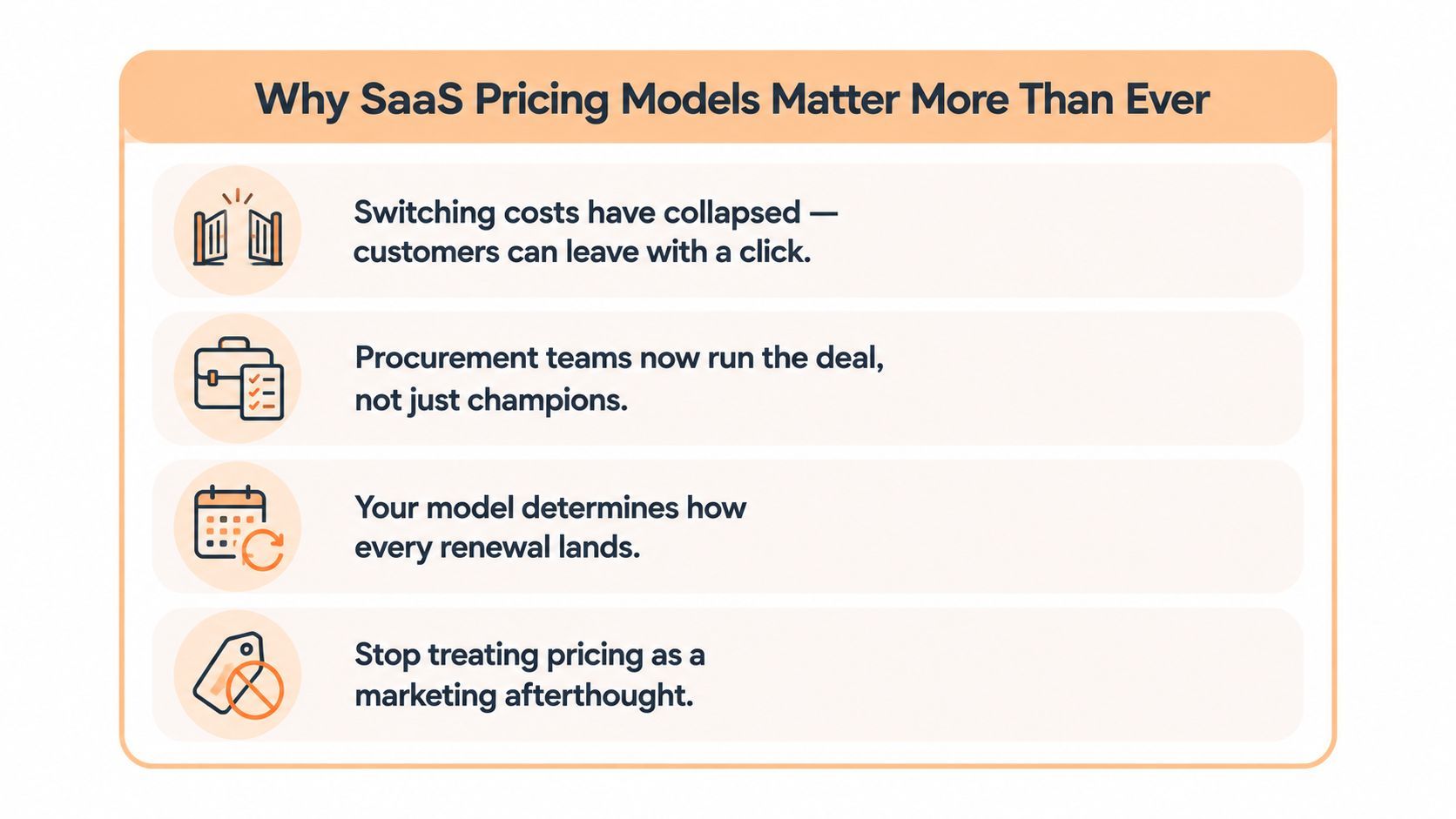
Why SaaS Pricing Models Matter More Than Ever
The popular “choose one model” rule creates unnecessary constraints. A flat subscription may help a simple product launch, but it can undercharge a heavy account. Per-seat pricing can work for collaboration software, yet it becomes awkward when value comes from automated actions, API calls, or AI processing. Pure usage billing aligns consumption and cost, but it can turn a successful customer into a nervous finance problem after one unexpected spike.
The market mix is changing. In a benchmark covering 619 SaaS companies, per-seat pricing fell from 44% in 2023 to 38% in 2025, while usage-based pricing rose from 27% to 34% and hybrid pricing increased from 31% to 42%. The 2026 startup pricing benchmark also reported that 61% of companies used some form of hybrid pricing. These figures don't prove that every company should meter usage, but they do challenge the idea that fixed seats remain the obvious default.
Six models at a glance
- Flat-rate: One recurring price for the whole product.
- Per-user: The bill grows with the number of seats.
- Tiered: Customers choose packaged plans with different limits or features.
- Usage-based: Customers pay for measurable consumption.
- Freemium: A free product tier leads into paid capabilities.
- Hybrid: A recurring base combines with seats, usage, credits, or add-ons.
Your pricing model also sets expectations for renewals. A flat plan promises stability. A usage plan promises fairness. A hybrid plan promises both, but only if you explain the variable component and provide controls. That's why pricing deserves a place beside product, finance, and customer success decisions.
Practical rule: If your model can't explain how an account grows, how an invoice changes, and how a customer avoids an unpleasant surprise, it isn't ready for scale.
The Six Core SaaS Pricing Models Explained
The six models below give you the vocabulary to identify what competitors are doing. They aren't endorsements. Each one makes a different promise to the buyer and creates a different workload for your team.
Flat-rate pricing
Definition: One fixed recurring charge gives access to the product, regardless of seats or consumption.
Analogy: A magazine subscription. The reader pays for access to the publication, not for each article opened.
Pricing-page pattern: One plan, monthly or annual billing, and a clear list of included capabilities.
Flat-rate works when customers have similar needs and usage doesn't vary dramatically. It keeps invoices easy to understand and makes forecasting straightforward. Its weakness is expansion. A customer can grow from a small team into a large one without paying more, unless you introduce a separate enterprise package.
Per-user pricing
Definition: Customers pay a recurring amount for every seat or user.
Analogy: A gym membership billed per member.
Pricing-page pattern: A published amount per seat per month, often with a minimum number of seats or different feature tiers.
This model fits collaboration tools, CRMs, and workspaces where each additional user receives direct value. It becomes punitive when many people need occasional or read-only access. It can also encourage shared logins, which damages adoption data and weakens account security.
Tiered pricing
Definition: Customers choose from packages with different feature sets, limits, or support levels.
Analogy: Airline fare bundles. Economy, flexible, and premium options serve different willingness to pay.
Pricing-page pattern: Plans such as Basic, Pro, and Enterprise, each with a deliberate upgrade boundary.
Tiering is usually the best starting point for a product serving distinct customer segments. The work is in choosing meaningful differences. If every tier is just an arbitrary collection of features, buyers won't understand why they should upgrade.
Usage-based pricing
Definition: The invoice follows a measurable unit such as API calls, transactions, storage, or processed records.
Analogy: An electricity bill. Consumption drives the charge.
Pricing-page pattern: A free allowance or minimum commitment, a unit price, volume breaks, and clear usage visibility.
Usage pricing feels fair when the meter maps directly to value. It also creates the largest operational burden because your event pipeline, invoice calculation, alerts, and dispute process must agree. For a practical explanation of the mechanics, see this guide to usage-based pricing for software.
Freemium pricing
Definition: A permanently free tier provides useful functionality, while paid plans open up scale, collaboration, administration, or advanced features.
Analogy: A coffee shop loyalty card that lets someone try the experience before paying for more.
Pricing-page pattern: Free access, a paid individual or team plan, and an enterprise option.
Freemium only works when the free product delivers a real outcome and the upgrade boundary appears naturally. If the free tier is too generous, users never pay. If it's too restricted, they leave before experiencing value.
Hybrid pricing
Definition: A fixed subscription combines with another pricing axis, such as seats, usage, credits, or outcomes.
Analogy: A phone plan with a device fee, minutes, and data.
Pricing-page pattern: A base plan includes core access and an allowance, then customers pay for additional seats or consumption.
Hybrid pricing is the strongest default for products with both predictable platform value and variable account activity. It protects a revenue floor while preserving expansion. It also creates more billing edge cases, so don't adopt it casually.
Pros and Cons Across Revenue, Trust, and Complexity
A pricing model should pass four tests: revenue predictability, customer trust, sales complexity, and product fit. Founders often optimize the first test and discover too late that the other three determine renewals.
| Model | Revenue predictability | Customer trust | Sales complexity | Best fit |
|---|---|---|---|---|
| Flat-rate | High | High | Low | Simple products with stable usage |
| Per-user | High | Medium | Low to medium | Collaboration and team software |
| Tiered | High | Medium to high | Medium | Products serving distinct segments |
| Usage-based | Variable | High when the meter is clear | Medium to high | APIs, infrastructure, and AI |
| Freemium | Variable | High at adoption, fragile at conversion | Low initially | Product-led products with a natural upgrade wall |
| Hybrid | Medium to high | High with guardrails | High | Platforms with multiple expansion paths |
Where each model earns its keep
Flat-rate wins on speed and simplicity. It can bleed expansion revenue when account value varies widely, so use it only when the product's economics support one price.
Per-user creates a clean land-and-expand motion. It fails when a customer wants broad adoption but many users are occasional participants. A growing team shouldn't feel punished for inviting colleagues.
Tiered pricing packages complexity behind recognizable choices. The risk is sticker shock at the upgrade boundary. Put the features and limits customers care about most into the plan comparison, not a dense feature inventory.
Usage-based pricing aligns cost with consumption and can open up large accounts. It also creates bill shock, less predictable finance planning, and more demanding support conversations. Caps, alerts, commit tiers, and transparent usage dashboards aren't optional extras.
Freemium lowers adoption friction and filters for product-led demand. It carries support and infrastructure costs before revenue arrives, and the conversion motion depends on a clear reason to upgrade. Don't launch it just because competitors have a free plan.
Hybrid captures recurring revenue and expansion. The trade-off is operational: every additional pricing dimension affects checkout, invoicing, proration, refunds, tax treatment, reporting, and customer communication.
Pure usage pricing is not automatically customer-centric. A surprise invoice can destroy more trust than an expensive but predictable plan.
The verdict is straightforward. Choose the simplest primary model that matches how customers receive value, then add one expansion mechanism. Don't add seats, credits, tiers, and outcomes at once.
Real Pricing Structures From Companies You Know
Public pricing pages reveal a company's go-to-market motion before you read its sales copy. The important question isn't only “what does it cost?” Ask what triggers expansion, who can buy without sales help, and which capabilities are reserved for larger accounts.
Slack is a useful per-seat reference. Its paid plans charge around active users, while higher packages add capabilities associated with administration, security, compliance, and enterprise control. That structure signals a product-led entry point with an enterprise expansion path. The active-user treatment also addresses a familiar objection: companies want to provision broadly without paying indefinitely for people who never engage.
Twilio represents the usage-based pattern. Customers pay for communication activity such as messages or voice usage, with pricing that varies by product and destination. The signal is clear: developers can start with consumption and scale when their applications generate more traffic. The model reduces the need for a large upfront commitment, but it requires accurate metering and customer visibility.
Notion illustrates freemium with team expansion layered into the journey. Individual users can begin without a paid commitment, then paid plans become relevant when collaboration, administration, or broader team needs matter. The upgrade trigger is not just “you used the product.” It is “your working context changed.”
| Company | Dominant model | Metric charged | Visible tiers | GTM signal |
|---|---|---|---|---|
| Slack | Per-active-user with tiered features | Active users and plan capabilities | Free, Pro, Business, enterprise-oriented options | Product-led adoption with team and enterprise expansion |
| Twilio | Usage-based | Messages, minutes, and other communication events | Product-specific usage rates and volume structures | Developer self-serve with consumption-led growth |
| Notion | Freemium with tiered collaboration features | Workspace needs, users, and advanced capabilities | Free and paid plans for individuals, teams, and larger organizations | Bottoms-up adoption followed by collaboration upgrades |
The same reverse-engineering method works outside software. If you're evaluating vendors that support distributed hiring, this guide to best remote staffing agencies is a useful example of how a category page organizes choices around buyer needs. Pricing pages deserve the same scrutiny. The visible ladder tells you which customer the company wants first and where it expects revenue to expand.
Billing, Tax, and Revenue Operations by Model
Pricing is a finance-stack decision disguised as a marketing-page decision. A fixed subscription mainly requires recurring charges, plan changes, receipts, dunning, and tax calculation. Per-seat billing adds seat counts, mid-cycle additions, removals, and proration, which must be understandable to both the customer and your accounting team.
Usage-based billing is a different system. You need event ingestion, aggregation windows, duplicate-event protection, usage reconciliation, customer-facing reporting, and a defensible audit trail from activity to invoice. Refunds and credits become harder because you aren't just reversing a recurring charge. You're correcting a calculation that may combine several events and time periods.
Tax adds another layer. The relevant treatment can vary by customer location, product category, billing entity, and transaction structure. A free tier may have no charge, but paid upgrades, usage overages, and digital services still require careful tax handling across jurisdictions. Data residency and transaction location can also affect how teams assess their obligations.
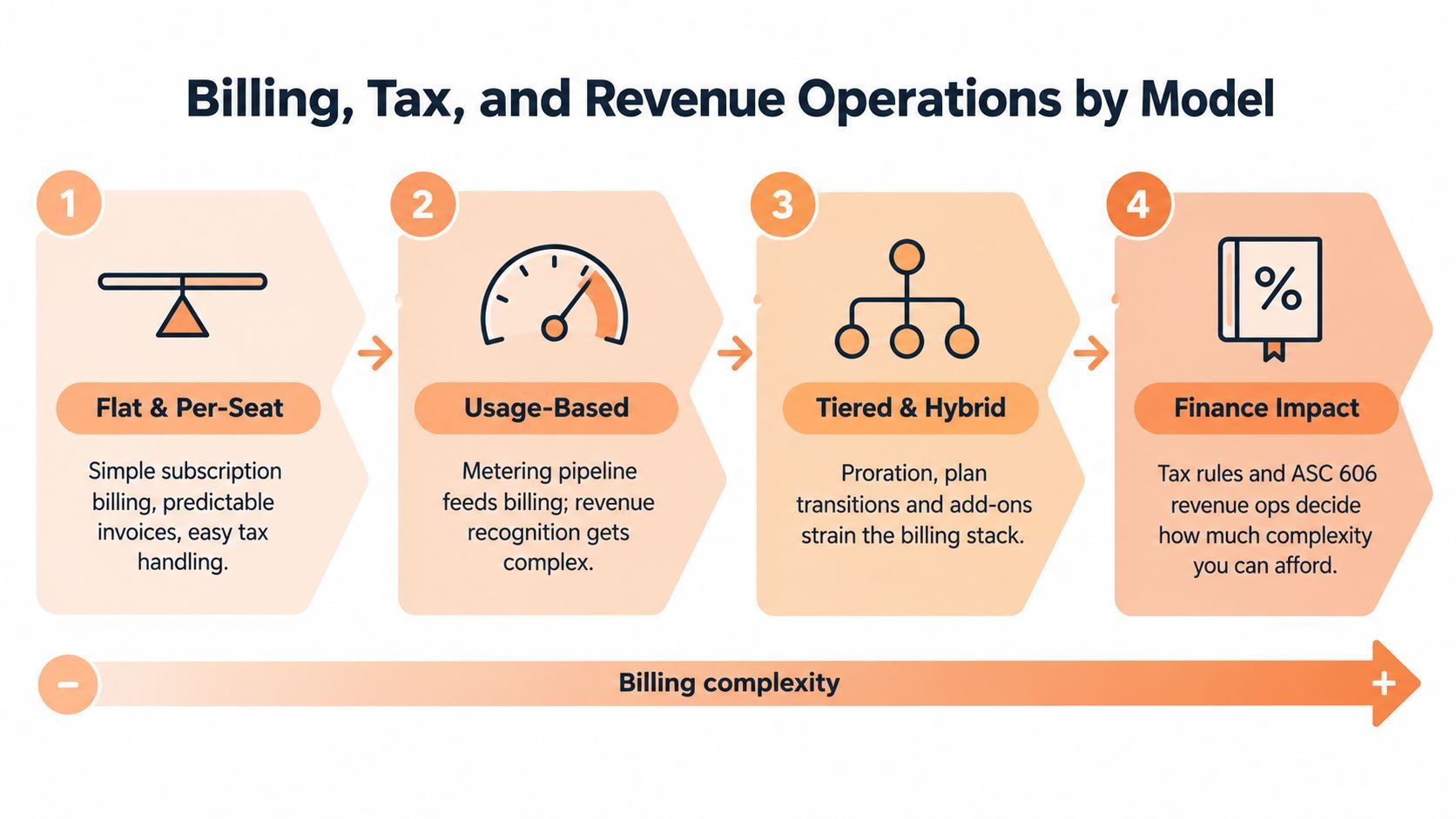
A hybrid model compounds the work because it stacks a recurring engine on top of a metering process. Before launch, decide how you'll handle caps, credits, overages, plan changes, failed payments, and disputed usage. Your dunning system also needs context. A payment failure on a stable subscription is different from a customer who receives an unexpectedly high variable invoice.
For teams that want to centralize subscription operations, SaaS billing and payment infrastructure can help frame the required capabilities, including plan changes, proration, invoices, and recovery flows. The specific implementation still depends on your tax model, ledger, billing provider, and accounting requirements.
How to Choose the Right Model for Your Product
Start with the value metric, the unit customers already understand as their value grows. It might be seats, records processed, transactions, storage, active workspaces, or a business result. If customers can't predict what makes their bill rise, your model will create resistance regardless of the price.
Use four product realities to narrow the choice:
- Value behavior: If usage scales directly with value, consumption or hybrid pricing fits. APIs, infrastructure, and AI products often have a natural meter. If value comes from continuous access and collaboration, per-user pricing is easier to understand.
- Customer profile: SMB buyers usually need a short pricing page and a quick purchase path. Enterprise buyers may accept tiers, commitments, feature gates, and negotiated terms, but they still need a clear commercial logic.
- Sales motion: Self-serve products need prices that buyers can calculate without a sales call. Assisted sales can support a more structured tier model. Sales-led products can use commitments and custom packaging, but complexity shouldn't become a substitute for positioning.
- Expansion path: Decide how revenue grows inside an account. Does the customer add users, process more volume, activate premium capabilities, or buy a larger outcome? Pick a second pricing axis only when it reflects that behavior.
A practical starting map
- Collaboration tools: Start with per-user or per-active-user pricing, then use feature tiers for administration and enterprise controls.
- APIs and infrastructure: Use usage-based pricing when calls, storage, events, or transactions map cleanly to value.
- Vertical SaaS: Use tiered packaging when customer segments need different workflows, permissions, or compliance capabilities.
- Product-led tools: Use freemium only when users can reach meaningful value before paying.
- Platforms serving SMB and enterprise: Use hybrid pricing, with a simple base for self-serve customers and commitments or metered expansion for larger accounts.
Run this four-question diagnostic before publishing a price page:
- What unit would a customer willingly pay more for as their results improve?
- Can a buyer forecast the bill before purchasing?
- Which internal team approves the spend, and what does procurement need?
- Does expansion come from seats, usage, features, or outcomes?
If the answers point in different directions, don't force one model. Use a predictable base and add one measured expansion path.
Experiments and Metrics That Improve Pricing
Treat pricing as an experiment with a revenue outcome, not as a design exercise. Test changes with new prospects first, keep acquisition conditions consistent, and judge the result using paid conversion alongside early retention and expansion. Existing customers carry historical expectations, so changing their terms introduces a communication and churn problem before you've validated the commercial idea.
Track the metrics that expose both upside and damage:
- Expansion ARR per customer: Shows whether the selected value metric creates natural account growth.
- Discount depth: Measures how far sales teams move customers from list price.
- Bill-shock churn: Identifies voluntary cancellations after an unexpectedly high usage invoice.
- Plan-level cohort retention: Compares survival and expansion for customers who started on different packages.
- Refund and credit impact: Shows gross margin after billing corrections, not just billed revenue.
Use usage cohorts to test whether your meter correlates with retention. If customers consume more without receiving more value, you've selected a cost metric, not a value metric. If retention improves as usage grows, restructure allowances and tiers around that behavior, then validate the new packaging with another prospect cohort.
| Metric | Category | Action threshold |
|---|---|---|
| Paid conversion | Acquisition | Investigate when a new price changes conversion without a clear improvement in customer quality |
| Expansion ARR per customer | Revenue quality | Rework the value metric when account growth doesn't follow the billed unit |
| Discount depth | Sales control | Review packaging when discounts become the default way to close deals |
| Bill-shock churn | Customer trust | Add alerts, caps, or commitments when cancellations follow usage spikes |
| Refunds and credits | Margin and operations | Fix metering or invoice rules when corrections become routine |
| Cohort retention | Lifecycle | Compare plans before expanding a pricing change |
Use controlled tests rather than changing several variables together. A new price, new limits, and new features in the same release won't tell you what caused the result. For a deeper operating view, use this churn analysis framework to connect cancellations with cohorts, billing events, and customer behavior.
A Decision Checklist and Where Pricing Goes Next
You can make the first decision in one afternoon:
- Pick one value metric customers already understand.
- Choose the primary model that matches your sales motion.
- Layer one expansion mechanism on top, usually seats, usage, or a higher tier.
- Instrument conversion, expansion, bill-shock churn, and cohort retention before launch.
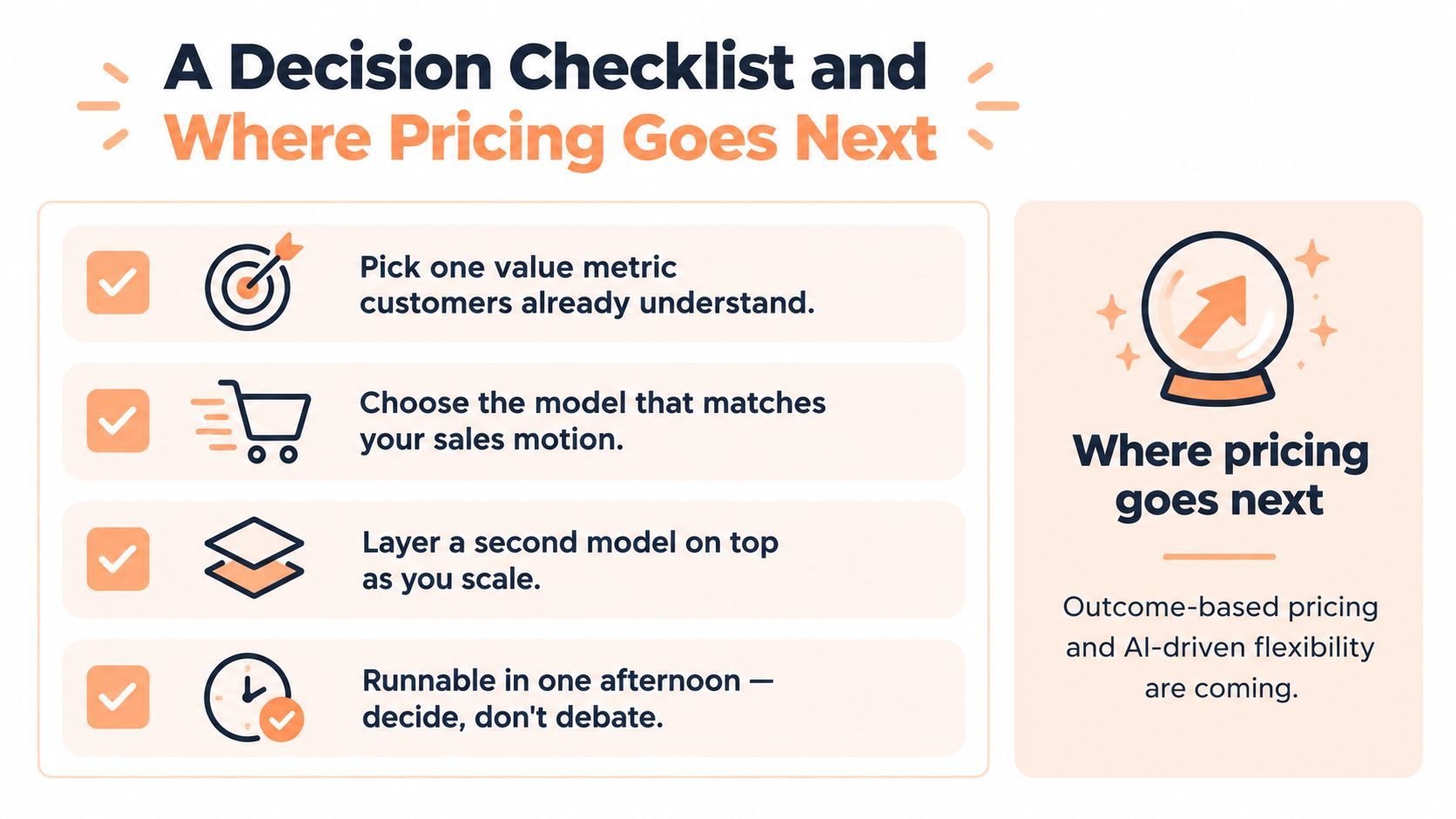
AI-metered pricing will make tokens, inference, generations, and agent actions increasingly important billing units. Outcome-based pricing will also gain attention where software can measure a business result, but neither approach should replace a stable commercial foundation prematurely. Use them as controlled layers on top of a hybrid base.
The winning pricing page won't remain a static list of plans. It will connect product telemetry, billing rules, tax operations, customer communication, and renewal strategy. Teams that design those systems together will protect trust while capturing expansion.
Creem helps software companies manage hosted checkout, subscription billing, seat-based pricing, usage-based constructs, automated tax compliance, invoices, and payment recovery through one platform. Visit Creem to evaluate whether its merchant-of-record and billing infrastructure fits the pricing architecture you're planning.