Usage-based pricing charges customers for what they consume, so invoices rise and fall with API calls, compute, storage, and transactions instead of a flat monthly fee. It has moved from a niche experiment to a mainstream model, with adoption rising from 27% in 2020 to 46% in 2022, and a later OpenView projection estimated 61% of the general SaaS index would adopt some form of usage-based pricing by the end of 2023.
A founder usually feels the appeal of that model the moment a customer's product usage spikes and the subscription math stops matching reality. The hard part is that the pricing idea sounds simple, while the operating model underneath it is anything but.
Table of Contents
- What Usage-Based Pricing Means for Modern Software
- The Four Core Usage-Based Pricing Models
- Pay-as-you-go
- Tiered usage and volume-based pricing
- Hybrid pricing
- Inside the Billing Stack That Makes Usage-Based Pricing Work
- How Usage-Based Pricing Reshapes Revenue
- Why finance teams like the upside and fear the variance
- Packaging Usage Into a Customer-Friendly Offer
- Build the offer around predictability
- Preventing Bill Shock Before It Kills Adoption
- Match the control to the anxiety
- Billing, Tax, and Compliance Implications Worldwide
- What the vendor still owns
- Choosing Whether Usage-Based Pricing Is Right for You
What Usage-Based Pricing Means for Modern Software
At midnight, a SaaS founder refreshes the dashboard and sees one customer's usage line shoot up after a busy week. The invoice that looked safe on Monday now looks very different, and the question is no longer only how much to bill, but whether the bill still feels fair and understandable to the customer.
That tension is the core of usage based pricing. Before it is a pricing model, it is an instrumentation problem. Software has to measure the right unit, record it cleanly, and explain it back to the buyer in a way that matches the value they received. Customers then pay for consumption, not just access, so the price moves with actual use, whether that use is measured in requests, seats, compute minutes, storage, or transactions. That is why OpenView's usage-based pricing benchmark has been widely cited in SaaS discussions about how quickly the model has spread.
The commercial logic is simple, but the mechanics are not. A subscription sells access for a period of time. Usage-based pricing sells a quantity of value, or at least a measurable proxy for value. That makes it a natural fit for cloud infrastructure, APIs, AI tools, and data-heavy products, where customer activity rises and falls in visible ways and the vendor's cost to serve often rises with demand. For a founder, the question is whether the software can measure that activity accurately enough to support billing, reporting, and trust across markets. That matters even more when the billing stack has to work globally through a merchant-of-record setup like Creem, where metering, invoicing, tax handling, and collection all need to line up.
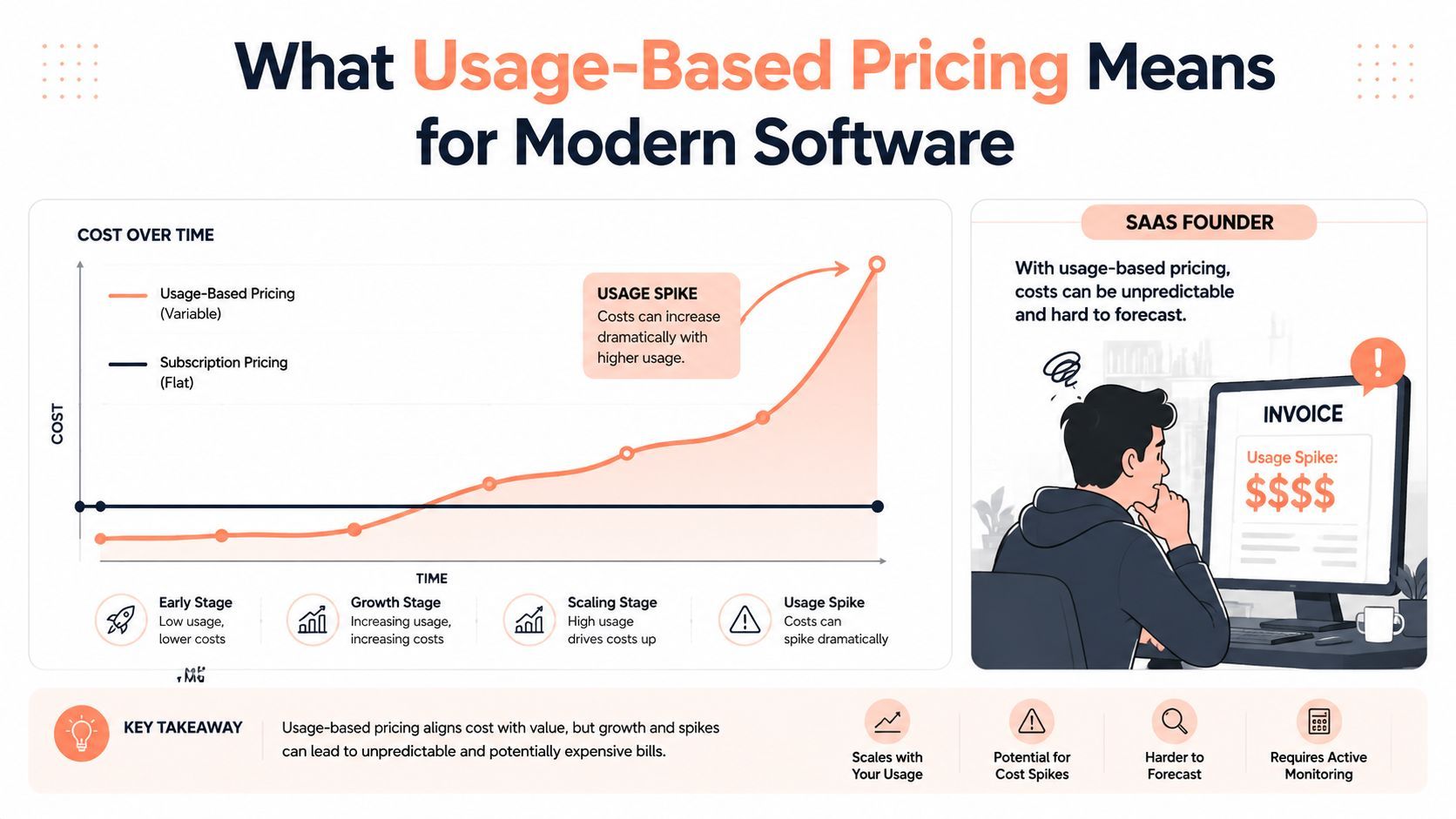
Practical rule: if your customer's value changes week to week, a flat fee often feels arbitrary. If the value barely moves, metering can just add friction.
The appeal and the anxiety arrive together. Variable revenue is harder to forecast, and customers can get nervous when they cannot predict the bill. That is why the model has to be designed around visibility, trust, and clean measurement first, then translated into a price point that customers can read without guessing.
The Four Core Usage-Based Pricing Models
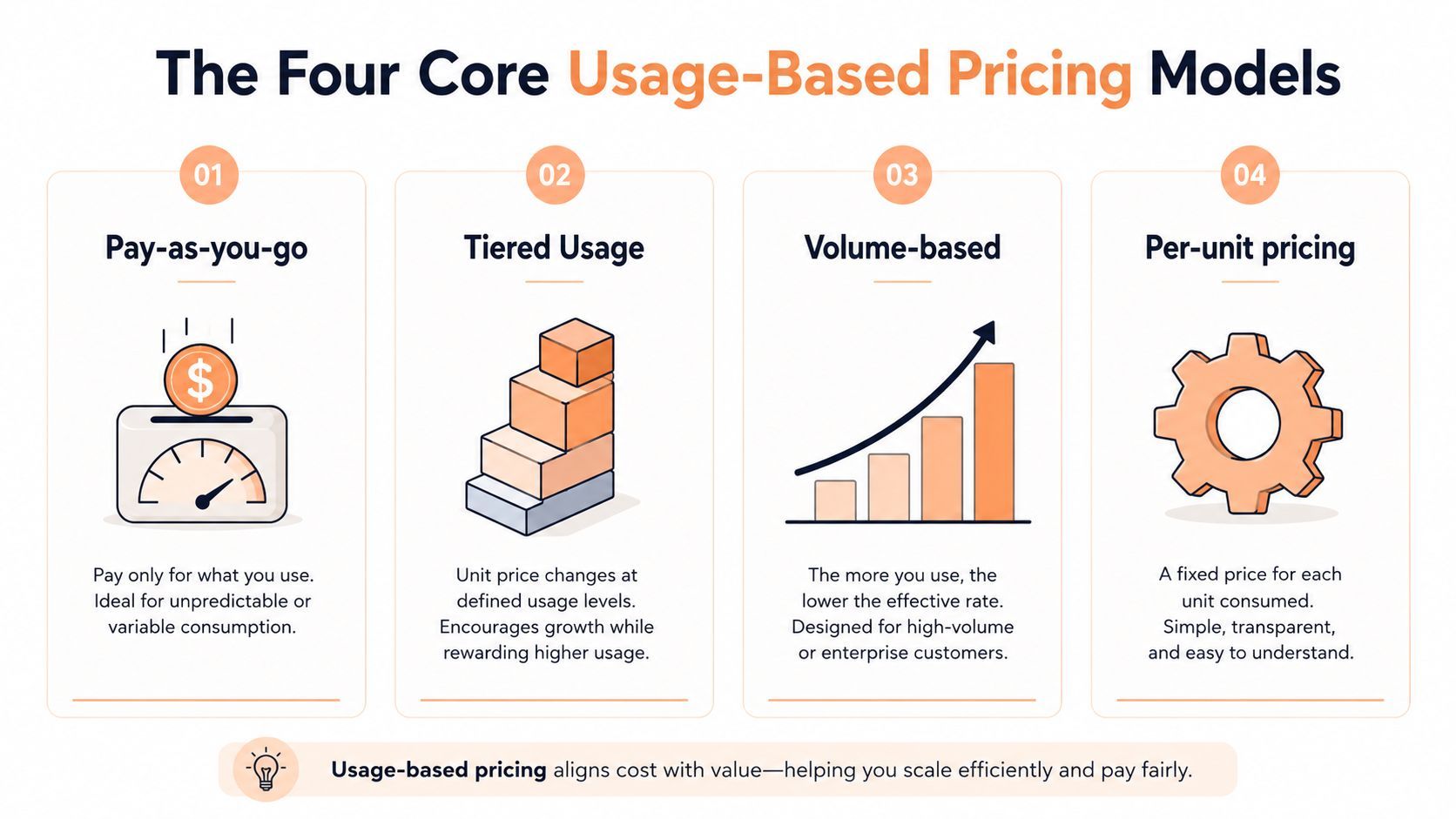
Usage-based pricing is a family of billing models, not a single formula. For a founder, the first job is to decide what you are measuring, because the metering choice shapes the customer experience long before the price per unit does.
| Model | How Charges Are Calculated | Best Fit | Key Trade-off |
|---|---|---|---|
| Pay-as-you-go | Customers pay for each unit consumed | APIs, compute, messaging, storage | Simple, but invoices can swing sharply |
| Tiered usage | Different rates kick in at different usage bands | Products with clear consumption levels | Easier to market, but bands can confuse buyers |
| Volume-based | Higher volume changes the rate for all or part of the purchase | Products where bulk use should be rewarded | Can favor larger customers more than smaller ones |
| Hybrid | A platform fee plus metered usage | Most SaaS products that need predictability | More complex to design, but easier to sell |
Pay-as-you-go
This is the most direct model. The customer uses one unit, the customer pays for one unit. It works like a utility meter, except the meter might be counting API calls, storage, or messages instead of electricity or water. That is why technical buyers usually understand it quickly, especially in products where value is tied closely to visible activity.
The downside is that the bill can change fast. A traffic spike, a new workflow, or a busy customer account can make the invoice jump in a way that feels fair to the vendor and unsettling to procurement. If the product's usage is naturally spiky, the model can still work, but the team has to be careful about visibility, alerts, and customer expectations.
Tiered usage and volume-based pricing
Tiered usage gives the customer different rates at different usage bands. It is useful when you want to reward growth without making every extra unit look identical. A buyer can move through a set of thresholds, and each threshold creates a clearer story about how the bill changes as consumption rises.
Volume-based pricing changes the unit economics based on total purchase volume, so bigger buyers get a different rate because they are buying more overall. That can make sense when larger customers bring lower servicing costs per unit or when the product should clearly reward scale. Both models work best when the usage boundaries are easy to explain and the team can meter them without ambiguity. For teams that need to understand how this sits inside billing for SaaS products, the pricing model only works if the operational layer can measure it cleanly. In practice, that often means pairing the pricing design with careful reporting, and sometimes with data observability for snowflake so usage records and financial records stay aligned.
Hybrid pricing
Hybrid pricing combines a fixed platform fee with metered usage. That gives the buyer a predictable floor and gives the vendor some recurring revenue before the meter starts moving. In practice, this is often the easiest shape for a SaaS company to sell, because it reduces the fear that every month will feel like a blank check while still letting heavy users pay more when they consume more.
That mix also fits how many software teams ship. They want a stable base for packaging, sales, and support, then a usage layer on top for the parts of the product that scale with demand. The hard part is keeping the base fee and the meter aligned so customers can tell what they are paying for and why. If those lines blur, the model starts to feel arbitrary instead of economic.
The right model is rarely pure. Most teams need a fixed floor, then a meter on top.
A useful way to judge the four models is by asking a simple question. Is the unit you are measuring a close proxy for customer value, or is it only a rough signal? If the answer is close, pay-as-you-go or tiered pricing can feel natural. If the answer is rough, hybrid pricing usually protects both sides better because it leaves room for a base commitment while the meter handles the variable part.
| Model | How Charges Are Calculated | Best Fit | Key Trade-off |
|---|---|---|---|
| Pay-as-you-go | Each unit is billed at the same or near-same rate | Infrastructure and API products | Revenue can be volatile |
| Tiered usage | Usage is grouped into levels with different prices | Products with clear consumption thresholds | Buyers may struggle to predict the next tier |
| Volume-based | Total purchase volume changes unit economics | High-volume customers | Smaller customers may see less benefit |
| Hybrid | Base fee plus usage charges | Most B2B SaaS | More moving parts in sales and billing |
Inside the Billing Stack That Makes Usage-Based Pricing Work
The pricing page is the easy part. The work starts when you need to capture usage accurately, turn it into a bill, and make sure the customer trusts the result.
That stack has three layers. Metering records the event, rating turns the event into money, and invoicing presents the charge and collects it. Stripe's SaaS guidance frames these as the minimum operating components, while M3ter's guidance adds that most implementations also need near-real-time tracking and integrations into CRM and ERP systems for reconciliation and visibility. Stripe's usage-based pricing strategy guidance
A simple example helps. One API call gets logged at the meter. The rating engine multiplies that call by the contract's per-call price. The invoice then aggregates all of those calls across the billing period and sends the customer one bill. If any part of that chain is late or inaccurate, the vendor can lose revenue and the buyer can lose confidence.
| Layer | What It Does | Why It Matters |
|---|---|---|
| Metering | Captures each usage event with account, quantity, and timestamp | Prevents missing or misattributed usage |
| Rating | Applies the pricing logic to the measured events | Converts raw telemetry into billable amounts |
| Invoicing | Sums charges and presents them for payment | Turns usage into revenue collection |
Aggregation rules matter more than most founders expect. Recurly notes that a cumulative model sums every usage record across the billing period, while a last-recorded model bills only the latest value, which can create very different invoices from the same telemetry. That isn't a small accounting detail, it changes customer expectations and can trigger disputes if the billing logic isn't clear.
Operational insight: if customers can't see their own usage near real time, they'll assume the invoice is wrong even when it's technically correct.
For teams building the plumbing, a practical reference point is data observability for Snowflake, because usage-based billing depends on the same discipline, clean event capture, traceability, and reconciliation. If you want a deeper view into how billing architecture supports SaaS operations, this guide on billing for SaaS covers the adjacent mechanics without blurring the line between measurement and invoicing.
How Usage-Based Pricing Reshapes Revenue
Usage-based pricing changes the shape of revenue, not just the wording on the pricing page. When customers consume more, revenue can rise with that activity, which is attractive in products where usage expands naturally as the customer grows.
That's one reason the model keeps spreading. In a January 2025 survey of 100 SaaS companies by Metronome and Greyhound Capital, 85% of respondents already had usage-based pricing in place, 77% of the largest software companies were reported to have some level of usage-based pricing, and 64% of Forbes' next billion-dollar startups offer usage-based pricing. Metronome and Greyhound Capital's usage-based pricing research
There's also a broader market signal. Stripo's 2026 research reported that 42% of SaaS products now offer a usage-based option, up from 27% in 2023, and among companies monetizing AI, 11% use pure usage-based pricing while 31% use a hybrid model. Stripo's SaaS pricing research
Why finance teams like the upside and fear the variance
The upside is straightforward. If the product's usage grows with customer value, the vendor can capture expansion without forcing a seat increase or a plan migration. Infrastructure-heavy businesses also like the fact that revenue can rise alongside variable cost-to-serve, which helps preserve margin discipline.
The downside is just as direct. Forecasting gets harder when bills aren't fixed, and finance teams have to think carefully about how usage lands in revenue recognition, deferred revenue, and monthly planning. That's why founders often hear enthusiasm from product and skepticism from finance in the same meeting.
Good pricing can still be hard finance. If the model increases revenue quality only after the billing and recognition stack is mature, the business has to earn that complexity.
A useful way to think about it is this. Usage-based pricing doesn't automatically improve retention or expansion. It creates the conditions for those outcomes when customer value really does rise with consumption, but the company still has to instrument the product well and manage the revenue ops cleanly. For a related finance lens, this ARR calculation guide for subscription businesses helps frame the difference between recurring base revenue and variable usage revenue.
Packaging Usage Into a Customer-Friendly Offer
A raw meter is not a product. Buyers need a package they can understand, budget for, and defend internally, or the pricing model will feel like a trap.
The simplest way to make that package work is to tie the meter to a visible value driver. API calls, transactions, compute time, data volume, and active users are common examples because they map more cleanly to how customers get value and, in many products, to how the vendor incurs cost. When the metric is easy to understand, sales has a story the buyer can repeat without translating it into engineering jargon.
Build the offer around predictability
Hybrid packaging is often the easiest sell. A platform fee creates a baseline, then usage kicks in on top of it. Some vendors also use committed-use discounts, which let customers buy a block of usage in advance and lower the fear of surprise bills without abandoning the meter entirely.
That's the packaging logic behind many successful offers. A buyer gets a stable starting point, then pays more as actual value shows up. The vendor gets a floor for planning, then upside when customers expand.
A practical structure usually includes:
-
A platform fee, so the customer knows the product has an entry point.
-
A measured unit, such as calls, jobs, or records, so the bill follows a traceable signal.
-
A discount or commitment layer, so larger customers can predict spend more easily.
-
An overage rule, so growth above the committed amount doesn't create a surprise contract rewrite.
The metric also needs to be hard to game. If customers can manipulate the count without getting more value, the price signal gets distorted and support tickets go up. If the metric is tightly correlated with cost-to-serve, the vendor can scale more confidently because revenue moves in the same direction as workload.
Choose the metric that your customer can explain in one sentence and your finance team can defend in one spreadsheet.
For founders thinking about presentation rather than just mechanics, affordable plans for researchers is a useful example of how a product can frame a usage-sensitive offer without making the pricing feel opaque. The specifics will differ in software, but the principle stays the same, simple entry, visible meter, and a clear path to growth.
Preventing Bill Shock Before It Kills Adoption
A common mistake is assuming customers only care that usage-based pricing is fair. They also care that it's predictable.
If the invoice is only visible after the billing period closes, some buyers will hold back usage just to avoid a nasty surprise. That's why transparency features are part of the product, not just the billing UI. Real-time usage dashboards, soft caps, hard caps, and alert thresholds all reduce the fear that the meter is running away from the customer.
Match the control to the anxiety
A dashboard answers the basic question, “How much have we used so far?” A soft cap says, “You're nearing the limit, but nothing stops automatically.” A hard cap says, “Usage will stop or pause here.” Alerts help at the margin, because they warn the buyer before usage crosses the line where finance starts asking questions.
The contrarian point is simple. Usage-based pricing can reduce consumption if customers are afraid of unpredictable bills. In AI and API products especially, that fear can be enough to slow adoption even when the product is valuable.
If customers can't see the meter, they'll budget for the worst case.
That's why visibility should appear before the final invoice, not after it. When product teams expose usage early, they give customers time to correct behavior, set internal approvals, or buy more committed capacity. Without that visibility, the company turns a flexible model into a trust problem.
The bigger lesson is that bill shock is a design failure, not a pricing inevitability. The meter can be fair and still feel hostile if the buyer can't see what's happening. The best teams treat spend alerts, usage bars, and cap controls as retention features.
Billing, Tax, and Compliance Implications Worldwide
Once usage becomes variable, the backend has to do more work. Events may arrive continuously, customers may buy in different currencies, tax rules can differ by country, and the invoice has to bring all of that together without breaking trust.
That's where a merchant-of-record platform becomes relevant. Creem operates as a merchant-of-record and payments platform for software companies, centralizing global checkout, automated VAT, GST, and sales tax compliance, subscription billing, revenue splits, and affiliate tooling so teams can sell worldwide with a single integration. Creem If you want to compare tax workflows with a focused compliance overview, this guide on SaaS sales tax compliance cost is a useful companion.
What the vendor still owns
The vendor still owns the product meter, the pricing logic, and the customer experience around usage visibility. A merchant-of-record does not replace good product instrumentation. It handles the commercial and compliance layer around the transaction, which is where a lot of the hidden complexity lives once invoices start varying from customer to customer.
That matters even more when the business spans multiple regions. Tax treatment, currency handling, invoicing, and payment recovery all become part of the growth equation, not just finance housekeeping.
For teams worried about trust and controls, SOC 2 Type I vs Type II is a helpful resource because variable billing often pushes buyers to ask harder questions about security and operational discipline. Once revenue becomes more dynamic, the supporting infrastructure has to look mature, even if the product is still early.
In practice, the right stack reduces busywork in three places. It limits manual invoice assembly, it lowers cross-border compliance drag, and it makes revenue sharing cleaner when partners, co-founders, or affiliates are involved. That's the operational backdrop a usage-based model needs if it's going to scale beyond the first few customers.
Choosing Whether Usage-Based Pricing Is Right for You
A founder with a data-transfer product and a clear usage signal will usually find this model easier to adopt than a team selling a simple workflow app with little variation in consumption. The difference is not taste, it is fit.
Usage-based pricing works best when customer value rises with measurable consumption, when the vendor's cost-to-serve also rises with use, and when the product can expose usage clearly enough that customers trust the bill. It struggles when usage barely changes, when the meter is easy to game, or when one metric cannot capture the value the customer cares about.
A useful way to judge it is to separate instrumentation from pricing. First ask whether the product can measure the right events reliably, like a water meter that records actual flow instead of guessing from pipe size. Then ask whether those measurements map cleanly to value and cost. If the answer to either question is shaky, the pricing model will be hard to defend no matter how elegant the invoice looks.
The quickest decision frame is simple:
-
Adopt it when usage is visible, variable, and tied to value.
-
Hybridize it when buyers want predictability but usage still matters.
-
Skip it when the product's value is mostly fixed, hard to meter, or easy to misunderstand.
That frame matters because the hardest part is rarely the tariff itself. The harder problem is deciding whether your product can measure consumption in a way customers recognize as fair, then support that measurement with the billing, tax, and payout machinery required to operate across markets.
If you are still unsure, compare your product against a business with metered value, like PlotStudio AI's affordable plans for researchers, and ask a simple question. Does the bill reflect a real consumption pattern, or does it just make pricing harder to explain?
The safest default for many software companies is a hybrid structure. It gives the customer a floor, gives the business room to grow with actual use, and leaves space for global billing infrastructure to do its job without forcing every dollar through the same fixed monthly box. For teams that need metering, checkout, tax handling, and revenue splits in one place, a merchant-of-record stack such as Creem can carry the commercial layer while the product team stays focused on measuring usage well.