

The usual advice is simple: direct deposit is cheap, wires are expensive, so choose direct deposit. That shortcut can leave a contractor with less money than expected, or cause a time-critical payment to miss its deadline. The useful question isn't which rail has the lower advertised fee. It's how much the recipient will receive, in which currency, on what date, and with what risk of delay or reversal.
| Criterion | Direct deposit (ACH) | Wire transfer |
|---|---|---|
| Best fit | Routine, scheduled domestic payouts | Urgent or high-value settlement |
| Timing | Batch processing, with timing shaped by banking days and cutoffs | Faster settlement during operating hours |
| Cost profile | Usually designed for lower-cost recurring payments | Fees may apply, with possible extra cross-border deductions |
| Reach | Primarily suited to U.S. bank accounts | Domestic and international, depending on provider and corridor |
| Finality | Can be returned under network rules | Final and irrevocable once processed through Fedwire |
| Operational priority | Scheduling, account validation, return handling | Beneficiary checks, approvals, sanctions screening, cutoff control |
For software platforms paying creators, affiliates, and contractors, the right choice depends on the whole payout journey, not one line in a fee schedule. A domestic recurring commission and an urgent international vendor payment have different settlement needs, even if both start with the same payout button.
Table of Contents
- Why the Direct Deposit or Wire Transfer Question Is Asked Wrong
- How Direct Deposit and ACH Actually Move Money
- How Wire Transfers Settle and Why Finality Matters
- Direct Deposit Compared to Wire Transfer Across Six Criteria
- The Real Cost of Each Payout Rail
- Choosing the Right Rail for Common Payout Scenarios
- A Practical Decision Framework Before You Approve a Payout
Why the Direct Deposit or Wire Transfer Question Is Asked Wrong
“Direct deposit is free, wire transfers cost money” is an incomplete comparison. It treats the sender's advertised fee as the whole cost, while ignoring what happens between the payer's account and the recipient's usable balance. For cross-border payouts, exchange-rate markups, intermediary-bank deductions, receiving-bank fees, and compliance holds can matter more than the visible transfer charge.
A useful comparison starts with net received. Ask what amount will land, in what currency, and when the recipient can use it. Then factor in the operational risk: an ACH credit can be returned under network rules, while a Fedwire payment becomes final and irrevocable once processed. Those are different trade-offs, not different prices.
The scale of the payment system helps explain why both rails matter. Nacha reports that 93% of American workers receive wages through direct deposit, which uses ACH for recurring electronic payments into bank accounts. In 2024, the Federal Reserve's ACH service processed 20.1 billion commercial transactions, up from 18.9 billion in 2023, while average daily commercial FedACH value was approximately $169.3 billion. The Federal Reserve's payment-system data places ACH in the middle of a mature infrastructure used for payroll and other scheduled transfers. That makes ACH a natural baseline for routine payouts, but not an automatic winner for every recipient or country.
For platforms coordinating revenue shares, the payment rail is part of the payout design. A clear view of who gets paid, how much, and when helps teams build reliable workflows; this guide to managing revenue splits without spreadsheets offers relevant context. The decision is about amount, urgency, geography, currency, recipient setup, and tolerance for settlement risk.
How Direct Deposit and ACH Actually Move Money
Direct deposit is generally an ACH credit: the payer instructs its bank to push money into a recipient's bank account. The payer's bank submits payment instructions to the ACH network, where transactions are processed in batches and routed to receiving banks. That differs from an ACH debit, which pulls money from an account after authorization, as with a recurring bill collection.
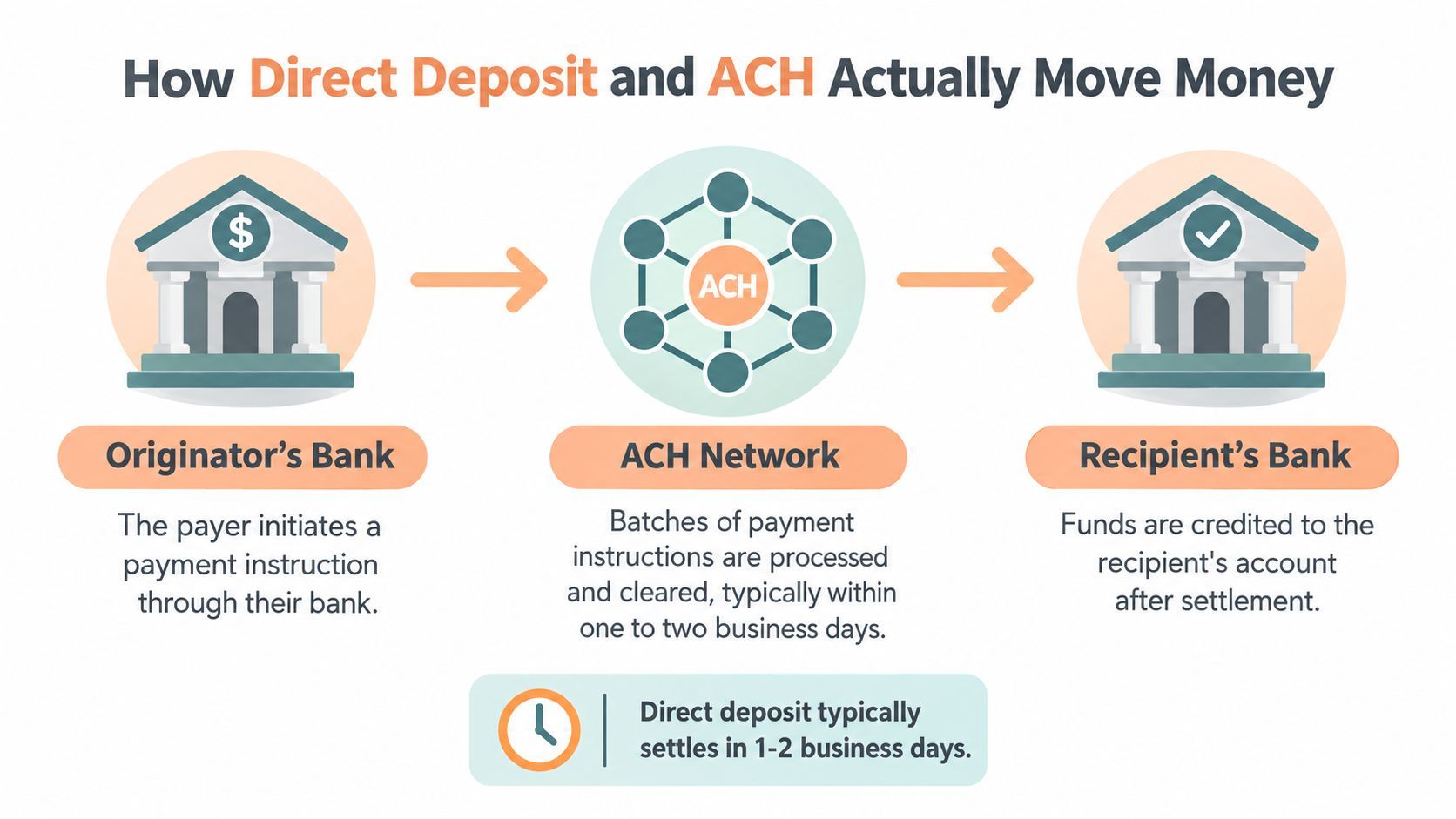
The word settlement describes the movement of funds between the financial institutions involved. It doesn't always mean the recipient sees usable funds at the exact moment the payer initiates a transfer. Standard ACH credits may settle the same day, the next banking day, or in two banking days. Eligible Same Day ACH payments use defined processing windows, so the sender's submission time and bank cutoffs affect whether a payment qualifies.
Nacha reports that roughly 80% of ACH payments settle in one banking day or less, including regular and Same Day ACH. It also says payroll direct deposits are generally available by 9 a.m. local time on payday when submitted under standard operating practices. Nacha's overview of how ACH payments work explains the network's processing and timing. For an operational perspective on why timing can vary, CEFCore's explanation of how Church Extension Funds speed ACH can help readers understand the role of processing steps and schedules.
For product teams, the practical implication is straightforward: don't label a payout “complete” merely because you initiated it. Track meaningful states such as initiated, submitted, settled, and returned. Build schedules around weekends, federal holidays, bank cutoffs, and the possibility of a return. That gives creators and contractors a more honest status than a vague “processing” message, and gives support teams a way to distinguish a pending payment from a failed one.
How Wire Transfers Settle and Why Finality Matters
A wire transfer follows a different settlement model. A U.S. Fedwire payment is processed individually through a real-time gross-settlement system, with funds settling in central-bank money. Once processed, it's immediate, final, and irrevocable through the payment system. That finality makes a wire useful when certainty and speed matter, but it also means the sender needs strong controls before releasing funds.
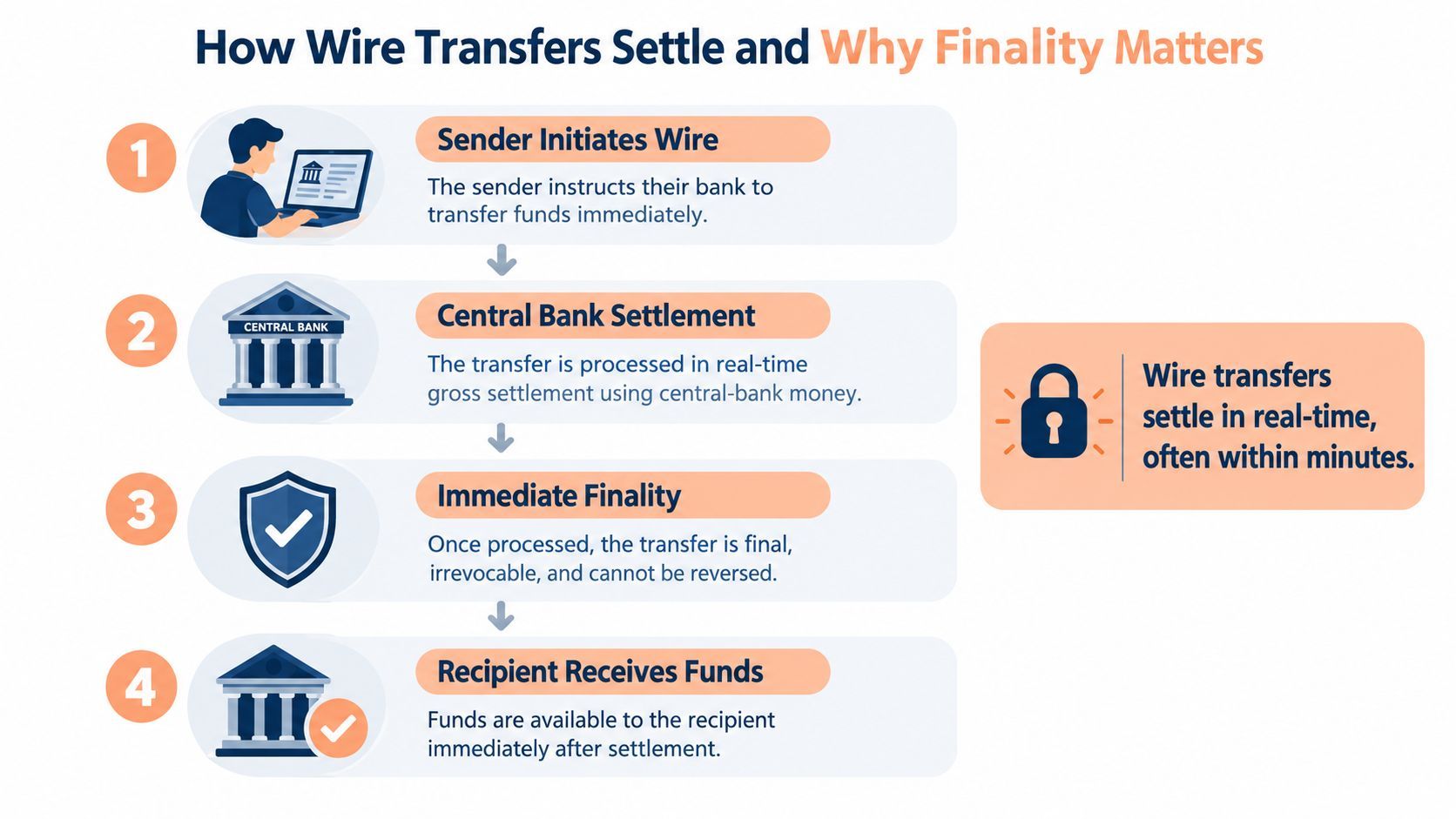
Fedwire operates on business days, excluding designated holidays, with its operating day beginning at 9 p.m. Eastern Time on the preceding calendar day and ending in the evening Eastern Time. That schedule makes cutoff monitoring a real product and operations requirement. A payment submitted too late, held for review, or sent with incorrect beneficiary details may not meet the intended delivery window.
Cross-border wires introduce additional institutions and instructions. SWIFT helps financial institutions exchange payment messages, while correspondent or intermediary banks may help move funds through a route where the sender's and recipient's banks don't have a direct relationship. That routing can affect timing and the amount ultimately delivered. A SWIFT message coordinates instructions, but it shouldn't be confused with the underlying settlement itself.
Fedwire's scale reflects its role in large-value settlement. In 2024, it processed 209,916,835 transfers with an aggregate value of approximately $1,133.4 trillion. The average transfer value was about $5.40 million, although individual transfers vary widely. The Federal Reserve's Fedwire statistics show why wires remain important for institutional and high-value business payments, even when batch ACH is better suited to routine disbursements.
The operational rule is strict: validate the beneficiary, verify changed bank details through a trusted channel, apply approvals, screen for sanctions, and monitor cutoffs before sending. A bank may be able to attempt a recall, but once settlement is final, recovery isn't guaranteed. Use wires when the transaction justifies that risk profile, not because “fast” sounds better.
Direct Deposit Compared to Wire Transfer Across Six Criteria
The choice isn't a contest with one universal winner. Direct deposit is the default for predictable domestic payouts; a wire is the exception for urgency, high value, or settlement finality. The six criteria below make the trade-offs easier to apply.
| Criterion | Direct deposit (ACH) | Wire transfer |
|---|---|---|
| Speed and timing | Batch-based, with settlement affected by processing windows, banking days, and cutoffs | Settles faster when processed during operating hours, subject to bank review and cutoffs |
| Cost | Generally suited to lower-cost, recurring payments | May involve sender, recipient, FX, and intermediary costs |
| Geographic reach | Primarily used for U.S. payments | Supports domestic and cross-border transfers, subject to provider and corridor |
| FX handling | A domestic ACH credit doesn't itself solve foreign-currency delivery | May support cross-border currency delivery, but the all-in conversion cost needs review |
| Security and fraud exposure | Returns can provide a correction path in certain cases, but account details still need validation | Finality increases the consequences of sending to the wrong beneficiary |
| Finality | Can be returned under applicable network rules | Fedwire settlement is final and irrevocable once processed |
Speed: ACH works when the schedule can accommodate batch processing. A wire makes more sense when the recipient needs a time-critical settlement and the transfer can be approved before the bank's cutoff.
Cost and geography: ACH is a practical domestic default, particularly for repeat payments. For international payouts, don't assume that a wire's displayed fee captures the full cost or that ACH is available for the destination. Evaluate the supported corridor and expected delivered amount.
FX and risk: A wire can deliver funds across borders, but the recipient may face currency conversion and deductions along the route. ACH's return possibility can be useful when an operational error needs handling, while wire finality means prevention matters more than recovery.
Decision rule: Use the rail that meets the recipient's delivery requirement at the lowest acceptable all-in cost and risk.
Teams comparing payout options for specific industries can also use this guide to choosing a payout rail as a practical reference. The underlying product decision remains yours: define what “paid” means for your recipient, then choose the rail that can reliably deliver it.
The Real Cost of Each Payout Rail
The price of a payout isn't the fee printed next to the transfer option. For a domestic ACH payment, the sender may see little or no visible fee, but the platform still has to account for payment operations, failed instructions, returns, retries, and support work. A wire may carry an explicit charge, yet its all-in value can still make sense when an urgent, high-value payment avoids a costly delay.
Cross-border payments make the gap between headline price and delivered value especially clear. The global average cost of sending a small cross-border transfer is 6.36% of the amount sent, according to the World Bank data cited in the provided cross-border payments reference. Recent BIS research presented implied FX markups of roughly 200–400 basis points for retail SWIFT wires, before explicit fees. This overview of the hidden costs of cross-border payments highlights why a low advertised transfer fee may not translate into a good recipient outcome.
Build a net-received calculation for each payout route:
- Start with the sent amount. Record the amount and the currency the recipient is meant to receive.
- Subtract sender and recipient charges. Include explicit fees taken from either side.
- Account for the FX spread. Compare the offered exchange rate with the rate used for the transaction, and make the conversion cost visible.
- Include intermediary deductions. Cross-border routes may involve fees deducted before funds reach the recipient.
- Add timing and exception costs. A delayed payout can trigger missed deadlines, support contacts, or extra processing. A returned ACH payment can require investigation and resubmission.
Fixed fees are especially punishing when spread across small recurring payouts. A platform paying modest commissions to many international affiliates should compare the total delivered value of a local-bank route, supported payout partner, and wire option before making one the default. The recipient cares about the amount that arrives, not whether the platform's own transfer fee looked small.
For ACH, manage operational costs by validating account details, monitoring returns, and setting clear payout statuses. For wires, treat bank cutoffs and compliance reviews as part of the delivery estimate. Measure success by net amount received and reliable arrival, not the fee label alone.
Choosing the Right Rail for Common Payout Scenarios
A scheduled commission run and a deadline-driven vendor payment shouldn't share the same default. Software platforms need payout rules that reflect the person being paid, the destination, and the business consequence of delay.
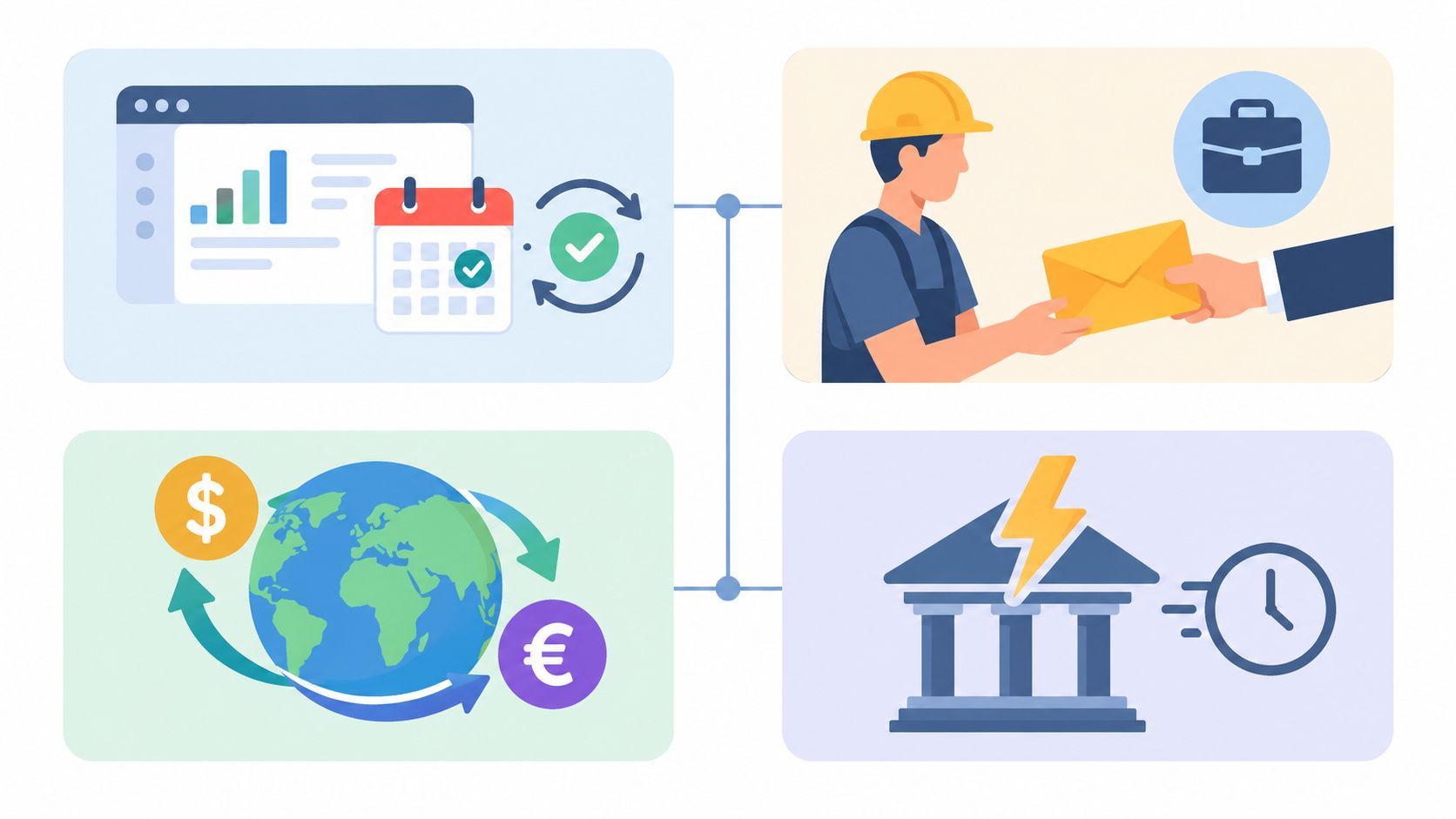
Domestic affiliate commissions: Use scheduled ACH credits when affiliates have verified U.S. bank details and the payment follows a predictable cycle. Keep a clear submitted-versus-settled status and a process for returned payments. Use a wire only when a specific deadline or high-value exception makes the additional control burden worthwhile.
A contractor in another country: Don't treat a domestic ACH setup as a global solution. Confirm the contractor's available receiving methods, payout currency, expected deductions, and delivery timing before choosing a route. Compare the net amount from a wire with any supported local-bank option; escalate to a wire when the corridor or urgency requires it, not by habit.
A vendor invoice with a hard deadline: If a delayed settlement could disrupt a transaction or business operation, a wire may be appropriate. Confirm the beneficiary details directly, require the right approvals, and allow time for bank review and cutoff rules. If the deadline has flexibility, a scheduled lower-cost method may be the better choice.
Recurring revenue shares: Use an automated payout process that can calculate each recipient's share and keep an audit trail. For domestic recipients, ACH is often the natural routine rail. For international recipients, compare the delivered currency and amount before setting a default. This guide to international payment processing for global SaaS provides useful context for designing payouts across countries and currencies.
The lesson from these scenarios is to set a primary rail and an explicit fallback, rather than force every payout through one method. A fallback should have a trigger, such as an unsupported destination, recipient preference, deadline, or payout amount that merits a different settlement profile. That keeps exceptions deliberate and makes the recipient experience easier to explain.
A Practical Decision Framework Before You Approve a Payout
Before approving a payout, make the decision with six checks. If the payment is routine, domestic, and scheduled, choose ACH where available. If it's urgent, high-value, or dependent on final settlement, consider a wire and apply stronger controls.
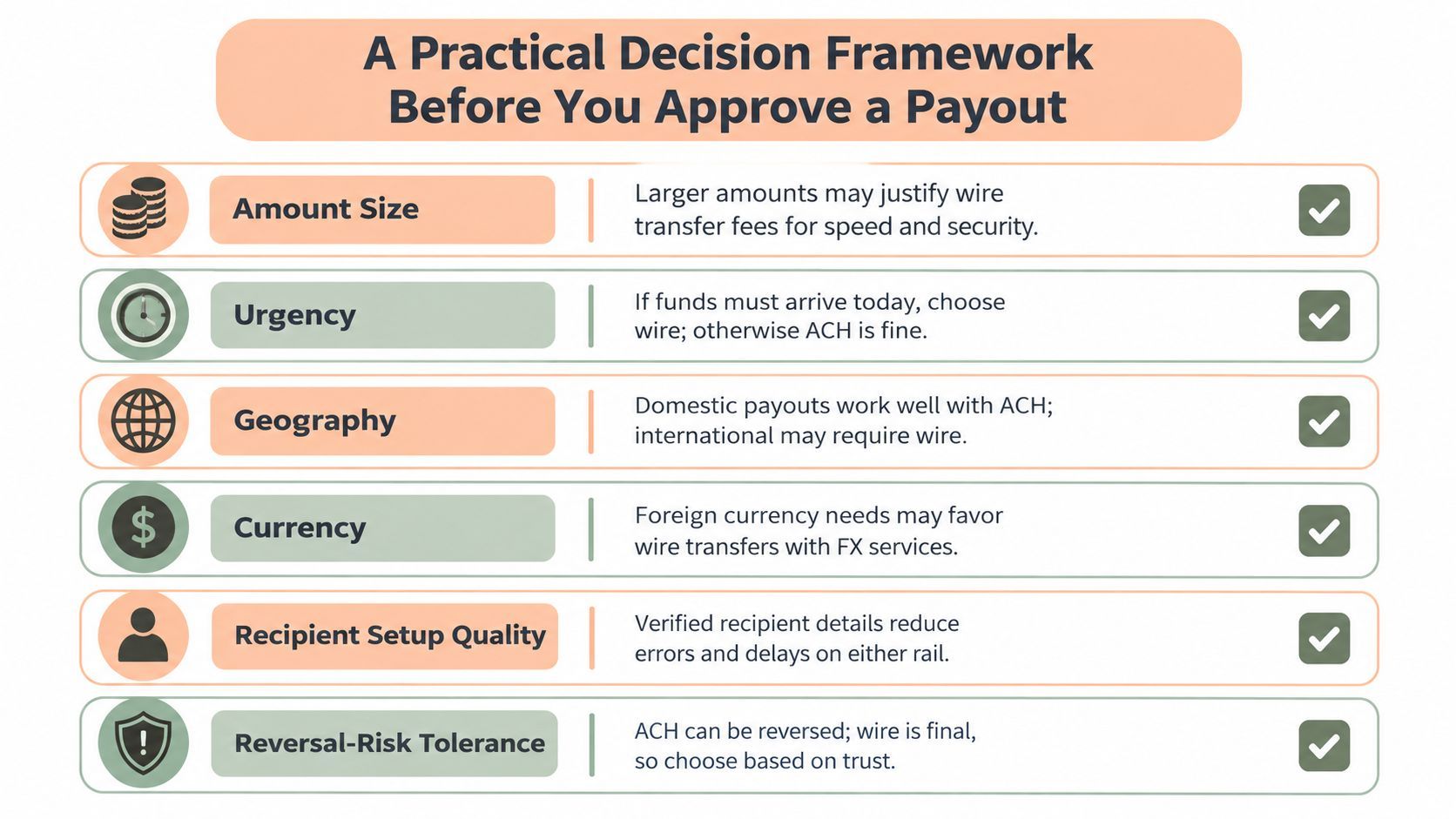
- Amount: Does the value justify the cost and control requirements of a wire?
- Urgency: Can the recipient wait for the planned ACH schedule, including banking days and cutoffs?
- Geography: Is the recipient's account supported by the proposed rail?
- Currency: What currency should arrive, and what deductions or conversion costs may apply?
- Recipient setup: Have the account details been verified and confirmed with the recipient?
- Reversal risk: Can the business tolerate an ACH return, or does the payment require final settlement?
For a platform, this framework belongs in the workflow, not just an internal policy document. Payment management software should make payout schedules, recipient records, statuses, approvals, and exceptions visible together. Teams that need background on contractor classification and payment responsibilities can consult this guide to paying independent contractors. For the operational side, a payment management system can help teams think through how payout processes fit alongside payment tracking and reconciliation.
Pick the rail by delivered value and risk profile, not by headline fee.
A sound setup can use ACH or local-bank methods for routine creator and affiliate payouts, reserving wires for high-value or time-sensitive exceptions. Other payout options may suit particular recipients and corridors, but they still need the same scrutiny: amount received, timing, fees, compliance requirements, and failure handling. If the recipient won't know what they'll receive or when, the payout design isn't finished.
Creem gives software companies and digital product makers a single platform for checkout, subscription billing, affiliate tools, revenue splits, and payouts to bank accounts or USDC wallets. If you're building a payout workflow for creators, affiliates, or contractors, visit Creem to see how its payment and payout tools fit together.