A free trial can produce an 8% median free-to-paid conversion rate, yet the same benchmark found that 20% of products convert below 2.5% across 200 software products. Trial design explains much of that gap. In the same 2026 benchmark, no-credit-card trials typically converted at 4% to 6%, while credit-card-required trials reached 25% to 35% in the good range and 50% to 60% in the great range. ChartMogul's SaaS conversion benchmark makes the central point clear: a free trial isn't a growth strategy by itself. The signup path, activation experience, billing logic, payment recovery, and abuse controls determine whether free access creates revenue or creates cost.
Table of Contents
Why Free Trials Make or Break SaaS Growth
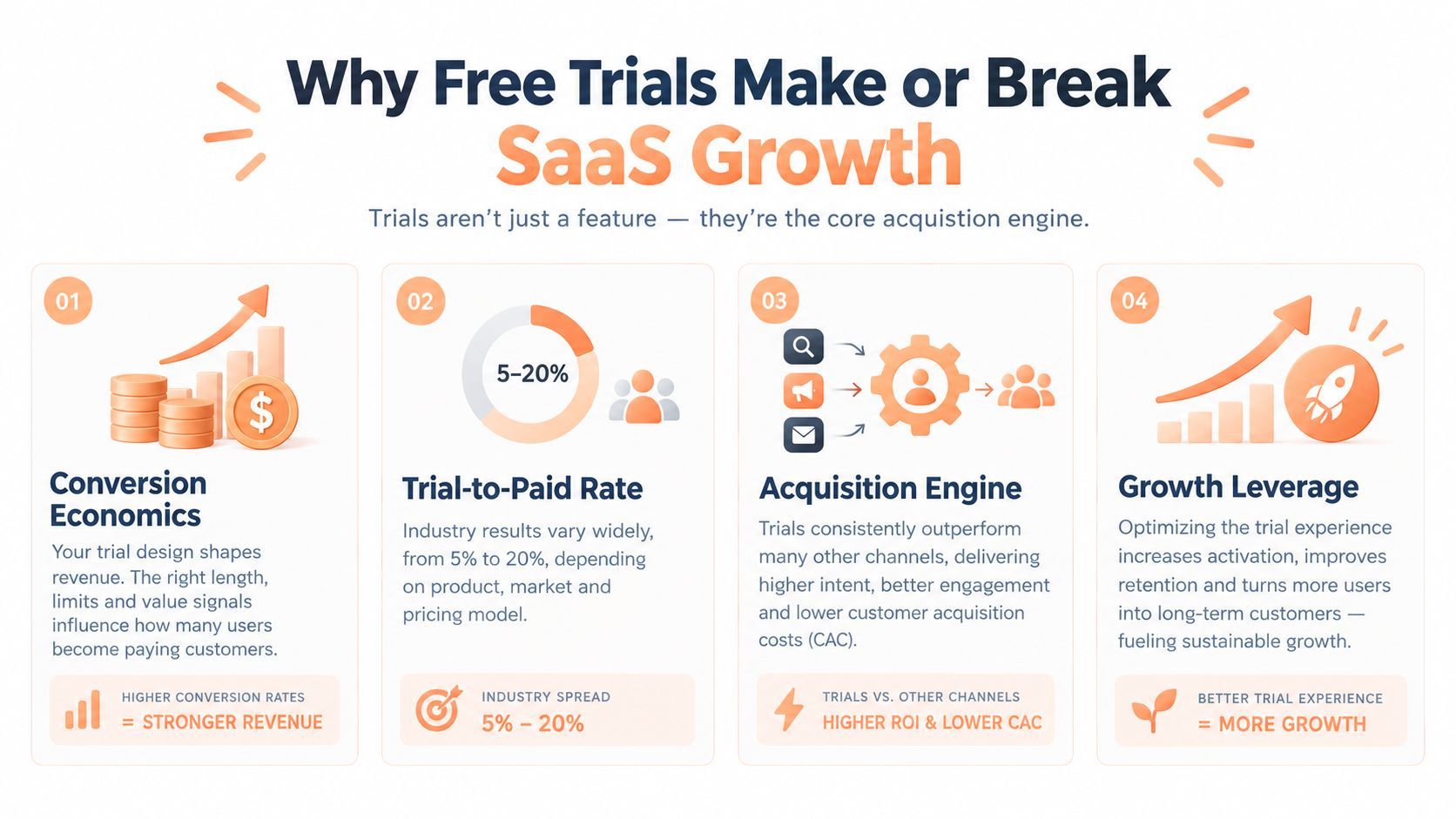
Free trial SaaS sits at the intersection of marketing, product, finance, and risk. A trial lowers the buyer's perceived risk because users can experience the product before committing. For the vendor, however, every trial creates infrastructure usage, support demand, payment-processing work, and a finite opportunity to demonstrate value.
That trade-off is why trial design matters more than the existence of a trial. A no-card flow may attract more exploratory users, but it can also produce low-intent accounts and weak payment commitment. A card-required flow filters harder. It may reduce signup volume, yet the users who complete checkout have shown stronger purchase intent. Independent benchmark coverage from First Page Sage reports an 8% median free-to-paid conversion rate across 200 B2B software products, with card-required trials converting at 30%, more than 5x the rate reported for trials without card details.
The funnel is bigger than trial conversion
Treating trial conversion as one blended percentage hides the decisions that improve performance. A useful operating model separates the journey into distinct stages:
-
Visitor to trial: Does the offer attract the right audience, and does checkout create unnecessary friction?
-
Trial to activation: Does the user complete the core action that reveals product value?
-
Activation to paid: Does the product, price, and buying experience support a payment decision?
-
Paid to retained: Does the customer continue receiving value after the first charge?
A low activation rate points toward onboarding, setup, or product clarity. A healthy activation rate with weak paid conversion may indicate pricing, trust, payment, or packaging problems. Strong trial-to-paid performance followed by failed renewals moves the problem into billing and dunning.
Practical rule: Never optimize a blended trial conversion rate until you know which stage is leaking.
The benchmark spread also explains why general advice can mislead. One industry benchmark places a typical SaaS free trial at about 25%, while another reports that 20% of products fall below 2.5%. Userpilot's benchmark discussion shows that “average” depends heavily on trial structure, product category, onboarding quality, and payment collection. Compare your cohorts against your own activation path before copying another company's headline rate.
A free trial becomes a growth asset when it gives the right user a fast route to a meaningful outcome, charges them predictably, and protects the business from avoidable usage and payment losses. That requires deliberate choices before launch, not a last-minute upgrade email.
Choosing Your Free Trial Model and Length
Start with the customer's buying behavior, not a conventional trial duration. A solo user evaluating a focused tool may reach value quickly and decide alone. A team evaluating workflow software may need setup, collaboration, internal approval, and procurement before anyone can authorize payment.
Compare the models honestly
| Trial Model | Best For | Trade-off to Watch |
|---|---|---|
| No-card opt-in trial | Products that need broad discovery and low signup friction | More low-intent accounts and weaker payment commitment |
| Card-required opt-in trial | Products with meaningful usage costs or a clear purchase path | Fewer signups and higher abandonment at checkout |
| Opt-out trial with payment method | Products where users can reach value quickly and billing terms are easy to understand | Trust, compliance, refund, and failed-payment risk |
| Guided or sales-assisted trial | Complex products with multiple stakeholders or implementation work | More operational effort and slower self-serve acquisition |
The contrast is substantial. A benchmark summary reports no-card opt-in trials around 8.9% to 18.5%, while card-required trials are reported around 30% to 31.4%. The 1Capture comparison of free-trial benchmarks also frames the decision correctly: higher conversion must be weighed against signup friction, fraud exposure, and compliance responsibilities.
For products with expensive computation, storage, or API usage, collect payment details earlier or restrict costly actions until the account demonstrates legitimate intent. For products that depend on virality, collaboration, or a large top-of-funnel audience, a no-card flow may be more rational. Don't force a card because it improves the ratio if it removes the audience your growth model needs.
Set length from time to value
Trial length should cover the path from signup to the first meaningful outcome, plus enough room for the buying process. Map the actions required to reach activation:
-
Create or import the first meaningful asset.
-
Invite the relevant collaborator or connect the required integration.
-
Complete the core workflow.
-
See a result the user can evaluate or share internally.
If that path takes several sessions, a very short trial creates artificial failure. If the product delivers value in the first session, a long window may encourage procrastination. The right duration is the shortest period that gives a qualified user a fair chance to activate and decide.
Test one variable at a time. Keep the onboarding, pricing page, and billing terms stable while comparing trial windows. Segment results by acquisition source, role, product tier, and activation status, because a longer window can help complex accounts while delaying a decision for already-activated users. Teams evaluating the wider free trial versus freemium decision should also ask whether the product needs a deadline at all. Freemium works better when habit, collaboration, or network effects need time to develop.
Setting Up Billing Proration and Checkout the Right Way
A trial should never be treated as a disconnected product experiment. Billing events must be designed before the first user signs up, including what happens when someone upgrades, changes seats, switches plans, or reaches the trial end without a usable payment method.
Build the checkout path first
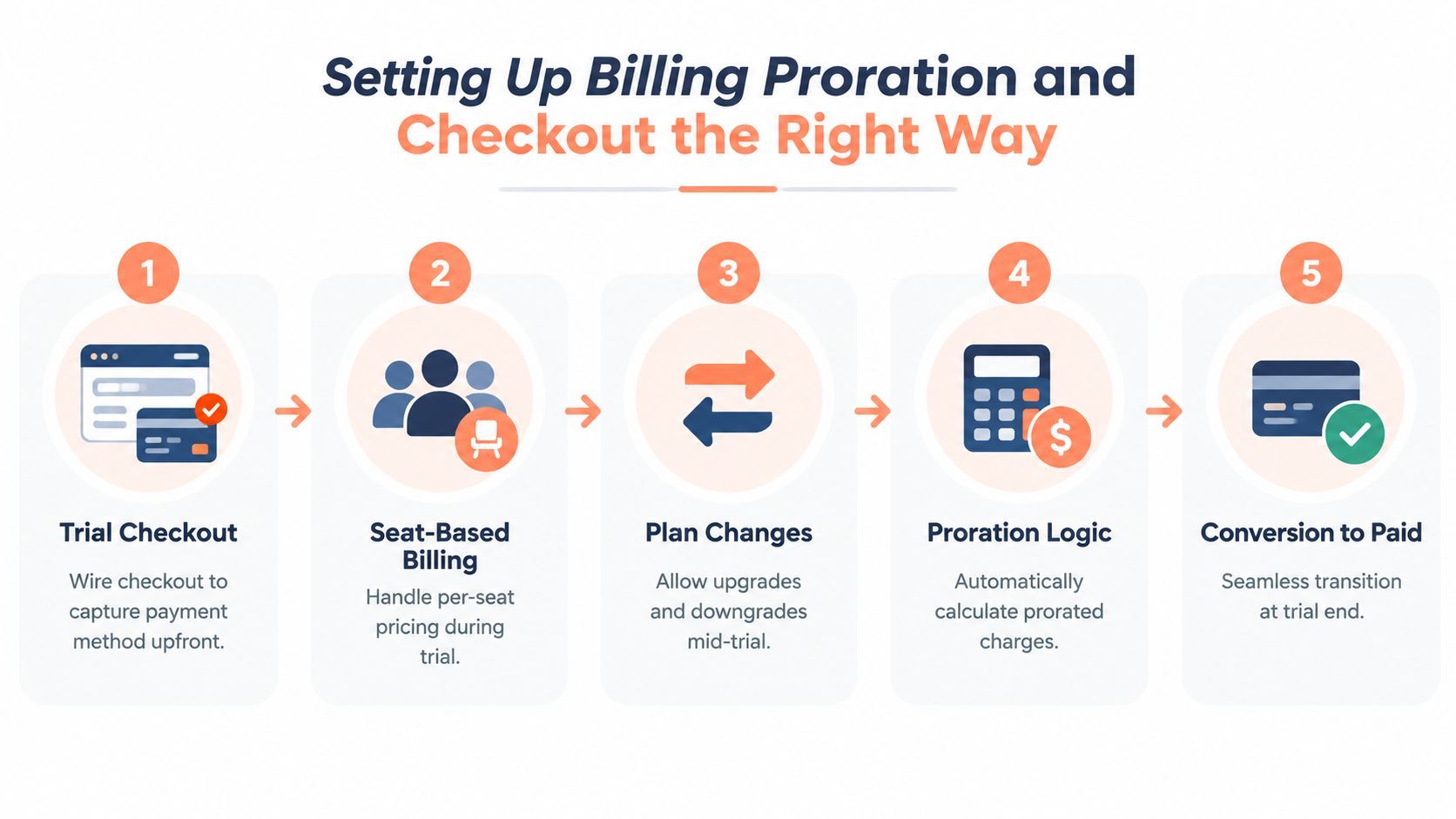
For a card-required trial, store a payment method through a compliant payment provider rather than handling sensitive card data in your application. Show the exact trial end condition, the first charge timing, the selected plan, usage assumptions, taxes, cancellation path, and receipt behavior before the user submits checkout.
For a no-card trial, define the conversion event explicitly. The user should see a clear upgrade path, a plan comparison, accepted payment methods, and the consequences of continuing or stopping. Don't let an expired trial leave the account in an ambiguous state. Choose whether access pauses, falls back to a limited plan, or requires payment before the user can continue.
A Merchant of Record can simplify cross-border tax collection, invoicing, and remittance when you sell globally. For teams comparing implementation approaches, billing for SaaS is a useful reference for separating subscription logic from tax and payment operations. A platform such as their billing feature can also be evaluated when you need subscription handling and customer billing workflows without building every administrative layer yourself.
Make seat and plan changes predictable
Seat-based products create billing questions during the trial. Decide whether new seats are free during evaluation, whether a minimum seat count applies, and whether the paid subscription bills the current seat total or the original selection. State the rule inside the product and in the checkout summary.
A practical implementation handles these events independently:
-
Mid-trial upgrade: Move the account to the new entitlement immediately, preserve the original trial end date unless your policy says otherwise, and record the plan change.
-
Mid-trial downgrade: Keep access to already-created data while applying the lower plan's limits at the defined effective time.
-
Seat increase: Update entitlements first, then calculate the paid quantity according to the agreed billing period.
-
Trial conversion: Create the subscription only once, attach the intended payment method, and emit a reliable webhook for internal provisioning.
Proration should be deterministic. If a customer changes from a lower-priced plan to a higher-priced plan after billing begins, the system should calculate the unused portion of the old plan and the remaining portion of the new plan according to your billing provider's rules. Show the result before confirmation whenever the customer can be charged immediately.
Finally, add a self-service portal for invoices, payment methods, cancellations, plan changes, and seat management. Automate receipts and internal webhook alerts so your support team isn't forced to reconcile every trial manually.
Turning Trial Users Into Paying Customers
A trial user doesn't convert because they logged in. They convert after completing a workflow that makes the product's value concrete.

Consider a project-management product. A new user who creates an account but never creates a project has learned almost nothing. A user who creates a project, invites a teammate, assigns work, and sees a completed workflow has evidence that the tool fits their operating model. Onboarding should guide the second journey, not celebrate the first login.
Design around the activation action
Start with one activation milestone for each important persona. An agency may need to create a client workspace and produce a report. A developer tool may need a successful integration and first deployment. An analytics product may need a connected data source and a useful dashboard.
Use the first screen to ask only questions that improve the route. Role, team size, primary goal, or existing workflow can support meaningful segmentation. Then personalize the checklist, empty states, examples, and prompts around the answer. A generic tour that points at every feature often overwhelms users before they've completed the one action that matters.
A strong onboarding sequence usually combines:
-
A focused checklist: Show the few actions that lead to the first useful outcome.
-
Helpful empty states: Explain what the user can create and why it matters.
-
In-app guidance: Trigger prompts when the user reaches a relevant screen, not at an arbitrary time.
-
Behavior-based email: Send setup help after inactivity or a friction event, rather than sending the same message to everyone.
-
Human assistance: Offer a demo or support route to accounts showing strong intent but stalled progress.
The customer analytics guide for retention and revenue can help teams connect product behavior with commercial outcomes instead of treating onboarding activity as a vanity metric.
Users don't need to understand the whole product during a trial. They need to complete the smallest workflow that proves the product belongs in their routine.
Use reminders to reduce uncertainty
Trial reminders should answer practical questions. Tell users when access changes, what they've already accomplished, what remains unfinished, and what payment or plan action is required. Avoid manufactured urgency. A user who hasn't connected a required integration needs an instruction and a reason, not another generic “your trial is ending” message.
Paywall prompts should appear at a logical boundary. If a user tries to export a report, add a team member, or use a costly feature, explain the plan limit and show the next step. Don't interrupt the first exploration before the user has seen enough value to understand the upgrade.
Here's a simple journey to instrument:
-
Signup: capture the job to be done and acquisition context.
-
First session: guide the user toward the core action.
-
Activation: confirm the outcome with an in-app success state.
-
Evaluation: show relevant advanced features and proof of fit.
-
Decision: present clear pricing, billing terms, and support.
-
Conversion: confirm the subscription and preserve the user's setup.
The best lifecycle messaging follows behavior. A dormant account needs reactivation. An activated account needs a clear reason to upgrade. A team that has invited colleagues may need collaboration limits explained. Treat those groups differently, and your messages will feel like product assistance rather than campaign noise.
Preventing Churn With Dunning Analytics and Abuse Controls
Trial conversion doesn't end when a user clicks upgrade. Payment failures, expired cards, disputed charges, accidental cancellations, and abusive accounts can all turn apparently healthy acquisition into uncollected revenue and avoidable cost.
Treat payment recovery as part of retention
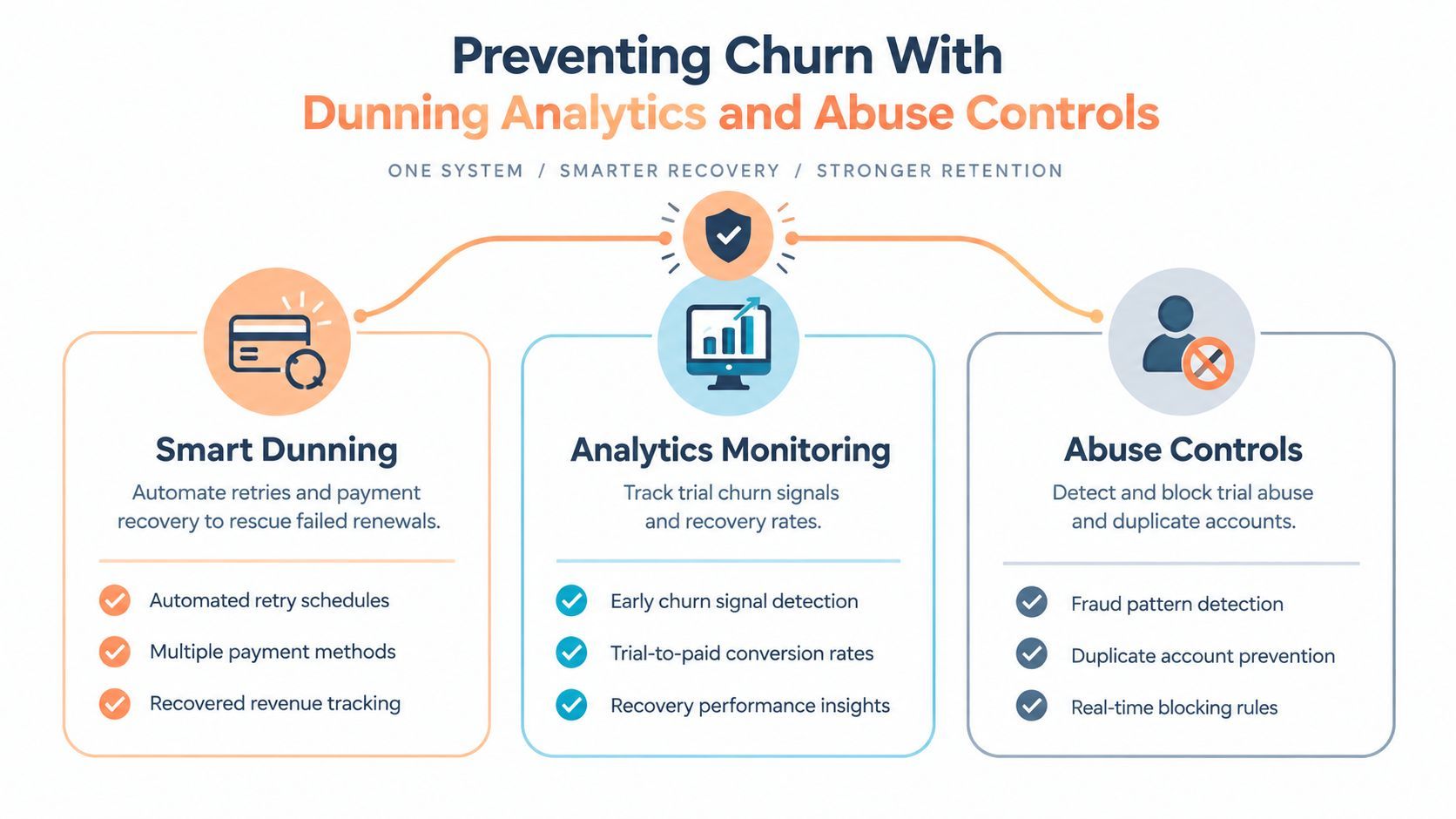
Configure automatic retries according to the payment provider's recovery capabilities, then notify the customer with a useful message. The message should identify the failed payment, explain how to update the method, preserve access where appropriate, and provide a direct billing-management link.
Track recovery separately from voluntary cancellation. A customer who wants the product but encounters a failed payment is a different retention problem from a customer who never reached activation. Your dashboard should distinguish failed initial charges, failed renewals, customer-requested cancellations, involuntary churn, refunds, and disputes.
A sensible dunning flow also includes an internal alert before access is suspended. Customer success can contact high-value or highly activated accounts, while low-engagement accounts can follow an automated recovery path. Don't make support guess what happened from a vague “subscription inactive” status.
Stop trial farming without punishing good users
Free-trial abuse behaves more like fraud than ordinary churn. Recent coverage of Stripe's models reported 6.2x more abusive free trials from November 2025 to February 2026 than in the same period a year earlier, and reported that more than 1 in 6 signups at AI companies were linked to multi-account abuse. The coverage of free-trial abuse in SaaS is especially relevant for products with expensive AI, compute, or usage-based features.
Look for combinations of signals rather than one blunt rule:
-
Device overlap: Multiple accounts repeatedly originate from the same device or browser pattern.
-
Infrastructure repetition: Signups share unusual network, automation, or environment characteristics.
-
Identity cycling: A user repeatedly changes email identities while reproducing the same behavior.
-
Instant high-cost usage: New accounts jump directly to expensive features without normal exploration.
-
Trial farming patterns: Accounts consume free resources, disappear, and return through a new identity.
Use graduated controls. Ask for additional verification when risk rises, cap expensive actions for suspicious accounts, and send high-confidence abuse cases to review. A blanket block on shared devices can punish legitimate teams, schools, offices, or families.
Monitor the stages separately
Your operational dashboard should show visitor to trial, trial to activation, activation to paid, failed-payment recovery, refund activity, and abuse review outcomes. This lets the team distinguish a weak promise from weak onboarding, a billing defect from voluntary churn, and genuine non-conversion from repeated free-resource extraction.
Your Free Trial Launch Checklist and Next Steps
A reliable free trial is a coordinated system, not a pricing-page toggle. Before launch, make each decision explicit:
-
Choose the entry model: Decide whether signup volume, payment intent, product usage cost, or fraud exposure matters most.
-
Define activation: Name the core user action that proves value for each major persona.
-
Set the trial window: Give users enough time to complete the activation path and make a buying decision.
-
Publish billing terms: Show the end date, first charge, taxes, plan limits, seat rules, cancellation path, and receipt behavior.
-
Wire lifecycle events: Track signup, activation, upgrade, downgrade, payment success, payment failure, cancellation, and expiration.
-
Test plan changes: Verify seats, entitlements, proration, refunds, and webhook handling before real customers depend on them.
-
Add recovery flows: Configure payment retries, customer notifications, billing self-service, and internal alerts.
-
Protect costly usage: Add rate limits, verification, monitoring, and review paths for suspicious trial behavior.
-
Review cohorts: Compare acquisition source, persona, plan, activation status, and payment outcome instead of relying on one blended rate.
Run experiments with discipline. Change one major variable at a time, preserve a clear control group, and judge results by downstream paid and retained behavior rather than signup volume alone. A new flow that produces more accounts but fewer activated users may increase infrastructure and support costs without improving the business.
Revisit friction when evidence changes. If legitimate users abandon checkout before seeing value, reduce the fields or move payment collection later. If trial farming consumes costly resources, strengthen verification around high-risk actions. If activated users fail to pay, inspect pricing clarity, billing reliability, payment methods, and the upgrade experience before shortening the trial.
The strongest free trial SaaS programs keep the loop tight: attract a qualified user, guide them to value, charge transparently, recover preventable failures, and block abuse proportionately. Ship the simplest version that protects those stages, then improve it with cohort evidence.
Creem provides hosted checkout, free-trial and subscription tooling, seat-based billing, proration, customer self-service, automatic invoices and receipts, smart dunning, and Merchant of Record support for tax collection and remittance. Visit Creem to evaluate whether one payments integration can cover the billing, compliance, and trial operations your SaaS product needs.