

Table of Contents
- Beyond the Hype Affiliate Marketing for Digital Products
- Finding and Vetting the Right Affiliate Programs
- Crafting an Application That Gets Approved
- Your First Steps Inside the Creem Affiliate Dashboard
- Understanding Commissions Payouts and Performance
- Conclusion Turning Your Partnership into a Revenue Stream
You've published useful content, built an audience, and recommended software you personally use. Yet paid ads keep getting more expensive, social platforms demand constant attention, and your own product revenue depends too heavily on launches. Learning how to join an affiliate program can add another revenue stream, but only if you understand the operational details behind approval, tracking, recurring commissions, payouts, and compliance.
For software creators, affiliate marketing isn't just placing a retail product link in a blog post. It's a partner channel that connects your audience with relevant digital products while giving merchants a measurable way to acquire customers. The right program can become a durable part of your business. The wrong one can create tracking disputes, weak conversions, tax paperwork, and an audience that no longer trusts your recommendations.
Beyond the Hype Affiliate Marketing for Digital Products
A software creator may turn to affiliate marketing after paid acquisition becomes harder to control, social content consumes the workday, and organic traffic takes time to compound. Readers, subscribers, or customers may already ask which tools you use. Affiliate partnerships make those recommendations trackable, but clicks alone do not create revenue. Approval, attribution, conversion, refunds, recurring commissions, tax handling, and payouts determine whether the channel works.
Affiliate marketing is now a substantial channel for software companies and digital creators. The global affiliate market was valued at 18.44 billion in 2025 and projected to reach 20.07 billion in 2026, according to Wix's affiliate marketing statistics overview. For a software business, that scale supports established operating processes, including applications, referral tracking, commission rules, approval workflows, and payout schedules.
Digital products also have a different cost structure from physical retail. Software can serve customers globally without inventory, shipping, or warehouse coordination. Subscriptions can generate recurring commission opportunities, while plugins and downloads can be delivered automatically. The trade-off is operational: global sales can create tax and compliance obligations, and recurring payouts require accurate cancellation, refund, and renewal tracking. Audience fit, conversion quality, and program terms still decide the outcome.
Practical rule: Treat affiliate marketing as a performance channel, not passive income. Earnings depend on the recommendation's relevance and the merchant's ability to convert and retain customers.
A report cited by affiliate marketing statistics from Marketing LTB states that 74% of brands generate 11% to 30% of total revenue from affiliate marketing. The figure does not promise easy earnings for a smaller publisher. It does show why software makers should assess affiliates as one part of customer acquisition, with clear tracking, compliant disclosures, reliable payouts, and support for recurring revenue.
The practical test is simple: can you recommend the product with enough relevance and credibility that your audience will act? For digital product creators, the answer also depends on whether the program can handle international customers, subscription changes, and automated payouts without creating avoidable administrative work. Choose the program around those requirements, not its headline commission.
Finding and Vetting the Right Affiliate Programs
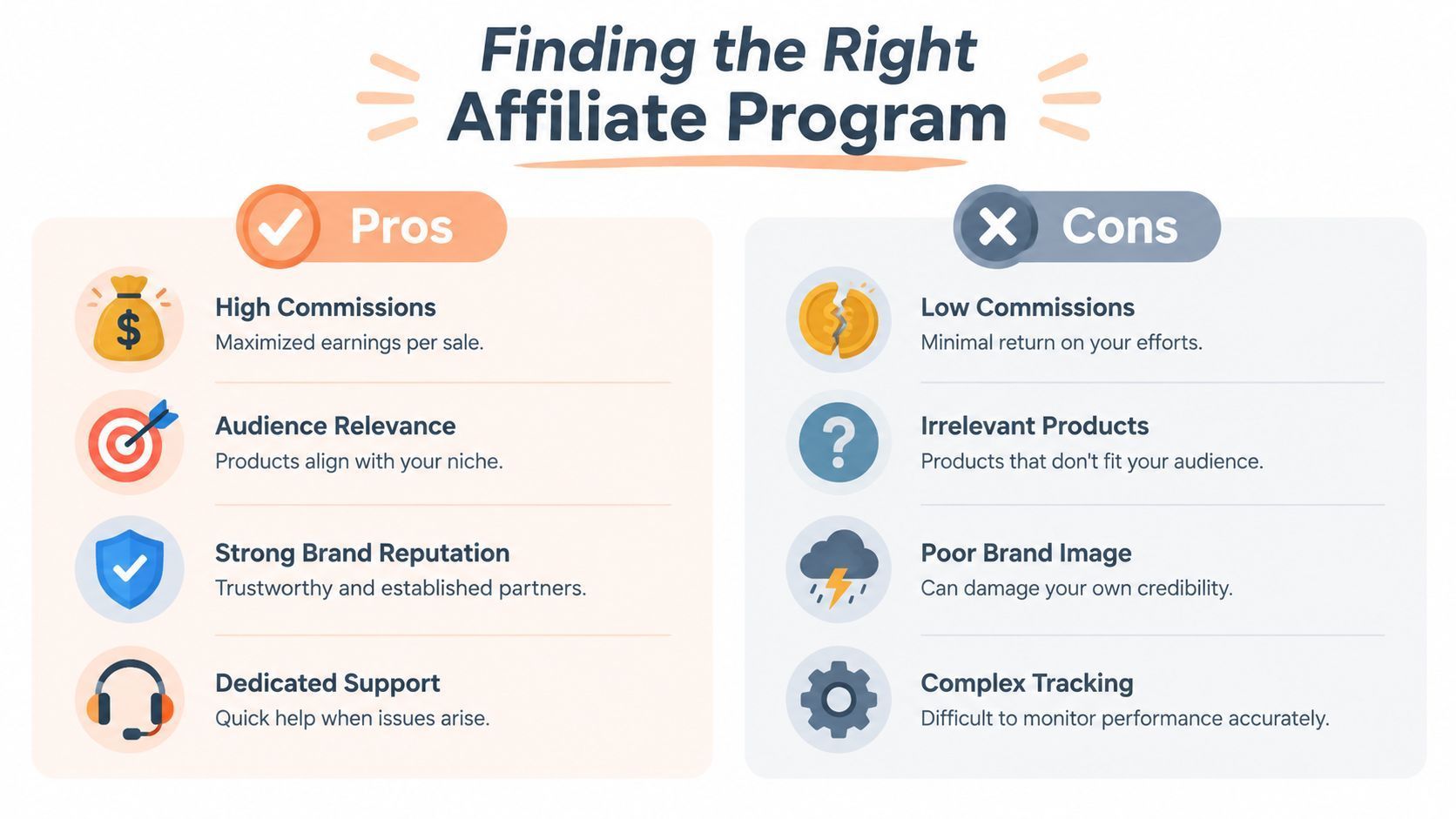
A large program can look attractive in a search result, yet still create problems for a software creator. Brand recognition does not guarantee useful commission terms, responsive support, accurate tracking, or a product your audience needs. A smaller in-house program may provide direct access to the merchant and clearer product context. A large affiliate network can offer broader discovery and a standardized interface, but program quality and support may vary.
Use this comparison before applying:
| Option | Advantages | Trade-offs |
|---|---|---|
| In-house program | Direct communication, focused product knowledge, and potentially clearer partnership expectations | Fewer products and less standardized reporting |
| Large affiliate network | Broad catalog, familiar application process, and centralized discovery | More competition, less personal support, and varying program quality |
| Creator-led partnership | Strong audience alignment and room for specific content | Requires more negotiation and careful documentation |
Evaluate the offer, not just the headline commission
For software, the commission percentage is only one part of the commercial model. Review how the program handles recurring subscriptions, upgrades, cancellations, refunds, trials, and renewals. Recurring commission can outperform a one-time payment, but only when the terms state how long it continues and which customer actions qualify.
Cookie duration affects attribution too. A tracking cookie records the referral after someone uses your link. If that visitor waits before buying, the cookie duration determines whether the later purchase is still credited to you. This matters more for software with trials, internal approval, or technical evaluation, because those steps lengthen the buying process.
Choose a product you can explain accurately. A poor recommendation can weaken audience trust, especially when the tool creates friction, lacks expected features, or has confusing billing. Review the merchant's support process, documentation, cancellation policy, and public reputation before attaching your name to the offer.
Watch for operational red flags
Avoid programs with vague commission language, unclear attribution rules, missing payout information, or no practical compliance guidance. You need to know when commissions become payable, how refunds change earnings, and where the dashboard records conversions. Without those details, revenue forecasts become unreliable and disputes take longer to resolve.
Program approval also varies by applicant quality. Shopify's affiliate marketing statistics coverage cites 2026 applicant-fit benchmarks estimating that brand-new applicants with no proof may see 5% to 18% approval, while creators with niche content and social proof can reach higher ranges. Treat selection as a two-way review. You assess the merchant's terms and operating capacity, while the merchant assesses whether your audience and promotional approach are credible.
For software creators comparing options, this guide to SaaS affiliate programs explains differences between subscription products, commission structures, and partner expectations. Check whether the program can support recurring revenue, international customers, and automated payouts before you commit.
Crafting an Application That Gets Approved
A strong affiliate application answers one question for the program manager: why should this person be trusted with our product and brand? Follower count may appear on the form, but it's rarely the whole case. A smaller audience with clear product relevance can be more useful than a broad audience that has no reason to buy the software.
Start with your platform and audience. Name the channels you'll use, such as a tutorial site, newsletter, YouTube channel, podcast, developer community, or product comparison library. Then describe who reads or watches your content and what problem they're trying to solve. “I create content for independent developers choosing subscription tools” gives a manager more useful context than “I post about technology.”

Build your trust case
Include evidence that you create useful content consistently and disclose commercial relationships responsibly. You don't need to inflate your reach. Show the quality of your work through relevant articles, product walkthroughs, comparison pages, demos, or educational videos.
A practical application can cover:
- Audience fit: Explain the buyer problem your audience already has and why the product belongs in that conversation.
- Promotion plan: Name the content formats you'll create, such as an implementation tutorial, product comparison, onboarding walkthrough, or newsletter recommendation.
- Content quality: Link to representative work that demonstrates clear explanations and responsible recommendations.
- Commercial transparency: State that you'll disclose affiliate relationships and follow the program's brand and advertising rules.
- Customer intent: Describe whether your audience is researching, comparing, implementing, or already paying for similar software.
If you're new, publish a small body of relevant content before submitting applications to selective programs. A program manager can't evaluate intent from an empty profile, but they can evaluate a focused resource that demonstrates product understanding. You can also outline your launch plan, including the first topics you'll cover and the audience problem each one addresses.
A useful application is a partnership proposal in miniature. It shows who you reach, what you'll publish, and why the merchant's product fits naturally.
Don't promise guaranteed sales or use language that makes the program sound like a shortcut. Managers want partners who understand that conversions come from relevance, education, and trust. If you're rejected, treat the decision as feedback about missing proof, weak fit, or an incomplete promotion plan. Improve the application rather than applying everywhere with the same generic paragraph.
Your First Steps Inside the Creem Affiliate Dashboard
After approval, don't rush straight to publishing links. Spend a few minutes learning where the program stores your referral URL, reporting, commission status, and payout information. A dashboard is useful only when you know which screen answers each operational question.
Complete the setup before promotion
Start by signing in with the email associated with your invitation or affiliate account. Review the program details before accepting them, paying particular attention to qualifying transactions, commission timing, refund treatment, prohibited promotion methods, and any disclosure requirements.
Then locate your unique referral link. Copy it into a test document and inspect the destination before publishing. The link should lead to the intended product or landing page, and you should understand whether the program provides separate links for different products or campaigns.
A basic setup checklist keeps small errors from becoming attribution problems:
- Confirm your profile: Use accurate identity and payout information so the merchant can process approved commissions.
- Read the terms: Identify what counts as a conversion and which marketing channels the program allows.
- Test the destination: Open the referral URL, check the landing page, and verify that the tracking parameter remains present.
- Choose one content asset: Begin with a useful tutorial, review, or comparison rather than scattering links across unrelated pages.
- Record the publication date: Keep a simple internal log of where each referral link appears.
You'll typically use reporting to separate clicks, conversions, pending commissions, approved commissions, and paid commissions. Don't treat clicks as revenue. A click indicates interest, while a conversion indicates that the merchant recorded a qualifying action under the program's rules. Pending commissions may later change because of refunds, cancellations, validation checks, or the program's approval process.
Creem's integrated approach places affiliate tooling alongside payments and subscription operations, which can reduce the number of systems a software business must reconcile. Its referral tracking system guide provides additional context on how referral events, attribution, and partner reporting fit together.
The onboarding experience affects whether partners become active. Industry benchmarking defines activation as generating at least one conversion within 30 days, and reports about 5–15% activation for programs without structured onboarding compared with 25–40% for programs with strong onboarding, as described by Referral Rocket's affiliate onboarding benchmarks. As an affiliate, you can't redesign the merchant's onboarding, but you can create your own version by testing the link, understanding the offer, and publishing a focused first asset.
Watch the walkthrough after you've reviewed the dashboard so the interface has practical context.
Understanding Commissions Payouts and Performance
A referral link answers only one part of the affiliate equation. To understand whether a program is worth your time, you need to know how attribution works, when commissions become valid, and when money reaches you.
Attribution is the process of assigning a conversion to a referral source. In a last-click model, the most recent eligible affiliate interaction receives credit. Other programs may use different rules, so read the terms rather than assuming that your link will receive credit whenever a buyer eventually purchases.
Cookie duration works like a time window. The buyer clicks your link, leaves to think about the purchase, and returns later. If the program's tracking window is still open and no other rule overrides your referral, the conversion may be attributed to you. If the window closes first, the sale may not qualify. This is why a product's buying cycle and the program's tracking rules must match.
Read SaaS commission terms closely
Software programs need more detail than a simple “commission per sale” label. Confirm whether the program pays on:
- Initial subscriptions: The first successful payment may qualify after the transaction passes validation.
- Recurring billing: Some programs continue commissions while the referred customer remains subscribed, while others pay only once.
- Upgrades and expansions: A customer who moves to a higher plan may or may not create additional commission.
- Trials and refunds: A trial may not count until payment succeeds, and a refunded transaction may reverse or remove the commission.
- Partner referrals: Some programs distinguish customer referrals from referrals that bring new affiliates into the program.
A dashboard should let you connect your activity to commercial outcomes. Review which content generated clicks, which pages produced conversions, and where visitors stopped moving forward. If a tutorial attracts clicks but no purchases, the issue may be audience intent, page positioning, product fit, or an unclear call to action. More links won't fix a weak match.
Payout mechanics affect cash flow. Check the minimum payout threshold, payment schedule, supported currencies, payout method, identity verification process, and any tax documentation requirements. For international creators, bank transfers may involve conversion or transfer friction, while a platform that supports bank accounts or USDC wallets can offer another payment route. Confirm the specific terms available to you before relying on any payout method.
Global compliance also matters. Affiliate income can create reporting obligations in your jurisdiction, and the merchant's tax handling may not cover your own income reporting. Keep records of commissions, invoices, payout confirmations, refunds, and business expenses. For software companies managing several revenue recipients, automated revenue splits without spreadsheets illustrates why automated allocation and reconciliation can matter as partner activity grows.
Time-to-first-conversion is a useful operational signal. Benchmarking reports that strong programs reach a first affiliate conversion in under 10 days, while weak programs often take 30 or more days, with slow approval, missing assets, and vague commission terms among the cited failure points, according to Track360's partner engagement benchmarking. Use that benchmark as a diagnostic, not a promise. Your audience, product category, content quality, and merchant funnel still determine the outcome.
Conclusion Turning Your Partnership into a Revenue Stream
Joining an affiliate program starts a working relationship, not a form submission. Choose a product that solves a real problem for your audience, review recurring commissions and refund rules, and show clear trust signals in your application. After approval, test the referral link and confirm how the dashboard records clicks, conversions, pending commissions, and paid earnings.
Software creators also need to assess the operating model behind each partnership. Subscription renewals, global customers, tax responsibilities, revenue sharing, and partner payouts can create recurring administration when separate tools handle each task. An integrated merchant-of-record and payments platform can bring checkout, subscriptions, tax handling, affiliate tracking, and automated payouts together. Confirm the exact terms and responsibilities that still apply to your business.
The affiliate channel is an established acquisition route, and U.S. advertisers are projected to spend billions on it in 2026, with continued year-over-year growth. That market activity does not guarantee effortless income. It supports building a disciplined partner process around products you can recommend with confidence.
Start with one well-matched program and one useful piece of content. Track the full path from referral click to approved payout. Then adjust the message, placement, or partner selection according to the results.
Creem combines checkout, subscription billing, affiliate tracking, revenue splits, automated payouts, and global tax compliance for software and digital product businesses. Visit Creem to assess whether a single platform can reduce partner administration and support a more manageable affiliate revenue workflow.