

You can feel a referral program is working before you can prove it. Sales calls get warmer, customer intros sound more trusted, and partners start sending traffic that looks better than cold ads. Then you open the dashboard and hit the core problem, lots of clicks, a pile of signups, and no clean answer to the question that matters most, which referrals turned into paying customers.
That gap is why a referral tracking system exists. It's not there to decorate a dashboard with vanity numbers. It's there to connect the invitation, the click, the signup, the purchase, the payout, and the return on investment into one chain you can trust.
Table of Contents
- Why Tracking Referrals Is Harder Than It Looks
- Why off-the-shelf tracking often breaks
- What a Referral Tracking System Does
- The moving parts in plain language
- The words that keep teams aligned
- The Five Features That Separate Real Systems From Link Shorteners
- What separates the serious stack
- Under the Hood of Event-Driven Attribution
- Why reward state needs its own lifecycle
- Scaling without making the user wait
- How to Choose the Right Referral Tracking System
- What to prioritize first
- Integrating the System With Your Stack
- What happens when money moves back
- Your Referral Tracking Checklist Before You Launch
Why Tracking Referrals Is Harder Than It Looks
A SaaS founder usually notices the problem after the program is already live. The dashboard shows thousands of clicks, a handful of signups, and maybe a few trial starts, but nobody can say which referral produced revenue. That's the moment the gap becomes obvious, sending referral links is not the same thing as running a referral program.
The hard part is time. A referral doesn't always convert in the same session, or even the same week. Someone gets a link, saves it, comes back later, signs up on a different device, then upgrades after a demo. Standard marketing analytics can count sessions and conversions, but referral attribution has to follow the breadcrumb trail across delay, retries, and human forgetfulness.
Recurring revenue makes it messier. A software business doesn't just need to know who bought once, it needs to know who stayed, who churned, who qualified for a commission, and when a reward is safe to pay. That's why guidance for referral metrics focuses on the full funnel, including referral rate, conversion rate, cost per acquisition, customer lifetime value, and time to convert rather than a single click count. A system built for durable growth has to connect those numbers to real revenue outcomes, not just site traffic, as described in the referral metrics guidance from Referral Rock.
Why off-the-shelf tracking often breaks
A generic campaign tracker usually treats every touchpoint like a one-off event. Referral programs need more than that, because the same person can click twice, sign up later, or trigger a webhook that fires again after a network retry. If your setup can't distinguish a real conversion from a duplicate event, you'll pay out twice and trust your reporting less each week.
Practical rule: if a system can count clicks but can't explain who gets credit after a delayed purchase, it's tracking traffic, not referrals.
That's why founders move beyond a simple link shortener. They need attribution they can defend in front of finance, operations, and partners, especially when the program starts touching subscriptions and commissions.
What a Referral Tracking System Does
A referral tracking system works like postal mail with accountability. One person sends the envelope, another person receives it, and the system keeps the address label, the delivery trail, and the receipt when something valuable arrives. The point is not just to move a link around. It is to preserve the connection between who referred whom, how they were referred, and what happened next.
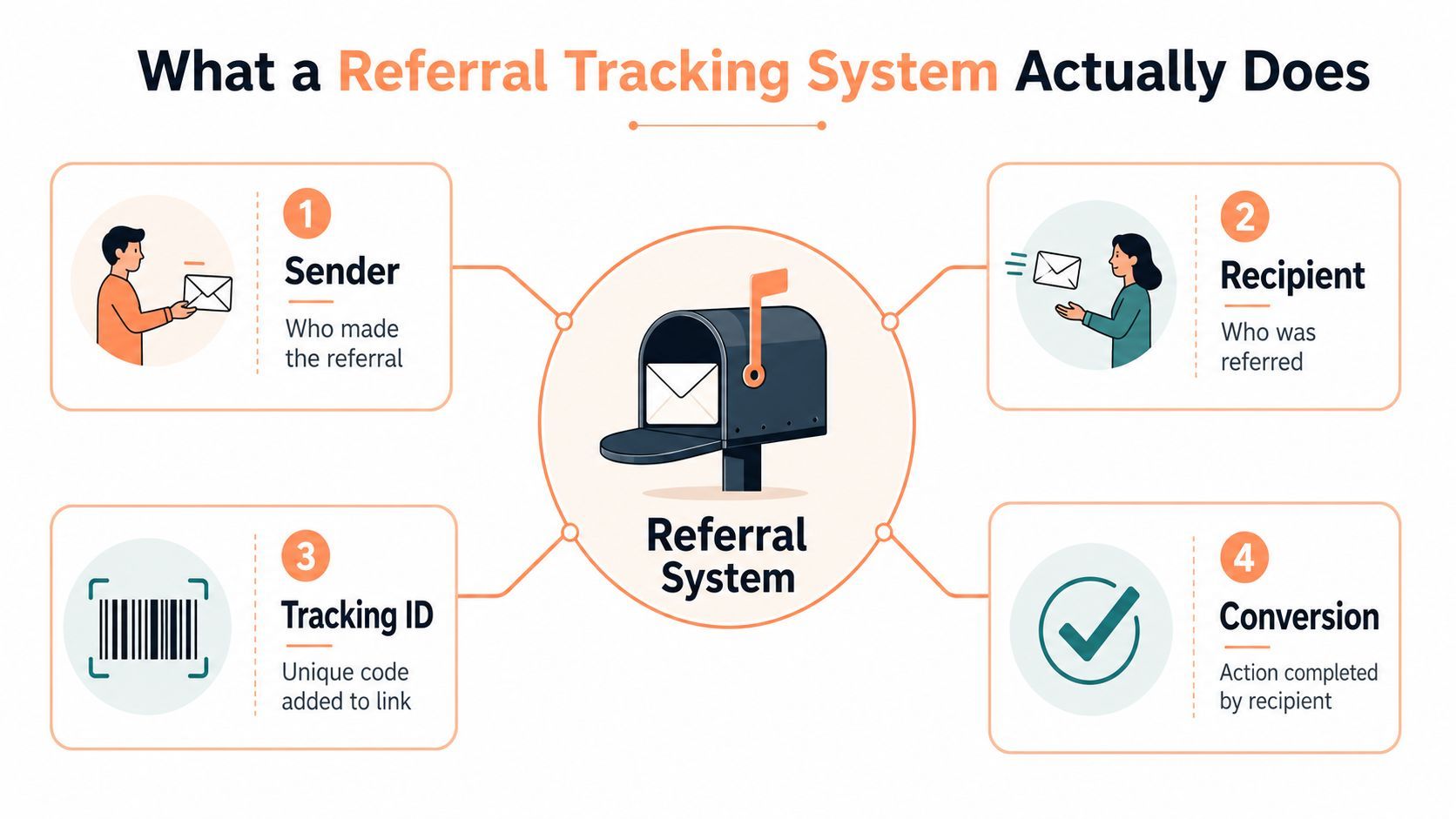
At the simplest level, the system records four things. It identifies the sender, the recipient, the tracking ID, and the conversion. The sender is the person or partner who made the referral, the recipient is the person who was referred, the tracking ID is the unique breadcrumb in the link or code, and the conversion is the completed action that proves value.
The moving parts in plain language
A clean way to frame it is this, the referral link is the envelope, the tracking window is how long you are willing to wait for the letter to be opened, and the payout rules decide when the stamp gets reimbursed. That is why a real system needs both attribution and reward logic. One captures the event, the other decides whether that event deserves a payout.
For example, if a referred visitor clicks today and purchases later, the system needs to know whether that later purchase still belongs to the original referrer. It also needs to know whether the same purchase was already counted through another path, such as a direct visit or a delayed webhook. A fragile setup sees only the last event. A production-grade setup stores the chain of events and resolves the credit rule before anyone gets paid.
Referral tracking, affiliate tracking, and partner programs often get blended together, but the operations differ. Affiliate programs usually rely on broader publisher relationships and commission rules, while referral programs often center on customer sharing, friend-to-friend invites, or product-led advocacy. A partner program may involve custom terms, higher-touch agreements, and more complex revenue sharing, which changes the accounting and payout flow.
For a software team, the practical question is not what label to use. It is whether the system can hold the full chain together, from click to reward, without losing attribution in the middle. For a broader SaaS-oriented framing of program structure, Creem's SaaS affiliate programs guide connects the terms to operating models you can compare against your own setup.
The words that keep teams aligned
When product, growth, and finance teams use the same vocabulary, the vendor demo gets much easier. You can ask about attribution windows, payout timing, conversion matching, and dashboard visibility without talking past each other. That shared language matters more than any one feature name.
A referral tracking system also gives each team a different answer from the same event stream. Growth wants to know which referrer drove the sign-up. Finance wants to know whether the conversion is eligible for payout. Operations wants to know whether the record can survive retries, duplicates, and delayed updates without creating a messy ledger.
That separation is what keeps the dashboard honest. Clicks, sign-ups, purchases, and payout states all need to stay linked, but they should not be treated as the same thing. Once those pieces are tracked separately, you can evaluate any vendor or in-house build with a clearer view of what it will support.
The Five Features That Separate Real Systems From Link Shorteners
A link shortener can send someone to a page. A production-grade referral tracking system has to do much more. It needs to survive retries, assign credit correctly, support payouts, and show the business whether the program is producing durable revenue, not just noisy activity.
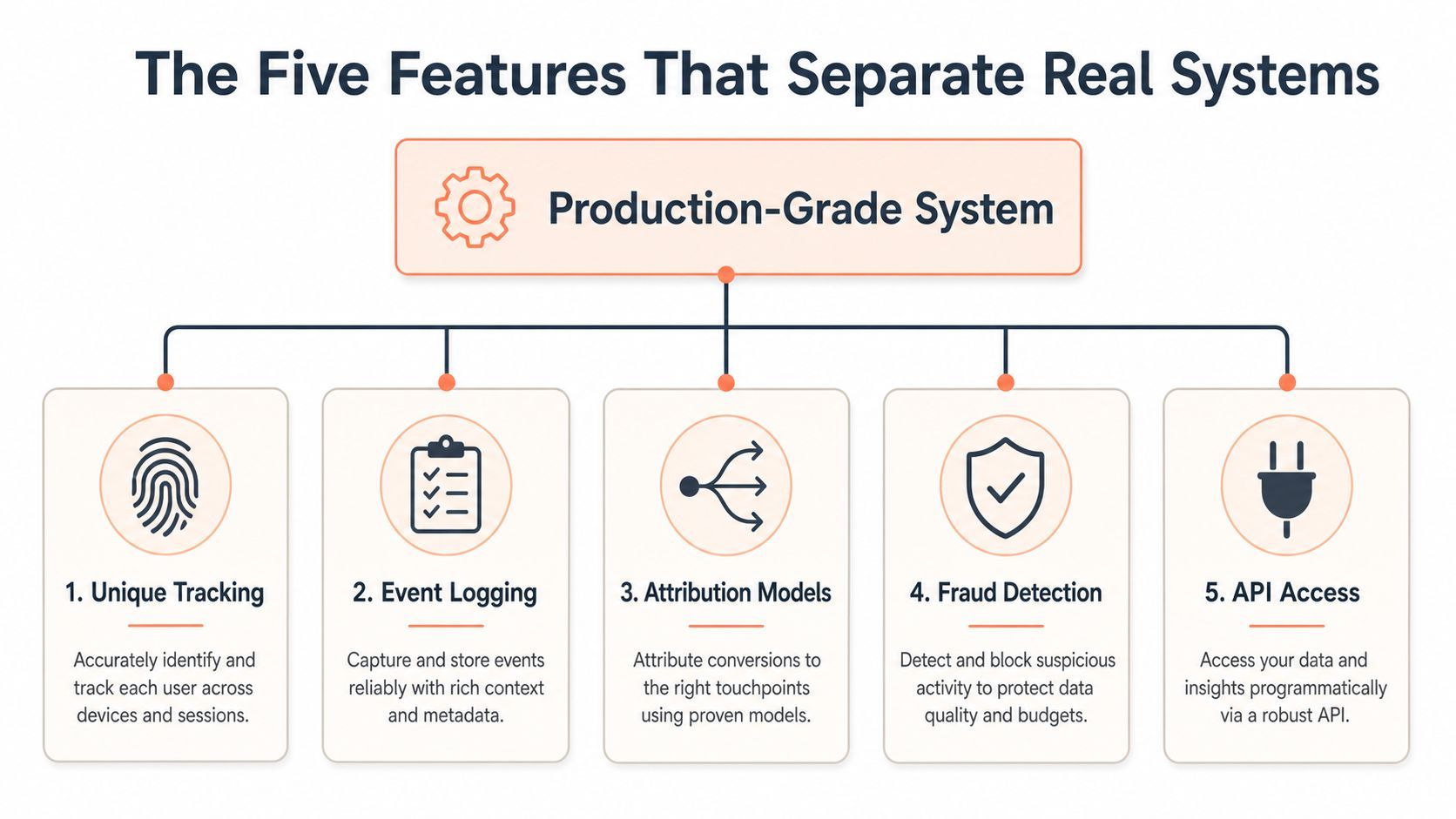
The first feature is unique tracking. Every referrer needs a distinct link or code, otherwise you can't tell who sent whom. The second is event logging, because the system has to record clicks, signups, purchases, and payout states instead of only the final conversion. The third is attribution models, since referral programs often need a rule for which touchpoint gets credit and for how long.
What separates the serious stack
The fourth feature is fraud detection. That's not a nice-to-have, it's the difference between a clean commission ledger and a payout system that can be gamed. The fifth is API access, which lets the referral layer talk to your billing, CRM, and analytics stack without a manual export dance every week.
Benchmarks from recent referral-program research give these features business context. A 2025 SaaS benchmark set reports a 4.75% average referral rate, 5% to 15% program join rates for startups, 25% to 35% share rates at growth-stage companies, and 8% to 12% referral success rates for high-growth startups, all from PreFiinery's 2025 metrics guide. The same source says referred customers can deliver 37% higher retention and 18% lower churn, and top SaaS companies may derive 15% to 30% of revenue from referrals. Those numbers explain why the features above aren't cosmetic, they affect how much of the funnel turns into lasting revenue.
A useful way to evaluate a system is to ask whether it can handle the boring parts cleanly. Does it know which click belongs to which user. Can it preserve open referrals until resolution. Can it show time-to-convert without manual spreadsheet work. Can it support recurring subscriptions and commission accounting without breaking the reward chain.
A dashboard is only useful when the event trail underneath it is clean.
That's the line that separates a system built for demos from one built for real revenue.
Under the Hood of Event-Driven Attribution
A referral flow can look correct on the dashboard and still be wrong underneath. A browser retries a signup, a webhook fires twice, or a queue replays a message after a timeout. If each replay is treated as a new action, the system records extra conversions and sends out payouts that were never earned.
The fix begins with server-side, idempotent event writes. Each event should carry a unique external_event_id, and the database should enforce a uniqueness rule such as (source_system, external_event_id). That lets the same real-world action arrive more than once without being credited more than once. The system captures the signal once, then rejects duplicates at the persistence layer, which is where attribution has to stay trustworthy.

Why reward state needs its own lifecycle
Raw attribution and payment eligibility should live in separate tracks. The usual reward lifecycle is pending → approved → paid. Pending means the system saw a qualifying event but has not cleared it for payout. Approved means the event passed the checks. Paid means money or credit has already moved.
That separation keeps finance from paying too early. It also makes audits easier, because the system can show why a reward is sitting in a given state. In the architecture guidance from Koder's referral tracking system article, immutable referral events are paired with a canonical event bus so reward checks and payout issuance stay separate from capture.
Scaling without making the user wait
At higher volume, referral systems are often built around cryptographically secure referral IDs, event-driven processing, and high-write distributed storage such as Cassandra or DynamoDB. The pattern is straightforward, generate the referral token on the server, place it in the link or deep link, write the click immediately to persistent storage, then publish the event to Kafka or RabbitMQ for asynchronous validation and reward processing. That keeps the product fast for users while attribution finishes in the background, a pattern described in Zigpoll's scalable referral tracking design.
One more detail matters here. A dedicated ReferralClick table indexed by (code, clicked_at DESC) and a separate ReferralConversion table keyed to a unique referee make fraud checks and lag analysis much easier. You cannot do clean partner reporting if the same user appears in three places with three different meanings.
A production setup also needs a dependable handoff from the event layer to the rest of the app. That is where a webhook pipeline comes in, and a practical reference is this guide to webhook site architecture. For teams that also need to compare referral attribution with broader funnel measurement, the conversion setup for growth teams provides a useful adjacent frame.
How to Choose the Right Referral Tracking System
The right choice usually comes down to failure prevention, not feature bragging. A slick dashboard won't help if attribution breaks on retries, or if subscriptions confuse the payout logic, or if finance can't reconcile commissions with the ledger. That's why the evaluation should focus on the part of the system that keeps your numbers believable.
| Selection Criterion | Why It Matters | Key Vendor Question |
| --- | --- | --- |
| Attribution model flexibility | Different referral motions need different credit rules | Can we define how and when credit is assigned? |
| Fraud and abuse controls | Prevents self-referrals, duplicates, and payout abuse | What checks run before a reward becomes payable? |
| Subscription support | Recurring billing changes when commission becomes due | How do you handle renewals, upgrades, and cancellations? |
| Payout rails and currency handling | Finance needs reliable, traceable disbursement | Which payout methods and currencies do you support? |
| Developer experience | Product teams need clean integration points | What do your SDKs, webhooks, and APIs expose? |
What to prioritize first
If you're a SaaS business, attribution correctness and payout reliability should outrank dashboard polish. A system can have beautiful charts and still mis-credit conversions. It can also look fine in the demo and fail the moment a refund, chargeback, or webhook retry shows up.
The best vendor conversations are blunt. Ask how they deduplicate events. Ask how they treat refunded purchases. Ask whether open referrals can remain unresolved until the billing system confirms payment. If they can't answer those questions clearly, the product is probably built for marketing display, not operational trust.
For a practical walk-through of conversion instrumentation, the conversion setup for growth teams guide is a helpful reference point because it frames the tracking problem from the action side, not just the traffic side. If you're comparing hosted tools and want to see how webhooks fit into the larger flow, Creem's webhook guide is a useful companion.
Selection rule: if attribution and payout logic are weak, no amount of reporting polish will save the program.
One option in this category is Creem, which combines payments, subscriptions, and affiliate tooling in the same platform, so the referral layer sits closer to billing and payout operations. That matters when you want fewer handoffs between finance and growth.
Integrating the System With Your Stack
A real rollout starts with a link and ends with an accounting entry. The flow usually begins when your product generates a referral link, the click lands on your site or checkout, and the tracking layer writes the event before anything else tries to interpret it. From there, the signup or purchase gets matched to the click, a webhook fires into billing or CRM, and the reward is queued for the right state.
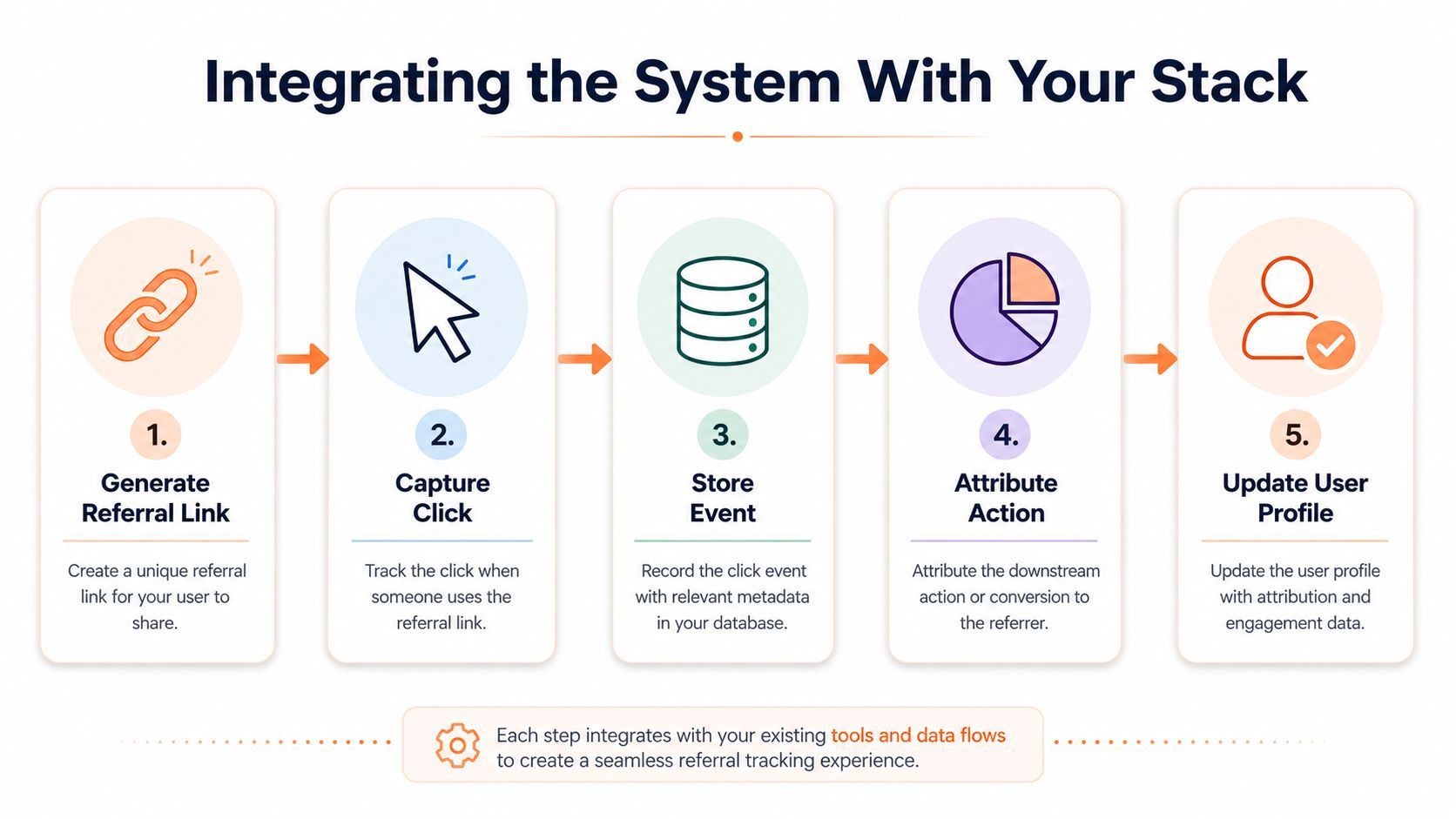
That sounds clean on paper, but the integration work lives in the edges. Hosted checkout is usually easier to instrument than an embedded flow because the billing platform already owns more of the purchase lifecycle. Embedded flows give you more control, but they also force you to think harder about retries, timing, and the moment a purchase becomes eligible for commission.
What happens when money moves back
Refunds, chargebacks, and cancellations have to reverse or void commissions. If they don't, the reward ledger becomes fiction. A good system treats those billing outcomes as first-class events, not as after-the-fact spreadsheet edits.
Webhook reliability becomes a product requirement, not just an engineering concern. If your billing platform emits a payment event and your referral layer misses it, the payout queue and the source of truth drift apart. Teams that care about integrations often compare webhook behavior alongside messaging platform integrations because the same operational discipline applies, event delivery has to be dependable, retryable, and visible.
The flow is also where finance and growth finally share the same language. The growth team sees who referred the customer. Finance sees whether the payment cleared, whether the commission is pending, and whether the reward should stay open until a refund window closes. If your stack can't show those states together, your reporting will always feel one step behind reality.
Don't wire the reward first and ask questions later. Wire the billing event first, then let payout follow proof.
That's the difference between a referral program that feels exciting and one that survives the first month of real usage.
Your Referral Tracking Checklist Before You Launch
Before you launch, ask five hard questions. Does the system assign credit correctly across delayed conversions. Does it deduplicate retries with a real event ID and uniqueness rule. Does it use a clear reward state machine, not a single fragile “paid” flag. Does it have fraud controls that catch obvious abuse before payout. Does it integrate cleanly with your billing, CRM, and analytics stack.
If any answer is vague, the launch is too early. A referral program doesn't become trustworthy because the dashboard looks polished. It becomes trustworthy when every durable event can be traced, matched, approved, and paid without guesswork.
For teams trying to keep rev-share and commissions out of spreadsheet chaos, Creem's revenue splits guide is a useful companion because it shows how payout logic and shared revenue can live in a more structured system. If you're also using automation or scraping-based internal tools to verify program data, the LLM Scrape API from Context.dev can help teams pull structured information into their workflow without turning the process into manual copy-paste.
The core test is simple. If you can't trust the numbers, you can't trust the referrals.
Creem gives software teams a single place to handle checkout, subscriptions, affiliate tracking, and automated payouts, which makes referral logic easier to connect to actual revenue. If you're building a referral-driven growth motion and want the billing side to stay aligned with attribution, visit Creem and see how the pieces fit together.