
Your template, plugin or SaaS app is ready, and now you need somewhere for buyers to pay, once or every month. Payhip and Gumroad are the two names that keep coming up.
At first it looks like a fee comparison. Then sales grow, buyers arrive from more countries, and the fee, the tax work and the payout timing all shift with them.
Getting it wrong costs real money. A monthly plan can eat into your quiet months. A lower cut can leave you filing VAT returns yourself. The platform that costs least at $500 a month is not the one that costs least at $10,000. Below, we work out what each one costs at your volume and who files the tax on your sales.
If selling software abroad is leaving you with VAT returns to file, Creem becomes the legal seller for 3.9% + 40¢ per successful sale, so you can try Creem and let us handle those returns.
TL;DR
- Pick Payhip if you want a full store around your catalog and will pay a monthly plan to buy a lower cut on each sale.
- Choose Gumroad if you want a hosted product page where the platform processes the payment and sends the payout.
Your monthly sales decide whether a paid Payhip plan is worth the charge. It pays for itself once the savings on each order cover the monthly fee.
Below that point, Payhip's free plan costs less. Check your row at $500, $2,000 or $10,000 a month in the pricing section before comparing headline rates.
For software subscriptions sold to buyers in many countries, tax responsibility matters as much as the fee. Check whose name is on the buyer's invoice and whether the platform handles tax on your actual sales or leaves you with registrations and filings.
If the platform is not the legal seller for those sales, registrations and filings stay with you. A merchant of record collects, files and remits VAT, GST and sales tax on the sales it covers, so those registrations stay off your desk.
The core difference: your payment account or theirs
When you sell a template to a buyer abroad, the payment goes through an account, and someone has to charge the applicable VAT or sales tax and file it. Owning that account does not, by itself, decide who carries the tax responsibility.
Payhip acts as a marketplace facilitator for US sales tax and a digital platform operator in Canada, and it reports and remits digital EU and UK VAT as your reseller. That covers those markets, but it does not make Payhip the legal seller worldwide.
For buyers elsewhere, VAT or GST registrations and filings can stay with you, so removing that work means choosing a platform that becomes the legal seller for those sales.
Gumroad is a merchant of record, so it sells to the buyer on your behalf and includes transaction-tax handling in its fee. A lower percentage elsewhere may leave more of that work with you.
Creem works the same way as the legal seller. It collects and remits VAT, GST and sales tax for buyers in 190+ countries, so you do not register or file for those sales.
I would factor Payhip's tax coverage into the decision for a catalog sold mainly in the US, Canada, the EU and the UK. For a worldwide catalog, I would check that tax coverage matches where the buyers are before choosing on price.
Payhip and Gumroad side by side
| Terms | Payhip | Gumroad |
|---|---|---|
| Monthly plan and cut per sale | $0/month plan + 5%. Plus: $29/month + 2%. Pro: $99/month + 0% | $0/month. Direct sales: 10% + $0.50 |
| Payment processing | Stripe or PayPal fees on top | Card processing (2.9% + $0.30) or PayPal fees on top of direct sales |
| Who handles sales tax and VAT | Digital EU/UK VAT, plus US and Canadian sales tax | Merchant of record |
| Digital downloads | Yes | Yes |
| Recurring memberships | Yes | Yes |
| Affiliate tools | Yes | Yes |
Payhip Pro still costs $99 a month plus processing. I would weigh that fixed bill against your quieter months, when fewer orders mean less in percentage savings to cover the plan.
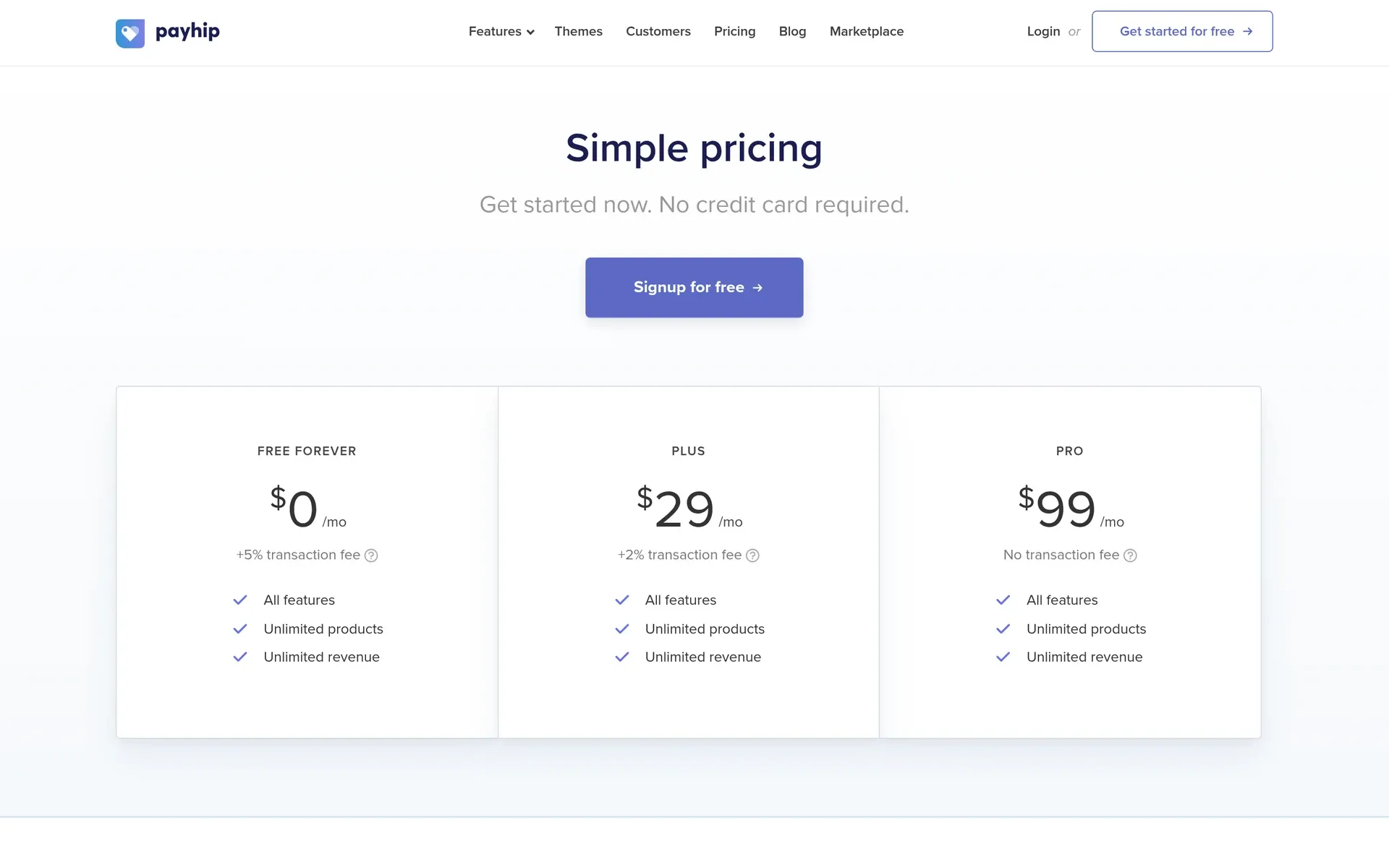
Payhip pricing page: Free Forever $0/mo +5% transaction fee, Plus $29/mo +2%, and Pro $99/mo with no transaction fee
1. Payhip
For a template or plugin catalog, Payhip gives you a customizable store, with paid plans that bring its cut of each sale down to 2% on Plus or zero on Pro.
Here is what the same $100 sale leaves after Payhip's platform fee, excluding Stripe or PayPal processing charges, taxes and refunds:
- Free Forever leaves $95, with no monthly charge.
- Plus leaves $98, with a $29 monthly charge.
- Pro leaves $100, with a $99 monthly charge.
The per-sale savings need to cover the monthly bill before a paid tier leaves you with more. I would stay on Free Forever while sales are unpredictable, because a paid tier commits you to a bill before you know next month's orders.
You need your first sale before the marketplace can help. Listing requires at least $10 USD in qualifying sales, then an account review and approval of each product. Self-purchases do not count, so bring your own buyers before counting on marketplace discovery.
Check anything borderline in your catalog before building your store around it. Payhip's prohibited-products list does not name every banned item, and selling prohibited products can lead to permanent account deletion without warning.
Payhip suits small digital-product sellers who want a store and expect steady enough sales to cover a paid tier. If that fits, open the store on the tier your typical month supports and move up when the per-sale savings cover the plan.
2. Gumroad
Gumroad homepage: “Go from 0 to $1” headline, Start selling button, marketplace search, and pink G coins
Gumroad gives you a hosted page for a download or recurring membership without a monthly plan to choose. It handles the payment and sends you the payout.
On a $100 direct sale, Gumroad's 10% + $0.50 fee takes $10.50, leaving $89.50 before any other charges. That cut applies to each sale, and there is no paid plan to reduce it as there is with Payhip's tiers.
Gumroad pricing page: “Simple, transparent pricing” heading on a yellow background with illustrated coins
While monthly sales are small and unpredictable, I would value not having a fixed platform bill to cover. Once sales settle into a steady pattern, that matters less and the amount going to transaction fees matters more.
Gumroad suits creators who want hosted pages for downloads or memberships and accept an ongoing cut of each sale in return for platform-managed payments. If that fits, launch one product page first and check what the flat cut takes at your actual order value.
Pricing: what you actually pay
Payhip Free Forever has the lowest platform charge at $500/month, Plus at $2,000 and Pro at $10,000. Gumroad direct sales cost more in platform fees than the cheapest Payhip tier at each volume, but that fee also covers its role as the legal seller.
| Platform or plan | $500/month | $2,000/month | $10,000/month |
|---|---|---|---|
| Payhip Free Forever | $25 | $100 | $500 |
| Payhip Plus | $39 | $69 | $229 |
| Payhip Pro | $99 | $99 | $99 |
| Gumroad direct sales | $60 | $240 | $1,200 |
| Gumroad Discover sales | $150 | $600 | $3,000 |
The figures use USD sales excluding tax, a $25 average order value and 20/80/400 orders. Direct sales use 10% + $0.50/order, and all figures exclude processing, conversion, payout charges and refunds.
Discover's 30% applies when buyers find you through Gumroad's marketplace, and it includes processing. Payhip and Gumroad direct sales both add card processing on top, and Payhip's tax coverage differs from Gumroad's.
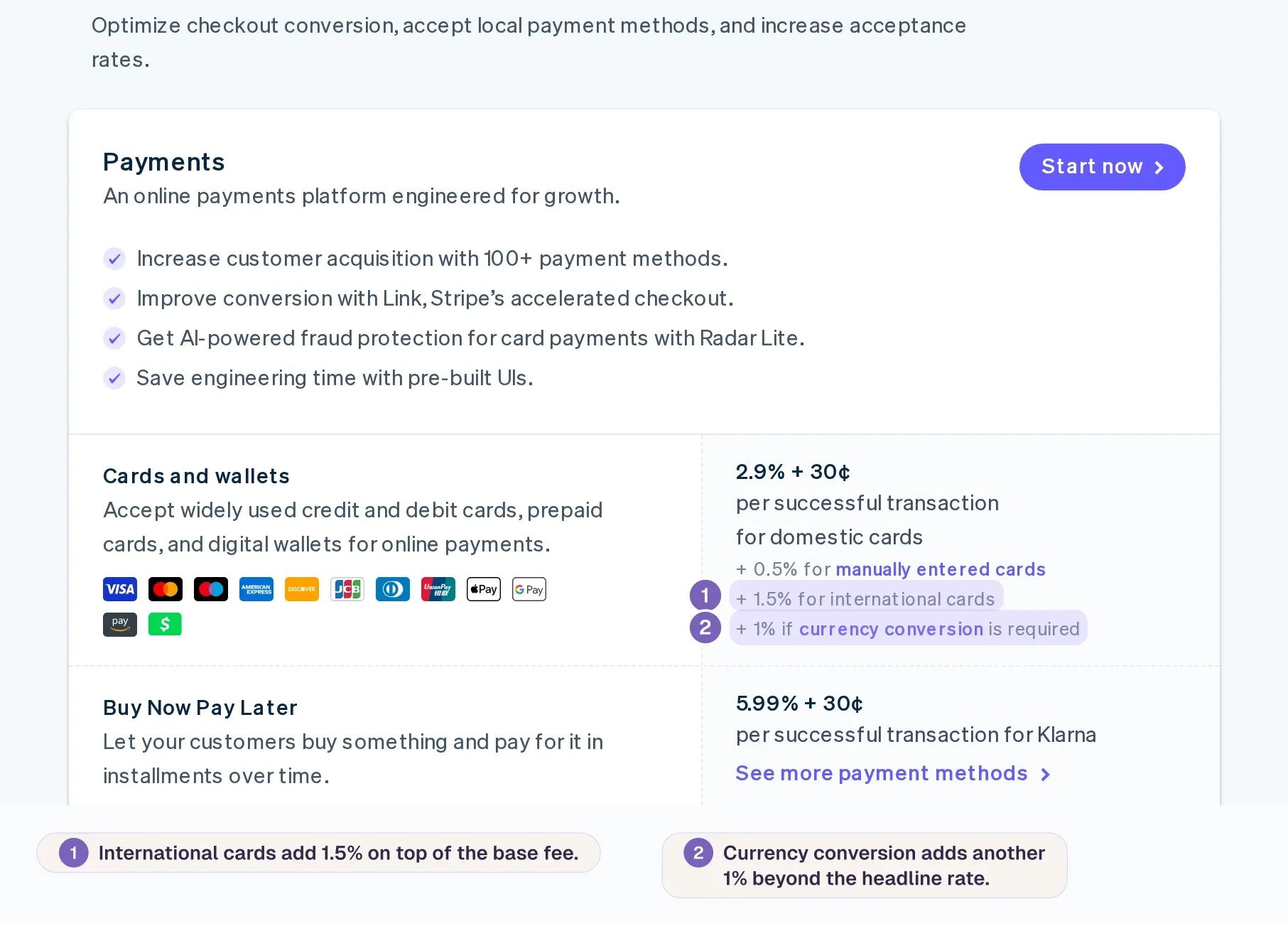
Stripe pricing page: 2.9% + 30¢ for domestic cards, with annotations highlighting international card and currency…
Your monthly cost adds up to the plan charge + percentage of sales + fixed fees per order + applicable processing, currency and payout charges.
With processing costs unchanged between Payhip plans, the upgrade thresholds are:
- Plus beats Free Forever above about $967/month ($29 ÷ 3%).
- Pro beats Plus above $3,500/month ($70 ÷ 2%).
Near either threshold, pick the tier you expect your sales to justify most months.
Gumroad takes $1 on a $5 direct sale, or 20%, versus $2.50 on $20, or 12.5%, before other charges. For low-priced templates, I would check what the fee takes from the cheapest products first.
Tax and VAT: who files what
VAT on the buyer’s receipt shows what was charged, not whether a return was filed or the money reached the tax authority. Those are separate jobs:
- Calculation determines the tax due on the sale.
- Collection takes that amount from the buyer at checkout.
- Filing reports the taxable sales and tax due to the authority.
- Remittance sends the collected tax to that authority.
Payhip’s marketplace-facilitator role covers US sales tax, and Payhip also remits digital EU and UK VAT and Canadian sales tax. For buyers in other countries, registration, filing and remittance can still fall to you. Where its coverage ends, collecting tax at checkout does not take those jobs off your desk.
Gumroad is a full merchant of record, so it is the legal seller and handles all four jobs for VAT and sales tax on its covered sales. Income tax on your earnings remains your responsibility on any platform.
The practical trigger is when a country first expects you to register and file a VAT or sales-tax return yourself. At that point, I would put transaction tax with a legal seller whose coverage includes those sales.
Payhip’s lower percentage fee needs to be weighed against the registrations and returns you still handle outside its tax coverage. Gumroad’s higher fee includes filing and remittance for the sales where it acts as the legal seller.
Files, license keys, courses, and memberships
For templates or course content sold as a bundle, giving buyers access after purchase is different from managing that access later. Payhip tracks enrollment in the bundle separately from enrollment in each product inside it.
Manually removing a buyer from a Payhip bundle still leaves them with access to products already in their account. To withdraw that access, you also need to remove them from each individual product.
If that product-by-product removal is too much work for your catalog, a Payhip bundle is not a fit.
Changing what the bundle contains works differently:
- Removing a template from the bundle changes future purchases. Existing buyers keep access to that template in their accounts.
- New buyers get the current bundle contents immediately. Adding a product later can take up to one hour to update existing buyers’ accounts.
Checkout, storefront, and payouts
Payhip gives you a store you can shape around your catalog, while Gumroad hosts a product page for you. I would choose based on whether buyers need to browse your collection or come straight to a specific product to buy.
On Payhip, you can edit a bundle’s thank-you page (manage bundle → Pages → edit thank-you page) to add a prominent Log In button, giving buyers a direct route to their purchases.
A payout marked as processed does not mean the money has reached your bank.
Plan bills and ad spend around when the money reaches your bank, and leave a buffer instead of committing the balance on the platform’s processing date. That way, you spend against money that has actually landed.
Subscriptions, affiliates, and integrations
For a paid template library or membership, both platforms cover recurring payments and referrals:
- Payhip supports memberships with recurring payments and has affiliate tools.
- Gumroad supports subscriptions and memberships and has a built-in affiliate center.
Before promising partners a commission, check how a referred sale becomes a partner payment:
- Which sales count as referred, and for how long?
- Who sends the partner’s money, and when?
Those answers tell you whether the platform pays partners automatically or leaves you sending transfers by hand.
Keeping subscribers through a future move is a separate question. Both platforms connect with marketing tools, but an email integration does not tell you whether subscribers’ card renewals can move to a new platform.
I would settle that before building a large subscriber base. If buyers have to enter payment details again and some never do, their renewals stop and renewal revenue falls.
Ask the receiving platform whether it can import your existing subscriptions and keep renewals running without buyers entering payment details again. That tells you whether the move keeps recurring payments intact or leaves you collecting card details again.
Payhip vs Gumroad: which one should you choose?
Your first product with uncertain sales
Stay off monthly plans until sales are steady. Payhip Free Forever takes 5% plus processing per order and leaves tax obligations outside its coverage to you, while Gumroad’s higher cut covers the legal-seller role, including transaction-tax handling.
A growing catalog where fees eat margin
Choose your Payhip tier by the monthly revenue your quieter months support, not by the number of products in your catalog. Pro’s 0% cut is lower than any per-sale rate on the headline number, but processing still sits on top.
Courses and memberships
Payhip’s course-selling tools fit structured lessons with modules, while Gumroad works for a recurring drop of digital content that does not need a course player.
Software sold worldwide on subscriptions
Gumroad suits simpler digital sales and sellers who want its marketplace, and it acts as the full legal seller. Gumroad and Creem both take that role, so the per-sale number decides.
A $100 direct sale on Gumroad's 10% + 50¢ leaves $89.50, while Creem's 3.9% + 40¢ leaves $95.70 before payout transfer fees, with tax, invoices and chargebacks inside the rate. Creem files VAT, GST and sales tax for buyers in 190+ countries and bills subscriptions, usage and prepaid credits.
DaisyUI creator Pouya Saadeghi moved from another merchant of record to Creem for lower fees and built-in revenue splits, which pay collaborators without a separate profit-sharing tool.
You still build, deliver and support the product, so for flat recurring prices, weigh Payhip’s tax coverage against Gumroad’s legal-seller service. If you meter usage or sell credits internationally, choose legal-seller coverage with billing that follows consumption.
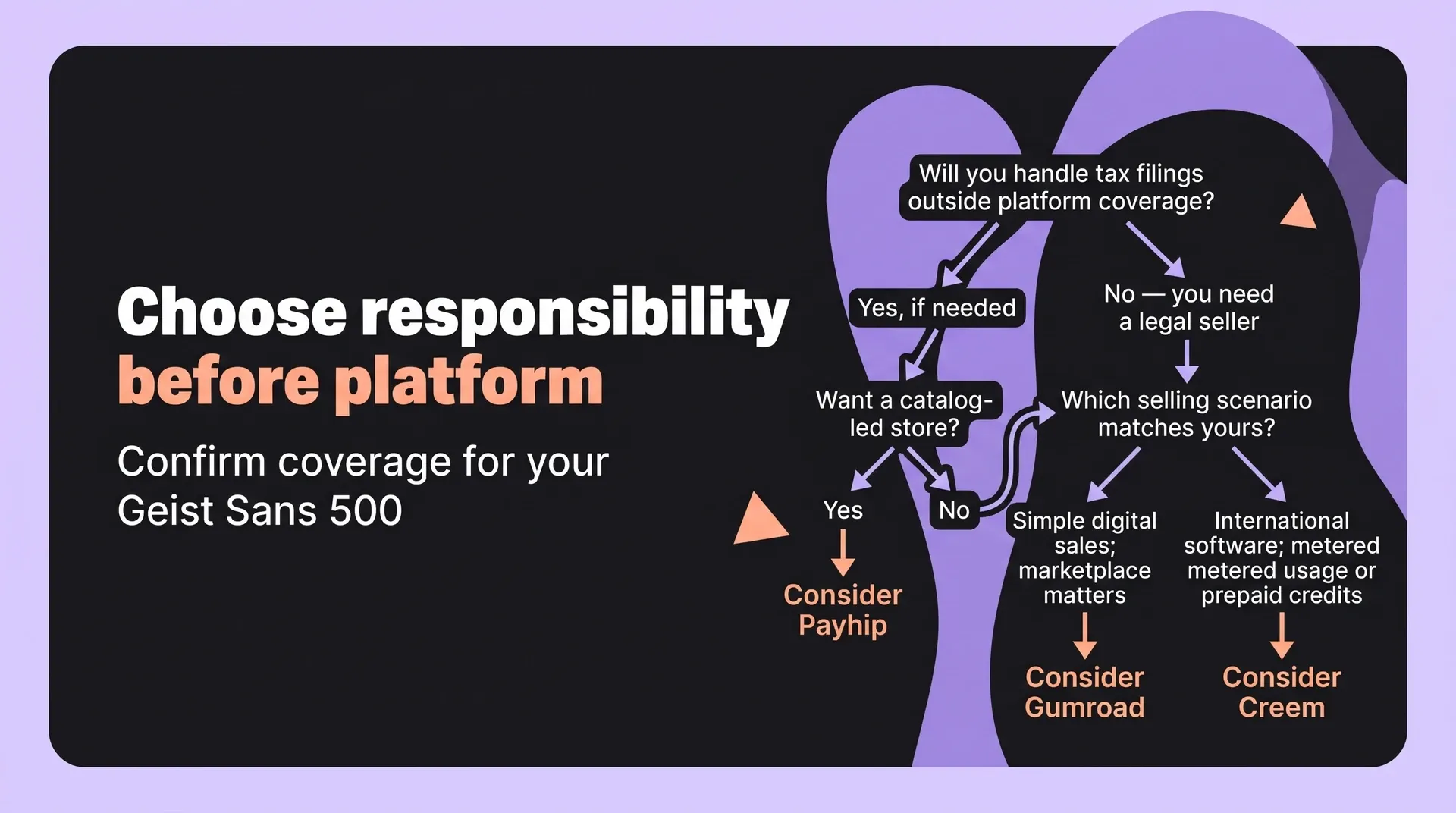
Payhip vs Gumroad decision tree with Creem considered for international software sold by usage or credits
Selling software worldwide? Let Creem be the legal seller
Payhip suits sellers who want a fuller store and are willing to pay monthly for a smaller cut of each sale. Gumroad suits sellers who want a hosted page with payment processing handled for them.
For subscribers paying from many countries, the deciding question is who acts as the legal seller on each renewal.
Creem is the legal seller for your templates, plugins and subscriptions, with tax, invoices and chargebacks included in one rate per successful sale.
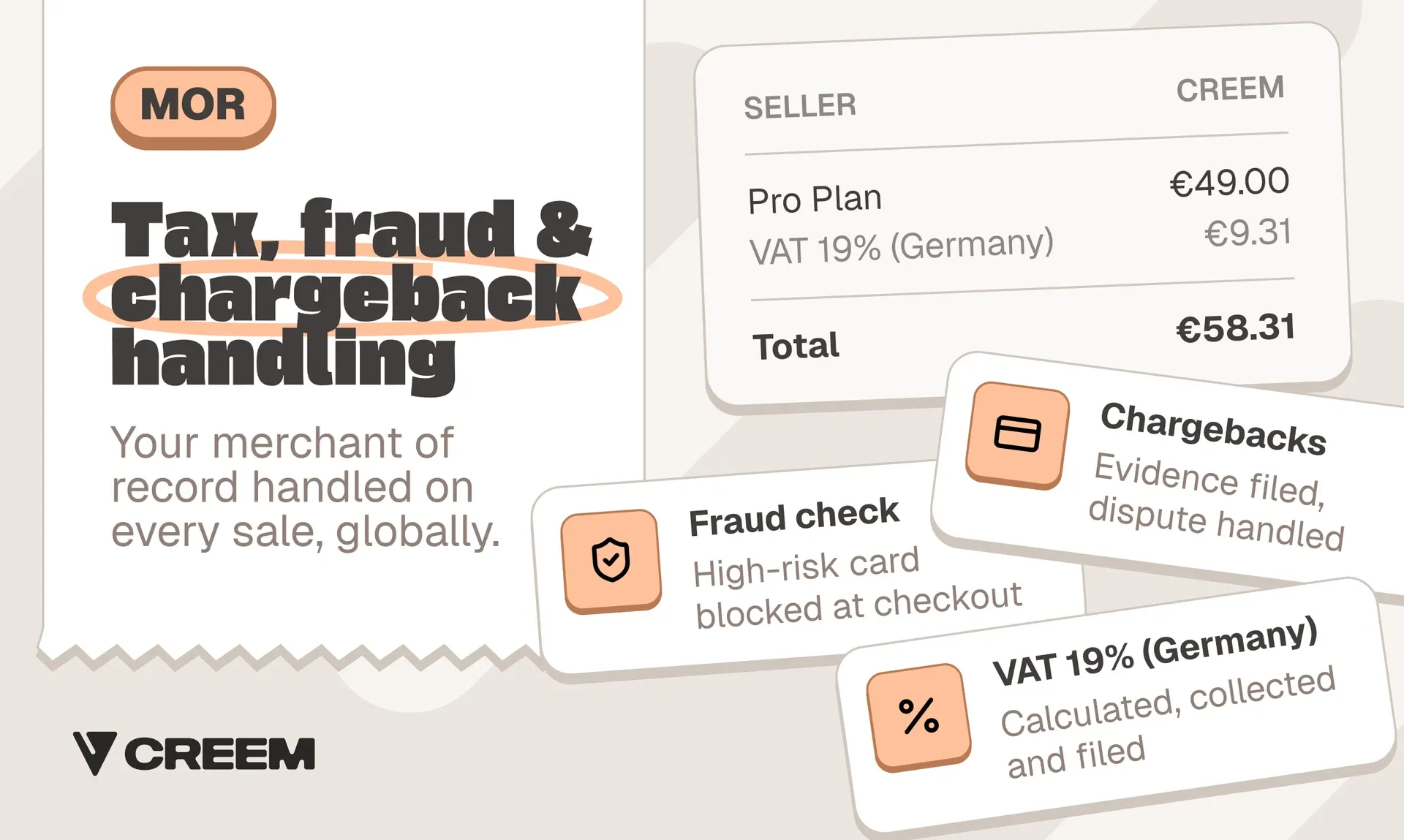
When you sell software internationally through Creem, we calculate, collect, file and remit VAT, GST and sales tax. You do not have to register or file for VAT on those sales, even in countries you have never visited.
Try Creem to set up your store and stop chasing tax filings across borders. Once your products are live, we handle the tax on your international sales while you keep building.