
Most advice on sales tax internet sales still assumes you're shipping physical products from a warehouse. That advice is increasingly dangerous for SaaS founders, software publishers, and digital-product sellers. Your real exposure often depends on where your customers are, which channel made the sale, what you're selling, and whether the platform collecting payment is responsible for the tax.
A marketplace may collect tax on transactions it facilitates while leaving you responsible for sales from your own website. A SaaS subscription may face different treatment from a downloadable template. A platform fee may become taxable even when your customer-facing product is treated differently. The compliance question isn't, “Do I sell online?” It's, “Which transaction happened through which channel, and what tax rules apply to that transaction?”
Table of Contents
- The Physical Presence Rule Is Dead
- Understanding Economic Nexus After Wayfair
- Marketplace Facilitator Laws Versus Direct Sales Obligations
- How VAT and GST Apply to Digital Sales Globally
- The Expanding Tax Net on Digital Services and Platform Fees
- Practical Compliance Options for Online Sellers
- Building Compliance Infrastructure Before You Need It
The Physical Presence Rule Is Dead
The old assumption was simple: if you didn't have an office, employee, warehouse, or other physical operation in a state, you didn't need to collect that state's sales tax. For digital businesses, that assumption no longer works.
On June 21, 2018, the U.S. Supreme Court decided South Dakota v. Wayfair in a 5-4 ruling and overturned the physical-presence rule associated with Quill. The Court held that economic and virtual contacts can create substantial nexus, meaning a state can require a remote seller to collect and remit sales tax even when the seller has no building, employee, or other physical operation there. The National League of Cities summary of the Wayfair decision provides the legal background.
That change matters even more for SaaS and digital-product businesses because digital companies can sell into many jurisdictions without shipping anything. A solo developer with customers across the country can create tax exposure through sales activity alone. Your code may run from one cloud region, your company may be registered in one state, and your team may work from one location. None of that automatically limits your sales-tax footprint.
Revenue can create an obligation
South Dakota's law, upheld by the Court, used two bright-line thresholds: more than $100,000 in annual gross sales or at least 200 transactions into the state. The case established the legal foundation for modern U.S. internet sales tax enforcement and changed compliance expectations for online sellers, including businesses selling software and digital services.
That doesn't mean every digital sale is taxable in every state. Product classification still matters. Exemptions still matter. Registration and filing rules still matter. But physical presence is no longer the only trigger, and treating it as the main test is a serious operational mistake.
Practical rule: Track customer location and gross receipts by state before your revenue reaches a threshold. Registration should follow a documented review, not a surprise notice from a tax authority.
A founder who wants an outside view of financial controls, reporting, and tax exposure can also look for a virtual CFO for ecommerce brands. The important point is to build a process that examines remote sales, not just physical operations.
Understanding Economic Nexus After Wayfair
Economic nexus connects a seller to a taxing jurisdiction through commercial activity rather than physical facilities. For a SaaS company, that activity usually begins with customer revenue, subscriptions, or other transactions attributed to buyers in a state.
The post-Wayfair pattern is straightforward. As your remote gross receipts grow, you evaluate each state separately. Once your activity crosses that state's applicable threshold, you may need to register, collect tax, file returns, and remit what you collected. The obligation can switch on in one state while you remain below the relevant threshold in another.
Many states adopted a 100,000 sales threshold, although the precise measurement rules and treatment of transactions vary. South Dakota's original framework also included the 200-transaction test, but that test is becoming less central. Guidance for 2026 indicates that all states with a sales tax have adopted economic nexus rules, and that the dominant threshold in many states is 100,000 in sales. The 2026 economic nexus guide from Beancount explains this state-by-state compliance pattern.
What substantial nexus means for SaaS
Suppose you sell a subscription through your own checkout. Your company has no office or employee in a customer's state, but your sales into that state grow. The relevant question isn't whether you've rented space there. It's whether your sales activity creates the level of economic connection that the state treats as nexus.
That requires more than watching total company revenue. You need a jurisdiction-level view of:
- Customer location: Record the address or other location evidence used to determine tax treatment.
- Gross receipts: Separate revenue by customer jurisdiction and transaction channel.
- Transaction counts: Keep transaction data available where a state still uses a transaction-based test.
- Product category: Distinguish SaaS, downloads, subscriptions, services, and other digital products.
- Channel coverage: Identify marketplace transactions separately from direct website sales.
Monitor before the threshold
The right workflow is proactive. Set a review trigger below each relevant state threshold, then investigate classification, registration, and collection requirements before the threshold is crossed. Don't wait until the following filing period to discover that your checkout has been charging the wrong rate or collecting nothing.
Founders selling subscriptions in the United States can use a dedicated SaaS sales tax guide as a starting point, but no generic guide replaces a product and channel review. Your billing system should be able to answer, for every transaction, where the customer is located, what was sold, which channel processed the sale, and whether tax was collected.
Marketplace Facilitator Laws Versus Direct Sales Obligations
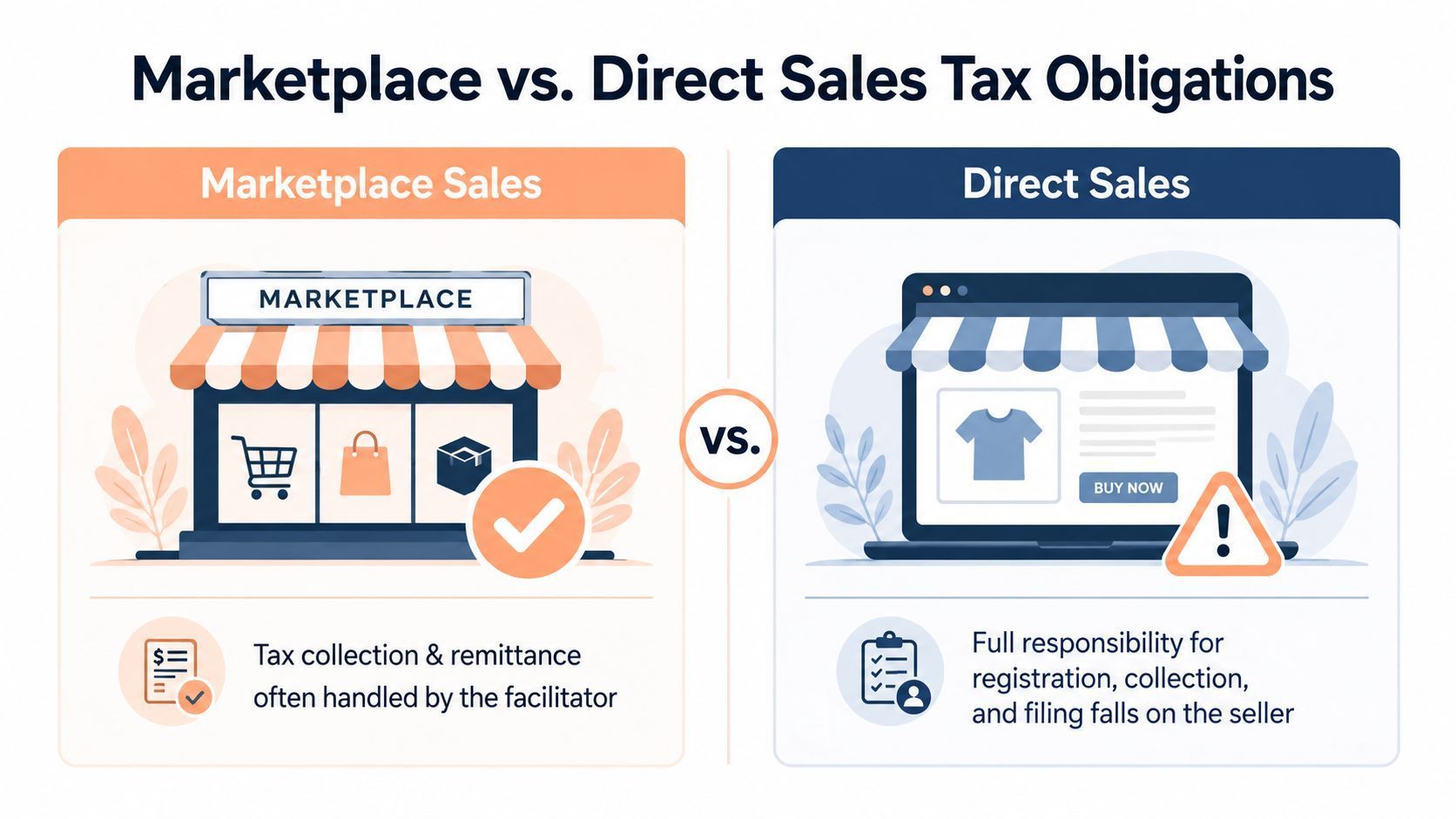
Marketplace facilitator laws solve one narrow problem. They often require the platform to collect and remit tax on sales made through that platform. They don't automatically erase the seller's obligations for every other channel.
This distinction catches digital businesses because founders frequently group all online revenue together. App-store sales, marketplace purchases, affiliate-referred orders, social-media storefront sales, direct licensing agreements, and sales from your own website may all appear in the same accounting report. Tax responsibility can differ across those streams.
Map responsibility by channel
A marketplace transaction may be covered by the facilitator's collection process. Your direct website usually demands a separate analysis. If your software business sells through a marketplace and also accepts annual contracts through its own checkout, the marketplace may handle one stream while your company remains responsible for the other.
Build a channel map with four questions:
- Who is the legal seller? Is the platform treated as the facilitator, or are you selling directly?
- Who controls checkout? Identify the party that determines the customer-facing transaction flow.
- Who collects the tax? Confirm this in the platform's documentation and transaction records.
- Which sales remain uncovered? Reconcile marketplace reports against direct invoices, subscriptions, and payment links.
Channel rule: A facilitator's tax collection generally applies to the marketplace sales it facilitates. Treating that coverage as universal is how direct-channel liabilities disappear from your records.
The same analysis applies to merchant-of-record arrangements. A merchant of record explanation can help clarify the difference between a payment processor, a marketplace facilitator, and a party that assumes responsibility for the customer transaction and indirect-tax obligations.
A short visual explanation can reinforce why the channel decision matters before you design your reporting model.
Reconcile platform reports with your own books
Don't rely on a marketplace summary that combines taxable, exempt, refunded, and direct transactions. Keep the platform's tax-collected amounts separate from your own sales-tax calculations. Retain reports showing gross sales, tax collected, refunds, fees, and payout amounts.
That separation protects you from two opposite errors. You may incorrectly collect tax on a sale the marketplace already handled, or you may assume the marketplace covered a direct sale that never passed through its system. Channel structure is not a minor accounting detail. For digital sellers, it's a primary tax-control decision.
How VAT and GST Apply to Digital Sales Globally
U.S. sales tax is only one part of the international picture. Governments worldwide increasingly use destination-based consumption taxes for remote and digital transactions. The Tax Foundation reports that global e-commerce sales reached $26.7 trillion in 2019, about 30% of world GDP, and that 101 countries had implemented VAT or GST on cross-border online sales. It also reports that more than 50 countries had adopted OECD recommendations for effective VAT collection on those sales. See the Tax Foundation overview of global digital taxation for the cited figures and policy context.
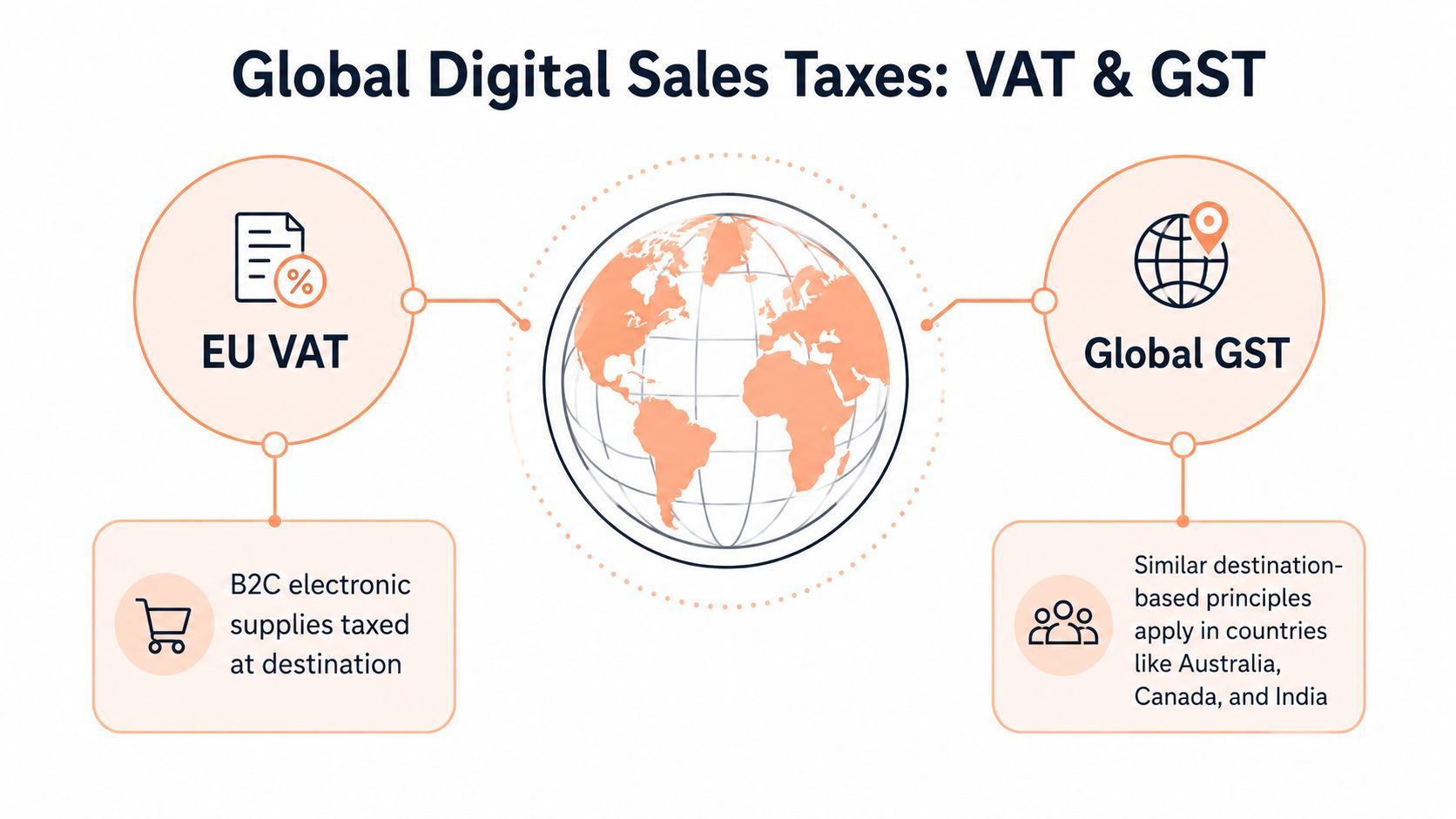
The operating principle is destination taxation. The customer's location drives the applicable tax treatment, not the location of your company or server.
The EU customer-location rule
For B2C electronically supplied services in the EU, tax is charged in the customer's country rather than the seller's country. This rule has applied since January 1, 2015, under Article 58. The European Commission's explanatory notes on electronically supplied services explains the customer-location approach and the evidence businesses need to support it.
For a software seller, that means checkout must do more than authorize a card. It should capture and retain location evidence that supports the rate and jurisdiction selected for the transaction. Depending on the transaction and applicable rules, that evidence may come from customer address data, billing information, or other checkout signals. Your tax process needs a defensible record, not just a calculated amount.
Choose a reporting route
A seller can register in each destination country where an obligation exists, or use the One-Stop Shop, OSS, to centralize reporting for eligible EU transactions. OSS reduces filing fragmentation, but it doesn't remove the need to classify products correctly, determine customer location, apply the right rate, retain evidence, and reconcile returns to transaction-level records.
Use this practical sequence:
- Classify the supply: Decide whether you're selling software, an electronically supplied service, a digital product, or another service.
- Determine the buyer type: B2C and B2B treatment can differ, so preserve the customer's business information where relevant.
- Validate location: Make location evidence part of the checkout and billing workflow.
- Select registration coverage: Compare local registrations with centralized schemes such as OSS.
- Reconcile continuously: Match tax calculations, refunds, invoices, and filings.
Sellers expanding beyond the United States should review VAT registration for software sellers before international demand becomes an administrative emergency. The key input is customer location, and your checkout is where that input must be captured correctly.
The Expanding Tax Net on Digital Services and Platform Fees
Generic internet sales tax guides usually focus on a taxable product moving from seller to buyer. That model is too narrow for modern digital commerce. States are increasingly examining SaaS, IT services, software publishing, web hosting, and the fees charged by platforms around the transaction.
The shift changes the compliance surface. Your company may need to evaluate not only what you sell to customers, but also the services you provide, the services you buy, and the fees associated with operating through a marketplace.
Recent examples show the direction
In 2025, Maryland implemented a 3% tax on certain IT services, including software publishing and web hosting. Louisiana expanded tax treatment for SaaS and digital products, while Texas began taxing marketplace seller fees such as listing fees, commissions, and data-processing charges. These details are reported in the 2025 mid-year sales tax and VAT report.
For SaaS founders, product classification can't stop at “software.” Ask whether the customer receives access to hosted functionality, a downloadable product, a support service, a data-processing service, or a bundled offering. A creator platform should also examine whether its marketplace commissions and seller-facing fees receive separate treatment.
Audit the surrounding service stack
A practical review should include:
- Customer subscriptions: Determine how each jurisdiction treats the recurring access or service.
- Implementation and support: Separate onboarding, consulting, training, and technical support where the rules require it.
- Hosting and publishing: Review whether your service model resembles taxable IT or web-hosting activity.
- Platform economics: Examine listing fees, commissions, data-processing charges, and other seller-facing amounts.
- Bundled pricing: Document how you allocate a single price across different taxable and nontaxable components.
Scope warning: Tax can attach to the service stack around a digital product, not only to the download, subscription, or license the customer sees.
This is why a single “internet sales” toggle in a payment dashboard isn't enough. Your tax engine, invoice descriptions, contracts, and accounting categories should describe the actual commercial model. If the product changes, the tax analysis needs to change with it.
Practical Compliance Options for Online Sellers
Digital sellers have three credible operating models. None removes the need for accurate product data and customer-location records, but each assigns the work differently.
Manual registration and internal control
A small seller with limited jurisdictions may register directly, configure tax rules, file returns, and maintain exemption documentation. This approach gives you control and may fit a straightforward product catalog, but the workload grows as economic nexus, channel coverage, refunds, and international VAT/GST enter the picture.
Tax automation with your own entity
Tax calculation and filing software can monitor thresholds, calculate jurisdiction-specific tax, and support registrations and returns. Your company still owns the compliance relationship, so you must configure products correctly, review notices, maintain registrations, and reconcile data from marketplaces and payment providers.
Merchant of Record
A Merchant of Record can assume responsibility for the customer transaction, including applicable indirect-tax collection, filing, and remittance within its coverage model. This can be a strong fit for SaaS companies and indie makers that want to avoid building a tax department, but you still need to review contract terms, supported countries, product eligibility, refunds, reporting, and payout reconciliation.
| Approach | Best For | Complexity | Cost Range | Risk Level |
|---|---|---|---|---|
| Direct registration and manual filing | Sellers with simple products and limited jurisdictions | High as coverage expands | Varies by registrations, advisors, and internal time | Higher if monitoring is inconsistent |
| Tax automation with your entity | Growing sellers that want control over registrations and filings | Moderate to high | Varies by software, filing volume, and professional support | Moderate, dependent on configuration |
| Merchant of Record | SaaS and digital-product businesses selling across borders | Lower operational burden | Provider transaction fees and commercial terms | Lower administrative exposure, subject to provider scope |
Choose based on operating reality
Use direct registration when you can maintain a reliable jurisdiction calendar and your product classification is stable. Use tax automation when your team can own the underlying registrations and audit trail. Consider a Merchant of Record when global selling is central to your growth and the cost of managing registrations, filings, remittance, and customer-location evidence would distract from product work.
Creem operates as a Merchant of Record and provides checkout, subscription billing, and sales-tax, VAT, and GST collection, filing, and remittance across 100+ countries. That model is one option for sellers that want those obligations handled through the transaction platform rather than managed independently.
Building Compliance Infrastructure Before You Need It
Reactive compliance is expensive because the correction happens after money has already changed hands. If you cross an economic nexus threshold without registering or collecting, you may need to investigate historical transactions, correct invoices, fund unpaid tax from company cash, and respond to notices. You also may not be able to recover tax cleanly from customers after the sale.
Build the control system while your transaction volume and product catalog are still manageable.
Put these controls in place
- Threshold monitoring: Track gross receipts and relevant transactions by customer jurisdiction and channel.
- Location evidence: Store the data used to determine the buyer's location and tax treatment.
- Product classification: Maintain a tax category for subscriptions, downloads, hosted software, support, and bundled services.
- Registration workflow: Assign an owner for identifying, approving, and completing jurisdiction-specific registrations.
- Filing reconciliation: Match returns against invoices, refunds, marketplace reports, and payment payouts.
- Change management: Reassess tax treatment when you add a new plan, service, country, marketplace, or fee structure.
Founder decision: If your team can't explain who collects tax on every revenue channel, your infrastructure isn't ready for national or global scale.
The practical recommendation is simple. Don't build a sprawling manual process if your business is designed for international digital sales. Choose either a tax automation stack that your team can operate confidently or a Merchant of Record arrangement whose coverage matches your markets and products.
Start by exporting your transactions, grouping them by customer location and channel, and identifying every state or country where your current process may be incomplete. Then document the decision for each channel and implement the required collection, reporting, and reconciliation controls before the next growth push.
Creem gives SaaS and digital-product sellers a Merchant of Record model with automated checkout tax calculation, collection, filing, and remittance, alongside subscriptions, invoices, payouts, and digital-product tools. Review your channel and product setup, then visit Creem to determine whether its global compliance infrastructure fits your sales model.