
Roughly 45% of B2B buyers identify unclear pricing as their biggest frustration, according to B2B International's buyer research. That's a useful starting point for writing quotes for sales: the buyer doesn't necessarily need more persuasion. They need fewer unanswered questions.
For SaaS and digital products, those questions extend beyond the subscription price. Buyers need to understand their commitment, who handles billing, and what happens when their requirements change. Treat the quote as a trust and risk-reduction asset, then build the process around preserving that clarity through payment.
Table of Contents
- Why a Sales Quote Is a Funnel Stage Worth Measuring
- The Building Blocks of Every Quote That Closes
- Pricing Strategies That Match Buyer Risk
- Legal Terms That Prevent Quote-Stalling
- Approval Workflows That Don't Slow Standard Deals
- Quote Speed, Accuracy, and the Buyer Self-Service Path
- Automating the Path From Quote to Paid Invoice
Why a Sales Quote Is a Funnel Stage Worth Measuring
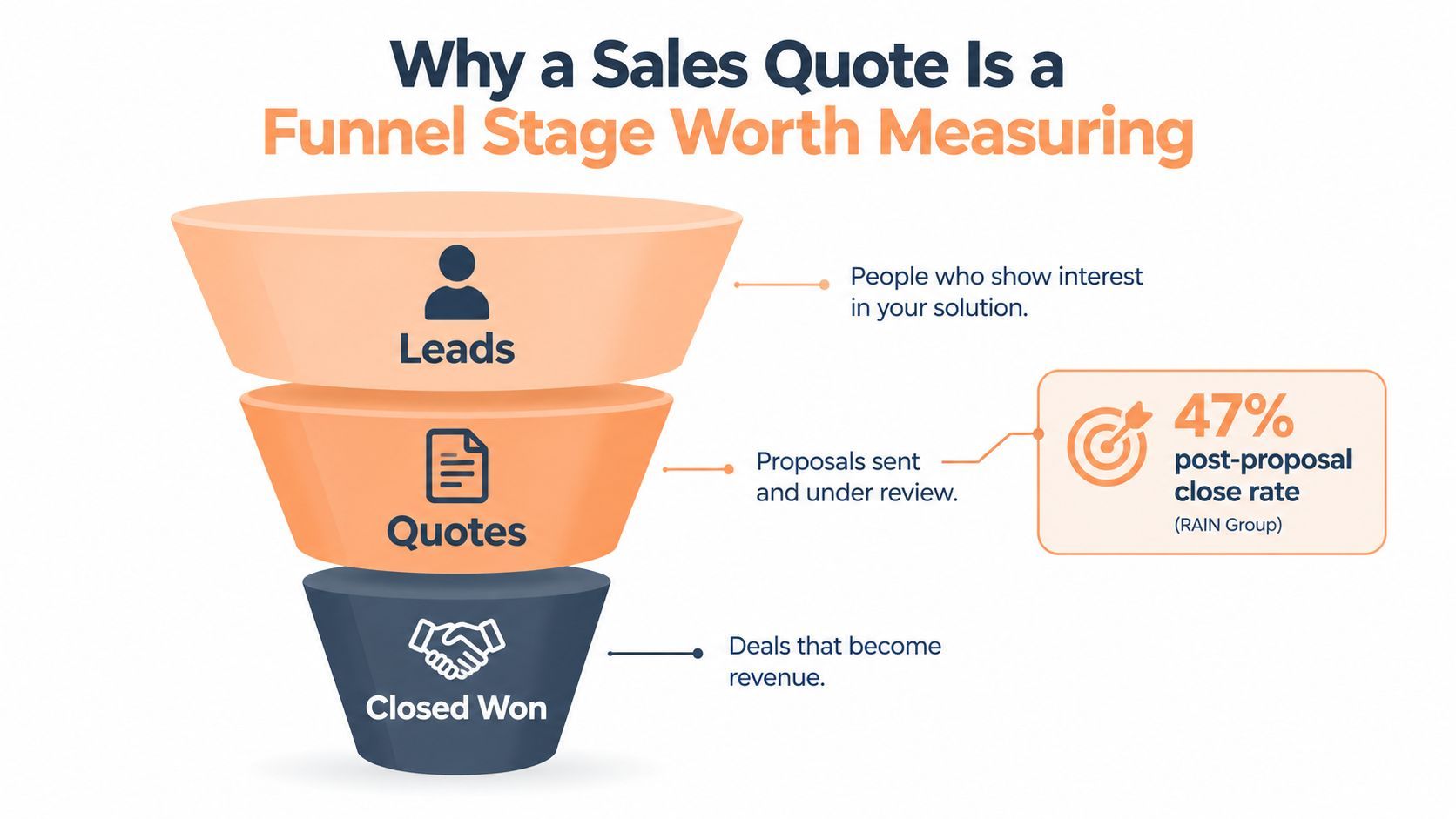
A published synthesis citing RAIN Group research reports a 47% post-proposal close rate among 472 sellers and sales executives, with the top-performing group achieving 73%, according to Quotway's quote-stage benchmark summary. These aren't lead-conversion rates. They describe opportunities that had already reached a proposal or quotation.
That distinction changes how you interpret performance. A buyer receiving a qualified quote has progressed beyond an initial expression of interest. Discovery and commercial evaluation should already have established why the product fits.
The funnel below highlights where that commercial milestone belongs.
Define the denominator before discussing performance
Broader opportunity-to-close benchmarks near 20–21% aren't directly comparable with proposal conversion because they include earlier-stage demand, as explained in Cobl's sales win-rate methodology. Comparing the two can make ordinary quote-stage performance look exceptional.
Consider a SaaS founder describing the company's close rate as strong. If the report starts only after buyers request formal pricing, it excludes prospects who disappeared during qualification. The founder may understand late-stage conversion while misunderstanding the health of the overall pipeline.
Track the commercial sequence explicitly:
- Quote requested: Record buyer intent without assuming qualification.
- Quote issued: Count a formal offer attached to a qualified opportunity.
- Quote accepted: Capture documented agreement to a specific version.
- Payment completed: Record successful collection separately from acceptance.
Preserve outcomes instead of hiding them
Use qualified opportunities receiving a formal quote as the quote-stage denominator. Classify outcomes as won, lost, no-decision, or still open, and define the reporting window so unresolved deals don't disappear from analysis.
Count opportunities rather than treating every revised document as a new selling chance. Otherwise, repeated revisions can distort the denominator and make operational activity look like additional demand.
Segment results by sales motion, contract value, geography, and quote type. A self-serve subscription and an enterprise procurement process shouldn't share an undifferentiated benchmark. When acceptance looks healthy but payment completion doesn't, investigate the payment handoff rather than rewriting the sales pitch.
The Building Blocks of Every Quote That Closes
Use a hypothetical seat-based SaaS purchase with an annual subscription and onboarding as a template test. Can the buyer forward the quote to finance without adding an explanatory email? If not, identify which missing details finance would need before approving it.
Build the document in the order a buyer reviews it. Start with identity and scope, move through the commercial breakdown, then make acceptance unmistakable.
Establish who is buying what
The header should identify the seller, quote reference, issue date, version, and responsible contact. Include the buyer's legal entity, billing address, purchasing contact, and relevant tax details. Don't assume the product user and the contracting organization are the same party.
Describe the purchased plan, seat quantity, included capabilities, and service boundaries. For onboarding, specify the deliverable and the buyer's responsibilities. A label such as “implementation included” leaves too much room for competing interpretations.
| Quote block | Buyer question it should answer |
|---|---|
| Seller and buyer details | Which entities are entering the agreement? |
| Product and scope | What exactly will our team receive? |
| Recurring line items | What will we pay again? |
| One-time services | What applies only to the initial purchase? |
| Taxes, fees, and totals | What amount should finance authorize? |
| Assumptions and exclusions | What could require another agreement? |
| Validity and acceptance | How and when can we proceed? |
Make the commitment readable
Separate recurring charges from one-time charges. Keep onboarding out of the subscription subtotal so buyers can distinguish the initial purchase from the continuing commitment. Itemize optional support or services instead of including them in the plan.
Display the billing currency clearly. Identify whether taxes are included, excluded, or dependent on validated billing information, and distinguish a provisional estimate from a confirmed payable total. Don't label an amount final if checkout may change it.
State the offer's validity period and explain which assumptions require revision. Finish with an acceptance block identifying the authorized buyer, accepted document version, and required next action.
Template test: A buyer should be able to explain the purchase internally using the quote itself, not the salesperson's memory of the discovery call.
Keep the template modular. Standard product details should come from maintained records, while deal-specific assumptions remain visible for review. Copying an old customer's document is convenient until an obsolete commitment survives into the next deal.
Pricing Strategies That Match Buyer Risk
Choose a pricing model by examining what the buyer can confidently commit to. Predictable spending may matter more than the lowest apparent unit price. Another buyer may prefer variable spending because they can't forecast adoption.
The quote should expose that trade-off rather than disguise it. Use a SaaS pricing-model comparison when evaluating packaging, then ensure the selected model can be explained without a separate spreadsheet.
Choosing a Pricing Model for Your Sales Quote
| Model | Best fit | What the quote must show |
|---|---|---|
| Flat-rate | Defined software access with predictable scope | Included capabilities, limits, billing cadence, and exclusions |
| Tiered | Buyers choosing among packages or expanding access | Selected tier, included allowance, and upgrade triggers |
| Usage-based | APIs or products with variable consumption | Meter definition, unit rate, included usage, and overage treatment |
| Value-based | Negotiated enterprise scope tied to business outcomes | Value assumptions, committed deliverables, and responsibility boundaries |
A flat-rate quote is readable, but the seller must still define limits. Usage-based pricing gives buyers flexibility while leaving them with forecasting risk. Show how consumption becomes a charge and provide a way to monitor it.
Tiered pricing requires clarity about boundaries. Explain whether exceeding an allowance changes the whole package or only creates an incremental charge. For value-based contracts, distinguish the business case from a contractual guarantee, and don't promise outcomes your team can't control.
Explain the arithmetic and the concession
For seat-based pricing, display the unit rate, committed seat quantity, billing period, and resulting subscription total. If you show a monthly equivalent for an annual contract, label it as an equivalent, not the amount due each month.
Make discount conditions explicit. An annual-prepayment concession, volume agreement, or limited introductory offer should have an identifiable rationale and duration. Buyers shouldn't have to guess whether the renewal price preserves the concession.
Acquisition costs belong in internal margin calculations, not as unexplained buyer-facing surcharges. If you're evaluating commission-based client acquisition from Ever Outbound Inc., assess those commercial obligations separately before approving customer discounts.
Transparent pricing doesn't mean exposing every internal cost. It means letting the buyer verify how their selected scope produces their commitment. Keep internal economics available to approvers while keeping the customer's calculation straightforward.
Legal Terms That Prevent Quote-Stalling
Write terms to help buyers understand their obligations, not merely to protect the seller after a dispute. Procurement needs to determine whether the proposed commitment fits company policy. Vague language leaves that reviewer with questions the salesperson may not be authorized to answer.
Clear terms won't eliminate legal review. They can, however, prevent avoidable clarification requests and make genuine disagreements easier to isolate.
Put operational consequences in plain language
Cover the payment schedule, due dates, accepted payment arrangements, and consequences of late payment. If late fees apply, disclose them and have counsel review their applicability. Explain when access begins and what happens if collection fails.
For subscriptions, specify renewal mechanics, cancellation requirements, notice periods, seat changes, upgrades, downgrades, and proration treatment. Keep these consistent with the agreement and billing configuration. A salesperson's informal assurance shouldn't contradict the customer's actual subscription behavior.
- Refunds and termination: Explain eligibility, exclusions, termination rights, and the treatment of prepaid amounts.
- Data and intellectual property: Distinguish customer-owned data from the software license, and state export and post-termination access arrangements.
- Service commitments: Identify included support, any agreed service levels, exclusions, and remedies.
- Liability and disputes: Reference approved liability provisions, governing terms, and the agreed dispute process.
Separate fixed policy from negotiable exceptions
Decide internally which positions require specialist approval. Data-handling commitments and intellectual-property boundaries need deliberate policies; payment timing or enhanced support may allow controlled negotiation. Don't let individual sellers improvise either category.
If the buyer requests a preliminary billing document, distinguish the quote's offer from the document's payment purpose. A guide to proforma invoices can help teams maintain that distinction without using the terms interchangeably.
Attach or link the applicable agreement with its version identified. Where documents conflict, approved precedence language should explain which terms control. Avoid maintaining different cancellation promises in the quote, contract, and checkout.
Vague terms force buyers to investigate. Specific terms let them decide whether the commitment is acceptable.
Keep the commercial summary readable and leave detailed legal provisions in the appropriate agreement. Reproducing every clause inside the quote can make review harder without adding protection.
Approval Workflows That Don't Slow Standard Deals
An approval request should identify an exception, not merely announce that a salesperson has prepared a quote. If every standard purchase needs a manager's intervention, redesign the rules before asking sellers to work faster.
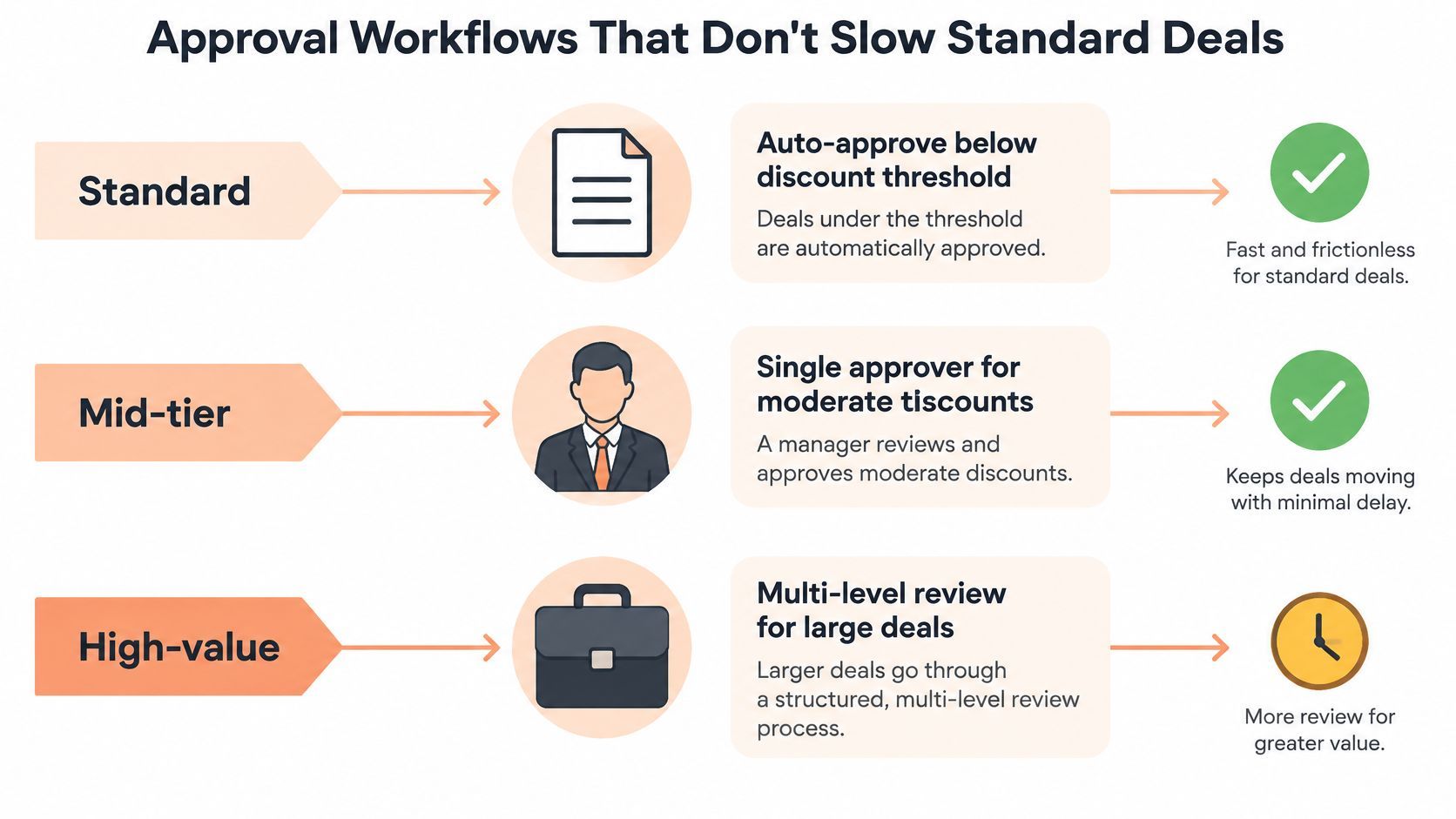
Use routing based on commercial and operational risk. The workflow below illustrates how standard offers can proceed while exceptions receive targeted review.
Route the exception to its owner
A standard annual subscription using an approved plan and permitted discount should proceed automatically. If the seller requests a concession beyond their authority, send the pricing exception to the sales lead. If the buyer also requests an unusual payment arrangement, finance should review that specific commitment.
This is more useful than forwarding the entire deal through an identical chain regardless of what changed.
- Standard route: Validate approved products, allowed quantities, supported billing arrangements, and permitted concessions.
- Commercial review: Send discretionary pricing or seat overrides to the role responsible for margin and packaging.
- Specialist review: Route custom revenue splits, atypical tax treatment, or amended legal terms to their designated owners.
A high contract value may justify additional scrutiny, but value alone isn't a complete risk model. A modest deal with unusual liability language can require more specialist attention than a large purchase on standard terms.
For a complementary view of the workflow, use this video alongside your internal routing map.
Make approval evidence part of the quote record
Store the requested exception, rationale, approver, decision, and approved version in the quoting system. Don't leave the only authorization inside a private Slack conversation. Finance needs to distinguish an intentional concession from an accidental edit.
Assign backup approvers and define what happens when the primary owner is unavailable. Where reviews are independent, let them happen in parallel. Sequential review should reflect an actual dependency, not an inherited habit.
Material changes should invalidate the relevant approval. A seller shouldn't be able to obtain approval for standard payment terms and then substitute a custom schedule before sending. Preserve the approved version and route only the changed exception back for review.
Quote Speed, Accuracy, and the Buyer Self-Service Path
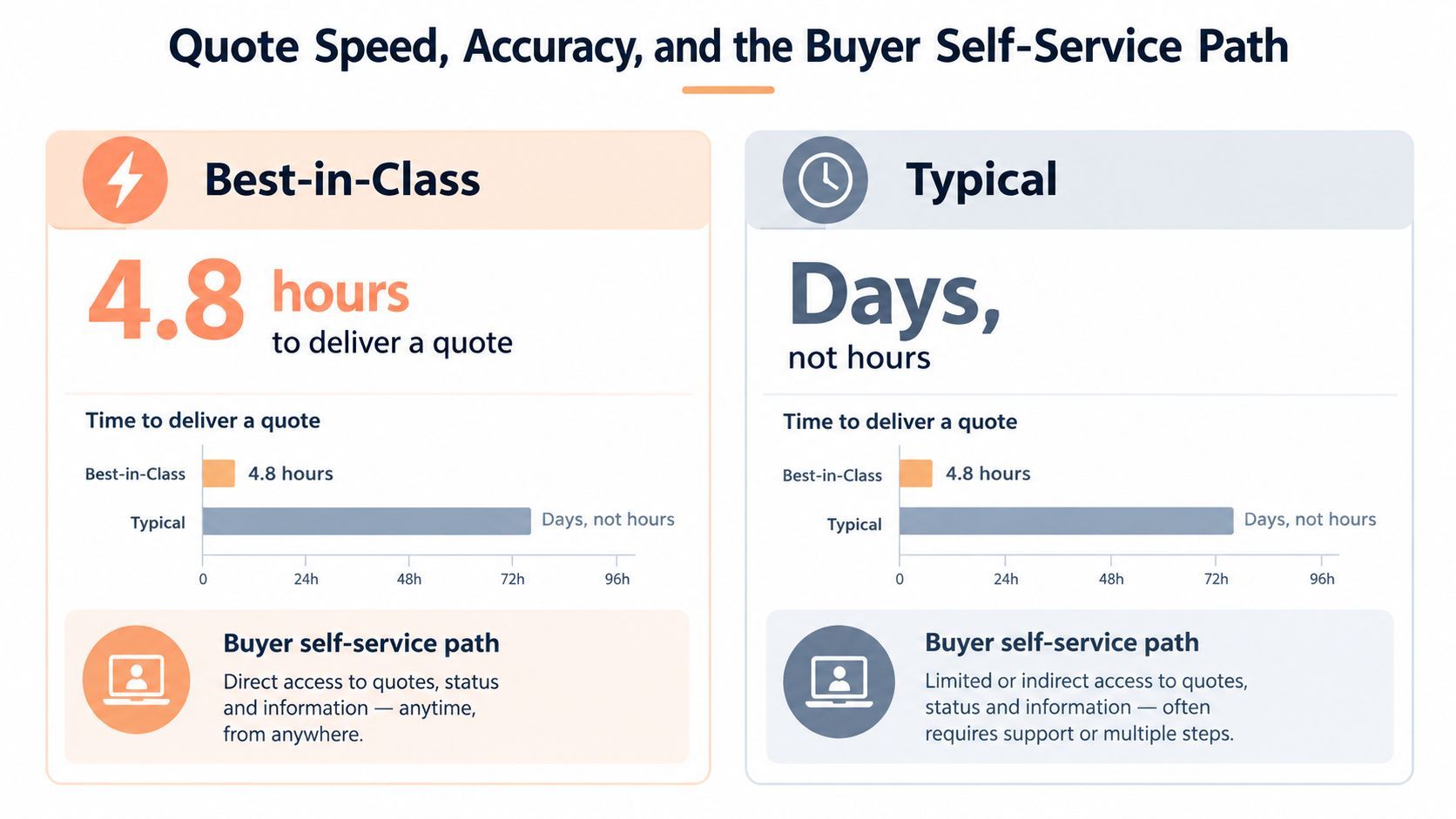
A cited operational benchmark puts average quote delivery at 4.8 hours for best-in-class organizations, compared with 2.1 days for the industry average and 5.4 days for bottom performers, as summarized in Stealth Agents' quote-generation benchmark roundup. Treat those figures as directional comparisons, not evidence that accelerating any quote will cause a sale.
Deal complexity and buyer intent can affect both turnaround and outcomes. Your operating target should reflect what your team can deliver accurately for each quote category.
The comparison below provides context for setting those targets.
Measure waiting time without hiding it
Timestamp the buyer request, qualification completion, quote generation, and buyer opening or acceptance. Measure both end-to-end waiting time and the internal preparation interval. Starting the clock after approvals hides the delay buyers experience.
Use the median and the slow-tail turnaround alongside segmentation for standard and customized offers. Investigate where work waits rather than assuming document generation is the bottleneck.
Speed also needs a quality check. Industry material reports pricing errors in 8.4% of manually created quotes, according to US Tech Automations' quote-generation guide. That's a reason to validate inputs and calculations, not a guarantee that automation will eliminate mistakes.
Give buyers the right completion path
Separate immediate purchases from assisted offers:
- Self-service offers: Use validated product configuration, approved terms, and a supported checkout path.
- Assisted offers: Hold custom commitments for the required review, then give the buyer a clear route to completion.
- Procurement-led purchases: Support internal circulation and authorization without assuming the recipient can pay immediately.
Checkout should retrieve the accepted quote's agreed commercial configuration. Don't make the buyer rebuild their cart or search for the promised discount. If billing information changes the tax calculation, explain the adjustment and obtain confirmation before collection.
Provide a shareable review view as well as a payment action. The person evaluating the quote may need a colleague to authorize spending.
Fast delivery only helps when buyers can rely on what arrives. Track whether the initial document was usable without correction, and test process changes within comparable segments. Otherwise, a faster turnaround report can conceal more revisions and a worse purchasing experience.
Automating the Path From Quote to Paid Invoice
Automate the approved commercial record, not just the document. The useful handoff is from a qualified request to a validated offer, then from accepted terms to payment and billing without manual transcription.
Give each quote a persistent identifier and preserve its version history. Pass that reference through acceptance, checkout, payment events, and invoicing so operations can reconcile what the buyer approved with what they received.
Build a recoverable operating loop
Generate the quote from maintained product and pricing records, apply the appropriate approval route, and send the approved version with its validity information. After acceptance, use that version to configure the transaction rather than reconstructing it from an email.
Define failure handling before launch. An expired offer, abandoned checkout, or unsuccessful payment should create an explicit status and owner. Acceptance isn't collection, and a failed payment shouldn't trigger paid access automatically.
The payment-provider interface is part of that operational review.
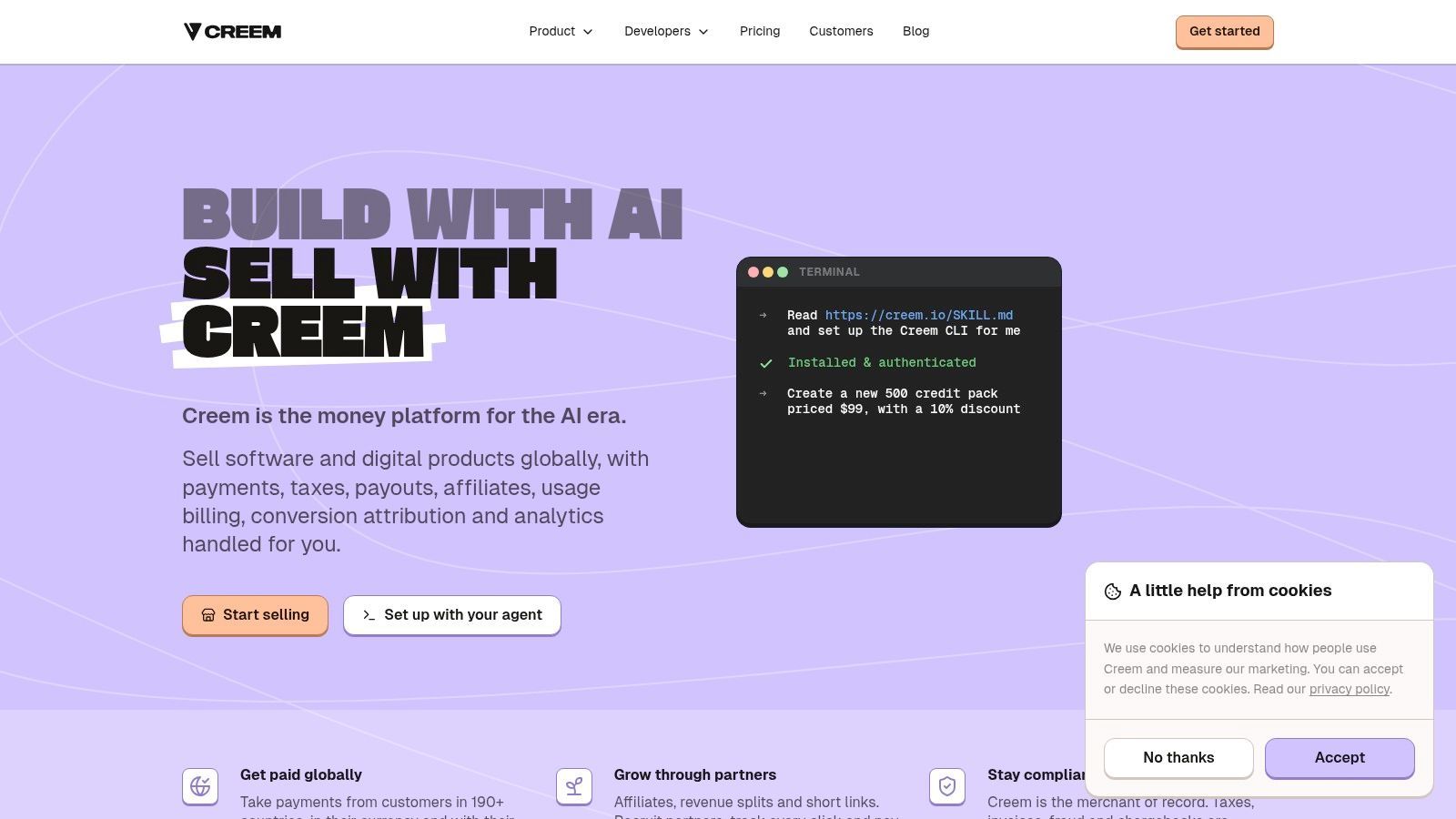
Evaluate a Merchant of Record's tax responsibilities, currency support, subscription handling, and recovery behavior against your selling requirements. Don't assume a provider's checkout automatically supports every negotiated commitment. Confirm how exceptions move through the integration.
Use an invoice-automation workflow to connect completed transactions with billing documents and reconciliation. Test retries and duplicate events so repeated notifications don't create duplicate invoices or provisioning actions.
Review the system quarterly
Keep a compact operational scorecard:
- Median quote turnaround: Segment by standard and assisted offers.
- Quote-to-cash time: Measure the interval from issuance to successful collection.
- First-pass accuracy: Record corrections required after delivery and their causes.
- Self-service conversion: Track eligible buyers who complete the supported purchase path.
- Exception frequency: Identify recurring requests that deserve a packaging or policy decision.
Assign corrective work to an owner. Repeated seat-pricing exceptions may require a packaging decision; repeated invoice corrections may require better input validation. Don't ask sellers to compensate indefinitely for a broken configuration.
A strong sales quote gives buyers enough certainty to approve the commitment and enough continuity to complete the purchase.
Creem offers Merchant of Record services, hosted checkout, automated tax compliance, subscription billing, and automatic invoices for software and digital-product teams. Visit Creem to evaluate how its payment infrastructure could support your quote-to-paid workflow, and bring your standard offer, billing requirements, and exception list to the integration review.