
If you've ever stared at a close on the 2nd or 3rd and wondered why the numbers still don't line up, you already know the problem. Payouts hit on one cadence, bank feeds lag, support is escalating a double charge, and someone in leadership wants net revenue by plan before the board packet goes out. That's not an accounting nuisance. It's a control failure that can hide real leakage.
Revenue reconciliation is the process that proves booked revenue landed where it should across billing, payments, tax, refunds, chargebacks, and partner splits. In SaaS, it stops being a tidy month-end task the moment subscriptions, proration, dunning, and global settlements enter the picture. Done well, it becomes a root-cause system for finding where money is slipping out of the business before the close hardens it into “just an adjustment.”
Table of Contents
- What Revenue Reconciliation Actually Solves
- The three mismatches that hurt SaaS teams most
- Building Side A and Side B Data Sets
- Start with the right two sides
- Use deterministic rules before you get clever
- Build for real settlement shapes
- Matching Payments to Invoices and Subscriptions
- Match by subscription context, not just amount
- Reconcile the full path, not just the receipt
- Handling Refunds, Chargebacks and Disputes
- Keep the original transaction attached
- Build an evidence packet, not a memory test
- Tracing Exceptions Back to Revenue Leakage
- Group exceptions by cause, not by queue
- Use one real break as a pattern test
- Build a monthly leakage view
- Choosing Manual, Automated, and Continuous Reconciliation
- Compare the operating models
- Audit Prep and the Habits That Keep You Ready
- Keep the evidence trail with the line
- Make close habits part of the control, not the ritual
What Revenue Reconciliation Actually Solves
The ugly version of close week looks like this. A payout file arrives late, the bank feed is a day behind, and a founder wants a clean answer on why the renewal line spiked when the invoice list says one thing and the processor says another. Somewhere in the middle is a support ticket about a customer who was charged twice, and finance is the team expected to explain all of it.
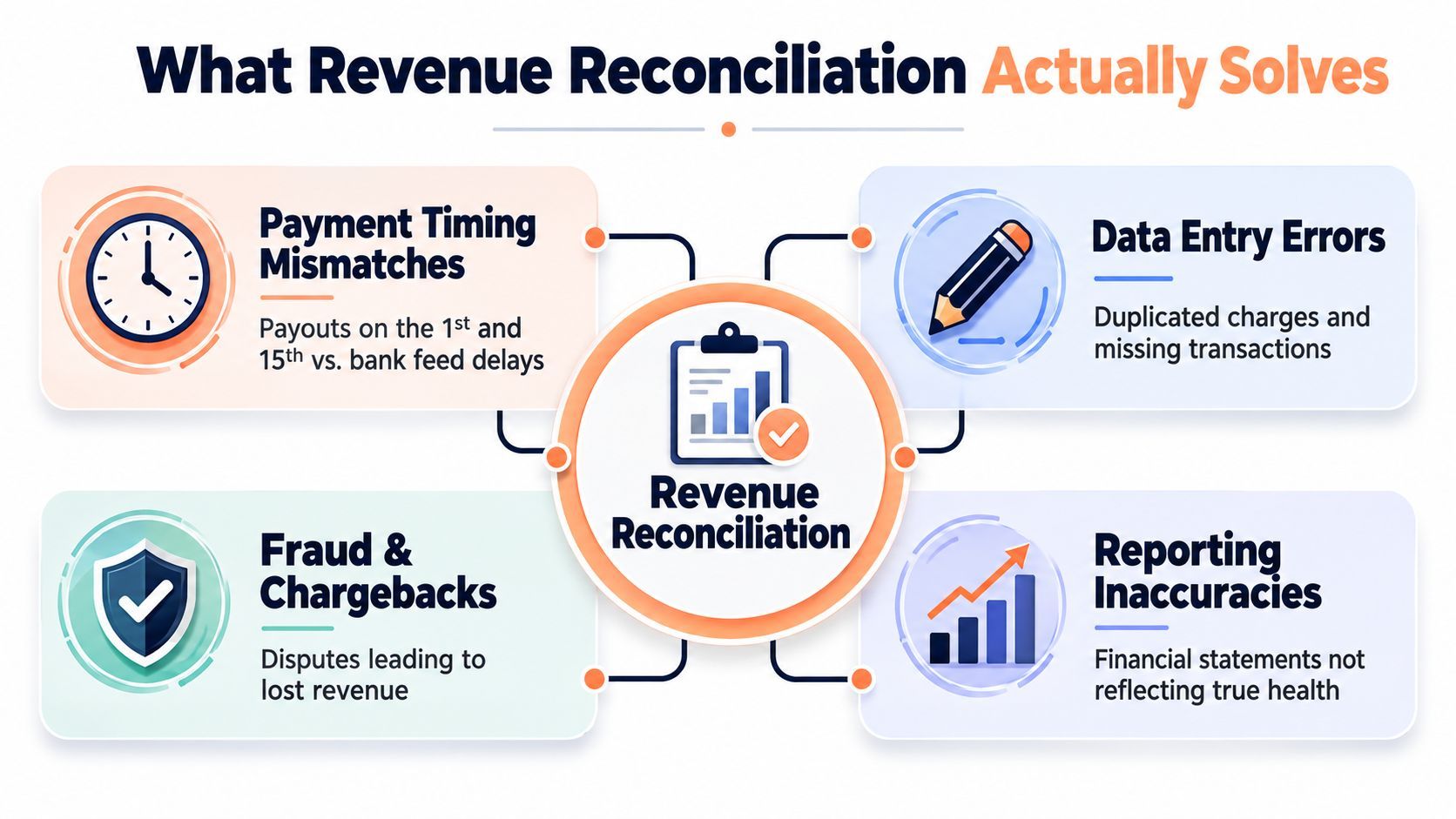
Revenue reconciliation answers one question, where did every dollar go. The answer has to span the ERP, the general ledger, subscription billing, payment processors, tax, and any partner or affiliate payout layer. If those systems disagree, the close doesn't just get slower, it gets less trustworthy.
The three mismatches that hurt SaaS teams most
The first problem is timing. Processor settlements, payout schedules, and bank posting dates rarely align neatly with invoice dates, so finance ends up looking at a temporary mismatch and wondering if it's real. That's why reconciliation has to distinguish between a delay and a true break.
The second problem is identity. A renewal, an upgrade, a refund, and a chargeback can all touch the same customer, but they won't always share the same reference in every system. If your team relies on invoice number alone, you'll miss edge cases and create false breaks.
The third problem is net-versus-gross logic. SaaS books often need to track gross invoice value, processor fees, tax, FX conversion, and partner splits separately. A line can be “reconciled” in the cash sense and still be wrong in the revenue sense.
Practical rule: if a break repeats, treat it as leakage until you've proven it's only timing.
That's the shift. Empirical evidence shows revenue reconciliation can be a measurable performance factor, not just an accounting cleanup. In a 2023 study of KTDA-registered tea factories, revenue reconciliation had a significant positive influence on financial performance, with a regression coefficient of 0.261 and p-value < 0.05 in the IOSR Journal of Economics and Finance study. Different industry, same lesson. When reconciliation quality improves, financial visibility usually improves with it.
For SaaS teams, that means the actual output isn't a matched spreadsheet. It's a cleaner operating picture that tells you whether the problem sits in billing, payments, tax, or revenue recognition. If you need a conceptual baseline for how deferred revenue fits into that picture, the deferred revenue overview is a useful companion.
And if you're still comparing processors, billing rails, or merchant-of-record options, the Refgrow Paddle vs Stripe guide is worth reading before you lock in a workflow that finance will hate later.
Building Side A and Side B Data Sets
The matching engine is only as good as the inputs. If Side A and Side B are messy, every exception report becomes a debate about who exported what, when, and with which filters. That's why the first job is building two standardized data sets instead of jumping straight into a matching rule.
Start with the right two sides
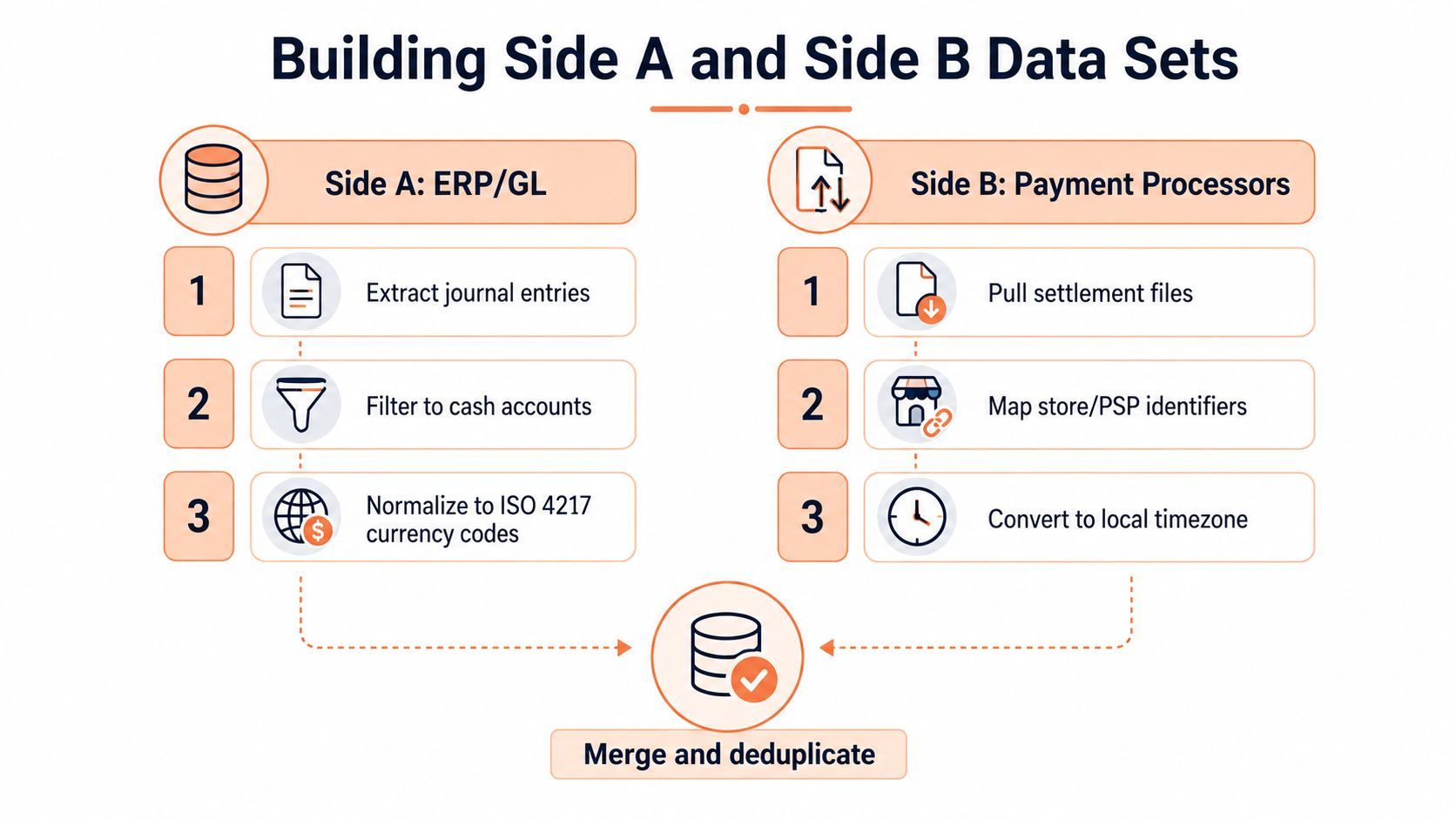
Side A should hold your ERP, GL, billing exports, and recognized revenue data. This side is what the business says it earned or booked. Side B should hold bank statements, PSP settlements, marketplace payouts, and partner remittance reports. This side is what moved.
The point isn't to collect everything and hope the spreadsheet survives. The point is to make both sides comparable. Normalize date formats, strip identifier prefixes, align currencies, and make decimal handling consistent before you try to match anything. The revenue reconciliation best practices guide lays out this standardized Side A and Side B setup well, especially the sequencing of deterministic matching before any fallback logic.
Use deterministic rules before you get clever
Strict identifier matching should come first. If subscription ID, attempt ID, payout reference, or settlement reference lines up cleanly, take the win. Only after those rules are exhausted should you fall back to combinations like amount plus date window plus counterparty.
Don't let fuzzy matching become the default. If you start there, you'll end up explaining machine-confidence errors to auditors and founders.
Many teams make mistakes by rushing into “smart” matching and skipping the fundamental work, which is often where errors are found. The better approach is to use deterministic methods first, followed by fallback logic, and finally resort to fuzzy matching only when necessary.
Build for real settlement shapes
SaaS and digital products rarely produce clean one-to-one patterns all day long. You'll see one-to-many when a single payout batches multiple invoices, many-to-one when several attempts settle into one net amount, net-to-net when fees and splits are already embedded, and partial matches when only part of a charge is captured. Tolerance logic matters here because small fee and rounding deltas should go into a controlled tolerance bucket, not a manual exception queue.
A workable analyst checklist is simple. Extract both sides from source systems, normalize identifiers and dates, convert to one currency standard with explicit FX timestamps, and tag any fee or rounding variance before matching. If that sequence is skipped, the rest of the process turns into cleanup work masquerading as finance discipline.
The same mindset applies if you're trying to automate invoicing and revenue flow in SaaS. The invoice automation guide is useful if your billing system is still generating avoidable mismatch noise before reconciliation even begins.
Matching Payments to Invoices and Subscriptions
The close gets real. A subscription can renew, prorate, upgrade, fail, retry, and refund inside the same billing window, and each event can look like a separate transaction if your matching key is too weak. The mistake is assuming invoice number alone will save you. It won't.
Match by subscription context, not just amount
For SaaS, the key usually needs to be subscription_id, billing_period, and attempt_id. That gives you enough context to separate a renewal from an upgrade charge and a retry from a new sale. If you only match on invoice number, you'll misclassify mid-cycle changes and create noise that looks like real revenue risk.
Here's the shape that tends to work. A 49 monthly plan gets prorated mid-cycle, a successful renewal posts, an upgrade adds a 30 charge, and a refund flips one invoice into a credit memo. In cash terms, several events happen. In finance terms, they all need to tie back to the same customer lifecycle with the right gross and net treatment.
Reconcile the full path, not just the receipt
Each line needs to answer a different question. Gross invoice value tells you what was billed. Net settled amount tells you what came through after fees or splits. FX conversion explains why the processor amount doesn't equal the ledger amount. Tax line items explain why the customer total doesn't equal revenue.
That's why subscription events need billing-period context attached to them. A duplicate webhook can fire and look like a second charge. A dunning retry can look like a fresh payment. A downgrade can create a new invoice for the same customer period without being a duplicate at all.
The fastest way to break reconciliation is to let operational events masquerade as financial events.
The matching routine should therefore classify transactions before it tries to settle them. Was it a renewal, an upgrade, a downgrade, a retry, or a refund against a prior attempt. Once that label is right, the cash tie-out gets much easier.
If you're operating a more complex subscription stack, especially one with usage, seat changes, or proration, the billing for SaaS guide is a useful reference for how billing design affects downstream matching.
Handling Refunds, Chargebacks and Disputes
Refunds and chargebacks are not the same thing, and treating them like one bucket is a good way to lose visibility. A refund is usually a deliberate customer or support action tied to a prior charge. A chargeback is a dispute path with a different timing, different evidence, and different recovery odds. If your reconciliation file merges them, you've already made recovery harder.
Keep the original transaction attached
A refund should point back to the original invoice and the original payment attempt, not show up as a new negative sale. That matters because the finance team needs to see what got reversed, why it got reversed, and whether the reversal closes the case or just starts another one. The same logic applies to partial refunds, where the original sale still exists but the settled amount has changed.
Chargebacks need a separate aging path. The timing is different, the evidence trail is different, and the outcome is often unresolved for longer than a routine refund. That means your exception register should carry reason code, root cause, and recovery status on every line, not just a generic “open” or “closed.”
Build an evidence packet, not a memory test
Every disputed case should keep the supporting material close to the line item. Customer communication, processor dispute codes, access logs, fulfillment history, or whatever proves service delivery should be stored with the case so whoever handles the next escalation doesn't have to hunt through inboxes.
The best teams don't wait for dispute chaos to tell them where the problem is. If refunds or chargebacks are climbing, the exception report already told you which plan, product, or surface is generating them. That's leakage information, not just support noise.
If your billing team is drowning in dispute follow-up, reduce ticket load with Halo AI is a practical read because it shows how billing support automation can help the team attach context faster instead of forcing manual case assembly.
Tracing Exceptions Back to Revenue Leakage
A month-end mismatch is not the finish line. It's a symptom. If you stop at “post the adjustment,” you've turned reconciliation into janitorial work and left the root cause untouched. The better move is to use exceptions as a leakage map.
Group exceptions by cause, not by queue
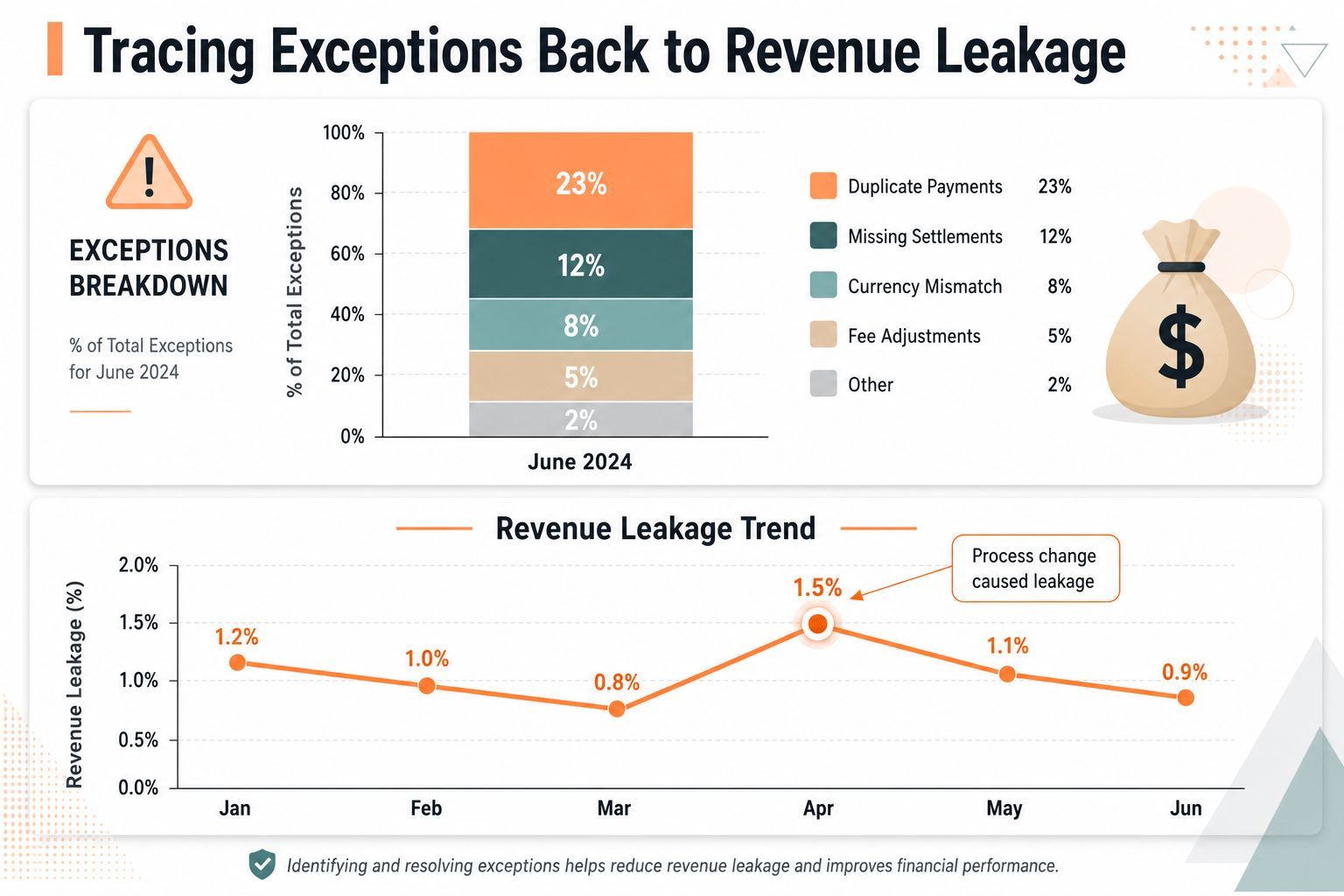
The categories that matter most in SaaS are usually pricing and discount errors, failed renewals recovered late, missed invoices for usage or seat overages, settlement delays, FX drift, and tax remittance gaps. Those are operational failures with financial consequences. If you lump them into one unresolved bucket, leadership sees volume but not causality.
The useful question is how much each exception type represents relative to the original transaction. That framing helps finance, billing, and product talk about priority in the same language. A recurring pricing error deserves a different response than an FX mismatch or a one-off processor delay.
Use one real break as a pattern test
Say a monthly gap traces back to a failed auto-renewal. The dunning flow retried multiple times before succeeding, but the original lapse still created a temporary revenue hole and a customer experience issue. The accounting fix alone doesn't solve the billing-policy problem that allowed the break to happen in the first place.
That's the central insight. Reconciliation should tell you whether a discrepancy came from a product rule, a retry policy, a billing configuration, or a settlement condition. Once you know that, the exception register stops being a close artifact and starts acting like an operations dashboard.
The healthcare benchmark from HFMA is a useful reminder of why this matters. Standard denial rates are often described as ranging from 5% to 10%, while 2% to 3% is considered successful performance, and hospitals are estimated to be underpaid by 2% to 5% of net patient revenue in the HFMA revenue integrity KPI analysis. Different industry, same operational truth. Small mismatch rates become material when transaction volume is high.
Build a monthly leakage view
The report I want from a finance ops team is simple. List each exception category, the root cause, the amount at risk, and whether the fix belongs in billing, product, payments, or tax. Then track whether the same break shows up again next cycle.
That one view changes the conversation. You stop asking whether reconciliation is done and start asking why the same leak keeps reopening.
Choosing Manual, Automated, and Continuous Reconciliation
A lot of teams ask the wrong question. They ask which tool to buy before they've decided how often the process should run. Frequency matters more than branding, because the operating model should match transaction volume, system complexity, and how fast you need to spot breaks.
Compare the operating models
| Reconciliation Model | Trigger Frequency | Effort per Close | Detection Latency | Best Fit |
|---|---|---|---|---|
| Manual spreadsheet close | Month-end | High | Slow | Low volume, simple rails, early-stage finance |
| Semi-automated workflow | Scheduled or event-driven batches | Moderate | Medium | Growing SaaS teams with stable rules |
| Continuous reconciliation | On webhook, payout, or settlement events | Lower after setup | Fast | Multi-currency, partner payouts, complex subscription stacks |
Manual still works when volume is low and the billing model is simple. It breaks when the same person has to chase settlements, invoice ties, and customer exceptions at once. Spreadsheet logic becomes a liability the moment people start editing the “source of truth” by hand.
Semi-automated reconciliation is the sane middle ground for many SaaS teams. Scripts pull the data, deterministic rules do most of the work, and reviewers only see exceptions. That approach is also where a platform like Creem fits naturally, since its Merchant of Record setup centralizes checkout, automated tax handling, subscription billing, revenue splits, and payouts into one system, which reduces the number of places the finance team has to reconcile in the first place.
Continuous reconciliation is where mature teams end up when they can't afford to wait for month-end to learn something is broken. It's especially useful when partner payouts, FX movement, or dunning recovery can change cash positions every day.
Accurate cash flow records depend on the same principle, clean source data and a reconciliation cadence that matches the business, not the spreadsheet owner's calendar. That's the decision rule. If errors can sit unnoticed for weeks, your cadence is too slow.
Audit Prep and the Habits That Keep You Ready
Audits get easier when reconciliation is boring. That doesn't happen because the team becomes perfect. It happens because every line item carries enough evidence that nobody has to reconstruct the story from scratch later.
Keep the evidence trail with the line
Every reconciled item should carry the source transaction, the matching rule applied, the tolerance used, reviewer sign-off, and any attached dispute or refund record. If you can't see that in one place, the audit trail is incomplete. If the trail is complete, the auditor's questions get much shorter.
A clean file structure helps too. Separate source exports, normalized working files, exception logs, adjustment support, and final journal entries so reviewers can move from raw data to posted result without guessing which version is final. That structure also protects the team when someone asks why an item was treated as a tolerance case instead of a break.
Make close habits part of the control, not the ritual
-
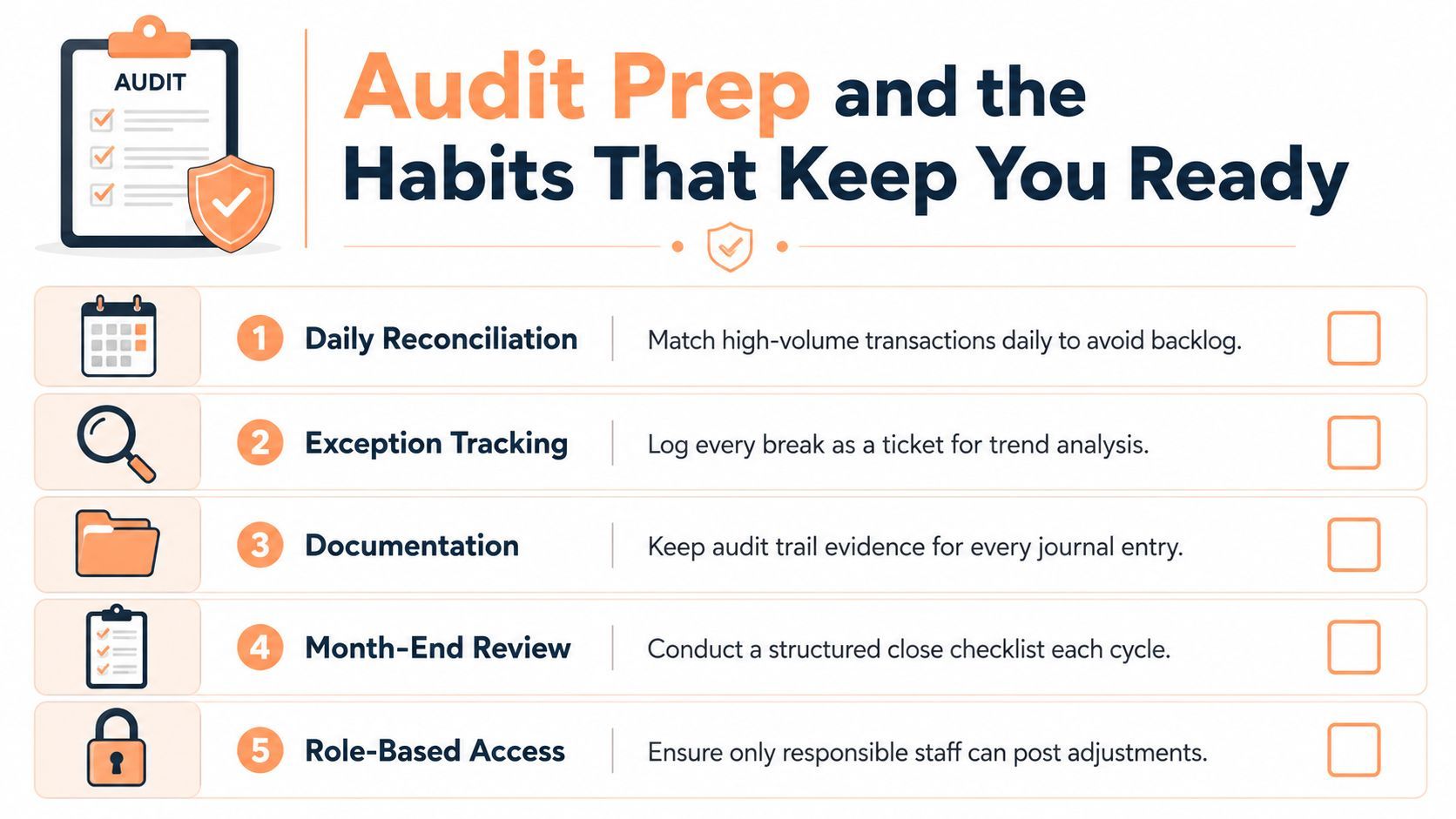
Daily Reconciliation: Match high-volume items before they pile up and turn every close into archaeology.
-
Exception Tracking: Log every break as a ticket so recurring patterns don't disappear into inboxes.
-
Documentation: Keep the evidence next to the entry, not in someone's memory.
-
Month-End Review: Use a structured checklist so the team doesn't rely on whoever stayed latest.
-
Role-Based Access: Let only the right people post adjustments, because uncontrolled edits destroy trust fast.
The recurring audit questions are usually straightforward. How often do you reconcile, what happens when the processor report doesn't tie to the GL, and who signs off on the final exception list. The best answer is the one backed by routine, not heroics.
A minimum cadence depends on volume, but high-volume subscriptions and payouts should never wait for a once-a-month look. When reconciliations happen continuously or at least daily on the busiest streams, month-end stops feeling like a rescue operation.
If you want fewer manual ties, fewer surprise exceptions, and better visibility across subscriptions, splits, tax, and payouts, Creem gives software teams a single system for checkout, billing, automated tax handling, revenue splits, and payout flows. Visit Creem if you want a setup that makes reconciliation cleaner before finance ever opens the spreadsheet.