If you're wiring up checkout for a SaaS, a digital download, or a React Native app, Apple Pay usually shows up as the thing everyone wants to “get in later.” That's a mistake. In the U.S. alone, the Consumer Financial Protection Bureau report on mobile payments shows Apple Pay had already become a mainstream checkout rail, and Apple's own reported scale points to a product that moved from novelty to infrastructure in a few years, not a decade.
The tricky part is that apple pay integration is not just a button. The core work sits behind the surface, in device checks, merchant validation, token handling, and whether your PSP or your own backend takes on decryption. If you've ever shipped a flow that looked fine in dev and then leaked conversion in production, Apple Pay is one of the places where that gap shows up fast.
Why Apple Pay Integration Matters in 2026
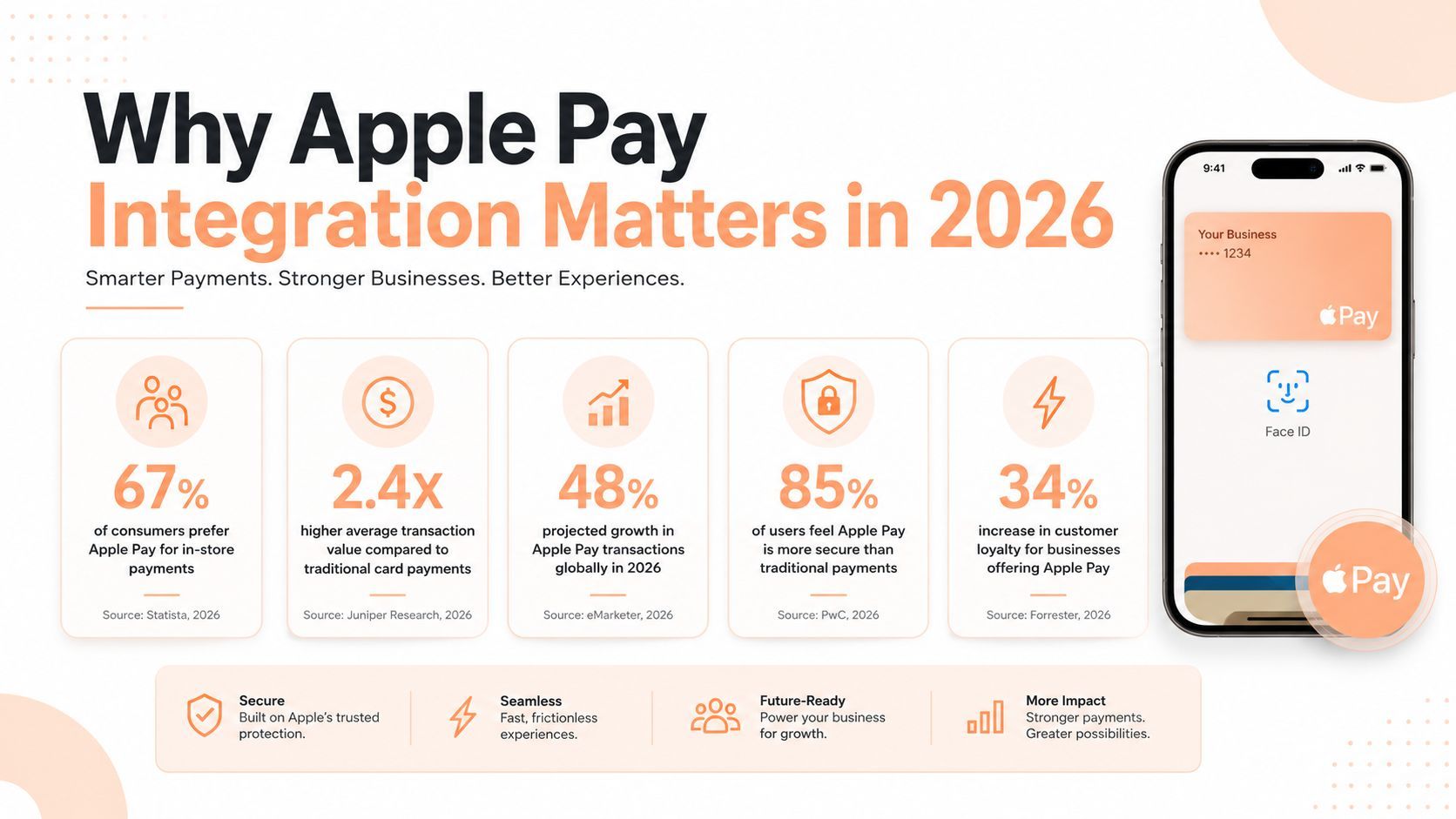
A checkout page can look polished and still lose the sale if Apple Pay is buried too late in the flow. On U.S. iPhone traffic, that matters because the CFPB reported broad Apple Pay activation among iPhone users, heavy in-store usage, and meaningful contactless spend tied to the wallet experience. That is behavior you have to design around, not a niche edge case.
Apple's own scale changes the engineering bar too. Apple said Apple Pay reached 10 billion transactions by 2019, and later Apple-reported figures cited in 2026 place it at 89 markets, with 11,000+ bank and network partners and 20+ local payment networks (Apple Pay statistics summary). If you sell subscriptions, digital goods, or any product with a short decision path, Apple Pay now belongs in the default checkout set for a lot of markets.
Practical rule: if your audience is on iPhone and you do not surface Apple Pay early, you are making them type card details for no good reason.
A clean-looking button is only part of the work. Apple breaks the integration into presenting the Apple Pay option, merchant validation, payment authentication, and payment processing, and that split is useful because it separates the customer-facing UI from the trust chain behind it. The frontend is straightforward. The validation session, token handoff, and decryption path are where integrations usually fail (Apple's merchant integration guidance).
For teams that ship payments alongside subscriptions, entitlements, receipts, and renewal logic, the payment method should not become the entire system. That is why a broader payment management system often sits around Apple Pay instead of beside it. If you are extending wallet experiences beyond checkout, how BonusQR works with Apple Wallet is a useful example of how the wallet surface can support more than one transaction path.
The takeaway is direct. In 2026, skipping Apple Pay is a checkout decision with a clear downside. The rest of the work is wiring it in without creating dead ends, compliance surprises, or a polished flow that still loses users at the last step.
Prerequisites Before You Write Any Apple Pay Code
Before you touch client code, the server side needs to be ready. Apple requires that pages showing the Apple Pay button be served over HTTPS, with a valid SSL certificate and TLS 1.2 or newer. That sounds basic, but teams still miss it when the button is embedded on a staging domain, a preview environment, or a subdomain that doesn't inherit the same certificate setup (Apple guidance).
You also need a public merchant identifier registered in your Apple developer account. The validation step won't work without it because Apple expects the merchant session to come from a registered identity and a publicly reachable endpoint. Your hosting environment must be able to make outbound TLS requests to Apple's servers for merchant validation, so don't wait until the end of implementation to discover your network policy blocks it.
Confirm the processor before the front end
The PSP question comes first, not last. Apple's guidance says you should confirm that your payment service provider supports Apple Pay before you expose the flow, and that matters because support varies by channel. Web and in-app integrations don't always share the same request shape, the same entitlements, or the same backend responsibilities (Apple guidance).
If your PSP can't process the Apple Pay flow you're building, a perfect front end just creates a broken promise.
A good pre-flight check is simple enough to run in a stand-up:
-
HTTPS is live everywhere: Every page that can show the Apple Pay button is served securely.
-
Merchant ID exists: The identifier is created in Apple's developer tooling and tied to the right domain or app.
-
Validation endpoint is reachable: Your server can accept the Apple validation callback and talk back out to Apple.
-
PSP support is confirmed: Your processor explicitly supports Apple Pay for the channel you're shipping.
-
PCI scope is understood: You know who decrypts the token before any code ships.
If you can't answer those five items cleanly, stop there. The front end can wait. The checkout failure you avoid now is cheaper than the support ticket you'll get later.
Wiring Up Apple Pay on the Web and in iOS Apps
The client flow is the same rhythm whether you're on Safari or inside a native iOS app. The shopper sees the button, your code triggers validation, the Apple Pay sheet opens, the user authenticates, and the token moves to your backend. The difference is mostly in the API surface and where the framework lives.
On the web, render only what the device can actually use
On the web, don't show the button just because the page loaded. Apple recommends using ApplePaySession.canMakePayments() so unsupported devices never get a dead-end checkout path (Apple merchant integration guidance). That check isn't cosmetic. It prevents support pain and avoids teaching users to tap a button that can't complete.
The merchant validation callback comes next. The browser asks your server to create a merchant session, your backend talks to Apple, and only then does the payment sheet appear. If that endpoint is slow, private, or misrouted, the whole checkout feels broken even though the visible UI looks correct.
In native iOS, the PassKit path is cleaner but not simpler
Inside iOS, the common path runs through PassKit and PKPaymentAuthorizationController. The request object carries the transaction details, and you configure shipping and contact fields there so the sheet asks only for what you need. That matters for digital goods, where unnecessary fields just add friction.
A small but important operational habit is to keep the client flow narrow. You're not building a general payment screen. You're wiring a controlled handoff into Apple's sheet, then waiting for the token. For teams who've shipped through platforms that abstract some of this, a good practical reference is a guide on NMI for SaaS retention, because it shows how processor behavior shapes the integration surface.
The integration rhythm should feel boring by the end, and that's a good sign:
-
Button appears only on supported devices
-
Merchant validation runs server-side
-
Apple Pay sheet opens
-
User authenticates with Face ID, Touch ID, or passcode
-
Encrypted token returns for backend processing
If any one of those steps is too eager, the flow becomes fragile. If they're sequenced correctly, the user experience feels fast because it has very little room to go wrong.
Handling the Apple Pay Token on Your Server
The token is the part that most guides wave at and move on from, but that's the part you have to get right. After the shopper authorizes the payment, Apple Pay returns an encrypted token. In practical terms, that token carries the payment instrument, a transaction identifier, and the cryptogram your PSP uses to authorize the charge. Apple's framework expects you to hand that token off correctly, not inspect it like a normal payload.
With API-based processing, the integration is explicit. Adyen's flow says to request paymentMethods with the correct countryCode, amount.currency, and channel, where Web is used for Safari and iOS is used for in-app flows, then send the applePayToken in a /payments request after stringifying and Base64-encoding the token (Adyen Apple Pay API guidance). That encoding detail matters because the token you get from the client isn't ready to post as raw JSON in the shape many PSPs expect.
Who decrypts the token is the real design choice
The biggest backend decision is who does the decryption. If your PSP handles it, your PCI scope is usually narrower and your implementation is simpler. If you decrypt it yourself, you take on the security controls, key handling, and compliance burden that come with it, which is a very different engineering responsibility.
| Option | Who Decrypts | PCI Scope Impact | Best For |
|---|---|---|---|
| PSP-managed decryption | Payment processor | Lower operational burden | Most SaaS teams, smaller engineering groups |
| Merchant-managed decryption | Your backend | Higher compliance and key-management burden | Teams with PCI maturity and custom payment infrastructure |
That table is the decision tree in plain language. If you don't need to own decryption, don't volunteer for it.
The server-side rule is simple and easy to forget when debugging. Never log the raw token, and never store it past the authorization window. If you need observability, log request IDs, status codes, and PSP responses, not the payload that can authorize money.
For teams building webhook-driven systems, token handling also needs to line up with your downstream payment events. The same discipline applies in webhooks for site integrations, where you want clean event handling without turning your payment payload into a debugging artifact.
Testing Apple Pay Across Devices and Browsers
Apple Pay testing breaks in the boring places. Sandbox looks straightforward in docs, then real hardware, sign-in state, browser support, and validation routing start to matter. Treat testing as a matrix problem, not a single happy-path demo.
Sandbox needs the right device state
For Apple Pay sandbox on a real device, you need a signed-in iCloud account and a test card added to Wallet. If that setup isn't right, the flow may look supported but won't complete the way you expect. That's why a quick desktop-only pass is never enough for Apple Pay, especially if you're shipping both web and in-app flows.
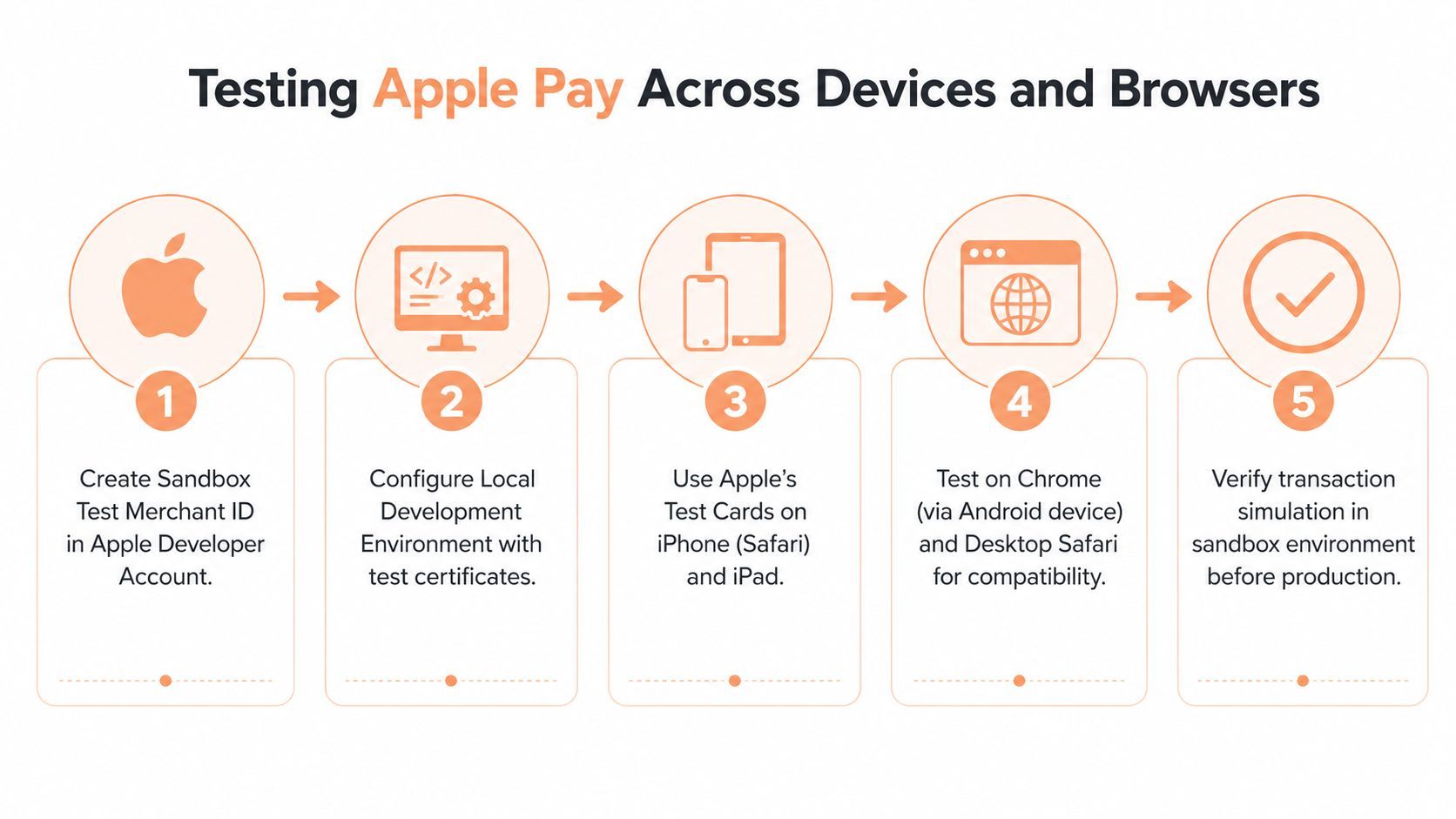
The browser matrix matters too. Test Safari on macOS, Safari on iPhone, in-app on iPhone and iPad, and now the iOS 18 browser fallback path that lets users complete Apple Pay on a non-Safari browser by scanning a code with their iPhone (Apple WWDC24 announcement). That change matters because teams that assumed Safari-only behavior will miss real traffic patterns on mixed-device sessions.
For card testing, keep the mechanics clean and repeatable. A useful reference for test-card workflow discipline is Stripe test cards, because the point is the same regardless of processor, get a predictable sandbox response and verify the auth path end to end.
Common test errors usually point to one broken layer
The highest-frequency failures are easy to classify once you know what to look for:
-
ApplePaySession** is undefined:** The page isn't on HTTPS, or the browser/device doesn't support the flow you're trying. -
Merchant validation returns 404: The validation endpoint URL is wrong, unreachable, or not publicly exposed.
-
Unsupported merchant capabilities: Your PSP hasn't enabled Apple Pay for that merchant ID or channel.
-
Sheet opens but auth fails: The token path or PSP configuration is wrong, not the button itself.
Practical rule: when Apple Pay fails, assume the bug is outside the visible sheet until proven otherwise.
Before launch, read the authorization result in your PSP dashboard rather than trusting the UI alone. The sheet can look perfect and still fail at the backend handoff. A visible success state without a confirmed PSP approval is just a nicer-looking error.
Conversion Pitfalls Most Apple Pay Guides Ignore
Most guides stop once the button renders. That's too late. The conversion work starts earlier, because shoppers don't always notice Apple Pay until the final step, and many merchants don't show branding inside the sheet in a way that builds confidence. Both of those issues create avoidable drop-off.
Surface it before the last checkout screen
If the Apple Pay option only appears at the end, you've already forced users through unnecessary friction. Put it where intent is already forming, in the cart or on the product page for eligible flows. That's especially relevant for subscriptions and digital goods, where the customer often knows what they want before they're asked to fill in a form.
Branding inside the sheet matters too. Merchant name and logo aren't decoration, they're verification cues. When the sheet looks generic, users hesitate, and hesitation is a conversion tax.
Recurring billing needs transparency
Apple also added a clearer Preauthorized Payments view in recent releases, which points to a broader shift toward transparency around recurring charges (Apple merchant integration guide). If you sell subscriptions, that should influence how you describe recurring billing in the UI and how you configure the checkout experience. Users should feel like they know what they're authorizing.
The browser change in iOS 18 makes this even more important. Apple Pay is no longer something you can mentally tie only to Safari. Users on Chrome or Firefox on iPhone can be handed off through a QR-code flow, which means your copy needs to explain what happens next instead of assuming an in-browser autofill path will carry the moment.
If your team cares about reducing inbox friction as well, the same product principle applies. Clear sender identity, good placement, and predictable UX are why how to stop email from going to spam in Gmail is such a useful parallel, because trust cues do as much work as the underlying system.
Use Apple Pay like a conversion surface, not a checkbox. That means:
-
Show it early: Don't wait until the final confirmation step.
-
Brand the sheet properly: Make the merchant identity unmistakable.
-
Clarify recurring charges: Don't leave subscriptions ambiguous.
-
Design for iOS 18 fallback: Users may complete the flow from another browser.
The difference between a technically enabled flow and a monetizing flow is often just whether the customer feels safe enough to finish.
Troubleshooting and Pre-Launch Checklist
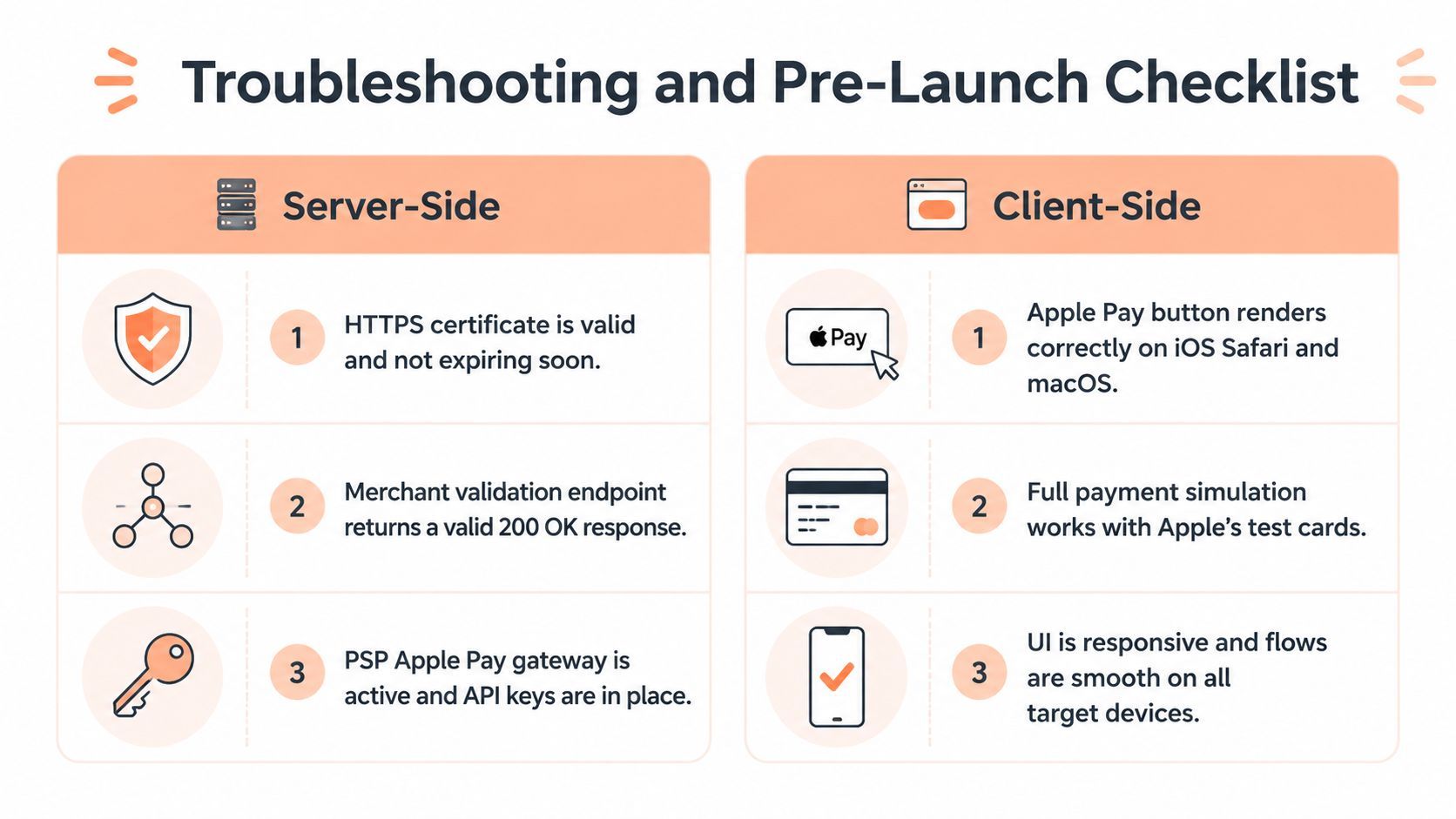
The last day before launch should feel like verification, not optimism. Apple Pay failures usually fall into a few buckets, and you can check each one directly before users do it for you.
Server-side checks
-
HTTPS is valid and current: The Apple Pay page is secured and the certificate isn't broken.
-
Merchant validation responds publicly: The endpoint is reachable and returns a clean validation response.
-
PSP support is active: Apple Pay is enabled in the gateway and the merchant account is configured correctly.
-
Decryption ownership is assigned: Someone on the team knows whether the PSP or your backend handles it.
Client-side checks
-
Button only appears on supported devices: Unsupported users never see a dead end.
-
Merchant ID and capabilities are correct: The app or web domain matches the Apple setup.
-
Shipping and contact fields are intentional: You're not asking for data you don't need.
-
Merchant branding is set: The Apple Pay sheet shows a recognizable business name and logo.
Token and conversion checks
-
Raw tokens aren't logged: Observability excludes sensitive payloads.
-
The token path works end to end: The PSP receives the encoded token and returns a real authorization result.
-
Apple Pay is visible before final checkout: Users don't discover it too late.
-
Fallback copy is clear: iOS 18 browser handoff doesn't confuse the shopper.
If a button doesn't appear, check HTTPS and canMakePayments() first. If validation fails, check the endpoint URL and public reachability. If users bounce out of the sheet, check merchant branding and whether the PSP authorization path is succeeding.
For SaaS and digital product teams, the final decision is whether to build all of this yourself or collapse the stack into one layer. A merchant-of-record platform like Creem can combine global checkout, Apple Pay, subscriptions, and tax handling in one integration, which is worth comparing against a from-scratch payment build before you commit engineering time.
If you're planning an Apple Pay rollout for a subscription product, digital download, or app checkout, Creem can give you a single place to handle checkout, Apple Pay, subscriptions, and tax without stitching together separate payment and compliance tools. Visit Creem to see whether that approach fits your stack before you start building every payment edge case yourself.