
Table of Contents
- The Moment You Outgrow a Simple Payment Button
- Why Subscription Billing Became a Strategic Category
- What a Subscription Billing Platform Actually Does
- Comparing Leading Subscription Billing Platforms
- Where Platforms Really Differ and Why It Matters
- Matching Platforms to Real Buyer Profiles
- A Decision Framework You Can Actually Use
- Choosing the Right Path Forward
Your SaaS started with a checkout link, a handful of plans, and a spreadsheet that seemed perfectly adequate. Now customers are upgrading mid-cycle, annual invoices need manual attention, failed cards are creating support tickets, and finance is reconciling refunds in a Slack thread. International sales have added tax questions, partner payouts are becoming operational work, and every pricing experiment needs engineering time.
That's the point where a subscription billing platform stops being a convenience and becomes core infrastructure. The right choice won't just collect recurring payments. It'll determine how quickly you can change pricing, how much cross-border compliance your team owns, how reliably you recover failed renewals, and whether finance can close the books without rebuilding transaction history by hand.
The Moment You Outgrow a Simple Payment Button
A founder I know launched a small SaaS product with a hosted checkout and a few payment links. It worked well at first. Customers picked a plan, paid, and received access. The team could see transactions in the payment dashboard, while a spreadsheet tracked which customers had trials, discounts, or custom terms.
Growth changed the shape of the work. A customer upgraded halfway through a billing period, so someone calculated a credit manually. Another requested an annual invoice with a purchase order. Several cards failed at renewal, and the team created a Slack channel to coordinate reminders, refunds, and account extensions. None of these tasks was individually difficult. Together, they became a permanent operating system built from exceptions.
Practical rule: If a pricing change requires a spreadsheet, a support ticket, and an engineer, your payment setup has become a product constraint.
The pressure usually arrives through predictable points:
-
Lifecycle changes: Trials, pauses, upgrades, downgrades, cancellations, and reactivations need consistent rules, especially when a customer changes plans mid-cycle.
-
Recovery work: A failed renewal needs more than a single email. Your team needs retry logic, payment-method updates, grace periods, and a clear decision about when access ends.
-
Cross-border selling: Customers in different countries introduce tax collection, invoice requirements, local payment preferences, and payout questions.
-
Finance operations: Refunds, credits, annual commitments, and usage charges must reconcile with accounting and revenue reporting.
-
Pricing experimentation: Tiers, add-ons, seat counts, discounts, and usage components turn a simple recurring charge into a product catalog.
Stitching together payment links, spreadsheets, tax tools, and custom webhooks can work for a while. It also creates ownership confusion. Engineering owns the billing logic, finance owns the corrections, and customer success absorbs the complaints when the two systems disagree.
A purpose-built platform absorbs much of that lifecycle work into a controlled model. It gives product teams room to test monetization, gives finance a reliable record of billing events, and gives developers APIs instead of a growing collection of one-off fixes. Choosing the platform at this moment matters because the architecture you select will shape every future price change, market launch, and partner arrangement.
Why Subscription Billing Became a Strategic Category
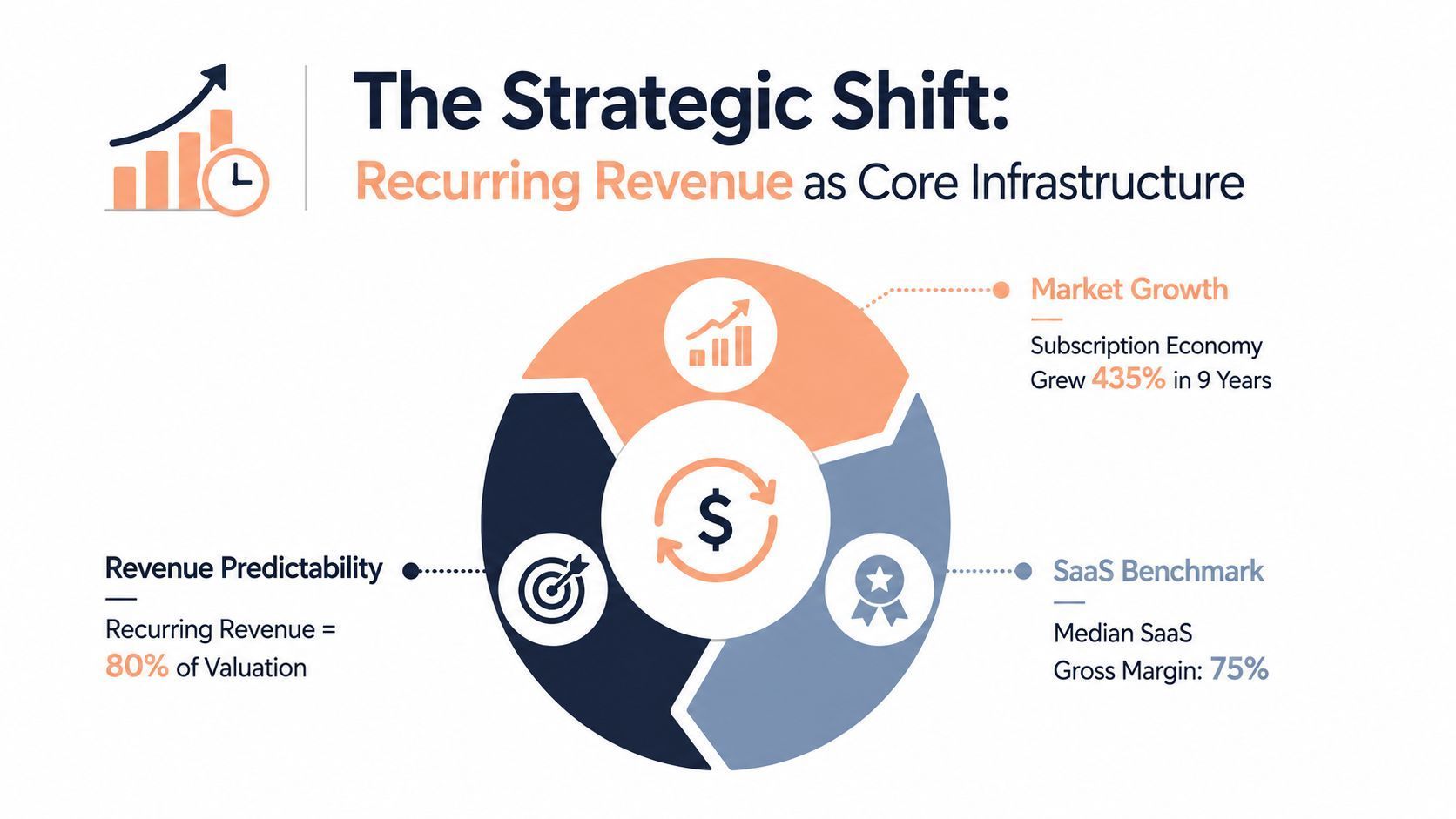
Recurring revenue infrastructure has moved well beyond software invoicing. Subscription models now support SaaS, digital media, memberships, consumer applications, and products that combine a recurring commitment with usage charges. That expansion explains why the subscription billing management market has become a multi-billion-dollar infrastructure category rather than a narrow back-office tool.
One 2026 industry estimate of the subscription billing management market valued it at USD 7.3 billion in 2025, projected USD 8.2 billion in 2026, and forecast USD 26.0 billion by 2035, with a 13.6% CAGR. The same source also presents an alternative estimate of USD 9.25 billion in 2026 and USD 19.36 billion by 2031, implying a 15.9% CAGR. The estimates differ, but the direction is clear. Platforms are becoming foundational for companies that need to monetize recurring products across North America, Asia-Pacific, and other major markets.
Recurring revenue changes the buyer's risk
The broader market makes the shift even easier to see. Juniper Research's 2024 subscription economy analysis reported subscription economy revenue of USD 593 billion in 2024 and projected USD 996 billion by 2028, a 68% increase. Another estimate in the same verified market context valued the global subscription economy at USD 492.34 billion in 2024 and projected USD 1.512 trillion by 2033, with North America representing 38.2% of 2024 revenue and B2B representing 55.2%.
Those figures matter because billing failures repeat. A declined renewal, an incorrect tax treatment, or a broken revenue split can affect a customer relationship and every future billing event attached to it. Dunning effectiveness therefore deserves executive attention. Recommended KPIs include recovery rate, involuntary churn rate, authorization or decline rate, days to recover, and revenue recovered, as outlined in Chargebee's dunning management guidance. A 2026 benchmark dataset cited there reported a 12.7% median attempted recovery rate and $1,236,764 in failed payments recovered in one month across its sample.
Pricing is equally strategic. Teams increasingly combine fixed subscriptions with seats, add-ons, and usage. If the billing engine can't represent those changes cleanly, product managers avoid experiments or engineers turn every experiment into a migration project. Our guide to billing for SaaS covers that connection between monetization design and billing operations.
Founders evaluating this category should also understand the company-building ecosystem around it. A curated Gritt.io investor database can help teams research investors focused on billing infrastructure and adjacent payments software. The buyer's job, however, isn't to select the vendor with the lowest visible fee. It's to match operational complexity with the platform's actual coverage.
What a Subscription Billing Platform Actually Does
A payment gateway moves money. A finance suite records and reports on money. A subscription billing platform sits between the product and those systems, translating commercial rules into invoices, payment events, entitlements, and financial records.
The core job starts with the catalog. The platform should model plans, billing intervals, trials, discounts, add-ons, seats, usage, and one-time charges. It should then apply those rules consistently when customers subscribe, change plans, receive credits, or cancel.
The billing lifecycle
A capable platform handles the full subscription lifecycle:
-
Plan creation: Define fixed, tiered, seat-based, usage-based, or hybrid pricing.
-
Subscription management: Start trials, schedule renewals, process upgrades, and calculate proration.
-
Invoicing: Generate invoices, receipts, credits, and payment records.
-
Payment orchestration: Connect payment methods and manage recurring authorization flows.
-
Dunning: Retry failed payments, notify customers, update payment methods, and enforce grace periods.
-
Compliance workflows: Apply tax rules and support revenue recognition or the necessary accounting integrations.
-
Analytics: Report on recurring revenue, churn, failed payments, recovery, plan performance, and customer cohorts.
A generic gateway usually won't understand why a customer moved from one tier to another or how much revenue should be recognized over a contract period. An ERP can preserve accounting records, but it isn't usually the right place to launch a new usage meter or test a discount structure. The billing platform owns the commercial logic, while the gateway and finance stack perform adjacent jobs.
Usage and hybrid pricing deserve special scrutiny. A platform needs to ingest product events, rate them correctly, and present the result in an invoice customers can understand. Teams exploring that model can use this usage-based billing guide as a practical reference.
Merchant of record is a responsibility decision
A merchant of record, or MoR, acts as the seller for defined transactions and can assume responsibility for collecting, filing, and remitting applicable indirect taxes. A billing tool that isn't an MoR generally gives the merchant tools and integrations, but the business remains responsible for compliance, registrations, filings, and tax decisions.
That distinction changes staffing and risk. Growth teams need fast checkout and flexible pricing. Finance needs auditability, revenue data, and reliable exports. Engineering needs stable APIs, webhooks, idempotent events, and sandbox behavior that resembles production. The right platform serves all three without forcing one team to become the permanent translator for the others.
Comparing Leading Subscription Billing Platforms
No platform wins every use case. Stripe Billing favors teams that want API control and already use Stripe. Paddle and Lemon Squeezy favor digital sellers that value merchant-of-record coverage over maximum control. Chargebee and Recurly suit teams that need deeper subscription operations, integrations, and revenue-recovery workflows.
The table below is a practical positioning guide, not a substitute for contract review. Pricing and coverage can vary by product, geography, payment method, volume, and negotiated terms.
Subscription Billing Platform Comparison
| Platform | Pricing Model | Developer Experience | Tax & MoR Coverage | Dunning Capabilities | Integration Ecosystem |
|---|---|---|---|---|---|
| Stripe Billing | Percentage-based recurring-payment pricing is emphasized publicly | API-first, strong for custom flows and usage metering | Strong payment infrastructure, but confirm which tax and seller responsibilities remain with the merchant | Billing and retry workflows available, with depth depending on configuration | Broad Stripe ecosystem and extensive developer tooling |
| Paddle | Platform-level commercial pricing, typically evaluated alongside MoR coverage | Hosted checkout with integration options for software sellers | Merchant of record model is a central fit for global digital sales | Subscription recovery and lifecycle tools | Strong fit for digital products and software workflows |
| Lemon Squeezy | Platform-level commercial pricing, evaluated with checkout and MoR coverage | Hosted checkout and developer integrations aimed at makers | Merchant of record model is central to the offering | Subscription management and payment recovery workflows | Particularly suitable for digital goods and lightweight product stacks |
| Chargebee | Published tiering and broader subscription-management packaging | API and integrations for growth-stage operations | Tax and compliance capabilities require scope review, especially across jurisdictions | Strong dunning, recovery, and subscription operations | Broad finance, CRM, accounting, and business integrations |
| Recurly | Custom commercial pricing tied to product and payment volume considerations | Subscription APIs and operational tooling | Global billing and tax support require detailed implementation review | Retention and dunning are core strengths | Wide payment gateway and business-system connectivity |
Stripe's strength is speed and control. Its public model emphasizes API-led billing and usage metering, but percentage-based recurring-payment pricing can become a meaningful consideration as volume grows. Chargebee is the stronger candidate when pricing experiments, integrations, and finance workflows matter more than a minimal implementation. Recurly belongs on the shortlist when failed renewals and retention are the main constraint.
Paddle and Lemon Squeezy reduce the merchant's compliance workload through their MoR orientation, but that convenience comes with less control over the commercial and payment stack than a direct processor-led setup. That trade-off is often rational for a small digital-product business, less so for a company that needs custom routing, complex marketplace economics, or direct control over every customer relationship.
The comparison is therefore about operating model, not feature count. Ask who owns tax exposure, who controls the checkout, who handles recovery, and who will reconcile partner payouts before comparing headline rates.
Where Platforms Really Differ and Why It Matters
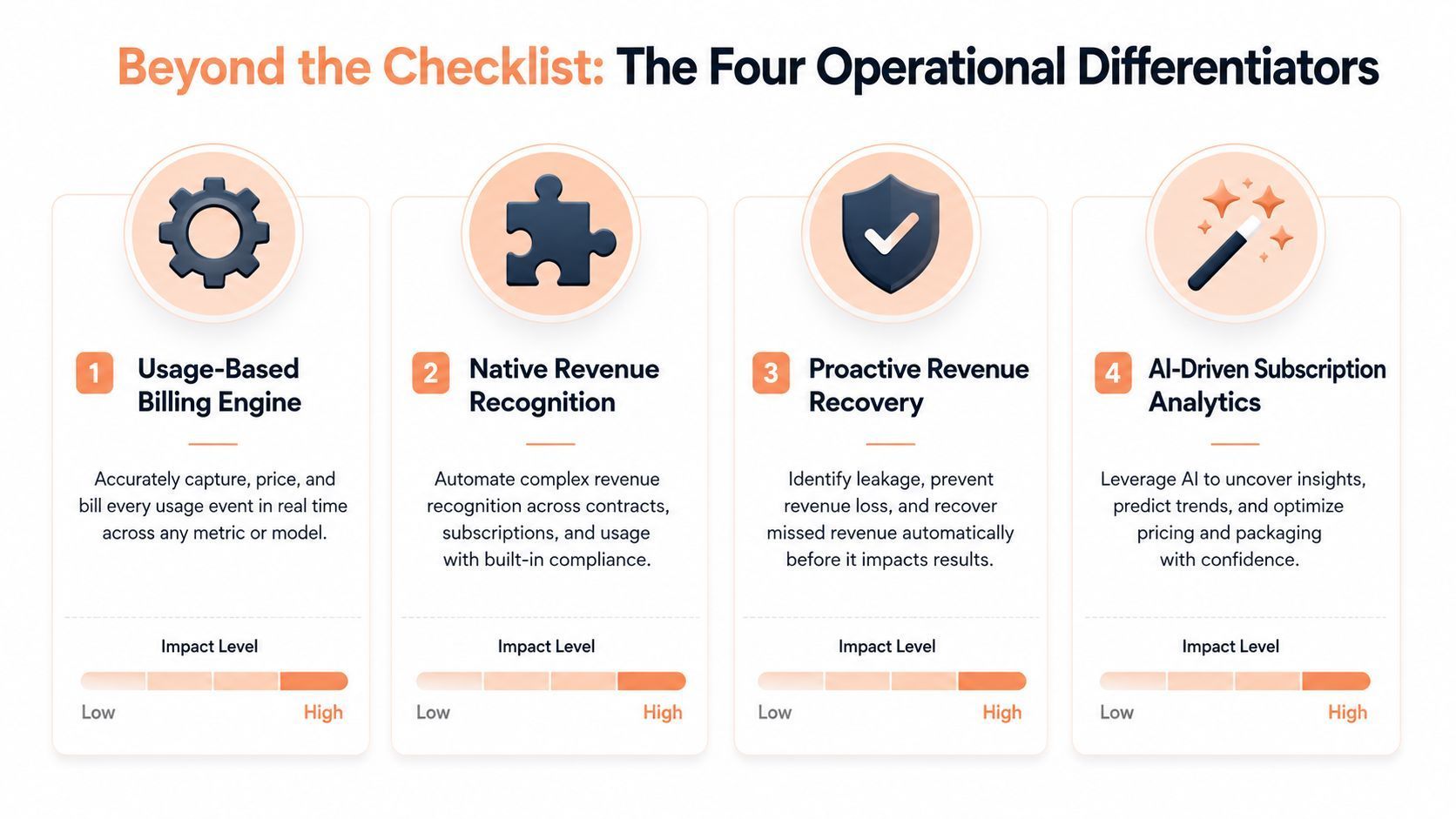
Feature pages make billing look interchangeable. The operational details are not. Four areas determine whether a platform supports growth or creates a new queue of tickets for engineering and finance.
Merchant of record coverage
The first question is not whether a vendor supports tax. It's who carries the responsibility. If the platform acts as merchant of record, it may collect, file, and remit indirect taxes for covered transactions. If it doesn't, your company may still need registrations, calculations, filings, evidence, and local advice.
That difference becomes more important as customers arrive from new jurisdictions. A multi-currency checkout doesn't automatically solve tax liability, invoice rules, or local reporting. Treat MoR coverage as a contract and responsibility question, not a checkout feature.
Tax depth and revenue splits
Tax handling must match the product and the transaction. Software subscriptions, digital downloads, usage charges, and services can create different treatment questions. A platform that only calculates tax at checkout may leave your team with filing, exemption, documentation, or reconciliation work.
Revenue splits create a second hidden layer. Agencies, marketplaces, and partner-led products need to route money to creators or contractors, record the split, coordinate payouts, and manage the associated documentation. A basic subscription engine can collect the customer's payment while leaving your finance team to distribute proceeds manually.
Developer ergonomics
Pricing experimentation depends on implementation quality. Developers should test how the platform handles webhook retries, idempotency, event ordering, SDK type safety, sandbox parity, versioning, and failed API calls. If a pricing experiment requires risky changes to entitlement logic or invoice generation, the team will ship fewer experiments.
The expensive platform is often the one that looks cheap but leaves your team maintaining tax, payout, and recovery infrastructure.
Watch the operational walkthrough below, then ask vendors to demonstrate the exact workflows your team will run rather than showing a prepared feature tour.
Headline processing rates matter, but they aren't the complete cost. Once a company sells across borders or adds partner economics, administrative labor, implementation delays, reconciliation, and missed recovery opportunities can outweigh a visible fee difference. This merchant of record versus payment processor comparison is useful when clarifying which responsibilities stay with the seller.
Matching Platforms to Real Buyer Profiles
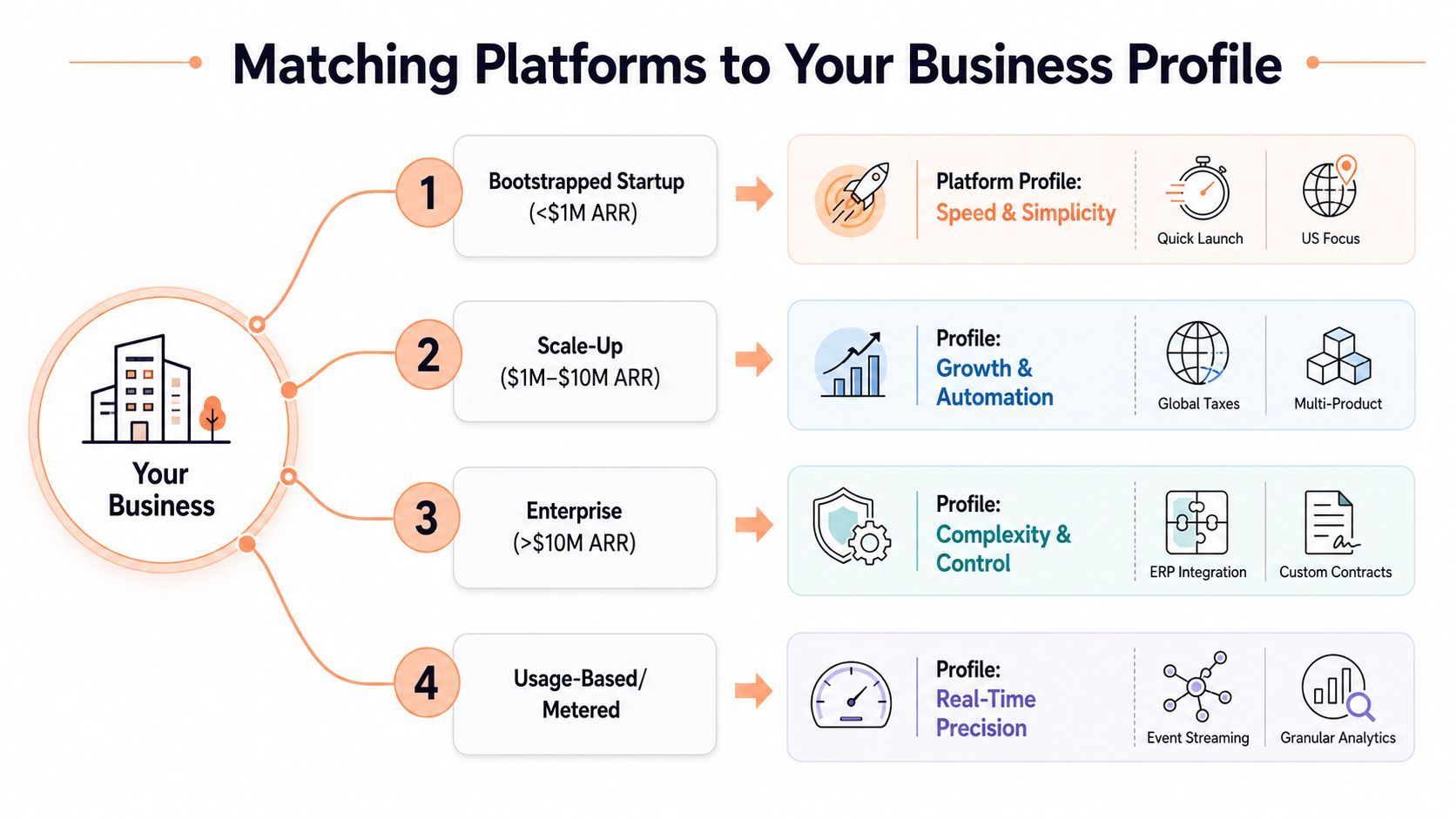
A platform should fit the business you're operating, not the business you hope to become someday. Overbuying creates implementation burden. Underbuying creates migrations at the exact moment the team needs speed.
The bootstrapped SaaS startup
A small SaaS team selling mainly to US customers usually benefits from an API-first platform with a familiar payment workflow. Stripe Billing is the natural starting point when the team already uses Stripe and has engineering capacity to own tax scope, checkout behavior, and custom billing logic.
The trade-off is responsibility. Direct control gives developers flexibility, but the company must decide which compliance and finance functions it will operate itself. Don't choose that path because the dashboard looks simple. Choose it because someone owns the work behind the dashboard.
The indie maker or digital-product creator
A creator selling courses, downloads, plugins, or a lightweight software product often benefits from a merchant-of-record platform such as Paddle or Lemon Squeezy. The attraction is operational compression. The platform can absorb more of the global tax and checkout burden while the creator focuses on the product and distribution.
The cost is control. Hosted flows, platform policies, payout timing, and supported product models may constrain businesses that later need advanced pricing, custom payment routing, or complex partner economics.
The agency or marketplace
Revenue-sharing businesses should prioritize payout orchestration before polished subscription screens. Agencies distributing proceeds to contractors and marketplaces paying creators need explicit split rules, payout status, reporting, and a clean record of who received what.
Paddle or Chargebee may fit depending on the commercial model and required partner workflows, but don't accept a generic “supports marketplaces” answer. Demand a live demonstration of partial refunds, failed payments, delayed payouts, tax documentation, and a partner leaving the platform.
The regulated or finance-heavy team
A growing team in health, fintech, education, or another regulated environment needs audit trails, predictable lifecycle rules, effective dunning, and revenue recognition support. Chargebee and Recurly are stronger candidates when finance and operations need mature subscription controls without immediately adopting a broader enterprise quote-to-cash program.
The trade-off is implementation discipline. These platforms can support more complex workflows than a basic checkout tool, but they require careful ownership, data mapping, and testing. A regulated team shouldn't approve a vendor based on a successful demo subscription. It should test amendments, refunds, tax changes, recovery paths, and accounting exports.
A Decision Framework You Can Actually Use
Score vendors against the work your team must own. Don't let a polished checkout outweigh a missing payout workflow or unclear tax responsibility.
Use this starting allocation:
-
Merchant-of-record scope: 25%
-
Tax and VAT handling depth: 20%
-
Revenue splits and partner payouts: 20%
-
Developer ergonomics: 20%
-
Pricing transparency and cross-border charges: 15%
Give each vendor a score from 1 to 5 for every criterion, then multiply the score by the suggested weight. A vendor with excellent APIs but weak MoR coverage may win for a US-focused SaaS company and lose for a solo creator selling globally. Adjust the weights when geography, product type, payment methods, or partner economics change.
Weighted Decision Matrix for Subscription Billing Platforms
| Criterion | Suggested Weight | Vendor A Score (1-5) | Vendor B Score (1-5) | Weighted Total |
|---|---|---|---|---|
| Merchant-of-record scope | 25% | |||
| Tax and VAT handling depth | 20% | |||
| Revenue splits and partner payouts | 20% | |||
| Developer ergonomics | 20% | |||
| Pricing transparency and cross-border charges | 15% | |||
| Total | 100% |
Before scoring, answer four questions. Where are your customers today? Which countries do you expect to enter next? Do you need cards only, or bank methods and wallets too? Will your pricing include seats, usage, add-ons, or partner revenue?
Reject a vendor if it can't explain its tax role in writing, hides foreign-exchange margins or surcharges, lacks reliable webhook behavior, can't model your planned pricing, or offers no credible dunning reporting. For a simple domestic SaaS, start with API depth and launch speed. For a global digital seller, start with MoR coverage. For a partner-led business, start with split and payout controls. For an enterprise finance team, start with auditability and revenue recognition.
Choosing the Right Path Forward
The platform decision comes down to four operational drivers: merchant-of-record coverage, tax automation, revenue split support, and developer experience. Headline fees matter, but they're only meaningful after you know which responsibilities remain with your company.
Indie makers and creators under 50K MRR can start by evaluating a merchant-of-record platform such as Paddle or Lemon Squeezy. Growth-stage SaaS companies selling directly should compare Stripe Billing and Recurly based on API requirements, recovery needs, and finance workflows. Agencies and platforms should shortlist vendors with native revenue splits. Enterprise teams should pilot at least two vendors in a sandbox before committing to production architecture.
Pull your last quarter's invoices, map tax exposure by country, list every pricing experiment you expect to run, and score two shortlisted platforms against the matrix. Don't sign until both vendors have demonstrated failed-payment recovery, refunds, plan changes, tax treatment, and payout reconciliation using your actual workflows.
Creem combines merchant-of-record coverage, global checkout, subscription management, automated tax workflows, revenue splits, and developer APIs for software companies and digital product makers. If you want to evaluate a platform around cross-border burden and monetization flexibility rather than a feature checklist, visit Creem and compare its operating model with your shortlist.