

Table of Contents
- Current Israel VAT Rate and What It Covers
- Historical Rate Changes and Why They Matter for Billing
- Standard-Rated vs Zero-Rated vs Exempt Supplies
- Registration Threshold and Trigger for Foreign Sellers
- Tax-Point Rules for Subscriptions and Prepaid Plans
- Filing Frequency and Return Requirements
- Customer Classification and Checkout Logic
- Merchant of Record vs Self-Managed Compliance
- Quick Reference Table for Israel VAT Rules
- Common Questions About Israel VAT for Digital Sellers
Israel's standard VAT rate is 18% in 2025 and 2026, and it applies to most domestic transactions, including digital services sold to Israeli consumers. For a SaaS company, the difficult part isn't finding the rate. It's applying the right rate to the right customer, supply, and service period.
Israel returned to 18% on 1 January 2025, after nine years at 17%, so subscription businesses need billing systems that understand effective dates rather than just applying today's rate to every invoice. Prepaid annual plans, renewals, upgrades, exports, and mixed B2B and B2C sales can all produce different compliance outcomes.
The practical standard is clear: classify each transaction, preserve the evidence behind that classification, calculate the tax point correctly, and reconcile the resulting VAT through your filing process. A checkout that only knows the customer's card country won't meet that standard.
Current Israel VAT Rate and What It Covers
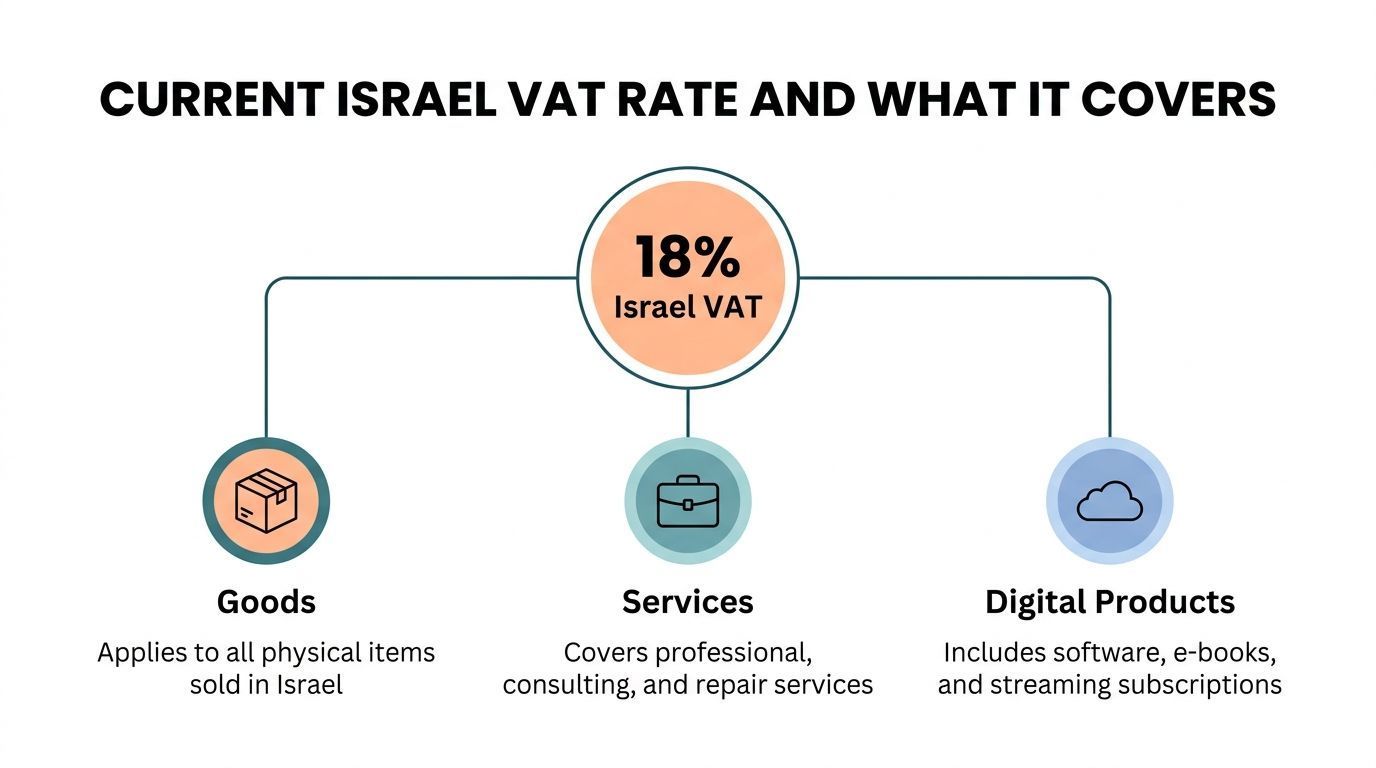
Israel's VAT rate is 18% for standard-rated supplies in 2025 and 2026. It covers most taxable domestic transactions, including many goods, services, and digital products supplied to Israeli customers. For a SaaS founder, the rate is only the starting point. The billing system must determine whether the customer, service, and transaction qualify for Israeli VAT.
Use three supply categories in your tax logic:
- Standard-rated supplies: A SaaS subscription sold to an Israeli consumer will generally fall into this category. The checkout should calculate VAT, display the charge where required, and retain the customer and transaction evidence.
- Zero-rated supplies: Exports of goods and certain services to non-residents may qualify. A zero rate keeps the transaction inside the VAT framework at a rate of zero, provided the applicable conditions are met and the seller preserves supporting evidence.
- Exempt supplies: Some supplies do not bear VAT as taxable transactions. Exemption can also limit input-tax recovery, so your records and reporting must distinguish exempt from zero-rated.
Why the category matters
Ordinary digital commerce generally does not use a broad reduced-rate schedule. The practical structure is standard-rated at 18%, zero-rated, or exempt.
That makes classification more important, not less. Your merchant of record or internal tax engine should distinguish an Israeli consumer subscription from an eligible export or exempt supply before finalizing the charge. Apply the classification consistently to recurring renewals, prepaid plans, upgrades, and cross-border digital services.
A wrong classification creates a direct operational problem. Over-collection leads to refunds, corrected invoices, and reconciliation work. Under-collection leaves the seller responsible for unpaid VAT and weakens the evidence supporting the return. Capture the classification basis with each transaction, rather than relying only on the customer's payment-card country.
Historical Rate Changes and Why They Matter for Billing
Israel's VAT history should change how you design billing logic. The OECD records VAT beginning at 8.0% in 1976, with the modern standard-rate history reaching 18.0%. The historical record also includes 16.5% in 2009, 16% from 2010 through 2012, 17% during part of 2012 and 2013, and 18% from 2013 through 2015, as summarized in the OECD VAT historical data.
The most important operational change came on 1 January 2025, when Israel raised VAT from 17% to 18%. The 17% rate applied from 1 October 2015 through 31 December 2024, and the Israel rate-change reference confirms the effective-date distinction.
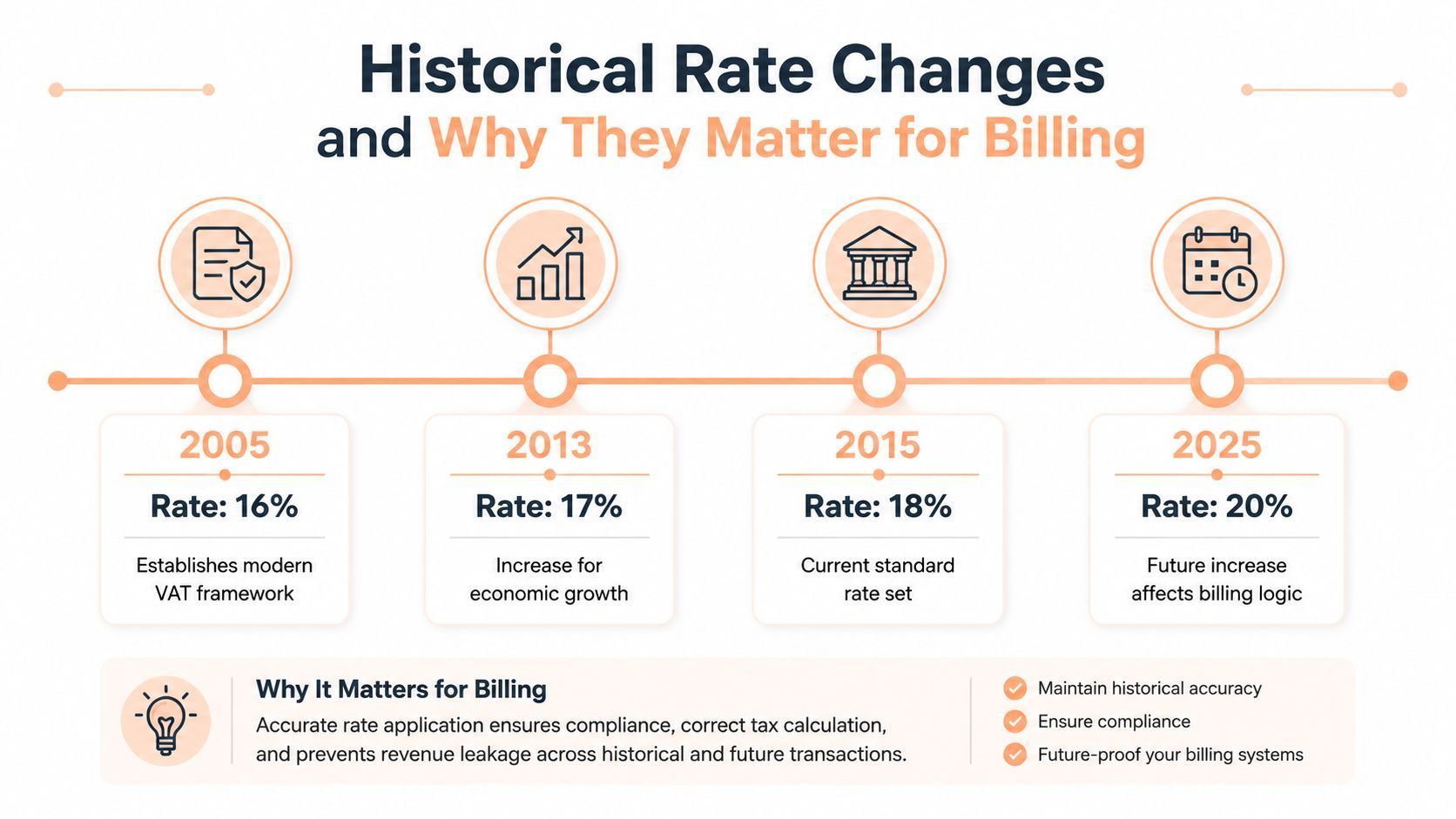
A transaction on 31 December 2024 was subject to 17%, while a transaction on or after 1 January 2025 required 18%, subject to the relevant tax-point rules. Your system therefore needs more than a configurable “current VAT rate” field.
Billing rule: Store the effective date, service period, payment event, invoice event, and customer classification for every taxable charge.
That data lets you correct invoices, explain renewals, handle credits, and respond to an audit without reconstructing the transaction from payment-provider logs. It also protects you during the next rate change, because the system will already separate tax logic from product pricing.
Standard-Rated vs Zero-Rated vs Exempt Supplies
Digital sellers must assign each transaction to the correct VAT category before checkout and invoicing. Standard-rated supplies carry VAT at the applicable rate. Zero-rated supplies remain within the VAT framework and carry a zero percent rate when the legal conditions are met. Exempt supplies do not carry VAT, and the exemption can affect recovery of input tax.
| Product Type | VAT Category | Rate | Key Condition |
|---|---|---|---|
| SaaS subscription sold to an Israeli consumer | Standard-rated | 18% | Treat as a taxable Israeli consumer supply when the digital service is used in Israel |
| Downloadable software sold to an Israeli consumer | Standard-rated | 18% | Customer location and taxable supply status must support collection |
| Software service supplied to a qualifying foreign customer | Potentially zero-rated | 0% | The seller must satisfy the export conditions and preserve evidence |
| Certain services in exempt categories | Exempt | No VAT charged | The exact category and exemption conditions must apply |
| Goods exported from Israel | Potentially zero-rated | 0% | Export documentation and the applicable legal conditions are required |
The word “potentially” controls the outcome. A foreign billing address alone does not establish that a digital sale qualifies for zero-rating. Review the customer's status, the place where the service is supplied or used, the contract structure, and the evidence captured at the time of sale.
What to retain
For a zero-rated claim, retain the contract, invoice, customer identity, location evidence, and records supporting the legal conditions. For an exempt supply, document the specific exemption rather than entering a zero tax value without explanation.
Your checkout should apply more than an “international customer” flag. Configure rules that combine customer type, location, product classification, and supporting evidence. Store the decision with the transaction, including the reason a supply was standard-rated, zero-rated, or exempt.
This matters most for subscription renewals and prepaid plans. A customer can change status, location, or billing details between charges. Recheck the relevant classification at each taxable event, and ensure invoices, credits, and refunds use the same logic. That control prevents the common error of treating every non-Israeli payment as zero-rated while ignoring the conditions attached to the supply.
Registration Threshold and Trigger for Foreign Sellers
Foreign SaaS companies should complete their Israeli VAT assessment before actively selling to Israeli customers. For B2C digital services, the relevant trigger may arise from the first sale to an Israeli consumer, so a general small-business threshold should not be treated as automatic protection. The Israeli VAT registration guidance for foreign digital providers supports the operational priority: identify the customer, classify the supply, and determine whether Israeli VAT applies before billing begins.
Threshold analysis still matters for the wider registration position. Determined AI's Israel VAT guide refers to an annual threshold of approximately NIS 120,000, with quarterly returns. Use that figure as a control point requiring confirmation for your business model, not as permission to delay review of earlier taxable sales. Customer type, supply classification, the first transaction, and current authority guidance all affect the outcome.
Build the assessment around taxable Israeli revenue
Maintain separate ledger views for:
- Israeli consumer revenue from taxable digital services.
- Israeli business revenue, supported by customer-status evidence.
- Sales to non-residents that may qualify for zero-rating.
- Exempt or otherwise non-taxable supplies.
- Refunds, chargebacks, credits, and cancelled subscriptions. A marketplace, reseller, or merchant of record may contract with the buyer and collect VAT instead of the software company. That arrangement changes the transaction flow, but it does not remove the need to identify the parties, supply, and tax responsibility. Use this practical VAT registration guide for software sellers before concluding that payment intermediation removes your exposure.
Prove where the buyer belongs
Set one customer-location policy and apply it consistently. Capture the billing country, declared business status, payment-country information where available, and other reliable location signals. Conflicting signals require review or conservative treatment supported by your tax advice.
Store the decision with each transaction. For subscriptions and prepaid plans, preserve the evidence used at signup and update it when customer details or billing arrangements change. That record connects the registration analysis to the invoices, renewals, credits, and refunds your billing system produces.
Tax-Point Rules for Subscriptions and Prepaid Plans
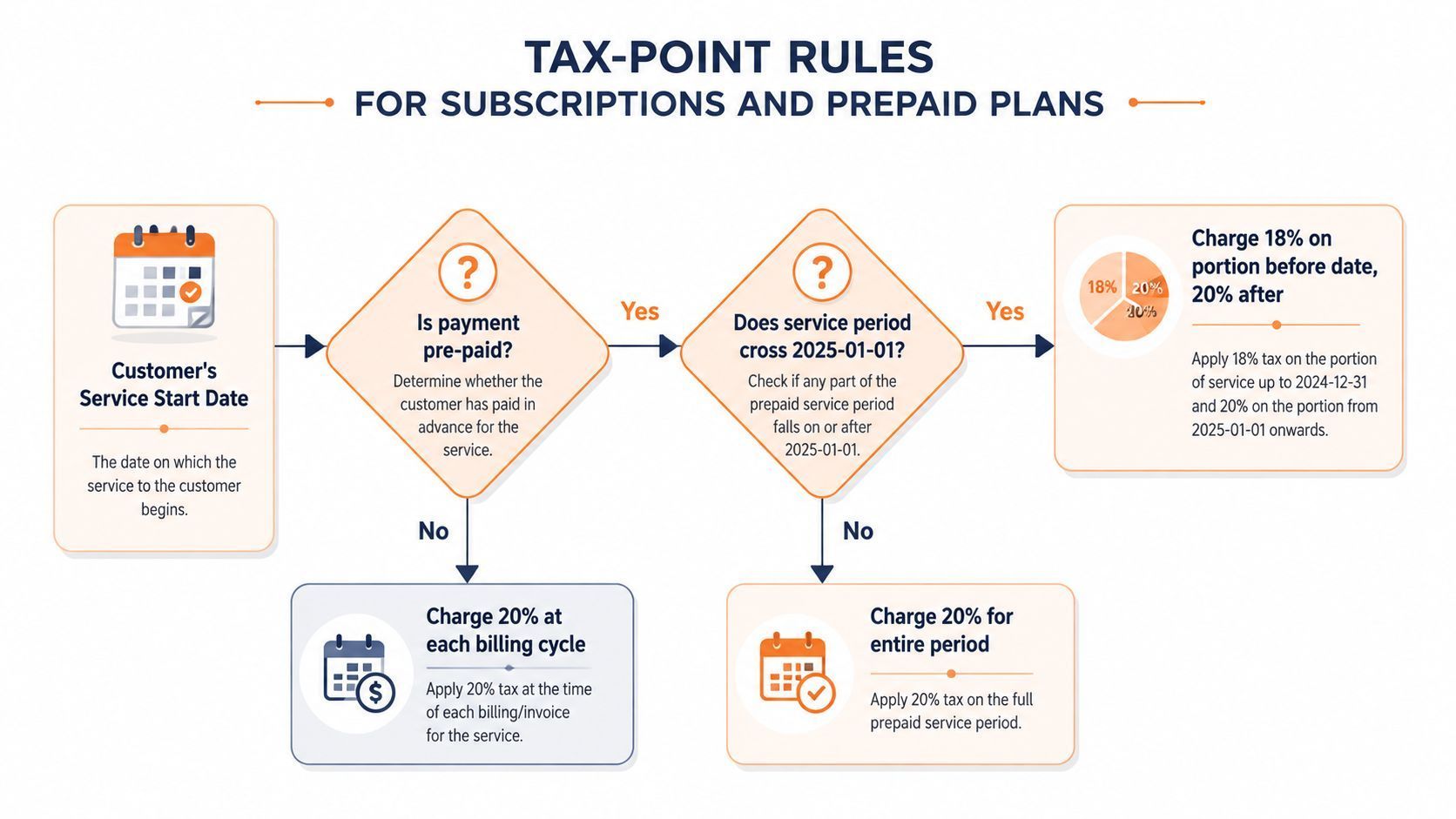
The 1 January 2025 increase creates its hardest problems in recurring billing. A monthly invoice is usually straightforward when the billing event and service period sit on the same side of the change date. A prepaid annual plan or continuous service can be different.
Israeli guidance discussed in VATupdate's summary of the Tax Authority instructions indicates that the tax point can depend on whether the business uses an accrual or cash basis, and addresses advance payments, long-term contracts, and continuous services that cross the effective date.
The December payment question
If a customer pays in December 2024 for service delivered in January 2025, don't apply a blanket rule. The answer can depend on the applicable tax-point method, whether the payment was an advance payment, the service period, the contract, and the specific instructions governing continuous or long-term services.
Your billing system should therefore support:
- Service-period allocation: Link each charge to the period in which the service is provided.
- Effective-date rates: Preserve the applicable rate instead of overwriting historical invoices.
- Split treatment: Permit one commercial charge to produce separate tax lines when the governing rules require it.
- Credit and renewal logic: Carry the original tax treatment into refunds, upgrades, downgrades, and cancellations.
- Audit records: Retain the invoice, payment timestamp, service dates, contract terms, and calculation output. An annual plan paid before the change date may require analysis of the payment and service period rather than a simplistic “invoice date wins” rule. A mid-cycle upgrade needs the same discipline, because the incremental charge may represent a new supply, an adjustment to an existing period, or both.
Implementation advice: Don't hard-code one VAT rate per invoice. Store the tax decision at the charge-line level, with the reasoning and source data that produced it.
Filing Frequency and Return Requirements
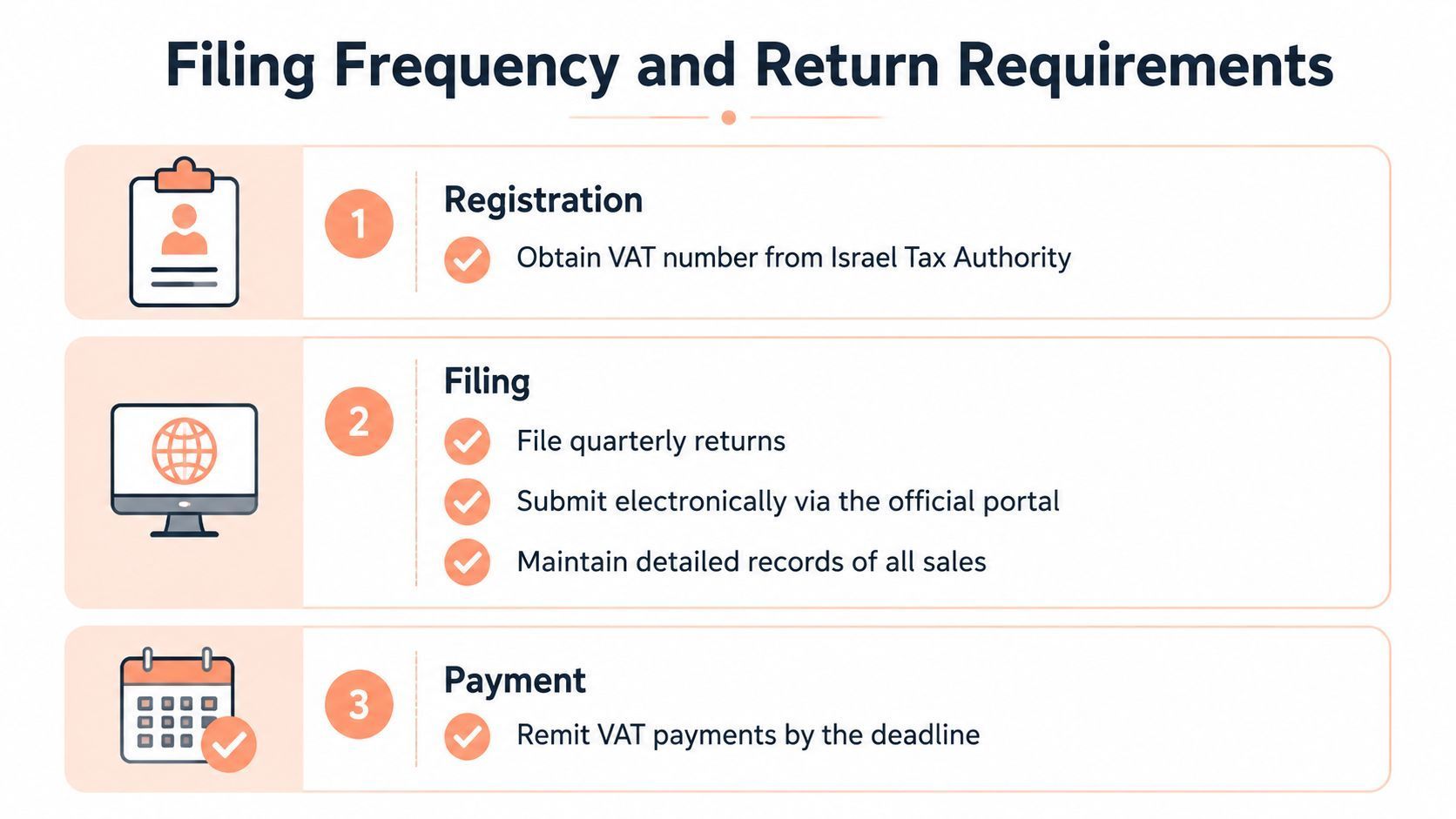
Once a foreign digital seller is registered, compliance becomes a recurring finance process. The available guidance identifies quarterly filing for the foreign digital-service regime, and the return should reconcile taxable sales, VAT collected, zero-rated transactions, exempt supplies, adjustments, and the amount payable.
Treat every return as a reconciliation
The return shouldn't be prepared from gross payment volume alone. Reconcile the tax ledger against invoices, refunds, failed payments, chargebacks, subscription cancellations, and currency-conversion records. If your checkout displays VAT separately, the accounting system must preserve the gross amount, taxable base, VAT amount, currency, and reporting conversion used.
Keep export support in a separate evidence folder. A zero-rated sale without a defensible customer and supply record can become a standard-rated sale during review.
Use a close checklist
- Reconcile sales: Match completed charges to issued invoices and receipts.
- Review classifications: Inspect Israeli B2C, B2B, non-resident, zero-rated, and exempt transactions.
- Process adjustments: Tie refunds and credits to their original invoices.
- Archive evidence: Preserve customer-location records and export documentation.
- Approve payment: Confirm the return total against the VAT ledger before remittance. Electronic filing is part of the Israeli compliance environment, so your process should assign ownership for data preparation, review, submission, and payment. Don't wait until the filing deadline to discover that your payment provider and accounting platform use different transaction dates.
Customer Classification and Checkout Logic
Effective VAT checkout begins by classifying the buyer before applying the product price. For SaaS, streaming, apps, and marketplaces, configure checkout to identify the customer's residence, B2C or B2B status, and the place where the digital service is supplied or used. These facts determine whether Israeli VAT applies and which evidence your records must retain.
A practical workflow should capture:
- Billing address: Collect the country and, where relevant, the complete business address.
- Customer declaration: Allow a business customer to identify itself and provide supporting details.
- Payment information: Use the payment country as supporting evidence, not conclusive proof.
- Technical location: Use IP geolocation to flag inconsistencies, without treating it as the legal classification.
- Product context: Record whether the purchase is an individual subscription, business software service, marketplace transaction, or another supply.
Resolve conflicting evidence deliberately
An Israeli consumer purchasing a SaaS plan should generally be processed as a taxable Israeli B2C transaction. A foreign company with an Israeli office requires review of the contracting entity, place of use, and available documentation. A customer traveling abroad remains subject to the relevant classification; a foreign login location does not, by itself, change the customer's status.
Flag conflicting signals for review. Do not let the system select the most favorable outcome automatically. Store the classification decision, the evidence collected at checkout, and any later correction. This gives customer support a consistent answer when a buyer challenges the result and gives your tax team a record for review.
Apply the same classification to the invoice. If checkout treats the buyer as taxable Israeli B2C but the invoice omits VAT, the sales ledger and invoice records will disagree. Set a rule that blocks invoice issuance until the customer status, tax treatment, and displayed VAT amount match. Review exceptions before the transaction enters the filing data.
Merchant of Record vs Self-Managed Compliance
Self-managed compliance gives you direct control over registration, checkout rules, invoices, customer data, returns, and remittance. It also makes you responsible for keeping those systems aligned when rates change, customer classifications change, or a subscription crosses a tax point.
A merchant-of-record model places the intermediary into the commercial payment structure and can centralize tax collection, invoicing, filing, and remittance. That reduces the number of internal processes your finance team must operate, but you still need to understand the transaction model, confirm the provider's coverage, and ensure the provider receives accurate product and customer data.
| Approach | Control | Internal workload | Main risk |
|---|---|---|---|
| Self-managed | Highest control over checkout and records | Registration, calculations, filings, and reconciliations stay with your team | Missed classifications, filing errors, and weak evidence |
| Merchant of record | Provider manages covered tax operations | Lower operational burden, with integration and oversight required | Incorrect product or customer data can still produce incorrect treatment |
Choose self-management when you already have tax ownership, accounting controls, local advice, and engineering capacity for tax-point changes. Choose a merchant of record when your priority is selling across jurisdictions without building a separate compliance operation for each market.
Creem's merchant-of-record overview describes the model in the context of handling payment and tax responsibilities through a platform. Evaluate any provider against concrete questions: Does it support Israel, handle recurring billing and prorations, issue compliant transaction records, manage refunds, and explain how it treats B2B, B2C, zero-rated, and exempt supplies?
Quick Reference Table for Israel VAT Rules
Use this table before configuring subscription billing. The rate is only the starting point. Product type, customer status, location, service period, and tax point determine the tax treatment, especially for renewals, prepaid plans, and cross-border digital services.
| Rule | Value | Practical Note |
|---|---|---|
| Current standard VAT rate | 18% in 2025 and 2026 | Apply it to taxable supplies at the applicable tax point |
| Previous standard rate | 17% through 31 December 2024 | Preserve historical invoices and effective dates |
| Rate effective date | 1 January 2025 | Test renewals, prepaid plans, prorations, refunds, and credit notes around the change |
| Standard-rate structure | Standard-rated, zero-rated, or exempt | Classify the supply before applying checkout logic |
| Foreign digital B2C sales | Registration and collection may apply from the first sale | Confirm the supply, customer status, and Israeli connection |
| Referenced annual threshold | Approximately NIS 120,000 | Validate the measurement period and obligation for your model |
| Filing frequency referenced for foreign providers | Quarterly | Reconcile sales, refunds, classifications, and VAT before filing |
| Export treatment | Goods and certain services may be zero-rated | Keep evidence supporting the export conditions |
For subscription systems, store the rate and tax point with each invoice rather than relying on the customer's current plan settings. A plan created under the earlier rate may require a different tax calculation after the effective date, while prepaid charges and later adjustments need consistent records.
The rate history and threshold references are summarized in PwC's Israel corporate tax summary and TaxAtlas's Israel VAT overview, alongside the foreign-provider guidance cited earlier. Confirm current administrative requirements with an Israeli VAT adviser or the relevant authority guidance before launch.
Common Questions About Israel VAT for Digital Sellers
Does an Israeli customer always mean VAT applies?
For a taxable digital service sold B2C to an Israeli consumer, the operational default is to assess Israeli VAT. Don't rely on the customer's card country alone. Capture location and customer-status evidence, then apply the product and supply classification.
What happens when a customer asks for a refund?
Link the refund to the original invoice and tax line. Reverse the VAT treatment consistently, preserve the reason and date, and ensure the adjustment appears in the correct reporting period. A chargeback shouldn't disappear from the VAT ledger because the payment processor handled it outside your accounting system.
How should a free trial be treated?
A genuine free trial with no consideration doesn't automatically create the same transaction as a paid subscription. The moment the trial converts, classify the resulting charge using the customer's status, location, product type, and applicable tax point. Document the conversion event so the invoice and checkout record agree.
What if the buyer disputes their location?
Pause the classification change until the buyer provides reliable evidence. A self-declaration can support the file, but conflicting billing, payment, and technical signals require review. Don't refund VAT merely because a customer says they live elsewhere.
Does VAT in Israel replace tax obligations elsewhere?
No. Israeli VAT analysis doesn't eliminate obligations in the customer's country, the seller's establishment jurisdictions, or other markets where digital-service taxes apply. Keep a jurisdiction-by-jurisdiction tax map and avoid assuming that one registration or merchant-of-record arrangement covers every obligation.
For further risk planning, review the guide to VAT penalties for digital products and escalate unusual contracts, disputed residency, large prepaid arrangements, and mixed supplies to qualified tax counsel.
Creem can act as a merchant of record for software and digital-product businesses, centralizing checkout, subscription billing, VAT collection, filing, and remittance across supported markets. If you want to sell to Israeli customers without building every tax-point and filing workflow internally, visit Creem to evaluate the integration and coverage for your product.