

Many Stripe sellers turn on Stripe Tax before their first international sale and assume the tax is off their hands. Then an EU consumer subscription clears on standard Stripe Payments, and registering, filing and remitting the VAT is still their job.
Stripe earns its place as the default because it is flexible and well documented. The catch is what it leaves on your desk once buyers abroad start paying you.
Choose wrong and compliance debt grows with every international sale, or a rushed move breaks renewals for subscribers who already pay you.
By the end you can price both at your own volume, see which duties stay with your team and know whether your billing model and subscribers survive a move.
If you already know you want someone else to be the legal seller, try Creem: we take that role at 3.9% + $0.40 per sale, against 5% + $0.50 on Polar Starter, with no monthly fee.
Polar vs Stripe at a glance
Standard Stripe Payments keeps you as the legal seller, while Polar takes that role for the transactions it processes. Stripe also offers Stripe Managed Payments, a merchant-of-record mode, so who takes responsibility depends on which Stripe service you use.
| Responsibility | Standard Stripe Payments | Polar |
|---|---|---|
| Legal seller | Your business | Polar |
| Transaction-tax remittance | Your business | Polar |
| Chargeback handling | Your business, using Stripe’s dispute tools | Polar as merchant of record |
| Best fit | You already run VAT or sales-tax registrations and returns and want to control payments and billing | You sell software and want someone else to be the seller and remit transaction tax |
Stripe has the lower headline per-sale rate. To see whether that means a lower total cost, count the VAT or sales-tax registrations, recurring returns and any tax tool or accountant you pay to handle them.
I’d start with who takes seller responsibility. If handing it off points you toward Polar, check that your product type fits its acceptable-use policy and that its current billing workflows support your billing model, including seats, usage or credits.
Who is the legal seller with Polar and with Stripe?
With standard Stripe Payments, you are the seller, even when Stripe Tax calculates tax and helps with registration and filing, so required registrations and returns remain your legal responsibility. With Polar, the buyer buys from Polar.
An EU consumer buying your monthly subscription makes that difference concrete. On standard Stripe, the sale belongs to your business, and any required VAT registration, return and remittance are your responsibility. The gap becomes practical when that first registration is required.
For the same subscription through Polar, Polar is the seller and collects and remits the VAT. You still build, deliver and support the software. Disputes follow the seller role too, so your business is responsible on standard Stripe, while Polar handles them on its transactions.
Stripe Managed Payments is Stripe’s **merchant-of-record mode**, with different eligibility rules. It excludes Connect platforms, platform-controlled accounts and services involving human intervention. If that includes your business, compare standard Stripe and your own tax setup with a separate merchant of record that covers your product.
I’d use the first registration as the decision point and check whose name appears as the legal seller on your buyer’s invoice. If it is your business, a tax tool has not handed off registration and recurring returns, so decide whether to keep that responsibility before changing checkout.
Stripe and Polar, side by side
Standard Stripe Payments processes the payment and leaves you as the seller. Polar sells on your behalf.
Stripe
Stripe’s subscription cost depends on which services you add and where your buyers pay from. It gives you room to fit billing around your product and has the lowest headline rate in this comparison.
For subscriptions on a US account, the fees stack up:
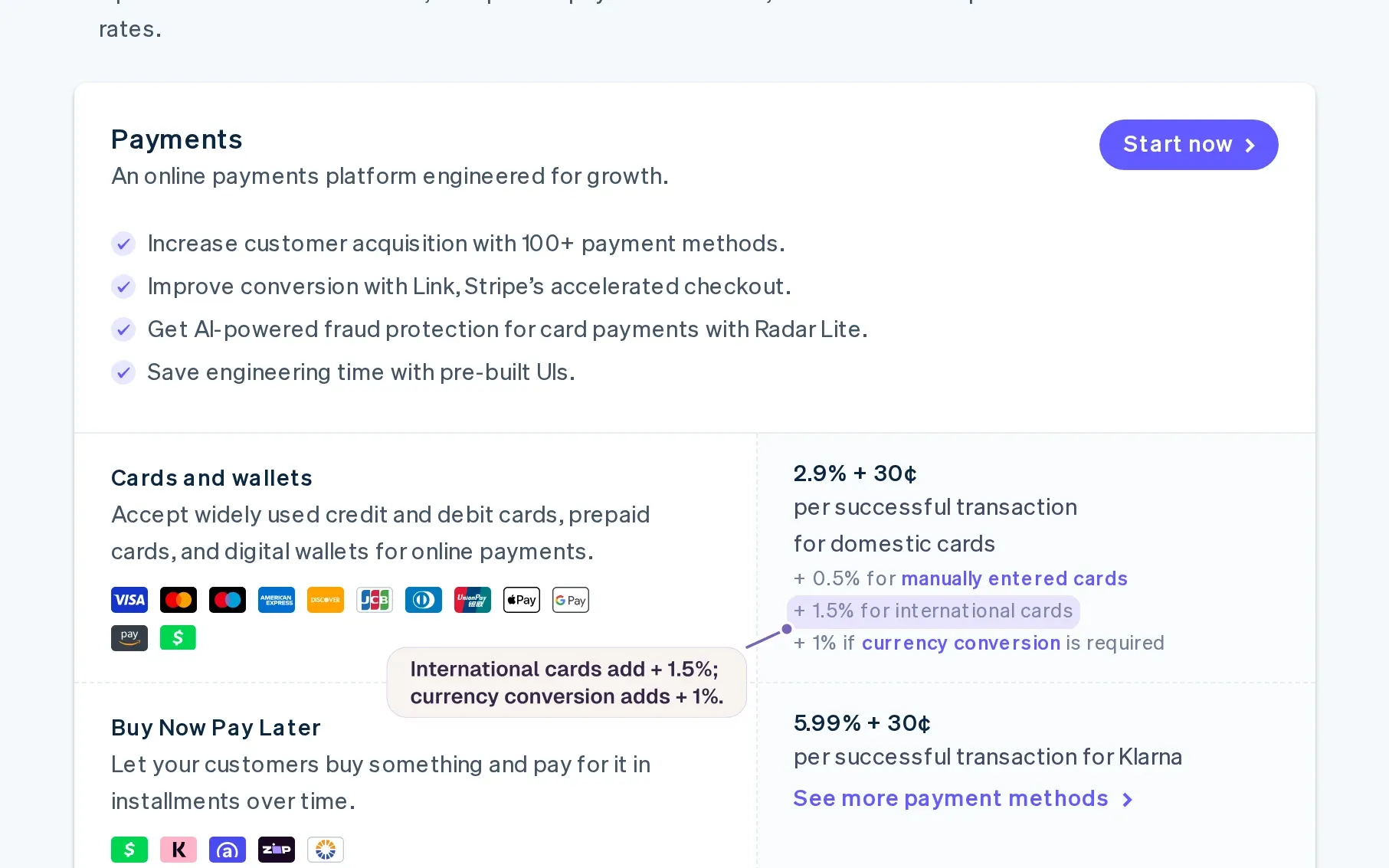
- Card processing starts at 2.9% + $0.30.
- Stripe Billing adds 0.7% of subscription volume on pay-as-you-go.
- Stripe Tax Basic adds 0.5% per transaction where you are registered, on the no-code integration.
- International cards add 1.5%, with another 1% when currency conversion applies.
An illustrative $100 international-card subscription costs $5.90 with Billing and Tax Basic, before currency conversion or filing costs, which leaves $94.10. Tax Basic calculates tax but does not file returns, so registration, returns and liability stay with you.
I see Stripe as a strong fit when you want control over payments and already have tax operations you trust. It stops fitting when a small team with no tax function has to handle consumer VAT returns across many countries, so price your first required VAT or sales-tax registration and the returns that follow before you compare it with Polar.
Polar
As merchant of record, Polar sells your software or digital product to the buyer in its own name, then collects and remits the tax on that sale. It supports one-time purchases and subscriptions.
Starter costs 5% + $0.50 per transaction with no monthly fee. Pro costs 3.8% + $0.40, plus $20 a month. On every plan, non-US cards add 1.5%.
A $100 sale on a US card leaves $94.50 on Starter or $95.80 on Pro before the monthly fee. That $1.30 difference covers Pro’s monthly fee at roughly sixteen $100 sales a month.
For usage pricing, plan around Polar’s existing usage billing. Its new engine is in early access, so do not count on billing-as-code or pricing simulation being generally available for your launch.

Polar has no built-in affiliates or revenue splits. You pay an affiliate or co-founder their share outside Polar, through another tool or by hand.
Before moving a usage-priced product, map each meter and credit purchase to a supported billing workflow and work out how each partner gets paid.
Fees: what each charges per sale
Stripe’s 2.9% + $0.30 covers processing only. Billing and Tax cost extra, and you still handle tax registration, filing and remittance. The lower headline rate does not tell you whether Stripe costs less overall.
For the same month of sales, add these five lines for each option:
| Cost to add | Standard Stripe Payments | Polar |
|---|---|---|
| Your percentage fee | Monthly revenue × 2.9% | Monthly revenue × your plan’s percentage rate |
| The fixed fee on every payment | Successful transaction count × $0.30 | Successful transaction count × your plan’s fixed fee |
| Any monthly plan fee | None for standard processing | No monthly fee on Starter, $20 on Pro |
| Add-ons | Billing, Tax and applicable international-card or currency-conversion charges | 1.5% on non-US cards, plus any outside tool or manual work for affiliate or revenue-split payouts |
| Your own tax work | Registration, advisers and time spent filing and remitting | Transaction-tax work drops out because Polar files and remits as the seller |
In an illustrative month with 1,000 renewals of $10, revenue is $10,000. Stripe’s percentage fee is $290 and its fixed fees total $300, putting the processing bill at $590 before Billing, Tax and filing costs.
At that renewal price, the fixed fee alone makes up more than half the processing bill.
Once a real share of your buyers pay from other countries or in other currencies, run the table using a recent month of actual sales.
Subscriptions, seats, usage and credits: which handles your billing model?
Polar’s existing usage billing sets the rules for usage and credits when billing changes, while its new engine is in early access. Stripe’s renewal retries have specific exceptions. I’d test your own billing events on each before committing to a subscription, seat, usage or credit model.
For an AI product on Polar’s existing usage billing, you can charge the base plan annually and settle usage monthly. The usage cycle must divide the subscription interval evenly. You choose that rhythm once, and it stays fixed for the product.
When a customer upgrades, Polar immediately invoices accrued usage at the old plan’s prices. Immediate cancellation also triggers a bill for usage consumed so far.
If that usage payment fails, the subscription and benefits stay active. Polar retries on days 2, 7, 14 and 21, then voids the order. To limit unpaid usage, watch for the failed usage payment and pause access in your own app, because Polar does not revoke it for you.
A subscription that falls past due behaves differently. Polar pauses its usage billing cycle but keeps recording consumption. When the subscription recovers, Polar bills the accumulated usage together, resets meters and grants credits.
Stripe Smart Retries skips retries for missing payment methods, issuer hard declines, India-issued cards and disconnected Connect accounts. Hard declines require a new payment method. Prompt the buyer to update their payment method rather than waiting for retries to recover the failed renewal.
Run these checks against your app’s access rules:
- Seat changes and upgrades: change quantity mid-cycle and check charges, proration and access.
- Failed renewal: trigger a hard decline and check access suspension and the buyer’s payment-update path.
- Credit refresh: check credits refresh when usage payment clears, separately from subscription renewal.
- Credit purchases: buy credits, exhaust the balance and check when spending stops.
Selling worldwide and getting paid out
A buyer in Spain being able to pay does not mean the provider can onboard your company or pay it out where it is registered. Buyer countries and seller countries are separate lists, and your product has to qualify too.
What lands in your bank means something different on each platform. Take an illustrative EU consumer sale where the buyer pays €120, including €20 of VAT.
On standard Stripe Payments, that €20 is included in your payout after fees. Your spendable amount is €100 minus Stripe’s fees, even if your bank balance looks higher.
On Polar, the €20 never reaches you. Polar collects and remits it, then pays your earnings after deducting its fee.
Check access to funds separately. Where its terms permit, Stripe can hold back part of your sales or debit your bank until it is satisfied the risk has passed. Polar’s published policy allows it to review or suspend accounts it considers high-risk.
Plan payroll and compute spend around cash already in the bank after setting aside tax owed, so money you cannot spend does not count toward your runway.
Before relying on either provider, ask:
- Seller country: “Can you onboard and pay out a company registered in my country?”
- Product: “Does my product type pass your acceptable-use rules?”
- Spendable payout: “How much of each payout is tax I still owe, or funds you can hold?”
Integration and migration: what changes in your app?
Moving from Stripe to Polar means two separate jobs. Your app needs a new checkout, SDK and webhook handler for new purchases, while existing subscriptions keep renewing on Stripe until you move them.
In one developer’s migration, the Stripe database columns stayed but were renamed to avoid clashes with Polar’s columns. Both providers’ customer and product records lived side by side as subscribers moved, and the developer switched to Polar’s SDK and added a webhook handler to control access.
No subscriber should move until the new handler correctly grants access after payment, keeps it through the paid period and revokes it when that period ends.
Polar’s migration importer skips subscriptions with multiple items or a quantity above 1, so per-seat subscriptions need a separate migration path.
Saved cards do not carry over between providers. I’d sort subscribers by next renewal date and send buyers who need to authorise payment a link well ahead of renewal, protecting them from involuntary churn during the move.
Give each subscriber a row in your migration map:
- Match the buyer and plan to the corresponding Polar customer, product and subscription records.
- Record the next renewal date and whether the buyer must authorise payment again.
- Confirm what preserves access during the move and which cancellation event ends it.
New sales use the new checkout from the next release. I’d keep current subscribers renewing on Stripe until each buyer’s payment authorisation and renewal transition are complete, moving them one at a time rather than on a single cutover day.
Polar vs Stripe: which one should you choose?
My rule is to decide which duties you keep, then compare fees. Polar suits international sellers who want to hand off tax and disputes, while standard Stripe suits teams that want control and will handle those duties themselves.
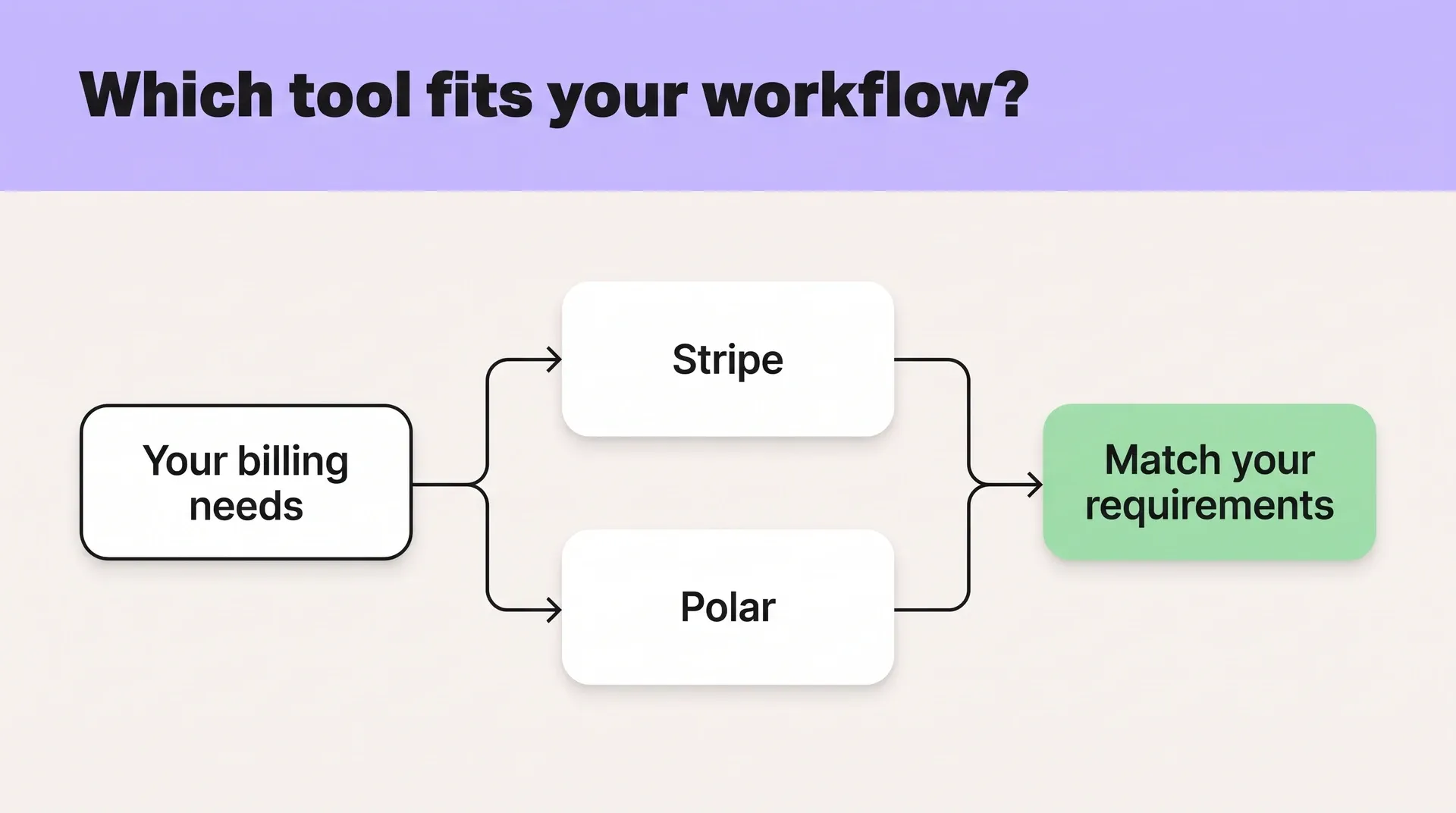
Decision tree comparing Stripe, Polar based on reader workflow needs
On a $100 sale, Stripe’s base processing fee is $2.30 below Polar Starter’s, and that gap pays for Polar to take the seller role and handle transaction tax. The Stripe saving holds only if its add-ons and your tax operations cost less.
Choose Polar if you want the seller role handed off
That handoff matters most when you sell self-serve to consumers across countries, because the required VAT registrations and returns otherwise land on you.
Check that Polar will sell your product and that your meters work with its current usage billing. Polar fits when developer experience matters and you do not need native affiliates or revenue splits.
Choose Stripe if control matters more than outsourcing
For mostly domestic sales with small renewals and a tax setup you trust, Stripe remains cheaper on fees alone.
It also suits custom billing and direct customer contracts. Managed Payments excludes Connect platforms, platform-controlled accounts and services involving human intervention, so you keep the seller role on Stripe with those setups.
Hold off on migrating if renewals aren't mapped
Use your migration map to check:
- Same plan: Polar has the subscriber’s price and plan.
- Usable payment method: Polar can collect the next invoice.
- Paid-through access: The handoff preserves access already purchased.
- Cancellation emails off: Disable Stripe’s cancellation messages before Polar cancels the source subscription.
Past-due, unpaid and paused subscriptions stay on Stripe until resolved, and subscriptions renewing within 24 hours stay there too.
A completed handoff cannot be reversed. Move only eligible subscriptions after checking the full contract, quantities, discounts, outstanding usage and credits, then track first Polar invoice collection success to confirm renewals are still getting paid.
When you need tax, usage billing and partner payouts in one place
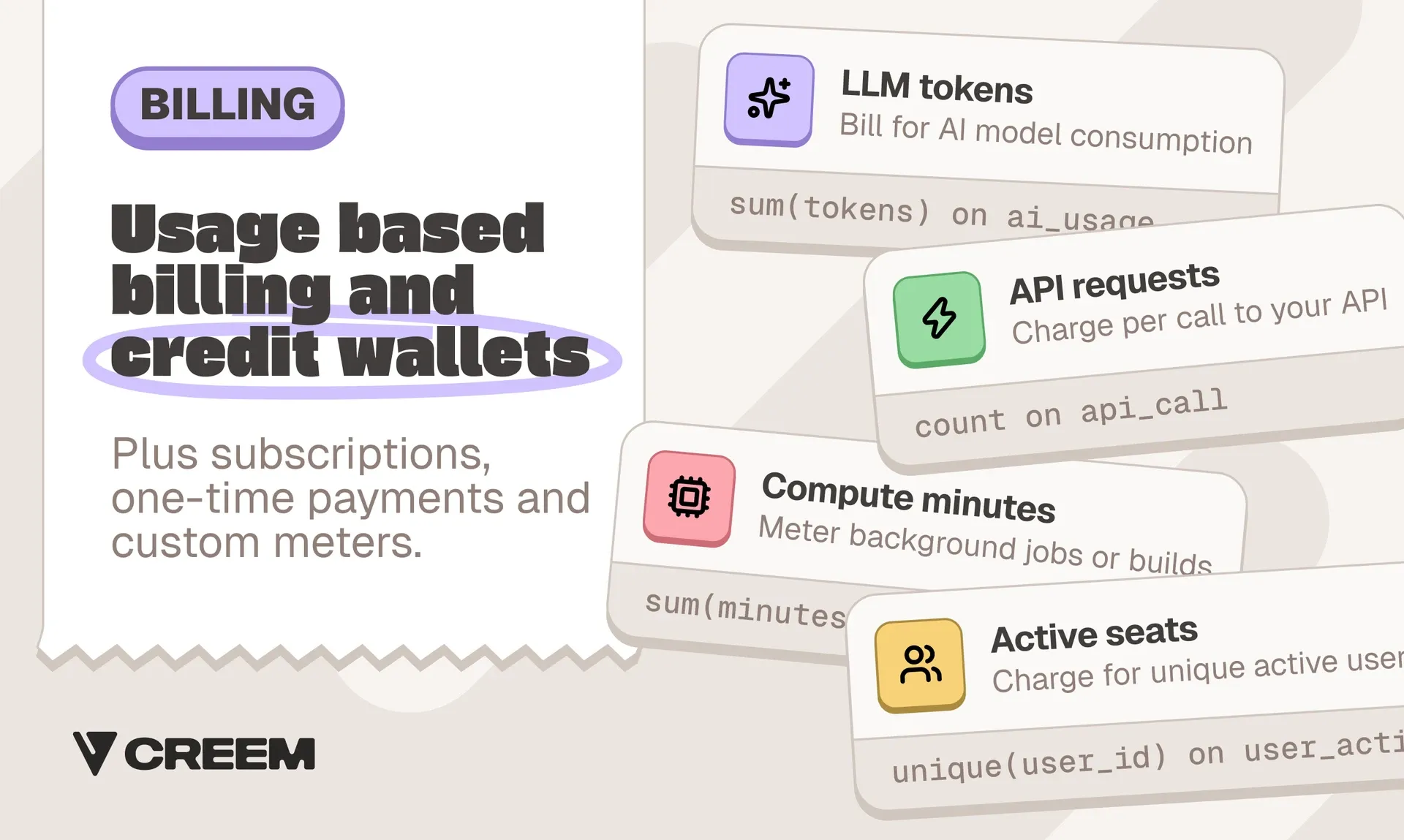
Creem is the legal seller for your software, with meters, credit wallets, affiliates and revenue splits in the same account. With standard Stripe, you remain the seller, while Polar has no native affiliates or revenue splits.
The standard rate is 3.9% + $0.40 per successful transaction, with no monthly fee, setup fee, minimum volume or international-card surcharge. A $100 sale leaves $95.70 after Creem fees on any card. On Polar Starter the same sale leaves $94.50 on a US card and $93.00 on a non-US card, and on Stripe an international-card subscription with Billing and Tax Basic leaves $94.10.
On a US card, Polar Pro takes 10¢ less per $100 sale than Creem, so it costs less once you pass 200 such sales a month, the point where those dimes cover its $20 monthly fee. On a non-US card, Pro takes $1.40 more per $100 sale. Creem charges extra for partner features:
- Affiliates add 2% before affiliate commission.
- Revenue splits add 2% before commissions.
Creem handles chargeback disputes, but you still bear the disputed amount and a $25 or €25 fee per chargeback.
Marko Denic (@denicmarko) described the choice for Active Builders: “When we started Active Builders, we needed two things: an easy payment processor and automatic revenue split. Creem handled both out of the box. Plus, they support affiliates natively too. Choosing them was a no-brainer!”
When Uneed moved from Polar to Creem, Thomas Sanlis changed 1,500+ lines of code using 3 AI prompts, with 0 integration errors, in a migration measured in minutes.
For usage-priced software, a failed postpaid charge can leave compute unpaid. Prepaid credits collect payment before consumption, and auto-refill can top up the balance before it reaches zero, so the cash for each customer's usage arrives before the compute cost does.
We file and remit transaction tax for buyers in 190+ countries.
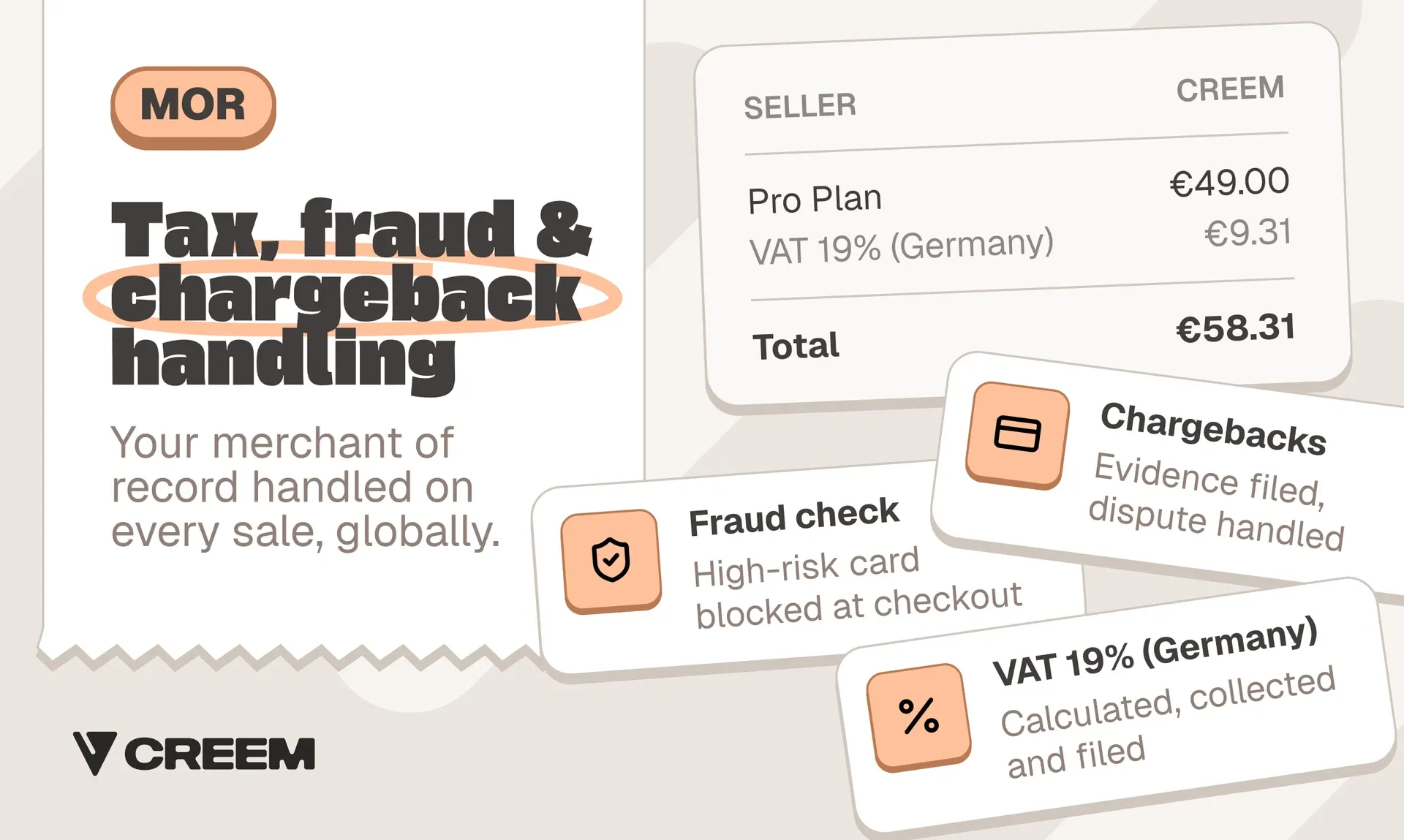
Want MoR tax, usage billing and affiliates together? Try Creem
If you sell usage or credits to buyers across countries and owe affiliates or co-founders a share of each sale, I'd use Creem. We are the legal seller billing the meter or credit pack, with each partner's share in the same balance until the regular payout run.
Your next sale can carry its tax, usage charge and partner shares through one legal seller instead of three tools. To put it there, try Creem with the product you already sell.