
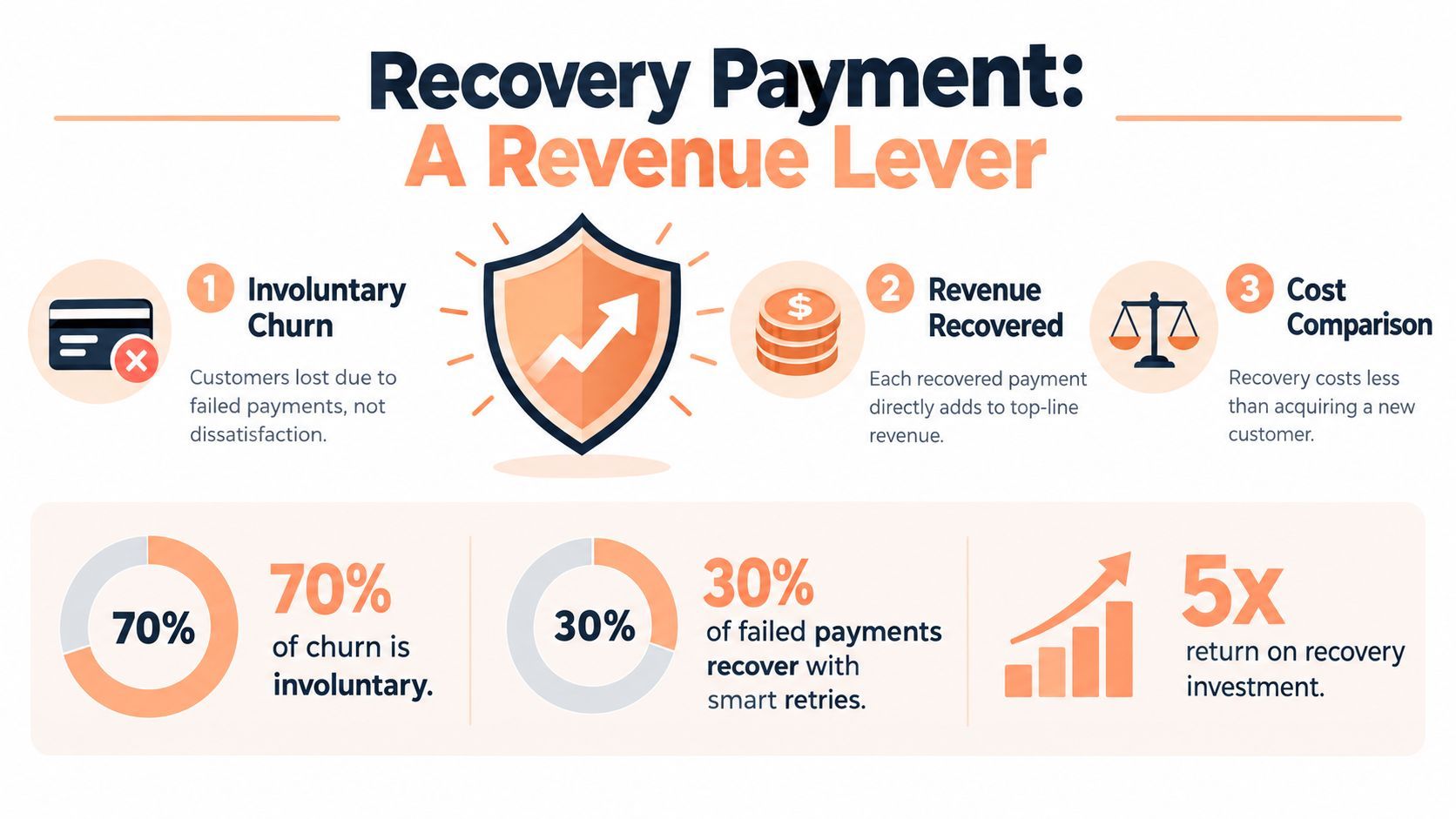
At least 7% of recurring payments fail in a typical 12-month period, and recovery flows target involuntary churn, which is roughly estimated at 20% to 40% of total churn. For a mid-size SaaS, a well-tuned retry sequence can therefore protect substantial revenue, potentially reaching six figures when the subscription base is large enough.
A failed renewal doesn't necessarily mean a customer changed their mind. Their card may have expired, funds may be temporarily unavailable, a bank may reject the transaction, or an authentication step may have failed. The customer still values the product, but the billing system treats a payment problem as a cancellation event.
That distinction changes how you design the system. Recovery payment isn't a collections afterthought. It's a revenue-retention workflow that combines decline diagnosis, retry timing, customer communication, account access, and dispute prevention.
Table of Contents
- Why Recovery Payment Is a Revenue Lever, Not a Collections Task
- The Core Concepts Behind Dunning and Recovery
- Why Decline Reasons Are Market-Specific, Not Global
- How a Modern Recovery Flow Is Built
- Where Recovery Sits Inside a Merchant of Record Stack
- How Creem Runs Recovery in Practice
- Build Versus Buy for Recovery
- Measuring Recovery the Right Way
Why Recovery Payment Is a Revenue Lever, Not a Collections Task
The first mistake teams make is measuring only the transaction that failed. A loss can include support tickets, manual reactivation work, a delayed renewal, a lost expansion opportunity, and the lifetime value of a customer who never returns. Forrester Consulting found that more than half of U.S. payment decision-makers reported at least 7% of payments failing during the preceding 12 months, while reported recovery costs reached 16% to 20% of the average payment size (Forrester Consulting payment strategy research).
Involuntary churn makes the distinction sharper. Customers can lose access because a card expired, funds were insufficient, billing details became outdated, or an issuer declined the transaction. Research summarized from Recurly's study of more than 1,200 subscription businesses places involuntary churn at approximately 26% of total churn, with broader estimates ranging from 20% to 40% (Recurly involuntary churn research summary).
The cost appears after the decline
A support agent who manually emails a customer is already operating too late. The customer may not understand which merchant attempted the charge, may not know how to update the payment method, or may interpret a sudden lockout as a product failure. A poorly timed sequence can turn a recoverable billing issue into a cancellation or chargeback.
Teams that want to stop chasing payments manually should start by separating three events: the failed authorization, the recovery attempt, and the eventual customer outcome. That separation gives finance and product teams a shared view of whether a payment was recovered, whether access was preserved, and whether the customer remained active afterward.
Practical rule: Treat every failed renewal as a customer-state event, not just a processor response.
The operating questions are straightforward. First, how should a recovery flow classify and act on different failures? Second, what changes when checkout, subscriptions, taxes, customer records, and payment recovery run inside the same Merchant of Record workflow?
The Core Concepts Behind Dunning and Recovery
A recovery payment system is the set of rules and tools that attempts to complete a recurring charge after the original authorization fails. It may include retries, billing emails, secure payment-update links, grace periods, account-state changes, and escalation to a person or alternative payment method.
Dunning is the customer-facing and operational process around that recovery. Collections generally focuses on money that is already owed and may involve manual outreach. A retry is only one action inside the larger system. Treating those terms as interchangeable leads teams to overbuild retries and underinvest in diagnosis.
A grocery delivery analogy
Think about a recurring grocery order. The store has a card-on-file relationship, just as a SaaS company stores a payment credential through its processor. If the card expires, the store knows the customer didn't necessarily cancel the weekly delivery. A sensible recovery process sends a clear notice, provides a secure way to replace the card, and avoids treating the customer as lost before the next order is attempted.
The payment lifecycle usually looks like this:
-
Authorization: The processor asks the issuer to approve the renewal.
-
Decline classification: The system records the issuer or processor response.
-
Decision: The workflow determines whether to retry, request authentication, ask for a new method, or stop.
-
Customer action: The customer receives a branded message or sees an in-product billing prompt.
-
Account state: Access remains active, becomes limited, or ends according to the product's grace-period policy.
Decline codes matter because not every failure deserves another attempt. An expired card or insufficient-funds response may be recoverable through a later retry or payment-method update. A hard decline, fraud signal, or issuer rejection that won't change with time may require a new method or direct customer contact instead.
Good smart payment reminders for treasurers make the next action obvious without making the customer feel accused. The message should identify the product, renewal, amount, and secure update path, while also making cancellation or support easy to find.
Voluntary churn happens when a customer intentionally cancels, downgrades, or doesn't renew. Involuntary churn happens when the intended renewal fails despite the customer's continued interest. Your analytics should keep those populations separate, otherwise product dissatisfaction gets mixed with payment friction and the recovery opportunity becomes impossible to size.
Why Decline Reasons Are Market-Specific, Not Global
A global customer base doesn't produce a global decline pattern. Subscription data shows that insufficient funds represented 50.1% of failures in the United States, 81.4% in Australia, 66% in the United Kingdom, 4.8% in India, and 62% in Germany. In India, do not honor declines were much more prominent, representing 24.7% of failures (Churnkey State of Retention 2025).
Those differences change the correct intervention. A retry schedule designed around insufficient funds may be useful where cash-flow timing drives failures, but it won't solve an opaque issuer decline that requires authentication, a replacement payment method, or human clarification.
| Market | Top decline reason | Second decline reason | Implied recovery action |
|---|---|---|---|
| United States | Insufficient funds, 50.1% | Other decline reasons | Use timed retries and payment updates, then escalate unresolved cases |
| Australia | Insufficient funds, 81.4% | Other decline reasons | Align retry timing with likely funds availability and prompt for another method |
| United Kingdom | Insufficient funds, 66% | Other decline reasons | Combine scheduled retries with clear customer notifications |
| India | Other decline reasons, including do not honor at 24.7% | Insufficient funds, 4.8% | Prioritize authentication, issuer clarification, and payment-method replacement |
| Germany | Insufficient funds, 62% | Other decline reasons | Use market-aware retries and localized update paths |
Build a decision matrix, not a universal sequence
The useful unit of automation isn't “retry three times.” It's a decision based on issuer response, country, payment method, customer value, and subscription state.
A customer with a high-value annual plan may justify proactive outreach after an opaque decline. A low-value monthly subscription may move directly to a self-service update page. A bank transfer or local payment method may require a different notification and settlement workflow than a card.
Retry timing also deserves discipline. Insufficient funds can reflect a temporary cash-flow problem, so repeated attempts at the same time of day add little value. A later attempt may work, but only if the customer isn't confused by multiple pending authorizations or threatening messages.
The dataset reports recovery rates as high as 89% with precision card retries, but that headline isn't a universal promise. Results depend on geography, decline code, customer segment, payment method, and timing. Use it as a reason to test decision quality, not as permission to retry every failure indiscriminately.
How a Modern Recovery Flow Is Built
A dependable recovery flow has four layers. Each layer has a different job, and skipping the first one usually makes every later layer less effective.
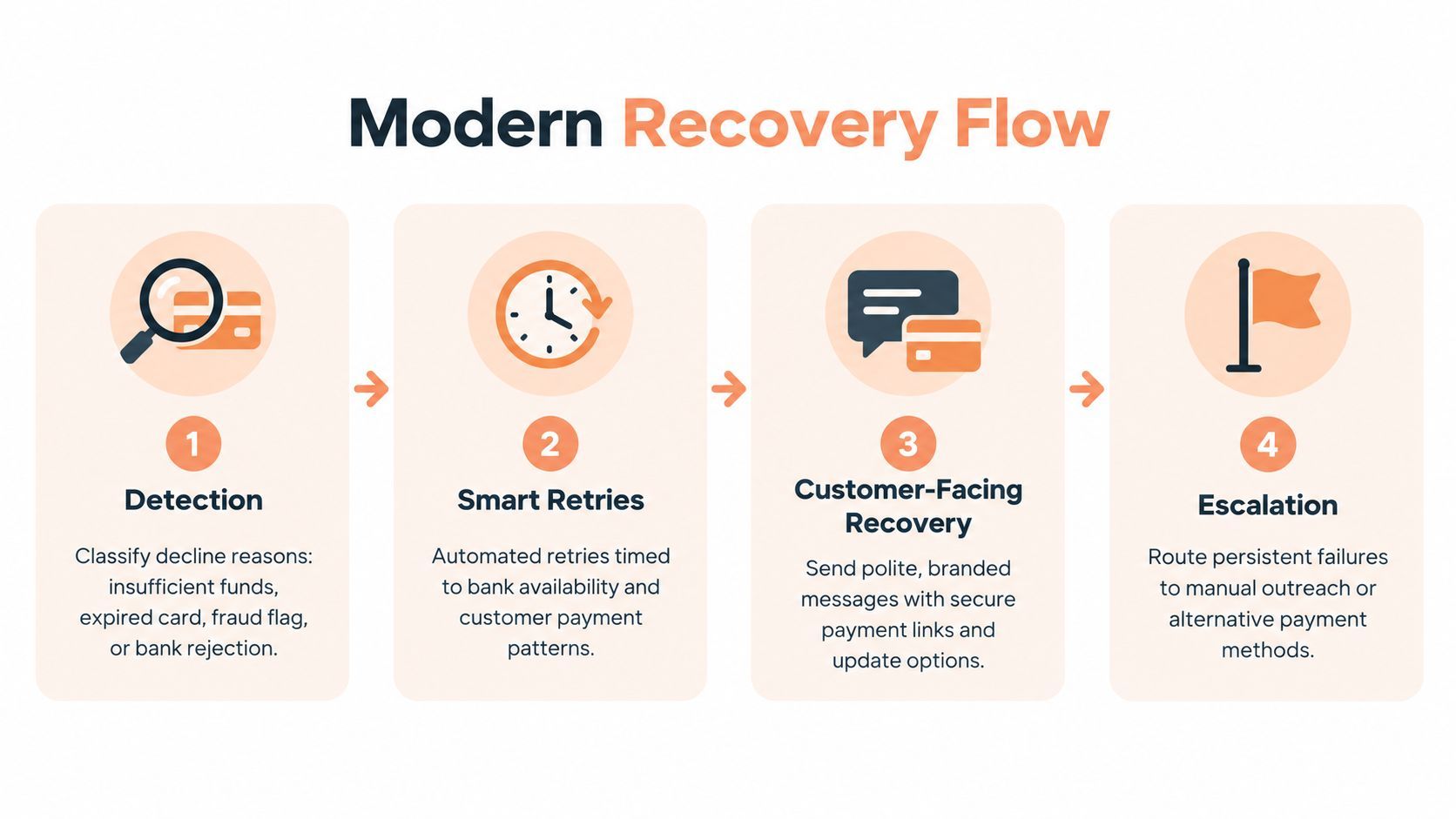
1. Detection
Start by capturing the failed event with its decline code, payment method, market, subscription value, customer state, and recent payment history. Don't schedule a retry from a generic “payment failed” flag. That label hides the difference between a temporary funds issue, an expired card, a fraud concern, and an issuer rejection.
2. Smart retries
The retry engine should select the next attempt based on the diagnosed failure. It can vary the delay, choose a fallback method, request authentication, or stop retrying when another attempt is unlikely to help. A customer should never receive a sequence that continues because the system has a fixed number of attempts left.
A retry is useful only when the next attempt has a different reason to succeed.
Machine learning can help predict a promising retry window from prior payment behavior, market conditions, payment method, and decline history. It can also rank a fallback method or decide which customers warrant proactive outreach. It doesn't make an opaque issuer rejection understandable, and it shouldn't be used as decoration around a sequence that lacks decline-code logic.
3. Customer-facing recovery
Give the customer a secure, branded path to update the payment method. Put the same path in the email, the customer portal, and the product interface. A short grace period can preserve access while the customer fixes the problem, which is often more respectful than an immediate lockout.
The message should state what happened without implying wrongdoing. Include the merchant descriptor, renewal context, support route, and cancellation option. Clarity reduces the chance that a legitimate renewal looks like an unauthorized charge.
4. Escalation
Persistent failures need a defined endpoint. Depending on customer value and product risk, that may be manual outreach, a new payment method, a different local method, or a controlled account limitation. Document the stop conditions so the system doesn't create repeated attempts that increase complaints and disputes.
Teams building the surrounding SaaS billing architecture can also review billing patterns for SaaS products, especially where subscription state, webhooks, and customer access need to stay synchronized.
Where Recovery Sits Inside a Merchant of Record Stack
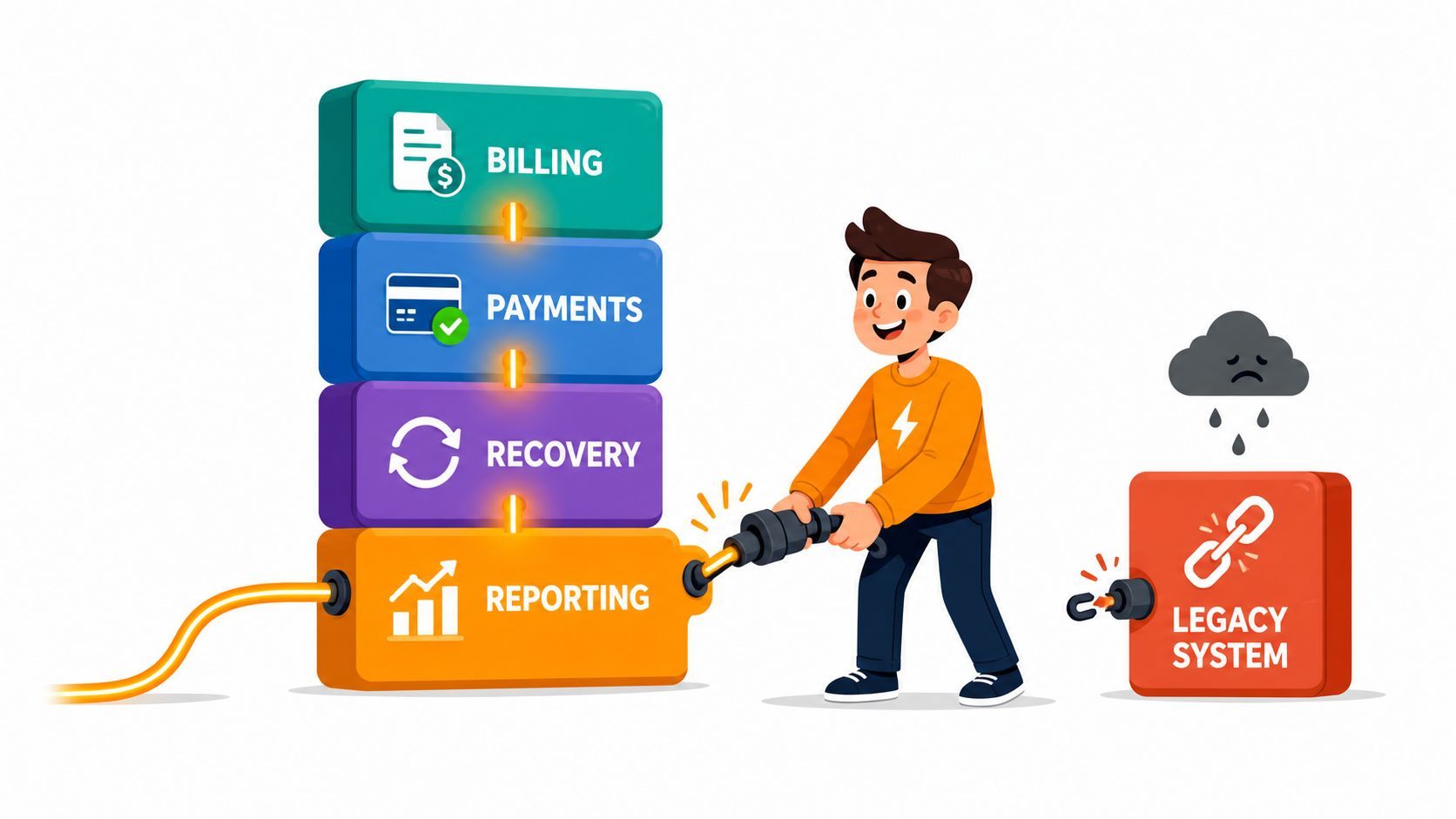
Recovery works best when it can see the complete commercial event. The checkout created the customer record, the subscription engine knows the plan and renewal date, the tax layer calculated the transaction, and the payment system knows the method and issuer response. If those systems are disconnected, a recovery service may not know whether the customer upgraded, changed seats, canceled, or moved to a different billing country.
A Merchant of Record adds another operational dimension. Global payment preferences, currencies, tax-inclusive pricing, local compliance, and customer communications all affect the recovery path. A renewal for a tax-inclusive European price shouldn't be handled as though it were identical to a card-present U.S. transaction.
One customer state, not several conflicting states
The platform needs a consistent answer to basic questions:
-
Is the subscription active, past due, paused, or canceled?
-
Which payment method should the system try next?
-
Was tax calculated for the original transaction?
-
What amount should the customer see in the update flow?
-
Which entity and descriptor should appear in the communication?
A fragmented setup can recover the payment but fail to update the subscription, or update access while the payment remains unresolved. Those mismatches create reconciliation work and can produce disputes even when the processor eventually approves a charge.
For teams operating in regulated verticals, payment operations also sit beside broader compliance work, much like the reference material collected in articles on healthcare certifications. The point isn't that those domains are identical. It's that operational ownership matters when multiple records, jurisdictions, and customer-facing obligations must agree.
A Merchant of Record that already handles VAT, GST, and sales tax collection, filing, and remittance can connect recovery to the original transaction context. The Merchant of Record model is therefore more than a tax arrangement. It can reduce the integration debt created when checkout, billing, compliance, and customer recovery live in separate systems.
How Creem Runs Recovery in Practice
A practical recovery loop starts before the first renewal. At checkout, a software company accepts supported methods such as cards, Apple Pay, Google Pay, and SEPA through a hosted payment flow. The platform stores the payment relationship in a form that the subscription engine can use later, without asking the customer to re-enter details at every renewal.
When the customer changes seats, upgrades a plan, or moves between billing options, the subscription record changes with them. Proration and plan-state updates keep the next charge aligned with the commercial agreement. That matters because a recovery email showing the wrong plan or amount can create confusion that no retry schedule can fix.
At renewal, a failed authorization generates an event for the billing workflow. Webhooks can notify the software product that the subscription is past due, while the recovery system classifies the failure and schedules the relevant action. The customer sees a self-service portal with a payment-method update link rather than a support ticket as the only route back to a successful renewal.
The loop closes on a successful renewal
The workflow isn't complete when an email is sent or a retry is queued. It closes when the payment succeeds, the subscription state updates, access reflects that state, and the customer receives a clear receipt or confirmation. If the customer changes the payment method, the new method should become available for future renewals where the payment network and consent rules allow it.
For the finance team, recovery also needs to end in a usable payout and reconciliation record. Creem's published platform model includes predictable payouts on the 1st and 15th, so recovered revenue has a defined destination after the payment lifecycle completes.
That end-to-end view is more useful than a dashboard tile showing “retries attempted.” It connects checkout, subscription data, decline handling, customer self-service, webhooks, access control, and payout operations into one recoverable state.
Build Versus Buy for Recovery
A custom recovery stack gives a SaaS team control over business rules, data models, and customer experience. It also creates a long-lived maintenance obligation. Someone must keep decline-code handling current, manage processor differences, maintain secure payment-update flows, test webhook edge cases, and reconcile the result across billing and finance.
A managed platform reduces that engineering surface, but it introduces dependency and platform constraints. The right choice depends on payment volume, team capacity, geographic complexity, and how much of the checkout and tax stack is already outsourced.
| Decision area | Build internally | Use a managed Merchant of Record |
|---|---|---|
| Initial integration | More control, but engineering owns the full workflow | Faster when checkout and subscriptions are already supported |
| Decline coverage | The team must map processor responses and maintain rules | Recovery logic is maintained as part of the platform |
| Customer experience | Fully custom portal, messaging, and account states | Uses platform workflows, with available integration points |
| Global operations | Team owns local methods, tax context, and compliance links | Platform coordinates payments, tax, and international selling |
| Reconciliation | Requires internal reporting across processors and tools | Payments, subscriptions, splits, and payouts can share a system |
| Cost evaluation | Engineering and maintenance costs can be hard to forecast | Published fees and comparison tools make direct modeling easier |
Creem publishes transparent fee comparison tools and describes a flat 3.9% plus $0.40 per successful transaction structure in its platform materials. That figure should be modeled alongside processor costs, support work, failed-payment loss, tax administration, and the engineering time required to maintain an internal system.
The hidden cost of building often appears after launch. A retry works in one market but not another. A processor changes a response format. A customer updates a card but the subscription remains past due. A finance team then reconciles several dashboards instead of one.
A managed platform can also consolidate adjacent workflows. When payments, subscription billing, affiliate commissions, revenue splits, and payouts share a dashboard, a small team has fewer reconciliation surfaces to maintain. That doesn't remove the need for testing or oversight, but it changes where the operational burden sits.
Measuring Recovery the Right Way
Recovered dollars are necessary, but they aren't sufficient. A system can show strong payment recovery while increasing customer complaints, confusing descriptors, repeated authorization attempts, or post-recovery cancellations.
UK consumer research found that 47% of people had experienced a payment problem, rising to 60% among 18 to 24-year-olds and 58% among ethnic-minority consumers. The same research found that 38% of consumers cited unauthorized purchases as their reason for disputing a payment, while delayed refunds accounted for 18% and missing or late deliveries for 17% (UK Payment Systems Regulator consumer research).
Those findings make transparency part of recovery performance. A successful flow should identify the merchant and renewal, offer a secure self-service update, preserve access for a defined grace period, and make cancellation or support easy to reach.
Track the following at each review:
-
Recovered recurring revenue: Separate successful recoveries by decline reason, market, payment method, and customer segment.
-
Time to recovery: Measure how long it takes from the original failure to a successful renewal.
-
Complaint and chargeback rate: Watch whether recovery attempts create customer friction or disputes.
-
Self-service update success: Count completed payment-method updates, not just clicks on an email.
-
Retention after recovery: Check whether recovered customers remain active rather than canceling soon afterward.
-
Access-state accuracy: Confirm that payment status, subscription status, and product access agree.
-
Cost net of recovery: Include processor costs, support contacts, refunds, and manual intervention.
Teams that need a wider view of involuntary and voluntary loss can use a structured churn analysis workflow. The useful outcome isn't a prettier recovery dashboard. It's a decision system that recovers legitimate renewals while protecting trust.
Creem combines global checkout, subscription billing, Merchant of Record tax handling, payment retries, customer update flows, webhooks, and payout operations in one platform. Review how Creem can fit your recovery workflow, then model the cost of managed recovery against your current processor, support, and engineering burden.