
Table of Contents
- Why the Subscription vs Perpetual Question Matters More in 2026
- What Each Licensing Model Actually Means in Practice
- The Multi-Year Revenue and Cost Math
- Tax, Accounting, and Compliance Workloads
- Customer Experience, Lock-In, and Exit Risk
- Which Model Fits Which Software Business
- Decision Checklist for Choosing Your Licensing Model
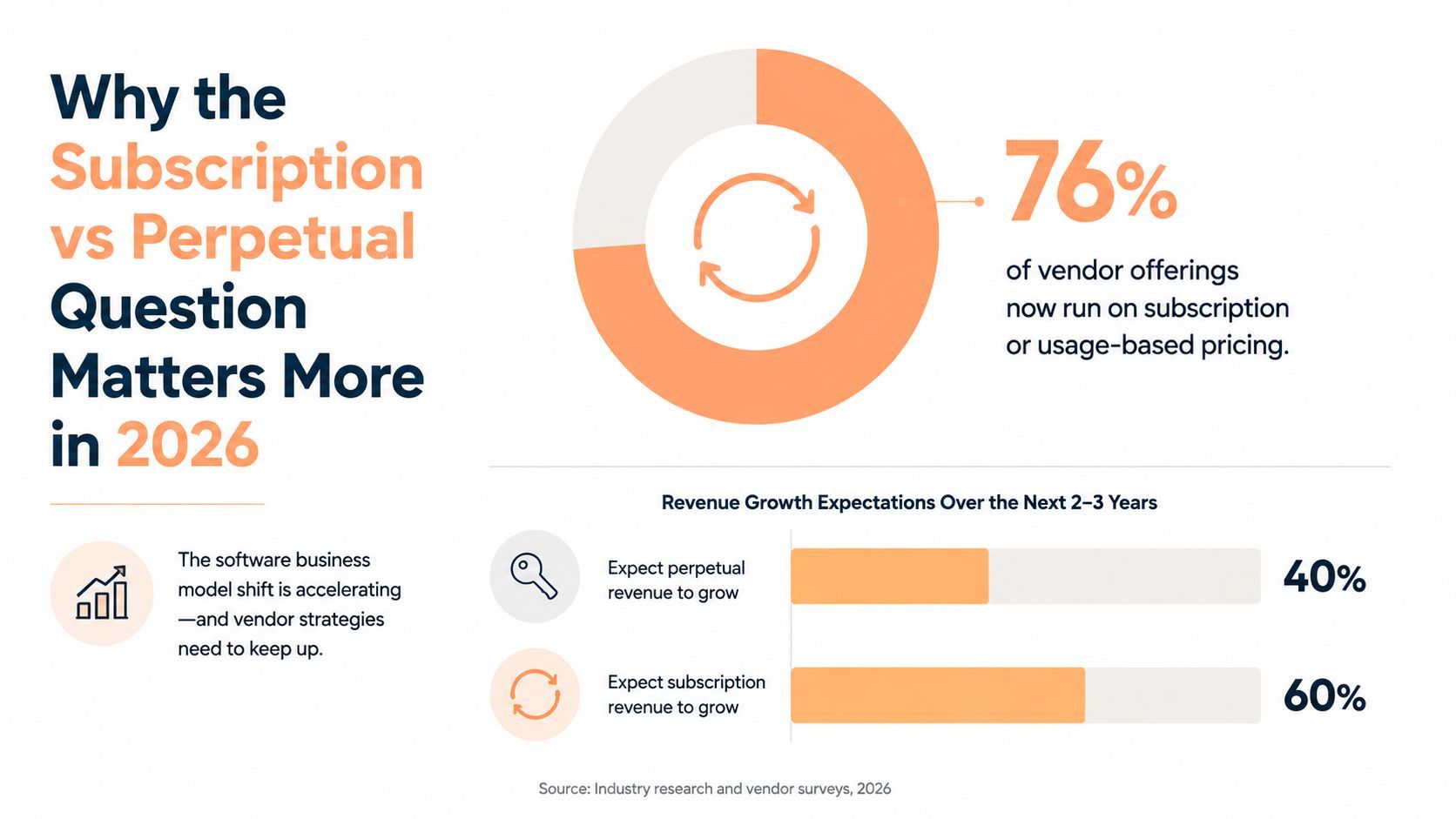
The counterintuitive truth is that subscription is no longer the default winner. In 2026 market analysis, 76% of software vendor offerings now run on subscription or usage-based pricing, while license-and-maintenance models have fallen to 24% of deployed solutions. That shift does not mean perpetual is dead, it means the decision is now about cash flow shape, tax and accounting treatment, and exit risk, not ideology.
| Dimension | Subscription License | Perpetual License |
|---|---|---|
| Payment shape | Recurring monthly or annual payments | One-time upfront payment |
| Access rights | Access continues while you keep paying | Indefinite use after purchase |
| Updates and support | Usually bundled in | Often separate or limited |
| Finance profile | Predictable recurring revenue for vendors | Front-loaded revenue for vendors |
| Buyer fit | Teams that value flexibility and current features | Teams that value long holding periods and budget control |
Why the Subscription vs Perpetual Question Matters More in 2026
The market has already picked a side, and that should change how you evaluate the deal. 76% of vendor offerings now sit in subscription or usage-based models, while only 24% are still deployed as license-and-maintenance solutions, which tells you recurring billing is the operating norm in major software markets today (Accio trend analysis). On top of that, Revenera reports only 40% of respondents expect perpetual revenue to grow by 2027, a 12-point drop from the prior year's results, which is a pretty blunt signal that vendor planning is moving away from one-time monetization.
Read the model as an economic choice
I've sold software both ways, and the mistake teams make is treating this like a product preference. It's an economic structure. Subscription changes the relationship between vendor and buyer from a one-time exchange to an ongoing financing and service relationship, which is why the arguments around it keep circling back to revenue stability, renewal control, and support commitments.
For vendors, the draw is obvious. Recurring billing smooths cash flow and makes forecasting less lumpy, while perpetual revenue spikes early and then slows unless you keep landing new deals. For buyers, the tradeoff is equally clear, recurring payments buy continuity, but they also keep the vendor in your budget every year.
Use three lenses, not one
Most bad decisions happen because someone compares only the sticker price. That misses the core mechanics. The right way to judge subscription vs perpetual license is through three lenses.
Practical rule: if your team can't explain the revenue path, the tax path, and the exit path, you're not ready to sign.
-
Revenue and cash flow. Vendors care about recurring revenue because it changes lifetime value and collection predictability.
-
Tax and compliance. The billing model affects how finance classifies spend and how much admin work lands on the seller.
-
Customer experience plus exit risk. Buyers need to know what happens if pricing changes, support disappears, or the product line gets folded into a new package.
That's the framework that cuts through the noise. If you only ask, “Which costs less this year?”, you'll miss the answer.
What Each Licensing Model Actually Means in Practice
A perpetual license is simple on paper. The buyer pays once, gets indefinite access to a specific version, and usually relies on a separate maintenance agreement for upgrades, patches, and support. A subscription license bundles access, updates, and support into recurring payments, so the buyer is paying for continuity rather than ownership-like access. For a clean vocabulary reference, the article what is recurring revenue in SaaS is useful because it shows why vendors care so much about the payment pattern, not just the product itself.
The operational difference is bigger than the sales pitch
In practice, the two models control different things. Subscription typically gives the vendor more control over packaging, renewal timing, and feature access. Perpetual gives the buyer more control over version longevity, but that control gets weaker when security updates, integrations, or support are gated behind separate contracts.
Common variants show up fast once you start buying or selling software:
-
Annual subscription. Common for business software when the vendor wants commitment without a long contract.
-
Monthly subscription. Easier to enter, easier to cancel, and usually less friendly to vendor cash flow.
-
Perpetual plus optional support. A classic enterprise setup, especially where buyers want ownership-like access but still need update coverage.
-
Named-user licensing. Tied to one person, often used where accountability matters.
-
Concurrent or floating licensing. Shared across a pool of users, common in engineering and design software.
-
Device-bound licensing. Tied to a machine rather than a person, often seen in specialized desktop software.
A quick comparison you can actually use
| Dimension | Subscription License | Perpetual License |
|---|---|---|
| Who controls access | Vendor controls continuity through renewals | Buyer keeps indefinite access to the purchased version |
| Updates and support | Usually included | Often separated into maintenance or support contracts |
| Payment timing | Recurring | Upfront |
| Budget behavior | Easier to spread across operating budgets | Easier to justify as a capital-style purchase in some buying motions |
| Exit posture | Easier to leave in theory, but access ends fast | Harder to leave in practice if support and upgrades matter |
The important thing is not to romanticize either one. Subscription is not “modern” and perpetual is not “old.” They're just different answers to the same question, who carries the risk, the vendor or the buyer.
The Multi-Year Revenue and Cost Math
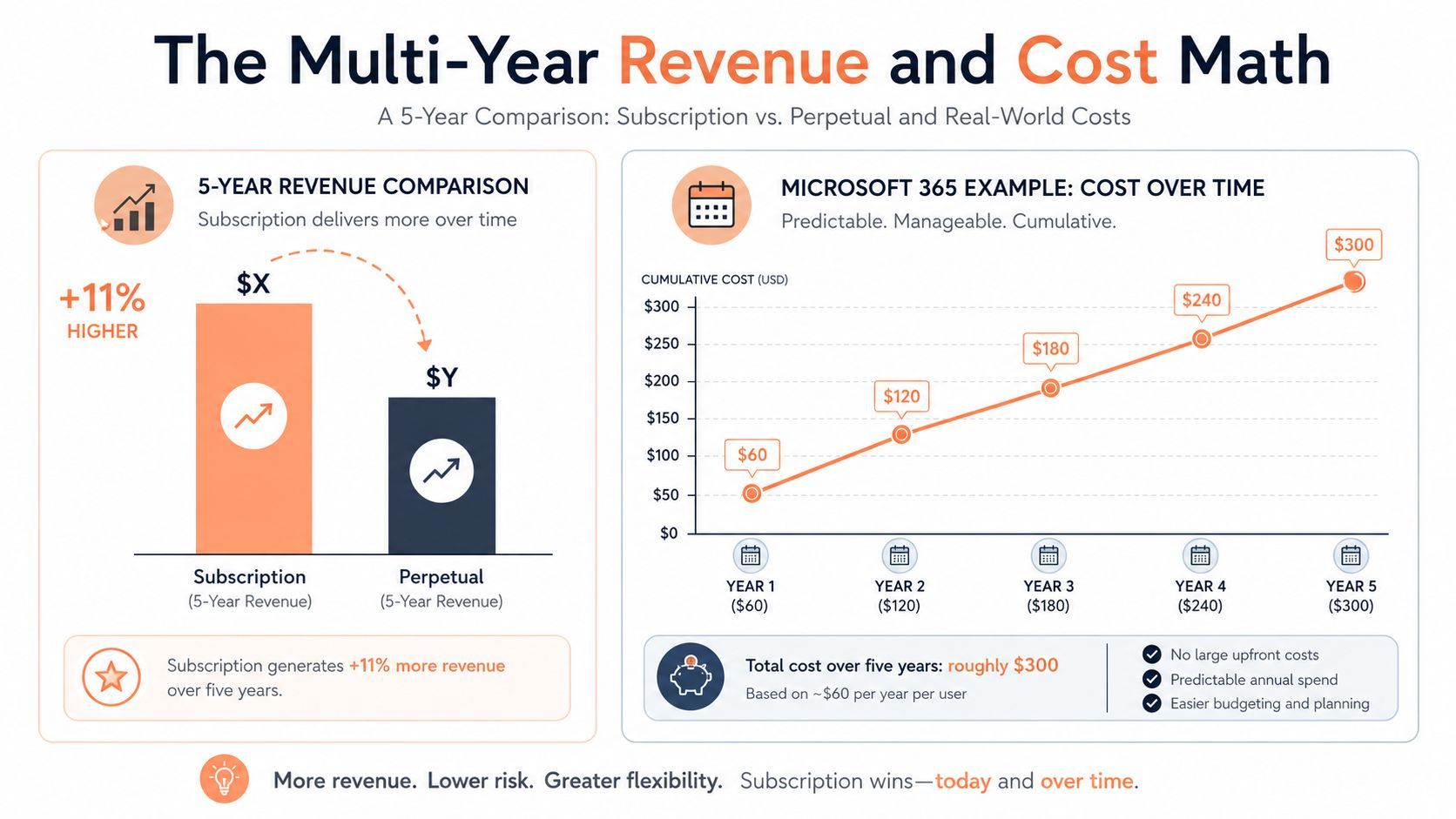
The five-minute version is straightforward, subscription usually wins on vendor revenue, while perpetual can win on buyer cost over long, stable use. One analysis of software licensing economics found that subscription pricing can generate 11% more revenue over 5 years than a comparable perpetual model (Dev.to analysis). Recurring fees stack over time, while perpetual revenue arrives mostly at the start of the relationship.
Vendors sell the revenue shape, buyers live with the expense shape
If you build software, recurring revenue is easier to forecast, easier to value, and easier to defend in board discussions. That is why subscription has become the default choice for so many vendors. If you buy software, the opposite can be true, because recurring payments never stop and can exceed the cost of ownership over time.
A published price example makes that concrete. Microsoft 365 Personal was listed at about 59.99 per year in the UK or ****5.99 per month on Microsoft's UK pricing pages, which totals roughly $300 over five years. A perpetual license is paid once and then used indefinitely, so a stable long-term user may get a lower total cost, but the buyer usually gives up major updates or support after a limited period.
The crossover point is where the decision actually lands
For predictable workloads, one 2026 TCO analysis says perpetual plus 20% annual maintenance reaches cost parity with subscription around year 4.5, and then becomes 28% to 40% cheaper over a 10-year horizon (Atonement Licensing TCO analysis). That is the number buyers should care about, not the first invoice. If you expect to keep the product a long time, the economic question is whether you can tolerate the support and upgrade path that comes with perpetual.
If the workload is stable and the seat count barely moves, perpetual gets more attractive as time passes. If usage changes often or the product must stay current, subscription becomes easier to defend.
For vendors, the implication is blunt. Subscription maximizes lifetime value and predictability, so it fits companies that want renewal-driven retention, annual adjustments, and tiered packaging. For buyers, the right move is to sketch the five-year cost path before arguing over monthly pricing.
Use the accounting language correctly
Finance teams also need to separate deferred revenue from earned revenue when they think about subscriptions. That accounting distinction matters because it shows why subscription cash arrives early but is not recognized all at once, which changes how vendors plan and how buyers interpret vendor stability. A useful primer on the mechanics is deferred revenue vs. earned revenue.
If your team is modeling recurring revenue properly, this ARR calculation guide is a useful internal reference for understanding how annual recurring revenue gets measured.
Tax, Accounting, and Compliance Workloads
The biggest operational difference between the models isn't philosophical, it's administrative. A perpetual deal often gets treated like a one-time purchase, so procurement can route it through a capital-style approval flow, while a subscription lands as operating expense and keeps showing up on the books every billing cycle. That one distinction changes who has to approve it, how finance reviews it, and how much ongoing reconciliation the company needs.
The billing model changes the finance workload
Perpetual licensing tends to feel cleaner to buyers who want budget certainty. You pay once, then your ongoing obligations usually sit in support or maintenance. Subscription is easier to start, but it creates a permanent finance relationship because renewal, expansion, downgrades, and seat changes all have to be tracked.
That means sellers need the right infrastructure from day one. If you collect payments globally, you also inherit tax rules across jurisdictions. For software companies selling across borders, that becomes a compliance burden fast, which is why many teams use a merchant-of-record stack like Creem to handle collection, filing, and remittance instead of rebuilding tax logic around each license type.
Tax obligations are part of the product, whether you like it or not
Once you sell in multiple countries, tax handling stops being a back-office afterthought. VAT, GST, and sales tax follow the transaction, and the seller needs a reliable way to classify and remit them without creating a patchwork of manual processes. That burden grows when you support subscriptions because the same customer may be billed repeatedly over time, across plan changes and upgrades.
Operational truth: the more countries you sell into, the more the billing model and the tax stack start acting like one system.
If you want a deeper look at the business side of that burden, the piece on SaaS sales tax compliance cost is relevant because it shows why many software teams stop trying to hand-build this layer.
The practical takeaway is simple. Subscription doesn't just change revenue collection, it changes the recurring compliance work attached to every renewal. Perpetual doesn't remove tax or accounting work, but it usually reduces the number of moments when the system has to be touched again.
Customer Experience, Lock-In, and Exit Risk
Most comparisons pretend the buyer's only risk is overpaying. That's lazy. The risk is getting stuck in a model that becomes expensive or inconvenient to escape, and the pain shows up differently depending on whether you bought subscription or perpetual.
Subscription gives you continuity, then asks you to keep paying for it
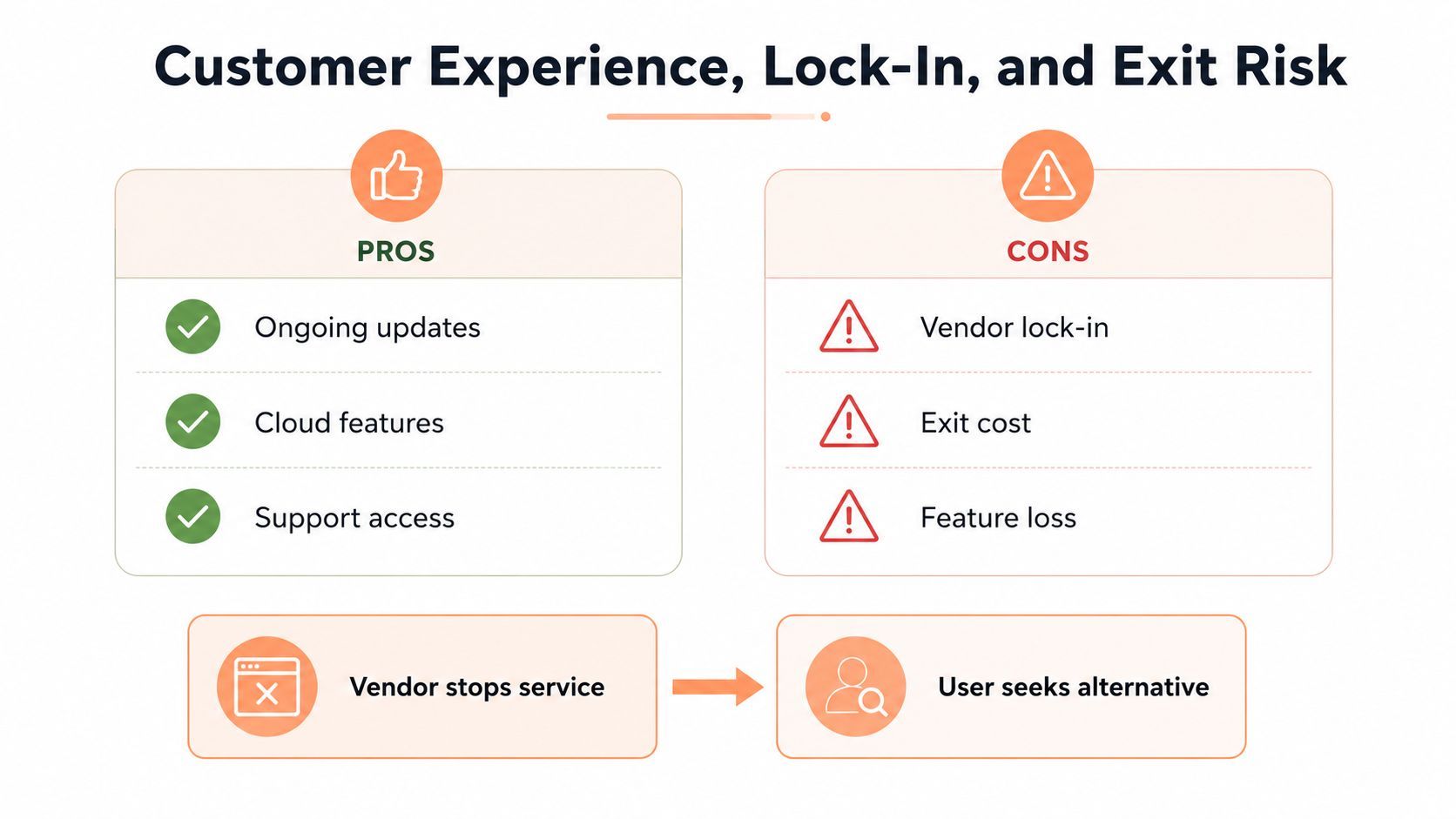
Subscription packaging usually includes updates, cloud features, and support in one recurring fee. That is convenient until the vendor changes tiers, moves a feature upmarket, or pushes renewal pricing harder than you expected. Your access can also disappear quickly if a renewal breaks down, which turns billing friction into business interruption.
That's why buyers need to look at exit terms before they sign. Can you export data cleanly? Can you keep using the product while you evaluate alternatives? What happens if the vendor stops bundling a feature you rely on? Those questions matter more than the monthly price.
Perpetual protects access, but not necessarily usefulness
Perpetual looks safer because you keep the software after purchase. In reality, that safety has a shelf life. If the vendor stops shipping security updates, changes integration standards, or sunsets the product line, the buyer can end up paying migration costs anyway. The license may still exist, but the product stops fitting the environment around it.
That is why hybrid licensing and flexible term arrangements are gaining attention. Buyers want a way to avoid being trapped at either extreme. The market guidance on subscription vs license reflects that shift, because many companies now want some mix of continuity, upgrade control, and exit optionality rather than a pure ideological choice.
If you're measuring churn, churn analysis is worth keeping nearby because exit risk and customer retention are tightly linked in recurring models.
Don't ask only whether the software works today. Ask how expensive it becomes to leave six months from now.
The honest conclusion is this. Subscription creates dependency through renewal. Perpetual creates dependency through stagnation. The best model is the one whose failure mode your team can survive.
Which Model Fits Which Software Business
For an indie maker shipping a plugin or downloadable tool, subscription usually fits when the product keeps changing, support questions are frequent, or you need predictable cash flow to fund updates. Perpetual can still fit when the product is stable, the audience dislikes ongoing bills, and buyers want a clean one-time purchase. A hybrid works when you want lifetime access for entry-level buyers and subscription for power users who need updates or premium support.
For a SaaS startup with continuous cloud updates, subscription is the default for a reason. You're already maintaining a live service, so tying revenue to ongoing access matches your cost structure and your support obligations. Perpetual occasionally fits as a legacy option for enterprise deals, but it usually creates version drift and support fragmentation.
For an on-premise vendor selling into regulated industries, perpetual often makes more sense because buyers care about control, procurement approval, and version stability. Subscription can still work if you package it as a managed term with clear support and upgrade commitments, but the buyer will usually ask for more contractual protection. The hybrid pattern here is common, perpetual core license plus paid support or a managed subscription overlay.
For a digital product shop shipping license keys, templates, or downloadable software, the model depends on how often the product changes. If you're shipping a static asset, perpetual is cleaner. If you're shipping updates, new content, or ongoing support, subscription tends to be more honest about the value exchange. This is also where a merchant-of-record platform that supports subscription billing and software license keys can save a lot of operational drag, because you're not rebuilding checkout, taxes, and entitlement handling from scratch.
Decision Checklist for Choosing Your Licensing Model
Start with the product, not the trend. If your software changes often, needs ongoing support, or depends on cloud delivery, subscription is usually the cleaner choice. If the product is stable, the buyer keeps it for years, and budget control matters more than update velocity, perpetual deserves a serious look.
Answer these eight questions before you commit
-
How often do you ship meaningful updates? Fast-moving products fit subscription better, because recurring billing matches recurring value.
-
How long do customers usually keep the product? Long retention makes perpetual more attractive, especially when the workload is stable.
-
How sensitive is the buyer to monthly or annual spend? Finance-sensitive buyers often prefer one-time budgeting, while growth teams tolerate recurring fees more easily.
-
Do you sell across many countries? If yes, your tax handling matters more, and the billing stack needs to be built for that.
-
Do customers expect included support? If support is central to the value proposition, subscription keeps the promise cleaner.
-
Can buyers exit cleanly if pricing changes? If the answer is no, you need to be honest about lock-in risk before a contract gets signed.
-
Do you need predictable vendor revenue to fund development? If yes, subscription is the stronger operating model.
-
Can your finance team handle renewals, support contracts, and upgrade tracking without chaos? If not, simplicity should beat theoretical ownership.
Use the answer pattern to choose
-
Subscription fits when updates are frequent, support is continuous, and the product is part of an active service relationship.
-
Perpetual fits when the product is stable, the buyer wants long-term control, and the cost crossover happens far enough out to matter.
-
Hybrid fits when you want a one-time entry point but still need recurring revenue from support, upgrades, or premium access.
The operational footnote matters too. Whatever model you pick, the merchant-of-record layer, predictable payouts, and integrated subscription billing determine how smoothly it runs at scale. If the payments stack is fragile, the licensing strategy won't save you.
If you're deciding how to sell software globally, build the billing layer around the model you want, not the one your checkout page can barely support. Creem handles merchant-of-record checkout, recurring billing, tax compliance, and software license keys in one system, which makes it easier to run subscription or hybrid licensing without stitching together five different tools. Visit Creem if you want to compare the licensing model, the payout flow, and the compliance workload before you ship.