

Hypothetical scenario: a SaaS founder connects subscription billing to an affiliate tool that handles the first payment but not recurring commissions. The program looks healthy until the first renewal cycle, when affiliates question missing earnings, finance finds no reliable reversal process, and the team starts reconciling invoices in spreadsheets.
That problem usually isn't caused by one missing feature. Affiliate tracking software has to match your billing model, sales motion, attribution rules, and operating scale. A tool built for Shopify coupon codes won't necessarily fit a subscription product. A network platform may be excessive for a founder recruiting a small group of technical partners.
This comparison groups ten tools by program model, not by a generic feature score. You'll find merchant-of-record and all-in-one platforms, Stripe-native SaaS tools, ecommerce software, B2B partner systems, and enterprise or network platforms. Each entry calls out practical integration points, suitable use cases, and stated limitations.
The aim is straightforward. Match the software to how you charge customers and pay partners, then test the parts that affect money: attribution, recurring events, refunds, commission approval, tax documentation, and payout timing. For broader performance-marketing context, see this guide for service businesses.
Table of Contents
- 1. Creem
- 2. Rewardful
- 3. FirstPromoter
- 4. Refersion
- 5. Tapfiliate
- 6. PartnerStack
- 7. impact.com
- 8. Everflow
- 9. Affise
- 10. TUNE
- Top 10 Affiliate Tracking Software Comparison
- Shortlisting Affiliate Tracking Software for Your Program
1. Creem
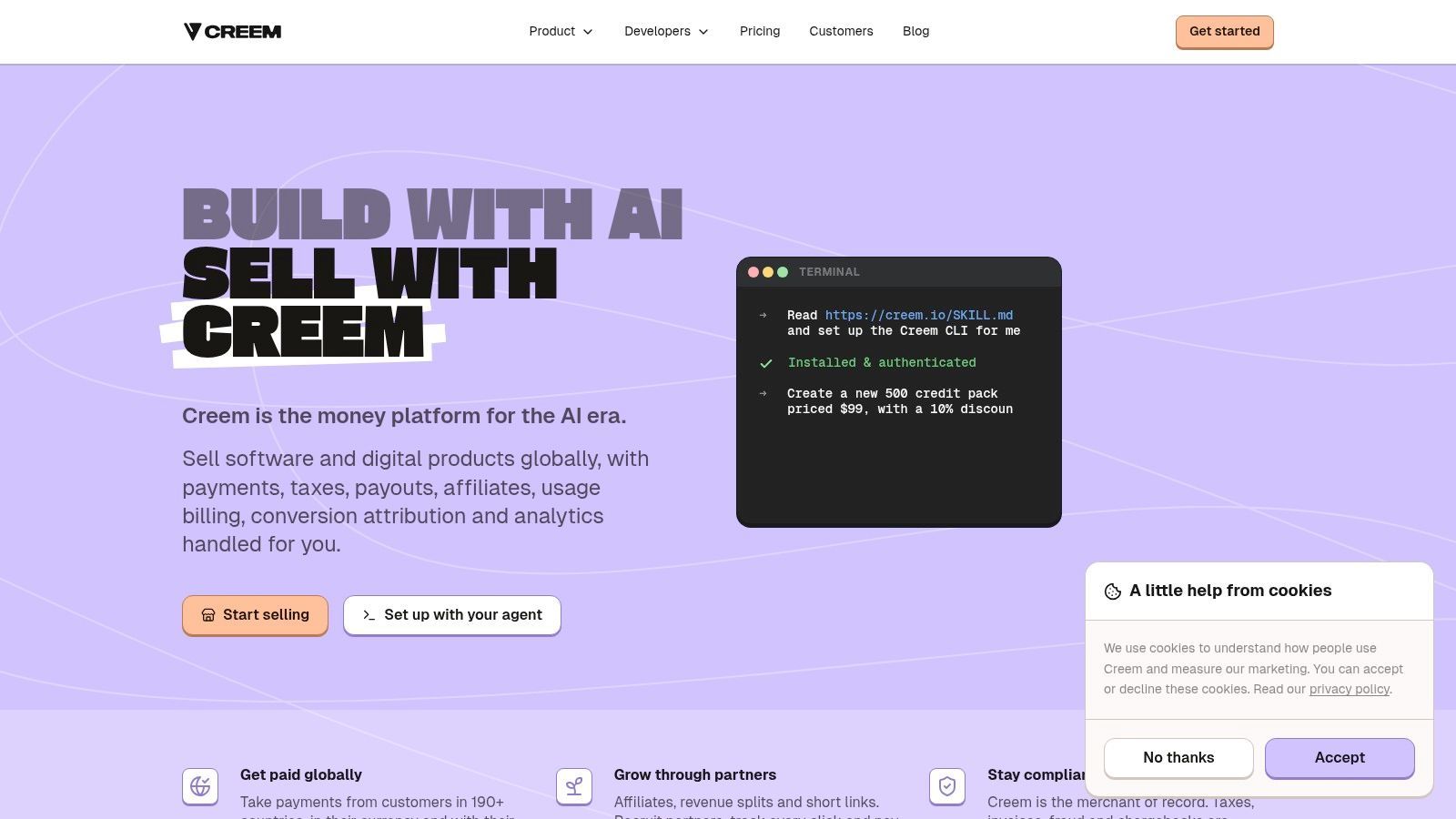
A merchant-of-record setup changes what affiliate tracking has to do. If billing, tax, renewals, refunds, and payouts all sit in the same flow, the affiliate tool can follow the actual transaction lifecycle instead of stopping at the first click. That is the case with Creem, which combines hosted checkout, subscription and usage billing, automated tax handling, revenue splits, payouts, and affiliate management in one system.
For software teams, that matters because affiliate attribution often has to survive more than an initial sale. A referred customer might start a trial, convert later, upgrade, renew, churn, or receive a refund. If those events live in separate tools, finance usually ends up reconciling partner commissions by hand. Creem reduces that handoff because the tracked referral and the payment record sit closer together.
Its Affiliate Hub covers referral-link tracking, click and conversion reporting, commission management, and automated payouts. The practical advantage is traceability.
Practical rule: Don't approve a recurring commission until you can trace it to the customer, subscription, invoice, currency, and current refund state.
The differentiator is the operating model. Creem acts as the merchant of record for payments it processes, handling tax collection, filing, and remittance while also generating invoices and receipts. That can suit SaaS teams selling across markets without building a separate billing and tax stack first. The platform also supports cards, Apple Pay, Google Pay, SEPA, PayPal, subscriptions, usage billing, seat-based plans, license keys, and digital delivery.
Where Creem works best
This option fits SaaS startups, indie makers, AI or usage-based products, and digital-product teams that want checkout, billing, affiliate tracking, and partner revenue sharing under one integration. It is especially relevant for programs where the billing model drives commission logic. Developers also get typed SDKs, REST APIs, webhooks, Next.js templates, CLI and agent integrations, and an MCP server for programmatic operations.
The trade-off is straightforward. Creem's published pricing is 3.9% + $0.40 per successful transaction, with no setup or monthly charges. That may be acceptable for teams that value one system more than custom payment economics. Very large merchants may prefer negotiated processing terms, and teams selling physical goods or running complex marketplace structures should confirm fit before migrating.
2. Rewardful
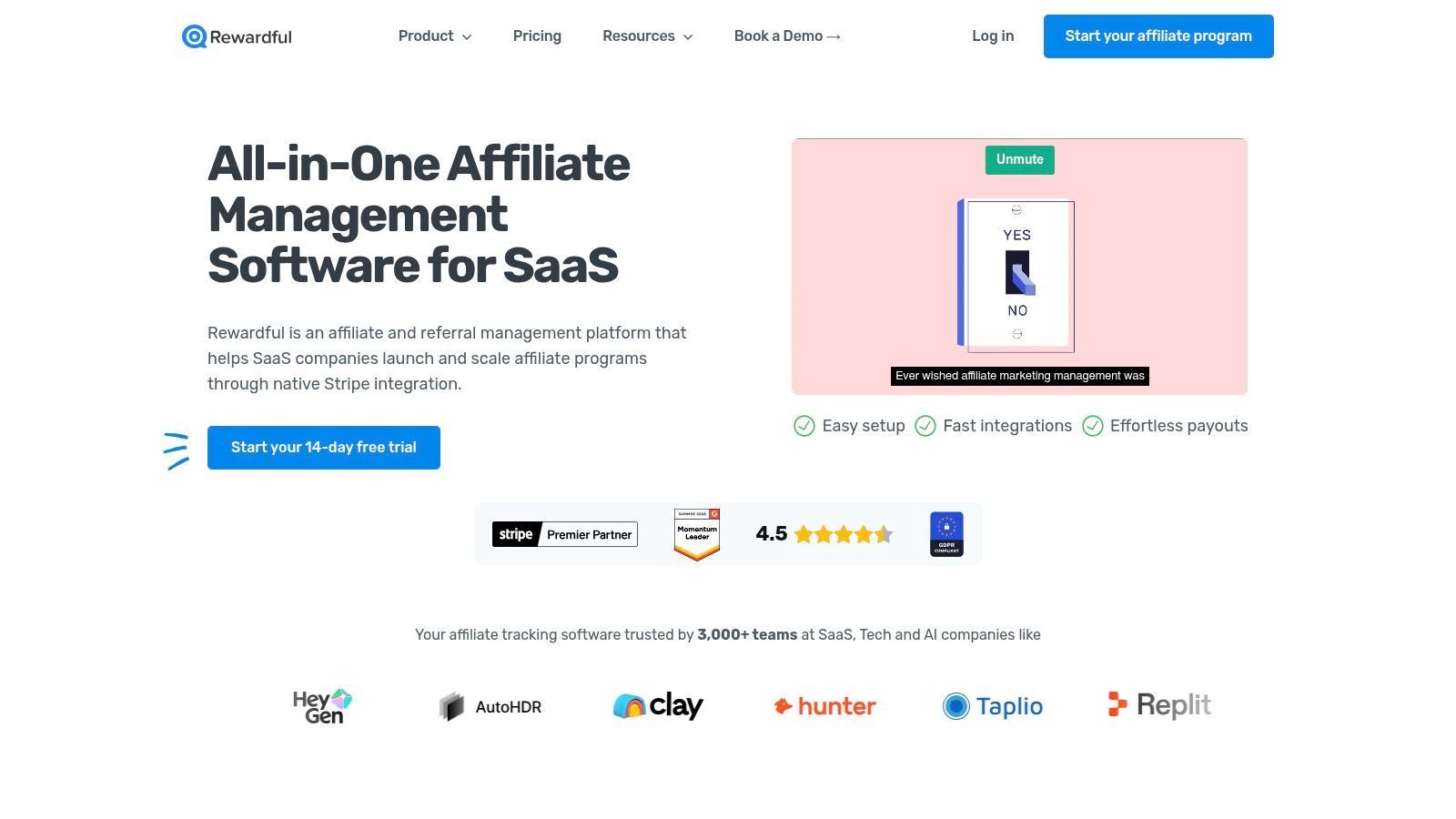
Rewardful is a Stripe-native affiliate and referral tool for SaaS and digital products. Its appeal is speed. A Stripe-based team can connect the billing system, configure an affiliate program, and start working with recurring or lifetime commission rules without adopting a broader partnership suite.
The Stripe connection is important because recurring commissions and refunds depend on billing events, not just a browser click. Rewardful supports recurring and lifetime commissions, refund handling, managed payouts, tax and KYC collection, APIs, and webhooks. Its managed payout workflow consolidates affiliate payments, so the business can fund one invoice while Rewardful distributes money to partners.
The practical trade-off
Rewardful is a good choice when the program is SaaS-led, Stripe-based, and relatively straightforward. It isn't designed to replace partner discovery, reseller operations, or a complex marketplace motion. You generally recruit affiliates yourself, then use the software to track and pay them.
That simplicity can be an advantage during launch. It keeps the integration focused on Stripe events, referral attribution, commissions, and payouts. It becomes less comfortable when the program needs deal registration, multi-stage B2B partner workflows, or extensive partner recruitment operations.
Rewardful states that affiliate-attributed revenue has 0% transaction fees, which makes the cost model easier to evaluate against a program's commission expense. Still, test how its events map to your own subscription objects. Confirm how a refund, failed renewal, cancellation, or plan change affects approval and reversal before inviting a large affiliate cohort.
For a deeper implementation view, this referral tracking system guide for 2026 is useful context alongside the product documentation.
Visit Rewardful if you want a focused Stripe affiliate layer without a full partnership marketplace.

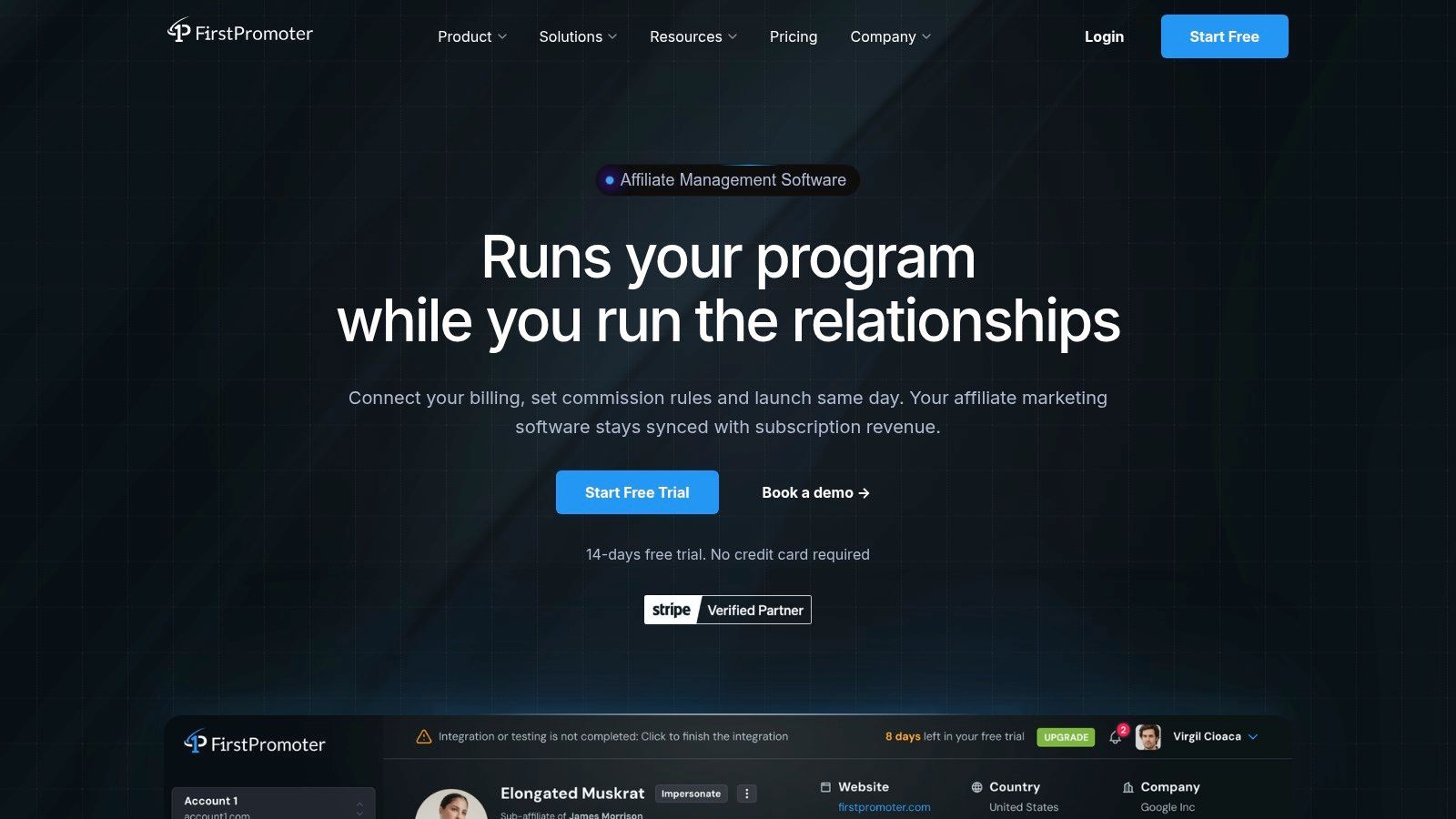
3. FirstPromoter
FirstPromoter is built around the messy parts of subscription affiliate programs. It connects with Stripe and also supports billing platforms such as Paddle, Chargebee, Recurly, and Braintree. That makes it more flexible than a tool tied to one payment provider, particularly for SaaS teams that may change billing infrastructure over time.
The Stripe integration supports two-way synchronization and historical imports. Teams can sync coupons, choose first-click or last-click tracking, and manage recurring or lifetime commissions. Historical import is useful when an existing customer base already contains referral relationships and the program shouldn't start from zero.
Built for subscription changes
FirstPromoter also supports mass payouts through PayPal, Wise, bank transfers, and crypto, with tax-document collection and campaign controls. Unlimited team members on all plans can help when marketing, finance, customer success, and founders all need access.
The important limitation is the affiliate-driven revenue cap on plans. That makes the pricing structure relatively clear while testing the channel, but successful growth can force an upgrade. Calculate the cost at the revenue level you expect after renewals, not only at launch.
SaaS teams should also test the full event lifecycle. Ask whether historical imports preserve the right customer and subscription identifiers. Verify how upgrades, downgrades, refunds, failed payments, and renewals affect commissions. A clean first conversion isn't enough if finance can't reconcile later events.
For program design ideas, this SaaS affiliate programs guide provides relevant background.
Explore FirstPromoter when recurring revenue is central and you want billing-system synchronization rather than basic link reporting.
4. Refersion
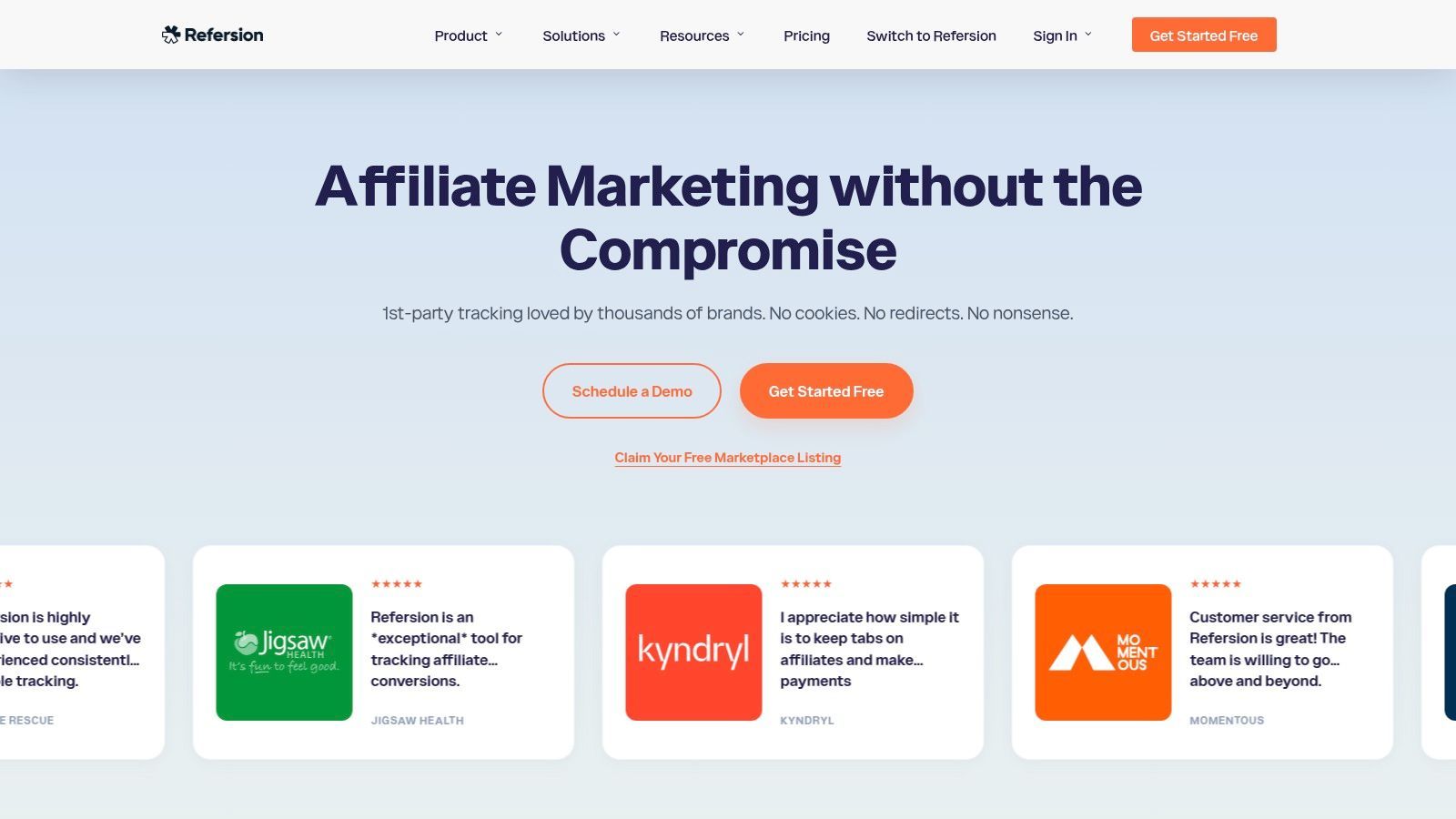
Refersion is aimed at ecommerce and direct-to-consumer brands, especially those operating on Shopify, BigCommerce, or WooCommerce. Its setup reflects ecommerce realities: product-level commissions, coupon attribution, customer-email matching, and affiliates promoting individual products or collections.
The platform supports first-party tracking through a dedicated tracking domain. It can attribute activity through links, coupon codes, SKUs, and customer email. SKU-level rules are valuable when margins vary sharply between products. A brand can reward one category differently from another instead of applying one commission rate across the whole catalog.
Why ecommerce teams choose it
Refersion also offers a marketplace listing, which gives merchants a route to affiliate discovery rather than requiring every partner to be recruited manually. Paid plans support unlimited affiliates, clicks, and conversions, while payout options include PayPal, Trolley, and gift cards. API access is available on higher tiers.
The main cost issue sits below the headline subscription. Lower tiers charge a percentage-of-affiliate-sales platform fee, so the effective cost rises with affiliate revenue. That may be acceptable for an early DTC program, but it deserves a volume model before the program becomes a major acquisition channel.
Refersion isn't the obvious choice for a SaaS business with trials, recurring invoices, seat changes, and renewals. It can make sense if the core sale is a physical or one-time ecommerce order. If the brand sells subscriptions, confirm how future billing events and cancellations are treated before assuming product-level tracking solves the whole problem.
See Refersion if your commerce stack is Shopify-led and your affiliate rules depend on products, coupons, and customer orders.
5. Tapfiliate
Tapfiliate takes a general-purpose approach. It supports ecommerce and SaaS integrations, including Shopify, WooCommerce, BigCommerce, Magento, and Stripe. That makes it useful for teams whose program model is still evolving or whose catalog includes both one-time digital products and recurring offers.
Its feature set covers recurring commissions, deeplinks, group, item, and category rules, bonuses, real-time reporting, and an in-platform messenger. Automation connections through Zapier and Mailchimp can help with partner onboarding and communication. White-label options and custom domains become relevant when the affiliate portal needs to look like part of the company's own product.
Flexibility has a price
Tapfiliate can accommodate more than a basic referral-link program. It offers options such as multi-level structures, SSO, and SEPA exports as programs mature. Those features are useful only when the operating model needs them. A small SaaS team can create unnecessary complexity by adopting advanced hierarchy or payout rules before it has stable commission governance.
The practical limitation is plan structure. Lower tiers have overage fees for clicks and conversions, plus limits on team members and feature access. Estimate usage from the program's traffic and conversion patterns, then model what happens during a campaign spike.
Tapfiliate is a sensible middle ground for a business that wants integrations and configuration without immediately buying enterprise partnership software. It isn't necessarily the best choice for a heavily regulated subscription program that needs merchant-of-record tax handling, nor for a global network that requires deep traffic controls and extensive operational tooling.
Review Tapfiliate if you need one affiliate platform that can serve several commerce models and grow into more advanced program rules.

6. PartnerStack
PartnerStack is designed for B2B SaaS partnerships, where affiliate links are only one part of the commercial motion. A software company may need referral tracking, lead registration, deal registration, reseller workflows, partner payments, CRM synchronization, and enablement in the same system.
That changes the evaluation criteria. A last-click affiliate tool can record a purchase, but it may not represent a partner who introduces an account, registers an opportunity, supports a sales cycle, and receives compensation after a deal closes. PartnerStack's marketplace also supports partner discovery, while CRM integrations connect partner activity with sales operations.
Better for partner-led sales
PartnerStack is a stronger match for B2B programs with longer sales cycles than for a simple creator campaign. It can support affiliate, referral, and reseller motions together, which reduces the need to force every relationship into a link-based model. Recruitment and activation features also matter when a team needs to build a partner channel, not merely issue tracking links.
The trade-off is commercial and operational. Pricing is opaque and typically finalized during a demo, so an early-stage SaaS company can't evaluate the full cost from a public rate card. The platform may also be expensive if the business has only a few affiliates and no reseller or referral process.
Ask for a precise explanation of lead ownership, deal registration, commission approval, CRM synchronization, and payout timing. Also clarify whether the system can distinguish sourced revenue from influenced revenue. Those definitions affect partner trust as much as the tracking code does.
This affiliate program overview offers additional context for comparing affiliate and broader partner motions.
Visit PartnerStack when your SaaS growth plan includes referrals, resellers, and co-selling rather than affiliate links alone.

7. impact.com
impact.com is built for mid-market and enterprise partnership programs that include affiliates, creators, influencers, and other partner types. Its marketplace supports discovery and matching, while contract rules and dynamic commissioning help teams manage different commercial arrangements.
This is useful for brands operating across multiple domains, countries, and business units. The platform supports multi-domain programs, global and multi-currency payouts, tax handling, and custom reporting on higher tiers. In practice, that can replace several disconnected systems for discovery, tracking, contracts, and partner payments.
Scale brings complexity
impact.com makes sense when a team has enough program breadth to justify a broad partnership platform. It can manage more advanced rules than a lightweight affiliate tool, particularly when commission logic varies by partner type, product, contract, or market.
The limitation is the same feature that attracts larger teams. Complexity increases implementation and training demands. Early-stage companies may spend more time configuring the platform than managing the program. Some merchants also report a heavier onboarding and learning curve, so the buying process should include a realistic implementation plan.
Before signing, define the smallest usable launch. Identify which partner types need access first, which commission rules are mandatory, and which reports finance requires. Don't buy a multi-brand operating model if the immediate need is one domain and a handful of partners.
Explore impact.com if partner discovery, contracting, global payouts, and multi-brand governance belong in one enterprise system.
8. Everflow
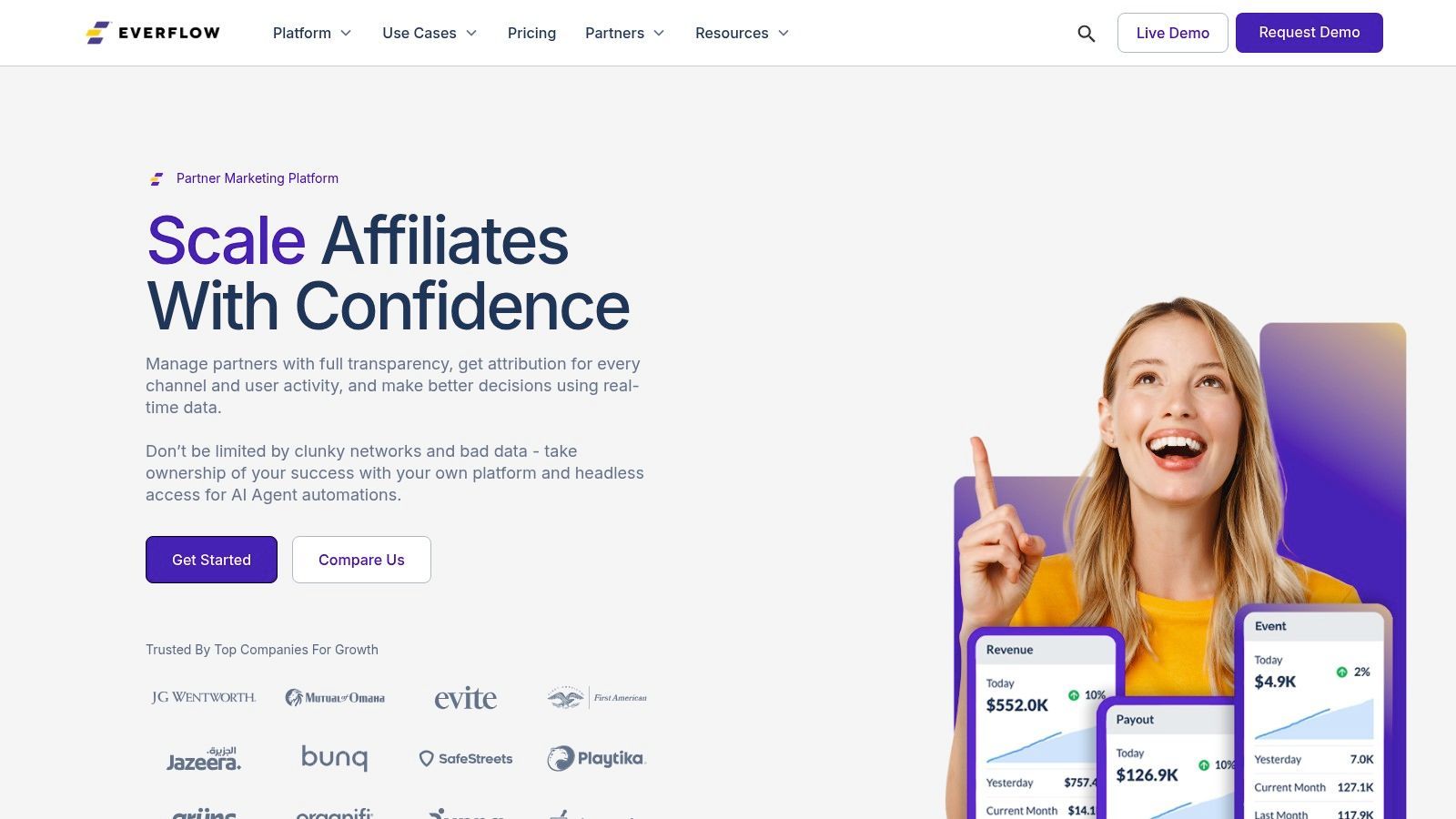
Everflow suits teams that need affiliate tracking plus broader performance-channel reporting. It can track conversions, repeat purchases, renewals, and upsells, which is relevant to programs where the first sale isn't the complete value of a customer.
The platform supports Shopify, BigCommerce, WooCommerce, ClickFunnels, ClickBank, server-to-server postbacks, and API connections. Placement-level reporting helps a brand see which partner placement or traffic source produced the conversion, rather than stopping at the affiliate account level. Its marketplace supports partner discovery, while white-label capabilities help agencies and brands present a branded experience.
Strong reporting, heavier commitment
Everflow is a good fit for mid-market teams, agencies, and advertisers running several partner or media channels. Server-to-server postbacks are especially useful when browser-side tracking is unreliable or when the conversion needs to be confirmed from a backend event.
The commercial limitation is clear. Everflow doesn't publish list pricing, and its stated six-month commitment plus onboarding services may not suit a short pilot. Request a quote that separates platform fees, implementation, support, and any volume assumptions.
Use the evaluation period to test more than the dashboard. Send duplicate events, reverse a conversion, process a renewal, and compare client-side and server-side records. A platform that reports beautifully but leaves finance unsure which event is payable hasn't solved the operational problem.
See Everflow if you need deep placement reporting, postbacks, and partner-channel visibility beyond a basic SaaS referral program.
9. Affise
Affise targets performance-marketing teams, agencies, brands, and affiliate networks operating at volume. It provides advanced tracking features such as view-through attribution, smartlinks, caps, targeting, and traffic controls. Those capabilities are more relevant to network and media-buying environments than to a small founder-led referral program.
Affise Pay centralizes mass partner payouts. Public pricing uses capacity-based tiers tied to traffic and conversion limits, which gives teams a way to relate the plan to expected operating volume. That structure is easier to model than quote-only pricing, although the right tier still depends on the program's traffic patterns and event definitions.
A network-oriented operating model
Affise works best when the team needs to manage many offers, traffic sources, and partners with controls at campaign level. Smartlinks and caps can help route or limit traffic according to campaign rules. View-through tracking may also matter for media programs that measure impressions as part of the customer journey.
The limitation is fit, not only functionality. Entry pricing and capacity-based structure favor teams that already operate at some volume. A small SaaS company running a controlled pilot may pay for infrastructure it won't use.
Fraud controls need careful review here. Ask which events are blocked automatically, which enter a review queue, and how an affiliate can challenge a reversal. A useful platform should preserve the evidence behind a decision, not just label a conversion suspicious.
Explore Affise if your program already resembles a performance network and needs traffic controls, smartlinks, and centralized partner payouts.
10. TUNE
TUNE is an API-first, white-label partner and affiliate platform for advertisers and networks that need extensive control. Its API surface, branded portals, real-time reporting, streaming capabilities, postback support, mobile tracking, and fraud controls support complex implementations rather than a quick no-code launch.
The platform is a natural candidate when the business wants to control the partner experience and integrate tracking into internal systems. White-label portals can support a branded partner operation, while APIs can connect partner events with billing, CRM, reporting, and payout workflows.
Choose control only when you can operate it
TUNE is well suited to advertisers and networks with technical resources. It can support custom partner setups, cross-platform tracking, and compliance requirements that simpler affiliate tools may not cover. The trade-off is implementation effort. A powerful API doesn't remove the need to define event schemas, attribution windows, fraud rules, approval states, and reversal handling.
Pricing is quote-based and not publicly listed. The buying process typically includes a demo and implementation discussion, so request a technical scoping session early. Ask which capabilities are included in the proposed package, what support covers, and what your team must build.
Don't select TUNE solely because it has more controls. Select it when your operating model requires those controls and someone owns the integration after launch.
Visit TUNE when branding, APIs, fraud governance, and custom partner workflows matter more than a fast, lightweight setup.
Top 10 Affiliate Tracking Software Comparison
| Product | Core features | ✨ Unique selling points | 👥 Target audience | 💰 Pricing / Value | ★ Quality / UX |
|---|---|---|---|---|---|
| 🏆 Creem | MOR, hosted checkout, multi‑currency payments, tax collection/filing, subscriptions, revenue splits, affiliate tools, SDKs | ✨ End‑to‑end MOR + tax remittance, built‑in revenue splits, USDC payouts, AI‑ready dev tools, ML dunning | 👥 SaaS startups, indie makers, digital‑product teams | 💰 Flat 3.9% + $0.40/tx, no setup/monthly; predictable 1st/15th payouts | ★★★★★ developer‑friendly, fast integrations |
| Rewardful | Stripe‑native affiliate tracking, recurring/lifetime commissions, managed payouts, API/webhooks | ✨ Fast Stripe setup, managed payouts with tax/KYC | 👥 Stripe‑based SaaS, small teams | 💰 Subscription plans + 0% tx fees on affiliate revenue | ★★★★ quick launch, simple UX |
| FirstPromoter | Two‑way Stripe sync, recurring & lifetime commissions, historical import, managed payouts | ✨ Deep SaaS billing sync, coupon & click attribution | 👥 SaaS with subscription edge cases | 💰 Tiered plans with revenue caps; predictable | ★★★★ tailored to subscription workflows |
| Refersion | First‑party tracking, SKU/coupon/link rules, marketplace listing, payouts | ✨ Shopify/DTC focus, free marketplace to recruit affiliates | 👥 DTC/ecommerce brands (Shopify, BigCommerce) | 💰 Tiered pricing; lower tiers include % fees | ★★★★ ecommerce‑optimized, easy onboarding |
| Tapfiliate | 30+ integrations, recurring commissions, MLM support, real‑time reporting | ✨ Broad integrations, MLM/white‑label options, automation hooks | 👥 Growing ecommerce & SaaS programs | 💰 Tiered plans with overage fees on lower tiers | ★★★★ flexible, good mid‑market fit |
| PartnerStack | Affiliate/referral/reseller motions, partner marketplace, CRM integrations | ✨ B2B partner marketplace + co‑sell & deal registration | 👥 B2B/SaaS companies running reseller/co‑sell programs | 💰 Opaque / demo‑based pricing (enterprise focus) | ★★★★ strong for partner motions |
| impact.com | Partner discovery, granular commissioning, multi‑brand support, global payouts | ✨ Enterprise partner marketplace, contract rules, integrated payouts/tax | 👥 Mid‑market & enterprise brands, creators | 💰 Quote‑based enterprise pricing | ★★★★ scalable, feature‑rich (steeper learning curve) |
| Everflow | Conversion & retention tracking, marketplace discovery, integrations, SOC2 | ✨ Placement‑level analytics, enterprise reporting, white‑label | 👥 Performance marketers, agencies, mid‑market teams | 💰 Quote‑based; onboarding/service fees | ★★★★ deep analytics, enterprise controls |
| Affise | Advanced tracking (view‑through, smartlinks), capacity tiers, Affise Pay payouts | ✨ Smartlinks & mass payouts, capacity‑based scaling | 👥 Networks, agencies, high‑volume advertisers | 💰 Public capacity tiers; scales with volume | ★★★★ built for high‑volume programs |
| TUNE | API‑first partner platform, white‑label portals, real‑time reporting, fraud controls | ✨ Highly customizable & white‑label, strong compliance/APIs | 👥 Advertisers, networks needing full control | 💰 Quote‑based, implementation effort required | ★★★★ mature, very customizable |
Shortlisting Affiliate Tracking Software for Your Program
Start with the billing system, not the feature page. Write down whether you use a merchant-of-record platform, Stripe, another subscription processor, Shopify, a CRM-led sales process, or a network-style offer system. Then document the payable event. Is it a one-time order, a paid trial, a subscription start, a renewal, an upgrade, a registered deal, or a manually approved invoice?
Next, match the sales motion to the right group. A software company selling globally through subscriptions may start with Creem, Rewardful, or FirstPromoter. A Shopify-led brand should examine Refersion or Tapfiliate. A B2B SaaS company with deal registration and reseller relationships belongs closer to PartnerStack. Teams with several brands, partner types, or global payout requirements may need impact.com, while performance networks and technically mature advertisers can assess Everflow, Affise, or TUNE.
Shortlist two or three tools, not ten. Request quotes where pricing isn't public. Ask vendors to model the same scenario: a referral creates a trial, the trial becomes paid, the customer upgrades, a renewal succeeds, and a later invoice is refunded. Their answers will reveal more than a feature checklist.
Test the money path, not only the click path.
Run a controlled test with a small affiliate cohort. Use real links, coupon codes, subscription events, refunds, and payout records. Compare the platform's conversion record with your payment system and finance ledger. Check whether client-side and server-side events reconcile, whether duplicate events create duplicate commissions, and whether the system retains the evidence needed for a dispute.
Review the governance rules before launch. Confirm the attribution window, first-click or last-click behavior, recurring commission logic, approval delay, reversal process, fraud review, and affiliate-facing explanations. For subscription products, test failed payments, cancellations, downgrades, prorations, chargebacks, and renewals. For global programs, check currency handling, tax-document collection, payout timing, and whether net or gross revenue drives the commission.
Finally, assess the operational burden. A low-cost tool can become expensive if your team spends hours reconciling payouts. An enterprise platform can be wasteful if nobody needs its discovery, contract, or traffic-management features. Choose the smallest system that can represent your real customer journey and produce a finance-ready payout record.
Features, limits, integrations, and pricing can change. Confirm current details directly with each vendor before committing, especially for transaction fees, plan caps, payout services, supported billing events, and implementation requirements.
Creem combines merchant-of-record payments, subscription and usage billing, affiliate tracking, revenue splits, tax handling, and automated payouts for software and digital-product businesses. If you want to evaluate affiliate attribution alongside the billing events that determine commission accuracy, visit Creem and test whether its unified approach fits your program.