

The highest commission isn't always the best choice. A large advertised percentage can still produce weak earnings if the offer converts poorly, attracts refunds, requires difficult approval, pays slowly, or depends on a short attribution window. Your audience, the product's price, recurring revenue, customer retention, compliance requirements, and the amount of operational work behind each sale matter more than the headline rate.
The affiliate channel is now a major performance-marketing ecosystem. Independent 2026 industry summaries place the global market at about 18.5 billion across 2024 to 2026, while projections range from 20.07 billion in 2026 to roughly 31.7 billion by 2031, depending on methodology. Awin's affiliate marketing statistics also indicate that the United States alone could see 13.81 billion in affiliate spend in 2026, which shows why program selection deserves more than a commission-rate comparison.
This ranking separates broad retail reach, SaaS recurring revenue, digital-product upside, and affiliate infrastructure for software creators. It serves publishers choosing offers and merchants deciding whether to build a partner program with a network or an integrated platform such as Creem. Program terms change, so confirm current rates, approval rules, cookie windows, payout schedules, refund policies, and disclosure requirements before committing.
Table of Contents
- 1. Creem
- 2. PartnerStack
- 3. impact.com
- 4. CJ
- 5. Rakuten Advertising
- 6. Awin
- 7. ShareASale
- 8. Amazon Associates
- 9. ClickBank
- 10. Digistore24
- Top 10 Affiliate Programs Comparison
- Choose the Program That Matches Your Monetization Model
1. Creem
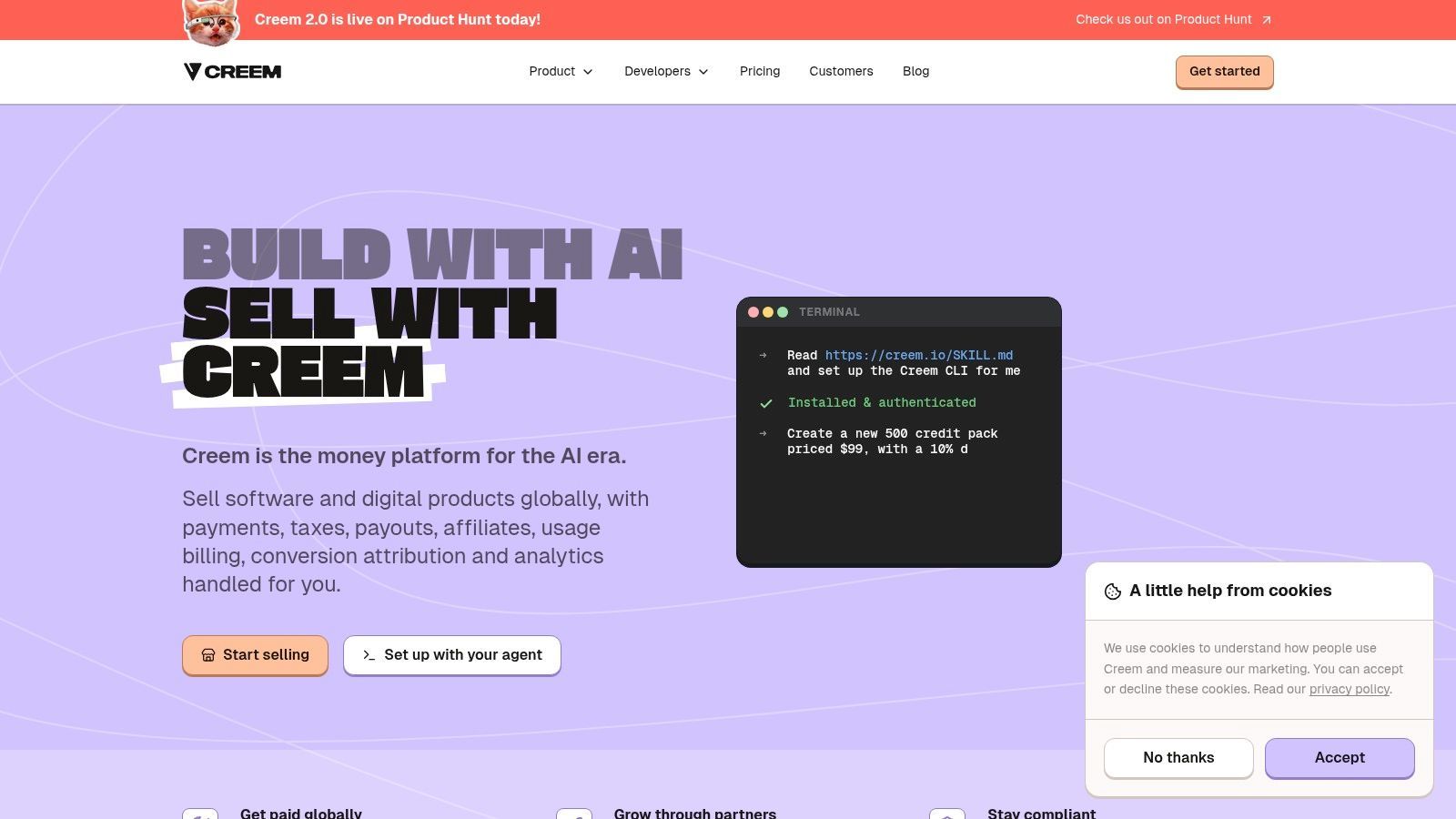
Creem fits software companies and digital-product makers that want to run their own affiliate program, rather than join a marketplace operated by someone else. It combines Merchant of Record services, hosted checkout, subscriptions, usage billing, global tax handling, revenue splits, affiliate tracking, and payouts in one developer-oriented platform.
For a SaaS founder, the decision concerns operational scope as much as publisher access. One system can attribute referrals, apply commissions, process recurring payments, manage partner splits, issue invoices, and reduce cross-border compliance work. Creem's product materials describe VAT, GST, and sales-tax collection, filing, and remittance across 190+ countries, plus fraud screening and chargeback handling. Confirm current jurisdictional coverage and legal terms for your business before relying on those capabilities.
Why the economics are different
Creem publishes a flat fee of 3.9% plus $0.40 per successful transaction, with no setup, monthly, or hidden fees, according to its product information. The fee applies to one-time payments and subscriptions, making the trade-off straightforward to model. High-volume or low-margin merchants may find lower negotiated processor rates elsewhere, but they would still need separate tax, billing, affiliate, fraud, and payout systems.
Built-in revenue splits can support co-founders, contractors, and affiliates without manual reconciliation. The platform also supports bank-account or optional USDC payouts, scheduled payouts on the 1st and 15th, credit wallets, usage meters, SDKs, REST APIs, webhooks, CLI tooling, and Next.js templates.
Best fit: Choose Creem when you want to launch a global software or digital-product business with affiliate tooling inside the same payments and subscription stack.
The main limitation concerns legal ownership. As Merchant of Record, Creem becomes the seller on transactions. That arrangement suits many makers, but not businesses that must retain seller status or manage their own tax registrations and invoicing. For recurring software offers, review this guide to SaaS affiliate programs, then confirm the current Creem platform terms before launch.
2. PartnerStack
PartnerStack is a natural choice for B2B publishers, SaaS vendors, referral partners, and reseller teams. Its marketplace is built around software programs rather than general retail, which makes discovery more relevant for audiences comparing project-management tools, CRM platforms, developer products, marketing software, and other business services.
The important distinction is lifecycle revenue. A retail affiliate usually earns when a customer completes a qualifying purchase. A SaaS partner program may continue attributing value through subscription renewals or defined milestones, depending on the merchant's terms. That makes PartnerStack more suitable when your content reaches buyers who need onboarding, product education, and ongoing workflow adoption rather than a one-off transaction.
Publisher and merchant fit
Publishers can manage multiple programs from one dashboard, while merchants can structure affiliate, referral, and reseller workflows. Recurring and milestone commissions let a software company align partner rewards with subscription economics, although the exact duration, renewal rules, and qualification events require confirmation for each program.
PartnerStack's B2B focus is also its boundary. It isn't the right first stop for a publisher whose audience primarily buys physical goods, fashion, household products, or general consumer offers. Merchants should also assess whether sales-led pricing and platform costs make sense before building a small early-stage program.
A useful selection rule is to compare the quality of the buyer relationship with the payout structure. A lower commission on a product that matches a technically qualified audience can outperform a larger payout attached to a product your readers don't trust or understand.
For a broader implementation perspective, compare PartnerStack with a referral tracking system before choosing whether you need a network, a first-party tool, or both. Visit PartnerStack to verify current marketplace access and merchant requirements.
3. impact.com
impact.com fits merchants whose partnership program includes more than standard affiliate placements. Its platform supports affiliates, creators, influencers, referrals, and other partner relationships, with marketplace discovery, commission rules, attribution settings, deduplication, fraud controls, and reporting.
That range gives software companies and retailers a way to manage several acquisition models in one system. A software merchant could combine review-site affiliates with creator campaigns, customer referrals, and strategic partnerships. A retailer could apply different commission rules to each partner category or campaign.
Where the platform earns its place
The platform's main advantage is operational control. Dynamic commissioning lets merchants vary rewards by product, partner, customer action, or campaign conditions. Attribution and deduplication are useful when multiple channels influence one conversion and the merchant needs a consistent method for assigning credit.
The Starter Edition and app options for Shopify and Stripe may reduce setup friction for growing brands. Larger teams can add more partnership processes as their programs develop. That depth can be excessive for a small business that only needs link creation, basic conversion reporting, and scheduled payouts. Enterprise pricing is sales-led, so budget and implementation requirements need confirmation before commitment.
For publishers, impact.com's marketplace can suit audiences interested in several partnership categories rather than one narrow product type. Program access and approval remain advertiser-specific, and a listed offer may still have weak audience fit, restrictive terms, or unattractive economics.
Practical rule: Choose impact.com when attribution complexity or partner diversity creates a measurable operational problem. A large marketplace alone is not a sufficient reason.
Before implementation, compare its tracking model with your checkout and analytics stack through this guide to affiliate attribution and referral tracking. Review impact.com's current commercial terms directly, especially when enterprise features, integrations, or custom commission structures matter. For a broader comparison of first-party and network-based approaches, see this referral tracking system guide.
4. CJ
CJ, formerly Commission Junction, remains a strong fit for publishers seeking established retail, lifestyle, and consumer brands. Its value comes less from a single universal payout promise and more from the network's breadth, tracking maturity, reporting, compliance operations, product feeds, and advertiser relationships.
Publishers can use CJ to find programs that fit shopping guides, product comparisons, seasonal content, and category-specific editorial sites. Advertisers can use tools such as Universal Tag, server-side tracking options, app or mobile measurement integrations, and product feeds to connect partner activity with broader commerce operations.
Why network quality matters
A large catalog doesn't automatically create income. Your content still needs a credible product match, a useful buying context, and a path from recommendation to checkout. CJ is most compelling when those conditions already exist and you need access to recognizable merchants with mature reporting.
The Placements Marketplace adds a route for premium media opportunities, but that isn't necessarily relevant to a small publisher starting with organic content. Some advertiser programs are selective, and approvals can be tougher when a site lacks clear editorial positioning, traffic quality, or compliance information.
Advertiser pricing isn't publicly standardized in the provided product information, and onboarding is sales-led. That creates a planning limitation for small merchants comparing total cost across networks. Publishers should also inspect individual commission rules, exclusions, validation periods, and return treatment rather than treating CJ as one uniform program.
For merchants, CJ makes more sense when brand access and tracking depth justify network involvement. For smaller software makers that want a first-party partner program inside checkout, a platform such as CJ may be less direct than an integrated Merchant of Record approach.
5. Rakuten Advertising
Rakuten Advertising is a good option for publishers who want broad brand access with structured network administration. Formerly known as LinkShare, it offers publisher enrollment, advertiser programs, tracking, consolidated payments, policy documentation, education resources, and compliance oversight.
The platform works well for content sites that cover multiple categories but still want to apply selectively. A travel publisher, shopping editor, or lifestyle creator can look for relevant brands instead of building separate technical relationships with every merchant. That reduces administrative work, although it doesn't remove the need to understand each advertiser's terms.
Strengths for newer publishers
Rakuten's education and network policies can help a publisher understand application expectations, disclosure responsibilities, and program conduct. Open publisher enrollment means you can apply without treating access as a private enterprise relationship, but individual program approvals still vary by advertiser.
That distinction is important. Joining a network doesn't mean every brand will accept you, and accepted access doesn't mean every program will pay the same way. A publisher should assess the product's conversion fit, approval requirements, attribution rules, and payment timing before investing in content.
For merchants, the network provides brand discovery and operational structure, but pricing isn't publicly detailed in the supplied information. If you need a highly customized recurring SaaS commission model, compare Rakuten with a B2B-focused platform or a first-party affiliate system.
A wide catalog helps you find relevant offers. It doesn't replace editorial judgment or program-level due diligence.
Use the Rakuten Advertising affiliate network to review current enrollment policies, advertiser availability, and publisher requirements. Treat the network as a sourcing and operations layer, not as a guarantee of earnings.
6. Awin
Awin is a practical choice for brands that want a global affiliate network with a clearer entry path for smaller advertisers. Its Awin Access plan is designed for SMB and direct-to-consumer brands, while higher-tier options support more advanced needs.
The distinction between Awin and some sales-led platforms is planning visibility. Awin provides an example of monthly and tracking-fee pricing for Access, including a 3.5% tracking fee in the supplied plan notes. That number is a current example rather than a universal cost for every account, so verify the live commercial terms before forecasting margin.
A useful path from launch to scale
Awin supports partner discovery, onboarding, automation through APIs, and reporting on customer journeys, creative performance, publishers, and products. Those reports can help a merchant identify whether a partner succeeds through a particular product, editorial format, or stage of the purchase journey.
For a first affiliate program, that reporting is more useful than a long list of theoretical features. You need to know which partners generate qualified sales and whether the total cost remains acceptable after commissions, tracking fees, refunds, and internal management time.
The main limitation is tiering. Some advanced capabilities require higher packages, and the tracking fee adds to the total cost per sale. Publishers may also find that program availability and approval standards differ substantially by advertiser and region.
Awin is therefore strongest for a merchant that wants a structured network but isn't ready to assemble a fully custom partner stack. It also makes sense for publishers whose audience spans several consumer categories and geographies. Review the current Awin affiliate network terms, regional availability, and plan conditions before applying.
7. ShareASale
ShareASale is a veteran option for US-focused niche publishers and content sites that want access to smaller merchants. Owned by Awin, it has long served a broad long-tail catalog covering specialty retail, direct-to-consumer products, and smaller brands that may not appear in every enterprise network.
Its self-serve orientation makes the platform approachable for publishers building category pages, gift guides, product reviews, and practical buying content. Real-time tracking, program terms, merchant messaging, and application resources give affiliates a workable operating base without requiring direct technical integration with every advertiser.
The trade-off is familiarity over polish
ShareASale's documentation and how-to material can help publishers understand applications and approvals. Its interface and some documentation may feel dated, though that doesn't necessarily prevent a well-matched publisher from finding useful offers.
The catalog is the reason to consider it. A niche site may find a strong product match among smaller US merchants even when a larger global network offers more recognizable brands. That match can matter more than platform polish because readers respond to relevance and trust, not network size alone.
Merchants should pay attention to the relationship between ShareASale and Awin Access. Pricing information is fragmented as more US SMB advertisers move toward Awin's newer plan structure, so obtain current terms rather than relying on older comparisons.
Publisher test: Search for merchants your audience already asks about, then compare their approval rules and actual offer terms before judging the network.
Use ShareASale to inspect current publisher access and merchant listings. Its best use is targeted discovery, not indiscriminate link placement across a general-interest site.
8. Amazon Associates
Amazon Associates is the default choice for broad product coverage and shopping-intent content. Its catalog spans nearly every consumer category, and the familiarity of Amazon's checkout can make it easy for readers to continue from a review, comparison, gift guide, or buying tutorial.
The program provides link-building tools, reporting, localized storefront coverage, consolidated payments, and Influencer Program extensions. That combination suits publishers who don't want to negotiate separate relationships with many product brands.
Reach is the advantage, not necessarily the payout
Amazon's category-based commissions can be low compared with specialized merchants, so a publisher shouldn't confuse product availability with superior unit economics. The program makes sense when your audience wants a convenient purchase path across many categories, particularly when your content strategy depends on product breadth.
It also carries policy sensitivity. Program rules and reporting can change, and publishers must follow current operating, disclosure, and linking requirements. Confirm the latest rules directly through the Amazon Associates program before publishing or updating a site.
The right content model is specific. A focused comparison of a product category, a practical setup guide, or a carefully maintained recommendation page gives readers a reason to click. A page filled with unrelated links gives Amazon's catalog breadth without giving the audience decision support.
For creators starting from scratch, this guide to joining an affiliate program explains the basic preparation involved. Publishers considering how to launch an Amazon affiliate site should also plan for disclosures, policy review, and a content strategy that can survive changes in search or platform traffic.
9. ClickBank
ClickBank is a digital-first marketplace for publishers who can evaluate information products, supplements, and direct-response offers with care. It supports both percentage-based revenue share and fixed CPA structures when sellers provide them, while handling payments and consolidated affiliate payouts.
The marketplace's filters and offer metrics can make initial discovery faster than searching for individual programs across the web. That convenience doesn't solve the core risk, however. Offer quality varies, and the publisher's reputation can suffer if a product makes unsupported promises, produces poor customer outcomes, or generates excessive refunds.
High payout potential needs a quality screen
ClickBank can suit performance marketers with a defined audience, strong conversion skills, and the discipline to vet the seller, landing page, refund terms, customer support, and promotional restrictions. It is less suitable for a publisher that wants to recommend products casually without reviewing the underlying offer.
Revenue share also creates exposure to cancellations and refunds. A headline commission can therefore overstate realized earnings if customers reverse purchases or fail to remain satisfied. Fixed CPA offers change the calculation, but they still require scrutiny around qualifying actions and approval.
Use the marketplace as a research environment, not a shortcut around product judgment. Compare offer relevance with refund exposure, compliance workload, and the trust your audience places in your recommendations.
Visit ClickBank to review current marketplace terms and offer details. Don't promote an offer until you understand what the buyer receives and how the seller handles post-purchase problems.
10. Digistore24
Digistore24 combines affiliate marketplace access, payments, tax and VAT handling, attribution, and automated payouts, making it a compelling option for digital-product publishers and vendors that want a relatively turnkey arrangement. Its marketplace includes information products and selected physical categories, with vendor listings organized across many niches.
For affiliates, the attraction is operational simplicity. You can find offers, review commission settings, use multi-device attribution and analytics, and receive payouts through the marketplace rather than establishing a separate payment relationship with each vendor. Affiliates can join without a fee according to the supplied plan notes, but individual offer terms still determine whether promotion is worthwhile.
Vet the vendor before you vet the percentage
Digistore24 is skewed toward information and direct-response verticals. That can produce useful opportunities for an audience already interested in education, business, fitness, or other digital topics, but it can also increase the importance of checking claims, refund language, fulfillment quality, and vendor reputation.
For merchants, commission setup, joint-venture revenue shares, reporting, tax handling, and payment processing reduce the number of systems required to sell through partners. The trade-off is marketplace context. A vendor still needs a credible product and clear customer experience because platform infrastructure cannot repair a weak offer.
Due diligence comes first: A digital marketplace's convenience is valuable only when the product, seller, refund policy, and promotional claims can withstand scrutiny.
Review current policies and marketplace conditions on Digistore24 before selecting an offer. Publishers should keep disclosures clear and avoid claims that go beyond the vendor's substantiated product information.
Top 10 Affiliate Programs Comparison
| Platform | Core features ✨ | Audience 👥 | Pricing / Value 💰 | Quality & UX ★ | Standout / USP 🏆 |
|---|---|---|---|---|---|
| Creem 🏆 | ✨ MoR tax filing (190+), hosted checkout, subs, ML dunning, revenue splits, affiliates, SDKs | 👥 SaaS makers, indie hackers, marketplaces | 💰 Flat 3.9% + $0.40, no setup/monthly fees | ★ Developer‑first, predictable payouts, ML recovery | 🏆 All‑in‑one MoR + native splits & USDC payouts, recommended |
| PartnerStack | ✨ Partner marketplace, recurring & milestone commissions, partner CRM | 👥 B2B SaaS vendors, resellers, referral partners | 💰 Sales‑led pricing; can be costly for early stage | ★ Strong SaaS partner discovery & lifecycle tracking | Native SaaS partner marketplace and CRM |
| impact.com | ✨ End‑to‑end partnership mgmt, dynamic attribution, fraud controls | 👥 Brands scaling global partner programs, enterprises | 💰 Starter to enterprise; sales‑priced tiers | ★ Enterprise‑grade tracking & attribution | Robust attribution + fraud protection for large programs |
| CJ (Commission Junction) | ✨ Global publisher network, server‑side tracking, app integrations | 👥 Publishers, large advertisers, premium brands | 💰 Advertiser pricing via sales; variable | ★ Mature reporting, compliance & enterprise features | Access to premium retail brands and advanced reporting |
| Rakuten Advertising | ✨ Open publisher signup, consolidated payments, compliance resources | 👥 Publishers & advertisers seeking wide brand access | 💰 Sales‑led advertiser pricing; publisher onboarding free | ★ Broad brand catalogue & publisher education | Long‑standing global network with compliance focus |
| Awin (incl. Awin Access) | ✨ Awin Access SMB plan, APIs, partner discovery, reporting | 👥 SMBs to enterprise advertisers, DTC brands | 💰 Example: monthly + tracking fee (~3.5%); transparent SMB option | ★ Scalable with clear SMB pricing examples | Clear Awin Access path for first‑time affiliate programs |
| ShareASale | ✨ Self‑serve onboarding, real‑time tracking, merchant catalogue | 👥 US SMB merchants & content publishers | 💰 Fragmented (transitioning to Awin Access) | ★ Large US merchant catalogue, familiar interface | Strong long‑tail US merchants for niche content sites |
| Amazon Associates | ✨ Massive SKU coverage, link tools, influencer add‑ons | 👥 Content sites, influencers, multi‑category publishers | 💰 Category‑based commissions; varies by product | ★ High conversion & shopper trust | Largest retail affiliate program with global localized stores |
| ClickBank | ✨ Digital marketplace, rev‑share or CPA, offer metrics | 👥 Performance marketers, info‑product affiliates | 💰 Varies; many high‑payout offers (quality varies) | ★ Transparent marketplace metrics; mixed offer quality | High‑payout digital offers with flexible commission models |
| Digistore24 | ✨ Built‑in payments, VAT/tax handling, automated affiliate payouts | 👥 Digital product vendors & affiliates (global) | 💰 No cost for affiliates; vendor fees vary | ★ Turnkey payments + tax + affiliate stack | Integrated payment + VAT handling for global digital merchants |
Choose the Program That Matches Your Monetization Model
The best affiliate programs to make money depend on what you're selling, who you're reaching, and how much operational complexity you can absorb. Amazon Associates is the practical choice for broad product coverage, especially when your content helps readers compare or select everyday products across many categories. Its advantage is breadth and shopper familiarity, while its category-based commissions and changing policies mean you need to monitor the program rather than treat it as permanent infrastructure.
SaaS networks are stronger for software audiences. PartnerStack is designed around B2B and subscription relationships, while impact.com is better suited to brands combining affiliates with creators, referrals, and more complex attribution. In both cases, don't compare only the advertised commission. Confirm whether renewals qualify, how long attribution lasts, what event triggers payment, how refunds affect commissions, and whether the program approves your audience and channel.
Mature global networks such as CJ, Rakuten Advertising, and Awin provide brand breadth, tracking depth, publisher discovery, and operational controls. ShareASale remains particularly relevant when a US niche publisher wants access to smaller merchants. These networks can reduce the work of finding advertisers, but each merchant still sets its own program economics and approval rules.
Digital marketplaces such as ClickBank and Digistore24 can offer attractive structures for information products and direct-response offers. Their wider variation in seller and product quality makes refund exposure, customer support, substantiated claims, and compliance review central to the decision. A large commission isn't valuable if reversals, complaints, or policy violations erase the commercial benefit.
The broader economics support a quality-first approach. A 2025 impact.com affiliate marketing report found that 74% of brands generated between 11% and 30% of total revenue through affiliate partnerships, while loyalty and rewards partners accounted for 55% of affiliate transactions in the first half of 2026, up from 48% a year earlier. Those figures point to a channel that rewards reliable partner relationships and measurable customer value, not merely a large publisher count.
Operational concentration reinforces that conclusion. Industry benchmarks report an average affiliate CTR of 0.09%, an average conversion rate of 1.8%, and the top 10% of affiliates generating 70% of program revenue. WeCanTrack's affiliate performance statistics therefore support a practical priority: recruit and support partners who can reach the right buyers instead of measuring success by the number of approved affiliates.
For software and digital-product businesses, Creem offers a different model. Rather than joining a network as a publisher, you can create a first-party partner program alongside hosted checkout, subscriptions, affiliate tracking, commission management, revenue splits, automated payouts, invoices, and Merchant of Record services. Its published pricing is 3.9% plus $0.40 per successful transaction, with no setup, monthly, or hidden fees, but the Merchant of Record structure means Creem becomes the legal seller, which may not suit every business.
Compare effective earnings after refunds, fees, approval friction, conversion fit, payout timing, renewal rules, and disclosure requirements. Then choose the program that matches your monetization model and protects your audience's trust.
Creem gives software and digital-product makers hosted checkout, subscriptions, Merchant of Record tax handling, revenue splits, affiliate tracking, and automated payouts in one platform. If you want to run a partner program without assembling separate billing, compliance, and attribution systems, visit Creem and review the current terms for your business.