
Subscriptions are a minority choice with an outsized revenue footprint: in August 2024, approximately 4% of mobile apps used subscriptions yet generated 45.4% of global app revenue during the measured period, according to Statista's subscription revenue distribution. That's a reason to take recurring revenue seriously, not a reason to put every app behind a recurring paywall.
My recommendation: build your app monetization strategy around the customer's paid outcome, not the transaction. Choose a model that matches how people get value, make billing behave predictably, and give the product team responsibility for what happens after payment.
Table of Contents
- Why Most App Monetization Strategies Stall
- The Five Monetization Models and When Each One Fits
- Designing Pricing Tiers, Trials, and Offers That Convert
- The Billing Layer Most Builders Get Wrong
- Retention and Activation as the Real Monetization Engine
- Analytics and Instrumentation You Can Ship This Quarter
- Three Traps That Quietly Kill App Revenue
Why Most App Monetization Strategies Stall
The model you pick matters less than the post-purchase loop you operate around it. A subscription can't compensate for an app that leaves paying customers confused. A polished checkout can't justify another charge when the buyer never accomplished the task they purchased it for.
The subscription concentration above supports a narrower conclusion than founders sometimes draw. A small share of apps captures substantial revenue through subscriptions, but that doesn't establish that switching models causes better results. Product fit, customer intent, and ongoing usefulness still matter.
A successful charge isn't a successful customer
Consider a hypothetical founder who copies a competitor's pricing page, connects checkout, and launches. Payments arrive, so the integration looks finished. When revenue stops growing, the founder changes the price without knowing whether customers reached value, encountered an access problem, or abandoned the product.
That's not pricing experimentation. It's changing a visible setting because the underlying behavior is invisible.
Billing and retention need to be treated as connected work, not separate projects.
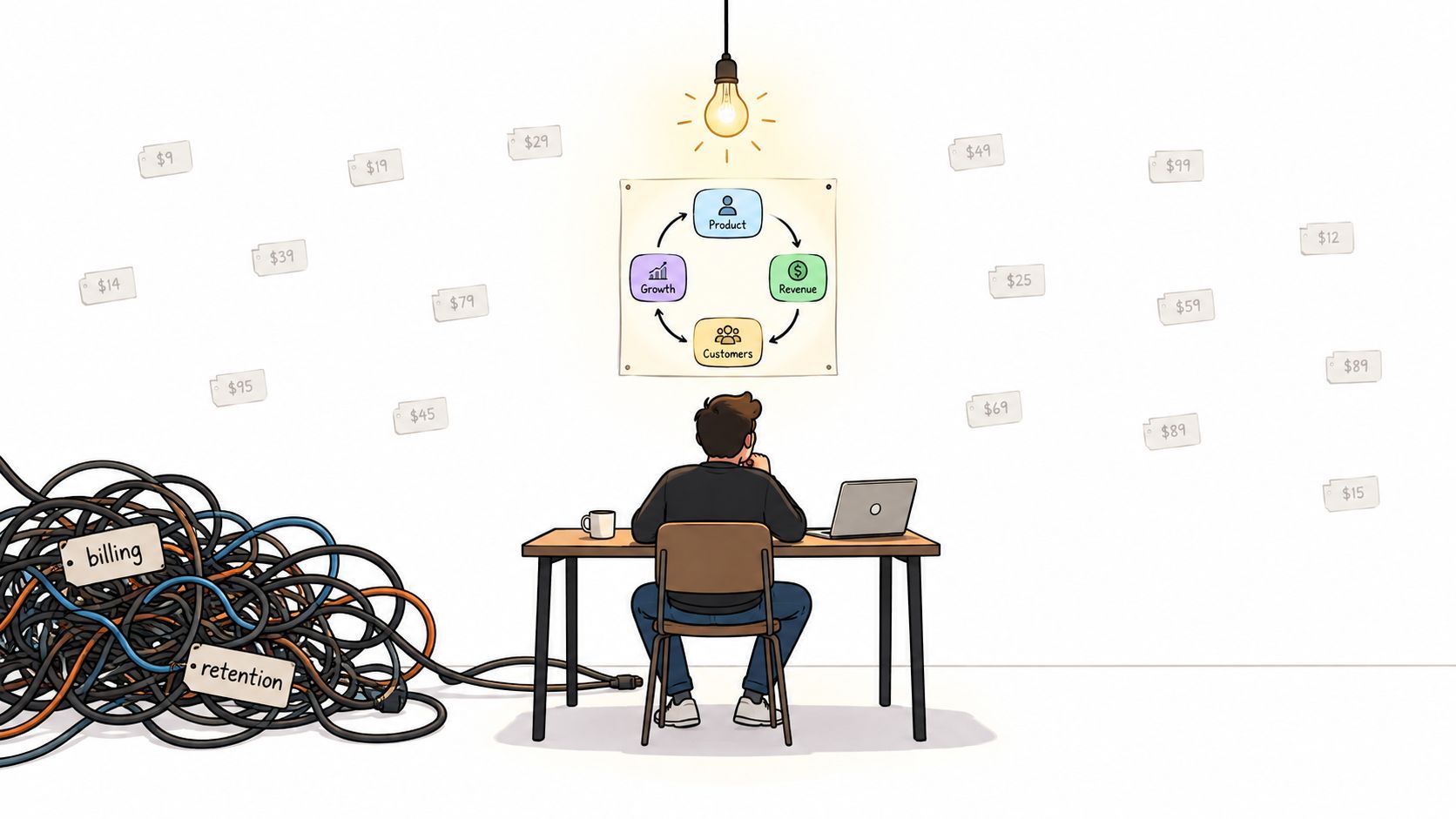
A revenue dashboard can look healthy while new buyers struggle. Collected payments describe transactions, not whether customers received the right access or understood what to do next. Without that context, you can mistake a temporary inflow for a repeatable business.
Operate the whole paid journey
Use a connected framework rather than a collection of conversion tactics:
- Model fit: Explain what customers pay for and why that payment timing matches the product's value.
- Billing execution: Translate the commercial promise into reliable charges, access, account changes, and receipts.
- Post-purchase delivery: Help buyers accomplish the promised outcome and distinguish product abandonment from payment trouble.
Assign an owner to each part, but review them together. A product lead should be able to explain why customers cancel; an engineer should know how billing states affect access; a founder should understand which customers make a plan sustainable.
Practical rule: Don't change the price until you can explain what happens between checkout and the customer's first useful result.
The operating loop is straightforward: observe customer behavior, identify the constraint, change the relevant part of the experience, and evaluate the resulting paid cohort. Resist redesigning the pricing page whenever revenue disappoints. Sometimes the price is wrong; sometimes you haven't delivered what the price promised.
The Five Monetization Models and When Each One Fits
Choose a model you can defend in a sentence. “Customers pay repeatedly because we help them run a recurring workflow” is a strategy. “Other apps charge monthly” isn't.
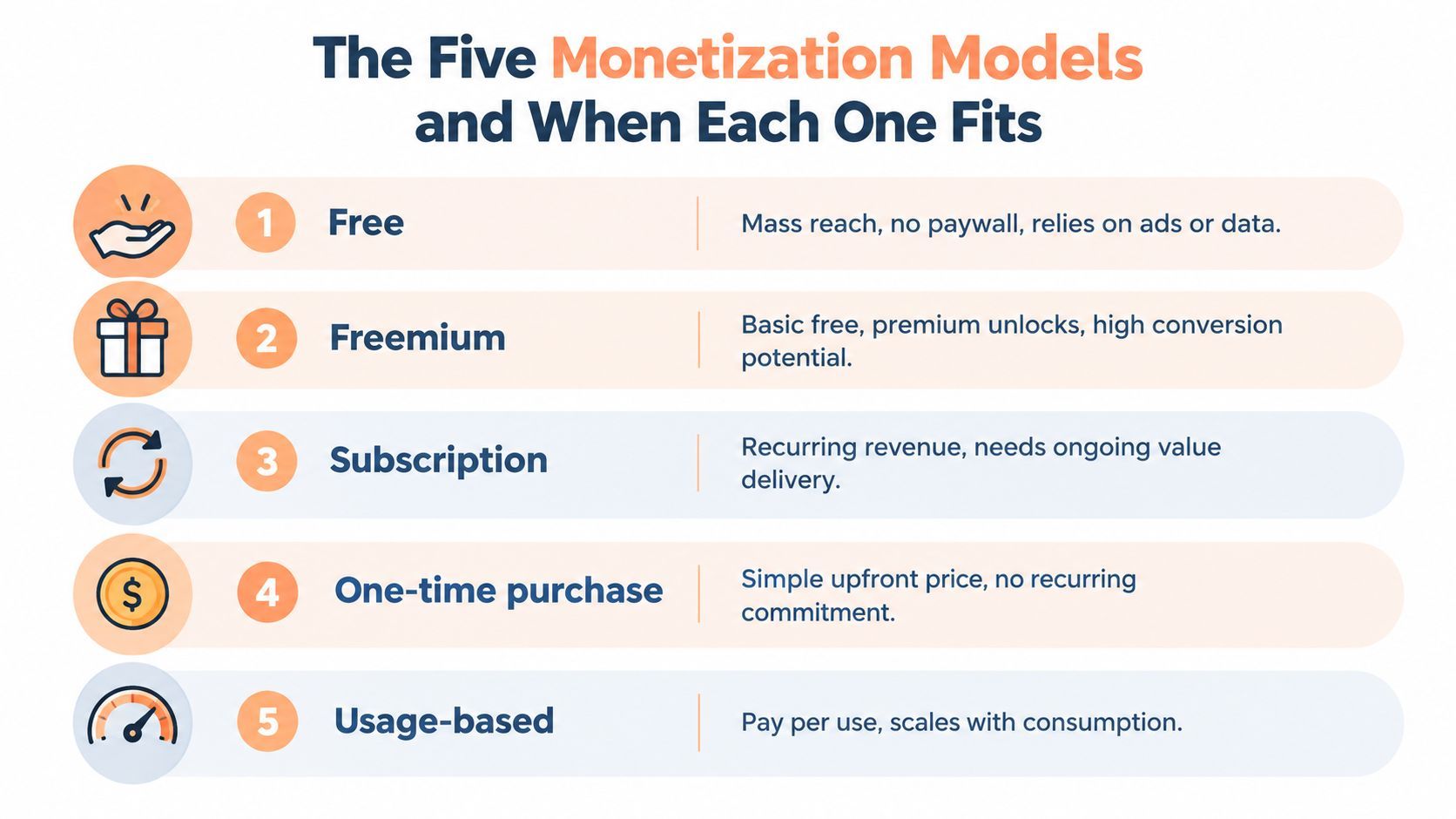
These models aren't mutually exclusive categories. Freemium describes an access structure, while subscription, one-time purchase, and usage-based pricing describe how paid access is charged. Still, comparing them separately helps expose the choices you're making.
Use this visual as a starting point, then pressure-test each option against your product.
Match the charge to the product
Free fits when someone other than the user funds the experience, or when the app supports a separate commercial offering. Treat advertising, sponsorships, and referrals as business arrangements you must validate, not automatic consequences of acquiring users. I wouldn't choose free access for a specialist tool unless I could name the payer and explain the economics.
Freemium works when customers can experience a complete basic outcome and later encounter a meaningful reason to upgrade. A hypothetical writing tool might allow individual drafting while charging for shared workflows. Don't make the free experience so limited that users can't evaluate the product, or so expensive to operate that every free account becomes a liability.
Subscriptions require continuing value. Recurring collaboration, monitoring, learning, or maintained content can support that promise. A fixed utility with no meaningful continuing service is a poor candidate merely because recurring revenue sounds attractive.
For an adjacent packaging reference, Gaeilgeoir AI offers a resource to compare language app subscriptions. Use it to frame questions about what buyers receive over time, not as evidence that its packaging will work for your audience.
A one-time purchase makes sense for a bounded deliverable or durable utility. The customer gets a clear asset or capability without a recurring commitment. Specify what's included, especially updates and support; don't casually promise indefinite service against finite payment.
Usage-based pricing fits when customers understand the unit they consume. API calls, completed processing jobs, or credits can provide a commercial meter, but an internal technical measurement isn't automatically a useful customer-facing unit. If buyers can't anticipate their bill, simplify the meter before launching it.
Choosing the Right Monetization Model
These are planning judgments, not market benchmarks.
| Model | Best for | Revenue shape | Operational complexity |
|---|---|---|---|
| Free | A product funded by another payer or offering | Indirect, dependent on the funding mechanism | Varies with ads, partnerships, or fulfillment |
| Freemium | Products with distinct basic and premium outcomes | Delayed payment after users encounter an upgrade need | Access rules and free-user cost control |
| Subscription | Continuing services and recurring workflows | Recurring, subject to renewal and retention | Subscription states and lifecycle management |
| One-time purchase | Bounded software or digital deliverables | Upfront payment, followed by new sales | Delivery, licensing, refunds, and support boundaries |
| Usage-based | Clearly measurable consumption | Variable, tied to customer activity | Metering, balances, reconciliation, and bill clarity |
Time-to-first-dollar follows the commercial structure. Upfront purchases ask for payment before full use; freemium delays that decision; usage-based billing depends on whether you sell prepaid access or invoice afterward.
For indie tools and SaaS, account-level costs and team workflows deserve attention alongside mobile purchase behavior. Start with the simplest defensible model. Add another only when a specific customer segment needs it.
Designing Pricing Tiers, Trials, and Offers That Convert
Start with customer differences, not a pricing-page template. A useful tier represents a distinct job, operating scale, or purchasing requirement. If the distinction is just a longer feature list, buyers must do the positioning work themselves.
Don't assume you need a middle plan or that most buyers will choose it. Build only the packages you can explain clearly. A solo creator and a team administrator might need different capabilities, but arbitrary limits don't become useful segmentation just because they look familiar.
Package outcomes before features
Write a plain-language promise for each proposed plan. A hypothetical individual plan might help someone finish and export their own work; a team plan might add shared ownership and administrative control. Every paid boundary should reinforce that distinction.
Before publishing, check the packaging:
- Buyer identity: Can the intended customer recognize which plan fits?
- Upgrade trigger: Does the customer encounter a real new need rather than an artificial obstacle?
- Cost exposure: Do included seats, storage, or consumption create obligations you can sustain?
- Access clarity: Can buyers tell what they'll retain or lose when they change plans?
Use the guide to SaaS pricing models that actually convert as a packaging reference, then validate your own customer assumptions. A coherent pricing argument matters more than visual similarity to another company's page.
Set trials around time-to-value
A trial should let the buyer evaluate the paid promise. Choose its duration from the work required to experience that promise, not from a competitor's checkout. If setup requires importing data or inviting colleagues, address those dependencies rather than merely extending the clock.
Distinguish opt-in conversion, where users actively purchase after the trial, from automatic conversion, where they agree to a later charge when starting it. I favor opt-in when setup uncertainty is high. Automatic conversion should come with conspicuous terms, an understandable charge date, reminders, and accessible cancellation.
A trial that ends before the customer can evaluate the product tests urgency, not value.
Make the paid experience visible during evaluation. Don't let users complete a trial successfully and then discover that the feature they tested belongs to a different plan. That's a packaging problem, not a persuasion opportunity.
Use offers with a stated purpose
Annual billing, introductory discounts, and promotional codes should each answer a specific commercial question. An annual option can suit a customer who already expects continuing use, while monthly billing lets someone make a shorter commitment. Don't confuse an upfront annual collection with evidence that the customer will renew.
For every offer, state the normal price, the promotional scope, and what happens afterward. Evaluate the customers who accept it against comparable customers, including their product use and later renewal behavior. Avoid permanent sale messaging; if the full price is indefensible, fix the offer rather than manufacturing urgency.
The Billing Layer Most Builders Get Wrong
A payment button is not a billing system. Your implementation needs to preserve the agreement customers made, including when they're charged, what they can access, and what happens when their circumstances change.
Treat billing as a product surface with financial consequences. The right acceptance test isn't “checkout worked.” It's “the customer's account matches the commercial agreement across every supported lifecycle state.”
Test lifecycle behavior, not just checkout
Document the transitions before choosing infrastructure. Include purchase, trial expiry, upgrade, downgrade, cancellation, refund, and payment failure. For each transition, define the charge, access change, customer message, and recovery path.
Then test the cases that don't fit a clean demo:
- Regional checkout: Evaluate payment methods and currency presentation for the buyers you intend to serve.
- Plan changes: Specify whether changes take effect immediately or at the next billing boundary, and explain any proration.
- Seat adjustments: Decide when newly added users gain access and how removals affect the next bill.
- Self-service: Let customers manage supported billing changes without requiring a support conversation.
- Event handling: Design for delayed, duplicated, and out-of-order notifications, then reconcile billing records with product access.
Hosted checkout can reduce the interface you maintain, but your application still needs explicit entitlement rules. Don't grant access solely because a browser reached a success page. Use authoritative transaction events and a reconciliation process.
The billing for SaaS guide is a useful reference when turning those requirements into an implementation checklist.
Decide which responsibilities you'll own
A merchant of record and a processor-led setup represent different operating choices. Evaluate who handles the sale, tax obligations, refunds, disputes, and customer documentation under the actual agreement. Don't assume a payment integration transfers every responsibility.
The following homepage screenshot is an example of a merchant-of-record platform to evaluate against those requirements.
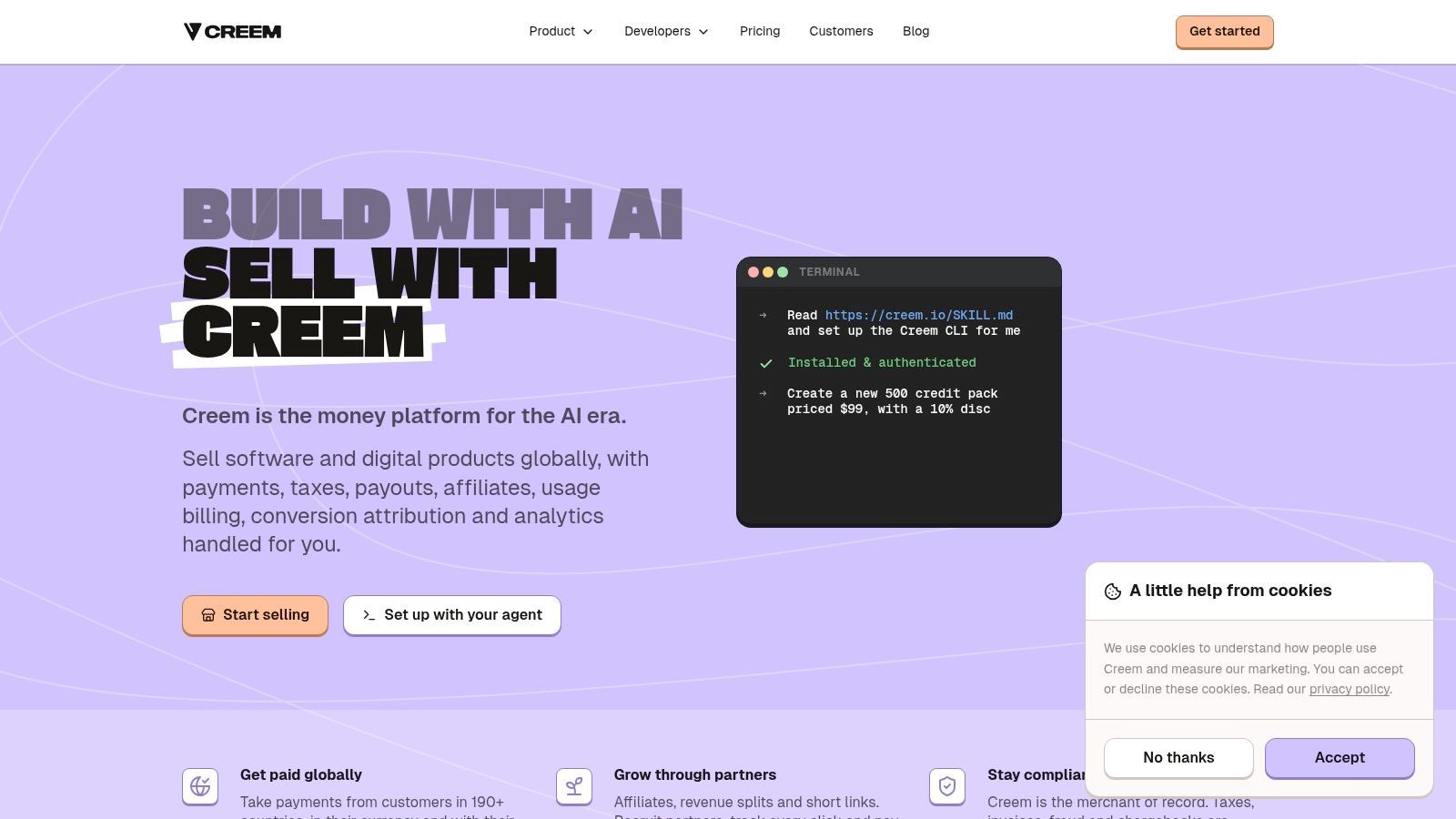
For a small team planning international software sales, I'd assess merchant-of-record coverage before committing engineering time to a custom tax and billing stack. For negotiated enterprise contracts, unusual funds flows, or regulated products, examine eligibility and contractual fit before treating that model as the default.
Mobile distribution needs its own review. Confirm the payment rules applicable to your storefront, geography, and product before adding a web checkout path. A working integration doesn't establish that a distribution platform permits it.
Compare total operating cost
A headline processing rate isn't the whole bill. Include currency conversion, tax administration, disputes, support work, reconciliation, engineering maintenance, and the cost of resolving broken access.
Buying criterion: Ask a billing partner to demonstrate a failed renewal, a downgrade, and a refund. A successful purchase is the easy part.
Keep ownership clear even when a partner performs the work. Someone on your team must verify that financial records, customer messages, and entitlements remain consistent. Outsourcing execution doesn't remove the need for oversight.
Retention and Activation as the Real Monetization Engine
Define an activation event as the first customer outcome that makes the paid promise credible. It's not necessarily account creation or tutorial completion. For a hypothetical reporting app, it might be producing a usable report from the customer's own data.
Map that outcome to the paid journey before adding more upgrade prompts.
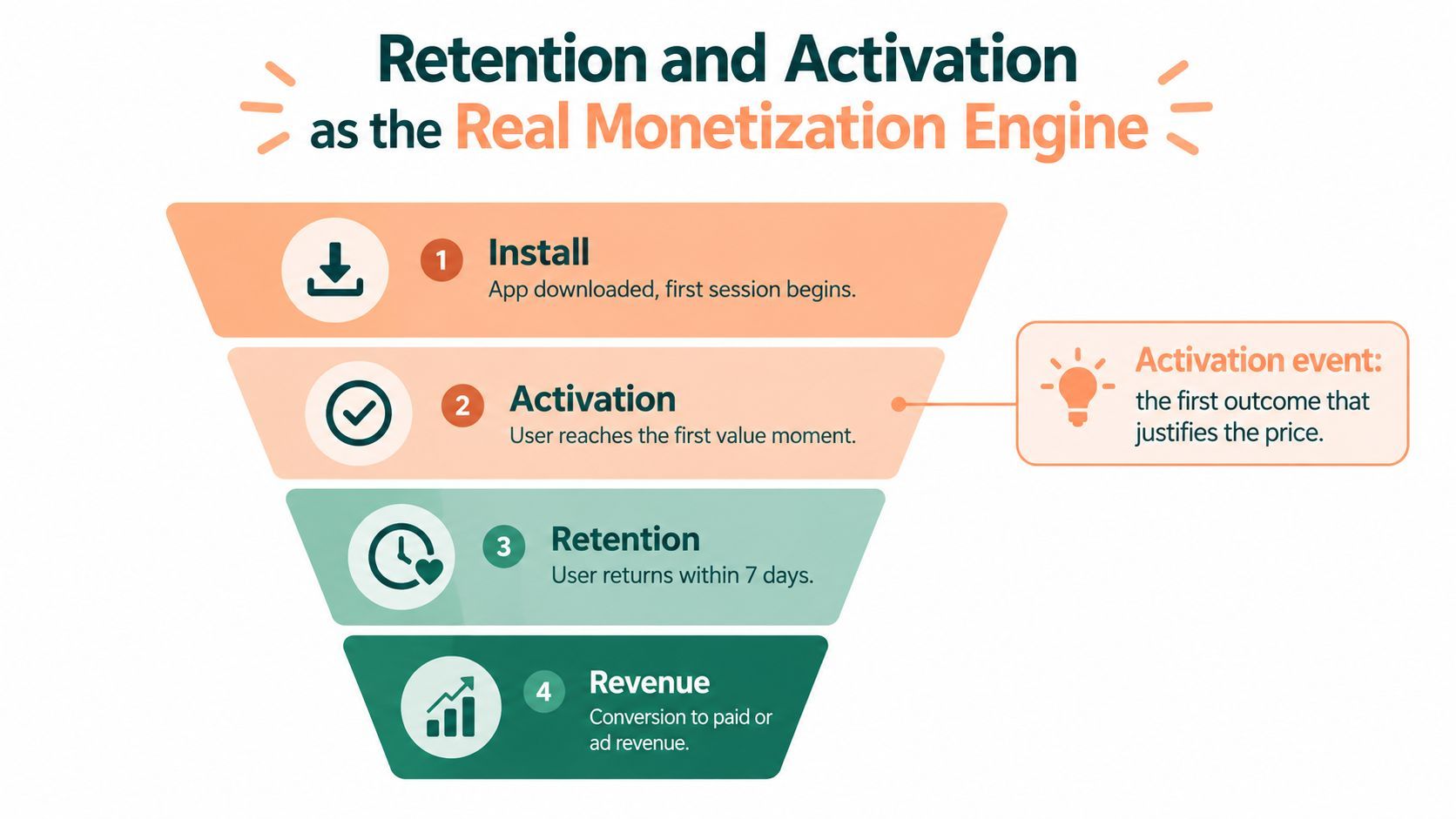
Early behavior deserves close attention: 82% of trial starts occur on installation day, while nearly 30% of annual subscriptions are canceled in the first month; the same RevenueCat subscription-app benchmarks report retention after a year of up to 36% for cheaper annual plans, compared with 6.7% for high-priced monthly plans. Those comparisons don't isolate billing cadence as the cause, but they challenge the assumption that collecting payment establishes lasting commitment.
Separate lack of value from failed collection
Measure time-to-value from the customer's entry into the product to the defined outcome. Inspect the steps where users stop, especially immediately after purchase. Don't respond to a setup failure with another marketing email.
Low-frequency products need a different activation definition from daily-use tools. For example, 3rd-i's resource about a safety app with trained agents offers a useful prompt for thinking about readiness rather than habitual use. For a safety-oriented product, I'd assess whether the customer understands and can prepare the relevant workflow, not encourage unnecessary emergency interactions.
Track voluntary cancellation separately from failed-payment loss. Dunning is the workflow for recovering an unsuccessful collection through appropriate retries and customer communication. A payment-update message should offer a direct resolution path, not imply that the customer rejected the product.
Use churn analysis to organize those causes before assigning fixes.
Adapt the work to customer economics
Platform averages aren't interchangeable: by day 90, non-gaming subscription ARPU was $8.39 on iOS and $1.54 on Android, while organic users generated 65% of subscription-app revenue in AppsFlyer's 2024 monetization analysis of high-income markets. Treat those findings as reasons to segment your analysis, not forecasts for your app.
Review these checkpoints with the product and billing owners:
- Onboarding: Remove steps that don't help customers reach the promised outcome.
- Activation: Record successful completion, not merely a click on the relevant feature.
- Renewal communication: Explain the upcoming charge and provide account-management access.
- Recovery: Track retry outcomes, payment updates, and restored entitlements.
For additional viewing alongside this operating checklist:
Analytics and Instrumentation You Can Ship This Quarter
Instrument the customer journey before buying a more elaborate dashboard. Use a stable customer identifier across product events and billing records, and retain the plan and acquisition context attached to each event.
Record events that answer decisions
| Event | Question it should answer |
|---|---|
| Trial started | Who begins evaluating the paid offer? |
| Activation completed | Who actually reaches the promised outcome? |
| First charge succeeded | Which evaluated customers become paying customers? |
| Renewal attempted | Which subscriptions reach a collection decision? |
| Recovery sequence entered | Where do unsuccessful payments require intervention? |
| Payment recovered | Which recovery actions restore collection? |
| Voluntary cancellation requested | Who deliberately leaves, and what reason do they provide? |
| Entitlement changed | Did product access match the billing decision? |
Keep event definitions written down. A cancellation request and an expired subscription aren't the same event, and a client-side button click shouldn't count as completed activation.
Build views you can act on
Start with cohorts grouped by acquisition period, plan, platform, and acquisition source. Compare customers at equivalent points in their lifecycle. When samples are small, inspect individual journeys rather than presenting unstable differences as proven improvements.
Maintain focused dashboard views:
- Journey view: Trial, activation, and paid conversion grouped by cohort.
- Renewal view: Collection outcomes separated into success, recovery, and unresolved failure.
- Customer view: Product activity displayed alongside plan changes and cancellation reasons.
Activation progress is a leading indicator of whether customers are reaching value. Collected revenue and completed renewals are lagging indicators of commercial outcomes. Use both, and make pricing changes against a documented hypothesis rather than a movement in the aggregate revenue chart.
Three Traps That Quietly Kill App Revenue
Funding a paid-value product with ads
Symptom: You keep adding placements without a convincing funding plan. Cause: You chose free access before identifying who pays. Test a direct paid offer if customers use the app to solve a valuable recurring problem.
Assigning renewal only to finance
Symptom: The team investigates lost revenue but not the customer experience. Cause: Nobody owns the connection between product delivery and billing. Assign shared accountability for cancellation causes, collection failures, and correct access.
Copying a competitor's price
Symptom: You can explain the competitor's tiers better than your own. Cause: Familiar packaging replaced customer evidence. Write down the buyer, paid outcome, and upgrade trigger for each plan, then test the assumption you're least confident about.
Choose the unresolved constraint that deserves attention before the next billing cycle. Don't launch another discount while leaving it untouched.
Creem offers merchant-of-record services, global checkout, automated tax compliance, and subscription billing for software and digital products. Visit Creem to evaluate its plan changes, customer self-service, and payment recovery against your paid customer journey, then test the lifecycle cases before launching your next offer.