

Table of Contents
- What Pay as You Want Really Means
- A Brief History of Pay as You Want
- How the Pricing Mechanics Actually Work
- Legal and Tax Implications for Digital Sellers
- Pros and Cons for Digital Product Makers
- How to Set Up Pay as You Want for Your Product
- When Pay as You Want Beats Fixed Pricing
Pay as you want pricing isn't an open invitation to pay nothing. Across the empirical literature, average payments were below 10 in all but a few field experiments, and often below 1, while individual studies recorded zero-payment shares from 19.3% to 43.0%. The practical answer is to structure the choice with a minimum price, a suggested anchor, and a customer-selected amount.
That framing challenges the most popular advice about this model. Sellers often hear, “Let customers pay what feels fair,” as though generosity does the commercial work. For a digital product, the more important question is how the checkout defines “fair” before the buyer types anything.
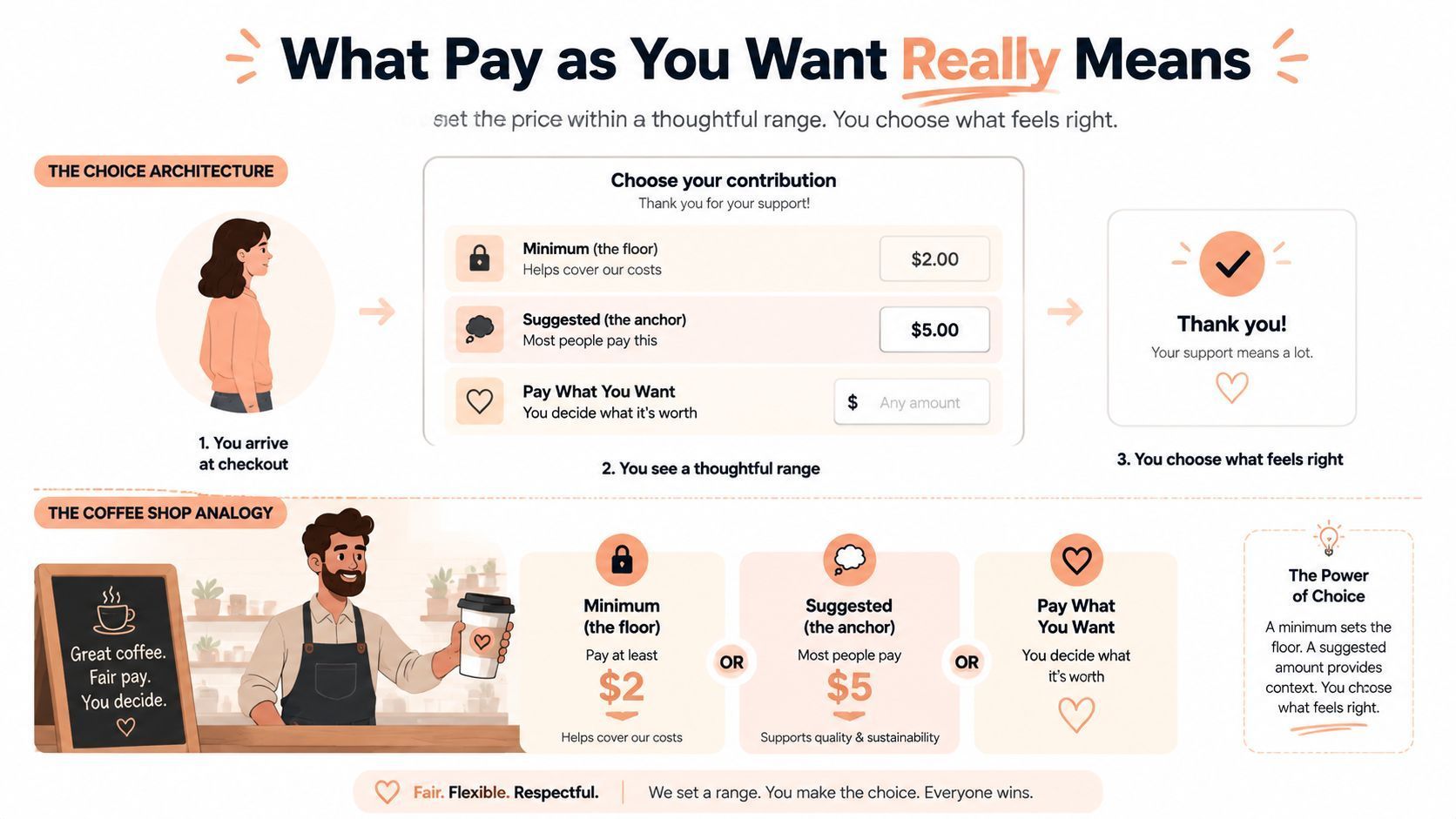
A well-designed pay as you want offer is a choice architecture. The seller sets the lowest acceptable amount, presents a reference price that shapes perceived value, and leaves room for the customer to choose a higher payment. The customer still has discretion, but that discretion operates inside boundaries.
This distinction matters because digital products can attract people with very different willingness to pay. One buyer may have a limited budget, another may be purchasing for a business, and a third may want to support an independent maker. A single fixed price can lose some of those buyers. An unstructured payment field can lose the seller.
What Pay as You Want Really Means
Start with three fields.
The minimum price is the floor. It defines the least the seller will accept for access, a download, a license, or another digital entitlement. The floor can protect payment-processing costs, support obligations, and the basic economics of delivering the product.
The suggested price is the anchor. It gives the customer a reference point for interpreting the product's value. Without an anchor, buyers must invent their own reference, often by comparing the product with something cheaper, free, or unfamiliar.
The chosen amount is the customer's decision. It can equal the minimum, match the suggestion, or exceed it. That amount isn't merely a payment. It can also reveal how different segments perceive the product, provided the seller analyses the full distribution rather than relying only on an average.
A coffee shop makes the structure easy to see. A sign that reads, “Latte, pay 3 or more, suggested 5,” is running pay as you want pricing. The cafe isn't operating a charity jar. It has established a revenue floor, offered a social reference, and allowed customers to reward the experience with a larger payment.
Why each lever matters
The floor is a margin guard. It filters out payments that can't support delivery or administration, although a high floor may discourage price-sensitive visitors.
The anchor is a perception lever. It tells customers what a normal or fair payment might look like, reducing uncertainty and influencing the amount they enter.
The chosen amount is a market signal. It shows what customers pay when the seller offers flexibility, but it must be interpreted carefully. A low payment can indicate low perceived value, a constrained budget, a weak anchor, or a buyer who would never have purchased at the fixed price.
That last point prevents a common analytical mistake. A customer who pays a small amount under PWYW isn't necessarily a lost full-price sale. The relevant comparison is the revenue and strategic value of the flexible offer against the fixed-price alternative, including conversion, support costs, refunds, and future purchases.
Central principle: Pay as you want outcomes are engineered through the floor, anchor, and customer choice. They aren't generated by generosity alone.
A Brief History of Pay as You Want
Pay as you want pricing became widely visible through high-profile launches, but those examples can make the model look easier than it is. Radiohead's In Rainbows brought flexible payment into mainstream discussion, followed by platforms such as Humble Bundle and experiments from independent software makers. Each case paired the payment choice with a particular audience, product, story, or reference point.
The wider research record needs more careful handling. A major review identified 72 empirical studies across 97 independent datasets published between 2006 and 2016, covering 30,634,507 transactions. However, 98.7% of all transactions came from one large dataset. The evidence therefore includes many studies but is heavily concentrated in one very large real-world sample. The review of empirical PWYW research documents that limitation.
The payment distribution also matters more than the headline question of whether customers pay. Buyers usually paid something, yet payments were often modest. A structured survey found average payments below 10 in all but a few field experiments and below 1 in many cases. Individual studies recorded zero-payment shares of 19.3%, 20.0%, 21.5%, 34.8%, and 43.0%.
The same body of findings includes outcomes closer to ordinary pricing. In one field-study review, consumers paid about 86% of the regular price on average. Results ranged from 10.62% above the regular price for hot beverages to 28.72% below it for cinema tickets and 19.37% below it for restaurant buffet lunch. The survey of PWYW findings reports these comparisons.
Real-world pay as you want outcomes
| Case | Year | Model | Average paid | Zero-payment or anchor effect |
|---|---|---|---|---|
| Radiohead, In Rainbows | 2007 | Flexible digital album pricing | Not established by the verified data provided | Zero-payment result is often discussed, but the specific figure isn't used here because it isn't included in the verified data |
| Humble Bundle | From 2010 onward | Tiered digital bundle with flexible payment | Not established by the verified data provided | Charity and tier structure are commonly discussed, but no verified average or distribution is supplied here |
| Field experiments in the research literature | 2006 to 2016 study window | Pay what you want | Often below 10, and frequently below 1 | Individual studies recorded zero-payment shares from 19.3% to 43.0% |
| Reviewed field-study outcomes | Not specified in the verified data | Flexible payment compared with regular price | About 86% of regular price on average | Results varied by product, from above to below the regular price |
The evidence shows that context changes the economics of PWYW outcomes. Identity, community, charity, novelty, and a strong reference price can encourage payment. A generic digital product without trust, a clear anchor, or a reason to support the seller faces a harder test. For an indie software founder, the practical historical lesson is straightforward: famous launches demonstrate a payment environment, not a universal pricing formula. The floor, suggested anchor, and surrounding choice design determine whether flexibility produces useful revenue.
How the Pricing Mechanics Actually Work
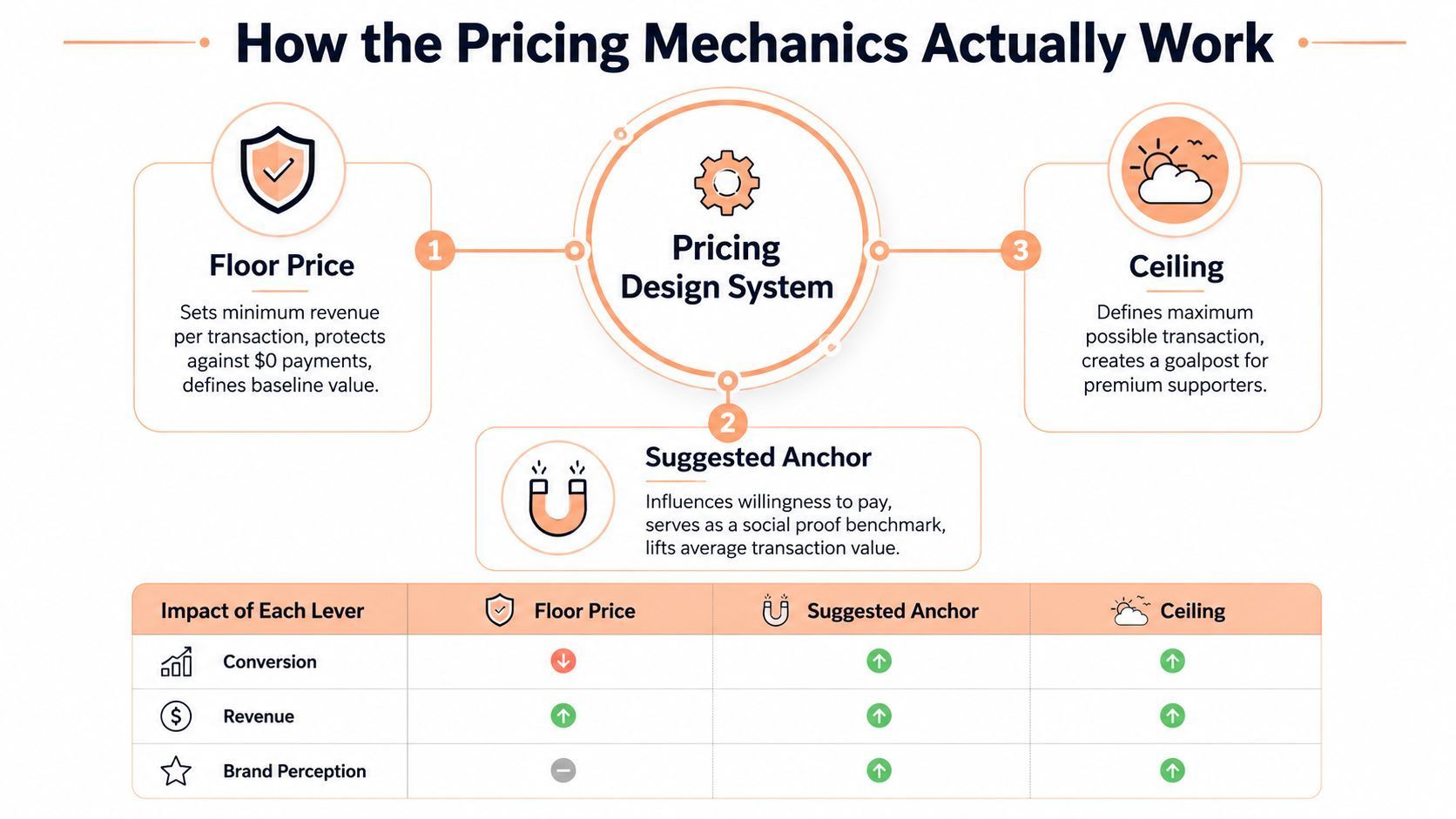
Treat the checkout as a single design system, not as three unrelated settings. The floor determines who can complete the purchase, the anchor shapes what the payment feels like, and an optional ceiling defines how far the buyer can go.
The floor is the simplest control. A zero floor maximizes openness but allows zero-payment transactions. A positive floor can cover direct costs, processing fees, and a refund buffer, which recent practitioner guidance recommends considering when setting a PWYW structure. The right floor depends on the product, the payment method, customer support burden, and whether the offer is a campaign or a permanent catalogue item.
For a software seller, testing a floor of 0, 1, or $3 can be useful as a design exercise, but those amounts aren't universal recommendations or verified performance benchmarks. The seller should begin with unit economics, then test whether the extra friction from a higher floor costs more conversions than it protects in revenue.
The suggested anchor works differently. It doesn't force a payment, and it doesn't change the minimum. It gives the buyer a benchmark, such as the product's former fixed price, a comparable competitor price, the cost of producing the product, or a rounded amount the seller considers fair. Sellers looking for a broader framework can compare this choice with guidance on how to price digital products, especially when deciding whether flexibility should replace or complement a fixed tier.
The ceiling is optional
A ceiling limits the highest amount a customer can enter. Most digital sellers won't need one because an unrestricted upper amount creates optionality for supporters who want to pay more. A cap can make sense for a time-limited edition, a coordinated campaign, or a setting where unusually high payments would create accounting or fulfilment complications.
Each lever creates a different tradeoff:
- Raise the floor: You may increase revenue per completed transaction, but some price-sensitive visitors may leave.
- Raise the anchor: You may shift customer expectations upward, but an arbitrary reference can reduce trust.
- Add a ceiling: You can make the offer feel controlled, but you compress the upside from high-intent supporters.
A checkout review should answer five questions:
- What direct costs must every completed transaction cover?
- Does the minimum clearly appear before the customer enters payment details?
- Why is the suggested price credible for this product and audience?
- Would an upper bound protect the offer, or just limit upside?
- Which result matters most, conversion, net revenue, data quality, or audience growth?
For SaaS teams comparing flexible pricing with metered alternatives, the distinction is also important. Usage-based pricing for software charges according to product consumption, while PWYW lets the customer choose the payment for access or delivery. They solve different pricing problems.
Legal and Tax Implications for Digital Sellers
PWYW doesn't remove ordinary tax and consumer-protection duties. A digital seller still needs to determine whether a transaction creates sales-tax, VAT, GST, or income-tax obligations, and the answer can depend on the buyer's location, product classification, seller status, and registration position.
For a paid transaction, indirect tax is generally connected to the amount charged, not the suggested anchor. A suggested price is a reference point, not automatically the taxable consideration. A zero-payment transaction can still create record-keeping and entitlement questions even when no payment is collected, so sellers shouldn't assume that setting the amount to zero makes compliance irrelevant.
Registration thresholds create another trap. Micropayments can feel too small to matter individually, but sellers need a jurisdiction-specific review of cumulative sales, customer location evidence, invoicing, and filing obligations. The table below is a high-level comparison, not legal advice.
Tax treatment of PWYW transactions by jurisdiction
| Jurisdiction | Tax applied to | Threshold to register | Reporting rule |
|---|---|---|---|
| EU VAT | The actual consideration for a taxable digital supply, subject to the applicable place-of-supply rules | Depends on the seller's establishment, scheme, and applicable registration rules | Maintain transaction, location, and tax records and report through the applicable national or special scheme |
| US sales tax | The taxable selling price where the seller has the required nexus | Varies by state and seller activity | Collect and remit according to each relevant state's filing and reporting requirements |
| UK digital services | The taxable consideration for a relevant digital service, subject to UK rules | Depends on seller status, establishment, and applicable registration requirements | Keep evidence and report through the applicable UK tax process |
Consumer wording and refunds
Be precise with the word free. If a customer must pay a minimum, “free” can misdescribe the offer. Use language such as “choose your price, minimum required,” and show the floor beside the amount field rather than burying it in terms.
Refund policies should apply consistently whether the buyer paid 0, 1, or $20. A customer-selected amount doesn't eliminate disputes, chargebacks, or obligations created by consumer law. Define whether a refund returns the payment, revokes the license, or handles a partial refund, and make those terms visible before purchase.
A merchant-of-record workflow can reduce operational complexity, but it doesn't replace product-specific legal review. Sellers comparing their options may also consult this sales tax internet sales compliance guide before launching across jurisdictions.
Pros and Cons for Digital Product Makers
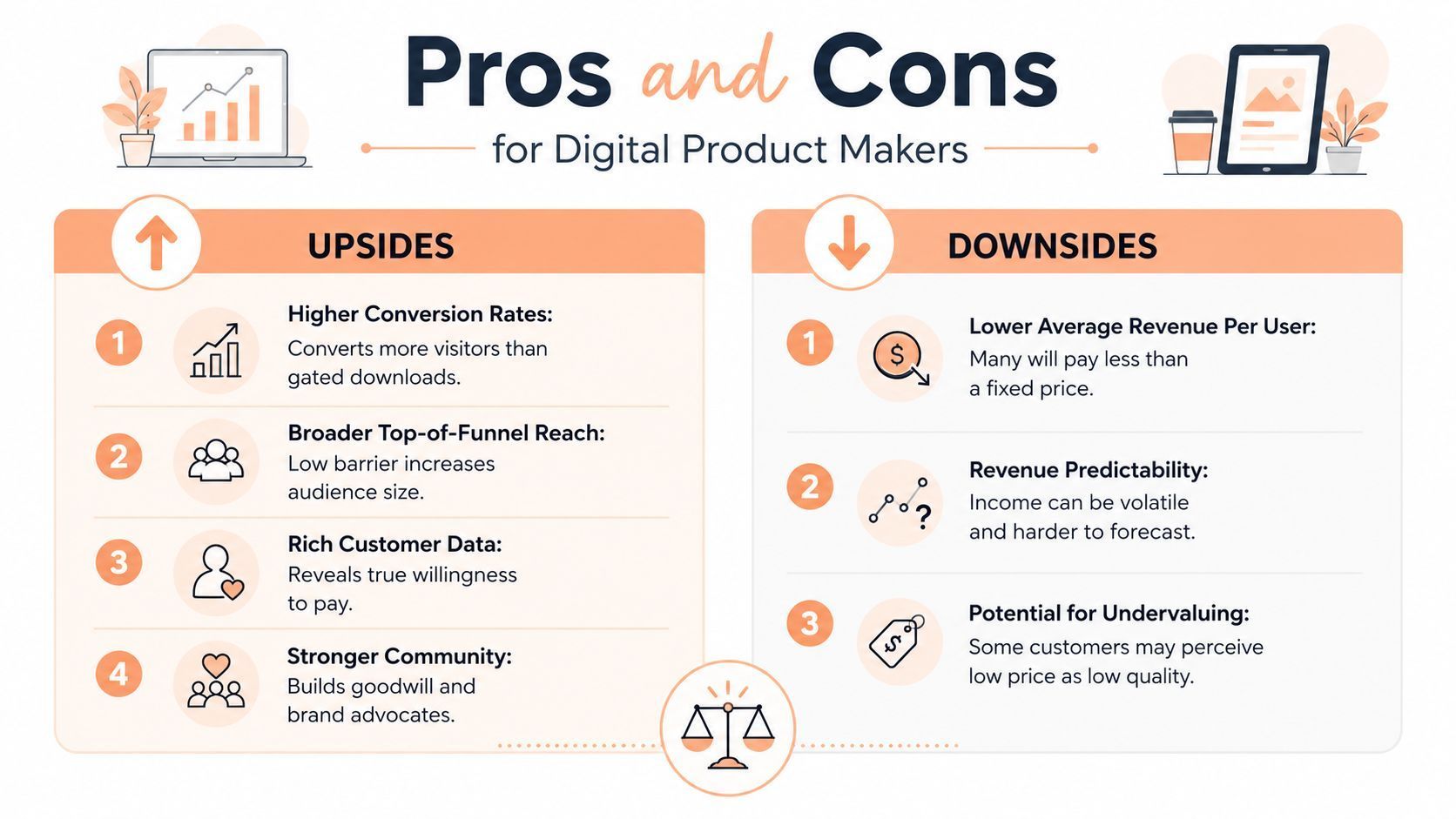
PWYW wins when market structure gives flexibility a specific role. For a digital maker, that role may be reach, learning, or supporter participation. A buyer who rejects a fixed price may still download, use, and recommend the product when the payment barrier is lower. The resulting audience can provide feedback and reveal which users attach meaningful value to the work.
The model also exposes information that one fixed price conceals. A seller can examine how payments cluster around the minimum, suggested amount, and higher values, then compare those patterns across acquisition sources or customer types. The average payment is only part of the picture. The distribution shows whether the floor is carrying the offer, the anchor is shaping choices, or a smaller group of supporters is lifting revenue.
The upside case
- Lower entry friction: Visitors can choose an amount that fits their circumstances rather than accepting one fixed price.
- Broader discovery: A flexible offer can attract curious buyers who are unwilling to make a full-price commitment.
- Useful willingness-to-pay data: Chosen amounts can indicate whether an audience sees the product as a utility, community project, or premium tool.
- Goodwill and sharing: Customers who feel respected may become advocates, especially when the product has an identity or mission beyond the transaction.
- Campaign flexibility: PWYW can serve as a launch mechanism, experiment, donation-adjacent offer, or audience-building event.
The financial trade-off is uncertainty. Cash-flow forecasts become less reliable when payment patterns shift with traffic source, audience composition, season, or anchor wording. A low average can also hide two different groups: high-paying supporters and many users who contribute little or nothing.
The downside case
- Zero-payment exposure: Field research reviews report recurring zero-payment outcomes, showing that non-payment is a design risk rather than a rare edge case.
- Unstable revenue: A seller may gain users while receiving less dependable revenue per visitor.
- Weak or arbitrary anchors: An unexplained suggested amount can seem manipulative or meaningless.
- Refund ambiguity: A named price does not resolve disputes when the product fails to meet expectations.
- Messy SaaS metrics: ARPU, LTV, and expansion analysis become harder to interpret when customers choose materially different entry payments.
PWYW often fits a short campaign better than an evergreen default. A campaign can give the floor and anchor a defined purpose, audience, and measurement window. A permanent catalogue needs unit economics that tolerate users who never become meaningful sources of revenue. The model pays off when its choice architecture produces useful reach or learning without allowing the lowest payment option to determine the business by accident.
How to Set Up Pay as You Want for Your Product
Begin with a product-fit audit. PWYW is easier to test when digital delivery has low marginal cost, the audience already trusts the maker, and the product has a natural path to upgrades, services, subscriptions, or community participation. It's harder when every customer creates substantial support work or when the product looks interchangeable with lower-priced alternatives.
Build the offer before the checkout
Set the minimum from costs, not optimism. Include payment-processing fees, delivery expenses, customer support, refunds, and a modest margin buffer. If a zero floor is strategically important, label it as an intentional acquisition cost and measure whether those users create later value. Don't disguise a required minimum as “free.”
Choose a suggested anchor with a reason buyers can understand. A previous fixed price, a comparable product, or a clearly described supporter amount is more credible than an unexplained number. Test different anchors against a fixed-price control where your traffic and experiment design allow it, and avoid changing the floor and anchor at the same time if you want to learn which lever caused the result.
The checkout should place the amount field beside a clear statement such as “minimum required”. Show what the customer receives, whether the amount is one-time or recurring, and what happens after payment. A vague field creates hesitation, while a transparent field lets the buyer make an informed choice.
Connect operations to measurement
Tax collection requires more than adding a payment button. Tools such as Stripe Tax, Paddle, and Lemon Squeezy can support tax workflows, but the seller still needs to verify product classification, registration responsibilities, invoices, and refund handling. A merchant-of-record option such as Creem's digital product store and checkout automation can centralize checkout and tax-related operations for software and digital product teams.
Log the complete payment distribution. Capture the minimum, the suggested amount, higher payments, zero-payment attempts if permitted, completed purchases, refunds, chargebacks, acquisition source, and product usage after purchase. The mean alone can hide whether most buyers paid near the floor or whether a small supporter group produced the revenue.
Use a practical measurement checklist:
- Conversion: Compare visitors who complete the offer with visitors who reach the checkout.
- Payment distribution: Review median, modes, floor concentration, and higher-payment frequency.
- Net revenue per visitor: Subtract fees, refunds, taxes borne by the seller, and support costs.
- Retention signals: Track activation, repeat purchases, upgrades, and subscription starts.
- Audience segments: Separate buyers by payment behavior and acquisition source for later nurture campaigns.
Run the test long enough to observe different traffic sources, but stop if the floor fails to cover the basic economics. PWYW isn't a permission to postpone measurement.
When Pay as You Want Beats Fixed Pricing
PWYW doesn't win because customers admire generosity. It wins when the market structure gives flexibility a job to perform.
Three conditions usually point toward a worthwhile pilot. First, the seller needs a high-traffic top of funnel, because low payments require enough visitors to create meaningful aggregate revenue. Second, the purchase context should be partly non-transactional, such as an experiment, donation-adjacent project, awareness campaign, or community-driven release. Third, distribution should be inexpensive and the product should offer distinctive value rather than competing as a commodity.
Academic work supports a conditional interpretation rather than a universal one. The foundational marketing research on PWYW describes a model in which buyers commonly pay something and sellers can generate positive revenue, but later reviews and newer theory emphasize that zero-price behavior and market structure remain central to the outcome. The foundational PWYW marketing research is a useful starting point for that more cautious view.
Two products, opposite decisions
Consider a $9 indie SaaS tool with a small audience and a direct transactional use case. If the product already converts visitors at a healthy fixed-price rate, replacing the price with an open field may trade reliable revenue for uncertain payment amounts. The seller may be better served by a free trial, a low-cost entry tier, or usage-based billing.
Now consider a viral creator with 500,000 newsletter readers distributing a distinctive digital asset. The creator has a large audience, low delivery cost, and a community context that can make voluntary support meaningful. PWYW still needs testing, but the model has a plausible strategic role because the seller can use access, sharing, and supporter payments together.
The specific decision rule in your brief uses conversion and traffic thresholds, but those figures aren't included in the verified data available for this article. Treat them as hypotheses to test, not established benchmarks. A fixed control remains essential because a higher number of downloads doesn't automatically mean higher net revenue.
Signals for a pilot
Pilot PWYW when:
- your audience has a strong relationship with the maker or mission;
- the product is distinctive and cheap to distribute;
- you want willingness-to-pay data, not only immediate revenue;
- you can define a floor without damaging the offer;
- the checkout can test anchors against a fixed alternative;
- your team can handle refunds, taxes, support, and payment analytics.
Avoid switching the entire catalogue at once. Run a controlled experiment with one product, a clear minimum, a defensible suggested amount, and a fixed-price comparison. Measure net revenue per visitor and the full payment distribution before deciding whether pay as you want belongs in your permanent pricing strategy.
Creem gives software companies and digital product makers checkout, one-time payments, subscription billing, tax handling, receipts, and digital delivery in one platform, including flexible payment flows that can support a defined minimum. If you're testing pay as you want pricing, visit Creem to evaluate whether its merchant-of-record and checkout tools fit your launch.