

The subscription ecommerce market is projected to grow from USD 180.48 billion in 2025 to USD 402.2 billion by 2031, representing a 14.28% CAGR from 2026 to 2031, according to Mordor Intelligence's subscription ecommerce market forecast. That growth changes the platform decision. You're not choosing a checkout widget for a side project. You're choosing the machinery that will approve renewals, calculate taxes, recover failed cards, process upgrades, and preserve customer trust for years.
Most founders discover the hard parts after launch. Pricing tiers multiply, trial conversions behave differently from paid renewals, customers request pauses, international tax obligations appear, and failed payments become churn. This guide evaluates a subscription based ecommerce platform through those operational risks, not a padded feature checklist.
Table of Contents
- Why Subscription Commerce Matters More Than Ever
- What a Subscription Based Ecommerce Platform Does
- The Decision Criteria That Separate Platforms
- Matching Platform Strengths to Seller Archetypes
- Integrations, APIs, and Developer Experience
- Retention, Recovery, and the New Compliance Layer
- Choosing Your Platform and Next Steps
Why Subscription Commerce Matters More Than Ever
Subscription commerce has become a multi-hundred-billion-dollar category, and the market continues to expand. Fortune Business Insights projects the market to rise from USD 2,719.54 billion in 2025 to USD 9,051.84 billion by 2034, with a 14.40% CAGR over the forecast period. Estimates vary because researchers define the market differently, but the business implication is clear. Recurring commerce now supports software, digital goods, memberships, and replenishment models.
Growth also raises the cost of choosing the wrong billing system. A setup that works for an early product can leak revenue after you add annual plans, usage charges, seat changes, discounts, refunds, and customers across borders. A strong product does not offset failed renewals or incorrect tax treatment. Both problems reduce trust and increase avoidable support work.

The platform is part of your retention strategy
A subscription based ecommerce platform shapes the customer experience after checkout. It controls retry timing for failed charges, lets customers update payment details without contacting support, calculates mid-cycle prorations, and keeps invoices aligned with the agreement.
Those mechanics affect net revenue retention, support workload, and margin. Good recovery flows reduce involuntary churn. Accurate billing prevents disputes. Clear records give finance and support teams fewer exceptions to resolve. Poor handling shifts the cost into engineering, operations, and compliance.
North America remains the largest subscription ecommerce market, while Asia Pacific is the fastest-growing region. That mix makes international readiness a revenue-retention concern, not a checkbox. Expansion can require local payment methods, tax calculation, invoice rules, and a clear answer to who collects and remits each obligation.
Hybrid pricing creates another risk. A platform must keep recurring fees, usage charges, discounts, refunds, and plan changes consistent across the invoice, payment event, and customer record. If those systems disagree, customers see confusing charges and teams lose reliable revenue data.
Founder's rule: Choose billing infrastructure based on the failure modes you expect at scale, not the simplicity of your first checkout.
Start the shortlist with operational exposure. Test involuntary churn controls, cross-border tax support, hybrid pricing, customer self-service, and data access before comparing dashboard polish. Those criteria show whether a platform can protect recurring revenue as the business becomes harder to operate.
What a Subscription Based Ecommerce Platform Does
A subscription platform exists to coordinate the lifecycle that breaks when merchants patch together custom schedulers, spreadsheets, and application logic. It manages recurring access, scheduled charges, plan changes, and payment failures as connected operations. A gym membership shows the pattern clearly: a customer joins, pays recurring dues, renews automatically, changes plans, pauses or cancels, and expects a declined card to be handled without creating a support ticket.
The platform creates the subscription record, schedules charges, issues invoices, updates access, and records the resulting events. The value is less any single feature than the way these pieces coordinate. That coordination protects revenue when customer accounts become harder to operate.
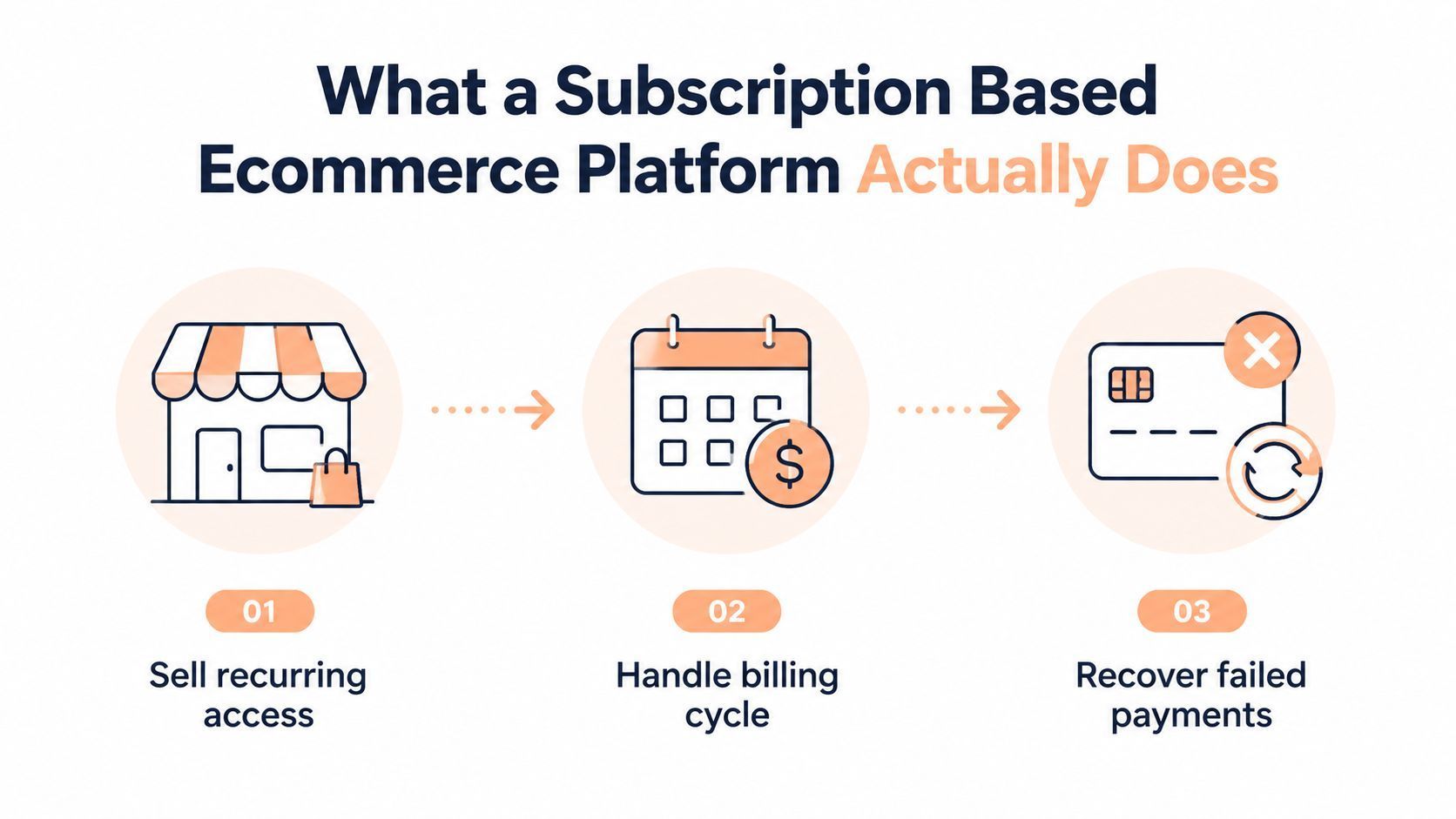
The operating cycle
A dependable platform should handle the following mechanics as one connected lifecycle:
- Recurring billing: Charge monthly, yearly, or custom recurring plans without building your own scheduler.
- Plan changes: Upgrade, downgrade, pause, resume, and cancel while preserving an accurate subscription history.
- Trial conversion: Move a customer from a free or discounted trial into the correct paid state, with clear notifications.
- Proration: Calculate the financial effect of a mid-cycle change instead of forcing finance teams to repair invoices manually.
- Invoicing: Generate receipts and invoices that match the product, price, tax treatment, credits, and payment status.
- Dunning: Retry failed charges and notify customers through a controlled recovery sequence.
- Refund handling: Apply full or partial refunds while updating subscription and reporting records consistently.
- Customer self-service: Let customers change payment methods, review invoices, and cancel without requiring a support agent.
Mixed pricing raises the coordination burden. A customer may pay a recurring platform fee, add seats, incur usage charges, and purchase a one-off implementation package. The platform must reconcile those components into understandable invoices and predictable access rules. Otherwise, the merchant maintains parallel logic across product code, spreadsheets, and accounting workflows, increasing the chance of revenue records drifting apart.
For a practical explanation of how billing components fit together in SaaS, see this guide to billing for SaaS. Keep customer-facing checkout separate from the underlying customer, subscription, invoice, transaction, and entitlement objects. A hosted checkout can launch quickly. Queryable records and events still support customer service, analytics, refunds, and migrations.
Data ownership becomes a revenue concern during a platform switch. If the vendor controls the only usable representation of customers and subscriptions, migration turns into reconstruction. Choose a system that lets you export commercial history and inspect the objects that drive access and revenue.
The Decision Criteria That Separate Platforms
A platform choice should be scored against operational risk, not a polished feature list. Put each candidate in a spreadsheet and require answers backed by documentation, sandbox behavior, and written commercial terms. Weight the criteria by their effect on revenue retention, especially involuntary churn recovery, tax exposure, and hybrid pricing.
Score the risks, not the screenshots
| Criterion | Why It Matters | Score (1-3) |
|---|---|---|
| Failed-payment recovery | Payment failures account for 20% to 40% of total churn, according to Stripe's dunning guidance. Ask about timed retries, decline-aware logic, notifications, and recovery reporting. | |
| Tax and VAT handling | Cross-border sales create calculation, collection, filing, and remittance obligations. Confirm which jurisdictions the platform covers and who remains legally responsible. | |
| Pricing flexibility | Monthly, seat-based, usage-based, and one-off charges need different billing primitives. Verify proration, metering, reconciliation, and clear invoices. | |
| Merchant of record model | An MoR can accept defined transaction and tax responsibilities. A direct processor usually leaves more obligations with the merchant. Read the exact allocation in the contract. | |
| API and webhooks | Product access and finance workflows depend on reliable records for customers, subscriptions, invoices, payments, refunds, and entitlements. Check whether every state change creates a documented event. | |
| Dunning controls | Recovery must be configurable, observable, and respectful. Test retry timing, customer messaging, grace periods, and cancellation rules in the sandbox. | |
| Analytics and cohorts | Revenue totals hide the source of movement. Require separate reporting for voluntary cancellations, failed payments, upgrades, downgrades, refunds, and reactivations. | |
| Compliance posture | Review PCI responsibilities, SOC 2 documentation, GDPR handling, access controls, retention policies, and audit logs. | |
| Total cost of ownership | Compare processing, platform, payout, foreign exchange, dispute, tax, and migration costs. Request a complete example invoice rather than a headline rate. |
The two questions vendors avoid
Ask first: “Show me the recovery report for a failed renewal.” The report should identify each attempt, notification time, issuer response, and access outcome. If those details require manual exports, customer success and finance will struggle to distinguish recoverable churn from a product cancellation.
Ask next: “Show me the tax responsibility matrix for my target markets.” A broad promise about global selling does not establish accountability. Confirm who calculates tax, collects it, files returns, remits funds, and retains supporting evidence.
Hybrid pricing deserves its own test. A recurring fee, seats, usage charges, and one-off services can produce disputes when the platform calculates each component differently. Request sample invoices and reconciliation records for plan changes, mid-cycle adjustments, refunds, and failed payments. Clear records protect collections and reduce the revenue leakage created by manual corrections.
Retry design also needs close review. Benchmark data summarized in 2026 reports indicates that a first retry within 48 hours can recover about 24% of failed payments, while three to five retries is described as the optimal range for recovering roughly half of what is recoverable. Treat these figures as evaluation context, not a forecast. Test whether the platform supports early, limited, decline-aware attempts instead of applying one rigid schedule to every failure.
Matching Platform Strengths to Seller Archetypes
The right platform depends on what you sell, how you price it, and who carries the operational burden. Comparing every vendor against every feature creates noise. Compare the bundle of responsibilities your business needs to delegate.
Three common operating profiles
A solo indie seller usually values speed over billing sophistication. If you're selling a small software tool, template library, or preset pack, hosted checkout, no-code plan management, customer self-service, and merchant of record coverage may matter more than a deep metering engine. The platform should remove tax administration and let you validate demand without building a finance department.
A SaaS team with meaningful recurring revenue has a different problem. Sales-assisted contracts, seat changes, usage charges, invoicing, revenue recognition, permissions, and audit evidence become important. The team may need direct control over billing logic, or it may prefer an MoR that reduces international administration. Either way, the platform must expose enough data for finance, product, and customer success to work from the same commercial record.
Agencies and productized studios often need partner economics rather than a simple merchant checkout. White-label subscriptions, multiple client accounts, delegated permissions, revenue splits, and payout workflows can matter more than a visually elegant pricing page. A platform that treats every seller as one account may force the agency to build the missing hierarchy itself.
| Capability | Solo Indie | SaaS Team (1M–20M ARR) | Agency / Productized Studio |
|---|---|---|---|
| Merchant of record coverage | High priority for reducing tax administration | Useful for global sales, but verify reporting and control needs | Valuable when selling across client markets |
| Metered billing depth | Usually limited need | Core requirement for usage and hybrid pricing | Depends on each client's commercial model |
| Dunning quality | Important because support capacity is limited | Critical for protecting recurring revenue | Important across multiple client accounts |
| Multi-currency support | Helpful for international checkout | Essential for global expansion and finance reporting | Useful for client-specific markets |
| Self-service portal | Reduces founder-led support | Supports account admins and billing teams | Helps clients manage their own customers |
| Multi-tenant permissions | Rarely needed | Useful for departments and environments | Central requirement for agency operations |
| Revenue splits and payouts | Occasional need | Relevant for partners and marketplaces | Often central to reseller economics |
| API and reporting depth | Enough to connect product access | Deep integration and auditability required | Needed to synchronize client systems |
The trade-off is straightforward. Simplicity reduces launch effort, but limited pricing primitives can become expensive when the business introduces usage, seats, or negotiated contracts. Control supports complex operations, but it also leaves more responsibility for tax, compliance, payment operations, and reconciliation.
The cheapest platform at launch can become the most expensive platform after your pricing model changes.
Choose for the next operational stage, not an imaginary enterprise future. But don't ignore the first complexity you already know is coming. If usage billing is central to the product roadmap, validate it before signing up for a platform designed only for fixed recurring plans.
Integrations, APIs, and Developer Experience
Developer experience determines whether billing ships as a product capability or remains a recurring source of edge cases. A polished dashboard can conceal an awkward API, unreliable event delivery, or an embedded checkout that provides no dependable customer record to query. Those gaps slow support, delay recovery work, and make revenue retention harder to protect.
Start with the commercial objects. Your team should retrieve customers, products, prices, subscriptions, invoices, transactions, refunds, payment methods, and entitlements through documented endpoints. If the platform exposes only hosted checkout sessions and opaque callbacks, your application will struggle to answer basic billing questions or keep access synchronized.
Test the integration before approving the vendor
Run a proof of concept that covers failure paths, not only a successful purchase:
- Create a customer and start a subscription.
- Confirm access from a verified payment event.
- Change the plan mid-cycle and inspect proration.
- Trigger a failed payment and process retry events.
- Update the payment method and confirm recovery.
- Cancel, refund, and reactivate the subscription.
- Replay webhook events and verify that your system does not duplicate access or charges.
Idempotency is required for state-changing requests. If a network timeout follows a subscription creation or refund request, your application needs a safe retry method that will not create a second record or transaction.
Webhook behavior deserves equal scrutiny. Check whether signatures are verifiable, events include stable identifiers, delivery failures are retried, and the platform provides a dead-letter queue or comparable inspection tool. “We have webhooks” says little about production reliability.
Integrations that matter most
Tax engines such as Avalara and TaxJar may belong in the stack when merchants retain tax responsibility. HubSpot may require customer and lifecycle events for sales and support. Amplitude and PostHog may need subscription state, plan, payment, and cancellation events to connect product behavior with revenue outcomes. These connections affect how quickly teams identify failed renewals, billing confusion, and customer access problems.
SDK quality matters too. Check the languages your team uses, including Node, Python, and PHP where relevant. Typed models, useful examples, test environments, and clear error responses shorten the path from documentation to working code.
Use this developer experience measurement guide to assess the human cost of integration work. The strongest API gives your team a reliable way to test, monitor, recover, and migrate with confidence.
Retention, Recovery, and the New Compliance Layer
Retention is a payment-operations and trust problem, not only a marketing metric. A customer may intend to continue but lose access because a card expired, an issuer declined the charge, or a recurring payment triggered additional authentication.
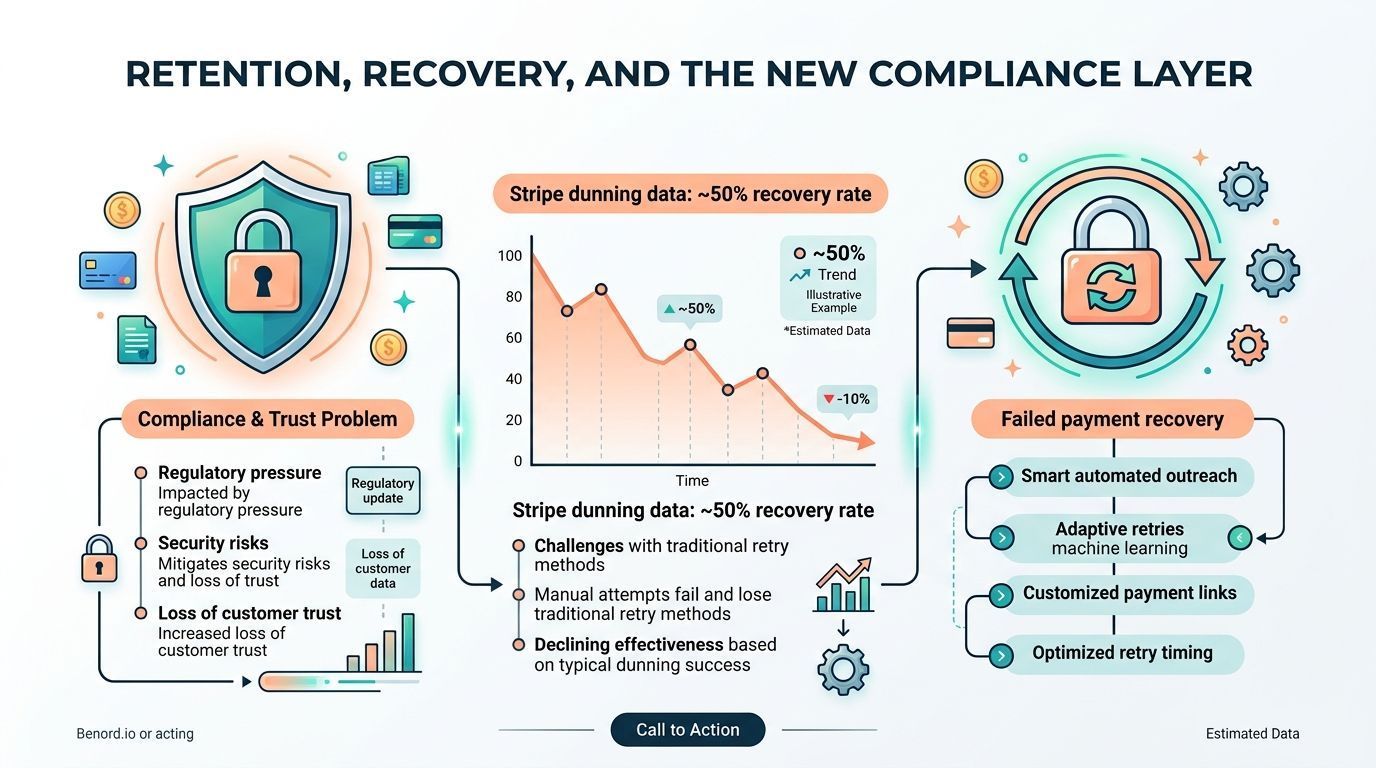
Stripe's dunning guidance identifies failed payments as a substantial source of churn. Failed payments recover roughly a quarter of at-risk renewals when retry timing is decline-aware. Treat involuntary churn as a revenue-recovery workflow with an owner, queue, and measurable outcome.
Recovery should be fast and controlled
Send a same-day card-expiry notification and route expired-card renewals into a dedicated retry queue within 48 hours. The queue should classify declines, select an appropriate retry path, and stop attempts when further charges are unlikely to succeed. Put the account-update action directly in the message, then record whether the customer paid, updated details, entered a grace period, or left.
Good recovery includes:
- Issuer-aware retries: Schedule attempts according to decline context rather than repeating the same charge blindly.
- Card updates: Give customers a direct path to replace expired or invalid payment details.
- Graceful access rules: Decide what remains available during recovery and communicate the policy clearly.
- Respectful messaging: Explain the problem without threatening or shaming the customer.
- Audit trails: Record attempts, notifications, payment updates, refunds, and final outcomes.
Cancellation is part of retention
A platform that obstructs cancellation can suppress visible churn briefly while increasing disputes, complaints, and distrust. Let customers see renewal terms, understand the next charge, pause when appropriate, and cancel without an unnecessary support exchange.
Cancellation flow and payment recovery belong in the same operational review because both affect continued consent. Recurring-payment authentication, renewal disclosures, cancellation requirements, and local tax obligations vary by market. The platform should preserve consent records, present accurate invoices, produce evidence for disputes, and identify whether the merchant or platform owns each obligation.
Use churn analysis for subscription businesses to separate voluntary cancellation from failed-payment loss. Combining them into one KPI leads marketing teams to win back customers who chose to leave, while billing operations miss a recoverable payment problem. Review both rates alongside recovery outcomes and access interruptions.
Recovery that feels like pressure can save one transaction and lose the customer's trust. Optimize for continued consent, not maximum friction.
Choosing Your Platform and Next Steps
Choose a platform around the operational failure your business is most likely to face next, then test that choice with real transactions. A feature checklist will not expose involuntary churn, cross-border tax exposure, or hybrid-pricing edge cases. A working billing flow will.
What to do this week
If you're an indie seller launching a first digital product, shortlist a merchant-of-record platform such as Lemon Squeezy or Gumroad. The immediate goal is to accept global payments while avoiding sales-tax registration and remittance work before validating the product. Confirm the refund policy, customer ownership model, payout terms, and export capabilities before launch. Those terms determine how quickly you can respond to disputes, change providers, or recover customer relationships.
If you run SaaS with predictable recurring revenue, build a paid Stripe Billing proof of concept against a sandbox product. Test plan changes, failed renewals, tax behavior, webhook processing, and access changes across the full subscription lifecycle. Compare the results with your existing stack, then document every custom rule your team would still maintain. Custom logic is a future failure surface, especially when billing events affect access and revenue reporting.
If you operate an agency or multiple product lines, shortlist two merchant-of-record vendors and two direct-billing vendors. Score them on tax ownership, hybrid pricing, dunning, multi-currency support, permissions, revenue sharing, reporting, and migration effort. Give the evaluation and migration a month. Billing is part of revenue operations, not a weekend configuration.
Before signing, get three commitments in writing:
- PCI scope: Identify what your team must secure and what the platform handles.
- Webhook behavior: Confirm idempotency expectations, retry delivery, signatures, and event history.
- Refund service levels: Document eligibility, approval flow, processing time, and customer communication.
Review the platform quarterly. Pricing models change, payment methods expand, regulations evolve, and finance teams discover new reporting needs. Each review should check for revenue leakage in failed renewals, tax handling, plan changes, refunds, and product access before those issues spread into support workflows.
For software companies and digital product makers, Creem provides merchant-of-record coverage, global checkout, subscription billing, tax handling, customer self-service, developer SDKs, REST APIs, webhooks, revenue splits, and affiliate tooling in one payments platform. Visit Creem to assess whether its subscription and compliance workflow fits your next operating stage.